
CHAPTER 2 EVENT CONCEPT FUNDAMENTAL ELEMENTS OF EVENTS
- Slides: 32
CHAPTER 2 EVENT CONCEPT
FUNDAMENTAL ELEMENTS OF EVENTS v Vision v Goals and Objectives v Site Selection v Promotion v Participants/Attendees v Agenda v Budget v Timeline v Food and Beverage v Transportation v Staffing
1. DEVELOPING THE CONCEPT 1. 1 Purpose of the event 1. 2 Theme of the event • Historical • Geographical and cultural • Sporting • Film, music and entertainment • Artistic • Food • objects
1. 3 Venue for the event – Potential to fulfil the purpose of the event – Ambience – Location – Access by public transport – Parking – Seating capacity
• • • Built features (such as stages) Cost of decoration, sound and lighting Cost of labor Logistics of setting up Food and beverage facilities safty
1. 4 Event audience 1. 5 Financial considerations 1. 6 Timing of the event 1. 2. 3. 4. Season Day of the week Time of day Duration
1. 7 Event team, contractors and other stakeholders – Event principal/client – Talent/performer/team and manager – Cast and crew – Local community – Organising committee
• • • Local and government authorities Emergency services Customers Colleagues contractors
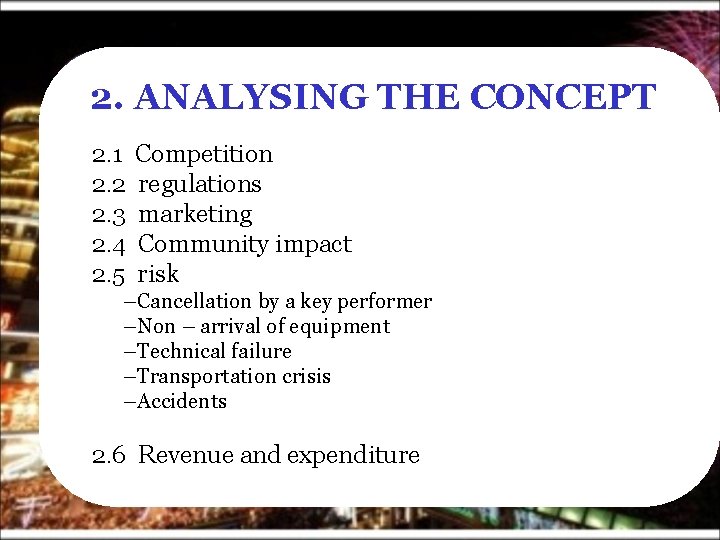
2. ANALYSING THE CONCEPT 2. 1 2. 2 2. 3 2. 4 2. 5 Competition regulations marketing Community impact risk –Cancellation by a key performer –Non – arrival of equipment –Technical failure –Transportation crisis –Accidents 2. 6 Revenue and expenditure
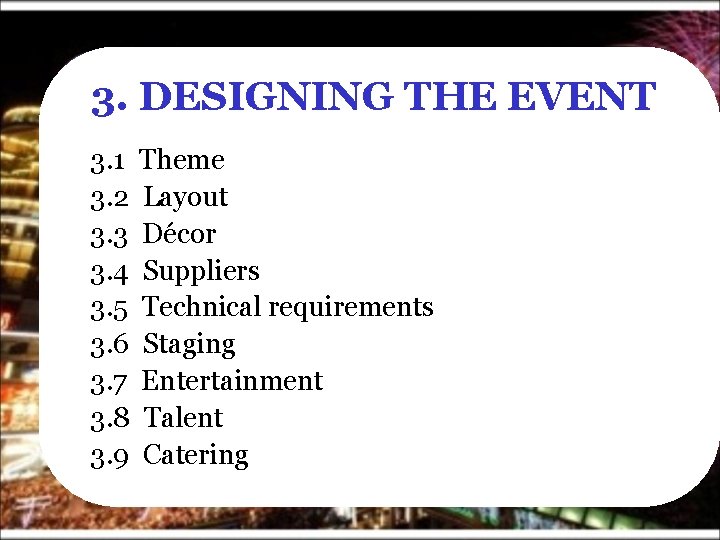
3. DESIGNING THE EVENT 3. 1 3. 2 3. 3 3. 4 3. 5 3. 6 3. 7 3. 8 3. 9 Theme Layout Décor Suppliers Technical requirements Staging Entertainment Talent Catering
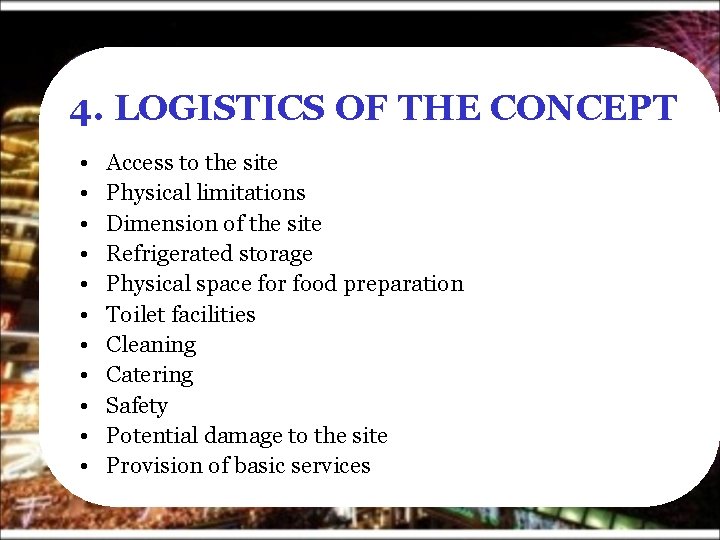
4. LOGISTICS OF THE CONCEPT • • • Access to the site Physical limitations Dimension of the site Refrigerated storage Physical space for food preparation Toilet facilities Cleaning Catering Safety Potential damage to the site Provision of basic services
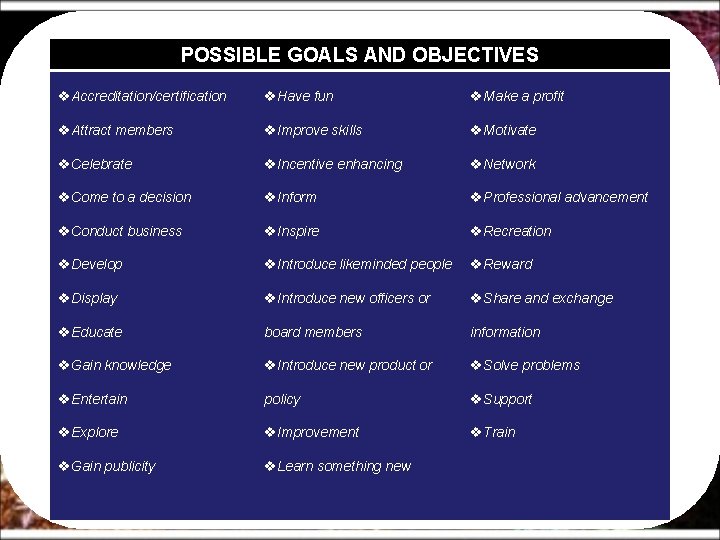
POSSIBLE GOALS AND OBJECTIVES v. Accreditation/certification v. Have fun v. Make a profit v. Attract members v. Improve skills v. Motivate v. Celebrate v. Incentive enhancing v. Network v. Come to a decision v. Inform v. Professional advancement v. Conduct business v. Inspire v. Recreation v. Develop v. Introduce likeminded people v. Reward v. Display v. Introduce new officers or v. Share and exchange v. Educate board members information v. Gain knowledge v. Introduce new product or v. Solve problems v. Entertain policy v. Support v. Explore v. Improvement v. Train v. Gain publicity v. Learn something new
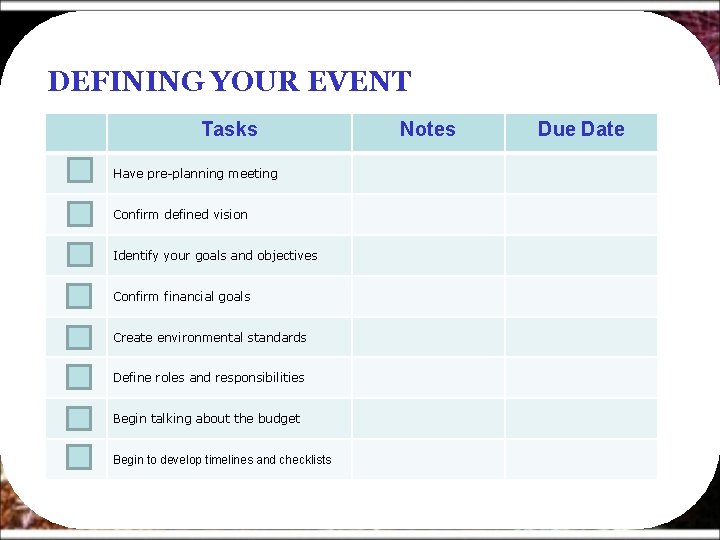
DEFINING YOUR EVENT Tasks Have pre-planning meeting Confirm defined vision Identify your goals and objectives Confirm financial goals Create environmental standards Define roles and responsibilities Begin talking about the budget Begin to develop timelines and checklists Notes Due Date
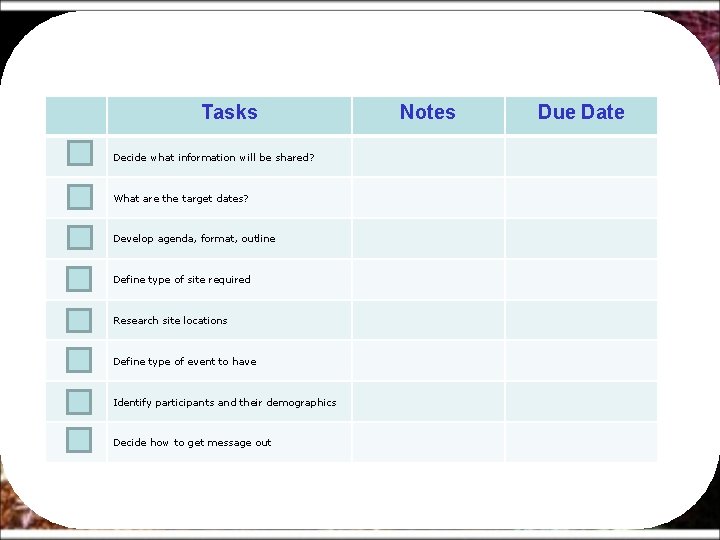
Tasks Decide what information will be shared? What are the target dates? Develop agenda, format, outline Define type of site required Research site locations Define type of event to have Identify participants and their demographics Decide how to get message out Notes Due Date
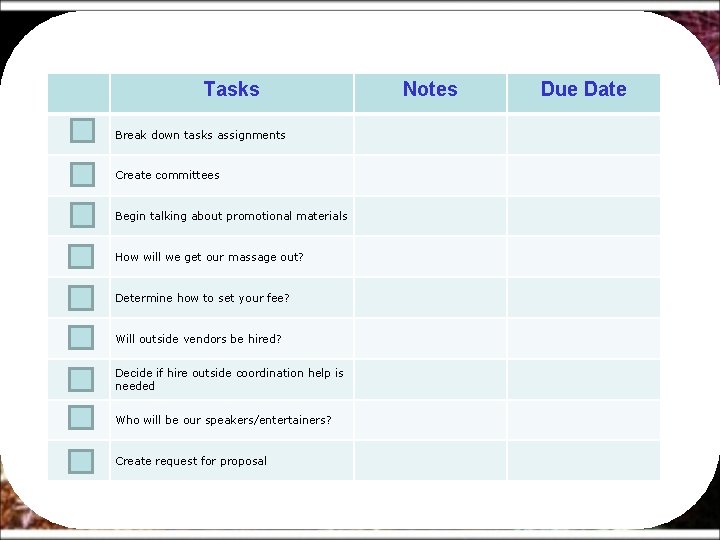
Tasks Break down tasks assignments Create committees Begin talking about promotional materials How will we get our massage out? Determine how to set your fee? Will outside vendors be hired? Decide if hire outside coordination help is needed Who will be our speakers/entertainers? Create request for proposal Notes Due Date
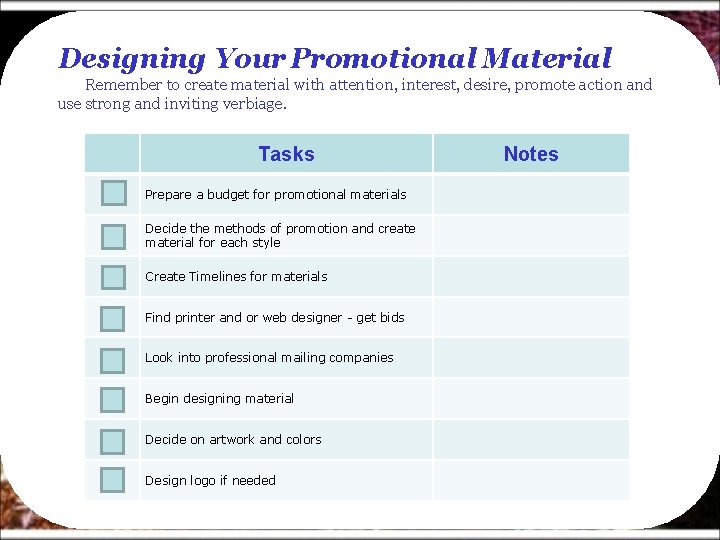
Designing Your Promotional Material Remember to create material with attention, interest, desire, promote action and use strong and inviting verbiage. Tasks Prepare a budget for promotional materials Decide the methods of promotion and create material for each style Create Timelines for materials Find printer and or web designer - get bids Look into professional mailing companies Begin designing material Decide on artwork and colors Design logo if needed Notes
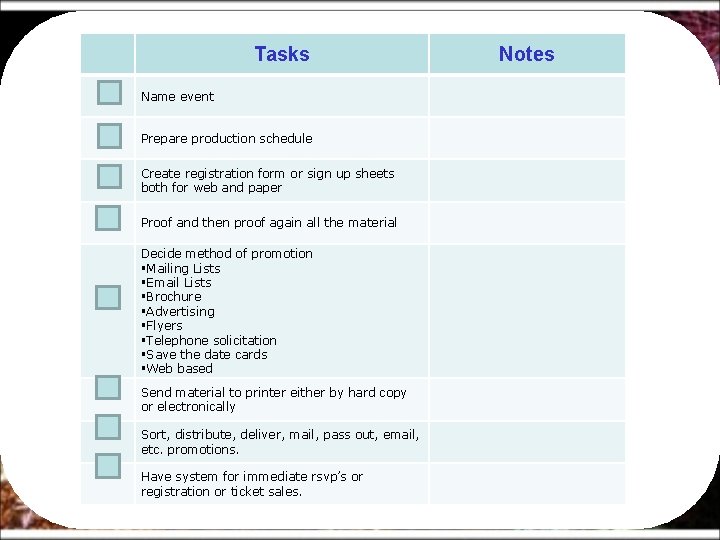
Tasks Name event Prepare production schedule Create registration form or sign up sheets both for web and paper Proof and then proof again all the material Decide method of promotion Mailing Lists Email Lists Brochure Advertising Flyers Telephone solicitation Save the date cards Web based Send material to printer either by hard copy or electronically Sort, distribute, deliver, mail, pass out, email, etc. promotions. Have system for immediate rsvp’s or registration or ticket sales. Notes
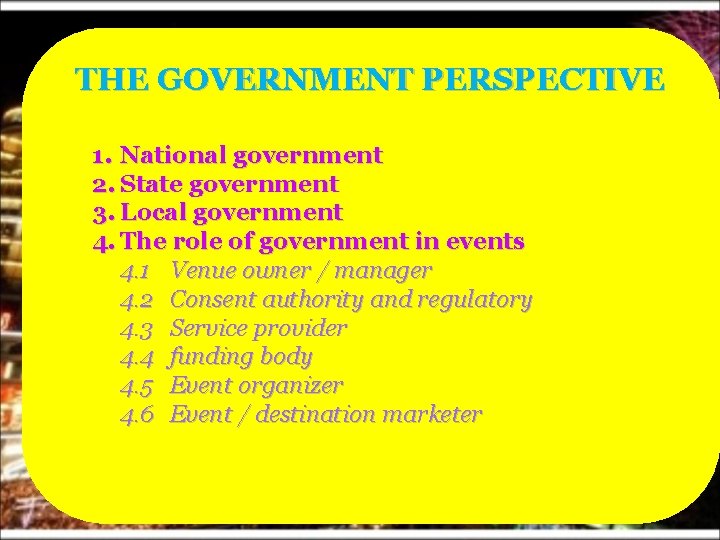
THE GOVERNMENT PERSPECTIVE 1. National government 2. State government 3. Local government 4. The role of government in events 4. 1 Venue owner / manager 4. 2 Consent authority and regulatory 4. 3 Service provider 4. 4 funding body 4. 5 Event organizer 4. 6 Event / destination marketer
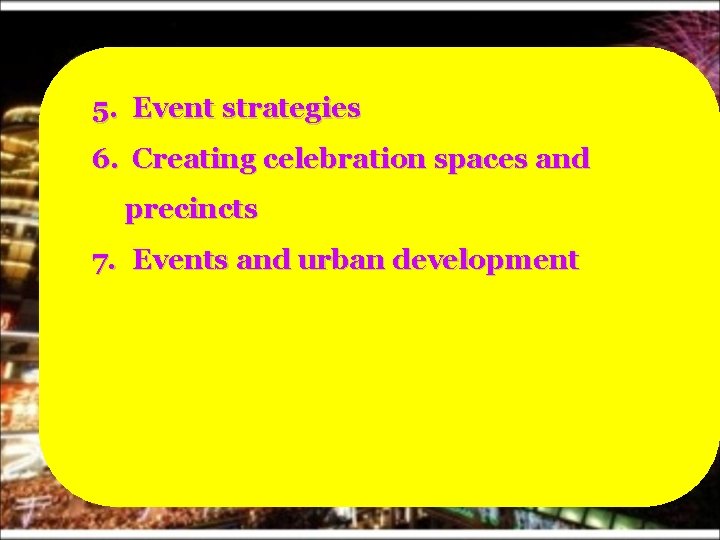
5. Event strategies 6. Creating celebration spaces and precincts 7. Events and urban development
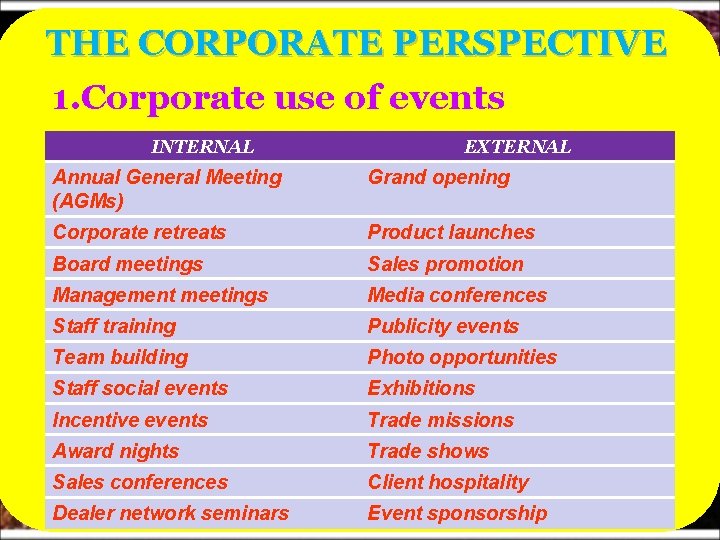
THE CORPORATE PERSPECTIVE 1. Corporate use of events INTERNAL EXTERNAL Annual General Meeting (AGMs) Grand opening Corporate retreats Product launches Board meetings Sales promotion Management meetings Media conferences Staff training Publicity events Team building Photo opportunities Staff social events Exhibitions Incentive events Trade missions Award nights Trade shows Sales conferences Client hospitality Dealer network seminars Event sponsorship
1. 1 Internal events 1. 2 External events 2. Association conference 3. Return on investment
THE COMMUNITY PERSPECTIVE 1. Community events 2. The individual perspective 3. Major events and the community
4. Strategies for community engagement 4. 1 Participation facilitation 4. 2 Inclusive programming 4. 3 Incentives 4. 4 Outreach 4. 5 Community development and capacity building 4. 6 Friends of the events / event alumni associations 4. 7 Local business engagement
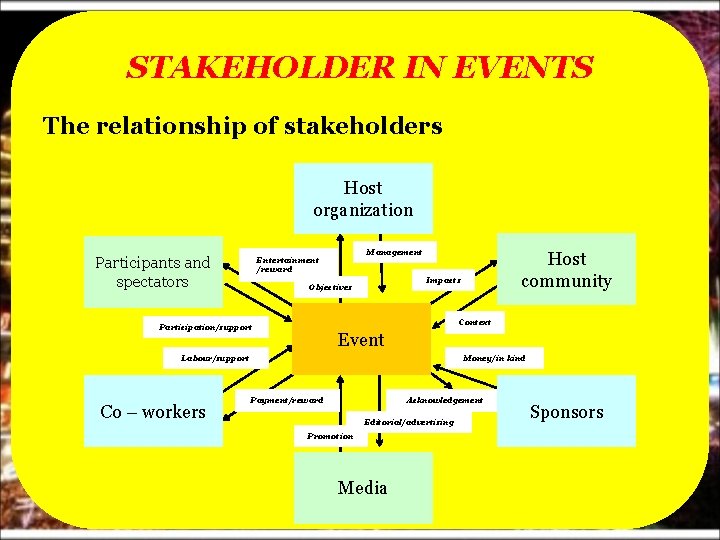
STAKEHOLDER IN EVENTS The relationship of stakeholders Host organization Participants and spectators Management Entertainment /reward Impacts Objectives Context Participation/support Event Labour/support Co – workers Host community Money/in kind Payment/reward Acknowledgement Editorial/advertising Promotion Media Sponsors
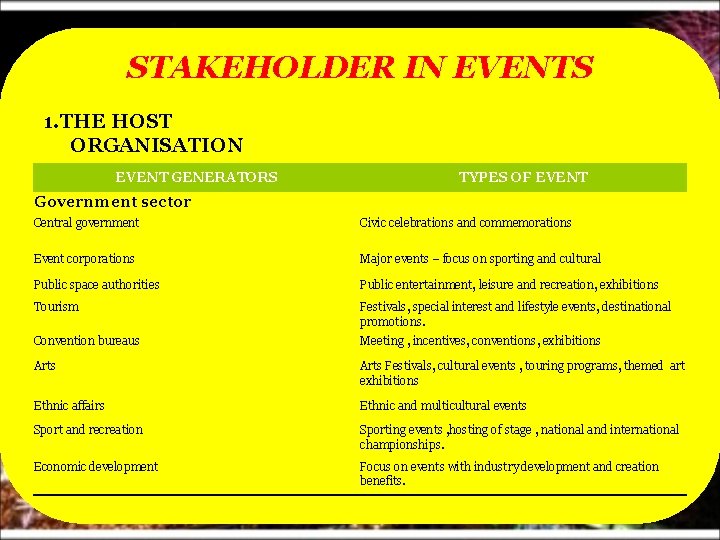
STAKEHOLDER IN EVENTS 1. THE HOST ORGANISATION EVENT GENERATORS TYPES OF EVENT Government sector Central government Civic celebrations and commemorations Event corporations Major events – focus on sporting and cultural Public space authorities Public entertainment, leisure and recreation, exhibitions Tourism Festivals, special interest and lifestyle events, destinational promotions. Convention bureaus Meeting , incentives, conventions, exhibitions Arts Festivals, cultural events , touring programs, themed art exhibitions Ethnic affairs Ethnic and multicultural events Sport and recreation Sporting events , hosting of stage , national and international championships. Economic development Focus on events with industry development and creation benefits.
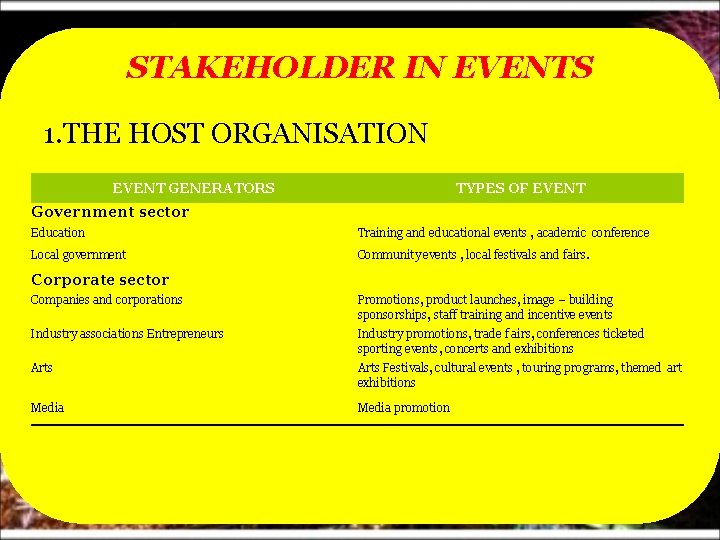
STAKEHOLDER IN EVENTS 1. THE HOST ORGANISATION EVENT GENERATORS TYPES OF EVENT Government sector Education Training and educational events , academic conference Local government Community events , local festivals and fairs. Corporate sector Companies and corporations Promotions, product launches, image – building sponsorships, staff training and incentive events Industry associations Entrepreneurs Industry promotions, trade f airs, conferences ticketed sporting events, concerts and exhibitions Arts Festivals, cultural events , touring programs, themed art exhibitions Media promotion
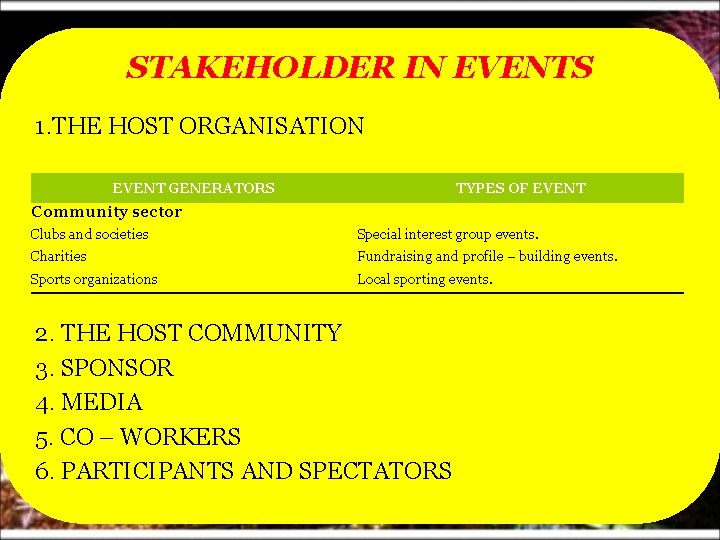
STAKEHOLDER IN EVENTS 1. THE HOST ORGANISATION EVENT GENERATORS TYPES OF EVENT Community sector Clubs and societies Special interest group events. Charities Fundraising and profile – building events. Sports organizations Local sporting events. 2. THE HOST COMMUNITY 3. SPONSOR 4. MEDIA 5. CO – WORKERS 6. PARTICIPANTS AND SPECTATORS
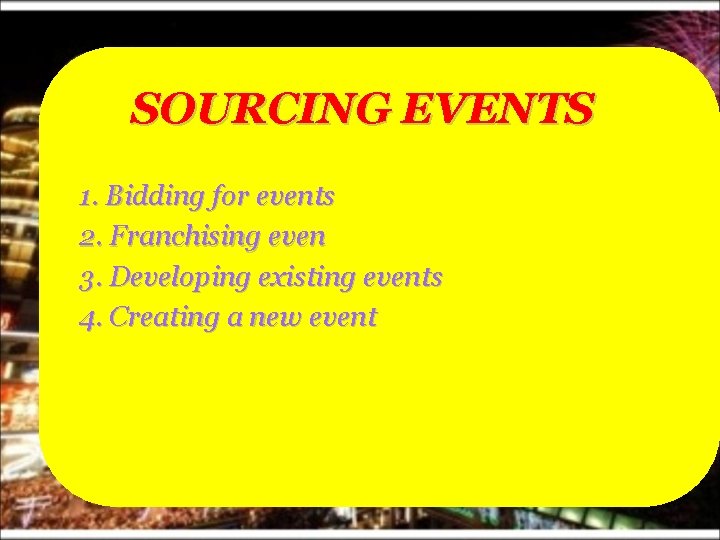
SOURCING EVENTS 1. Bidding for events 2. Franchising even 3. Developing existing events 4. Creating a new event
CREATING THE EVENT CONCEPT 1. Defining the purpose of the event 2. Identifying the event audience 3. Defining the timing of the event 4. Choosing the event venue
CREATING THE EVENT CONCEPT 5. Choosing the event concept • The brainstorming process − Define the parameters of the event. − Form a group of event stakeholders and colleagues. − Brief them on the event context and the parameters of the event. − Brainstorm a wide range of event concepts and ideas. − Identify the ideas that best serve the needs of the event. − Evaluate and refine an event concept. 6. Sumarising the event creation process
EVALUATING THE EVENT CONCEPT 1. The marketing screen 2. The operations screen 3. The financial screen
The End