
Chapter 2 Ethical Principles and Reasoning EIA Chapter

- Slides: 42
Chapter 2: Ethical Principles and Reasoning EIA Chapter 2 1
Which is More important? An Ethical or Law-Abiding Society? Ethics: How Citizens Should Behave Laws: How Citizens Must Behave EIA Chapter 2 2
Ethical Absolutism: Ethical Rules are Universal and Unable to be Changed • Murder is wrong in all cultures and situations Ethical Relativism: Ethical Rules Evolve Over Time and Vary Among Cultures and Religions • Gay Rights • Gender Equality EIA Chapter 2 3
Introduction to the AICPA Code of Professional Conduct Responsibilities Principle “In carrying out their responsibilities as professionals, members (CPAs) should exercise sensitive professional moral judgments in all their activities. ” EIA Chapter 2 4
Introduction to the AICPA Code of Professional Conduct Public Interest “Members should accept the obligation to act in a way that will serve the public interest, honor the public trust, and demonstrate commitment to professionalism. ” EIA Chapter 2 5
Introduction to the AICPA Code of Professional Conduct Integrity “To maintain and broaden public confidence, members should perform all professional responsibilities with the highest sense of integrity. ” EIA Chapter 2 6
Introduction to the AICPA Code of Professional Conduct Objectivity and Independence “A member should maintain objectivity and be free of conflicts of interest in discharging professional responsibilities. A member in public practice should be independent in fact and appearance when providing auditing and other attestation services. ” EIA Chapter 2 7
Introduction to the AICPA Code of Professional Conduct Due Care “A member should observe the profession’s technical and ethical standards, strive continually to improve competence and the quality of services, and discharge professional responsibility to the best of the member’s ability. ” EIA Chapter 2 8
Introduction to the AICPA Code of Professional Conduct Scope and Nature of Services Principle “A member in public practice should observe the Principles of the Code of Professional Conduct in determining the scope and nature of services to be provided. ” EIA Chapter 2 9
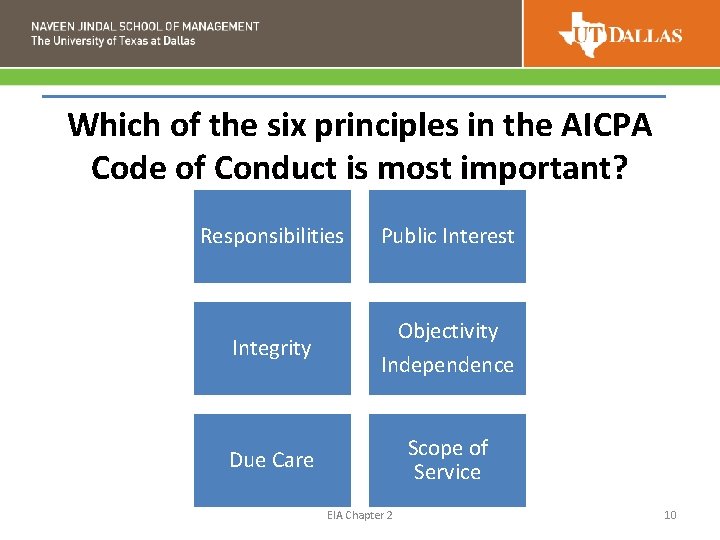
Which of the six principles in the AICPA Code of Conduct is most important? Responsibilities Integrity Public Interest Objectivity Independence Scope of Service Due Care EIA Chapter 2 10
The Development of Moral Reasoning – Theory holds that moral reasoning, the basis for ethical behavior, has six developmental stages – People reach more advanced levels of ethical reasoning at each stage because of experience EIA Chapter 2 11
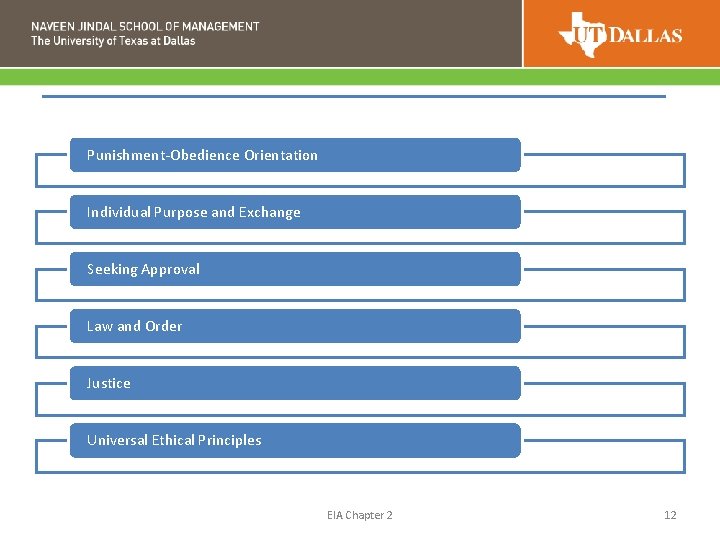
Punishment-Obedience Orientation Individual Purpose and Exchange Seeking Approval Law and Order Justice Universal Ethical Principles EIA Chapter 2 12
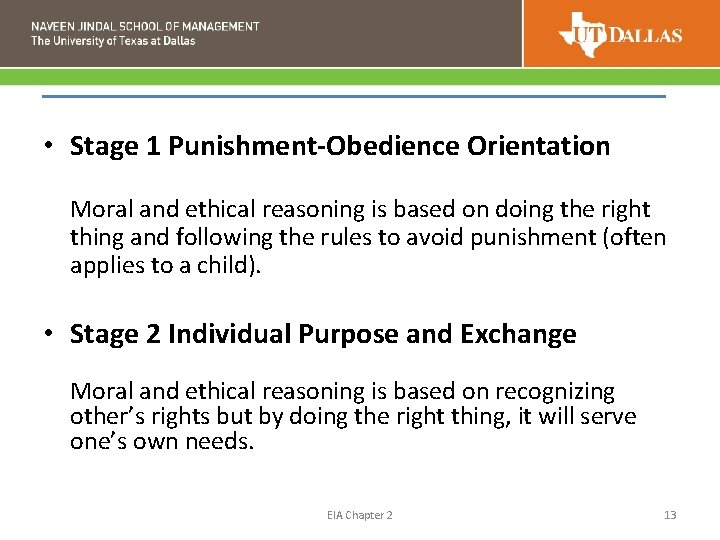
• Stage 1 Punishment-Obedience Orientation Moral and ethical reasoning is based on doing the right thing and following the rules to avoid punishment (often applies to a child). • Stage 2 Individual Purpose and Exchange Moral and ethical reasoning is based on recognizing other’s rights but by doing the right thing, it will serve one’s own needs. EIA Chapter 2 13
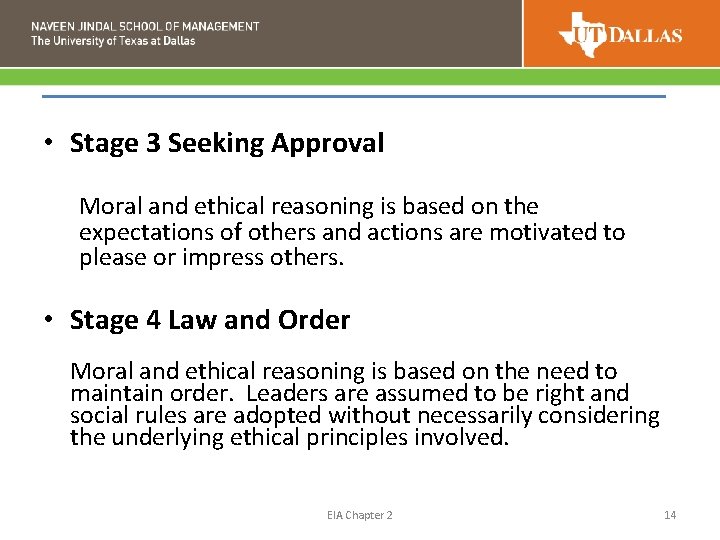
• Stage 3 Seeking Approval Moral and ethical reasoning is based on the expectations of others and actions are motivated to please or impress others. • Stage 4 Law and Order Moral and ethical reasoning is based on the need to maintain order. Leaders are assumed to be right and social rules are adopted without necessarily considering the underlying ethical principles involved. EIA Chapter 2 14
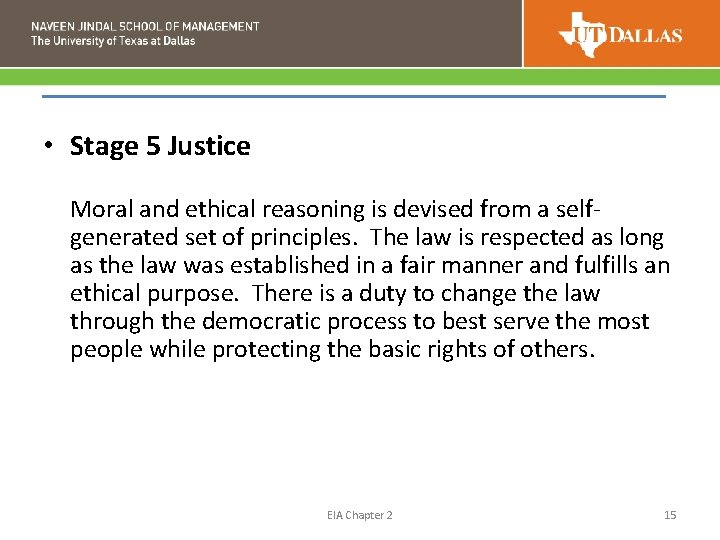
• Stage 5 Justice Moral and ethical reasoning is devised from a selfgenerated set of principles. The law is respected as long as the law was established in a fair manner and fulfills an ethical purpose. There is a duty to change the law through the democratic process to best serve the most people while protecting the basic rights of others. EIA Chapter 2 15
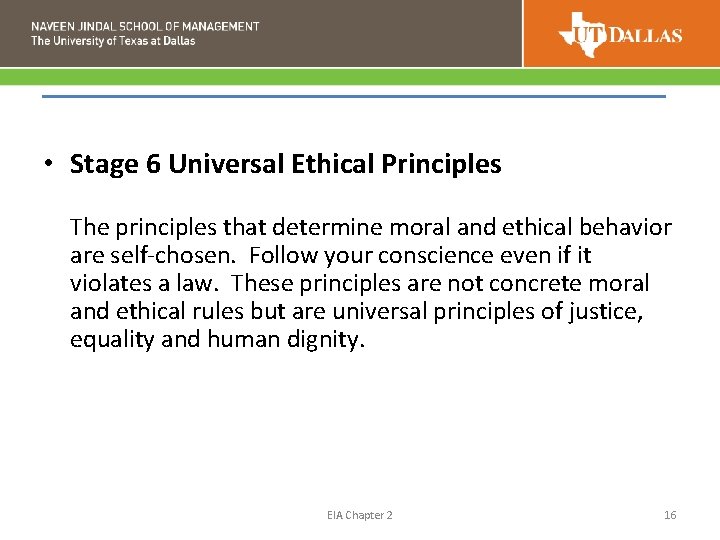
• Stage 6 Universal Ethical Principles The principles that determine moral and ethical behavior are self-chosen. Follow your conscience even if it violates a law. These principles are not concrete moral and ethical rules but are universal principles of justice, equality and human dignity. EIA Chapter 2 16
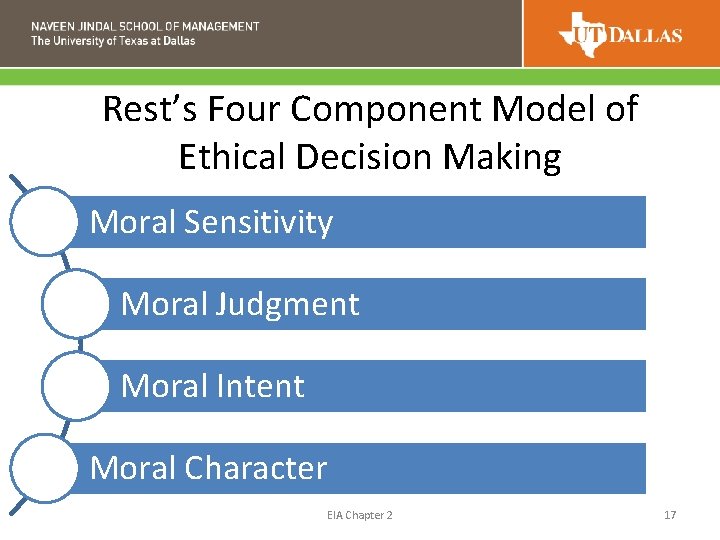
Rest’s Four Component Model of Ethical Decision Making Moral Sensitivity Moral Judgment Moral Intent Moral Character EIA Chapter 2 17
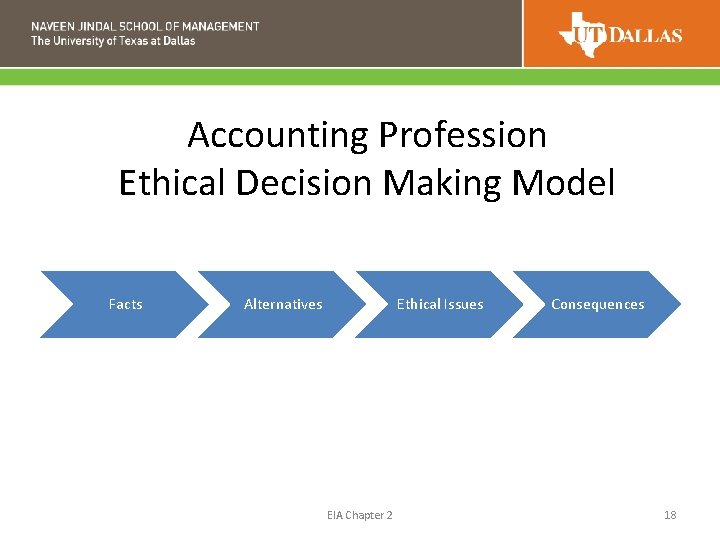
Accounting Profession Ethical Decision Making Model Facts Alternatives Ethical Issues EIA Chapter 2 Consequences 18
Chapter 3: The Core Philosophies EIA Chapter 3 19
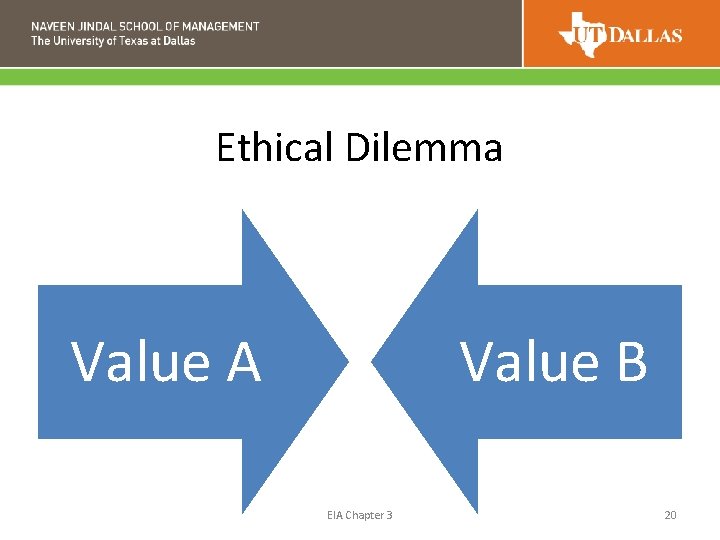
Ethical Dilemma Value A Value B EIA Chapter 3 20
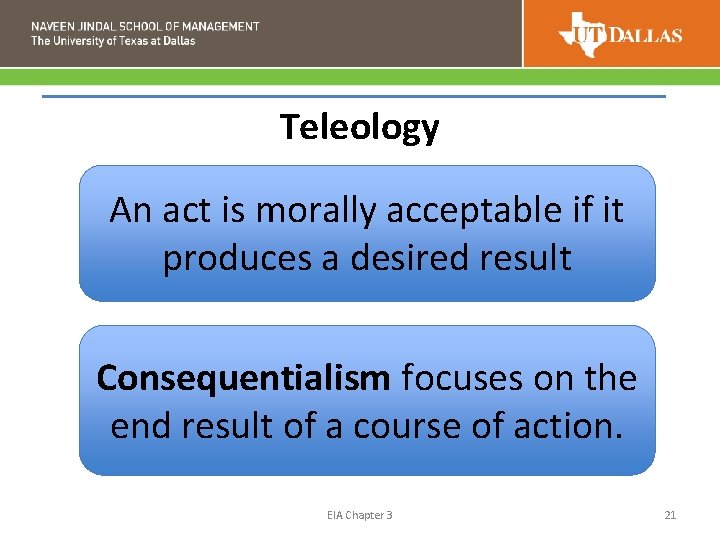
Teleology An act is morally acceptable if it produces a desired result Consequentialism focuses on the end result of a course of action. EIA Chapter 3 21
Utilitarianism • Mandates that an act is ethical if it improves overall well-being of society. • Best decision = highest net benefits to society • Worst decision = highest net harms to society EIA Chapter 3 22
Focus on Utilitarianism Advantages – Practical – Often the approach in the business world Challenges – Hard to evaluate all consequences – Rights of minorities may be sacrificed EIA Chapter 3 23
Deontology contends that people innately owe certain duties to each other. • Focuses on the concept of duty to others, regardless of consequences. • Universality principle mandates that certain duties and rights apply globally to all people in all situations EIA Chapter 3 24
Focus on Deontology Advantages – Often used in public policy debates (i. e. right to life) Challenges – Determining which duty is more important – Reconciling deontological and consequentialist approaches when conflict EIA Chapter 3 25
Utilitarianism vs. Deontology “If you really want to do the moral thing, sell most of your worldly possessions and give the proceeds to those starving in poor countries. ” Would utilitarians and deontologists agree or disagree with this statement? EIA Chapter 3 26
Utilitarianism vs. Deontology The Hippocratic Oath that doctors adhere to often is interpreted to say, “First do no harm. ” Is this oath consistent with deontology, utilitarianism, or both? EIA Chapter 3 27
Right to Privacy Identify the privacy rights that you have sacrificed in return for “free” economic benefits. Read the legal waivers to which you consent every time you join a social media site or receive “free” software updates. What are the “privacy waiver” provisions that you find most intrusive and offensive? EIA Chapter 3 28
Chapter 4: Virtue, Justice, and Social Responsibility EIA Chapter 4 29
Distributive Justice How individuals should share society’s resources EIA Chapter 4 30
Distributive Justice Aristotle says… …. equals should be treated equally …. and unequals should be treated unequally. EIA Chapter 4 31
Distributive Justice A recent study showed that female medical school graduates earn less, on average, than male medical school graduates. 1. Is this consistent with Aristotle’s philosophy of distributive justice? 2. Why do you think this pay differential exists? 3. Do you believe that the reasons you identified above are just or unjust? EIA Chapter 4 32
Distributive Justice Rawl’s Theory of Social Justice… …is based on the premise that we are all born with different talents and abilities, and these differences affect our attitudes about justice. Therefore, as a society, we must establish societal principles that are unbiased toward our differences. EIA Chapter 4 33
Distributive Justice Rawl’s Theory of Social Justice… …also included a “difference principle” concluding that it is acceptable to provide greater rewards to some people as long as this difference also improves the welfare of those who are less well-off. EIA Chapter 4 34
Virtue Ethics Focus on inputs that develop a person’s value systems EIA Chapter 4 35
Egoism Consequentialist theory concerned with maximizing the utility of a self-focused decisionmaker, not overall society. EIA Chapter 4 36
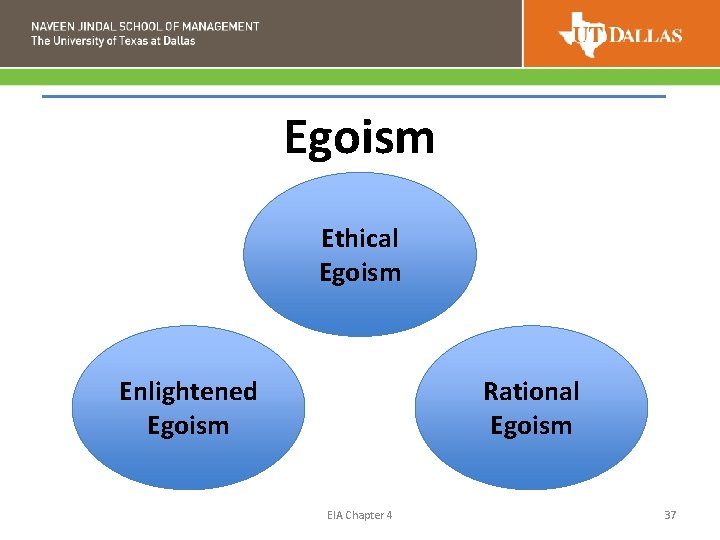
Egoism Ethical Egoism Rational Egoism Enlightened Egoism EIA Chapter 4 37
Egoism • Pros: Milton Friedman said “there is one and only one social responsibility of business – use resources and engage in activities designed to increase profits so long as it stays within the rules of the game” • Cons: Henry Ford said “a business that makes nothing but money is a poor kind of business” EIA Chapter 4 38
A Look at the Philosophies of Ethics…. According to popular folklore, Robin Hood and his band of merry men “robbed from the rich to give to the poor. ” • Would utilitarians approve of Robin Hood’s actions? • Would believers in deontology approve of Robin Hood’s actions? • Would supporters of Rawls’ theory of justice approve of Robin Hood’s actions? • Is Robin Hood a believer in egoism? EIA Chapter 4 39
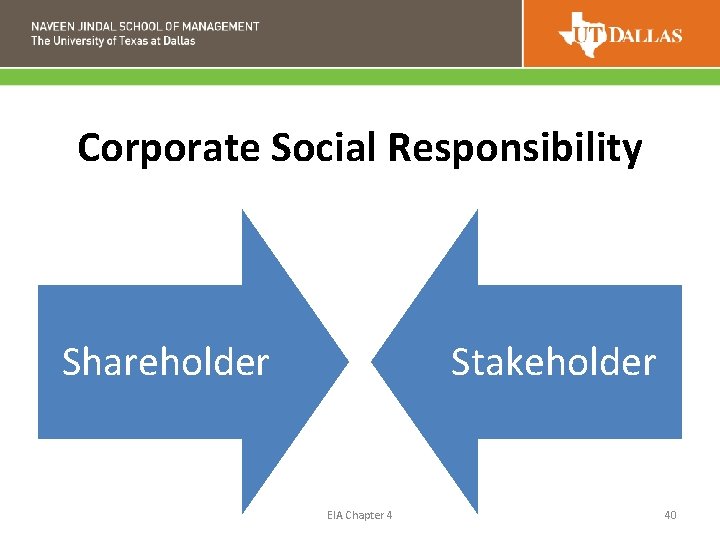
Corporate Social Responsibility Shareholder Stakeholder EIA Chapter 4 40
Corporate Social Responsibility beyond economic and legal obligations – to act ethically and to contribute in a positive way to society EIA Chapter 4 41
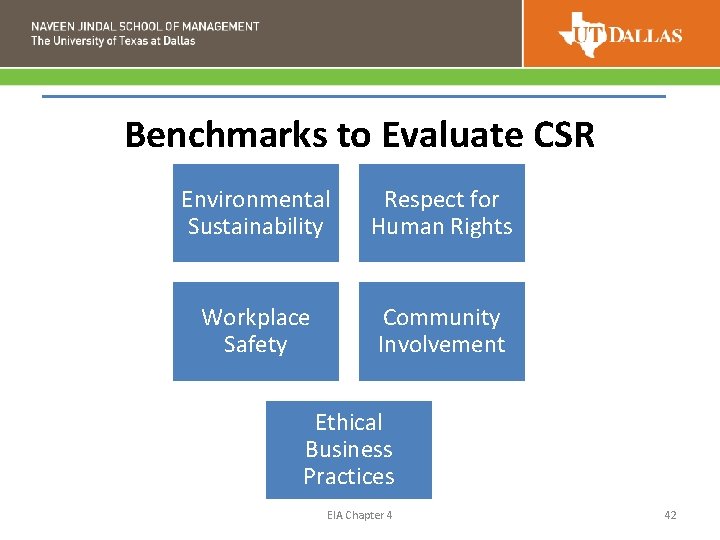
Benchmarks to Evaluate CSR Environmental Sustainability Respect for Human Rights Workplace Safety Community Involvement Ethical Business Practices EIA Chapter 4 42