
Chapter 2 Environmental Laws Economics and Ethics Overview
- Slides: 38
Chapter 2 Environmental Laws, Economics and Ethics
Overview of Chapter 2 o o o US Environmental History US Environmental Legislation Economics and the Environmental Problems in Central and Eastern Europe Environmental Ethics, Values and Worldviews
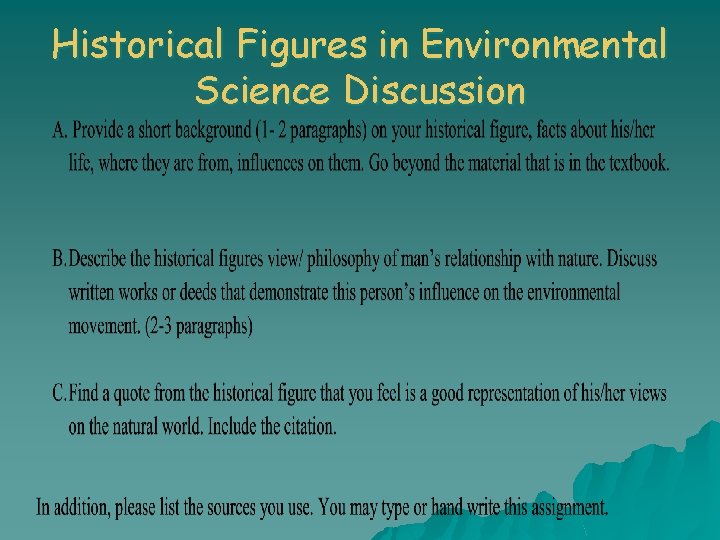
Historical Figures in Environmental Science Discussion
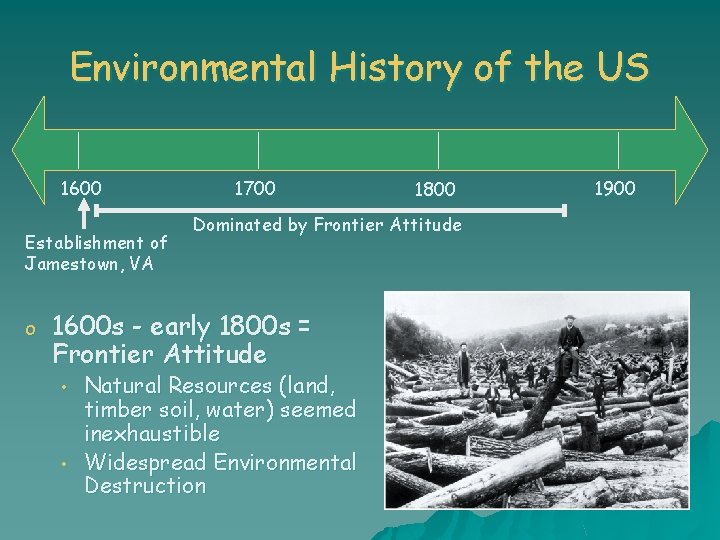
Environmental History of the US 1600 Establishment of Jamestown, VA o 1700 Dominated by Frontier Attitude 1600 s - early 1800 s = Frontier Attitude • • 1800 Natural Resources (land, timber soil, water) seemed inexhaustible Widespread Environmental Destruction 1900
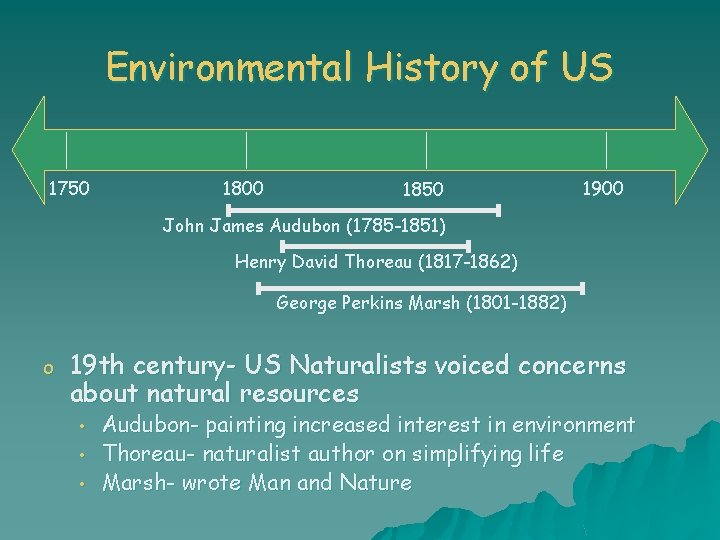
Environmental History of US 1750 1800 1850 1900 John James Audubon (1785 -1851) Henry David Thoreau (1817 -1862) George Perkins Marsh (1801 -1882) o 19 th century- US Naturalists voiced concerns about natural resources • • • Audubon- painting increased interest in environment Thoreau- naturalist author on simplifying life Marsh- wrote Man and Nature
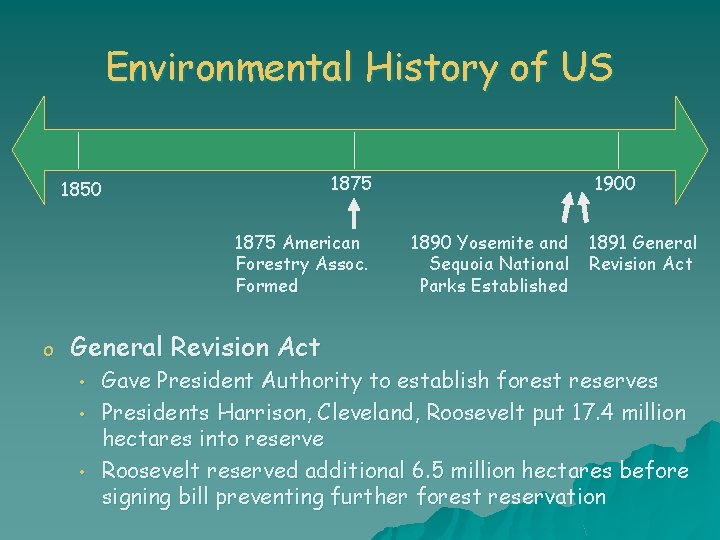
Environmental History of US 1875 1850 1875 American Forestry Assoc. Formed o General Revision Act • • • 1900 1890 Yosemite and Sequoia National Parks Established 1891 General Revision Act Gave President Authority to establish forest reserves Presidents Harrison, Cleveland, Roosevelt put 17. 4 million hectares into reserve Roosevelt reserved additional 6. 5 million hectares before signing bill preventing further forest reservation
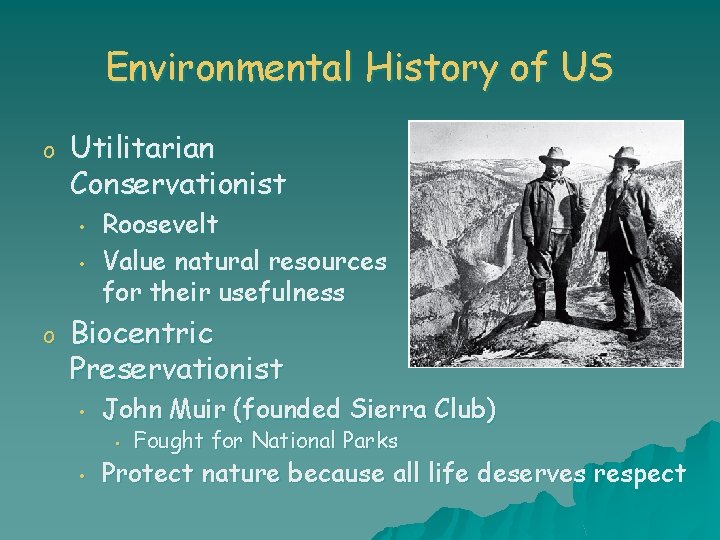
Environmental History of US o Utilitarian Conservationist • • o Roosevelt Value natural resources for their usefulness Biocentric Preservationist • John Muir (founded Sierra Club) • • Fought for National Parks Protect nature because all life deserves respect
Ken Burns National Parks Documentary- Watch select pieces o http: //www. pbs. org/nationalparks/
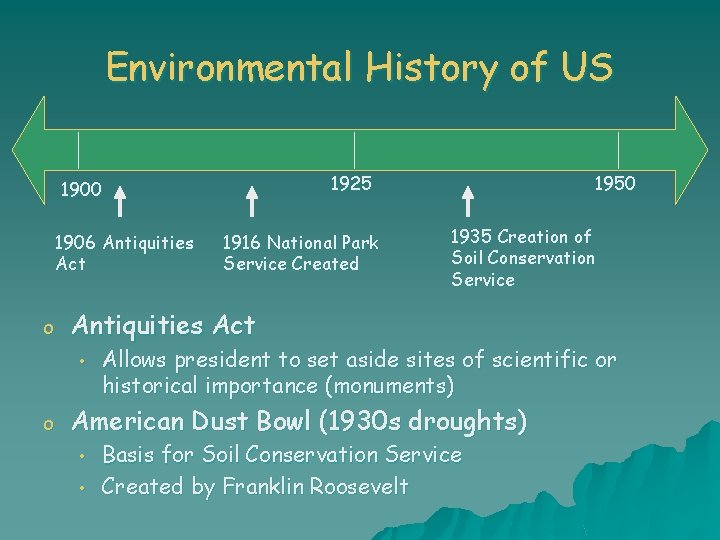
Environmental History of US 1925 1900 1906 Antiquities Act o 1935 Creation of Soil Conservation Service Antiquities Act • o 1916 National Park Service Created 1950 Allows president to set aside sites of scientific or historical importance (monuments) American Dust Bowl (1930 s droughts) • • Basis for Soil Conservation Service Created by Franklin Roosevelt
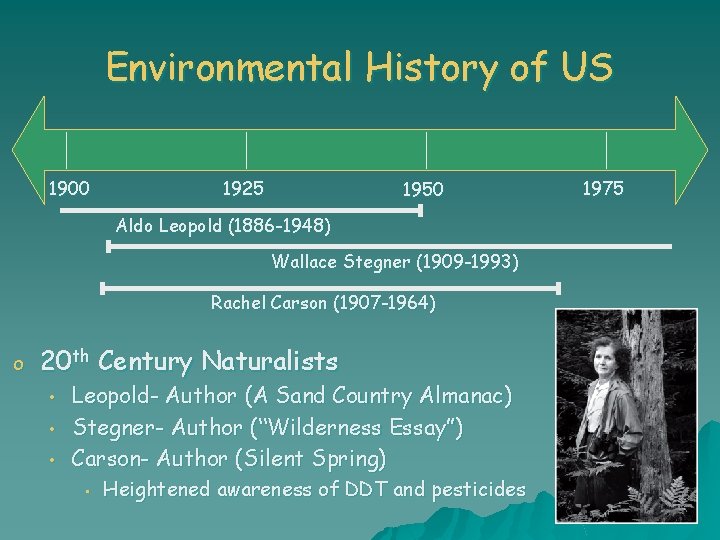
Environmental History of US 1900 1925 1950 Aldo Leopold (1886 -1948) Wallace Stegner (1909 -1993) Rachel Carson (1907 -1964) o 20 th Century Naturalists • • • Leopold- Author (A Sand Country Almanac) Stegner- Author (“Wilderness Essay”) Carson- Author (Silent Spring) • Heightened awareness of DDT and pesticides 1975
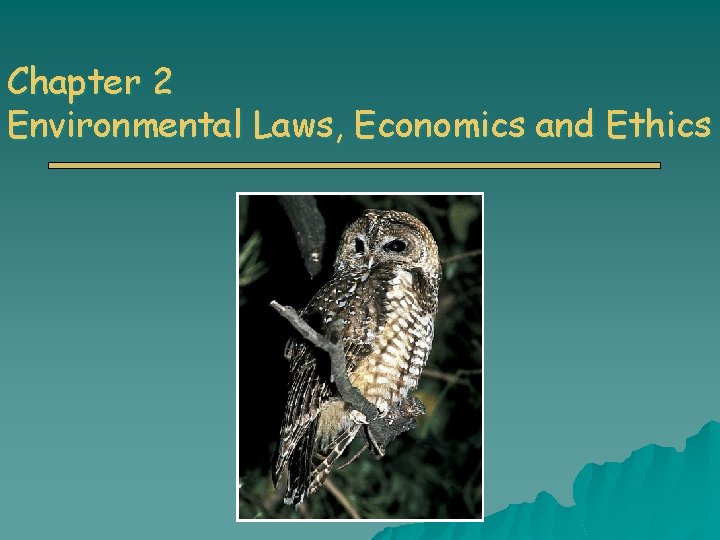
Day 2: Case study o Spotted Owl controversy • Law, politics and the environment
Spotted Owl Controversy. HW please read article and be prepared to discuss in class Article: “The spotted owl’s new nemesis” o http: //www. smithsonianmag. com/sciencenature/The-Spotted-Owls-New. Nemesis. html
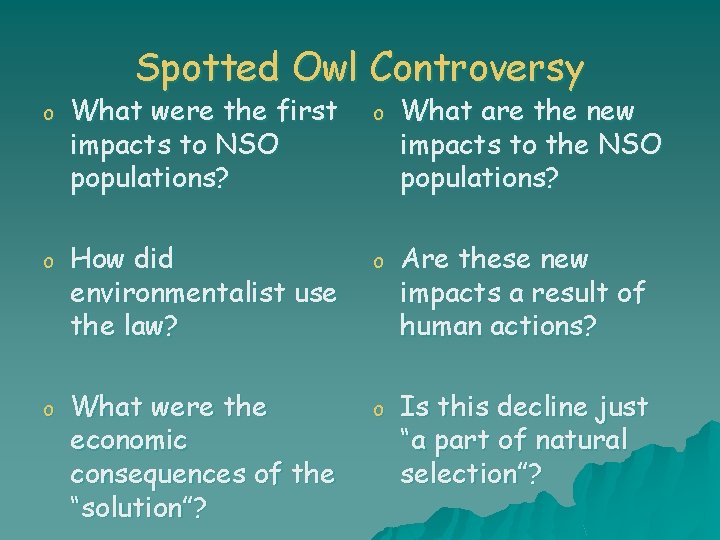
Spotted Owl Controversy o What were the first impacts to NSO populations? o What are the new impacts to the NSO populations? o How did environmentalist use the law? o Are these new impacts a result of human actions? o What were the economic consequences of the “solution”? o Is this decline just “a part of natural selection”?
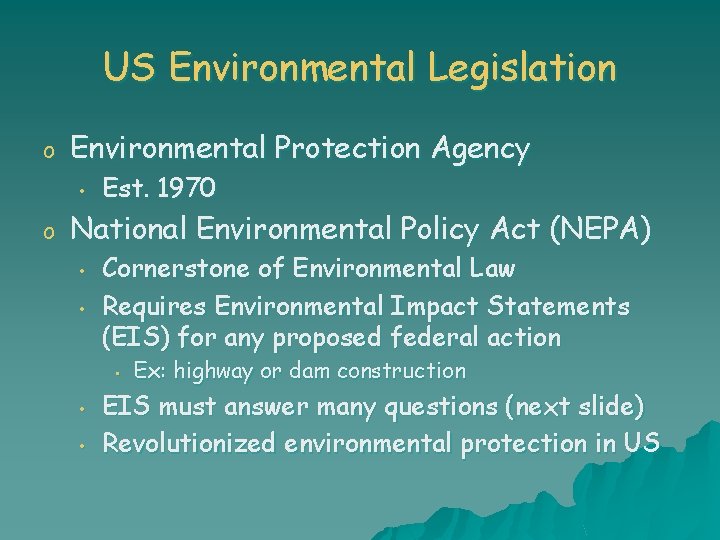
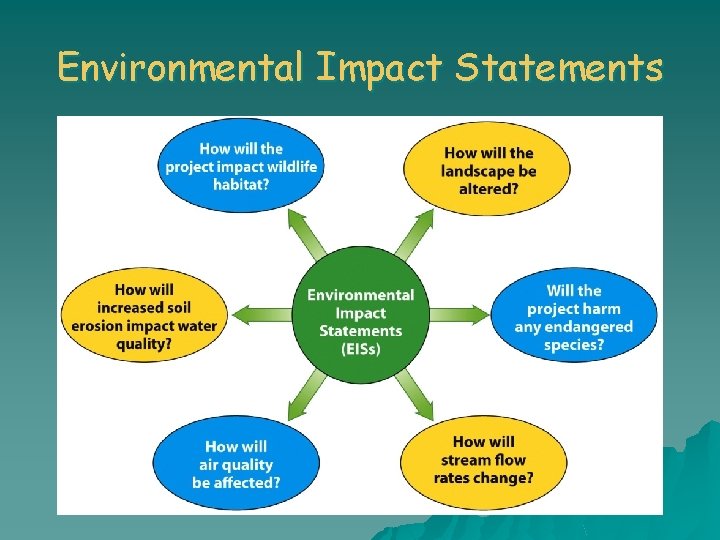
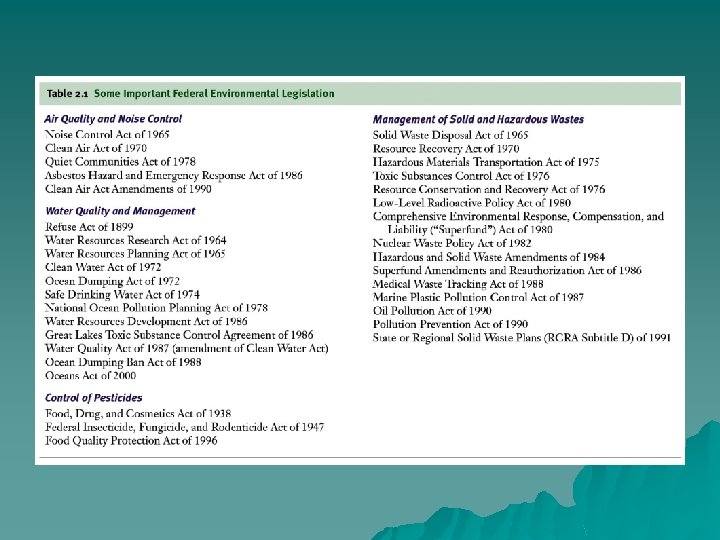
US Environmental Legislation o Environmental Protection Agency • o Est. 1970 National Environmental Policy Act (NEPA) • • Cornerstone of Environmental Law Requires Environmental Impact Statements (EIS) for any proposed federal action • • • Ex: highway or dam construction EIS must answer many questions (next slide) Revolutionized environmental protection in US
Environmental Impact Statements
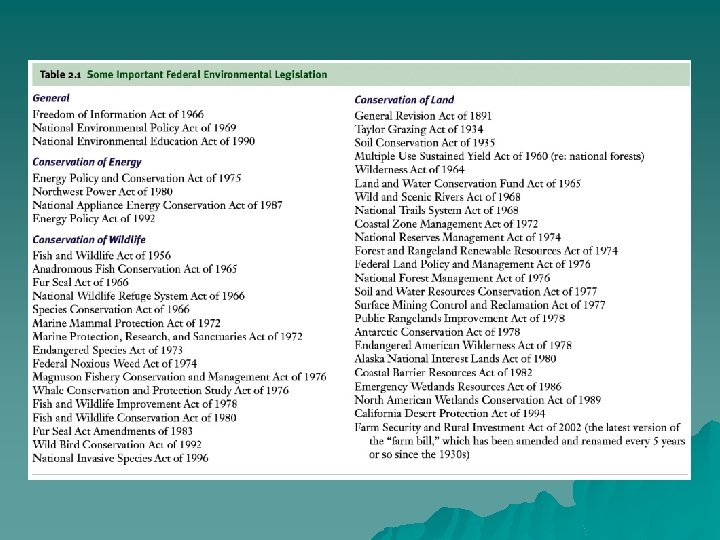
US Environmental Legislation o o Numerous laws passed since 1970 They address: • • • Clean water Clean air Energy conservation Hazardous waste Pesticides Federal regulation of pollution
Environmental Law Assignment Please type your answers in a word document. o By Monday 7: 45 AM all Environmental Law Summaries must be emailed to me. I will compile this and post on my webpage. Format: Law (Initial enactment, Most recent Revision) Name o
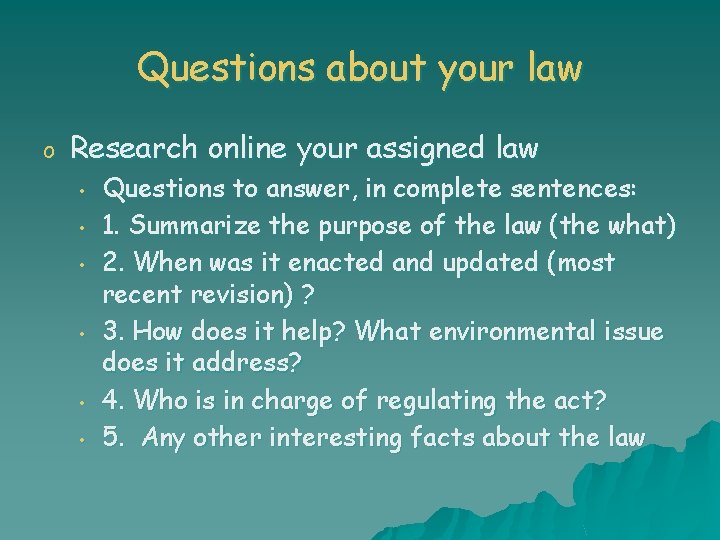
Questions about your law o Research online your assigned law • • • Questions to answer, in complete sentences: 1. Summarize the purpose of the law (the what) 2. When was it enacted and updated (most recent revision) ? 3. How does it help? What environmental issue does it address? 4. Who is in charge of regulating the act? 5. Any other interesting facts about the law
Day 3: o Q of day: What was your previous knowledge of your law? Give one piece of info about your law now? Do you know of a case where your law has been applied?
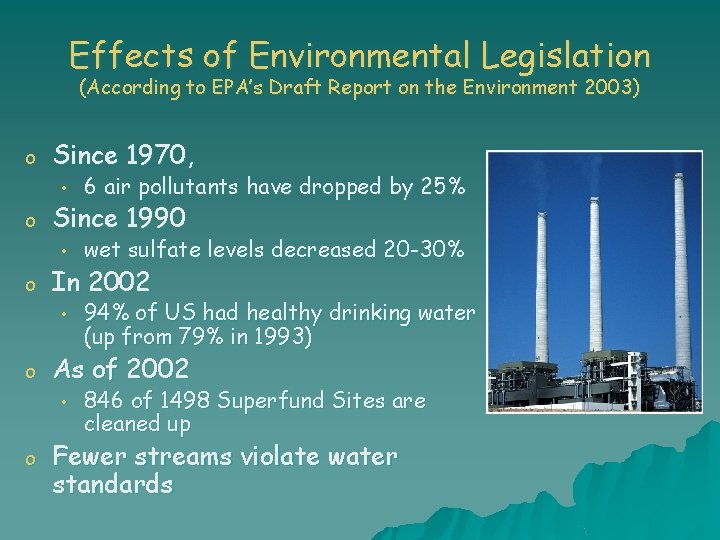
Effects of Environmental Legislation (According to EPA’s Draft Report on the Environment 2003) o Since 1970, • o Since 1990 • o 94% of US had healthy drinking water (up from 79% in 1993) As of 2002 • o wet sulfate levels decreased 20 -30% In 2002 • o 6 air pollutants have dropped by 25% 846 of 1498 Superfund Sites are cleaned up Fewer streams violate water standards
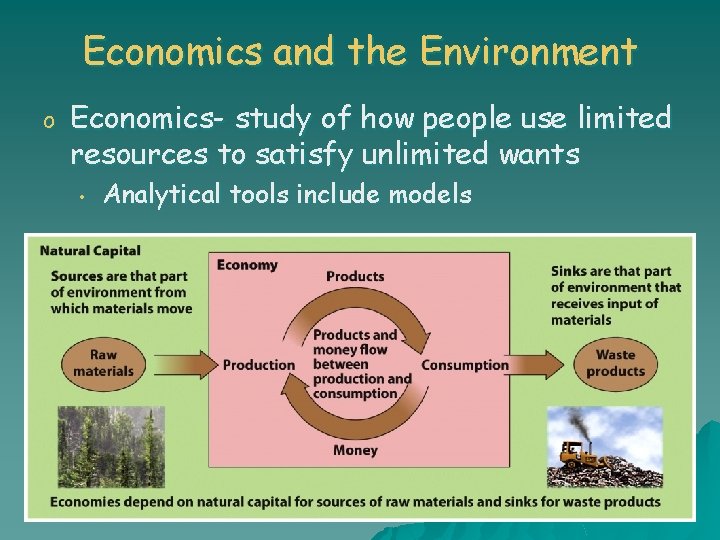
Economics and the Environment o Economics- study of how people use limited resources to satisfy unlimited wants • Analytical tools include models
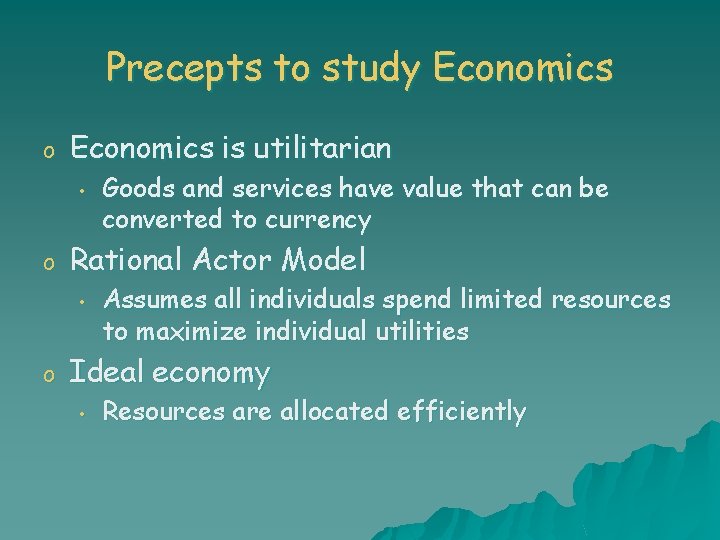
Precepts to study Economics o Economics is utilitarian • o Rational Actor Model • o Goods and services have value that can be converted to currency Assumes all individuals spend limited resources to maximize individual utilities Ideal economy • Resources are allocated efficiently
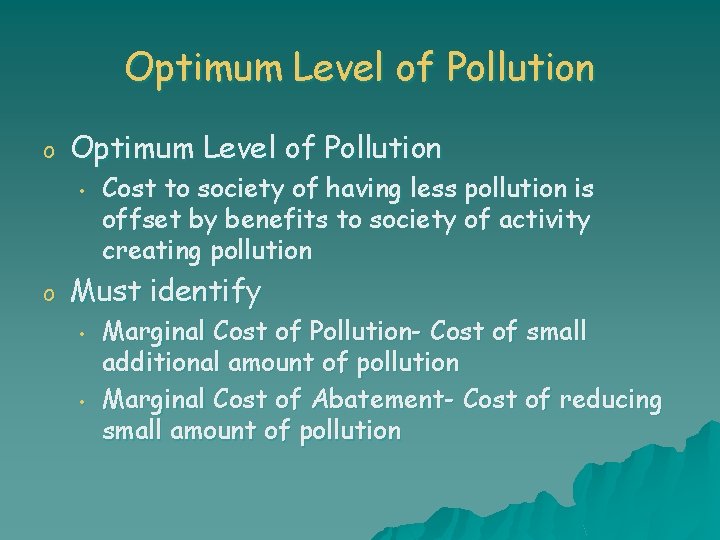
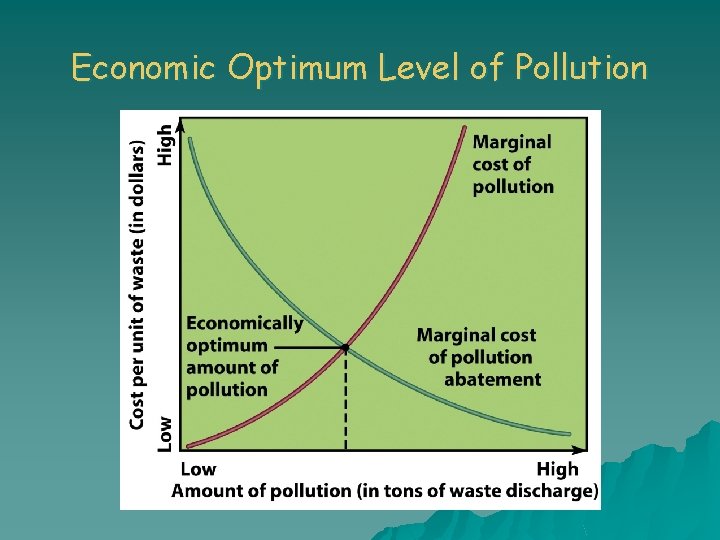
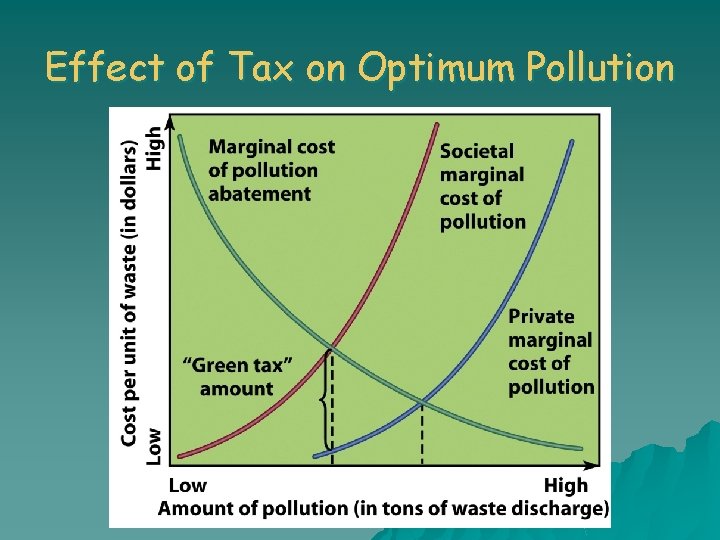
Optimum Level of Pollution o Optimum Level of Pollution • o Cost to society of having less pollution is offset by benefits to society of activity creating pollution Must identify • • Marginal Cost of Pollution- Cost of small additional amount of pollution Marginal Cost of Abatement- Cost of reducing small amount of pollution
Economic Optimum Level of Pollution
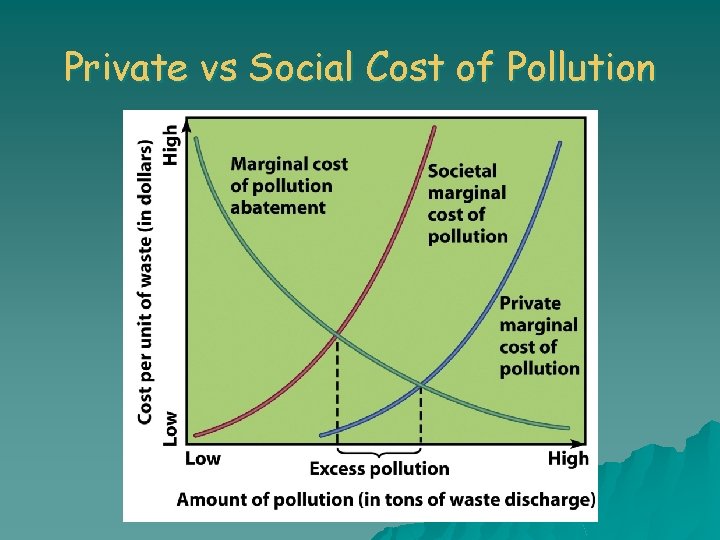
Private vs Social Cost of Pollution
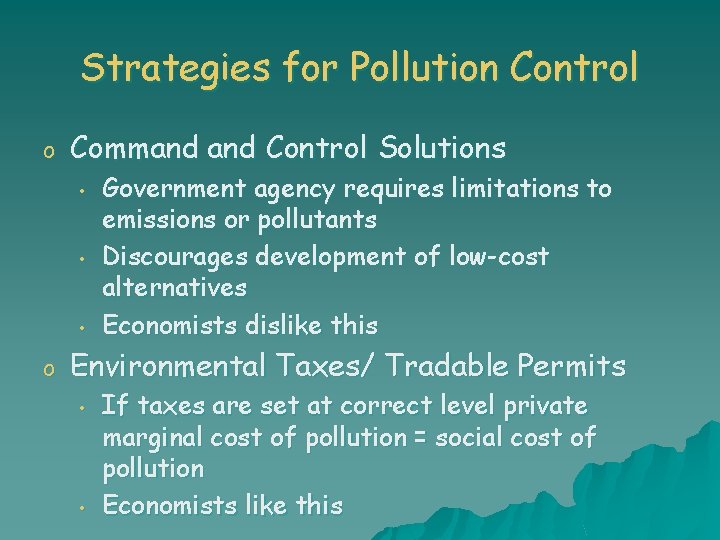
Strategies for Pollution Control o Command Control Solutions • • • o Government agency requires limitations to emissions or pollutants Discourages development of low-cost alternatives Economists dislike this Environmental Taxes/ Tradable Permits • • If taxes are set at correct level private marginal cost of pollution = social cost of pollution Economists like this
Effect of Tax on Optimum Pollution
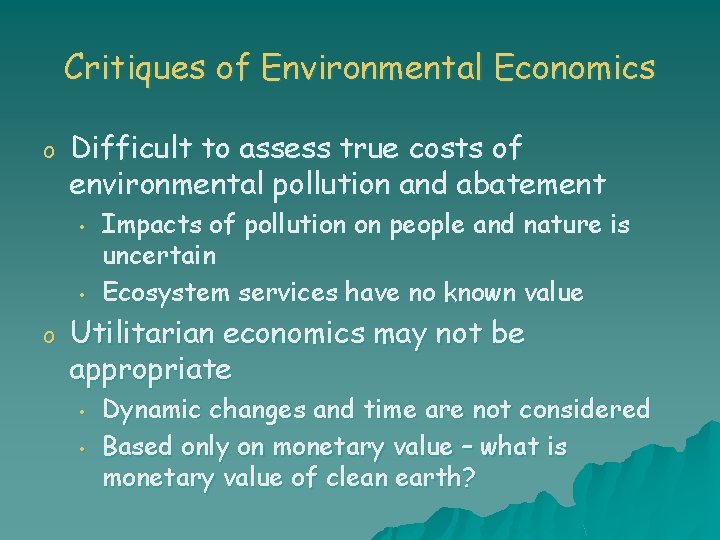
Critiques of Environmental Economics o Difficult to assess true costs of environmental pollution and abatement • • o Impacts of pollution on people and nature is uncertain Ecosystem services have no known value Utilitarian economics may not be appropriate • • Dynamic changes and time are not considered Based only on monetary value – what is monetary value of clean earth?
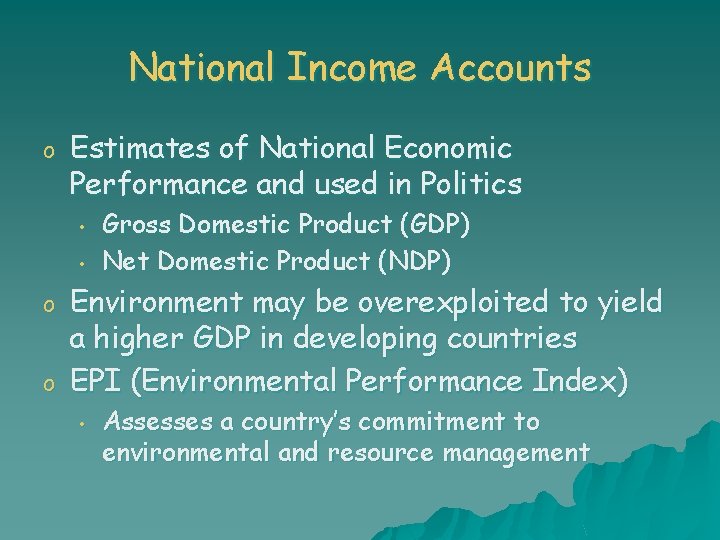
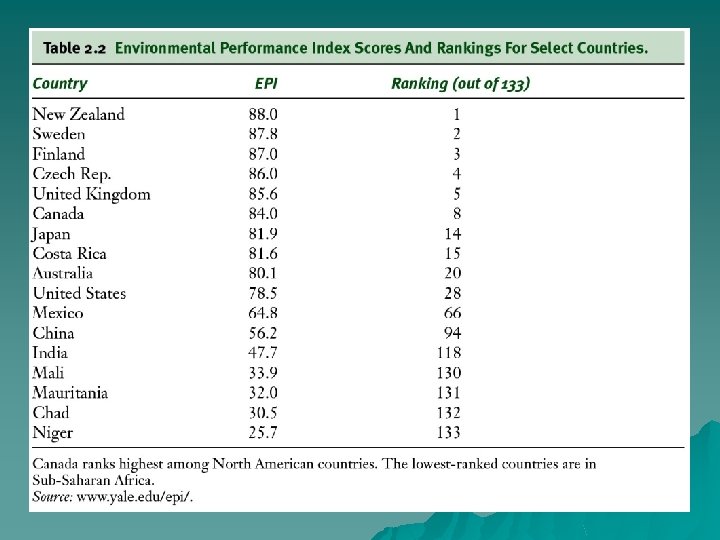
National Income Accounts o Estimates of National Economic Performance and used in Politics • • o o Gross Domestic Product (GDP) Net Domestic Product (NDP) Environment may be overexploited to yield a higher GDP in developing countries EPI (Environmental Performance Index) • Assesses a country’s commitment to environmental and resource management
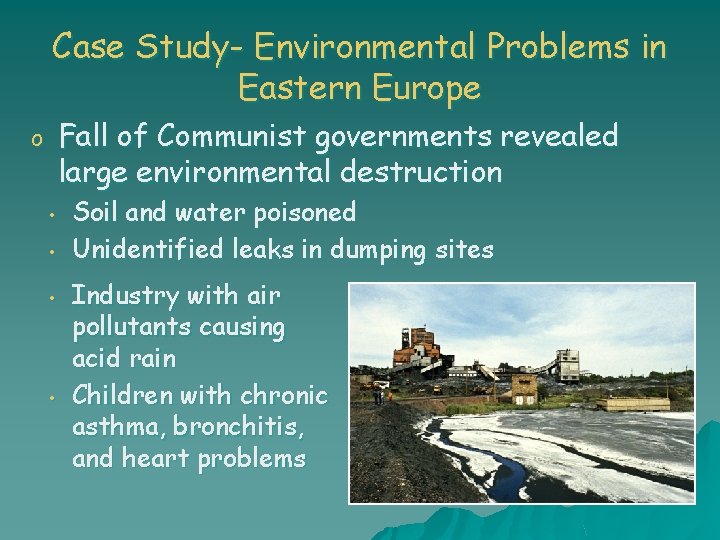
Case Study- Environmental Problems in Eastern Europe Fall of Communist governments revealed large environmental destruction o • • Soil and water poisoned Unidentified leaks in dumping sites Industry with air pollutants causing acid rain Children with chronic asthma, bronchitis, and heart problems
Case Study- Environmental Problems in Eastern Europe o o Meeting industrial quotas took precedence over environmental concerns Switch from communism to market economies- need to improve environment • o Will take decades to clean up polluting economics of communism Success varies by country • • Romania- EPI = 90 th Czech Republic- EPI = 4 th
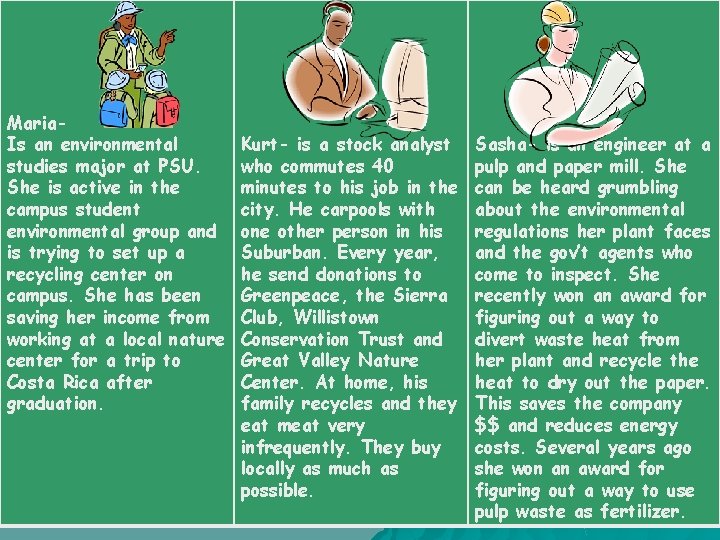
Activity: Who is the environmentalist? o Consider the character descriptions on the next slides. Which of these individuals, if any, is an environmentalist? Why? • What does this imply about environmentalism?
Maria. Is an environmental studies major at PSU. She is active in the campus student environmental group and is trying to set up a recycling center on campus. She has been saving her income from working at a local nature center for a trip to Costa Rica after graduation. Kurt- is a stock analyst who commutes 40 minutes to his job in the city. He carpools with one other person in his Suburban. Every year, he send donations to Greenpeace, the Sierra Club, Willistown Conservation Trust and Great Valley Nature Center. At home, his family recycles and they eat meat very infrequently. They buy locally as much as possible. Sasha- is an engineer at a pulp and paper mill. She can be heard grumbling about the environmental regulations her plant faces and the gov’t agents who come to inspect. She recently won an award for figuring out a way to divert waste heat from her plant and recycle the heat to dry out the paper. This saves the company $$ and reduces energy costs. Several years ago she won an award for figuring out a way to use pulp waste as fertilizer.
Environmental Ethics o o Field of ethics that considers the moral basis of environmental responsibility Western Worldview • o Deep Ecology Worldview • o Human superiority and dominance over nature All species have an equal worth to humans Most people’s ethics fall somewhere in between