
Chapter 2 Environment Analysis The aim of this
- Slides: 32
Chapter 2 Environment Analysis The aim of this part of the curriculum design process is to find the situational factors that will strongly affect the course.
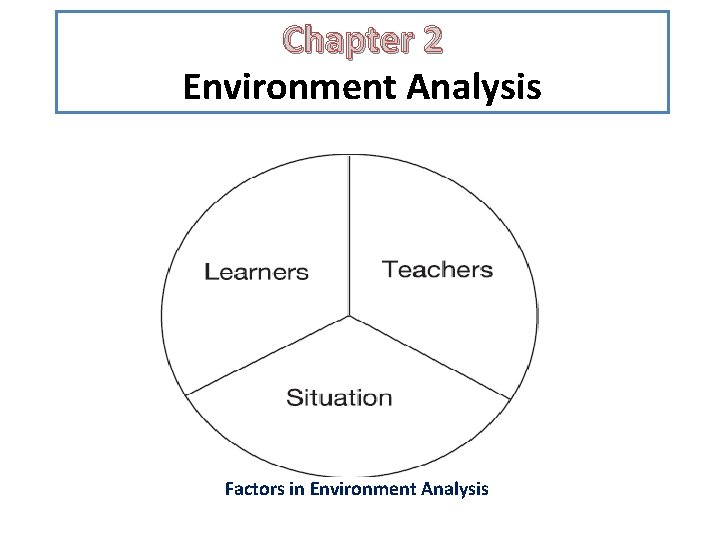
Chapter 2 Environment Analysis Environment analysis involves: Ø looking at the factors that will have a strong effect on decisions about the goals of the course, Ø what to include in the course, and Ø how to teach and assess it. These factors can arise from the learners, the teachers, and the teaching and learning situation.
Chapter 2 Environment Analysis Factors in Environment Analysis
Chapter 2 Environment Analysis Environment analysis is also called “situation analysis” or “constraints analysis”. A constraint* can be positive in curriculum design. For example, a constraint could be that the teachers are all very highly trained and are able and willing to make their own class activities. This would have a major effect on curriculum design as much of the format and presentation work could be left to the teachers. In some models of curriculum design, environment analysis is included in needs analysis. * The state of being restricted or confined within prescribed bounds
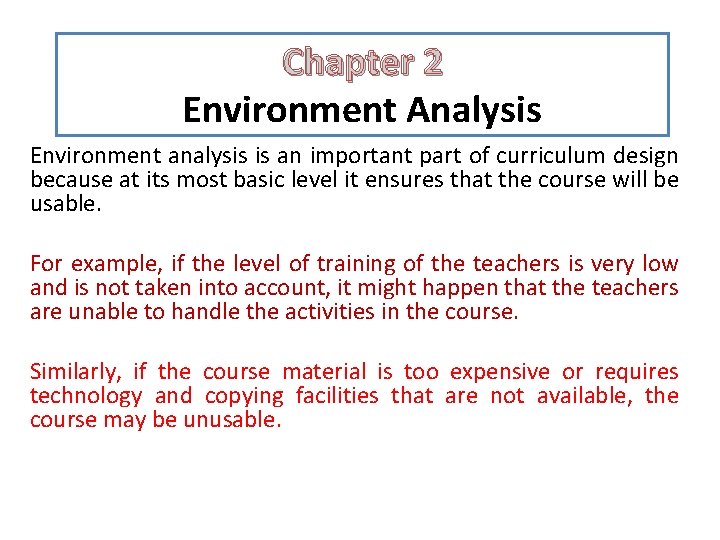
Chapter 2 Environment Analysis Environment analysis is an important part of curriculum design because at its most basic level it ensures that the course will be usable. For example, if the level of training of the teachers is very low and is not taken into account, it might happen that the teachers are unable to handle the activities in the course. Similarly, if the course material is too expensive or requires technology and copying facilities that are not available, the course may be unusable.
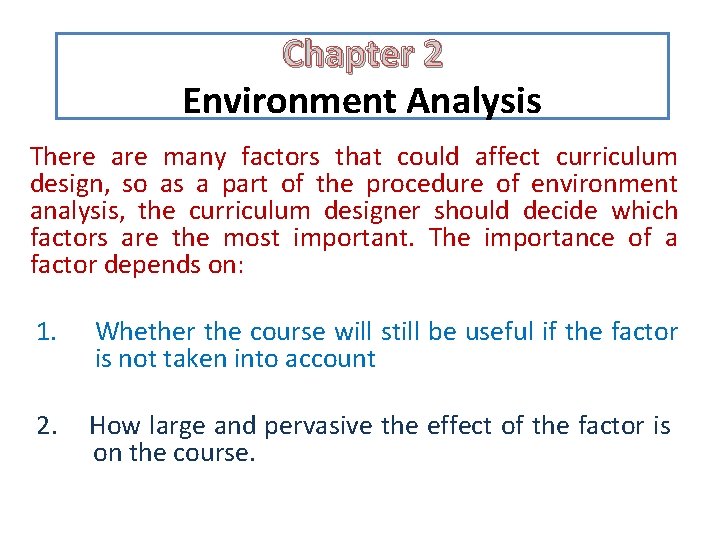
Chapter 2 Environment Analysis There are many factors that could affect curriculum design, so as a part of the procedure of environment analysis, the curriculum designer should decide which factors are the most important. The importance of a factor depends on: 1. Whether the course will still be useful if the factor is not taken into account 2. How large and pervasive the effect of the factor is on the course.
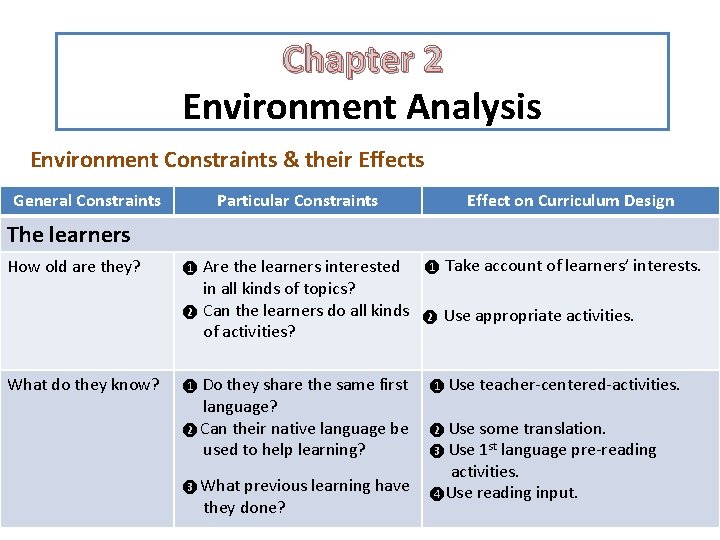
Chapter 2 Environment Analysis Environment Constraints & their Effects General Constraints Particular Constraints Effect on Curriculum Design The learners How old are they? What do they know? ❶ Are the learners interested in all kinds of topics? ❷ Can the learners do all kinds of activities? ❶ Do they share the same first language? ❷ Can their native language be used to help learning? ❸ What previous learning have they done? ❶ Take account of learners’ interests. ❷ Use appropriate activities. ❶ Use teacher-centered-activities. ❷ Use some translation. ❸ Use 1 st language pre-reading activities. ❹Use reading input.
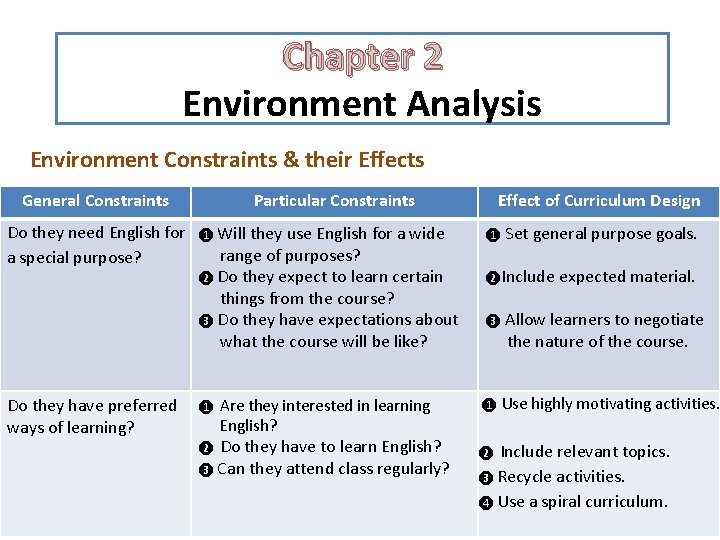
Chapter 2 Environment Analysis Environment Constraints & their Effects General Constraints Do they need English for a special purpose? Do they have preferred ways of learning? Particular Constraints ❶ Will they use English for a wide range of purposes? ❷ Do they expect to learn certain things from the course? ❸ Do they have expectations about what the course will be like? Effect of Curriculum Design ❶ Set general purpose goals. ❷Include expected material. ❸ Allow learners to negotiate the nature of the course. ❶ Are they interested in learning ❶ Use highly motivating activities. ❷ Do they have to learn English? ❷ Include relevant topics. English? ❸ Can they attend class regularly? ❸ Recycle activities. ❹ Use a spiral curriculum.
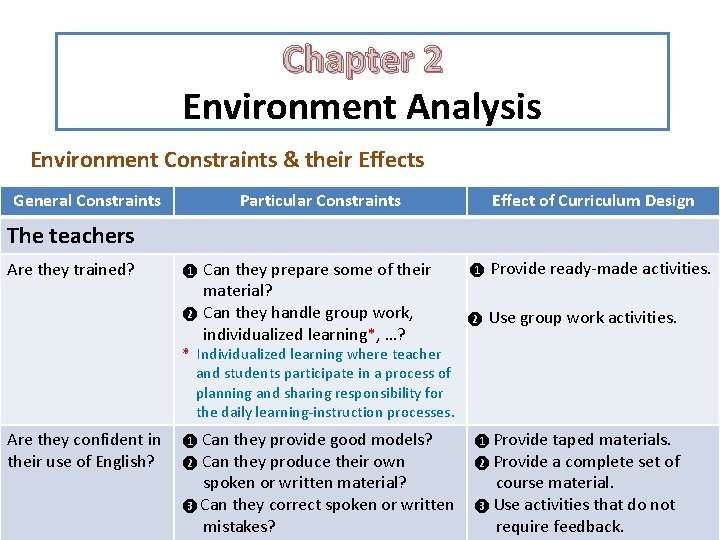
Chapter 2 Environment Analysis Environment Constraints & their Effects General Constraints Particular Constraints Effect of Curriculum Design The teachers Are they trained? ❶ Can they prepare some of their material? ❷ Can they handle group work, individualized learning*, …? ❶ Provide ready-made activities. ❷ Use group work activities. * Individualized learning where teacher and students participate in a process of planning and sharing responsibility for the daily learning-instruction processes. Are they confident in their use of English? ❶ Can they provide good models? ❶ Provide taped materials. spoken or written material? ❸ Can they correct spoken or written mistakes? course material. ❸ Use activities that do not require feedback. ❷ Can they produce their own ❷ Provide a complete set of
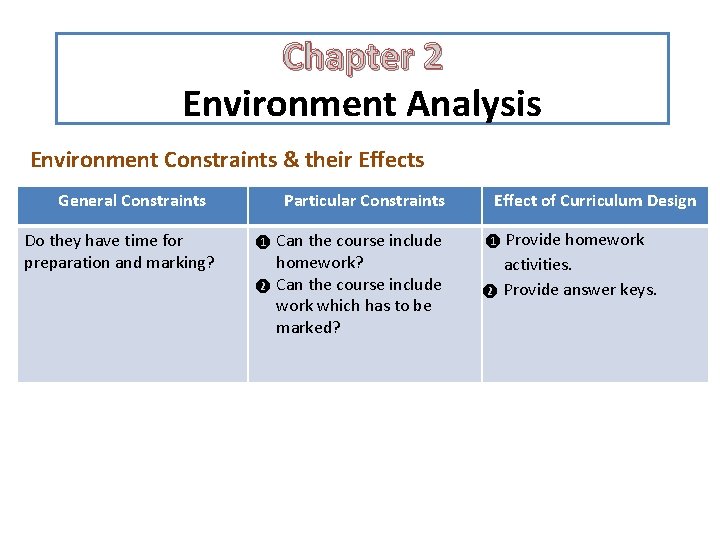
Chapter 2 Environment Analysis Environment Constraints & their Effects General Constraints Do they have time for preparation and marking? Particular Constraints ❶ Can the course include homework? ❷ Can the course include work which has to be marked? Effect of Curriculum Design Provide homework activities. ❷ Provide answer keys. ❶
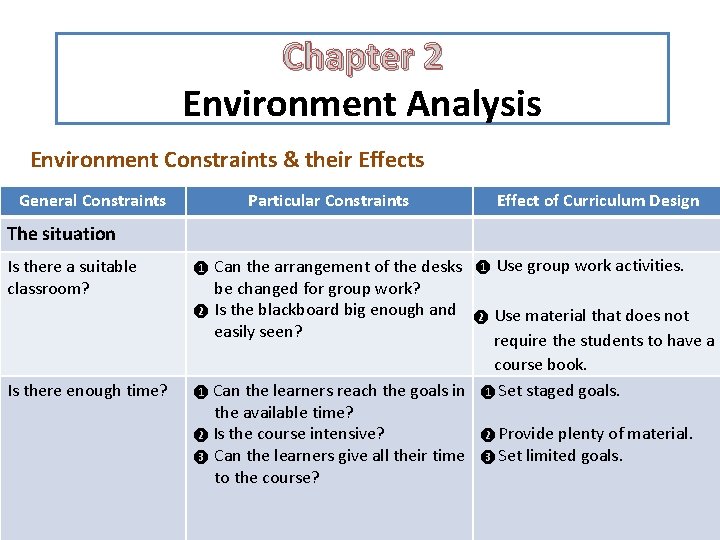
Chapter 2 Environment Analysis Environment Constraints & their Effects General Constraints Particular Constraints Effect of Curriculum Design The situation Is there a suitable classroom? Is there enough time? ❶ Can the arrangement of the desks ❶ Use group work activities. be changed for group work? ❷ Is the blackboard big enough and easily seen? ❷ Use material that does not require the students to have a course book. ❶ Can the learners reach the goals in ❶ Set staged goals. the available time? ❷ Is the course intensive? ❷ Provide plenty of material. ❸ Can the learners give all their time ❸ Set limited goals. to the course?
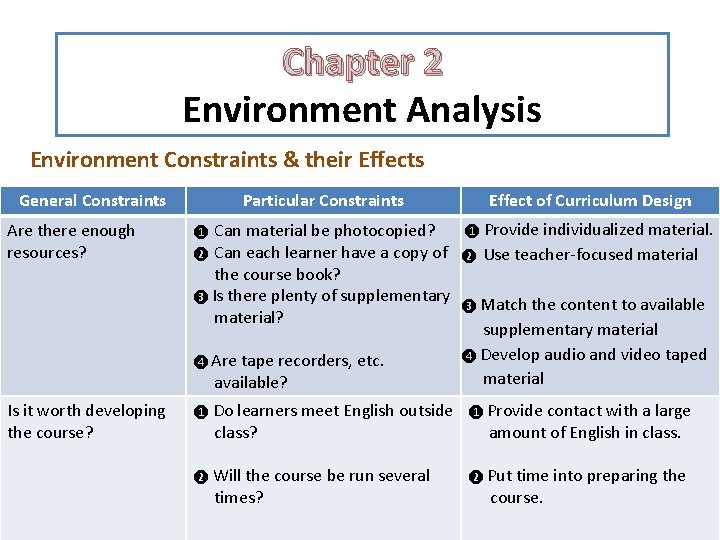
Chapter 2 Environment Analysis Environment Constraints & their Effects General Constraints Particular Constraints Effect of Curriculum Design Provide individualized material. ❷ Can each learner have a copy of ❷ Use teacher-focused material the course book? ❸ Is there plenty of supplementary ❸ Match the content to available material? supplementary material ❹ Develop audio and video taped ❹ Are tape recorders, etc. material available? Are there enough resources? ❶ Can material be photocopied? Is it worth developing the course? ❶ Do learners meet English outside ❶ Provide contact with a large class? ❷ Will the course be run several times? ❶ amount of English in class. ❷ Put time into preparing the course.
Chapter 2 Environment Analysis Understanding the Constraints In order to understand a constraint fully, it is usually necessary to examine the nature of the constraint in the environment you are working in, and to examine previous research on the constraint.
Chapter 2 Environment Analysis Understanding the Constraints For example, if the constraint of class size is considered to be important for the particular course being designed, it is useful to know exactly how large the classes are. Do they contain 40 students or 140 students? Is it possible to change class sizes?
Chapter 2 Environment Analysis Understanding the Constraints (Contd. ) There has been considerable research on and examination of teaching large classes. This research has looked at the relative merits of group work and teacher-centred activities, the effect of class size on learning, and individualisation.
Chapter 2 Environment Analysis Understanding the Constraints (Contd. ) There have been many articles and books on activities and techniques for large classes, and on the principles of group work.
Chapter 2 Environment Analysis Understanding the Constraints (Contd. ) Good curriculum design must take account of research and theory so that it provides the best possible conditions for learning that the state of the art* allows. *the highest degree of development of an art or technique at a particular time
Chapter 2 Environment Analysis Understanding the Constraints (Contd. ) Some of the major constraints investigated by research and analysis include the time available, cultural background, the effect of the first language on language learning and special purposes.
Chapter 2 Environment Analysis Understanding the Constraints (Contd. ) The following section looks at time as an example of an important constraint in the environment, and provides information that would be useful in helping to plan the length of a course.
Chapter 2 Environment Analysis Understanding the Constraints (Contd. ) This investigation of the time constraint provides a model of the application of the steps in environment analysis that can be applied to other constraints.
Chapter 2 Environment Analysis The Constraint of Time Local information from the environment Useful information to gather about the constraint is how much class time is available, how much time out of class could be given to learning, and what the goals of the course are.
Chapter 2 Environment Analysis The Constraint of Time Research information Useful research information would reveal what could be achieved within certain time periods. The estimates of the time taken to reach various levels of proficiency for learners of particular languages are based on the idea that some languages are more difficult than others for native speakers of English to begin to learn.
Chapter 2 Environment Analysis The Constraint of Time Research information (Contd. ) To reach an elementary level of proficiency in French or Indonesian for example would take approximately 240 hours of study. To reach the same level for a more difficult language such as Arabic or Japanese would take approximately 360 hours. These estimates derive from the considerable experience of teachers.
Chapter 2 Environment Analysis The Constraint of Time The effect of the time constraint on the design of the course An environmental constraint can be approached in two ways: (1) working within the constraint, and (2) overcoming the constraint.
Chapter 2 Environment Analysis The Constraint of Time The effect of the time constraint on the design of the course To work within the constraint, the curriculum designer could limit the goals of the course to fit the available time.
Chapter 2 Environment Analysis The Constraint of Time The effect of the time constraint on the design of the course Another way of limiting would be to try to cover most of the language items and skills but at a rather superficial level, relying on later experience to make up for the quick coverage. Alternatively, very intensive study procedures could be used.
Chapter 2 Environment Analysis The Constraint of Time The effect of the time constraint on the design of the course (Contd. ) To overcome the constraint, the curriculum designer might try to provide self-study options for work to be done outside of class time or if possible the time available for the course could be increased.
Chapter 2 Environment Analysis Steps in Environment Analysis The steps in environment analysis can be as follows: 1. Brainstorm and then systematically consider the range of environment factors that will affect the course. 2. Choose the most important factors (no more than five) and rank them, putting the most important first.
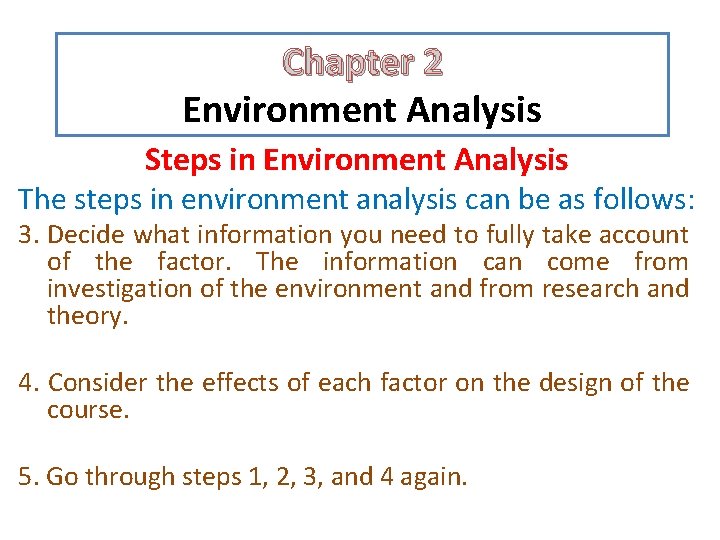
Chapter 2 Environment Analysis Steps in Environment Analysis The steps in environment analysis can be as follows: 3. Decide what information you need to fully take account of the factor. The information can come from investigation of the environment and from research and theory. 4. Consider the effects of each factor on the design of the course. 5. Go through steps 1, 2, 3, and 4 again.
Chapter 2 Environment Analysis Steps in Environment Analysis (Contd. ) Environment analysis involves looking at the local and wider situation to make sure that the course will fit and will meet local requirements. There is considerable research data on many of the important environment factors, including class size, motivation, learners of mixed proficiency and special purpose goals. Good environment analysis draws on both analysis of the environment and application of previous research and theory.
Chapter 2 Environment Analysis Task 1: The range of constraints Brainstorm to create a list of constraints that may significantly affect the design of courses. Task 2: Examining your teaching environment 1. List five important constraints that may face you in your teaching situation. Rank your constraints according to the strength of the effect that they may have on your course.
Chapter 2 Environment Analysis Tasks (Contd. ) 2. Very briefly describe the most important constraint or strength and say why it is important. 3. What do you know or need to know about the constraint or strength? 4. How can you take account of the constraint or strength in your curriculum? (What parts of the syllabus will it most affect? ) 1 2 3 4