
Chapter 2 ELA ELD Framework This Mornings Objectives
Chapter 2 ELA / ELD Framework
This Morning’s Objectives • Review goals and themes of ELA / ELD Framework. • Share models of instruction for effective delivery of ELA / ELD standards. • Analyze the role assessments and collaboration play in student achievement. • Describe Integrated and Designated ELD Instruction.
Goals of ELA / ELD Instruction • Develop Readiness for College, Careers, & Civic Life • Attain the Capacities of Literate Individuals • Become Broadly Literate • Acquire Skills for Living & Learning in the 21 st Century
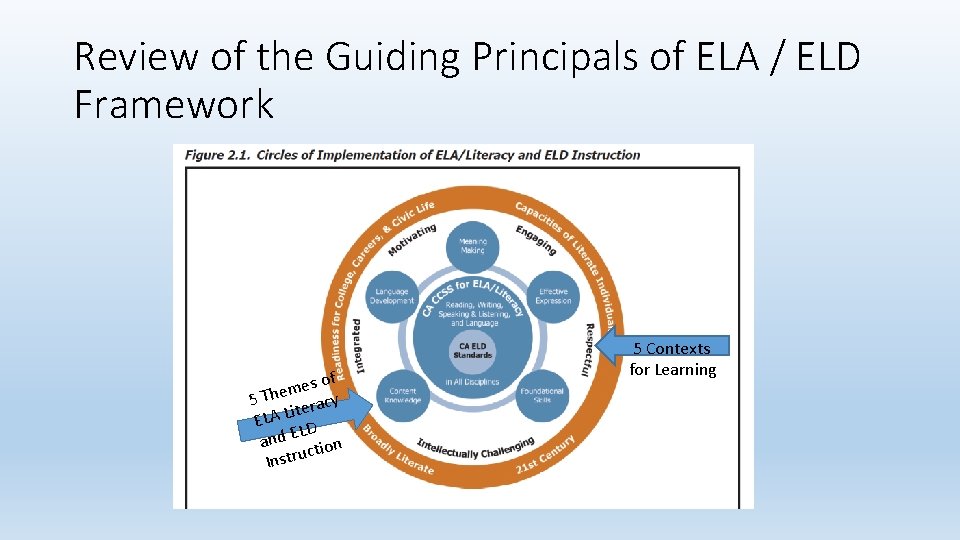
Review of the Guiding Principals of ELA / ELD Framework of s e m 5 The eracy it ELA L D L and E tion c Instru 5 Contexts for Learning

Three Themes are Amplified for ELs
Intentional Teaching (pg. 58) • Effective teaching is intentionally planned regardless of the model of instruction. While variations will occur in response to student learning and events in the moment, or even as part of an instructional model, the purposes of instruction are clear and coherent. The goals for instruction are collaboratively determined by the instructional team in response to assessed student needs and the curriculum. Instruction is planned to build students’ skills, knowledge and dispositions for learning over the course of each teaching unit and year. Selected instructional methods are well matched to instructional goals, content, and learners’ needs and maximize opportunities for applying and transferring knowledge to new settings and subjects.
Models of Instruction • Inquiry – Based Learning • Collaborative Learning • Direct Instruction
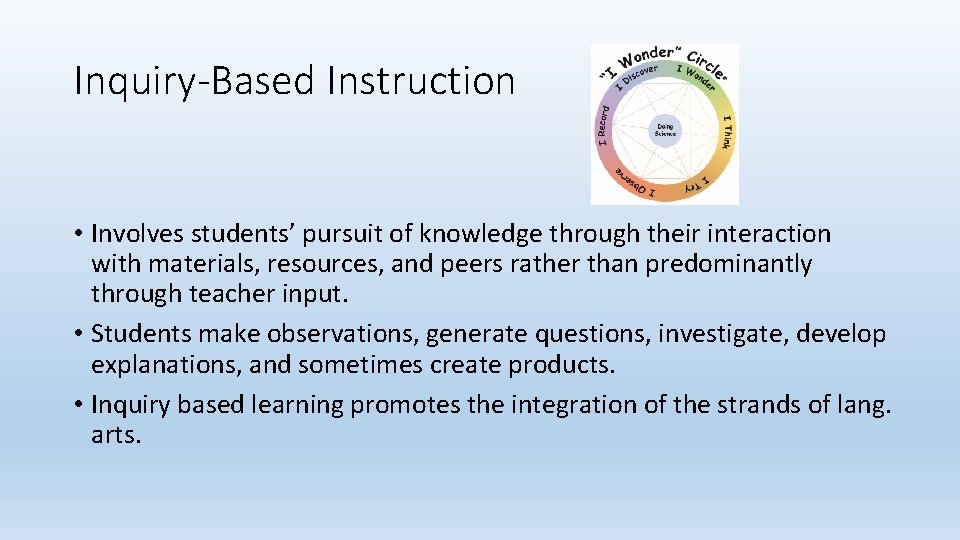
Inquiry-Based Instruction • Involves students’ pursuit of knowledge through their interaction with materials, resources, and peers rather than predominantly through teacher input. • Students make observations, generate questions, investigate, develop explanations, and sometimes create products. • Inquiry based learning promotes the integration of the strands of lang. arts.

Collaborative Learning • Involves two or more students working together toward a shared academic goal. Each student must contribute to the other’s learning. • Reciprocal teaching is a form of collaborative learning focused on four comprehension strategies, summarizing, questioning, clarifying & predicting. • Using a gradual release of responsibility approach – teachers initially direct the discussions. They lead the group, model strategies, scaffold student efforts and provide feedback. • Collaborative learning promotes communication among students and is particularly beneficial for ELs, as they develop language.
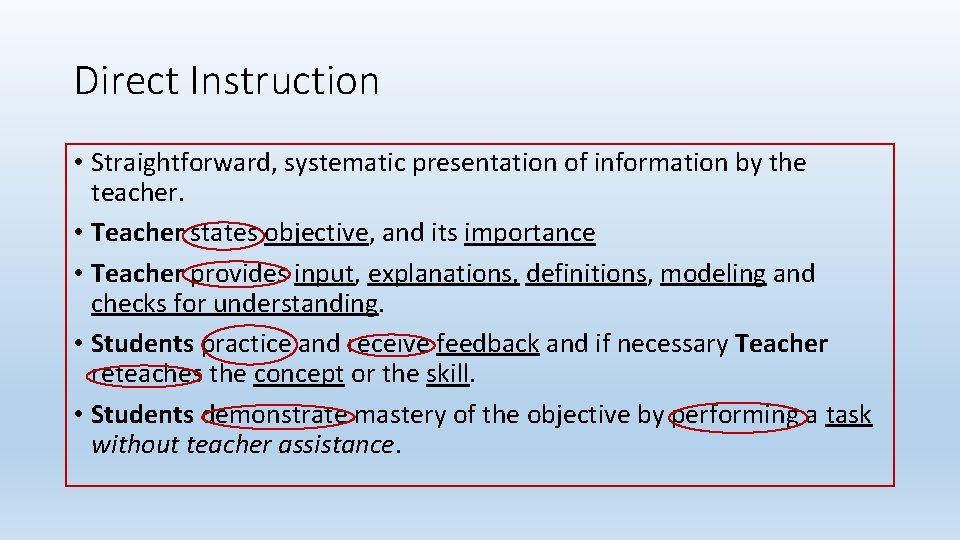
Direct Instruction • Straightforward, systematic presentation of information by the teacher. • Teacher states objective, and its importance • Teacher provides input, explanations, definitions, modeling and checks for understanding. • Students practice and receive feedback and if necessary Teacher reteaches the concept or the skill. • Students demonstrate mastery of the objective by performing a task without teacher assistance.
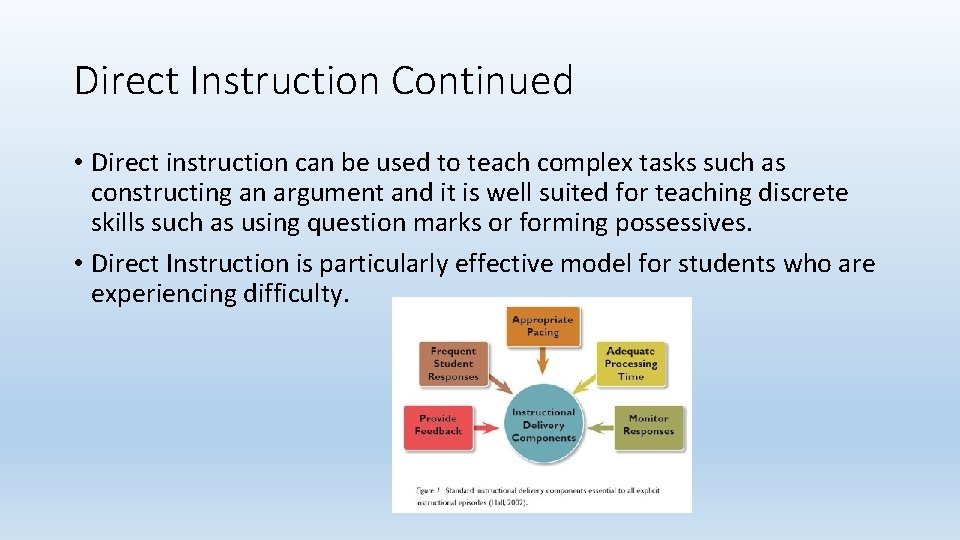
Direct Instruction Continued • Direct instruction can be used to teach complex tasks such as constructing an argument and it is well suited for teaching discrete skills such as using question marks or forming possessives. • Direct Instruction is particularly effective model for students who are experiencing difficulty.
Supporting Students Strategically • Universal Design for Learning • Multi-Tiered System of Supports • Sharing Responsibility
Universal Design for Learning • Planning first instruction to meet the needs of all learners. • Teachers provide students with multiple means of acquiring skills and knowledge, expressing their understandings and engaging with the content. • General Ed teachers consider Equity and Access
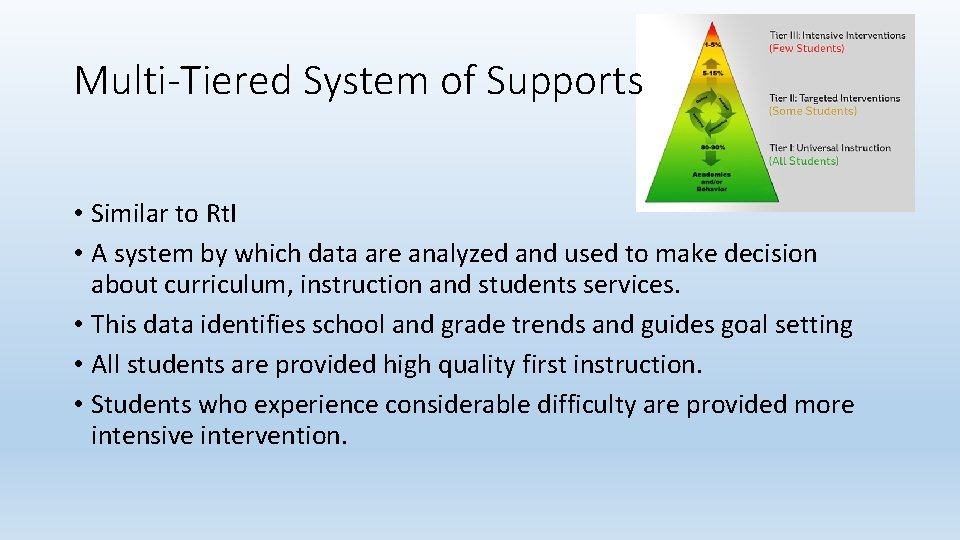
Multi-Tiered System of Supports • Similar to Rt. I • A system by which data are analyzed and used to make decision about curriculum, instruction and students services. • This data identifies school and grade trends and guides goal setting • All students are provided high quality first instruction. • Students who experience considerable difficulty are provided more intensive intervention.
Shared Responsibility (Collaboration) • The integrated and interdisciplinary nature of CA ELA / ELD standards requires new conceptions of planning, curriculum, instruction, and assessment to implement the standards as envisioned. • Sharing responsibility means that all teachers, specialists, and administrators should collaborate to ensure all students are provided curriculum and instruction that effectively merges literacy with content. • Responsibility for English Language Development is also shared.
Elementary Collaboration • Teachers need to meet within and across grade levels to determine how ELA and ELD will be provided. • They will need to determine how ELA and ELD content will be integrated.
Secondary Collaboration • Teachers within ELA departments will need to consider how to implement ELA / ELD standards • Teachers across other content areas will need to consider how to implement ELA/ELD literacy standards within their disciplines in in conjunction with their own content standards. • Collaboration between disciplinary areas (History/ Science) is emphasized. • This collaboration may necessitate refining the ways in which teachers work together to optimize and integrated approach to teaching and learning.
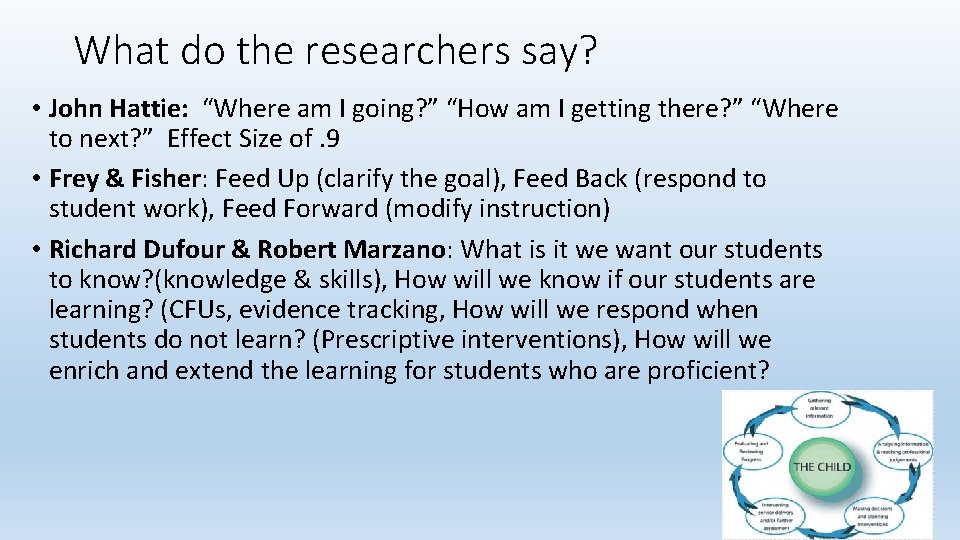
Using Assessments to Inform Instruction • Using the results of assessment to make decisions to modify instruction. • Formative Assessments involves gathering, interpreting and using information as feedback to change teaching and learning in the short run so that the gap between expected and observed student performance can close. • Information teachers use to refine, reinforce, extend, deepen or accelerate teaching of skills and concepts.
What do the researchers say? • John Hattie: “Where am I going? ” “How am I getting there? ” “Where to next? ” Effect Size of. 9 • Frey & Fisher: Feed Up (clarify the goal), Feed Back (respond to student work), Feed Forward (modify instruction) • Richard Dufour & Robert Marzano: What is it we want our students to know? (knowledge & skills), How will we know if our students are learning? (CFUs, evidence tracking, How will we respond when students do not learn? (Prescriptive interventions), How will we enrich and extend the learning for students who are proficient?
Scaffolding • Particular ways in which teachers provide temporary support to students, adjusted to their particular learning needs. • Scaffolding does not spontaneously occur, but is intentionally designed for a learner’s particular needs. • The level of scaffolding a student needs depends on a variety of factors, (background knowledge, language level, mastery of pre-skills). • Scaffolding practices are intentionally selected based on the standardsbased goals of a lesson, the needs of the learners, and the anticipated challenge of the task.
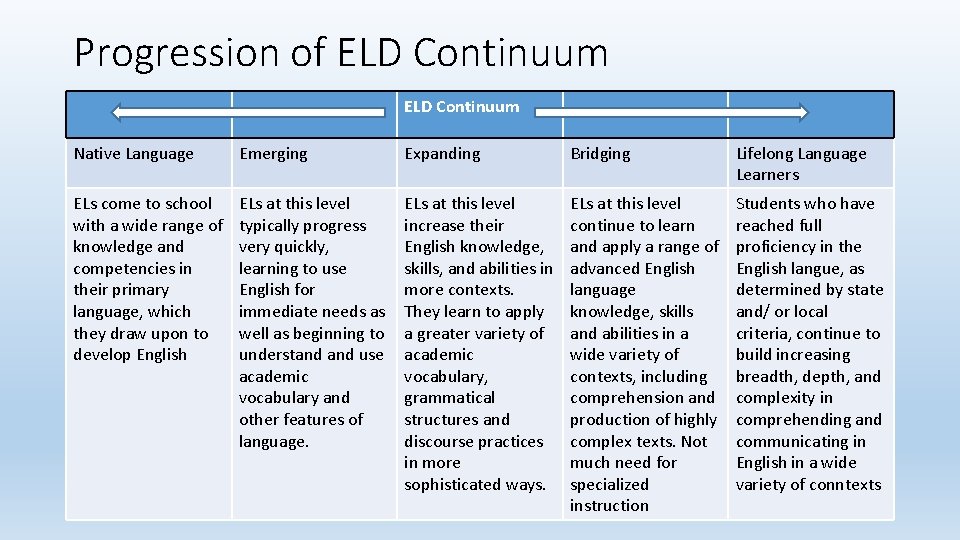
Progression of ELD Continuum Native Language Emerging Expanding Bridging Lifelong Language Learners ELs come to school with a wide range of knowledge and competencies in their primary language, which they draw upon to develop English ELs at this level typically progress very quickly, learning to use English for immediate needs as well as beginning to understand use academic vocabulary and other features of language. ELs at this level increase their English knowledge, skills, and abilities in more contexts. They learn to apply a greater variety of academic vocabulary, grammatical structures and discourse practices in more sophisticated ways. ELs at this level continue to learn and apply a range of advanced English language knowledge, skills and abilities in a wide variety of contexts, including comprehension and production of highly complex texts. Not much need for specialized instruction Students who have reached full proficiency in the English langue, as determined by state and/ or local criteria, continue to build increasing breadth, depth, and complexity in comprehending and communicating in English in a wide variety of conntexts
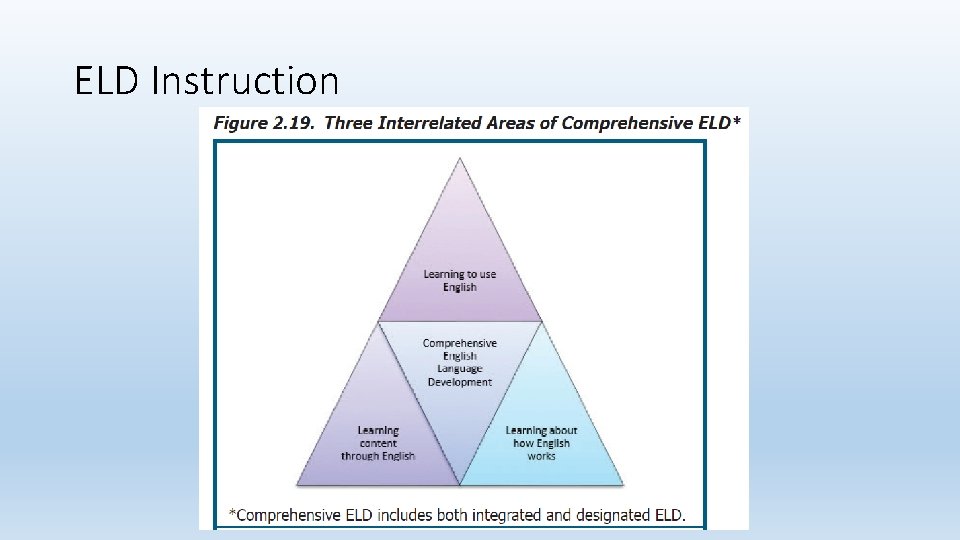
ELD Instruction
Integrated Instruction from a Student’s Perspective • Previously known as Sheltered and SDAIE • ELD throughout the day • ELs should engage in activities in which they listen to, read, analyze, interpret, discuss and create a variety of literary and informational text types. • Engaged in discussions to develop content knowledge, apply comprehension strategies, and analytical skills to interpret complex text, produce oral and written English that increasingly meets the expectations of the context, and develop an awareness about how English works to make meaning.
Integrated Instruction from a Teacher’s Responsibility • Instruction must include an abundance of collaborative discussions about content, meaningful interaction with complex text and engaging intellectually rich tasks. • Think-pair-share, structured group work, reciprocal teaching • Scaffolding teachers provide, such as sentence stems or frames should be used purposefully and judiciously. • Thoughtful planning includes: • Lessons constructed using ELA standards and ELD standards • Interactive and engaging experiences that are meaningful, relevant and intellectually rich and challenging. • Appropriate scaffolds and strategic supports
Designated Instruction • Previously known as Dedicated ELD • Time set aside to focus strategically on language development • Support discourse practices • Collaborative discussions • Grammatical structures • Vocabulary development • Some level of reading & writing tasks • Designated Instruction is NOT time to teach or reteach content. • It is a time to focus on the language of the content areas.
What does Designated Instruction Look Like? • Sentence Unpacking activity (pg 93) • Focus on grammatical supports • Pre-teaching vocabulary to content instruction • Supports to develop discourse practices necessary to participate in academic tasks. • Developing skills and abilities to use language for speaking, reading, writing, meaning making.
Ticket Out the Door • Define Integrated & Designated ELD instruction for your staff • Think of at least one strategy to support students during integrated instruction. • What is the factors must a teacher consider during Designated Instruction?
- Slides: 27