
Chapter 2 Economic Systems Resource Allocation and Social
- Slides: 37
Chapter 2 Economic Systems, Resource Allocation, and Social Well-Being: Lessons From China’s Transition Mc. Graw-Hill/Irwin Copyright © 2010 by the Mc. Graw-Hill Companies, Inc. All rights reserved.
Key Concepts • Pure command economic systems • Pure market economic systems • Transitional economies • Competitive markets • Monopolistic markets • Imperfectly competitive markets • The Soviet model • Economic systems and social well-being • Surplus • Shortage • Turnover tax • Infrastructure
Markets • A market exists for a product whenever the buyers and sellers of the product engage in exchange involving this product • Economic systems differ by how important the markets are • Markets § Geographical dimension: local, national, international § Do not have to be a physical place 2 -3
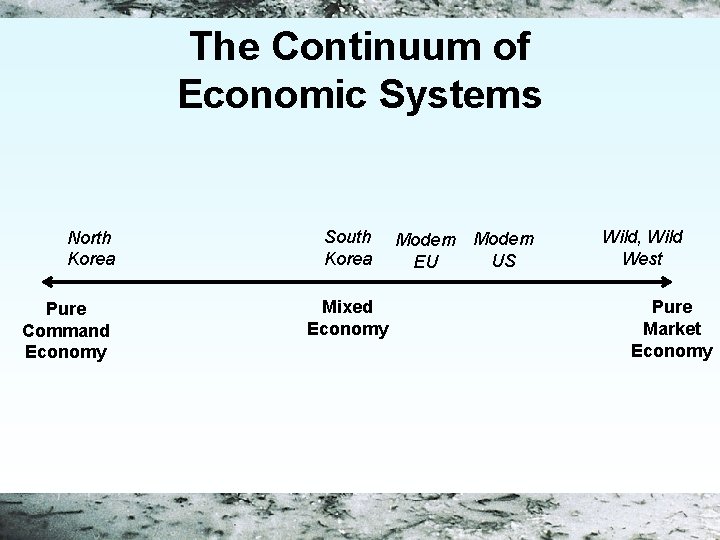
The Continuum of Economic Systems North Korea Pure Command Economy South Korea Mixed Economy Modern US EU Wild, Wild West Pure Market Economy
Pure Market Economy • Pure market economy: economic system based on private ownership and control of resources, known as private property rights, and coordination of resource-use decisions through markets § Private ownership of resources § Decentralized decision making coordinated through markets § Close examples: U. S. , Canada in early 1800 s
Pure Command Economy • Pure command economy: economic system characterized by state ownership and/or control of resources and centralized resource-use decision making § Mirror image of pure market economy § State ownership of resources § Centralized planning § Markets are not necessary in pure command economies § Close examples: the Soviet Union, North Korea, Cuba
Mixed Systems • Mixed systems § Economies that combine elements of the pure market and pure command economies § Examples: US, Canada, South Korea, Japan, China, Vietnam today § Transitional economies: a nation in the process of replacing an economic system of command control with the one based on market principles (former USSR and Eastern Europe)
Economic Systems and Resources Allocation • Markets allocate resources more in the market-oriented economies • Planning agencies allocate resources more in the command-control economies 2 -8
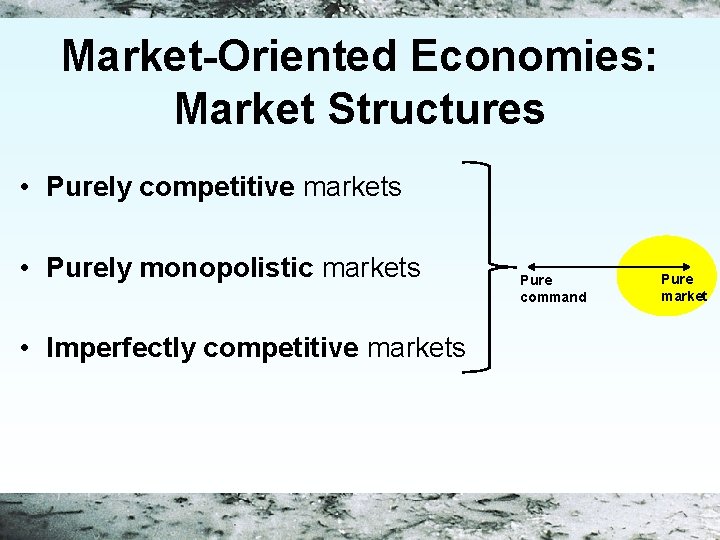
Market-Oriented Economies: Market Structures • Purely competitive markets • Purely monopolistic markets • Imperfectly competitive markets Pure command Pure market
Purely Competitive Markets • Large number of buyers and sellers no one can change the market price • Each seller offers standardized product (homogeneous product) buyers can easily choose between different sellers • Product prices free to move up or down government does not control prices • Buyers and sellers must be mobile buyers buy at the lowest price, sellers sell at the highest price • Freedom of entry and exit inefficient producers leave, efficient producers enter 2 -10
Purely Monopolistic Markets • Only one seller of the product the seller can influence the price • The seller can block entry limited or no scope for competition • Consumers § § Face higher prices and/or lower quality Reduce their demand so the seller cannot set prices too high • Competition benefits society as a whole Monopoly will be analyzed later • Caveat: monopolies can be beneficial in some cases
Imperfectly Competitive Markets • Exhibit characteristics of both pure markets and purely monopolistic environment • Most markets are imperfectly competitive
Demand • Demand schedule and demand curves • Law of demand • Factors influencing demand § § § Consumers’ income Prices of related goods Consumers’ tastes Consumers’ expectations Number of consumers
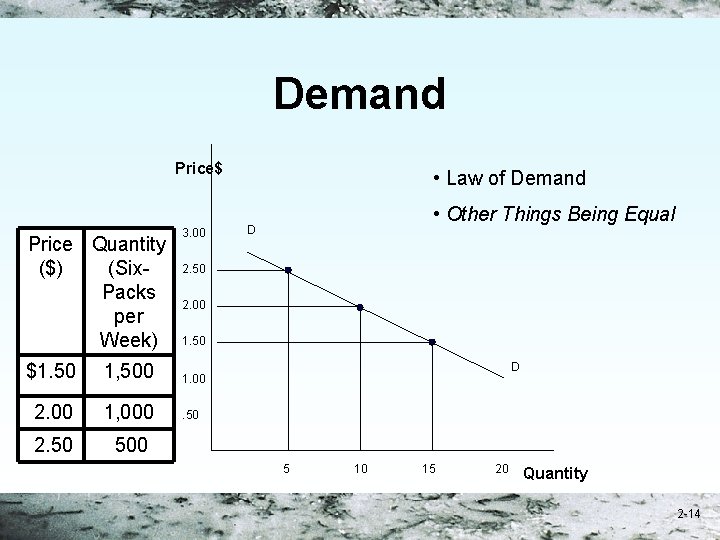
Demand Price$ Price Quantity ($) (Six. Packs per Week) 3. 00 • Law of Demand • Other Things Being Equal D 2. 50 2. 00 1. 50 $1. 50 1, 500 1. 00 2. 00 1, 000 . 50 2. 50 500 D 5 10 15 20 Quantity 2 -14
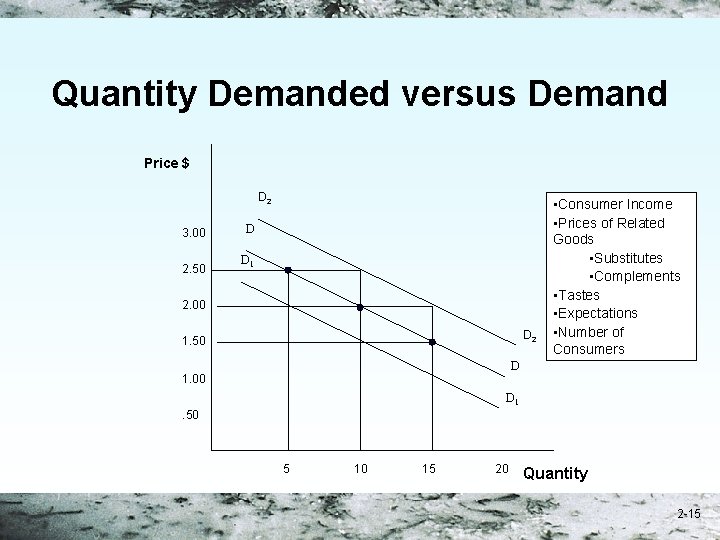
Quantity Demanded versus Demand Price $ D 2 3. 00 2. 50 D D 1 2. 00 D 2 1. 50 • Consumer Income • Prices of Related Goods • Substitutes • Complements • Tastes • Expectations • Number of Consumers D 1. 00 D 1. 50 5 10 15 20 Quantity 2 -15
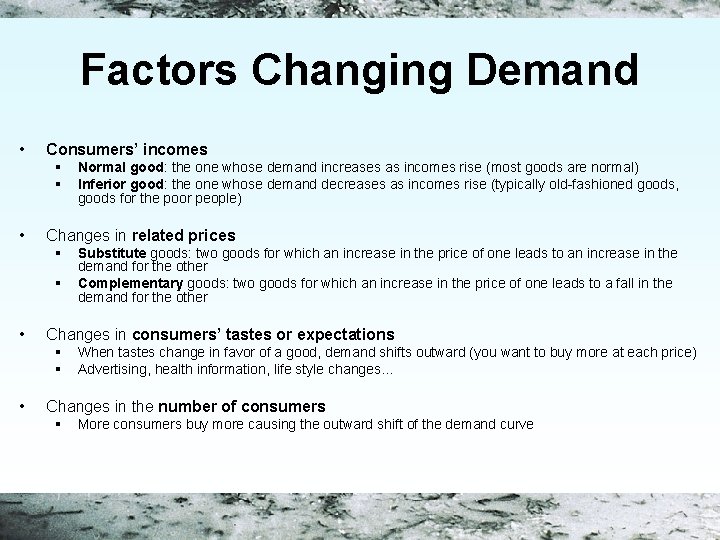
Factors Changing Demand • Consumers’ incomes § § • Changes in related prices § § • Substitute goods: two goods for which an increase in the price of one leads to an increase in the demand for the other Complementary goods: two goods for which an increase in the price of one leads to a fall in the demand for the other Changes in consumers’ tastes or expectations § § • Normal good: the one whose demand increases as incomes rise (most goods are normal) Inferior good: the one whose demand decreases as incomes rise (typically old-fashioned goods, goods for the poor people) When tastes change in favor of a good, demand shifts outward (you want to buy more at each price) Advertising, health information, life style changes… Changes in the number of consumers § More consumers buy more causing the outward shift of the demand curve
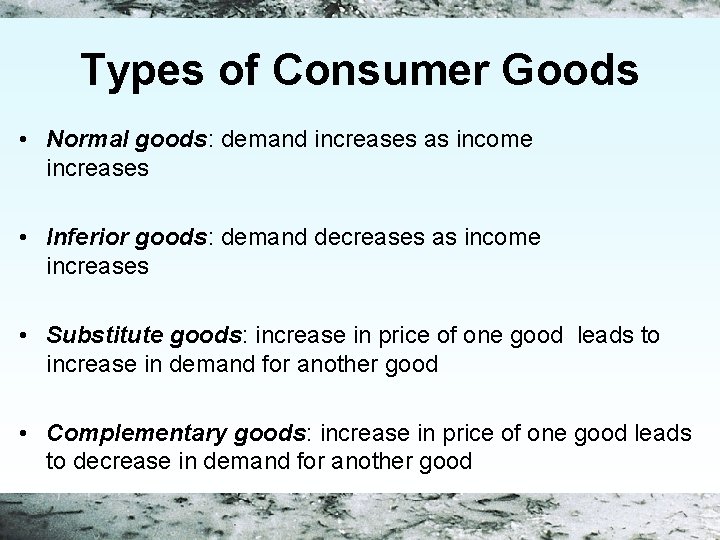
Types of Consumer Goods • Normal goods: demand increases as income increases • Inferior goods: demand decreases as income increases • Substitute goods: increase in price of one good leads to increase in demand for another good • Complementary goods: increase in price of one good leads to decrease in demand for another good
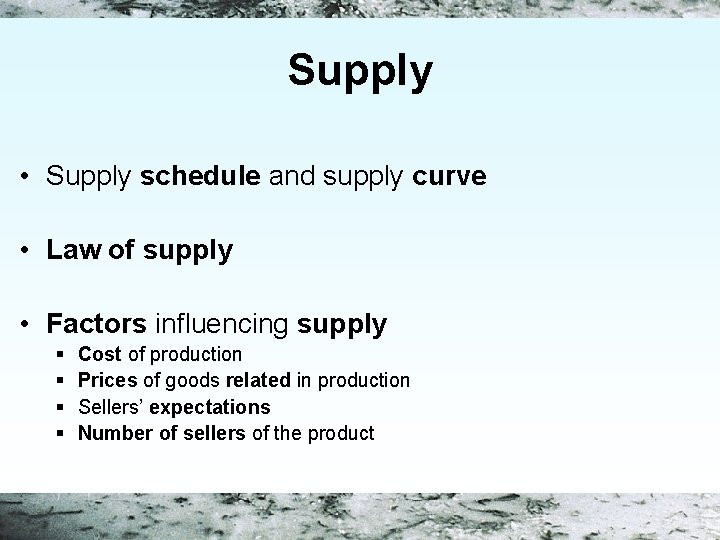
Supply • Supply schedule and supply curve • Law of supply • Factors influencing supply § § Cost of production Prices of goods related in production Sellers’ expectations Number of sellers of the product
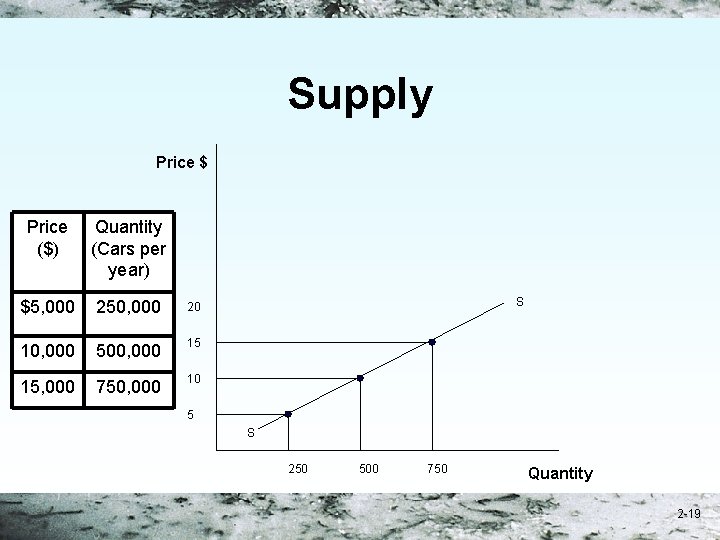
Supply Price $ Price ($) Quantity (Cars per year) $5, 000 250, 000 20 10, 000 500, 000 15 15, 000 750, 000 10 S 5 S 250 500 750 Quantity 2 -19
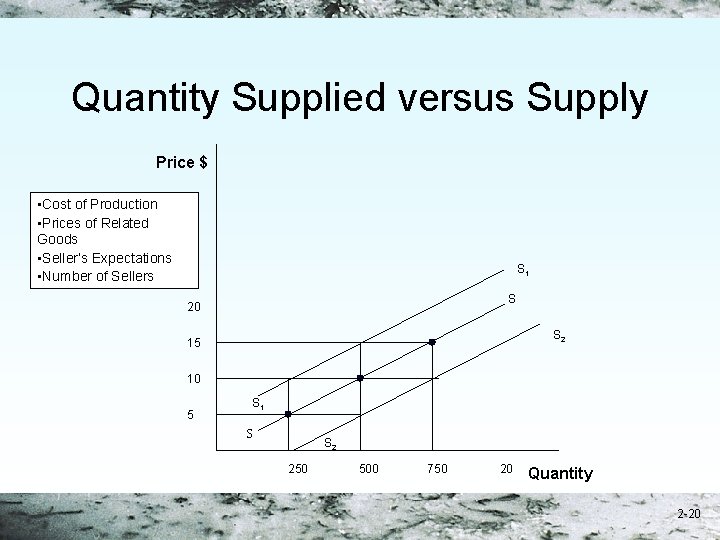
Quantity Supplied versus Supply Price $ • Cost of Production • Prices of Related Goods • Seller’s Expectations • Number of Sellers S 1 S 20 S 2 15 10 5 S 1 S S 2 250 500 750 20 Quantity 2 -20
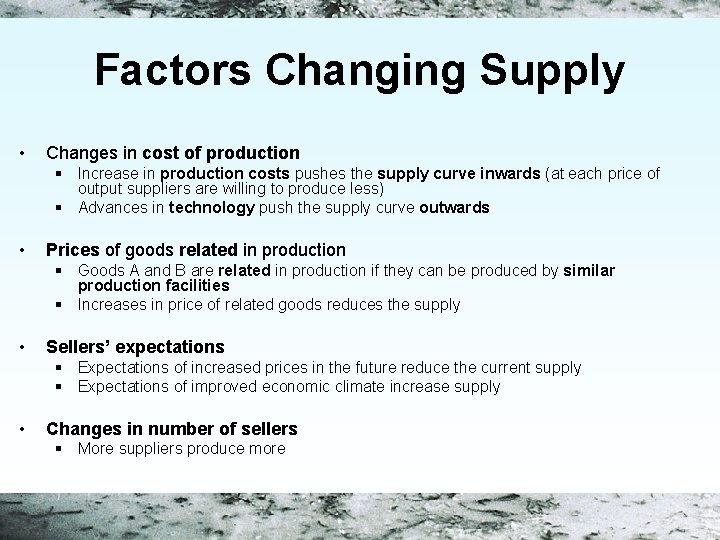
Factors Changing Supply • Changes in cost of production § Increase in production costs pushes the supply curve inwards (at each price of output suppliers are willing to produce less) § Advances in technology push the supply curve outwards • Prices of goods related in production § Goods A and B are related in production if they can be produced by similar production facilities § Increases in price of related goods reduces the supply • Sellers’ expectations § Expectations of increased prices in the future reduce the current supply § Expectations of improved economic climate increase supply • Changes in number of sellers § More suppliers produce more
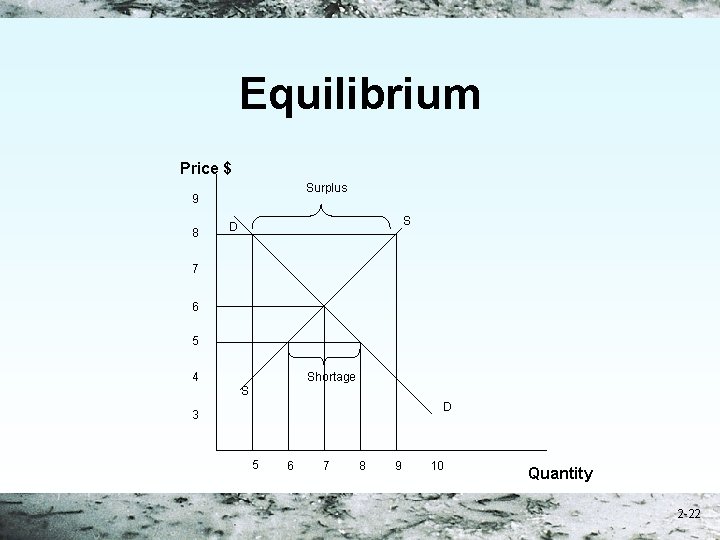
Equilibrium Price $ Surplus 9 8 S D 7 6 5 4 Shortage S D 3 5 6 7 8 9 10 Quantity 2 -22
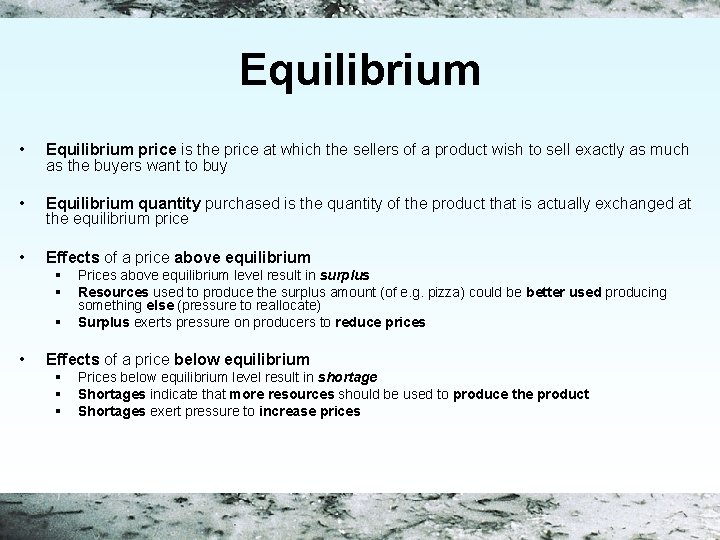
Equilibrium • Equilibrium price is the price at which the sellers of a product wish to sell exactly as much as the buyers want to buy • Equilibrium quantity purchased is the quantity of the product that is actually exchanged at the equilibrium price • Effects of a price above equilibrium § § § • Prices above equilibrium level result in surplus Resources used to produce the surplus amount (of e. g. pizza) could be better used producing something else (pressure to reallocate) Surplus exerts pressure on producers to reduce prices Effects of a price below equilibrium § § § Prices below equilibrium level result in shortage Shortages indicate that more resources should be used to produce the product Shortages exert pressure to increase prices
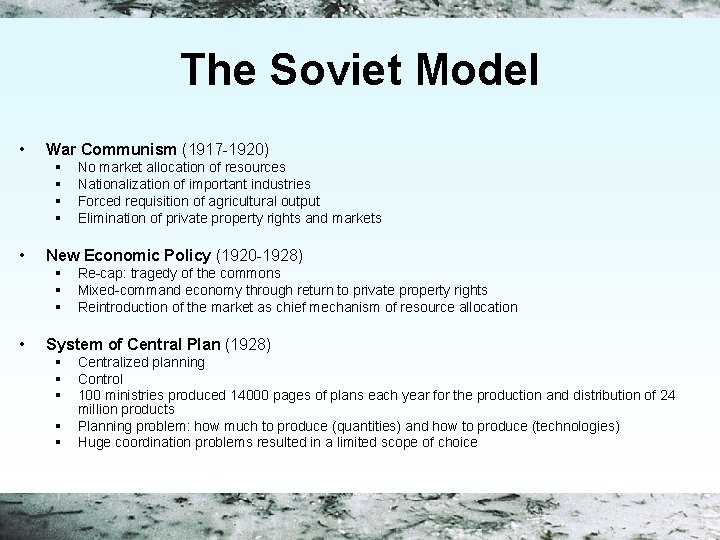
The Soviet Model • War Communism (1917 -1920) § § • New Economic Policy (1920 -1928) § § § • No market allocation of resources Nationalization of important industries Forced requisition of agricultural output Elimination of private property rights and markets Re-cap: tragedy of the commons Mixed-command economy through return to private property rights Reintroduction of the market as chief mechanism of resource allocation System of Central Plan (1928) § § § Centralized planning Control 100 ministries produced 14000 pages of plans each year for the production and distribution of 24 million products Planning problem: how much to produce (quantities) and how to produce (technologies) Huge coordination problems resulted in a limited scope of choice
Shortcomings of Central Planning • Informational Requirements • Incentives for Efficient Production • Managerial Incentives • Heavy Industry versus Consumer Goods 2 -25
Informational Requirements • What goods to produce? • In what quantities to produce? • Technology to use? • Production resources (where from, how much) • Distribution of output • All these questions in an economy with millions of goods and services
Incentives to Produce Efficiently • Consider a community of 1000 farmers • Revenue minus costs minus State share get evenly distributed among farmers in the end of the year • Suppose one farmer works twice as hard compared to the others so that an additional $2000 is earned for the community • In the end of the year, the addition to the hard-working farmer’s income is $2 • Why work hard?
Managerial Incentives • Managers are given production goals in terms of units, not quality • It pays off to lobby the lowering of the plan target • Ratchet effect: efforts to produce less since efficient production results in plan target increase • Squandering resources is hard to prove • Quality controls typically low-standard • Investment decisions improving productivity will not increase managers’ wealth
Heavy Industry vs Consumer Goods • Heavy industry given emphasis under Central Plan § Basis of final goods production § Juche • If we are on the PPF, the only way to increase heavy industry output is to sacrifice consumer goods • Consumption goods in a Soviet-type economy § Limited variety § Low quality § Chronic shortages
China’s Transition to a Market-Oriented Economy • Brief history • The idea of a gradualist approach • Agricultural reform • Industrial reform • Lessons for other economies 2 -30
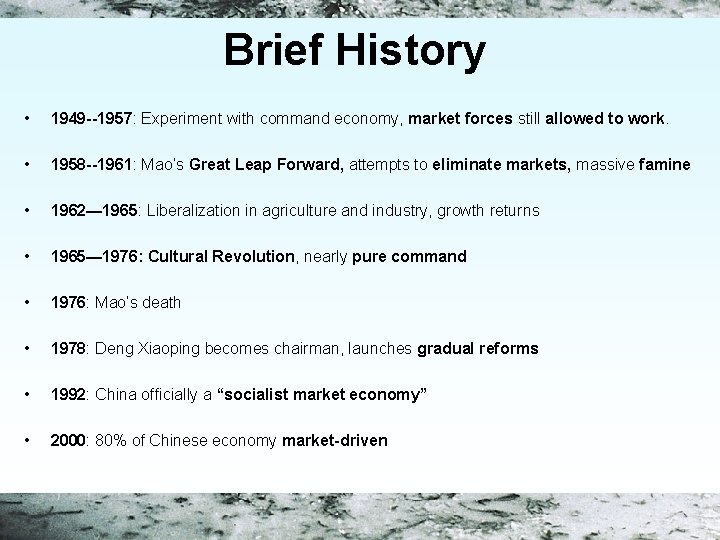
Brief History • 1949 --1957: Experiment with command economy, market forces still allowed to work. • 1958 --1961: Mao’s Great Leap Forward, attempts to eliminate markets, massive famine • 1962— 1965: Liberalization in agriculture and industry, growth returns • 1965— 1976: Cultural Revolution, nearly pure command • 1976: Mao’s death • 1978: Deng Xiaoping becomes chairman, launches gradual reforms • 1992: China officially a “socialist market economy” • 2000: 80% of Chinese economy market-driven
Gradualist Approach • Transition to a market economy proceeds slowly and cautiously § Russia in 1990 s: “big bang” approach • “Crossing the river while feeling the rocks. ” • Slow changes in: § Prices (price liberalization) § Property (privatization) § Labor markets (unemployment) 2 -32
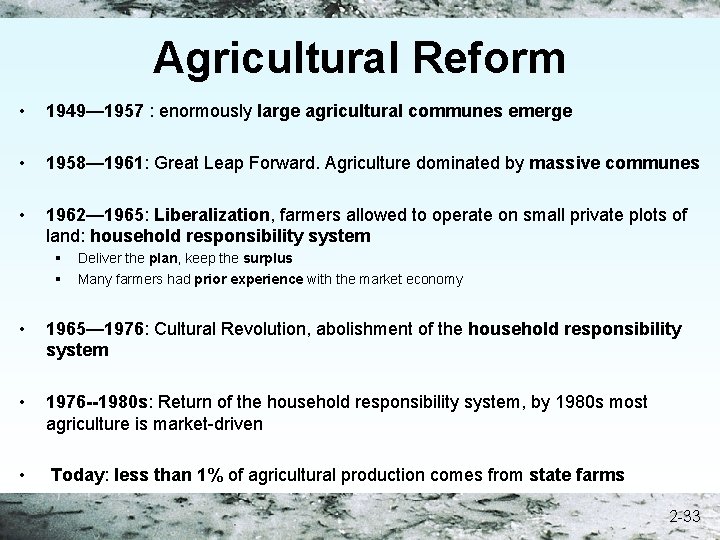
Agricultural Reform • 1949— 1957 : enormously large agricultural communes emerge • 1958— 1961: Great Leap Forward. Agriculture dominated by massive communes • 1962— 1965: Liberalization, farmers allowed to operate on small private plots of land: household responsibility system § § Deliver the plan, keep the surplus Many farmers had prior experience with the market economy • 1965— 1976: Cultural Revolution, abolishment of the household responsibility system • 1976 --1980 s: Return of the household responsibility system, by 1980 s most agriculture is market-driven • Today: less than 1% of agricultural production comes from state farms 2 -33
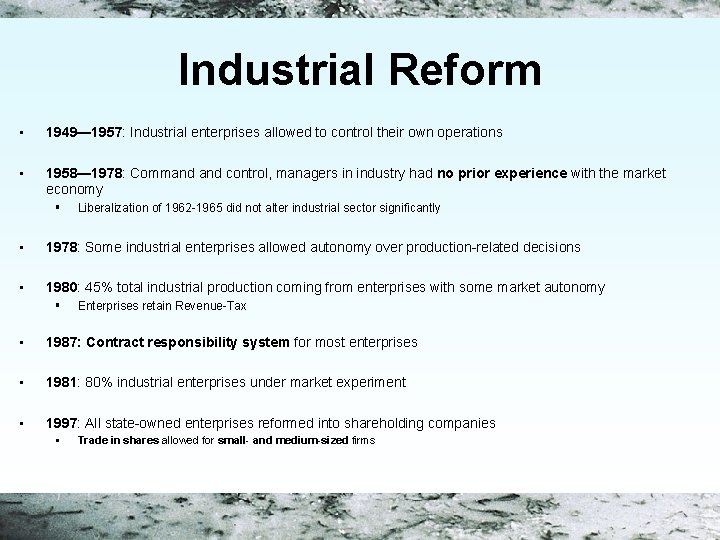
Industrial Reform • 1949— 1957: Industrial enterprises allowed to control their own operations • 1958— 1978: Command control, managers in industry had no prior experience with the market economy § Liberalization of 1962 -1965 did not alter industrial sector significantly • 1978: Some industrial enterprises allowed autonomy over production-related decisions • 1980: 45% total industrial production coming from enterprises with some market autonomy § Enterprises retain Revenue-Tax • 1987: Contract responsibility system for most enterprises • 1981: 80% industrial enterprises under market experiment • 1997: All state-owned enterprises reformed into shareholding companies § Trade in shares allowed for small- and medium-sized firms
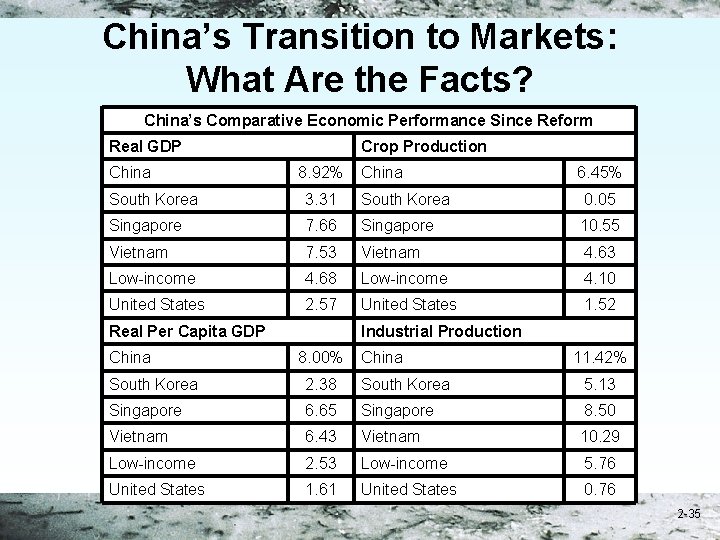
China’s Transition to Markets: What Are the Facts? China’s Comparative Economic Performance Since Reform Real GDP China Crop Production 8. 92% China 6. 45% South Korea 3. 31 South Korea 0. 05 Singapore 7. 66 Singapore 10. 55 Vietnam 7. 53 Vietnam 4. 63 Low-income 4. 68 Low-income 4. 10 United States 2. 57 United States 1. 52 Real Per Capita GDP China Industrial Production 8. 00% China 11. 42% South Korea 2. 38 South Korea 5. 13 Singapore 6. 65 Singapore 8. 50 Vietnam 6. 43 Vietnam 10. 29 Low-income 2. 53 Low-income 5. 76 United States 1. 61 United States 0. 76 2 -35
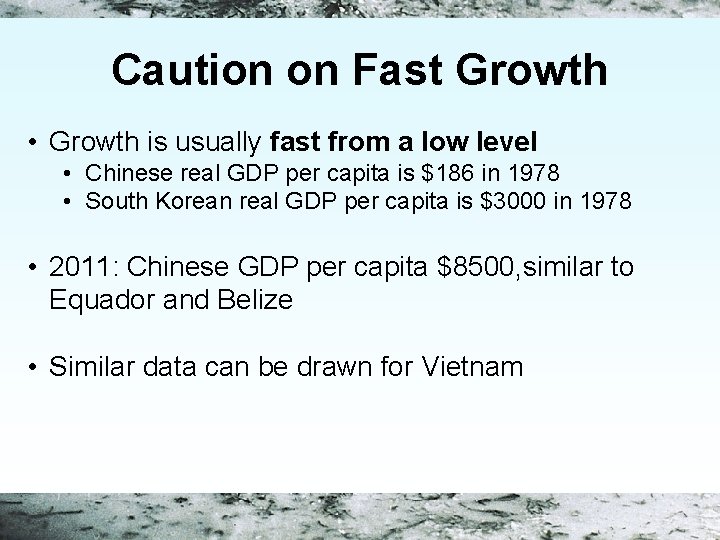
Caution on Fast Growth • Growth is usually fast from a low level • Chinese real GDP per capita is $186 in 1978 • South Korean real GDP per capita is $3000 in 1978 • 2011: Chinese GDP per capita $8500, similar to Equador and Belize • Similar data can be drawn for Vietnam
Problems of Transition in China • Unemployment and inflation • Corruption • Population pressures • Pollution problems • The desire for democracy 2 -37