
Chapter 2 Early Civilizations 4000 1000 B C
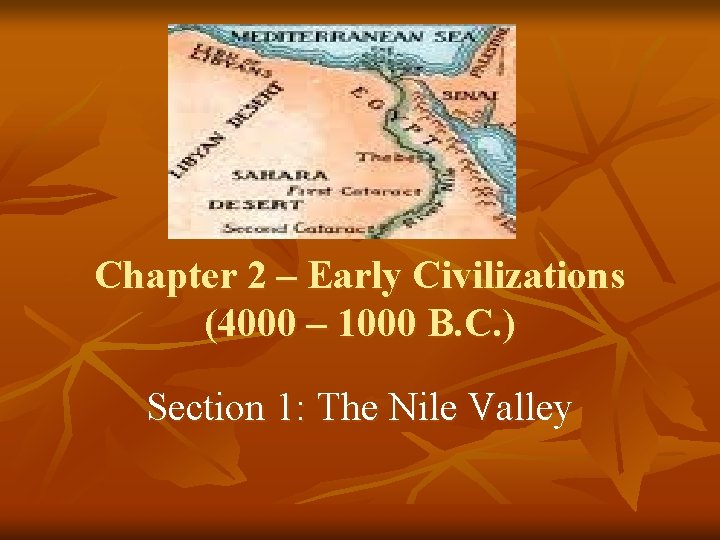
Chapter 2 – Early Civilizations (4000 – 1000 B. C. ) Section 1: The Nile Valley
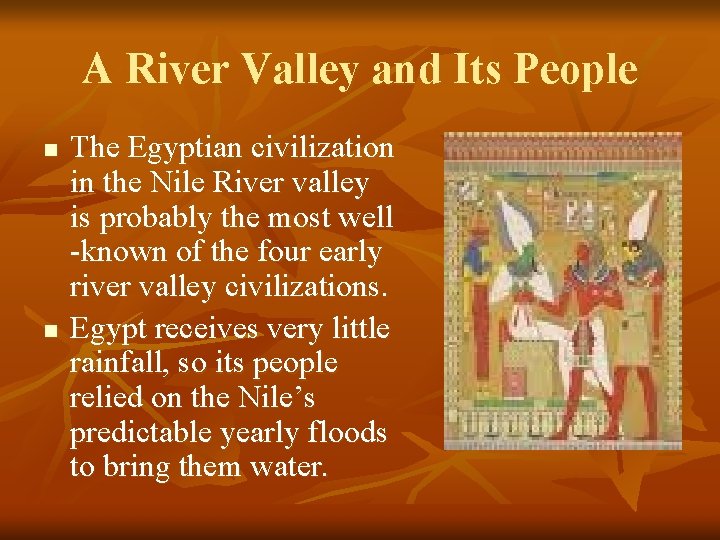
A River Valley and Its People n n The Egyptian civilization in the Nile River valley is probably the most well -known of the four early river valley civilizations. Egypt receives very little rainfall, so its people relied on the Nile’s predictable yearly floods to bring them water.
A River Valley and Its People (cont. ) n n Around 3000 B. C. a king of Upper Egypt invaded and conquered Lower Egypt, setting up the first government that ruled the entire country. Historians have organized the dynasties that ruled ancient Egypt into three periods: 1. 2. 3. The Old Kingdom The Middle Kingdom The New Kingdom
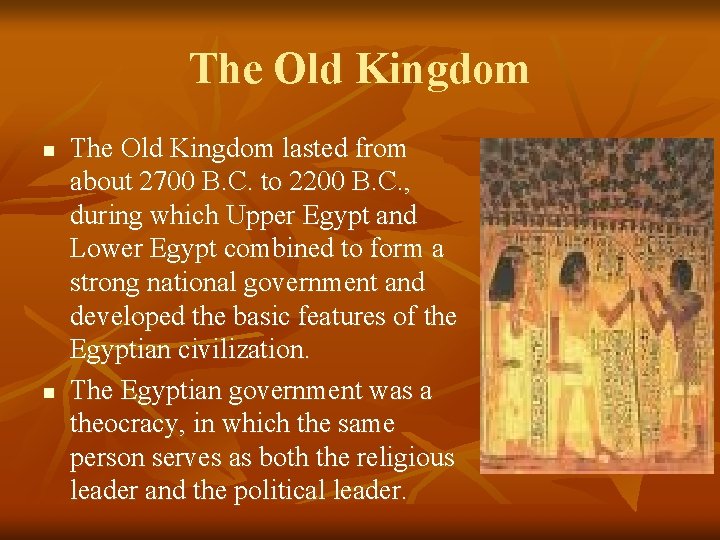
The Old Kingdom n n The Old Kingdom lasted from about 2700 B. C. to 2200 B. C. , during which Upper Egypt and Lower Egypt combined to form a strong national government and developed the basic features of the Egyptian civilization. The Egyptian government was a theocracy, in which the same person serves as both the religious leader and the political leader.
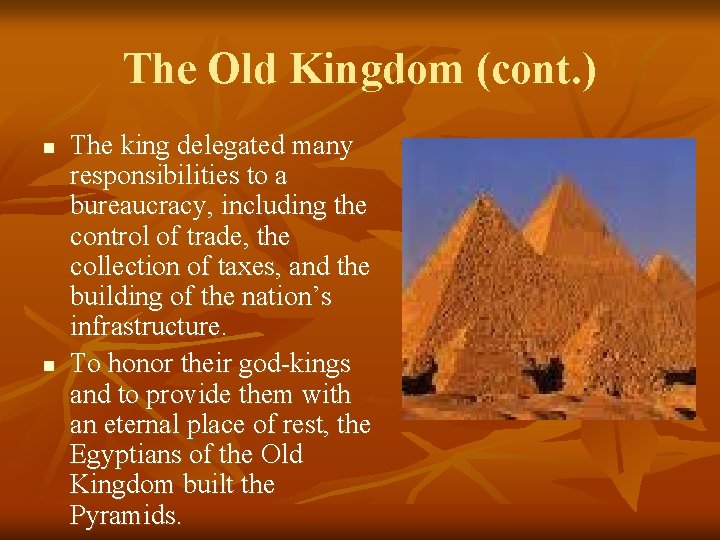
The Old Kingdom (cont. ) n n The king delegated many responsibilities to a bureaucracy, including the control of trade, the collection of taxes, and the building of the nation’s infrastructure. To honor their god-kings and to provide them with an eternal place of rest, the Egyptians of the Old Kingdom built the Pyramids.
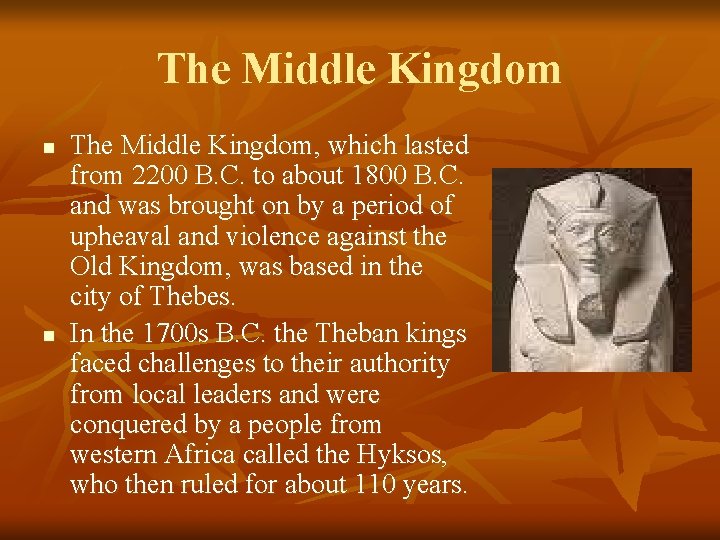
The Middle Kingdom n n The Middle Kingdom, which lasted from 2200 B. C. to about 1800 B. C. and was brought on by a period of upheaval and violence against the Old Kingdom, was based in the city of Thebes. In the 1700 s B. C. the Theban kings faced challenges to their authority from local leaders and were conquered by a people from western Africa called the Hyksos, who then ruled for about 110 years.

The New Kingdom n n n An Egyptian prince named Ahmose overthrew the Hyksos in about 1600 B. C. Around 1480 B. C. Queen Hatshepsut came to power in Egypt, carrying out an extensive building program. Queen Hatshepsut’s stepson Thutmose III, who claimed the throne at her death, established an empire by conquering Syria and moving the Egyptian frontier to the northern part of the Euphrates River.
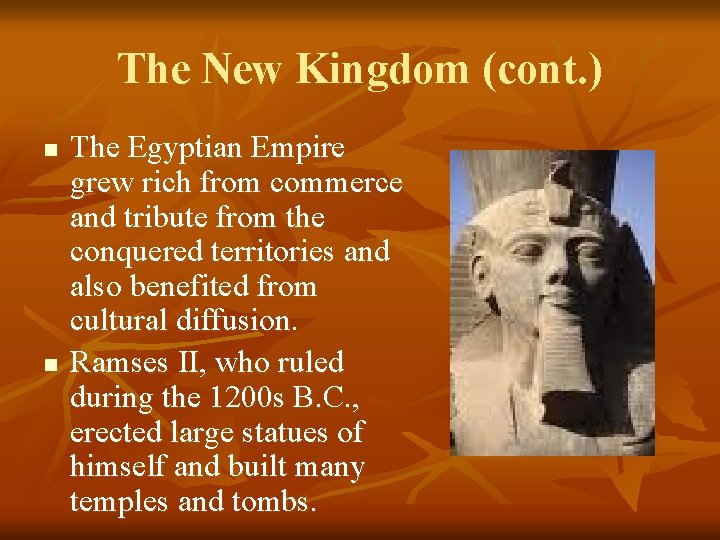
The New Kingdom (cont. ) n n The Egyptian Empire grew rich from commerce and tribute from the conquered territories and also benefited from cultural diffusion. Ramses II, who ruled during the 1200 s B. C. , erected large statues of himself and built many temples and tombs.
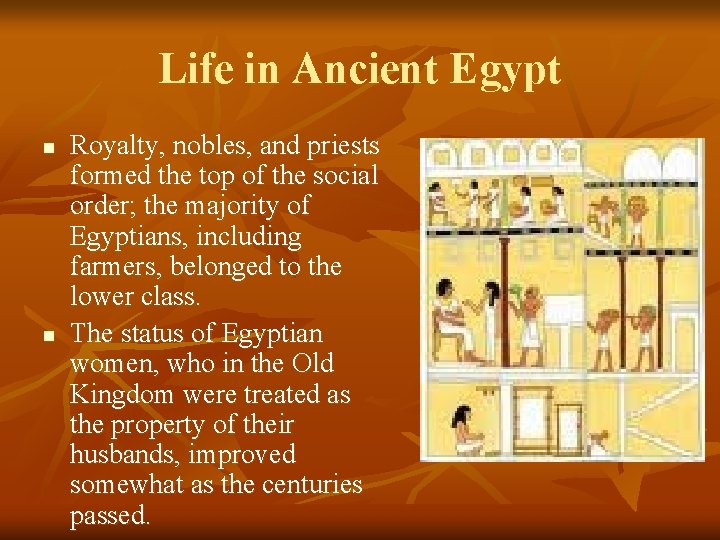
Life in Ancient Egypt n n Royalty, nobles, and priests formed the top of the social order; the majority of Egyptians, including farmers, belonged to the lower class. The status of Egyptian women, who in the Old Kingdom were treated as the property of their husbands, improved somewhat as the centuries passed.
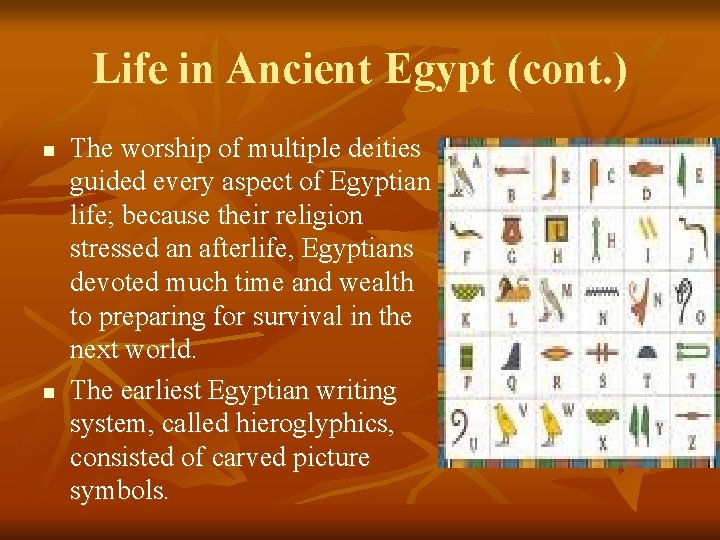
Life in Ancient Egypt (cont. ) n n The worship of multiple deities guided every aspect of Egyptian life; because their religion stressed an afterlife, Egyptians devoted much time and wealth to preparing for survival in the next world. The earliest Egyptian writing system, called hieroglyphics, consisted of carved picture symbols.
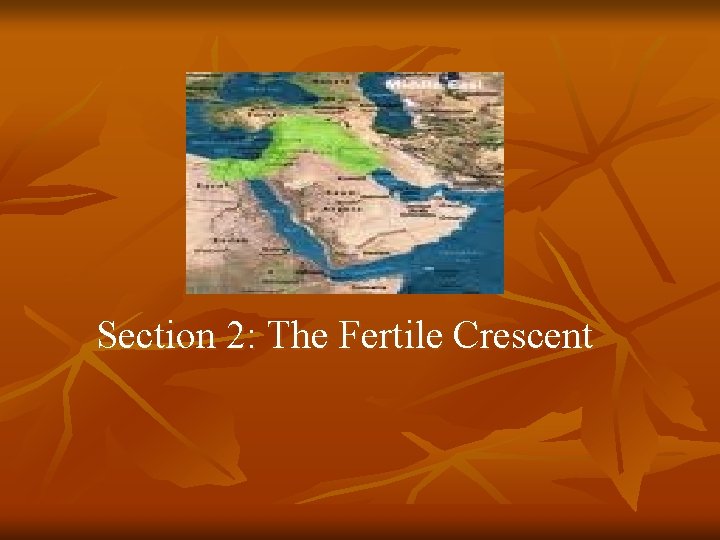
Section 2: The Fertile Crescent
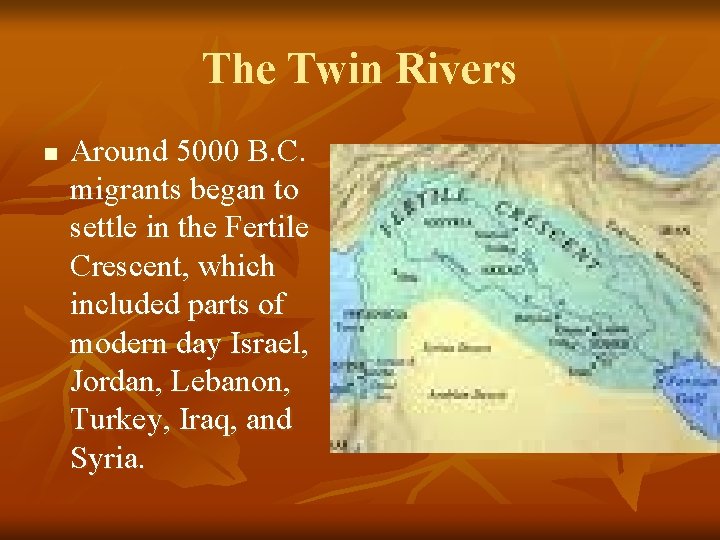
The Twin Rivers n Around 5000 B. C. migrants began to settle in the Fertile Crescent, which included parts of modern day Israel, Jordan, Lebanon, Turkey, Iraq, and Syria.
The Twin Rivers (cont. ) n n Many of these peoples chose to settle in Mesopotamia, between the Tigris and Euphrates Rivers, but the twin rivers did not provide a regular supply of water, and their strong flood sometimes swept away entire villages and fields. To meet the rivers’ challenges, the early Mesopotamian villages cooperated to build dams, escape channels, canals, and ditches.

The Sumerian Civilization n n Around 3500 B. C. a people called the Sumerians arrived in Mesopotamia and built what historians consider the world’s first city-states. Each Sumerian city-state usually governed itself independently and selected a military leader to serve as king and high priest.
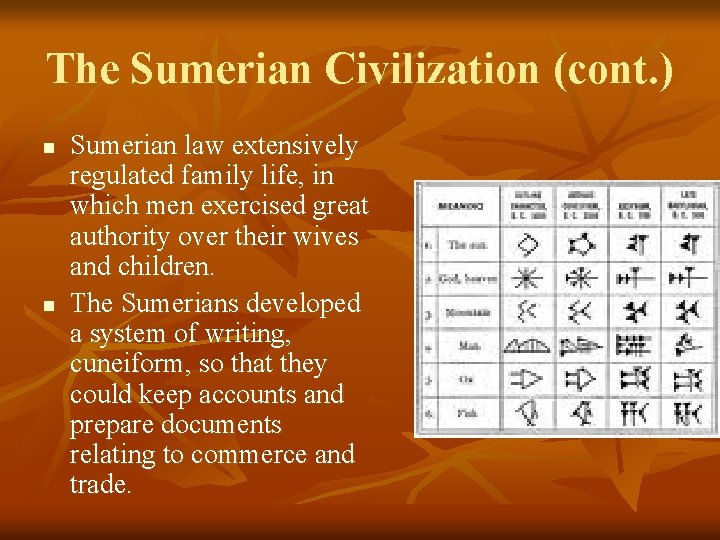
The Sumerian Civilization (cont. ) n n Sumerian law extensively regulated family life, in which men exercised great authority over their wives and children. The Sumerians developed a system of writing, cuneiform, so that they could keep accounts and prepare documents relating to commerce and trade.
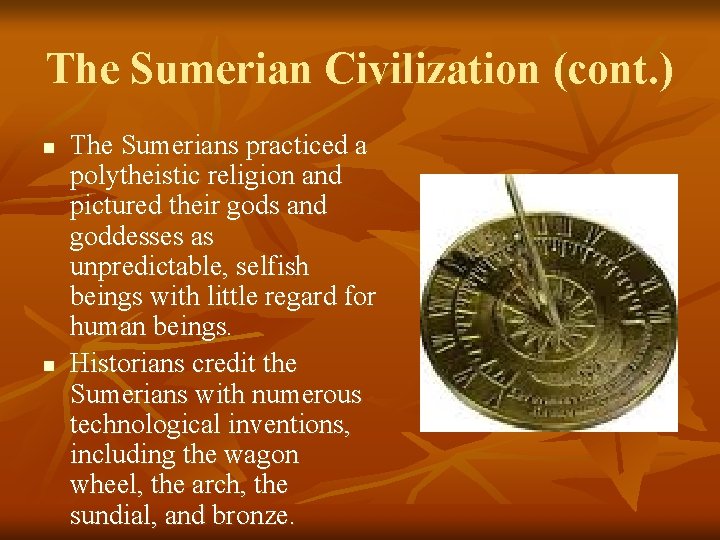
The Sumerian Civilization (cont. ) n n The Sumerians practiced a polytheistic religion and pictured their gods and goddesses as unpredictable, selfish beings with little regard for human beings. Historians credit the Sumerians with numerous technological inventions, including the wagon wheel, the arch, the sundial, and bronze.
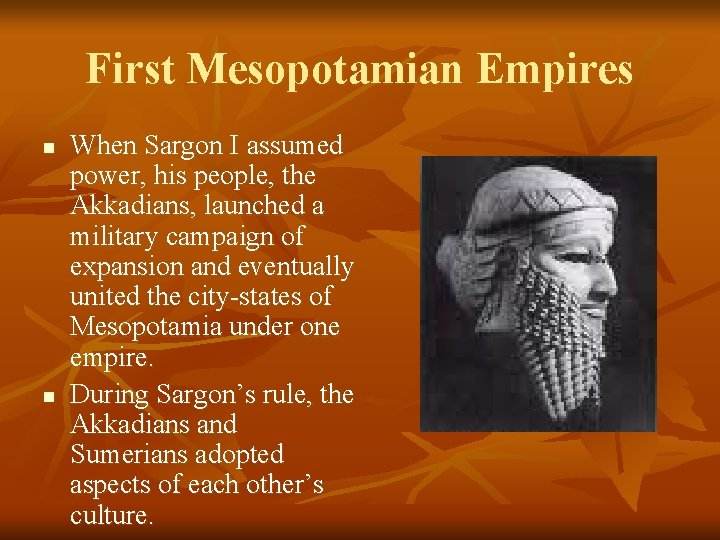
First Mesopotamian Empires n n When Sargon I assumed power, his people, the Akkadians, launched a military campaign of expansion and eventually united the city-states of Mesopotamia under one empire. During Sargon’s rule, the Akkadians and Sumerians adopted aspects of each other’s culture.
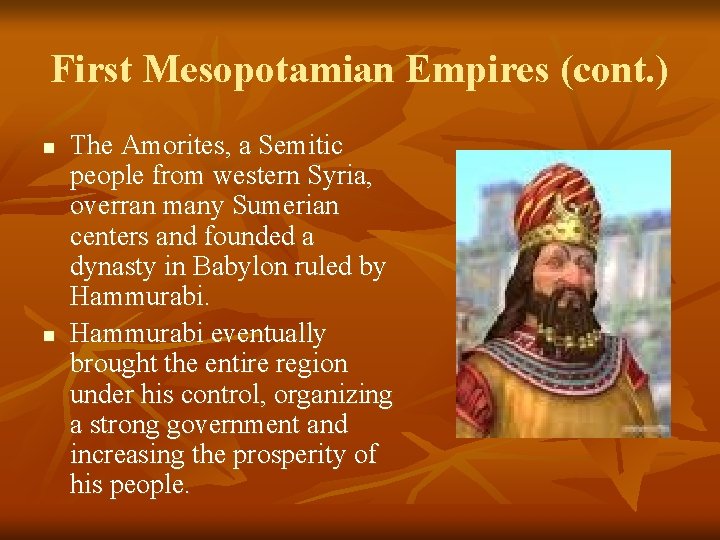
First Mesopotamian Empires (cont. ) n n The Amorites, a Semitic people from western Syria, overran many Sumerian centers and founded a dynasty in Babylon ruled by Hammurabi eventually brought the entire region under his control, organizing a strong government and increasing the prosperity of his people.
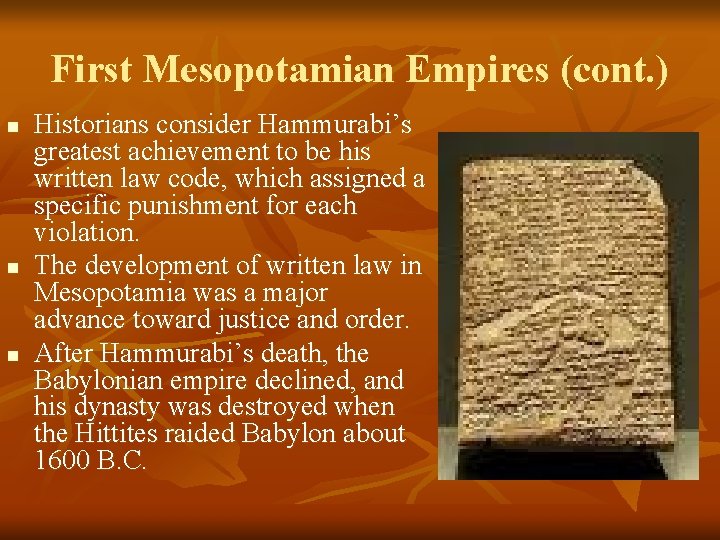
First Mesopotamian Empires (cont. ) n n n Historians consider Hammurabi’s greatest achievement to be his written law code, which assigned a specific punishment for each violation. The development of written law in Mesopotamia was a major advance toward justice and order. After Hammurabi’s death, the Babylonian empire declined, and his dynasty was destroyed when the Hittites raided Babylon about 1600 B. C.
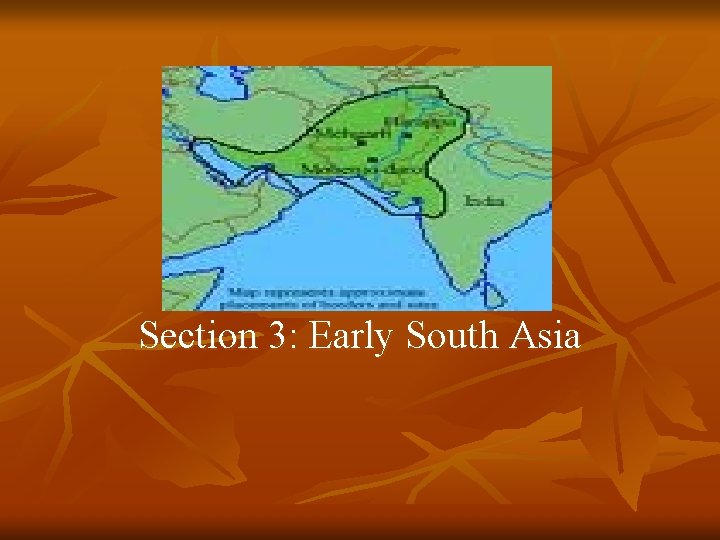
Section 3: Early South Asia
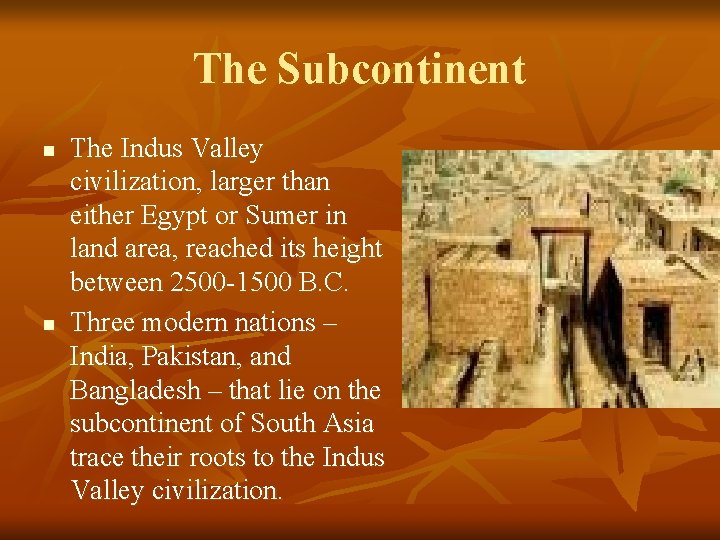
The Subcontinent n n The Indus Valley civilization, larger than either Egypt or Sumer in land area, reached its height between 2500 -1500 B. C. Three modern nations – India, Pakistan, and Bangladesh – that lie on the subcontinent of South Asia trace their roots to the Indus Valley civilization.
The Subcontinent (cont. ) n n Natural barriers, including water to the east and west and mountain ranges to the north, separate the South Asian subcontinent from the rest of Asia. Three rivers in South Asia, fed by rain and melting mountain snows and flowing across the plains located to the south of the mountains, have supported large numbers of people over the ages.
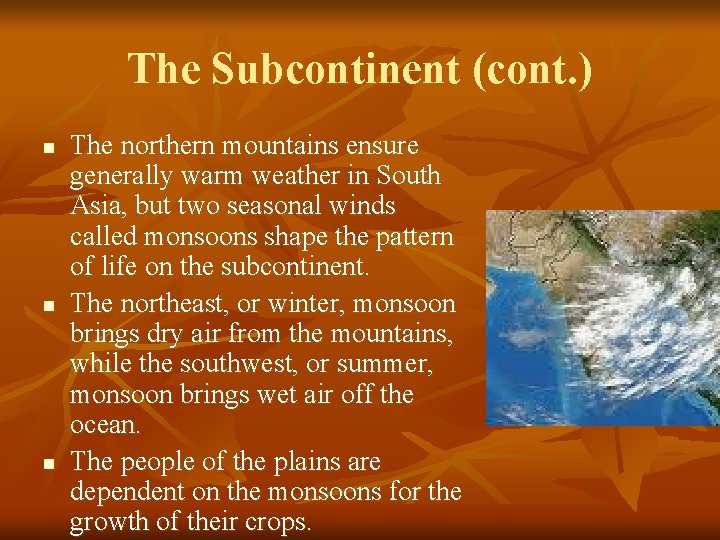
The Subcontinent (cont. ) n n n The northern mountains ensure generally warm weather in South Asia, but two seasonal winds called monsoons shape the pattern of life on the subcontinent. The northeast, or winter, monsoon brings dry air from the mountains, while the southwest, or summer, monsoon brings wet air off the ocean. The people of the plains are dependent on the monsoons for the growth of their crops.
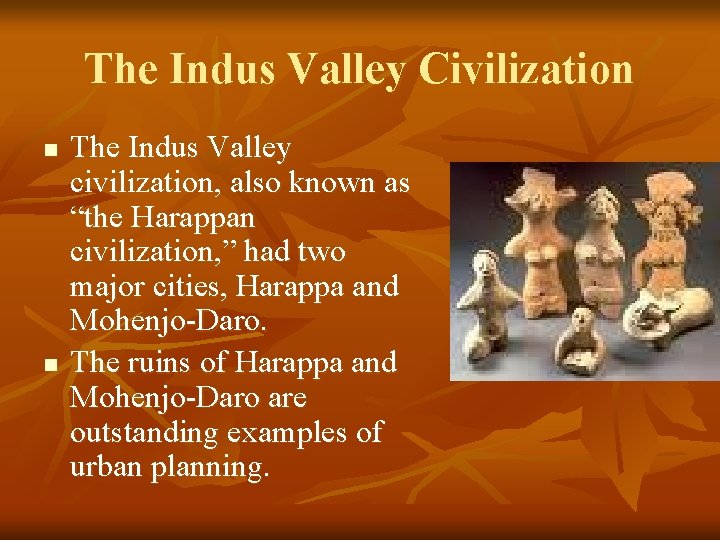
The Indus Valley Civilization n n The Indus Valley civilization, also known as “the Harappan civilization, ” had two major cities, Harappa and Mohenjo-Daro. The ruins of Harappa and Mohenjo-Daro are outstanding examples of urban planning.
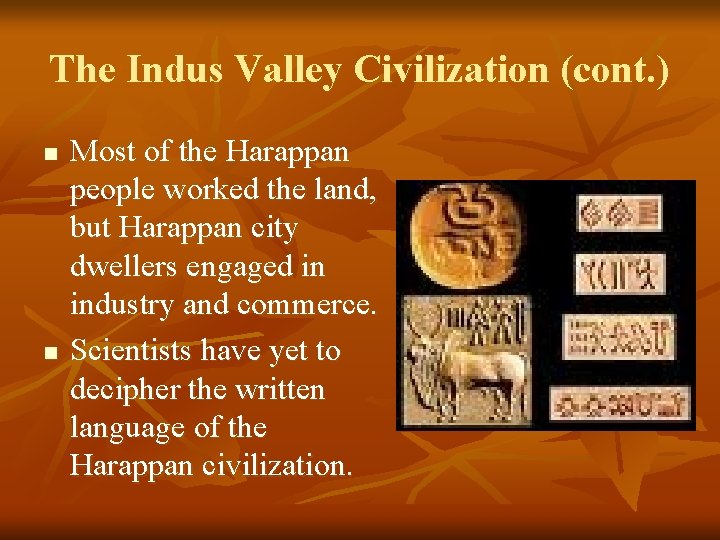
The Indus Valley Civilization (cont. ) n n Most of the Harappan people worked the land, but Harappan city dwellers engaged in industry and commerce. Scientists have yet to decipher the written language of the Harappan civilization.
The Indus Valley Civilization (cont. ) n n The lack of written records has made it difficult to learn as much about the Harappan civilization as is known about the Egypt or Mesopotamia, but artifacts have provided some clues. Historians are not sure why the Harappan civilization disappeared by 1500 B. C. , but massive flooding and hostile invasion are two theories for the collapse.
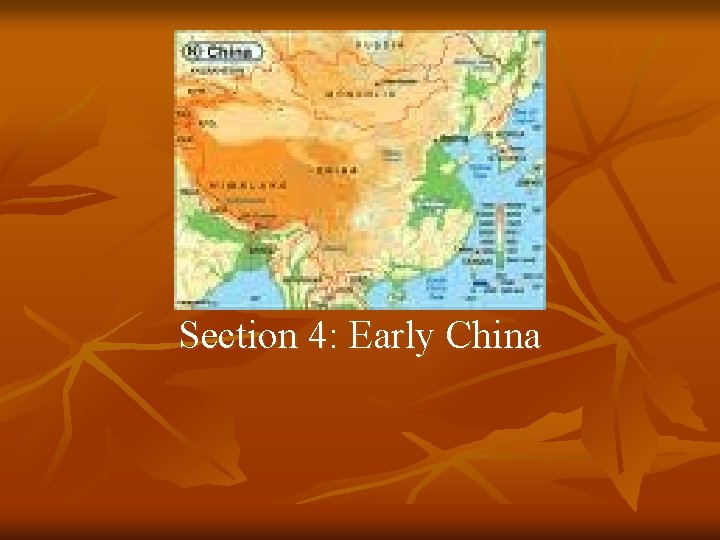
Section 4: Early China
China’s Geography n n n China’s lack of outside contacts allowed the Chinese to develop one culture across many regions and a strong sense of identity. China’s rugged physical features hindered cultural diffusion both into and out of China for many centuries. For centuries large numbers of Chinese have farmed in the region’s North China Plain, which is drained by three major rivers.
China’s Geography (cont. ) n n The Huang He, or the Yellow River, is known as “the Great Sorrow” because of the tragedy brought by its floods – but its silt deposits have also made the North China Plain a rich agricultural area. Farmers of the North China Plain region have long depended for their success on the favorable seasonal rhythms of temperature and rainfall.
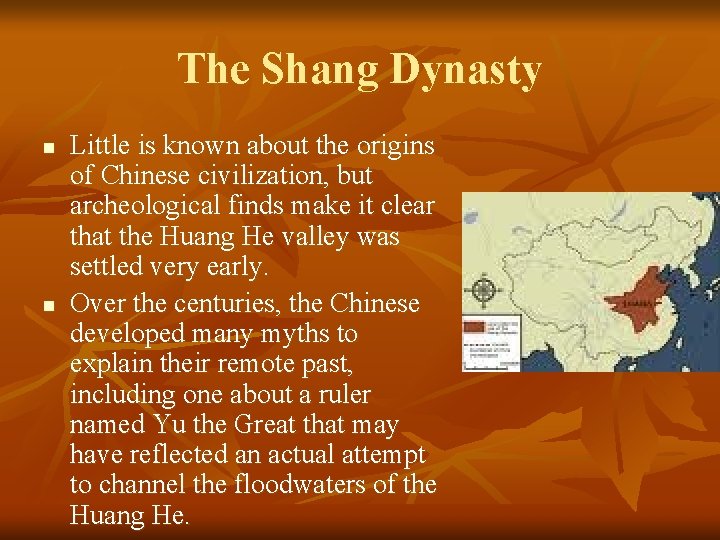
The Shang Dynasty n n Little is known about the origins of Chinese civilization, but archeological finds make it clear that the Huang He valley was settled very early. Over the centuries, the Chinese developed many myths to explain their remote past, including one about a ruler named Yu the Great that may have reflected an actual attempt to channel the floodwaters of the Huang He.
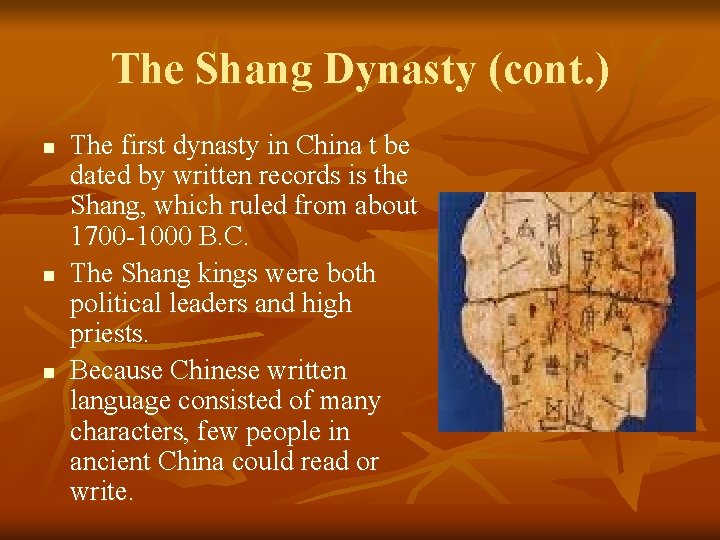
The Shang Dynasty (cont. ) n n n The first dynasty in China t be dated by written records is the Shang, which ruled from about 1700 -1000 B. C. The Shang kings were both political leaders and high priests. Because Chinese written language consisted of many characters, few people in ancient China could read or write.
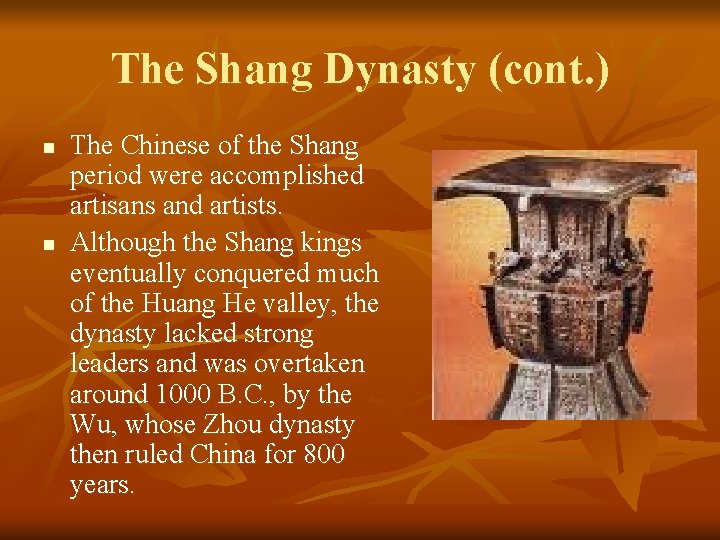
The Shang Dynasty (cont. ) n n The Chinese of the Shang period were accomplished artisans and artists. Although the Shang kings eventually conquered much of the Huang He valley, the dynasty lacked strong leaders and was overtaken around 1000 B. C. , by the Wu, whose Zhou dynasty then ruled China for 800 years.
Many Centuries of Dynasties n n Western historians have followed the Chinese practice of dividing Chinese history into periods based on dynasties. The Chinese believed that their rulers governed according to the Mandate of Heaven, which allowed rulers to remain in power only as long as they were just and effective.
- Slides: 33