
CHAPTER 2 DIODES APPLICATIONS DC Power Supply DC


- Slides: 60
CHAPTER 2: DIODES & APPLICATIONS
DC Power Supply Ø DC Power supply converts the standard ac voltage (120 V, 60 Hz) provided by the wall outlet into a constant dc voltage. Ø The voltage produced is used to power all types of electronic circuits including: Ø Consumer electronics (ex: radio, television, DVD, etc. ) Ø Computers Ø Industrial controllers Ø Most laboratory instrumentation systems and equipment Ø The dc voltage level required depends on the application, but most applications require relatively low voltage.
Complete DC power supply Ø Ø Ø A basic DC power supply consists: Transformer – to step down to a lower AC voltage Rectifier – converts AC voltage to pulsating DC voltage Filter – eliminates fluctuation to produce smooth DC voltage Regulator – maintains a constant DC voltage Complete Dc power supply
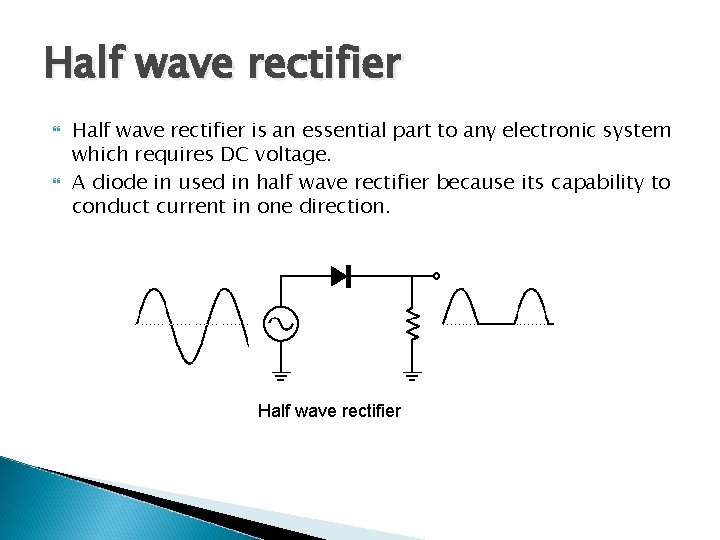
Half wave rectifier is an essential part to any electronic system which requires DC voltage. A diode in used in half wave rectifier because its capability to conduct current in one direction. Half wave rectifier
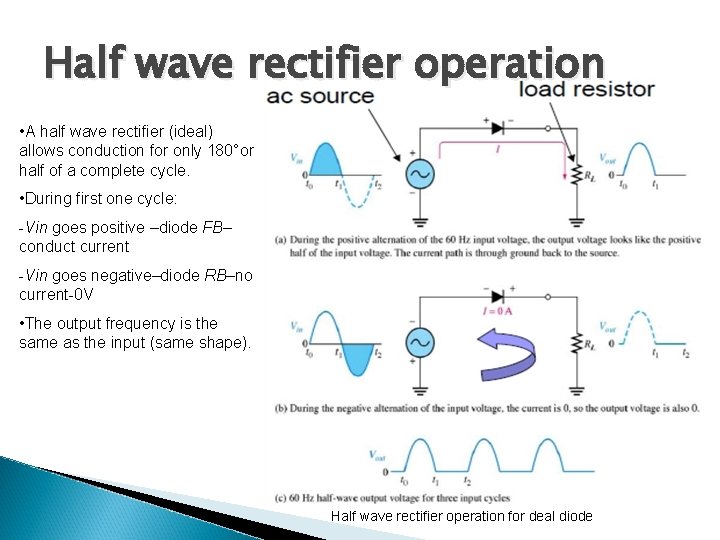
Half wave rectifier operation • A half wave rectifier (ideal) allows conduction for only 180°or half of a complete cycle. • During first one cycle: -Vin goes positive –diode FB– conduct current -Vin goes negative–diode RB–no current-0 V • The output frequency is the same as the input (same shape). Half wave rectifier operation for deal diode
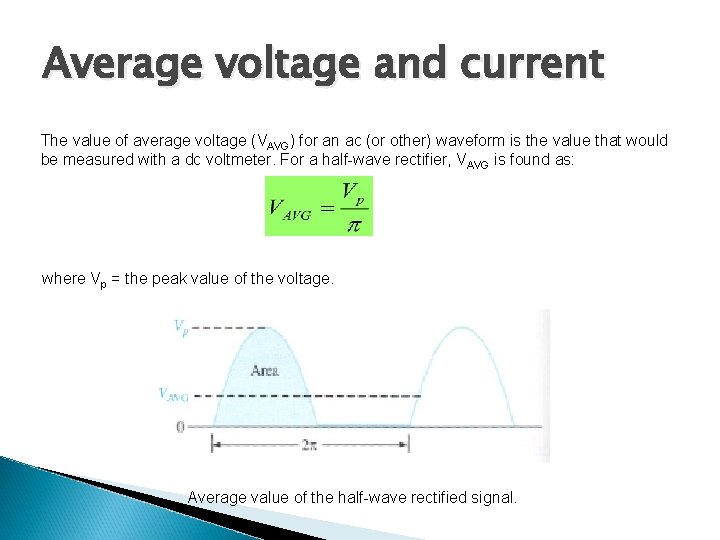
Average voltage and current The value of average voltage (VAVG) for an ac (or other) waveform is the value that would be measured with a dc voltmeter. For a half-wave rectifier, VAVG is found as: where Vp = the peak value of the voltage. Average value of the half-wave rectified signal.
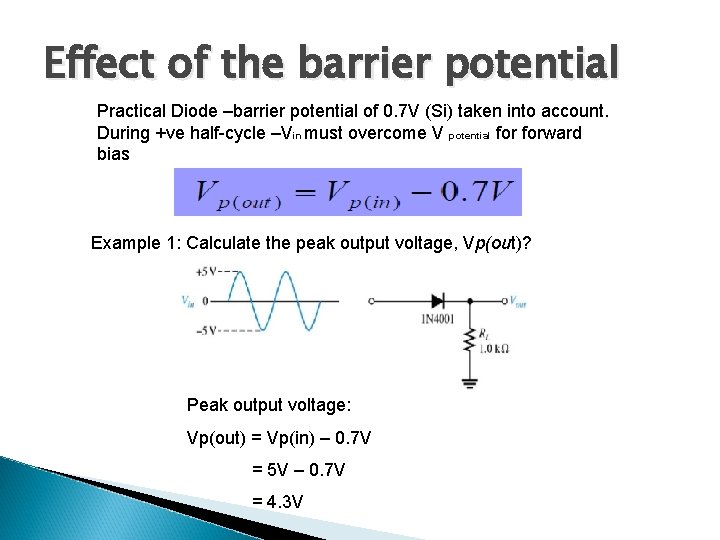
Effect of the barrier potential Practical Diode –barrier potential of 0. 7 V (Si) taken into account. During +ve half-cycle –Vin must overcome V potential forward bias Example 1: Calculate the peak output voltage, Vp(out)? Peak output voltage: Vp(out) = Vp(in) – 0. 7 V = 5 V – 0. 7 V = 4. 3 V
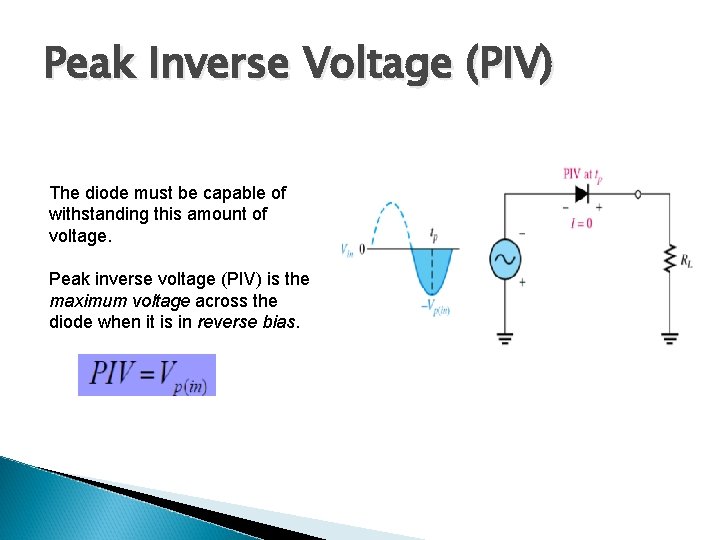
Peak Inverse Voltage (PIV) The diode must be capable of withstanding this amount of voltage. Peak inverse voltage (PIV) is the maximum voltage across the diode when it is in reverse bias.
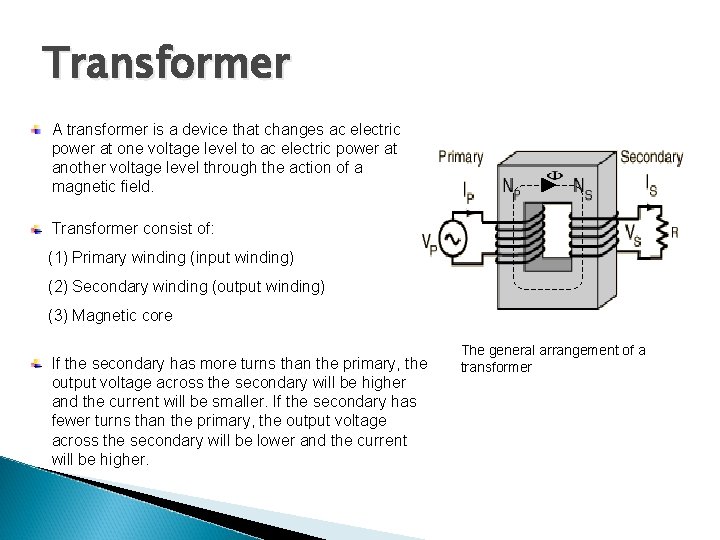
Transformer A transformer is a device that changes ac electric power at one voltage level to ac electric power at another voltage level through the action of a magnetic field. Transformer consist of: (1) Primary winding (input winding) (2) Secondary winding (output winding) (3) Magnetic core If the secondary has more turns than the primary, the output voltage across the secondary will be higher and the current will be smaller. If the secondary has fewer turns than the primary, the output voltage across the secondary will be lower and the current will be higher. The general arrangement of a transformer
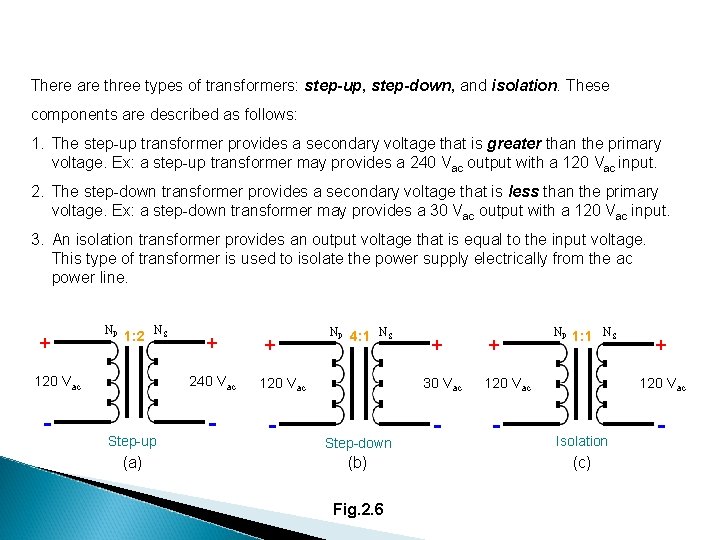
There are three types of transformers: step-up, step-down, and isolation. These components are described as follows: 1. The step-up transformer provides a secondary voltage that is greater than the primary voltage. Ex: a step-up transformer may provides a 240 Vac output with a 120 Vac input. 2. The step-down transformer provides a secondary voltage that is less than the primary voltage. Ex: a step-down transformer may provides a 30 Vac output with a 120 Vac input. 3. An isolation transformer provides an output voltage that is equal to the input voltage. This type of transformer is used to isolate the power supply electrically from the ac power line. + NP 1: 2 NS 120 Vac - + 240 Vac Step-up (a) - + NP 4: 1 NS 120 Vac - + 30 Vac Step-down (b) Fig. 2. 6 - + NP 1: 1 NS 120 Vac - + 120 Vac Isolation (c) -
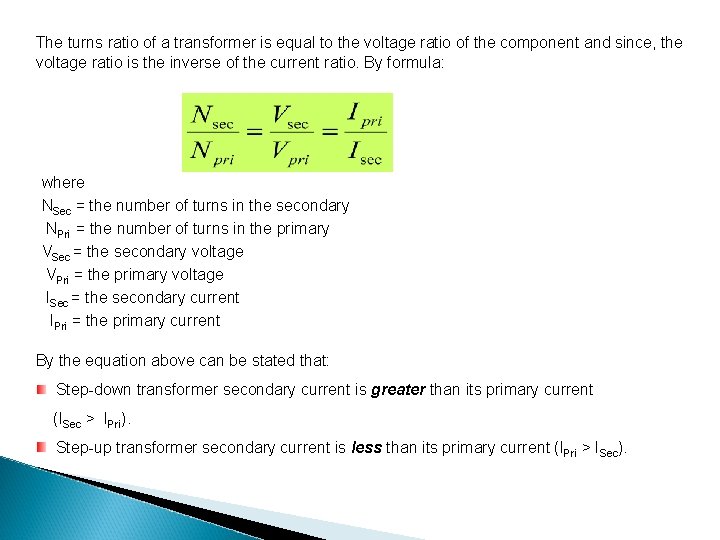
The turns ratio of a transformer is equal to the voltage ratio of the component and since, the voltage ratio is the inverse of the current ratio. By formula: where NSec = the number of turns in the secondary NPri = the number of turns in the primary VSec = the secondary voltage VPri = the primary voltage ISec = the secondary current IPri = the primary current By the equation above can be stated that: Step-down transformer secondary current is greater than its primary current (ISec > IPri). Step-up transformer secondary current is less than its primary current (IPri > ISec).
Half wave rectifier with transformer A rectifier is a diode circuits that converts the ac input voltage to a pulsating dc voltage. There are two types of rectifier circuits: 1. Half-wave rectifier 2. Full-wave rectifier The half-wave rectifier is simply a diode that is placed in series between a transformer (or ac line input) and its load.
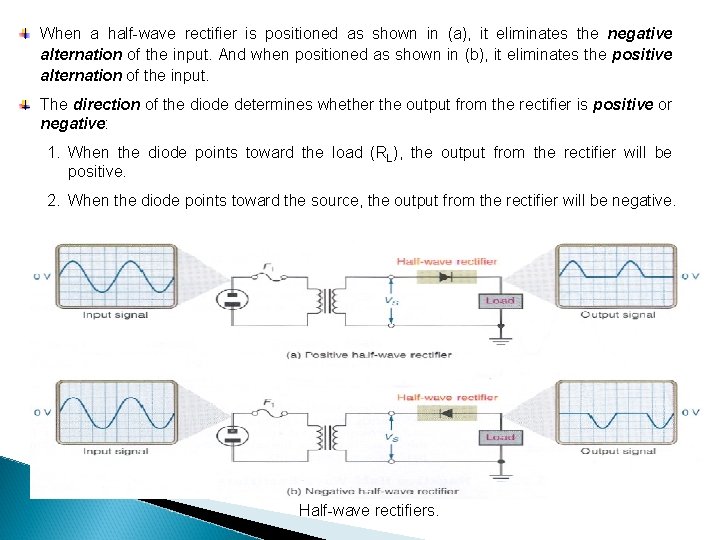
When a half-wave rectifier is positioned as shown in (a), it eliminates the negative alternation of the input. And when positioned as shown in (b), it eliminates the positive alternation of the input. The direction of the diode determines whether the output from the rectifier is positive or negative: 1. When the diode points toward the load (RL), the output from the rectifier will be positive. 2. When the diode points toward the source, the output from the rectifier will be negative. Half-wave rectifiers.
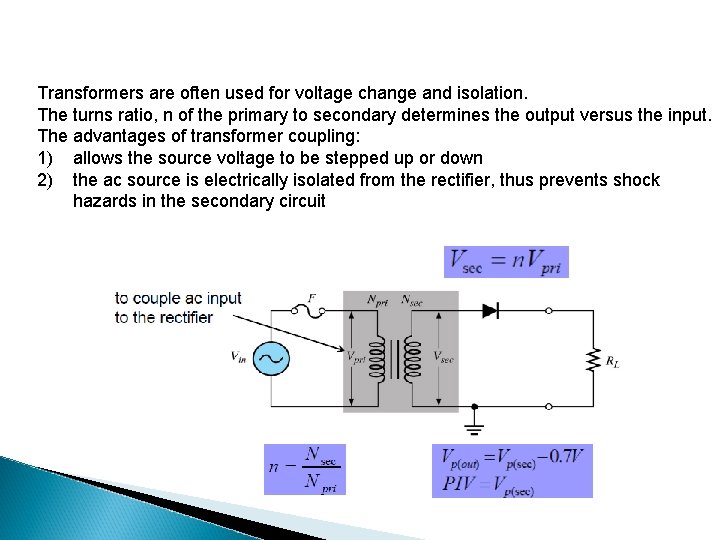
Transformers are often used for voltage change and isolation. The turns ratio, n of the primary to secondary determines the output versus the input. The advantages of transformer coupling: 1) allows the source voltage to be stepped up or down 2) the ac source is electrically isolated from the rectifier, thus prevents shock hazards in the secondary circuit
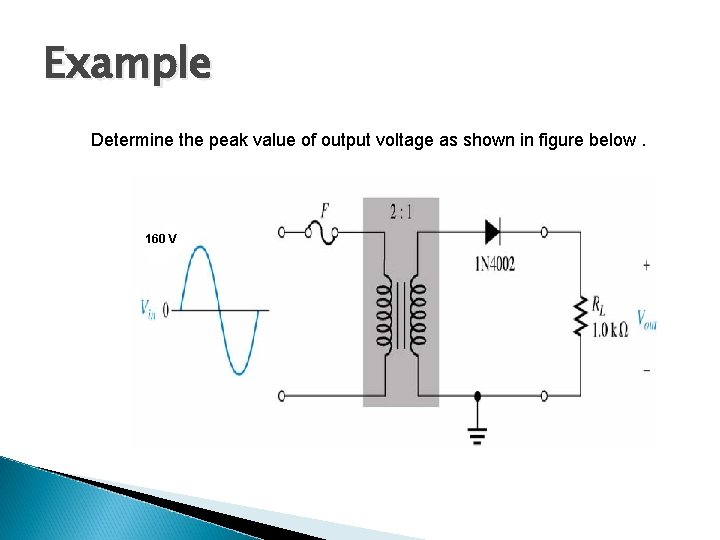
Example Determine the peak value of output voltage as shown in figure below. 160 V
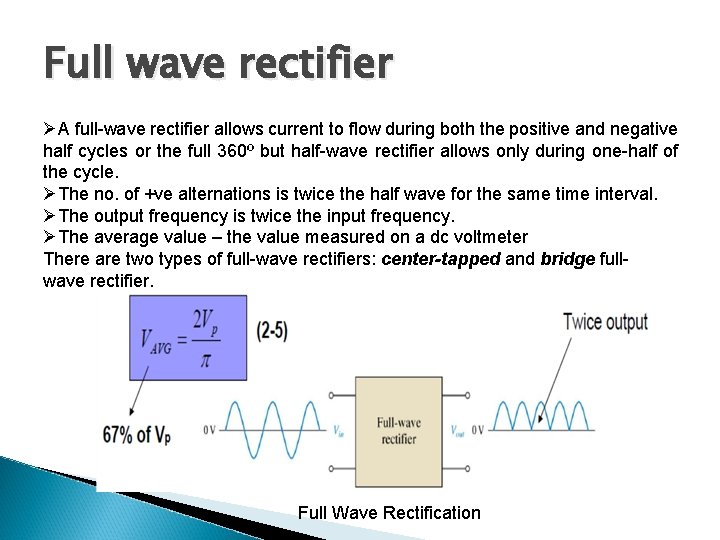
Full wave rectifier ØA full-wave rectifier allows current to flow during both the positive and negative half cycles or the full 360º but half-wave rectifier allows only during one-half of the cycle. ØThe no. of +ve alternations is twice the half wave for the same time interval. ØThe output frequency is twice the input frequency. ØThe average value – the value measured on a dc voltmeter There are two types of full-wave rectifiers: center-tapped and bridge fullwave rectifier. Full Wave Rectification
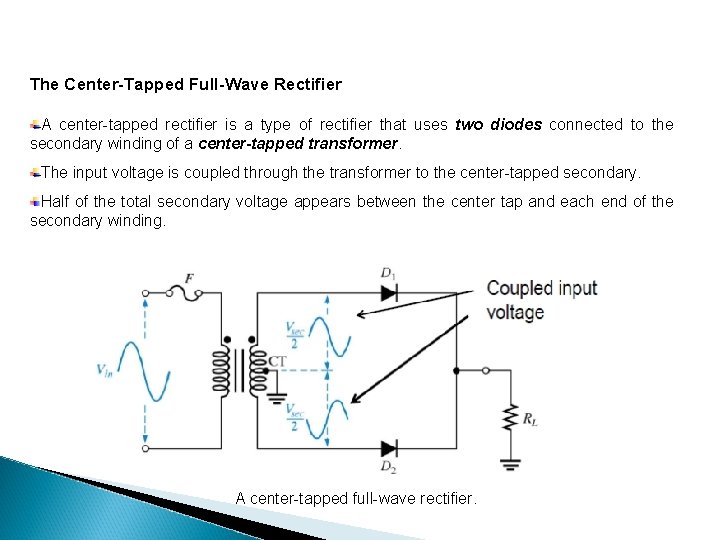
The Center-Tapped Full-Wave Rectifier A center-tapped rectifier is a type of rectifier that uses two diodes connected to the secondary winding of a center-tapped transformer. The input voltage is coupled through the transformer to the center-tapped secondary. Half of the total secondary voltage appears between the center tap and each end of the secondary winding. A center-tapped full-wave rectifier.
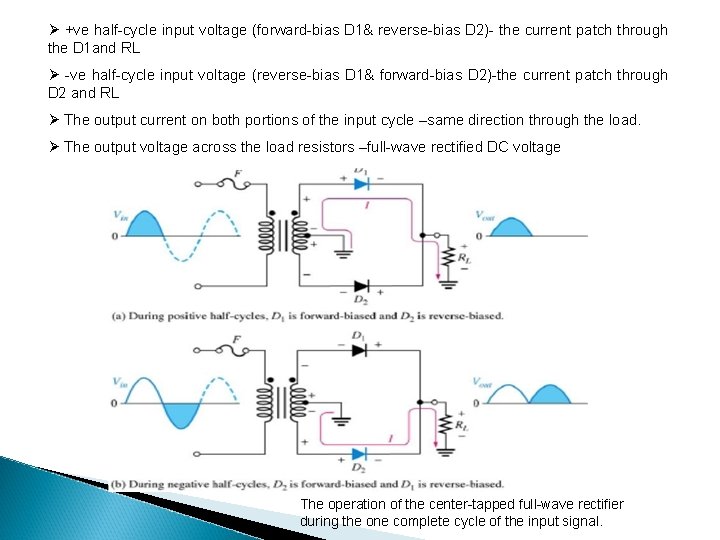
Ø +ve half-cycle input voltage (forward-bias D 1& reverse-bias D 2)- the current patch through the D 1 and RL Ø -ve half-cycle input voltage (reverse-bias D 1& forward-bias D 2)-the current patch through D 2 and RL Ø The output current on both portions of the input cycle –same direction through the load. Ø The output voltage across the load resistors –full-wave rectified DC voltage The operation of the center-tapped full-wave rectifier during the one complete cycle of the input signal.
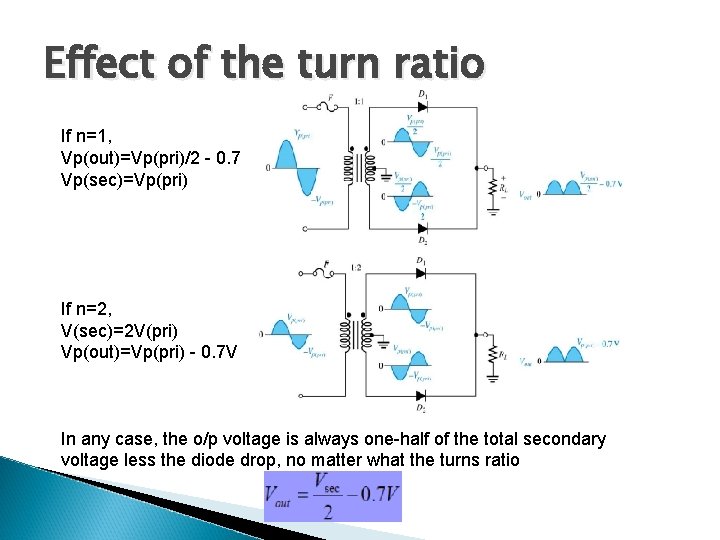
Effect of the turn ratio If n=1, Vp(out)=Vp(pri)/2 - 0. 7 Vp(sec)=Vp(pri) If n=2, V(sec)=2 V(pri) Vp(out)=Vp(pri) - 0. 7 V In any case, the o/p voltage is always one-half of the total secondary voltage less the diode drop, no matter what the turns ratio
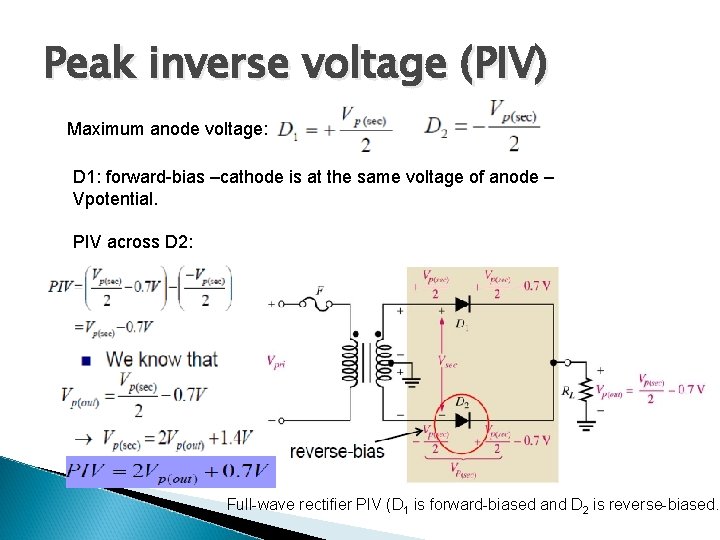
Peak inverse voltage (PIV) Maximum anode voltage: D 1: forward-bias –cathode is at the same voltage of anode – Vpotential. PIV across D 2: Full-wave rectifier PIV (D 1 is forward-biased and D 2 is reverse-biased.
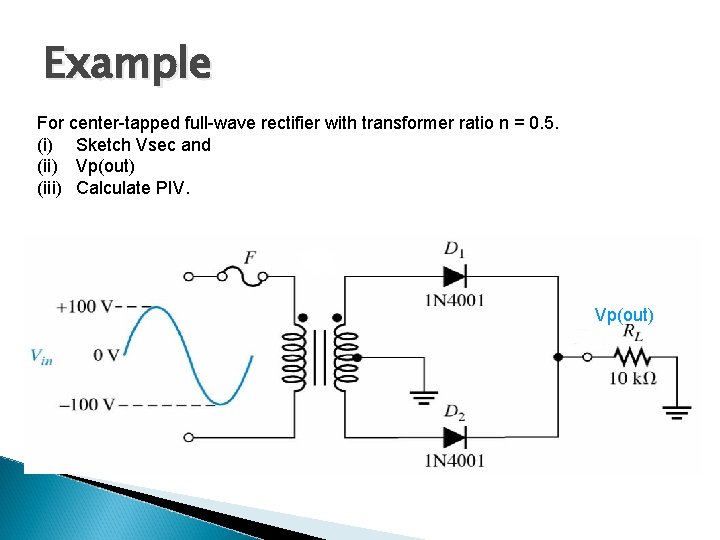
Example For center-tapped full-wave rectifier with transformer ratio n = 0. 5. (i) Sketch Vsec and (ii) Vp(out) (iii) Calculate PIV. Vp(out)
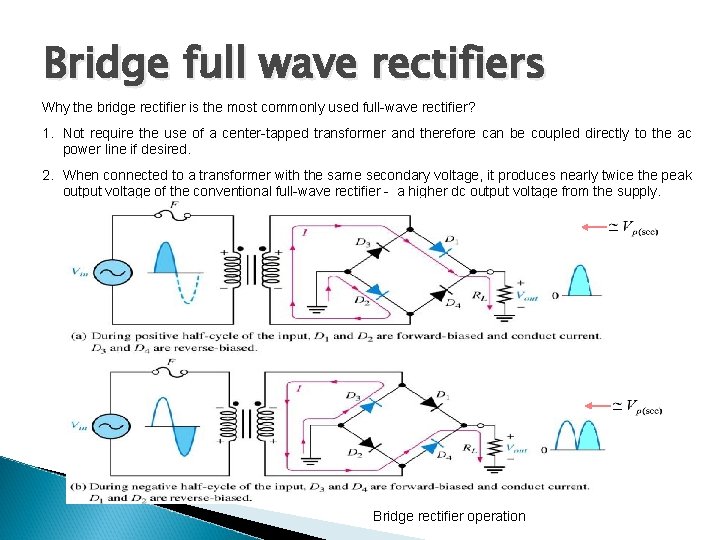
Bridge full wave rectifiers Why the bridge rectifier is the most commonly used full-wave rectifier? 1. Not require the use of a center-tapped transformer and therefore can be coupled directly to the ac power line if desired. 2. When connected to a transformer with the same secondary voltage, it produces nearly twice the peak output voltage of the conventional full-wave rectifier - a higher dc output voltage from the supply. Bridge rectifier operation
The bridge full-wave rectifier alternates conduction between two diode pairs. When the input half-cycle is positive, the transformer has the polarity as shown in (a), causing diodes D 1 and D 2 are forward-biased and conduct the current in the direction shown. A voltage is developed across RL that looks like the positive half of the input cycle. During the time, diodes D 3 and D 4 are reverse-biased. When the input half-cycle is negative, the transformer has the polarity as shown in (b). Diodes D 3 and D 4 now are forward-biased and conduct the current in the same direction through RL. During the time, diodes D 1 and D 2 are reverse-biased. A full-wave rectified output voltage appears across RL as a result of this action.
Bridge output voltage Assuming the diodes in the bridge as shown in Fig. 2 -35 to be ideal (in other word, the diode drops are neglected), the rectifier has a peak output voltage of Bridge operation during a positive half-cycle of the primary and secondary voltages for a ideal diodes. If the voltage drops across the two conducting diodes as shown in Fig. 2. 14 are taken into account, the output voltage is The 1. 4 V is the sum of the diode voltage drops. In the bridge rectifier, two diodes are always in series with the load resistor during both the positive and negative half-cycles. Bridge operation during a positive halfcycle of the primary and secondary voltages for a practical diodes.
Peak Inverse Voltage When Vsec has the polarity as shown in (a), D 1 and D 2 are forward-biased that the current flows through D 1 and D 2 as shorts (ideal model). As shown, D 3 and D 4 are connected across the transformer secondary and thus, D 3 and D 4 have a peak inverse voltage equal to the peak secondary voltage. Since the output voltage is ideally equal to the secondary voltage, If the voltage drops of the forward-biased diodes are included as shown in (b), the peak inverse voltage across each reversebiased diode in terms of Vp(out) is Peak inverse voltages across diode D 3 and D 4 in a bridge rectifier during the positive half-cycle of the secondary voltage.
Example For bridge full-wave rectifier (practical model) with RL= 10 kΩ, the transformer have a 15 Vrms secondary voltage with Vp(in)= 110 V. (a) Sketch Vsec & Vp(out) for the following problem: (b) What PIV rating required for each diode?
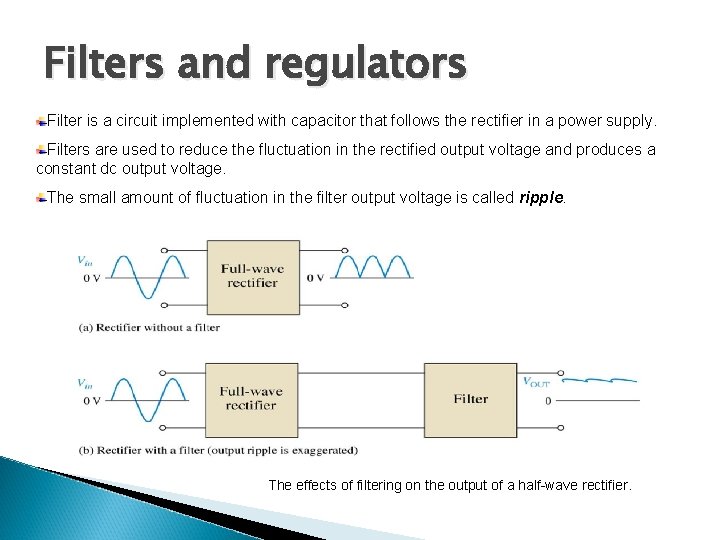
Filters and regulators Filter is a circuit implemented with capacitor that follows the rectifier in a power supply. Filters are used to reduce the fluctuation in the rectified output voltage and produces a constant dc output voltage. The small amount of fluctuation in the filter output voltage is called ripple. The effects of filtering on the output of a half-wave rectifier.
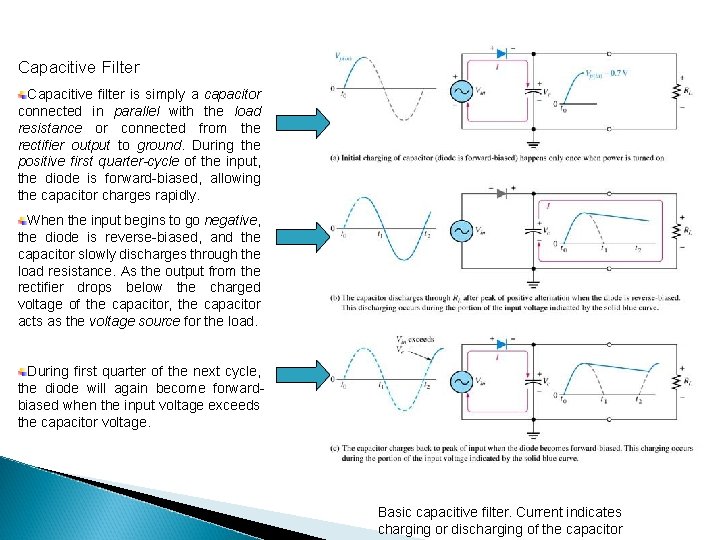
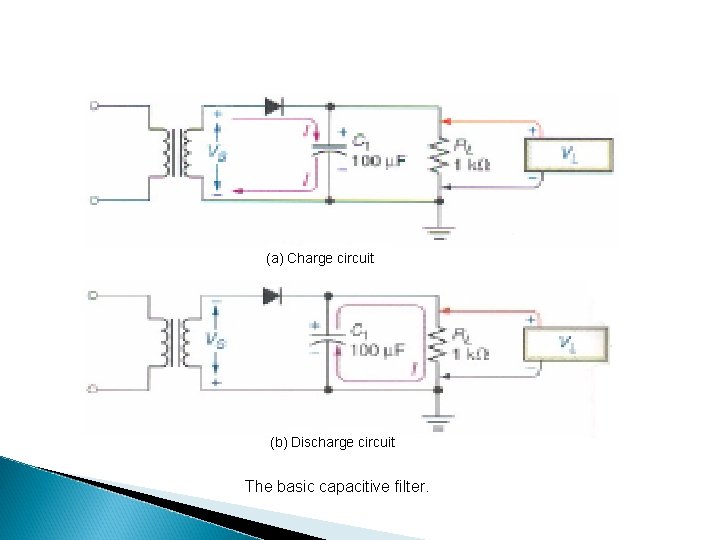
Capacitive Filter Capacitive filter is simply a capacitor connected in parallel with the load resistance or connected from the rectifier output to ground. During the positive first quarter-cycle of the input, the diode is forward-biased, allowing the capacitor charges rapidly. When the input begins to go negative, the diode is reverse-biased, and the capacitor slowly discharges through the load resistance. As the output from the rectifier drops below the charged voltage of the capacitor, the capacitor acts as the voltage source for the load. During first quarter of the next cycle, the diode will again become forwardbiased when the input voltage exceeds the capacitor voltage. Basic capacitive filter. Current indicates charging or discharging of the capacitor
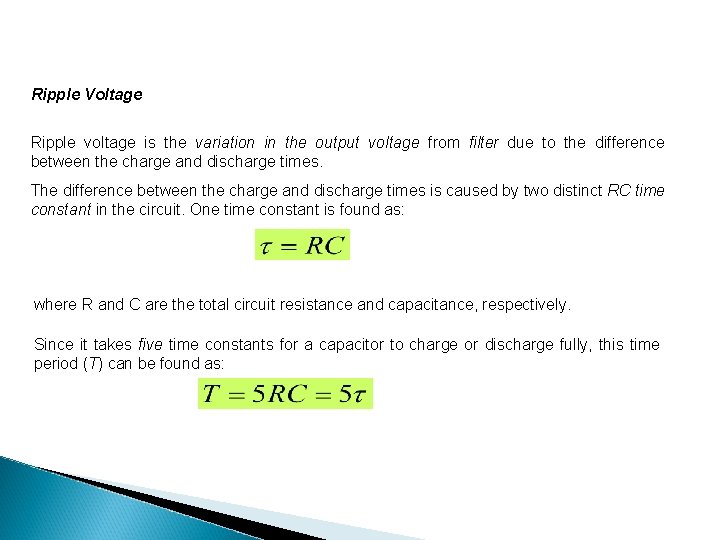
Ripple Voltage Ripple voltage is the variation in the output voltage from filter due to the difference between the charge and discharge times. The difference between the charge and discharge times is caused by two distinct RC time constant in the circuit. One time constant is found as: where R and C are the total circuit resistance and capacitance, respectively. Since it takes five time constants for a capacitor to charge or discharge fully, this time period (T) can be found as:
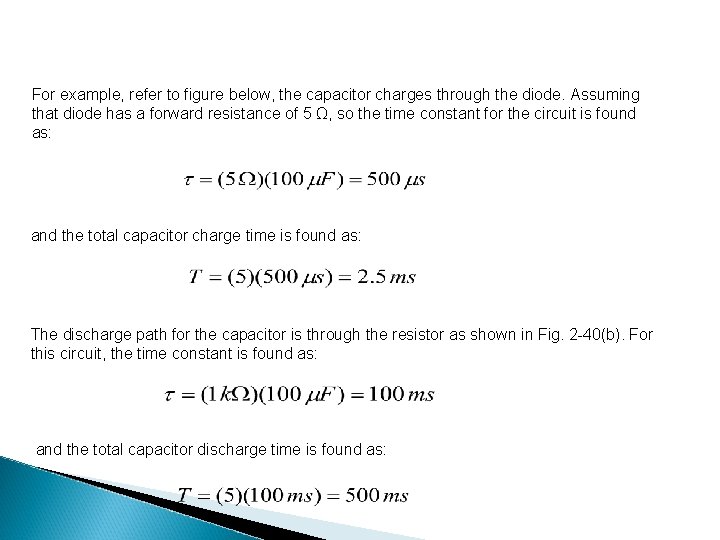
For example, refer to figure below, the capacitor charges through the diode. Assuming that diode has a forward resistance of 5 Ω, so the time constant for the circuit is found as: and the total capacitor charge time is found as: The discharge path for the capacitor is through the resistor as shown in Fig. 2 -40(b). For this circuit, the time constant is found as: and the total capacitor discharge time is found as:
(a) Charge circuit (b) Discharge circuit The basic capacitive filter.
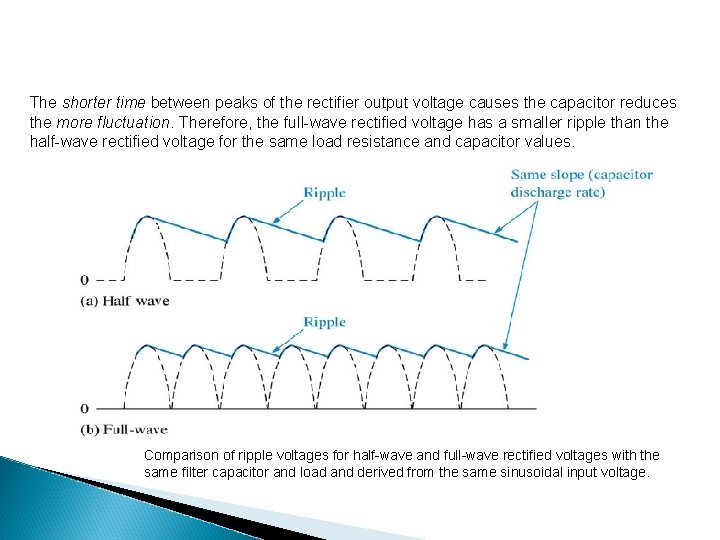
The shorter time between peaks of the rectifier output voltage causes the capacitor reduces the more fluctuation. Therefore, the full-wave rectified voltage has a smaller ripple than the half-wave rectified voltage for the same load resistance and capacitor values. Comparison of ripple voltages for half-wave and full-wave rectified voltages with the same filter capacitor and load and derived from the same sinusoidal input voltage.
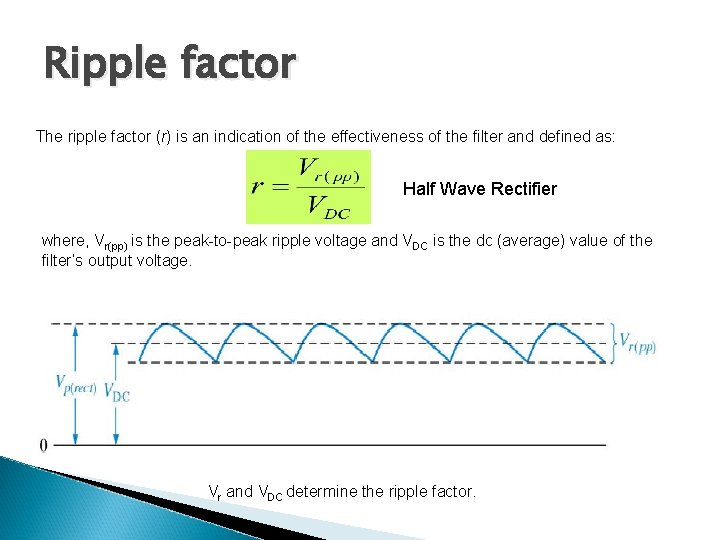
Ripple factor The ripple factor (r) is an indication of the effectiveness of the filter and defined as: Half Wave Rectifier where, Vr(pp) is the peak-to-peak ripple voltage and VDC is the dc (average) value of the filter’s output voltage. Vr and VDC determine the ripple factor.
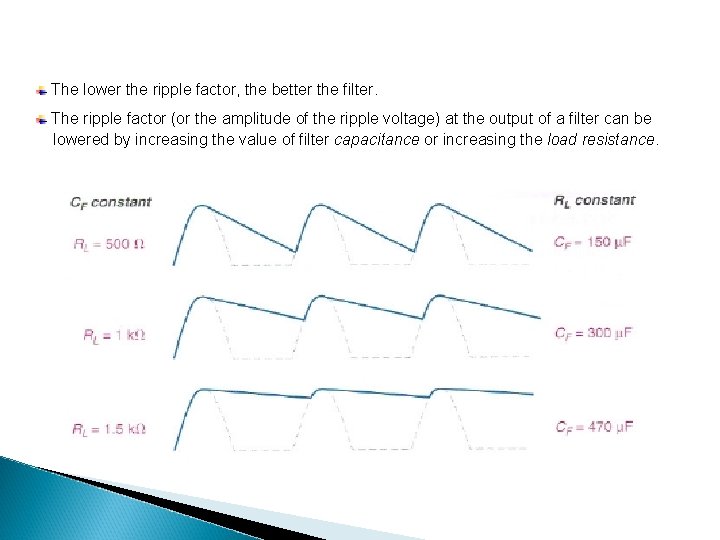
The lower the ripple factor, the better the filter. The ripple factor (or the amplitude of the ripple voltage) at the output of a filter can be lowered by increasing the value of filter capacitance or increasing the load resistance.
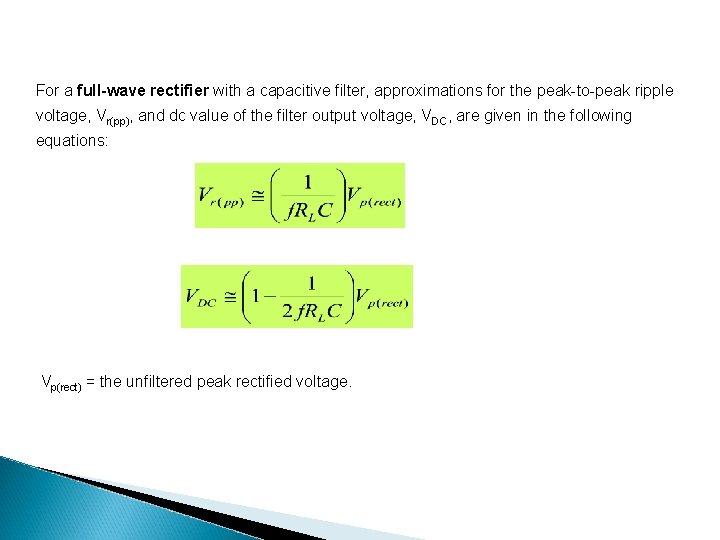
For a full-wave rectifier with a capacitive filter, approximations for the peak-to-peak ripple voltage, Vr(pp), and dc value of the filter output voltage, VDC, are given in the following equations: Vp(rect) = the unfiltered peak rectified voltage.
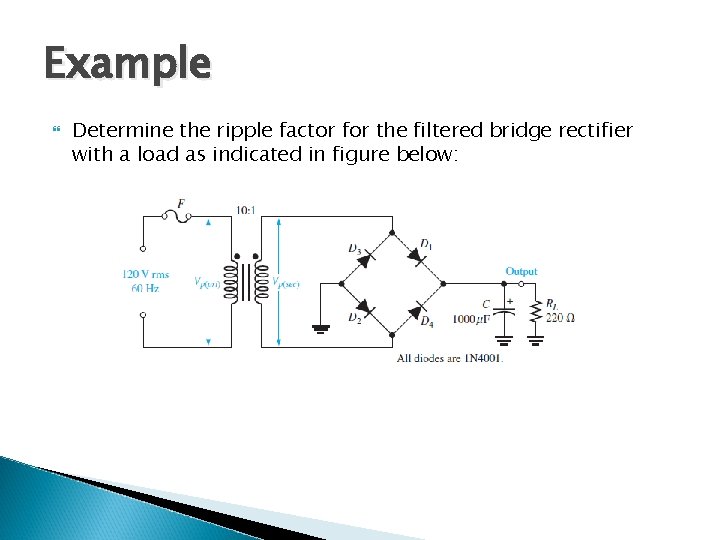
Example Determine the ripple factor for the filtered bridge rectifier with a load as indicated in figure below:
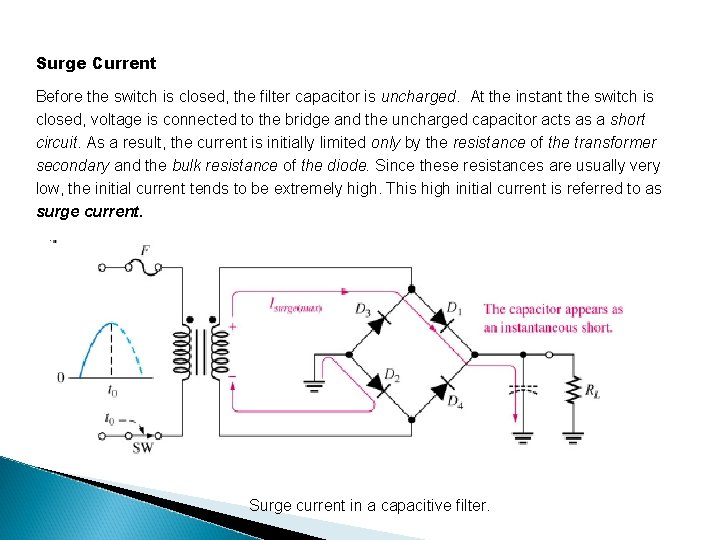
Surge Current Before the switch is closed, the filter capacitor is uncharged. At the instant the switch is closed, voltage is connected to the bridge and the uncharged capacitor acts as a short circuit. As a result, the current is initially limited only by the resistance of the transformer secondary and the bulk resistance of the diode. Since these resistances are usually very low, the initial current tends to be extremely high. This high initial current is referred to as surge current. Surge current in a capacitive filter.
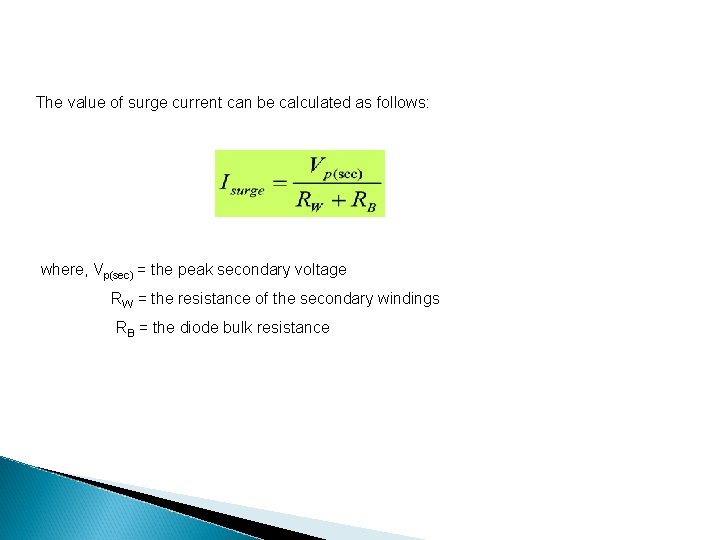
The value of surge current can be calculated as follows: where, Vp(sec) = the peak secondary voltage RW = the resistance of the secondary windings RB = the diode bulk resistance
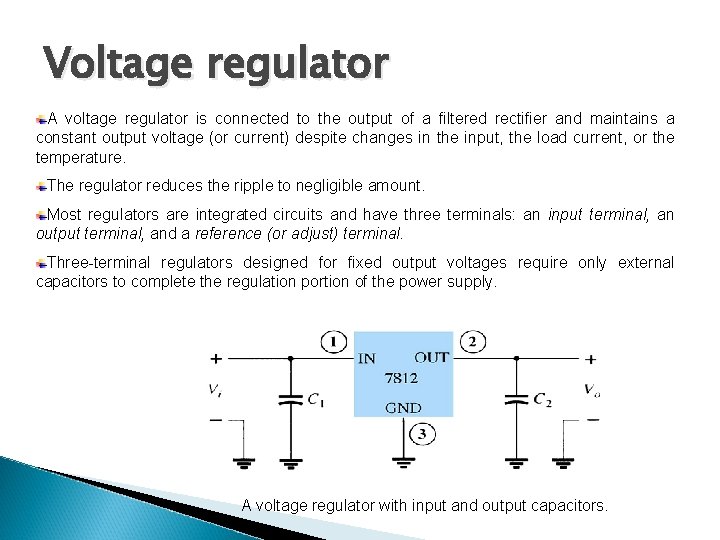
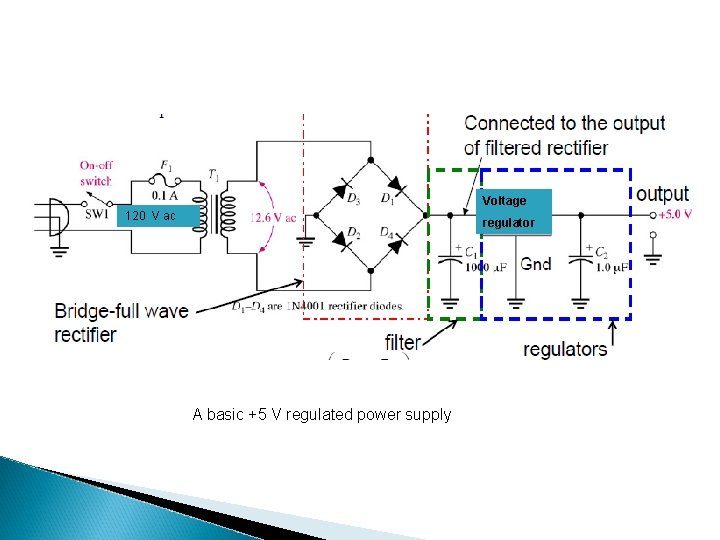
Voltage regulator A voltage regulator is connected to the output of a filtered rectifier and maintains a constant output voltage (or current) despite changes in the input, the load current, or the temperature. The regulator reduces the ripple to negligible amount. Most regulators are integrated circuits and have three terminals: an input terminal, an output terminal, and a reference (or adjust) terminal. Three-terminal regulators designed for fixed output voltages require only external capacitors to complete the regulation portion of the power supply. A voltage regulator with input and output capacitors.
Voltage 120 V ac regulator A basic +5 V regulated power supply
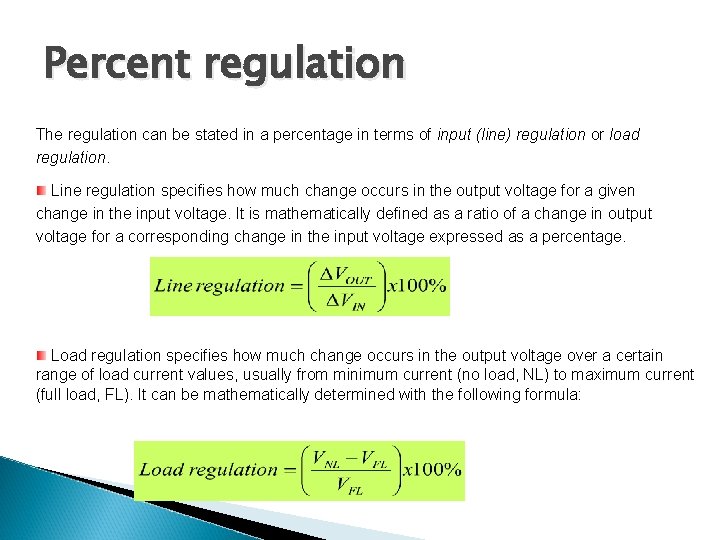
Percent regulation The regulation can be stated in a percentage in terms of input (line) regulation or load regulation. Line regulation specifies how much change occurs in the output voltage for a given change in the input voltage. It is mathematically defined as a ratio of a change in output voltage for a corresponding change in the input voltage expressed as a percentage. Load regulation specifies how much change occurs in the output voltage over a certain range of load current values, usually from minimum current (no load, NL) to maximum current (full load, FL). It can be mathematically determined with the following formula:
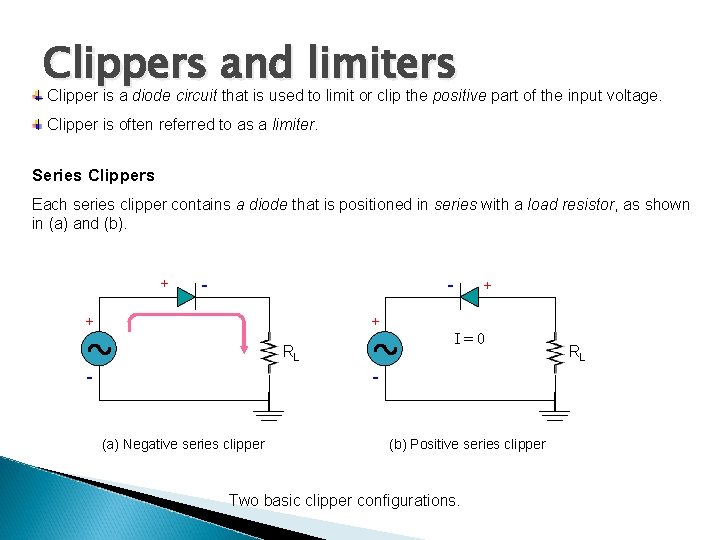
Clippers and limiters Clipper is a diode circuit that is used to limit or clip the positive part of the input voltage. Clipper is often referred to as a limiter. Series Clippers Each series clipper contains a diode that is positioned in series with a load resistor, as shown in (a) and (b). + - - + + RL - + I=0 - (a) Negative series clipper (b) Positive series clipper Two basic clipper configurations. RL
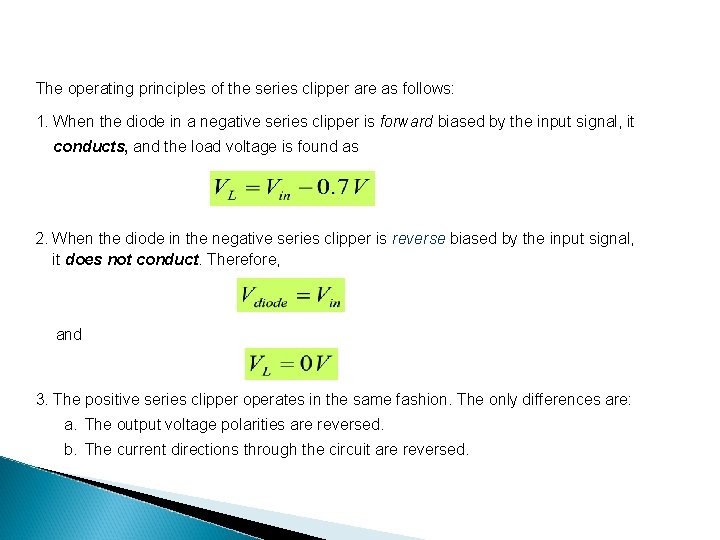
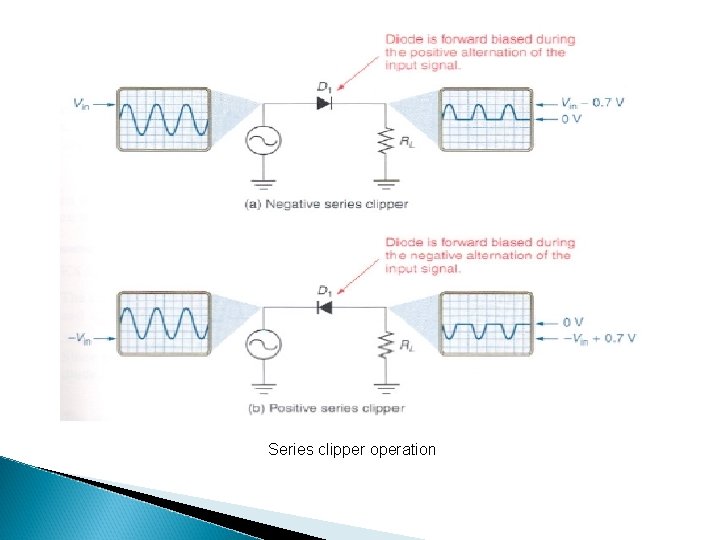
The operating principles of the series clipper are as follows: 1. When the diode in a negative series clipper is forward biased by the input signal, it conducts, and the load voltage is found as 2. When the diode in the negative series clipper is reverse biased by the input signal, it does not conduct. Therefore, and 3. The positive series clipper operates in the same fashion. The only differences are: a. The output voltage polarities are reversed. b. The current directions through the circuit are reversed.
Series clipper operation
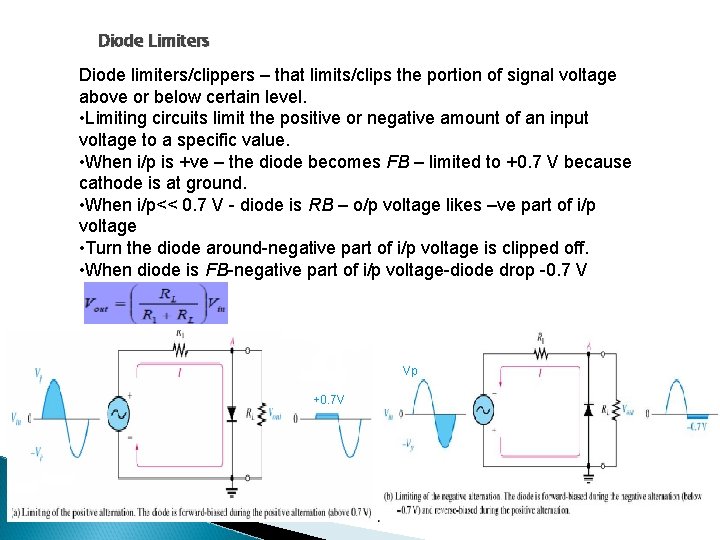
Diode Limiters Diode limiters/clippers – that limits/clips the portion of signal voltage above or below certain level. • Limiting circuits limit the positive or negative amount of an input voltage to a specific value. • When i/p is +ve – the diode becomes FB – limited to +0. 7 V because cathode is at ground. • When i/p<< 0. 7 V - diode is RB – o/p voltage likes –ve part of i/p voltage • Turn the diode around-negative part of i/p voltage is clipped off. • When diode is FB-negative part of i/p voltage-diode drop -0. 7 V Vp +0. 7 V
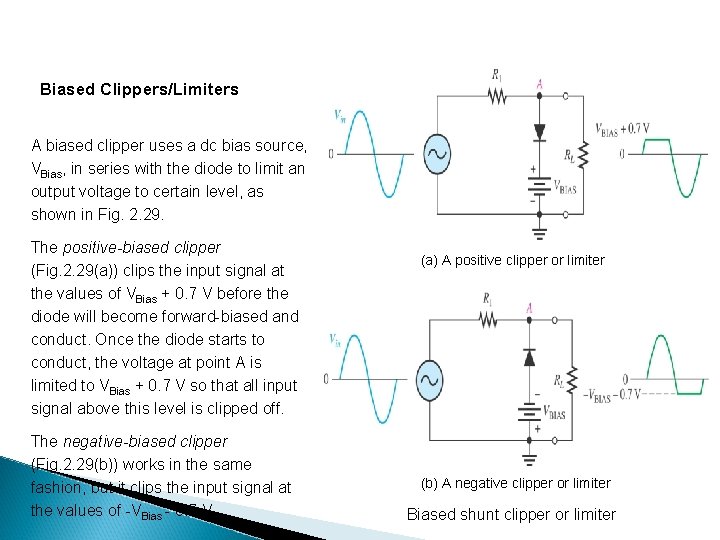
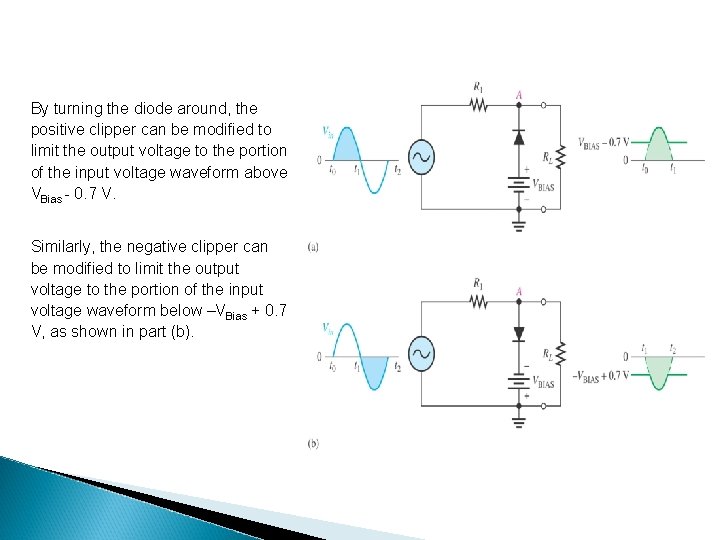
Biased Clippers/Limiters A biased clipper uses a dc bias source, VBias, in series with the diode to limit an output voltage to certain level, as shown in Fig. 2. 29. The positive-biased clipper (Fig. 2. 29(a)) clips the input signal at the values of VBias + 0. 7 V before the diode will become forward-biased and conduct. Once the diode starts to conduct, the voltage at point A is limited to VBias + 0. 7 V so that all input signal above this level is clipped off. The negative-biased clipper (Fig. 2. 29(b)) works in the same fashion, but it clips the input signal at the values of -VBias - 0. 7 V. (a) A positive clipper or limiter (b) A negative clipper or limiter Biased shunt clipper or limiter
By turning the diode around, the positive clipper can be modified to limit the output voltage to the portion of the input voltage waveform above VBias - 0. 7 V. Similarly, the negative clipper can be modified to limit the output voltage to the portion of the input voltage waveform below –VBias + 0. 7 V, as shown in part (b).
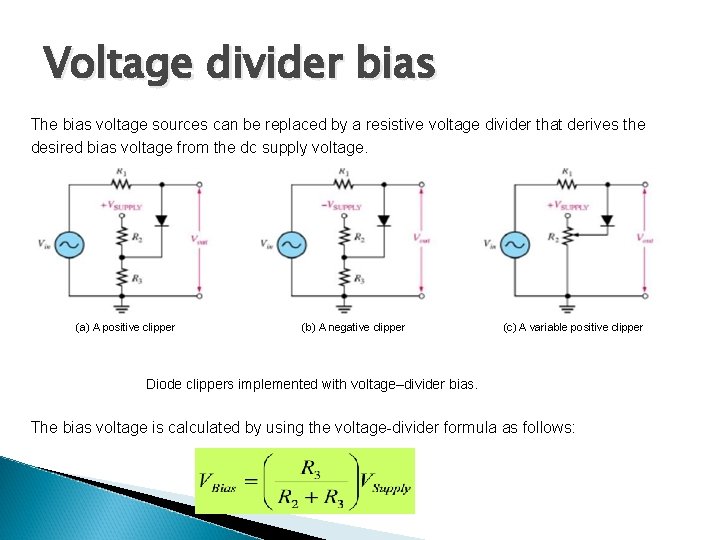
Voltage divider bias The bias voltage sources can be replaced by a resistive voltage divider that derives the desired bias voltage from the dc supply voltage. (a) A positive clipper (b) A negative clipper (c) A variable positive clipper Diode clippers implemented with voltage–divider bias. The bias voltage is calculated by using the voltage-divider formula as follows:
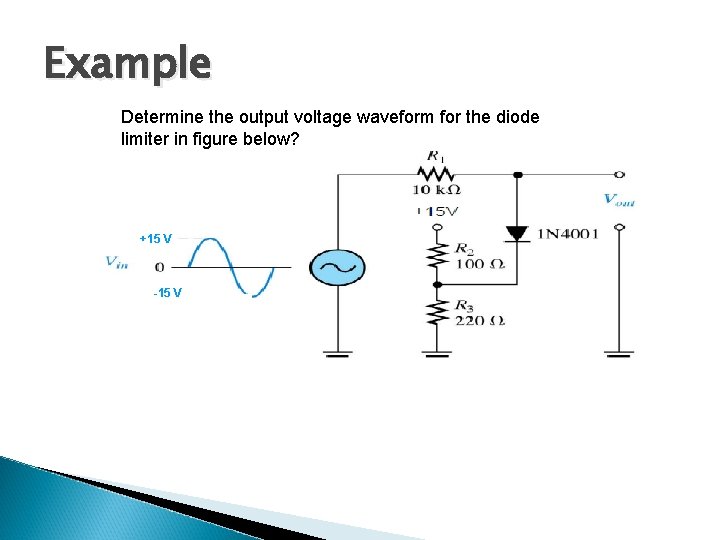
Example Determine the output voltage waveform for the diode limiter in figure below? +15 V -15 V
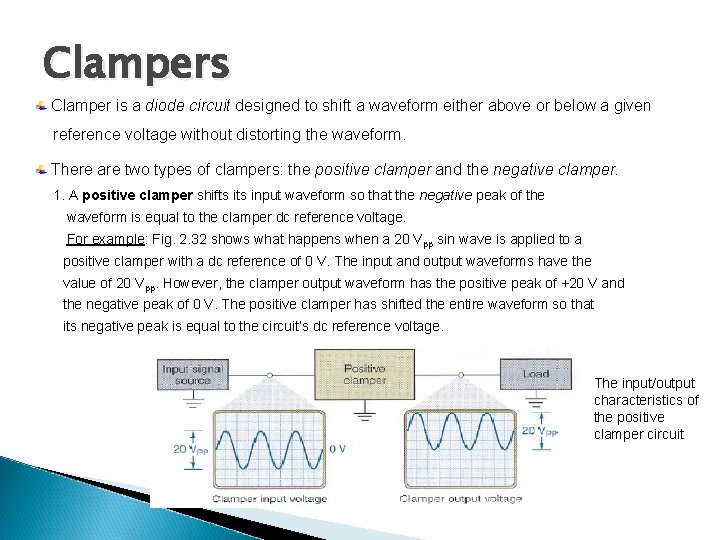
Clampers Clamper is a diode circuit designed to shift a waveform either above or below a given reference voltage without distorting the waveform. There are two types of clampers: the positive clamper and the negative clamper. 1. A positive clamper shifts input waveform so that the negative peak of the waveform is equal to the clamper dc reference voltage. For example: Fig. 2. 32 shows what happens when a 20 Vpp sin wave is applied to a positive clamper with a dc reference of 0 V. The input and output waveforms have the value of 20 Vpp. However, the clamper output waveform has the positive peak of +20 V and the negative peak of 0 V. The positive clamper has shifted the entire waveform so that its negative peak is equal to the circuit’s dc reference voltage. The input/output characteristics of the positive clamper circuit
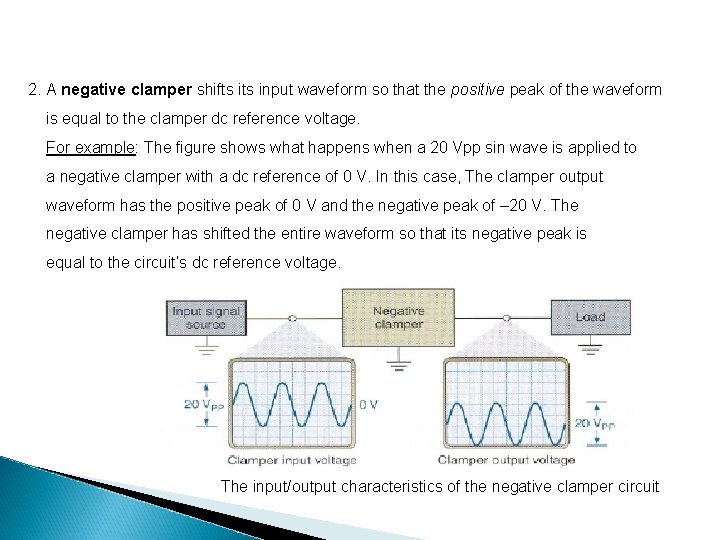
2. A negative clamper shifts input waveform so that the positive peak of the waveform is equal to the clamper dc reference voltage. For example: The figure shows what happens when a 20 Vpp sin wave is applied to a negative clamper with a dc reference of 0 V. In this case, The clamper output waveform has the positive peak of 0 V and the negative peak of – 20 V. The negative clamper has shifted the entire waveform so that its negative peak is equal to the circuit’s dc reference voltage. The input/output characteristics of the negative clamper circuit
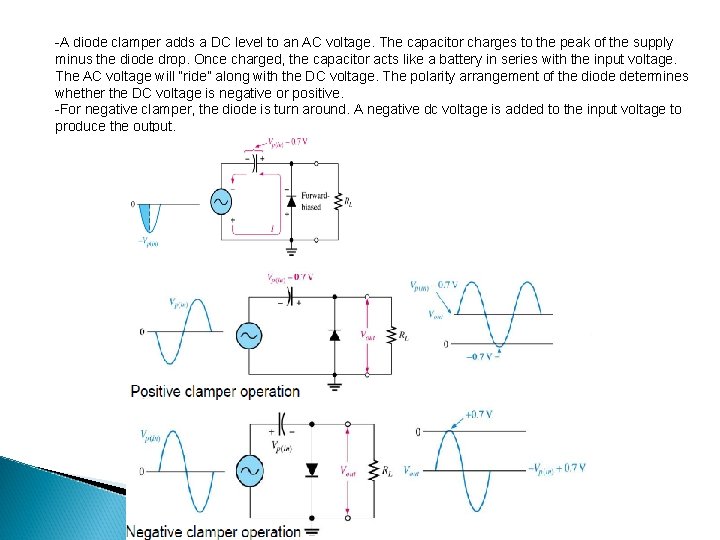
-A diode clamper adds a DC level to an AC voltage. The capacitor charges to the peak of the supply minus the diode drop. Once charged, the capacitor acts like a battery in series with the input voltage. The AC voltage will “ride” along with the DC voltage. The polarity arrangement of the diode determines whether the DC voltage is negative or positive. -For negative clamper, the diode is turn around. A negative dc voltage is added to the input voltage to produce the output.
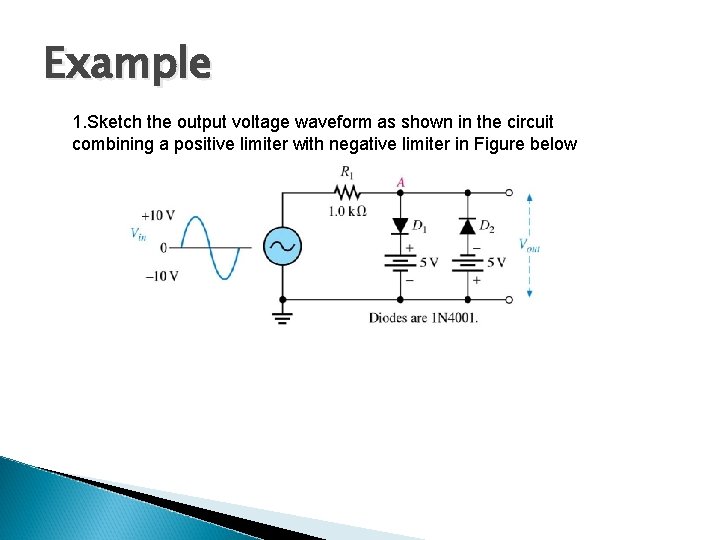
Example 1. Sketch the output voltage waveform as shown in the circuit combining a positive limiter with negative limiter in Figure below
Voltage multiplier A voltage multiplier is a circuit providing a dc output voltage that is a multiple of its peak input voltage. When a voltage multiplier increases a peak input voltage by a given factor, the peak input current is decreased by approximately the same factor. The typical application of a voltage multiplier is to supply the high-voltage, low-current input required to operate the cathode-ray tube in a television and to operate the particle accelerators. There are several types of the voltage multiplier: Voltage doublers : half-wave voltage doubler and full-wave voltage doubler. Voltage tripler Voltage quadrupler
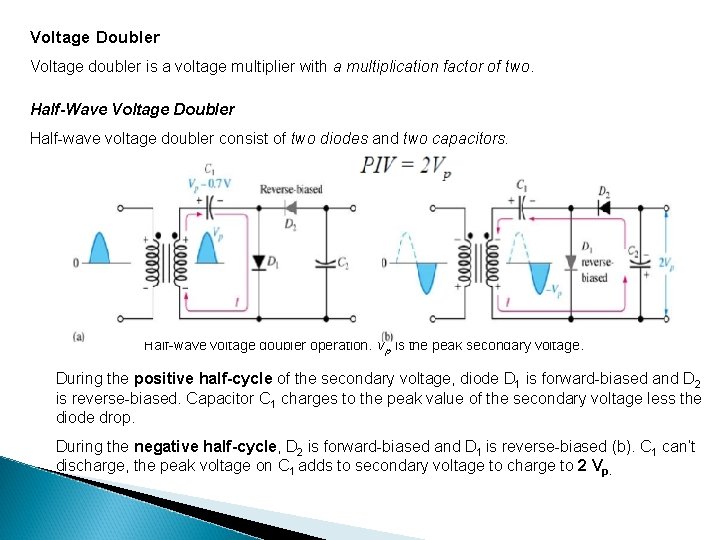
Voltage Doubler Voltage doubler is a voltage multiplier with a multiplication factor of two. Half-Wave Voltage Doubler Half-wave voltage doubler consist of two diodes and two capacitors. Half-wave voltage doubler operation. Vp is the peak secondary voltage. During the positive half-cycle of the secondary voltage, diode D 1 is forward-biased and D 2 is reverse-biased. Capacitor C 1 charges to the peak value of the secondary voltage less the diode drop. During the negative half-cycle, D 2 is forward-biased and D 1 is reverse-biased (b). C 1 can’t discharge, the peak voltage on C 1 adds to secondary voltage to charge to 2 Vp.
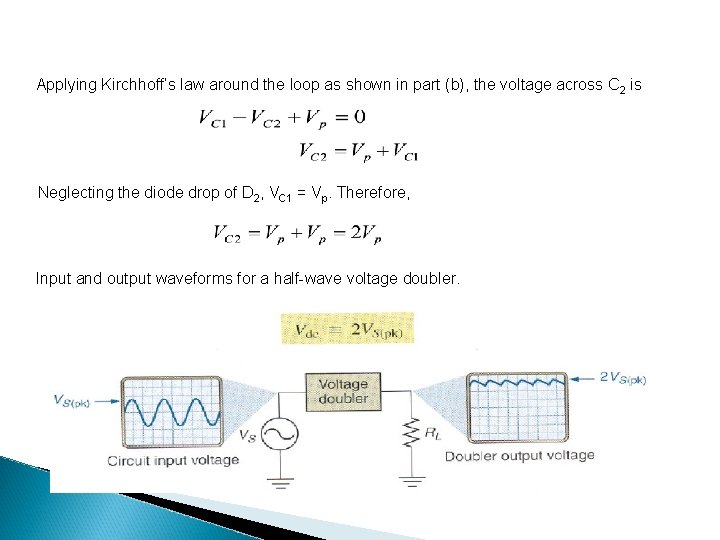
Applying Kirchhoff’s law around the loop as shown in part (b), the voltage across C 2 is Neglecting the diode drop of D 2, VC 1 = Vp. Therefore, Input and output waveforms for a half-wave voltage doubler.
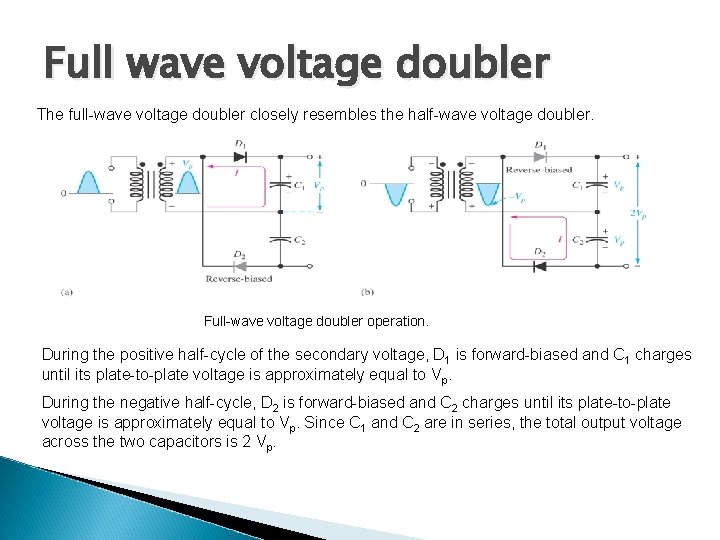
Full wave voltage doubler The full-wave voltage doubler closely resembles the half-wave voltage doubler. Full-wave voltage doubler operation. During the positive half-cycle of the secondary voltage, D 1 is forward-biased and C 1 charges until its plate-to-plate voltage is approximately equal to Vp. During the negative half-cycle, D 2 is forward-biased and C 2 charges until its plate-to-plate voltage is approximately equal to Vp. Since C 1 and C 2 are in series, the total output voltage across the two capacitors is 2 Vp.
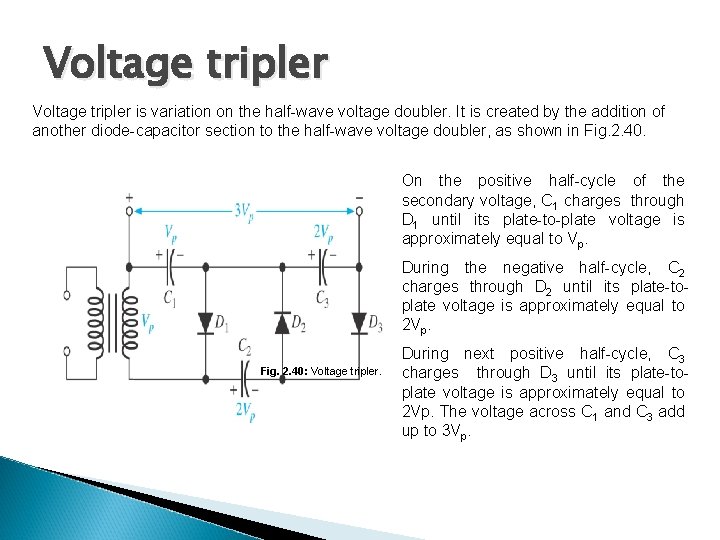
Voltage tripler is variation on the half-wave voltage doubler. It is created by the addition of another diode-capacitor section to the half-wave voltage doubler, as shown in Fig. 2. 40. On the positive half-cycle of the secondary voltage, C 1 charges through D 1 until its plate-to-plate voltage is approximately equal to Vp. During the negative half-cycle, C 2 charges through D 2 until its plate-toplate voltage is approximately equal to 2 Vp. Fig. 2. 40: Voltage tripler. During next positive half-cycle, C 3 charges through D 3 until its plate-toplate voltage is approximately equal to 2 Vp. The voltage across C 1 and C 3 add up to 3 Vp.
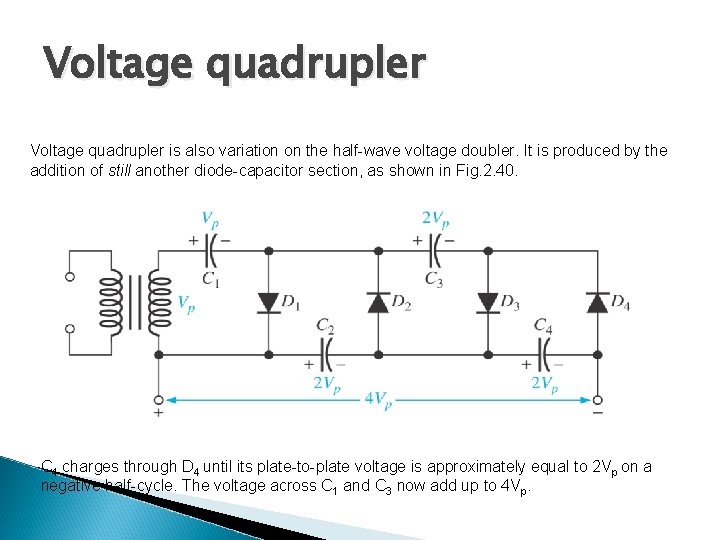
Voltage quadrupler is also variation on the half-wave voltage doubler. It is produced by the addition of still another diode-capacitor section, as shown in Fig. 2. 40. C 4 charges through D 4 until its plate-to-plate voltage is approximately equal to 2 Vp on a negative half-cycle. The voltage across C 1 and C 3 now add up to 4 Vp.
Summary Half-wave voltage doubler provides a dc output voltage that is approximately twice its peak input voltage. Full-wave voltage doubler provides a dc output voltage that is approximately twice its peak input voltage. Voltage tripler produces a dc output voltage that is approximately three times its peak input voltage. Voltage quadrupler produces a dc output voltage that is approximately four times its peak input voltage.