
CHAPTER 2 DIFFERENTIAL FORMULATION OF THE BASIC LAWS
CHAPTER 2 DIFFERENTIAL FORMULATION OF THE BASIC LAWS 2. 1 Introduction · Solutions must satisfy 3 fundamental laws: conservation of mass conservation of momentum conservation of energy · Differential formulation: application of basic laws to differential element 1
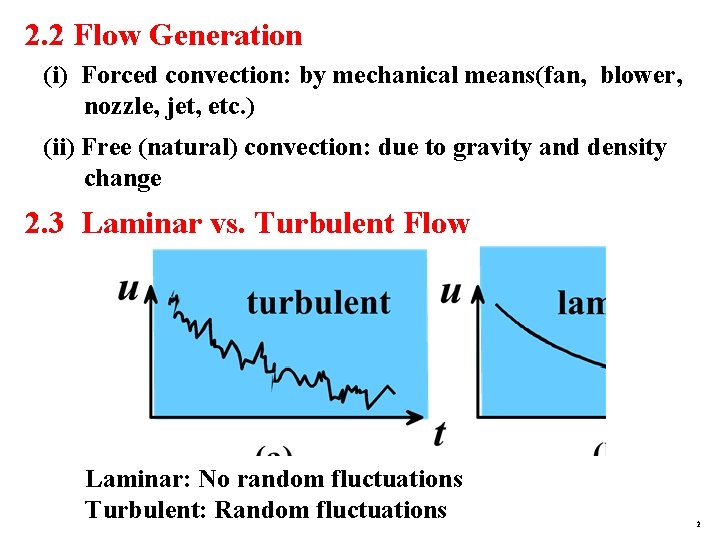
2. 2 Flow Generation (i) Forced convection: by mechanical means(fan, blower, nozzle, jet, etc. ) (ii) Free (natural) convection: due to gravity and density change 2. 3 Laminar vs. Turbulent Flow Laminar: No random fluctuations Turbulent: Random fluctuations 2
Transition from laminar to turbulent: Transition Reynolds number, depends on · flow geometry · surface roughness · pressure gradient · etc. Flow over flat plate: 500, 000 Flow through tubes: 2300 2. 4 Conservation of Mass: The Continuity Equation 3
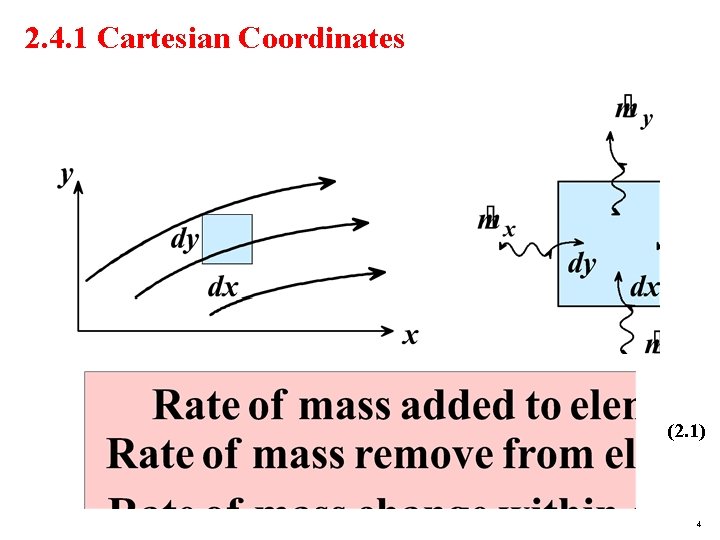
2. 4. 1 Cartesian Coordinates (2. 1) 4
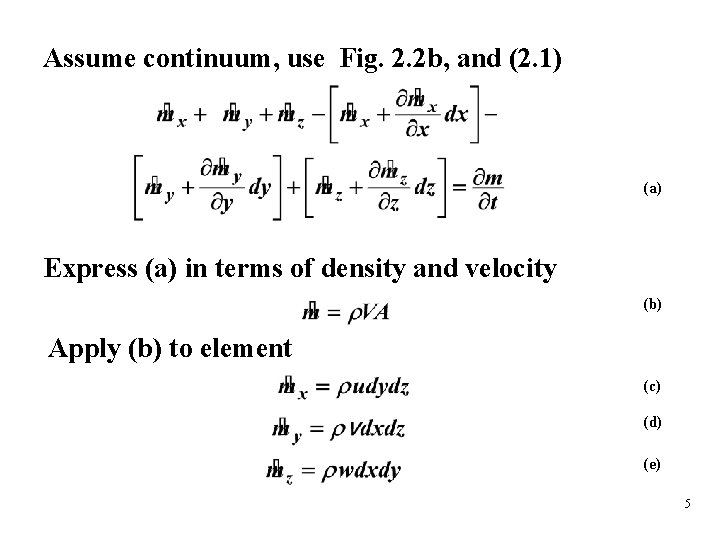
Assume continuum, use Fig. 2. 2 b, and (2. 1) (a) Express (a) in terms of density and velocity (b) Apply (b) to element (c) (d) (e) 5
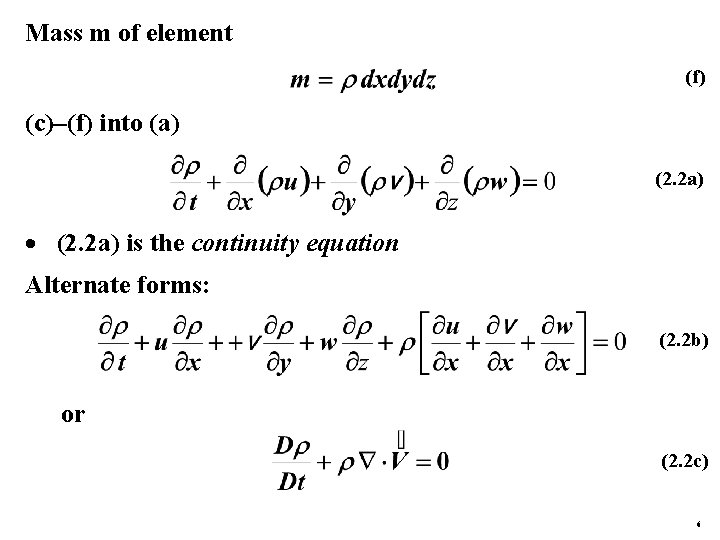
Mass m of element (f) (c)–(f) into (a) (2. 2 a) · (2. 2 a) is the continuity equation Alternate forms: (2. 2 b) or (2. 2 c) 6
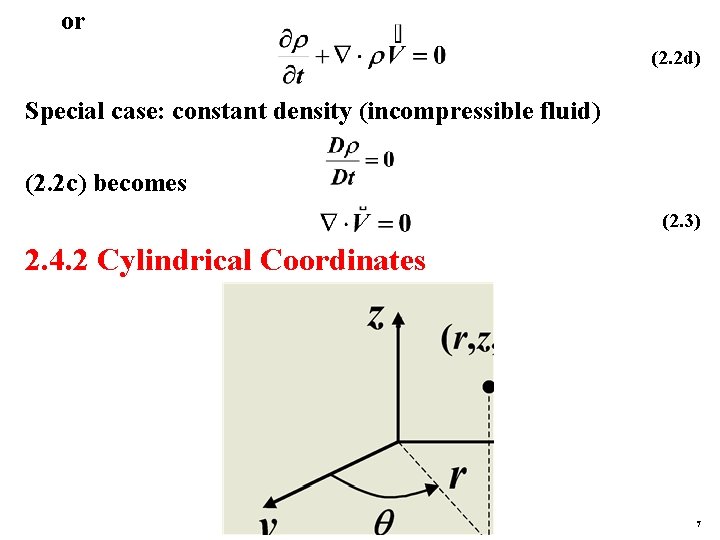
or (2. 2 d) Special case: constant density (incompressible fluid) (2. 2 c) becomes (2. 3) 2. 4. 2 Cylindrical Coordinates 7
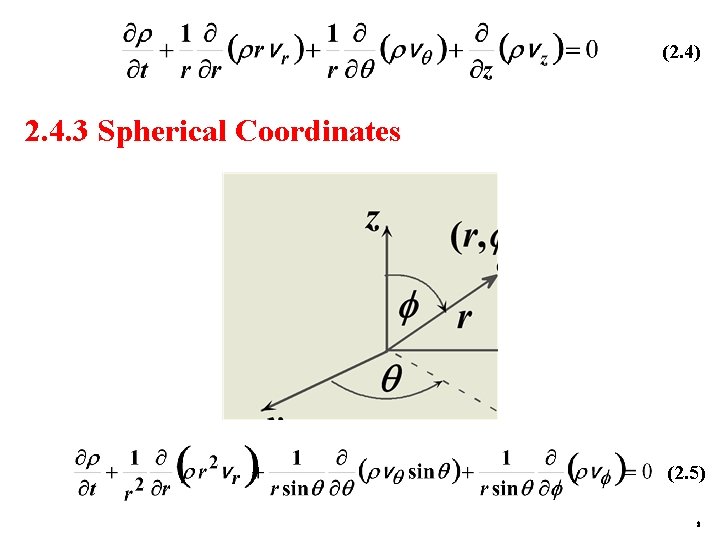
(2. 4) 2. 4. 3 Spherical Coordinates (2. 5) 8
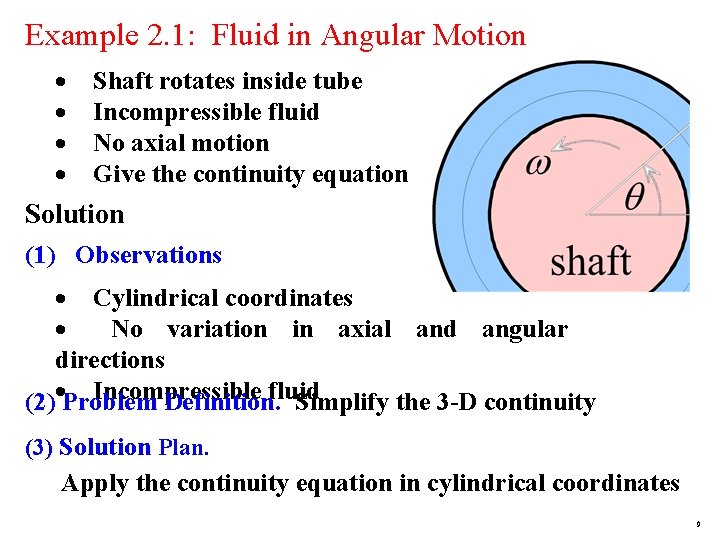
Example 2. 1: Fluid in Angular Motion · · Shaft rotates inside tube Incompressible fluid No axial motion Give the continuity equation Solution (1) Observations · Cylindrical coordinates · No variation in axial and angular directions Incompressible (2)·Problem Definition. fluid Simplify the 3 -D continuity (3) Solution Plan. Apply the continuity equation in cylindrical coordinates 9
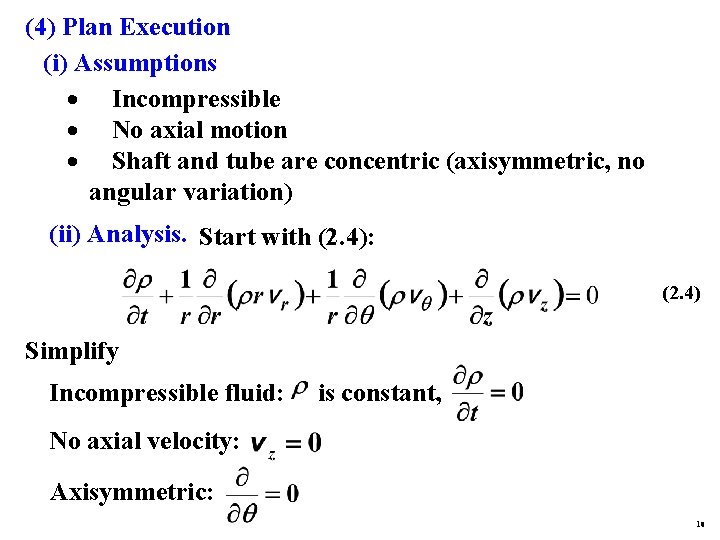
(4) Plan Execution (i) Assumptions · Incompressible · No axial motion · Shaft and tube are concentric (axisymmetric, no angular variation) (ii) Analysis. Start with (2. 4): (2. 4) Simplify Incompressible fluid: is constant, No axial velocity: Axisymmetric: 10
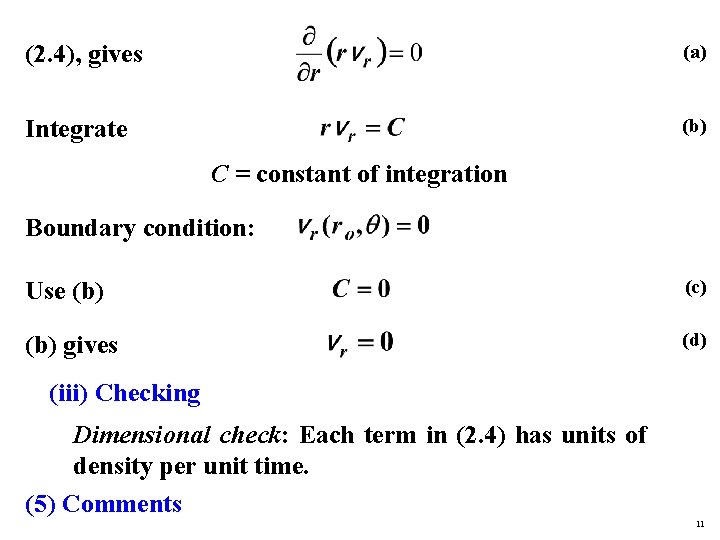
(2. 4), gives (a) Integrate (b) C = constant of integration Boundary condition: Use (b) (c) (b) gives (d) (iii) Checking Dimensional check: Each term in (2. 4) has units of density per unit time. (5) Comments 11
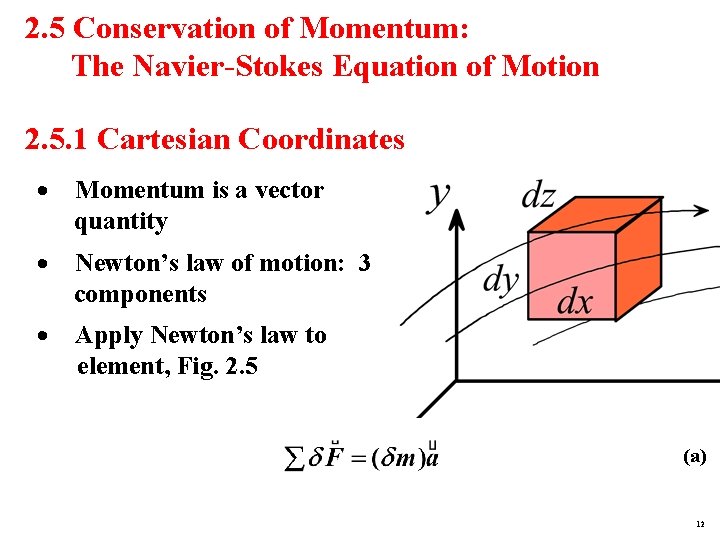
2. 5 Conservation of Momentum: The Navier-Stokes Equation of Motion 2. 5. 1 Cartesian Coordinates · Momentum is a vector quantity · Newton’s law of motion: 3 components · Apply Newton’s law to element, Fig. 2. 5 (a) 12
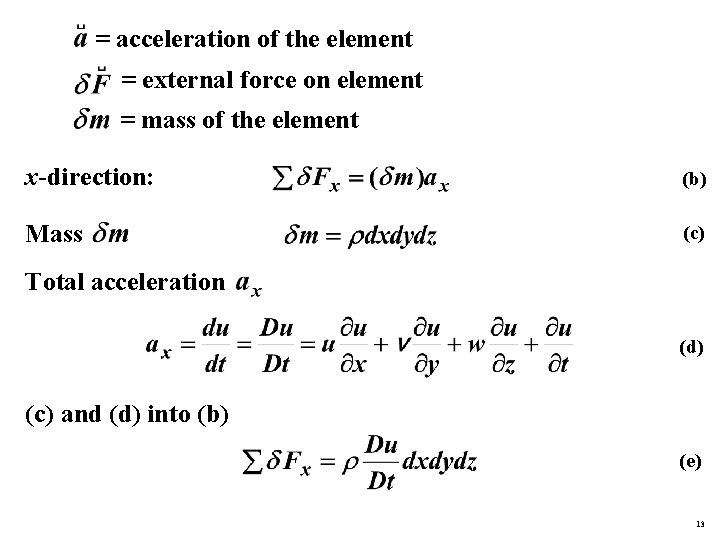
= acceleration of the element = external force on element = mass of the element x-direction: (b) Mass (c) Total acceleration (d) (c) and (d) into (b) (e) 13
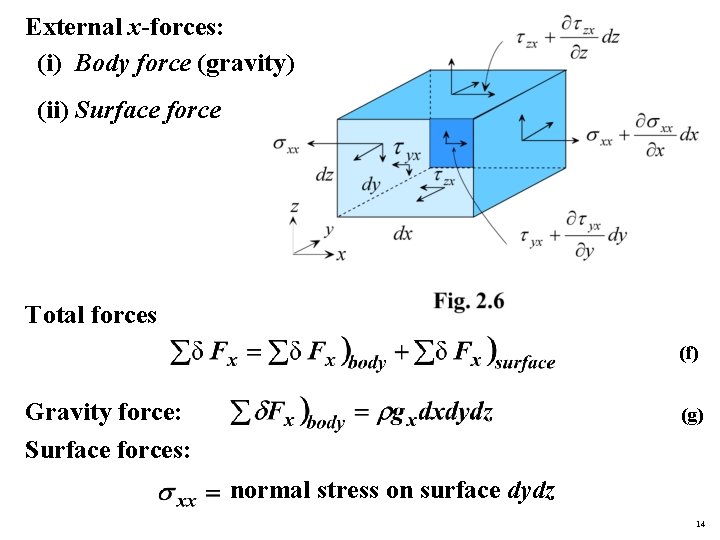
External x-forces: (i) Body force (gravity) (ii) Surface force Total forces (f) Gravity force: Surface forces: (g) normal stress on surface dydz 14
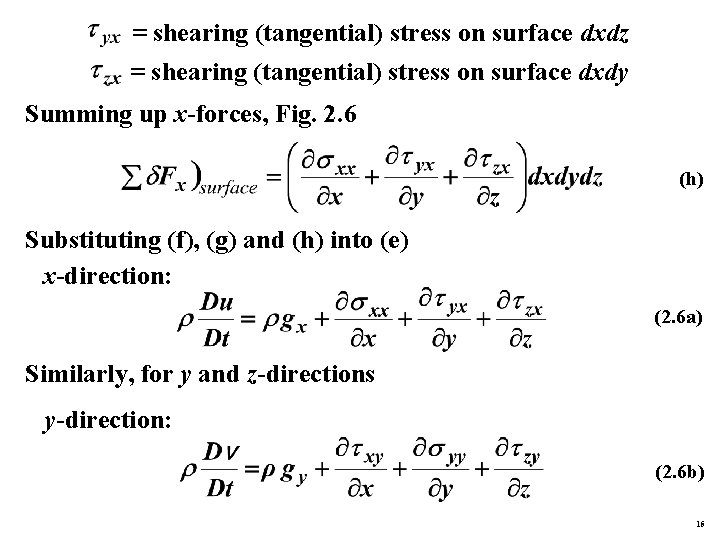
= shearing (tangential) stress on surface dxdz = shearing (tangential) stress on surface dxdy Summing up x-forces, Fig. 2. 6 (h) Substituting (f), (g) and (h) into (e) x-direction: (2. 6 a) Similarly, for y and z-directions y-direction: (2. 6 b) 15

z-direction: (2. 6 c) Unknowns in (2. 6), 13: u, v, w, However , , , (i) Reduce number of unknowns: Use empirical relations called the constitutive equations (2. 7 a) (2. 7 b) 16
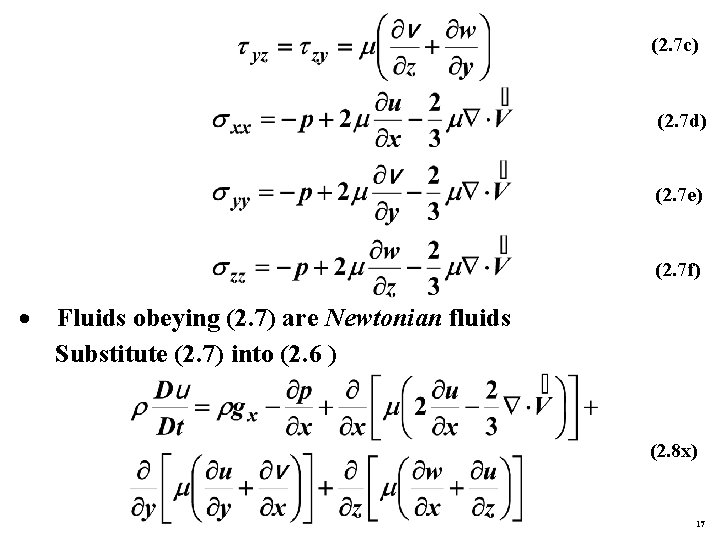
(2. 7 c) (2. 7 d) (2. 7 e) (2. 7 f) · Fluids obeying (2. 7) are Newtonian fluids Substitute (2. 7) into (2. 6 ) (2. 8 x) 17
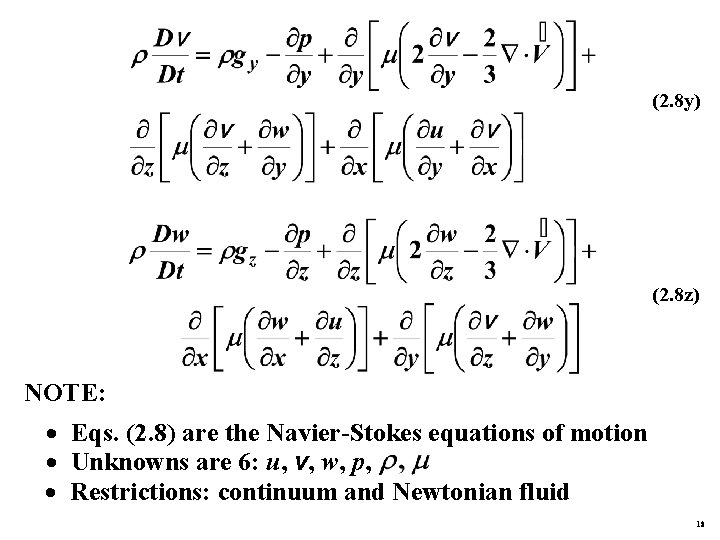
(2. 8 y) (2. 8 z) NOTE: · Eqs. (2. 8) are the Navier-Stokes equations of motion · Unknowns are 6: u, v, w, p, · Restrictions: continuum and Newtonian fluid 18
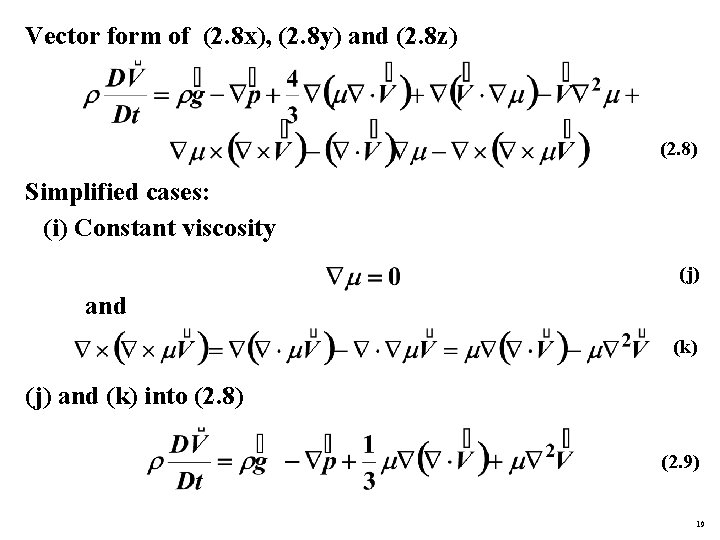
Vector form of (2. 8 x), (2. 8 y) and (2. 8 z) (2. 8) Simplified cases: (i) Constant viscosity (j) and (k) into (2. 8) (2. 9) 19
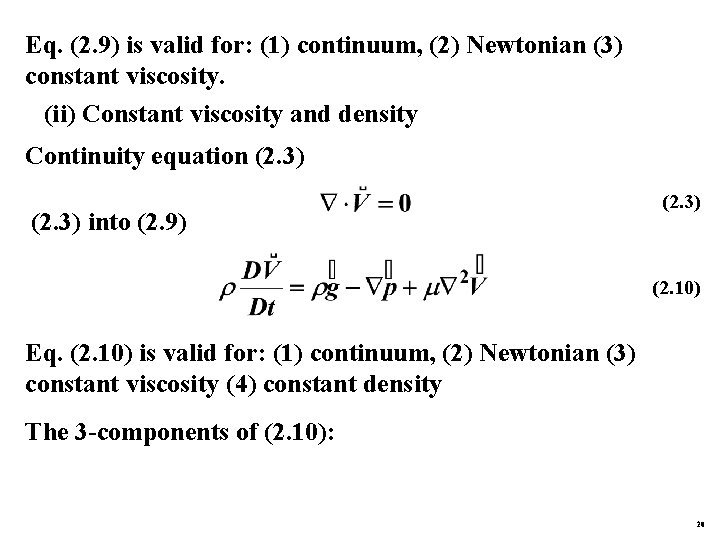
Eq. (2. 9) is valid for: (1) continuum, (2) Newtonian (3) constant viscosity. (ii) Constant viscosity and density Continuity equation (2. 3) into (2. 9) (2. 3) (2. 10) Eq. (2. 10) is valid for: (1) continuum, (2) Newtonian (3) constant viscosity (4) constant density The 3 -components of (2. 10): 20
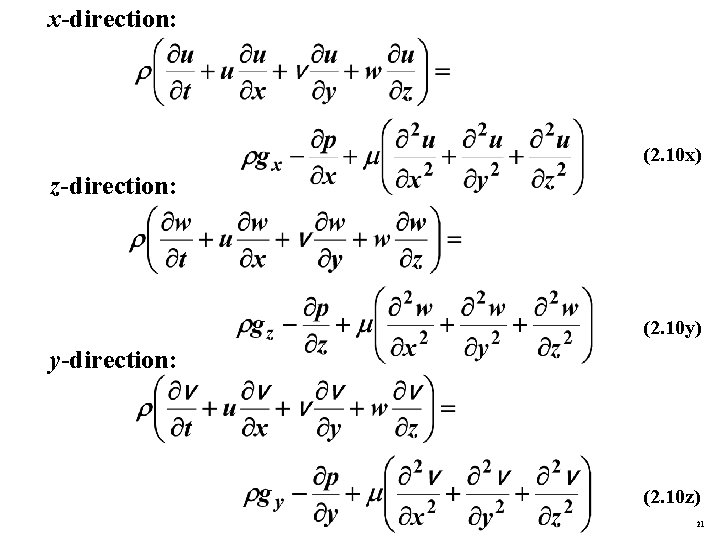
x-direction: (2. 10 x) z-direction: (2. 10 y) y-direction: (2. 10 z) 21
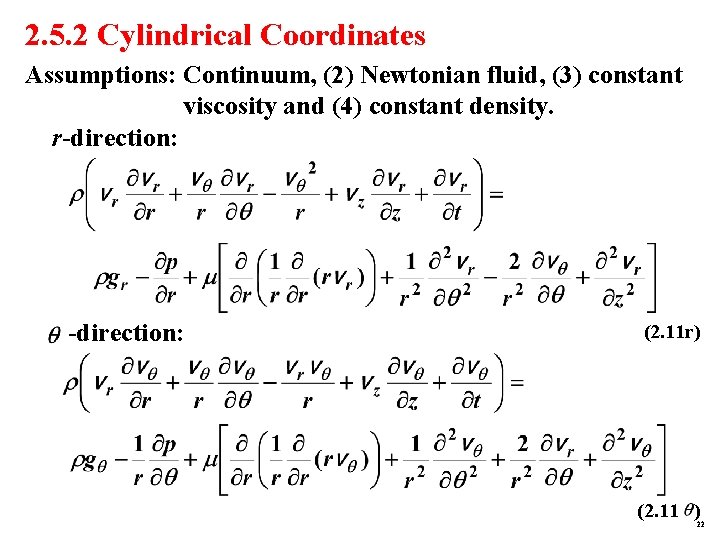
2. 5. 2 Cylindrical Coordinates Assumptions: Continuum, (2) Newtonian fluid, (3) constant viscosity and (4) constant density. r-direction: (2. 11 r) (2. 11 ) 22
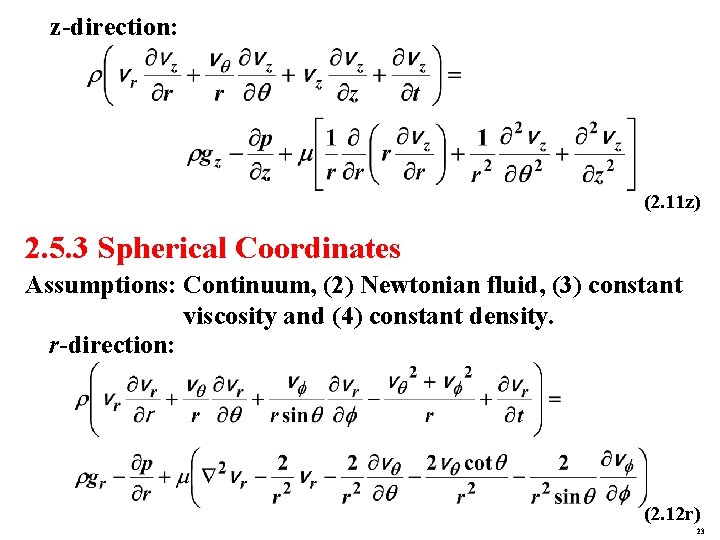
z-direction: (2. 11 z) 2. 5. 3 Spherical Coordinates Assumptions: Continuum, (2) Newtonian fluid, (3) constant viscosity and (4) constant density. r-direction: (2. 12 r) 23
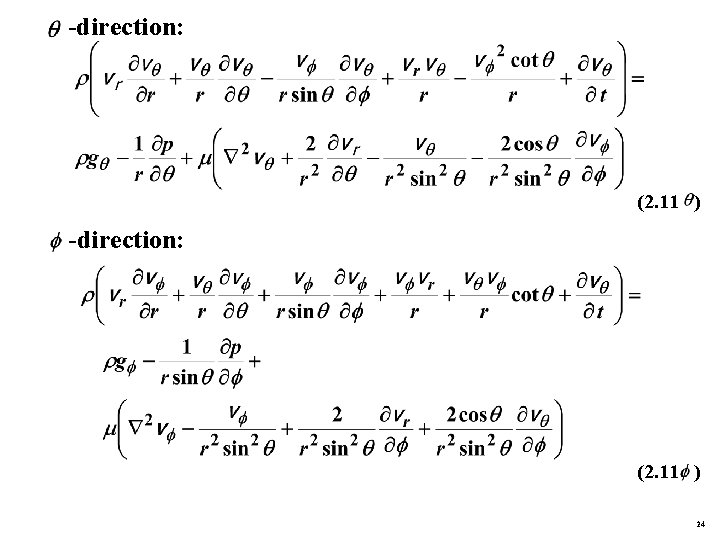
-direction: (2. 11 ) 24
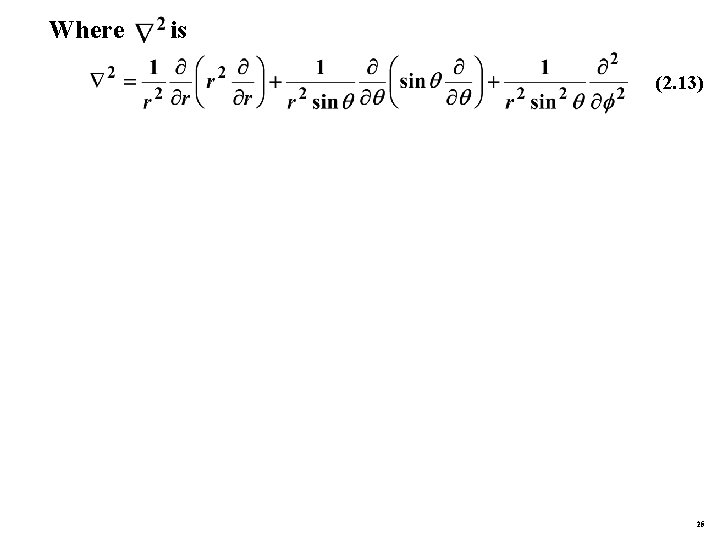
Where is (2. 13) 25
Solution of N-S eqs for simple flow problems
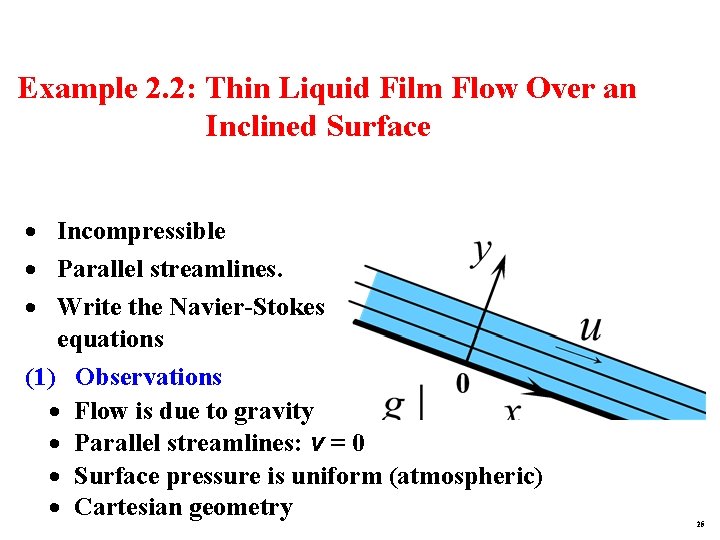
Example 2. 2: Thin Liquid Film Flow Over an Inclined Surface · Incompressible · Parallel streamlines. · Write the Navier-Stokes equations (1) Observations · Flow is due to gravity · Parallel streamlines: v = 0 · Surface pressure is uniform (atmospheric) · Cartesian geometry 25
(2) Problem Definition. Simplify the x and y components of the Navier-Stokes equations (3) Solution Plan. Start with the Navier-Stokes equations in Cartesian coordinates and simplify for this case (4) Plan Execution (i) Assumptions · · · Newtonian steady state flow is in the x-direction only constant properties uniform ambient pressure parallel streamlines 26
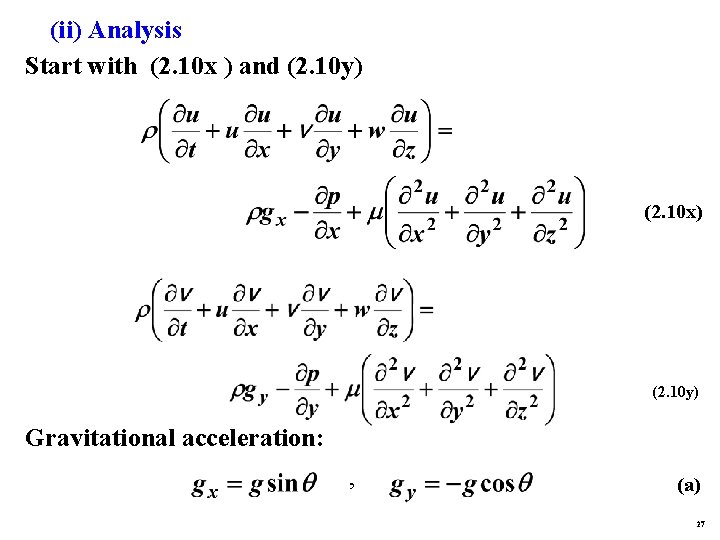
(ii) Analysis Start with (2. 10 x ) and (2. 10 y) (2. 10 x) (2. 10 y) Gravitational acceleration: , (a) 27
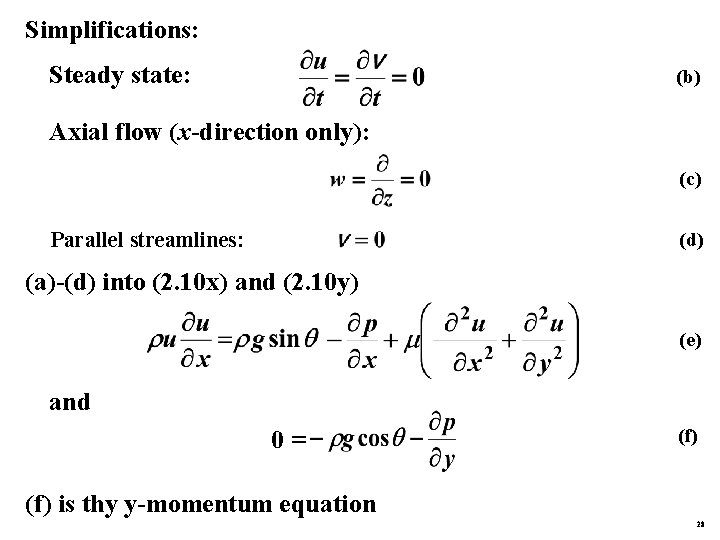
Simplifications: Steady state: (b) Axial flow (x-direction only): (c) Parallel streamlines: (d) (a)-(d) into (2. 10 x) and (2. 10 y) (e) and 0= (f) is thy y-momentum equation 28
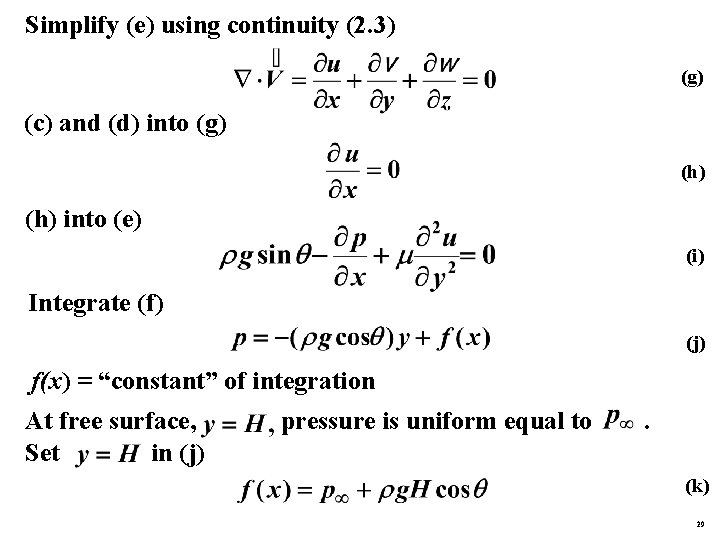
Simplify (e) using continuity (2. 3) (g) (c) and (d) into (g) (h) into (e) (i) Integrate (f) (j) f(x) = “constant” of integration At free surface, Set in (j) pressure is uniform equal to . (k) 29
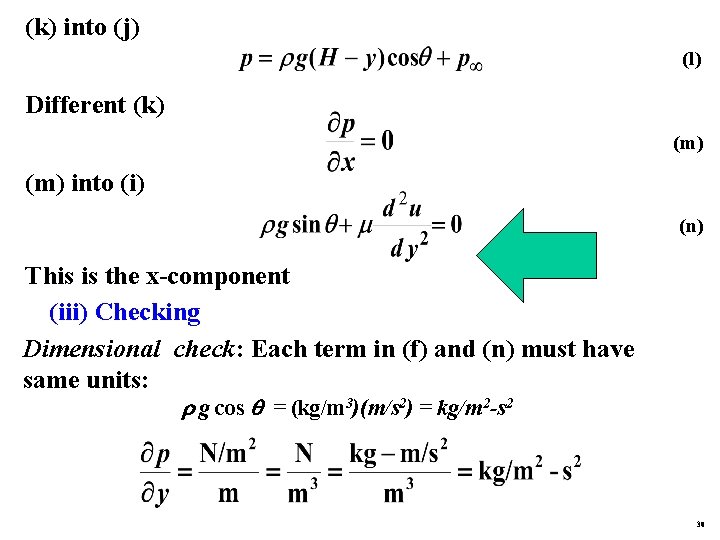
(k) into (j) (l) Different (k) (m) into (i) (n) This is the x-component (iii) Checking Dimensional check: Each term in (f) and (n) must have same units: g cos = (kg/m 3)(m/s 2) = kg/m 2 -s 2 30
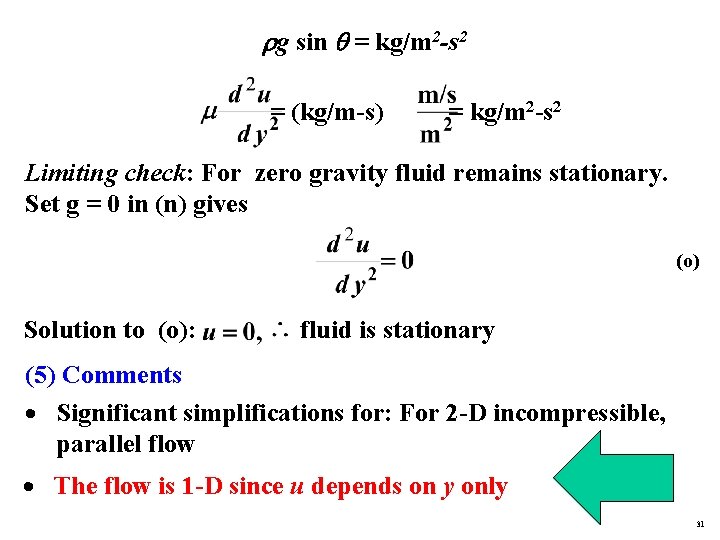
g sin = kg/m 2 -s 2 = (kg/m-s) = kg/m 2 -s 2 Limiting check: For zero gravity fluid remains stationary. Set g = 0 in (n) gives (o) Solution to (o): fluid is stationary (5) Comments · Significant simplifications for: For 2 -D incompressible, parallel flow · The flow is 1 -D since u depends on y only 31
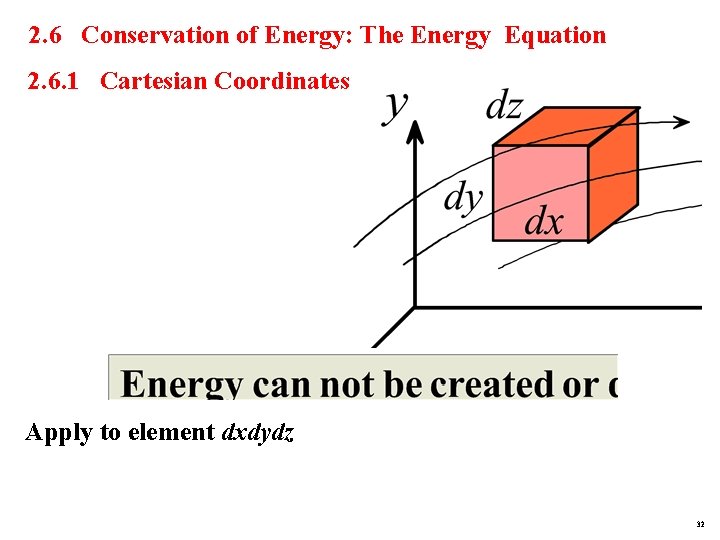
2. 6 Conservation of Energy: The Energy Equation 2. 6. 1 Cartesian Coordinates Apply to element dxdydz 32
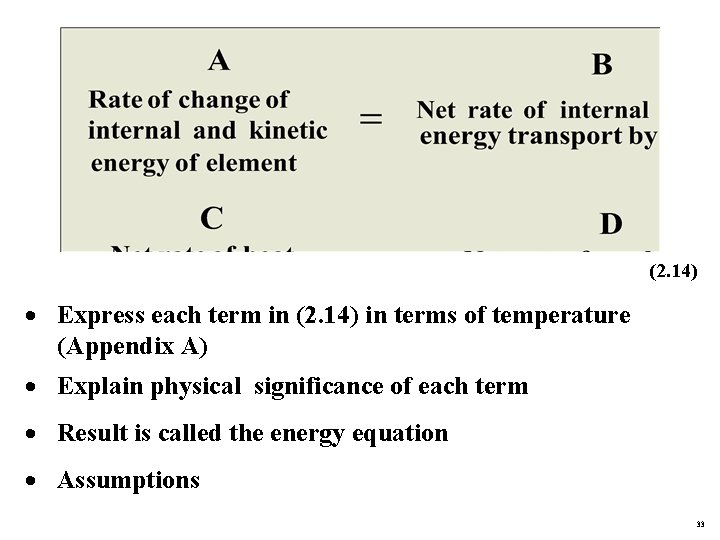
(2. 14) · Express each term in (2. 14) in terms of temperature (Appendix A) · Explain physical significance of each term · Result is called the energy equation · Assumptions 33
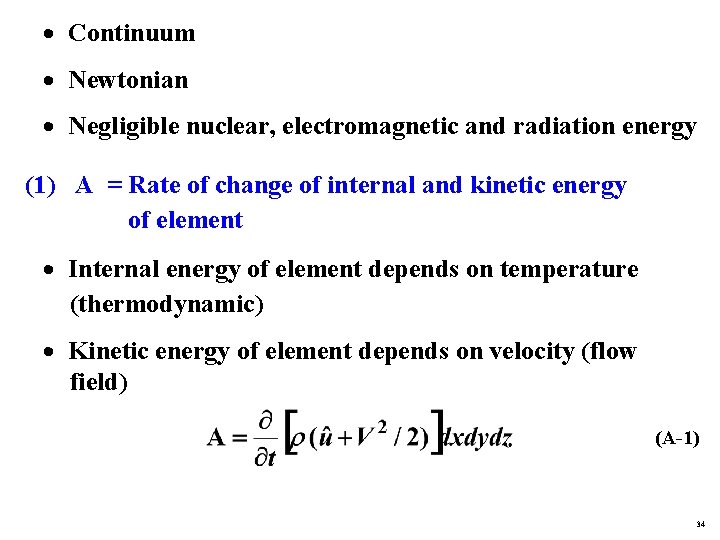
· Continuum · Newtonian · Negligible nuclear, electromagnetic and radiation energy (1) A = Rate of change of internal and kinetic energy of element · Internal energy of element depends on temperature (thermodynamic) · Kinetic energy of element depends on velocity (flow field) (A-1) 34
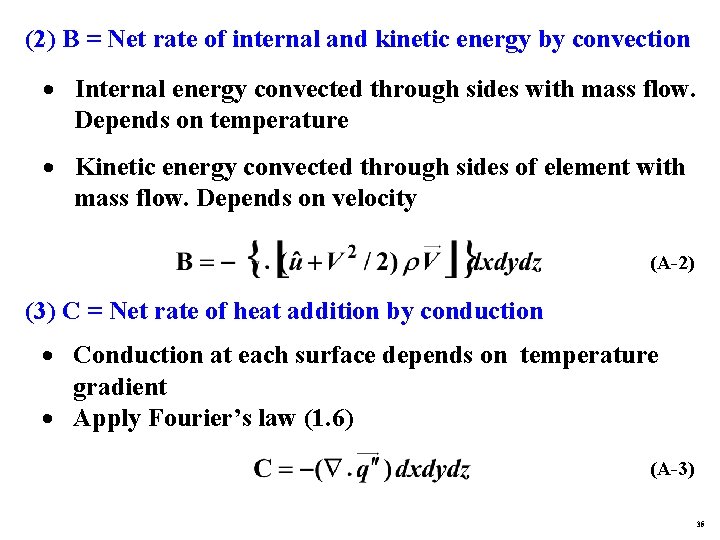
(2) B = Net rate of internal and kinetic energy by convection · Internal energy convected through sides with mass flow. Depends on temperature · Kinetic energy convected through sides of element with mass flow. Depends on velocity (A-2) (3) C = Net rate of heat addition by conduction · Conduction at each surface depends on temperature gradient · Apply Fourier’s law (1. 6) (A-3) 35
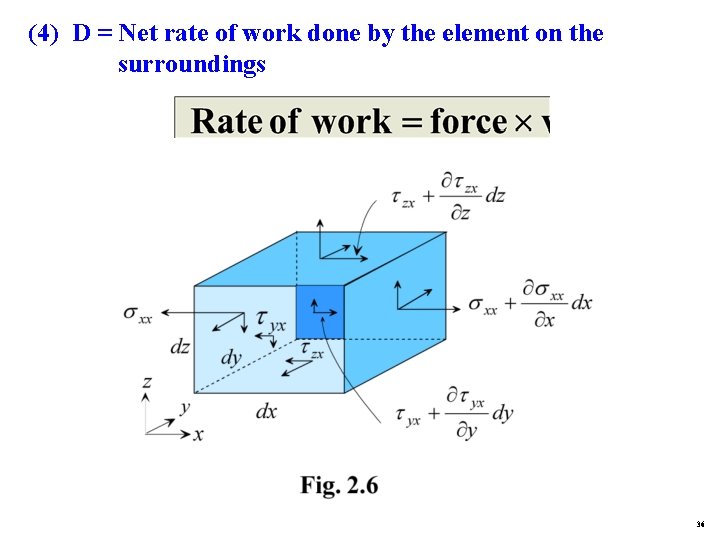
(4) D = Net rate of work done by the element on the surroundings 36
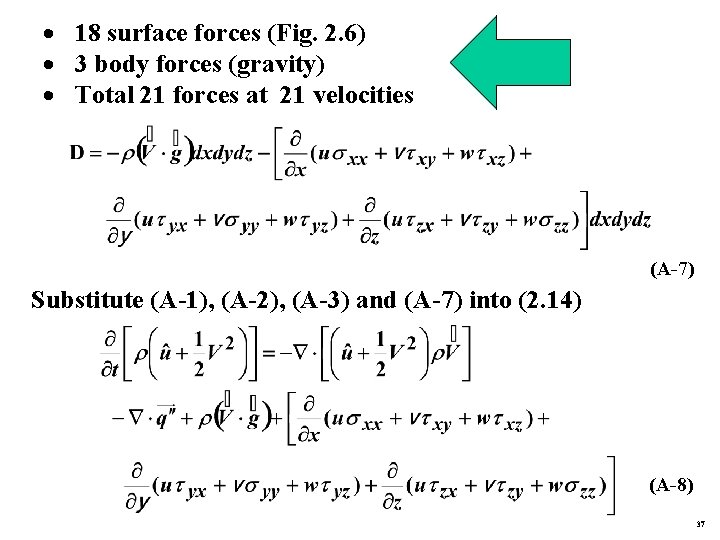
· 18 surface forces (Fig. 2. 6) · 3 body forces (gravity) · Total 21 forces at 21 velocities (A-7) Substitute (A-1), (A-2), (A-3) and (A-7) into (2. 14) (A-8) 37
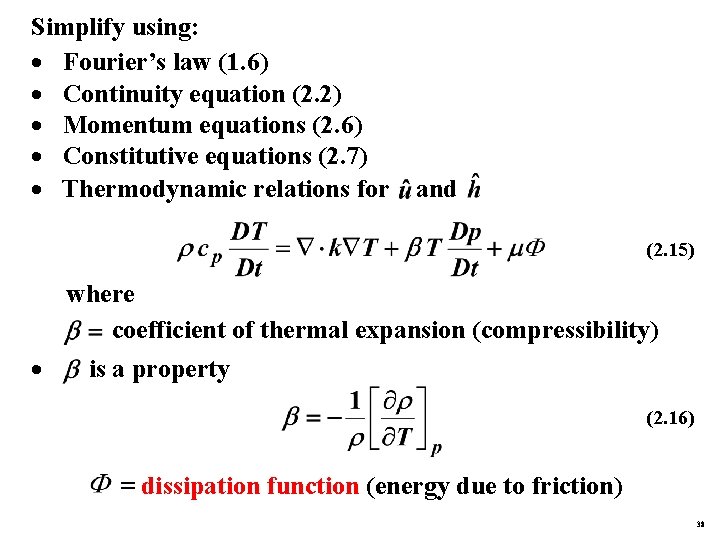
Simplify using: · Fourier’s law (1. 6) · Continuity equation (2. 2) · Momentum equations (2. 6) · Constitutive equations (2. 7) · Thermodynamic relations for and (2. 15) where coefficient of thermal expansion (compressibility) · is a property (2. 16) = dissipation function (energy due to friction) 38
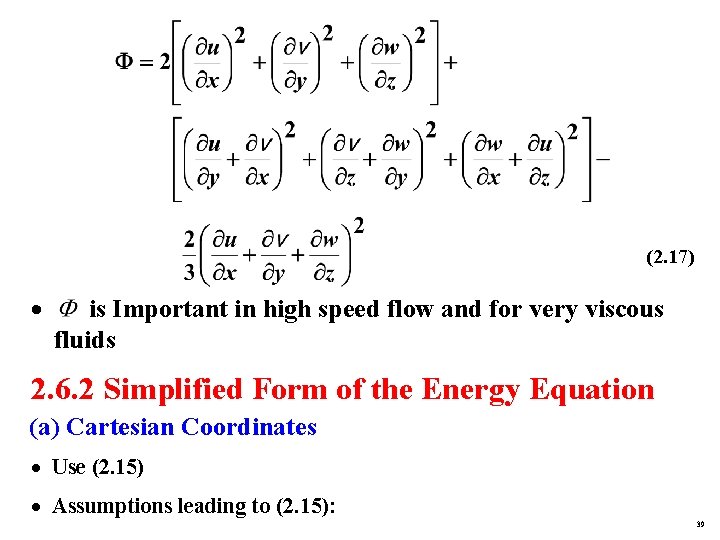
(2. 17) · is Important in high speed flow and for very viscous fluids 2. 6. 2 Simplified Form of the Energy Equation (a) Cartesian Coordinates · Use (2. 15) · Assumptions leading to (2. 15): 39
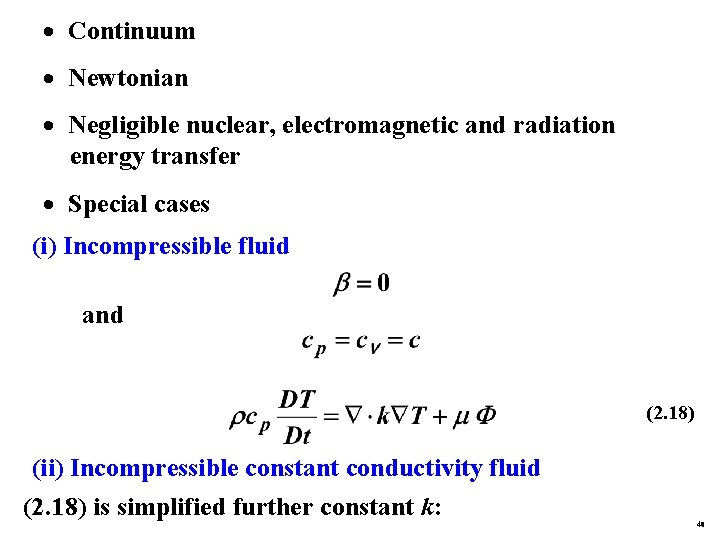
· Continuum · Newtonian · Negligible nuclear, electromagnetic and radiation energy transfer · Special cases (i) Incompressible fluid and (2. 18) (ii) Incompressible constant conductivity fluid (2. 18) is simplified further constant k: 40
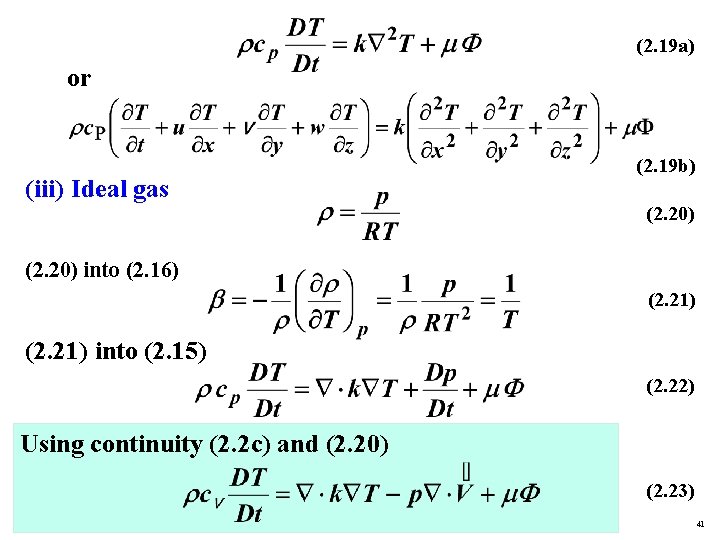
(2. 19 a) or (iii) Ideal gas (2. 19 b) (2. 20) into (2. 16) (2. 21) into (2. 15) (2. 22) Using continuity (2. 2 c) and (2. 20) (2. 23) 41
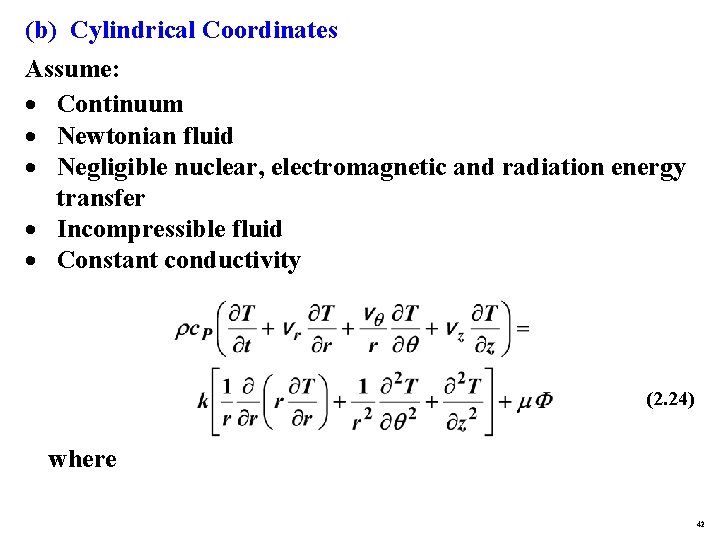
(b) Cylindrical Coordinates Assume: · Continuum · Newtonian fluid · Negligible nuclear, electromagnetic and radiation energy transfer · Incompressible fluid · Constant conductivity (2. 24) where 42
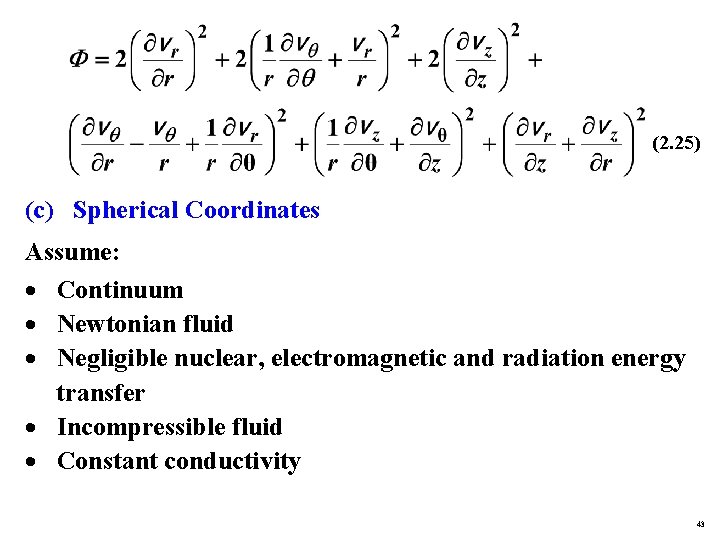
(2. 25) (c) Spherical Coordinates Assume: · Continuum · Newtonian fluid · Negligible nuclear, electromagnetic and radiation energy transfer · Incompressible fluid · Constant conductivity 43
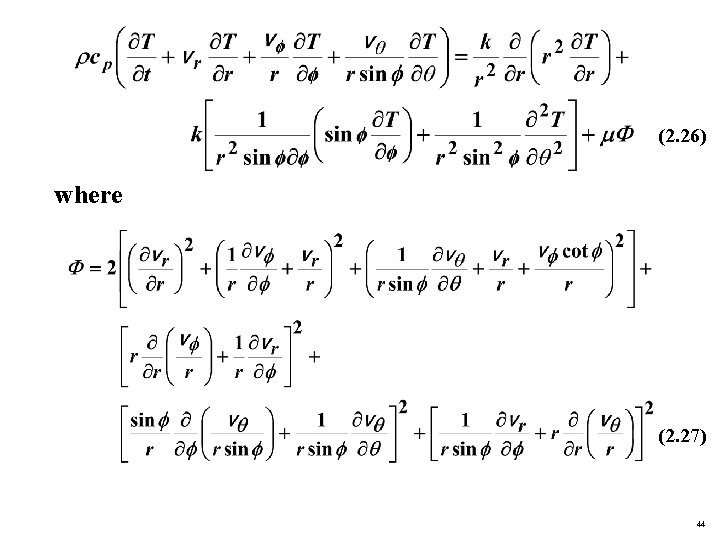
(2. 26) where (2. 27) 44
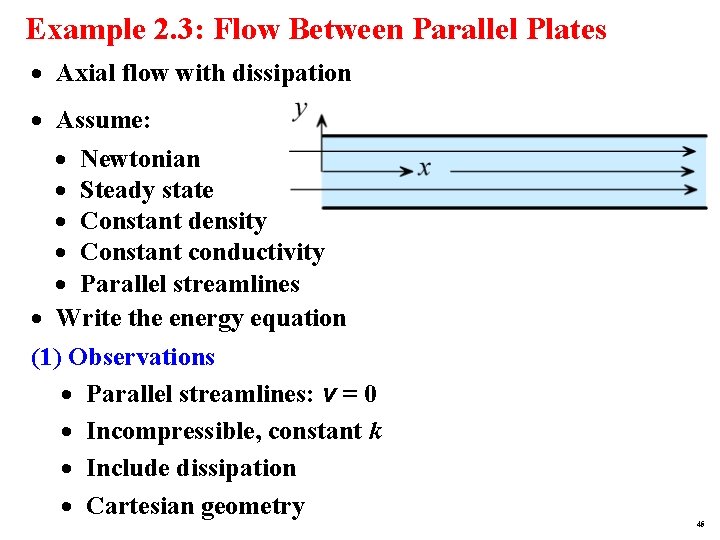
Example 2. 3: Flow Between Parallel Plates · Axial flow with dissipation · Assume: · Newtonian · Steady state · Constant density · Constant conductivity · Parallel streamlines · Write the energy equation (1) Observations · Parallel streamlines: v = 0 · Incompressible, constant k · Include dissipation · Cartesian geometry 45
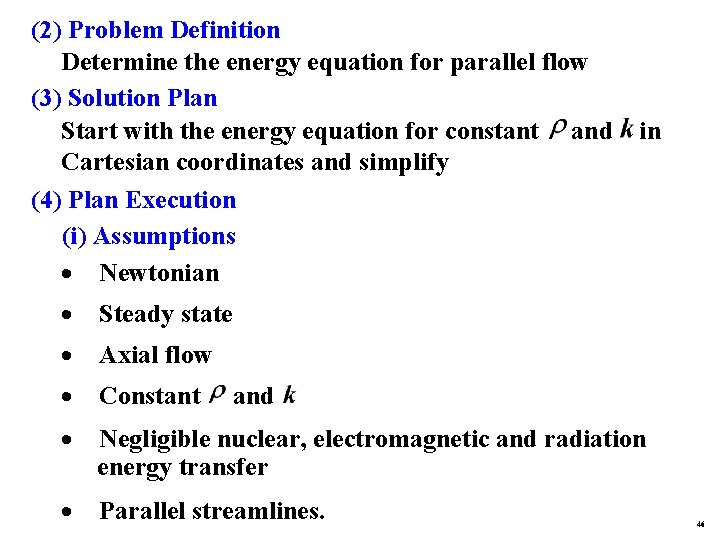
(2) Problem Definition Determine the energy equation for parallel flow (3) Solution Plan Start with the energy equation for constant and Cartesian coordinates and simplify (4) Plan Execution (i) Assumptions · Newtonian in · Steady state · Axial flow · Constant · Negligible nuclear, electromagnetic and radiation energy transfer · Parallel streamlines. and 46
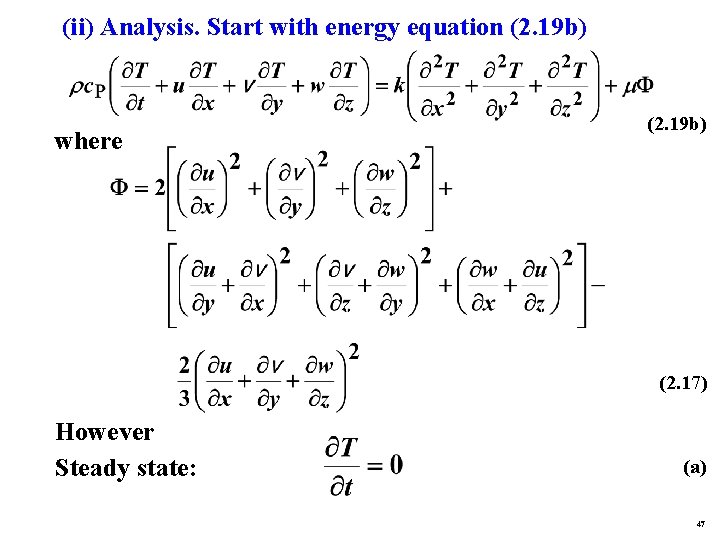
(ii) Analysis. Start with energy equation (2. 19 b) where (2. 19 b) (2. 17) However Steady state: (a) 47
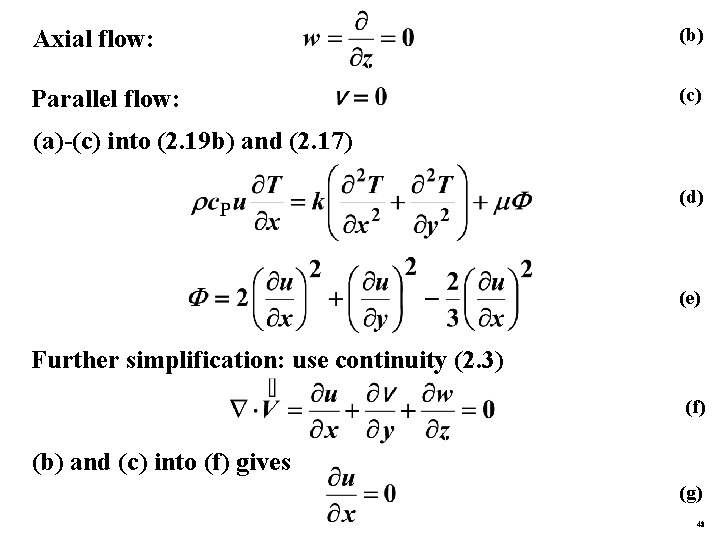
Axial flow: (b) Parallel flow: (c) (a)-(c) into (2. 19 b) and (2. 17) (d) (e) Further simplification: use continuity (2. 3) (f) (b) and (c) into (f) gives (g) 48
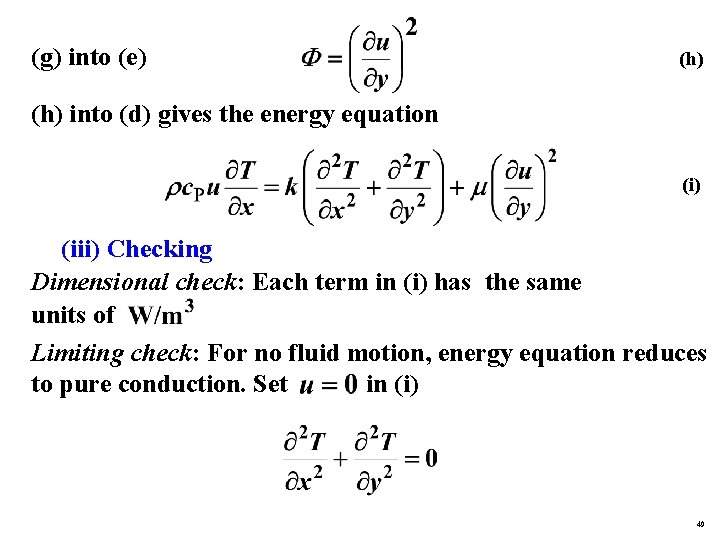
(g) into (e) (h) into (d) gives the energy equation (i) (iii) Checking Dimensional check: Each term in (i) has the same units of Limiting check: For no fluid motion, energy equation reduces to pure conduction. Set in (i) 49
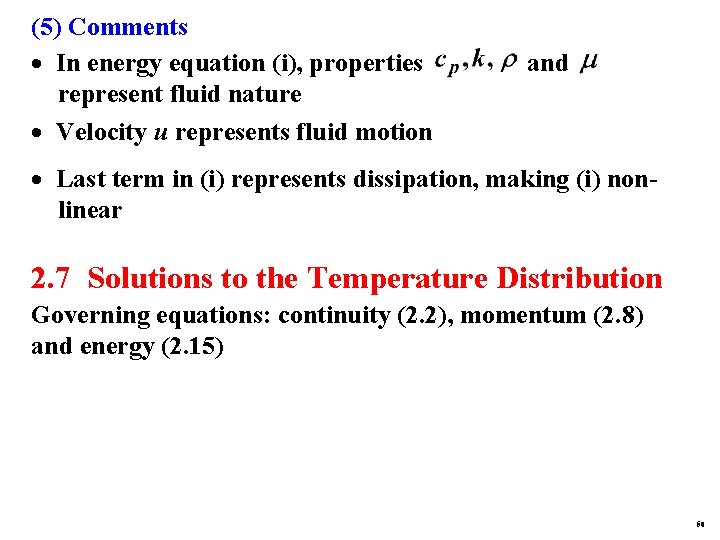
(5) Comments · In energy equation (i), properties represent fluid nature · Velocity u represents fluid motion and · Last term in (i) represents dissipation, making (i) nonlinear 2. 7 Solutions to the Temperature Distribution Governing equations: continuity (2. 2), momentum (2. 8) and energy (2. 15) 50
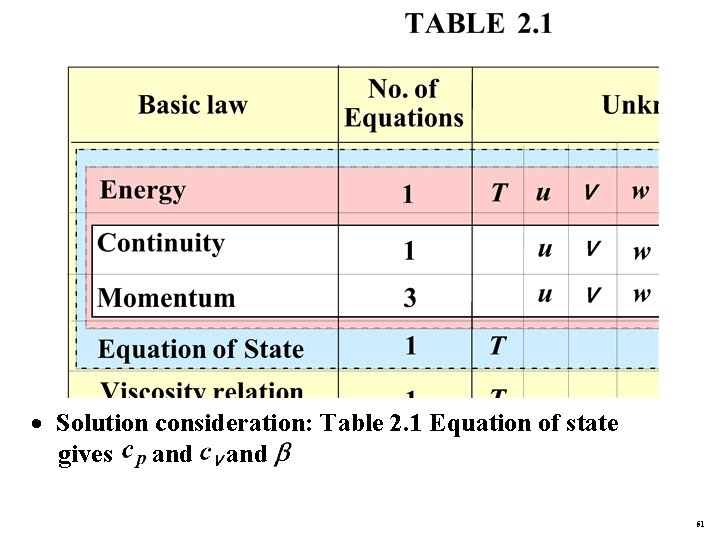
· Solution consideration: Table 2. 1 Equation of state gives and 51
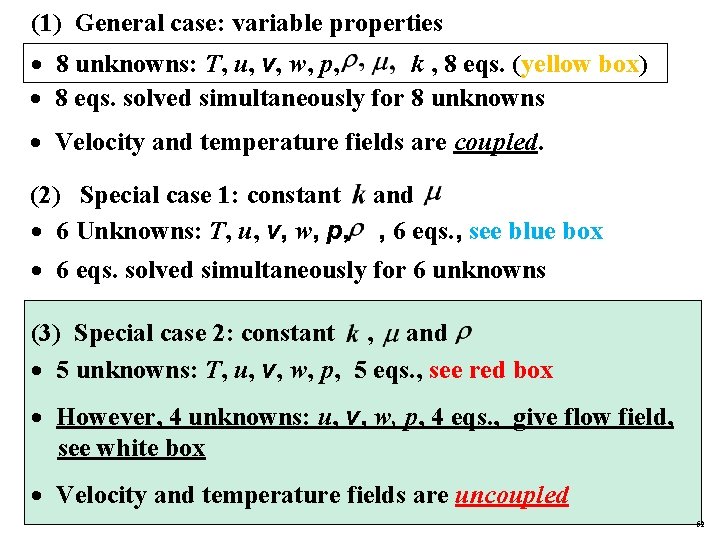
(1) General case: variable properties · 8 unknowns: T, u, v, w, p, k , 8 eqs. (yellow box) · 8 eqs. solved simultaneously for 8 unknowns · Velocity and temperature fields are coupled. (2) Special case 1: constant and · 6 Unknowns: T, u, v, w, p, , 6 eqs. , see blue box · 6 eqs. solved simultaneously for 6 unknowns (3) Special case 2: constant , and · 5 unknowns: T, u, v, w, p, 5 eqs. , see red box · However, 4 unknowns: u, v, w, p, 4 eqs. , give flow field, see white box · Velocity and temperature fields are uncoupled 52
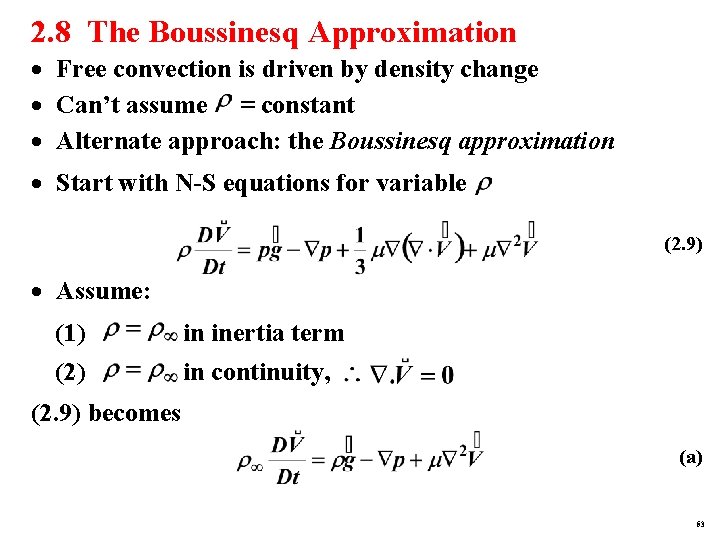
2. 8 The Boussinesq Approximation · Free convection is driven by density change · Can’t assume = constant · Alternate approach: the Boussinesq approximation · Start with N-S equations for variable (2. 9) · Assume: (1) in inertia term (2) in continuity, (2. 9) becomes (a) 53
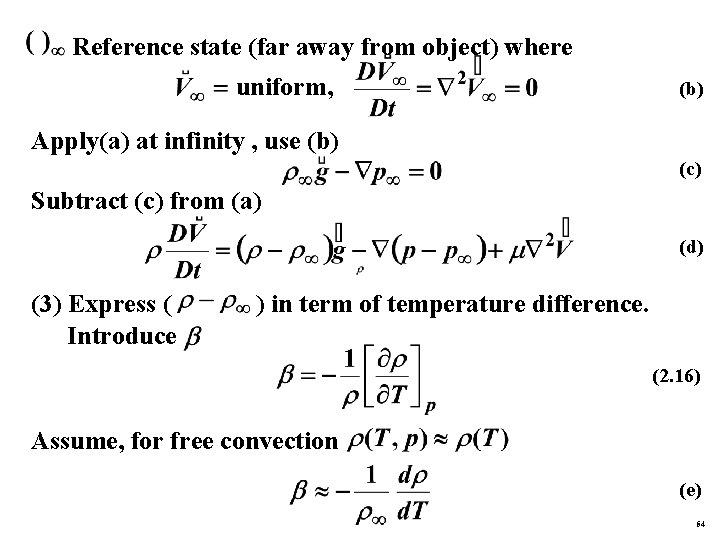
Reference state (far away from object) where uniform, (b) Apply(a) at infinity , use (b) (c) Subtract (c) from (a) (d) (3) Express ( Introduce ) in term of temperature difference. (2. 16) Assume, for free convection (e) 54
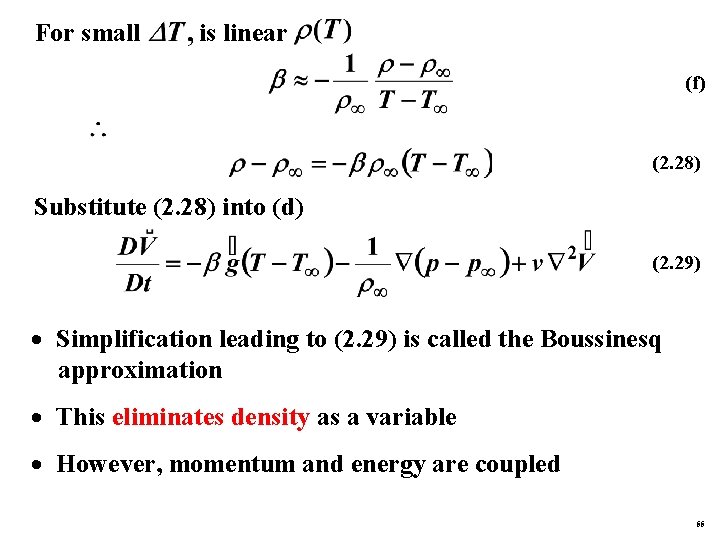
For small is linear (f) (2. 28) Substitute (2. 28) into (d) (2. 29) · Simplification leading to (2. 29) is called the Boussinesq approximation · This eliminates density as a variable · However, momentum and energy are coupled 55
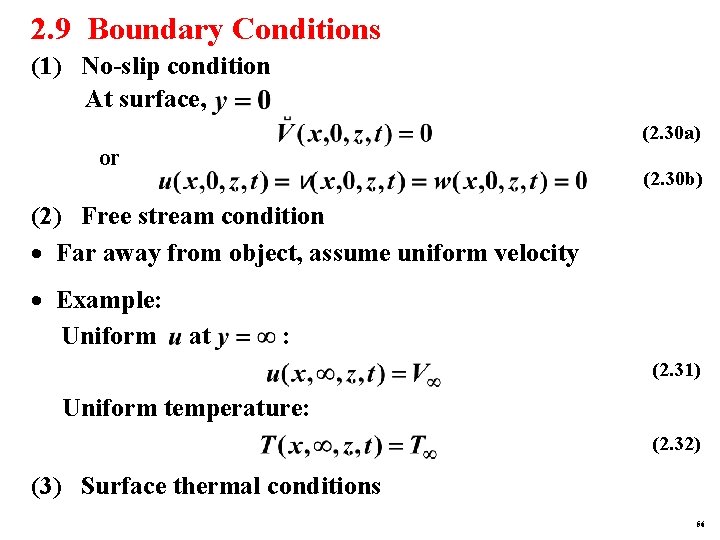
2. 9 Boundary Conditions (1) No-slip condition At surface, (2. 30 a) or (2. 30 b) (2) Free stream condition · Far away from object, assume uniform velocity · Example: Uniform at : (2. 31) Uniform temperature: (2. 32) (3) Surface thermal conditions 56
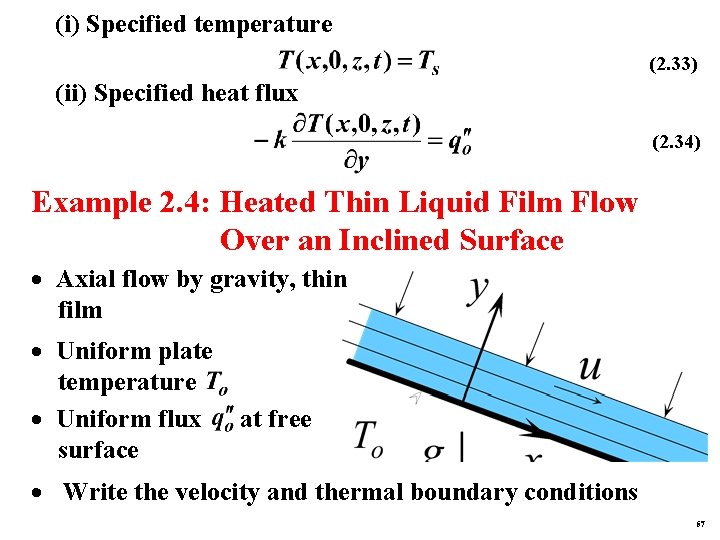
(i) Specified temperature (2. 33) (ii) Specified heat flux (2. 34) Example 2. 4: Heated Thin Liquid Film Flow Over an Inclined Surface · Axial flow by gravity, thin film · Uniform plate temperature · Uniform flux surface at free · Write the velocity and thermal boundary conditions 57
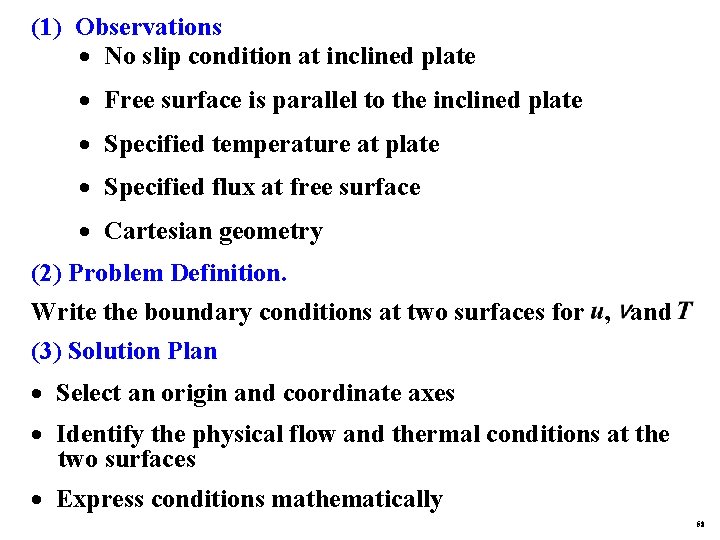
(1) Observations · No slip condition at inclined plate · Free surface is parallel to the inclined plate · Specified temperature at plate · Specified flux at free surface · Cartesian geometry (2) Problem Definition. Write the boundary conditions at two surfaces for , and (3) Solution Plan · Select an origin and coordinate axes · Identify the physical flow and thermal conditions at the two surfaces · Express conditions mathematically 58
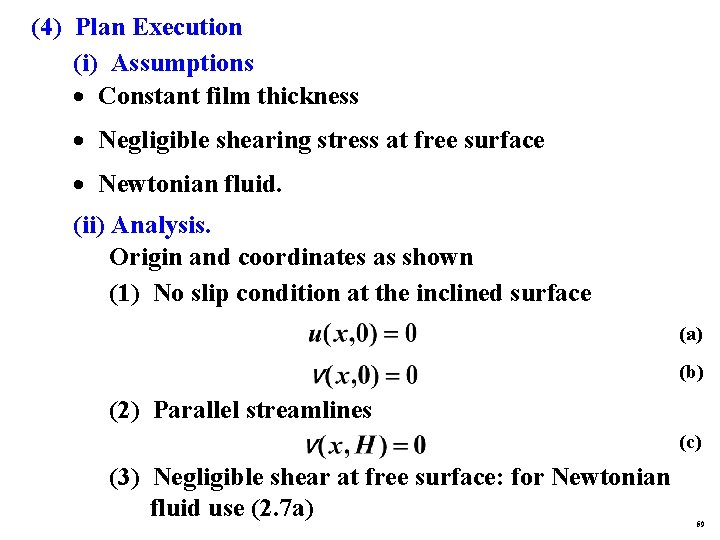
(4) Plan Execution (i) Assumptions · Constant film thickness · Negligible shearing stress at free surface · Newtonian fluid. (ii) Analysis. Origin and coordinates as shown (1) No slip condition at the inclined surface (a) (b) (2) Parallel streamlines (c) (3) Negligible shear at free surface: for Newtonian fluid use (2. 7 a) 59
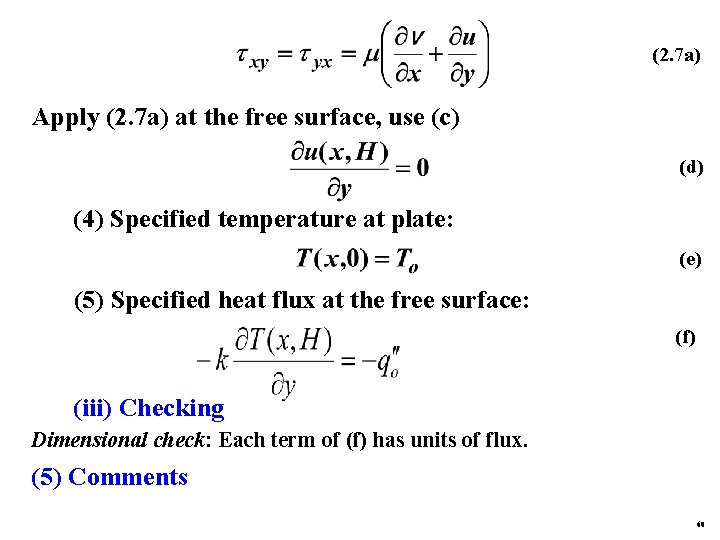
(2. 7 a) Apply (2. 7 a) at the free surface, use (c) (d) (4) Specified temperature at plate: (e) (5) Specified heat flux at the free surface: (f) (iii) Checking Dimensional check: Each term of (f) has units of flux. (5) Comments 60
- Slides: 62