Chapter 2 Developing Marketing Strategies and a Marketing






- Slides: 36
Chapter 2 Developing Marketing Strategies and a Marketing Plan ©Mc. Graw-Hill Education. All rights reserved. Authorized only for instructor use in the classroom. No reproduction or further distribution permitted without the prior written consent of Mc. Graw-Hill Education.
Learning Objectives Learning Objective 2. 1 Define a marketing strategy. Learning Objective 2. 2 Describe the elements of a marketing plan. Learning Objective 2. 3 Analyze a marketing situation using SWOT analyses. Learning Objective 2. 4 Describe how a firm chooses which consumer group(s) to pursue with its marketing efforts. Learning Objective 2. 5 Outline the implementation of the marketing mix as a means to increase customer value. Learning Objective 2. 6 Summarize portfolio analysis and its use to evaluate marketing performance. Learning Objective 2. 7 Describe how firms grow their business. 2 © Mc. Graw-Hill Education
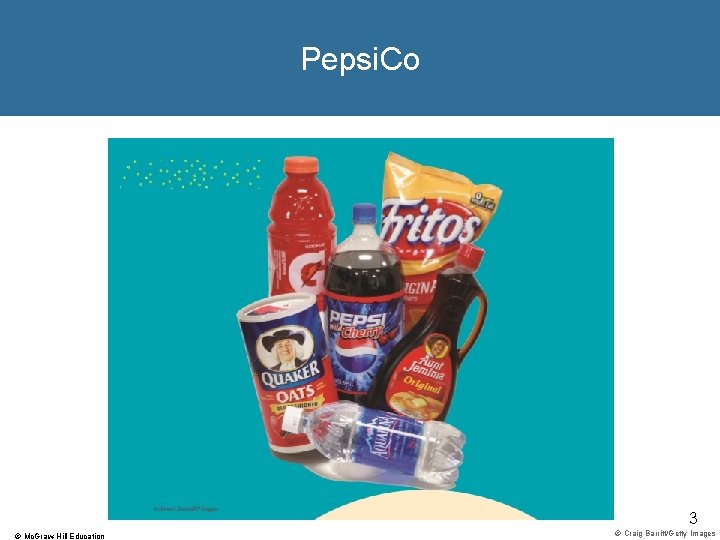
Pepsi. Co 3 © Mc. Graw-Hill Education © Craig Barritt/Getty Images
What is a Marketing Strategy? A marketing strategy identifies: • A firm’s target market. • A related marketing mix. • The bases on which the firm plans to build a sustainable competitive advantage. 4 © Mc. Graw-Hill Education
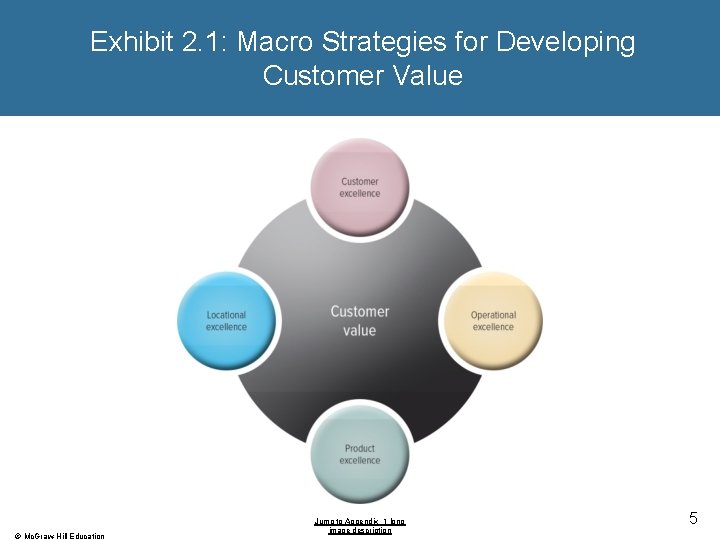
Exhibit 2. 1: Macro Strategies for Developing Customer Value © Mc. Graw-Hill Education Jump to Appendix 1 long image description 5
Customer Excellence • Retaining loyal customers • Providing outstanding customer service 6 © Mc. Graw-Hill Education ©TAO Images Limited/Alamy Stock Photo
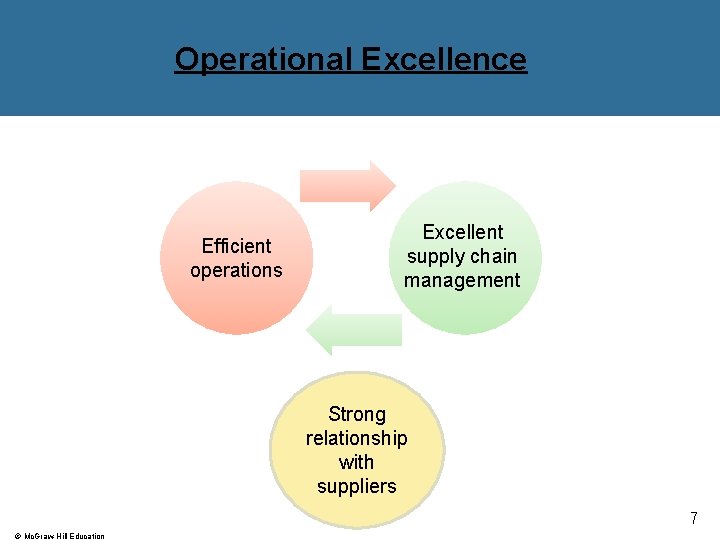
Operational Excellence Efficient operations Excellent supply chain management Strong relationship with suppliers 7 © Mc. Graw-Hill Education
Product Excellence Provide products with high perceived value and effective branding and positioning. Bloomberg Businessweek’s top global brands: • Apple, Google, Microsoft, Coca-Cola, Amazon, Samsung, Toyota, Facebook, Mercedes, IBM 8 © Mc. Graw-Hill Education ©Sean Gallup/Getty Images
Locational Excellence Especially important for retailers and service providers. Many say, “The three most important things in retailing are location, location. ” Competitive advantage based on location is not easily duplicated. Starbucks makes it difficult for competitors to enter a market and find good locations. 9 © Mc. Graw-Hill Education
Multiple Sources of Advantage A single strategy (low prices or excellent service) is usually not enough to build a sustainable competitive advantage. Southwest Airlines • Provides good service at a good value (on-time flights that are reasonably priced) 10 © Mc. Graw-Hill Education
PROGRESS CHECK (1 of 3) 1. What are the various components of a marketing strategy? 2. List the four macro strategies that can help a firm develop a sustainable competitive advantage. 11 © Mc. Graw-Hill Education
Exhibit 2. 2: The Marketing Plan © Mc. Graw-Hill Education Jump to Appendix 2 long image description 12
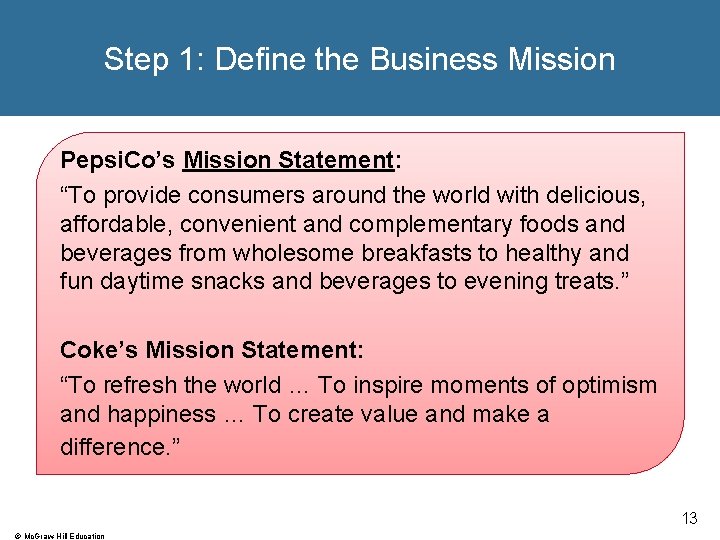
Step 1: Define the Business Mission Pepsi. Co’s Mission Statement: “To provide consumers around the world with delicious, affordable, convenient and complementary foods and beverages from wholesome breakfasts to healthy and fun daytime snacks and beverages to evening treats. ” Coke’s Mission Statement: “To refresh the world … To inspire moments of optimism and happiness … To create value and make a difference. ” 13 © Mc. Graw-Hill Education
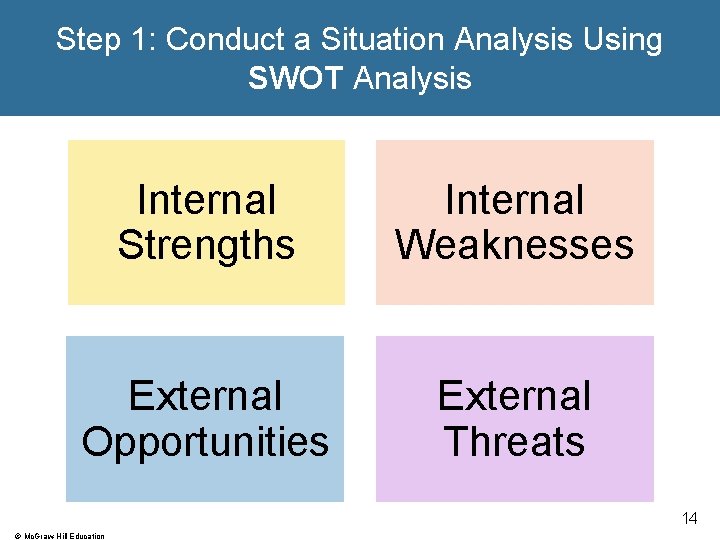
Step 1: Conduct a Situation Analysis Using SWOT Analysis Internal Strengths Internal Weaknesses External Opportunities External Threats 14 © Mc. Graw-Hill Education
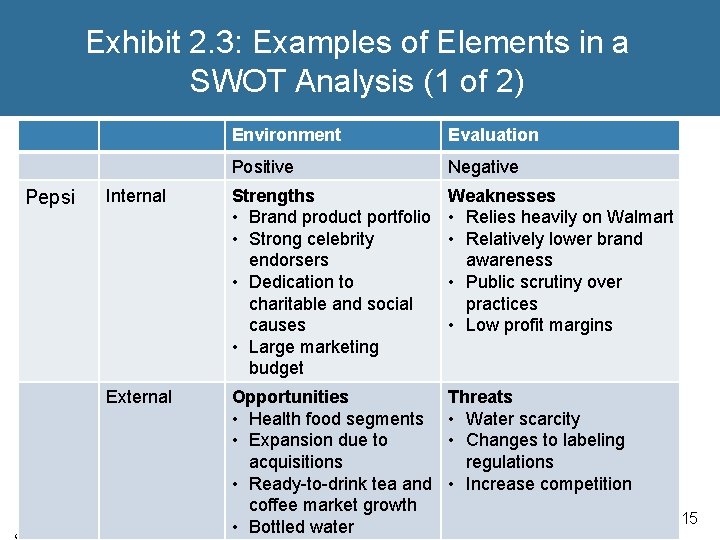
Exhibit 2. 3: Examples of Elements in a SWOT Analysis (1 of 2) Pepsi © Mc. Graw-Hill Education Environment Evaluation Positive Negative Internal Strengths • Brand product portfolio • Strong celebrity endorsers • Dedication to charitable and social causes • Large marketing budget Weaknesses • Relies heavily on Walmart • Relatively lower brand awareness • Public scrutiny over practices • Low profit margins External Opportunities • Health food segments • Expansion due to acquisitions • Ready-to-drink tea and coffee market growth • Bottled water Threats • Water scarcity • Changes to labeling regulations • Increase competition 15
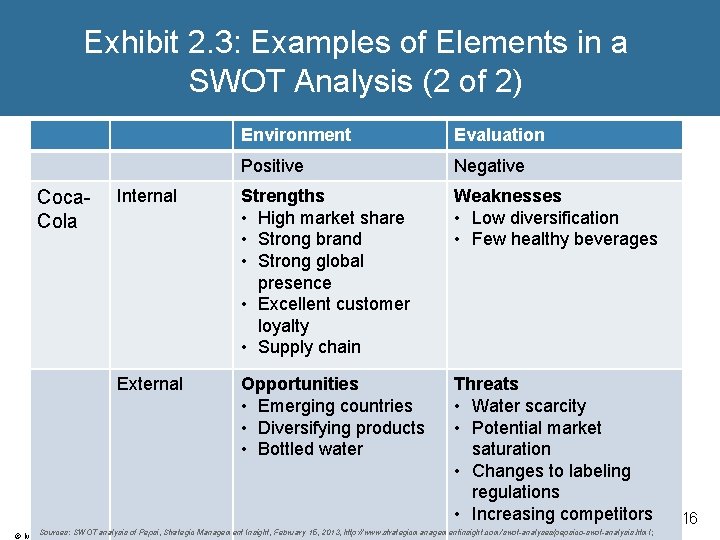
Exhibit 2. 3: Examples of Elements in a SWOT Analysis (2 of 2) Coca. Cola Environment Evaluation Positive Negative Internal Strengths • High market share • Strong brand • Strong global presence • Excellent customer loyalty • Supply chain Weaknesses • Low diversification • Few healthy beverages External Opportunities • Emerging countries • Diversifying products • Bottled water Threats • Water scarcity • Potential market saturation • Changes to labeling regulations • Increasing competitors Sources: SWOT analysis of Pepsi, Strategic Management Insight, February 15, 2013, http: //www. strategicmanagementinsight. com/swot-analyses/pepsico-swot-analysis. html; © Mc. Graw-Hill Education 16
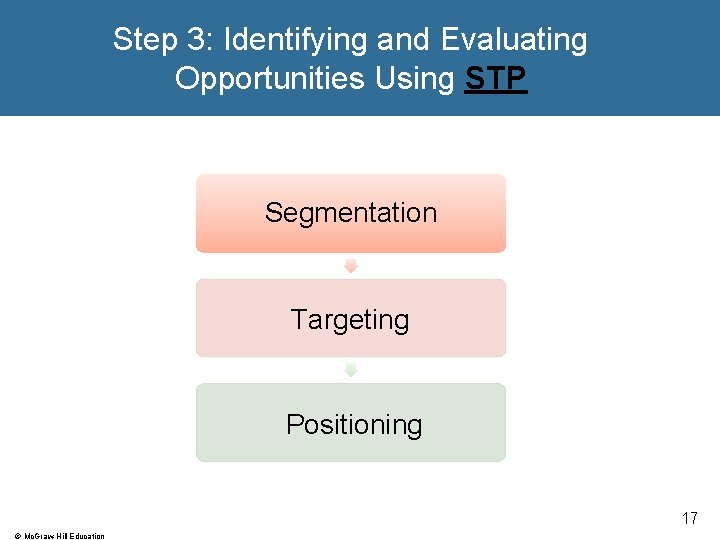
Step 3: Identifying and Evaluating Opportunities Using STP Segmentation Targeting Positioning 17 © Mc. Graw-Hill Education
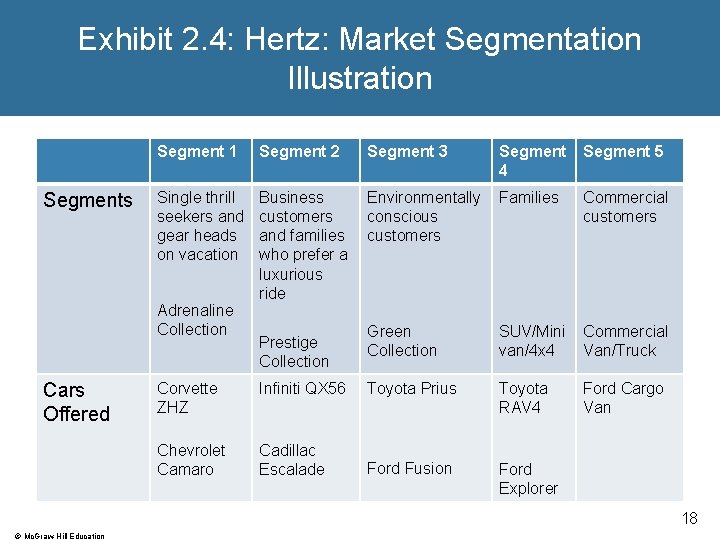
Exhibit 2. 4: Hertz: Market Segmentation Illustration Segments Segment 1 Segment 2 Single thrill seekers and gear heads on vacation Business Environmentally Families customers conscious and families customers who prefer a luxurious ride Adrenaline Collection Cars Offered Prestige Collection Segment 3 Segment 4 Segment 5 Commercial customers Green Collection SUV/Mini van/4 x 4 Commercial Van/Truck Ford Cargo Van Corvette ZHZ Infiniti QX 56 Toyota Prius Toyota RAV 4 Chevrolet Camaro Cadillac Escalade Ford Fusion Ford Explorer 18 © Mc. Graw-Hill Education
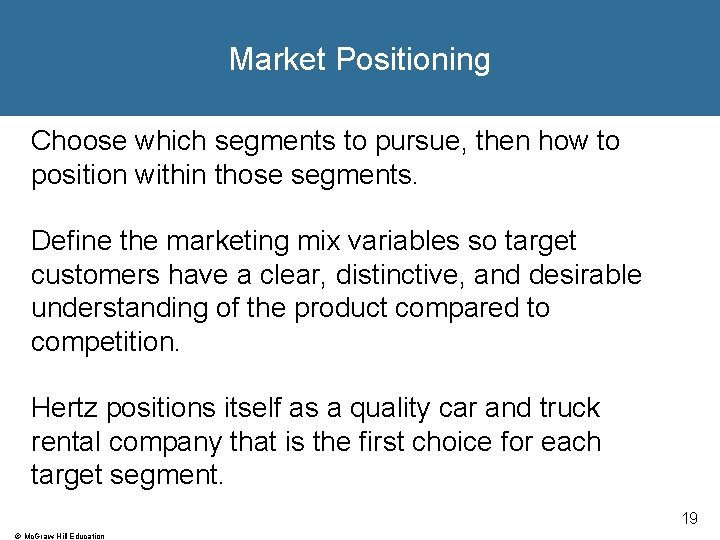
Market Positioning Choose which segments to pursue, then how to position within those segments. Define the marketing mix variables so target customers have a clear, distinctive, and desirable understanding of the product compared to competition. Hertz positions itself as a quality car and truck rental company that is the first choice for each target segment. 19 © Mc. Graw-Hill Education
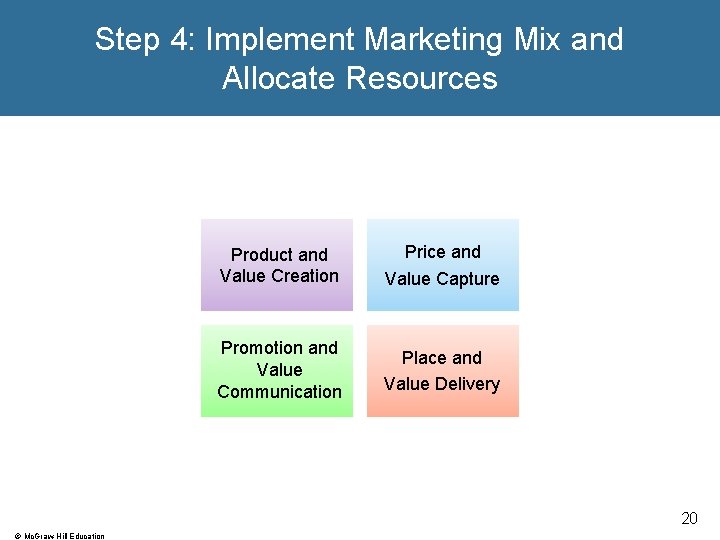
Step 4: Implement Marketing Mix and Allocate Resources Price and Product and Value Creation Value Capture Promotion and Value Communication Place and Value Delivery 20 © Mc. Graw-Hill Education
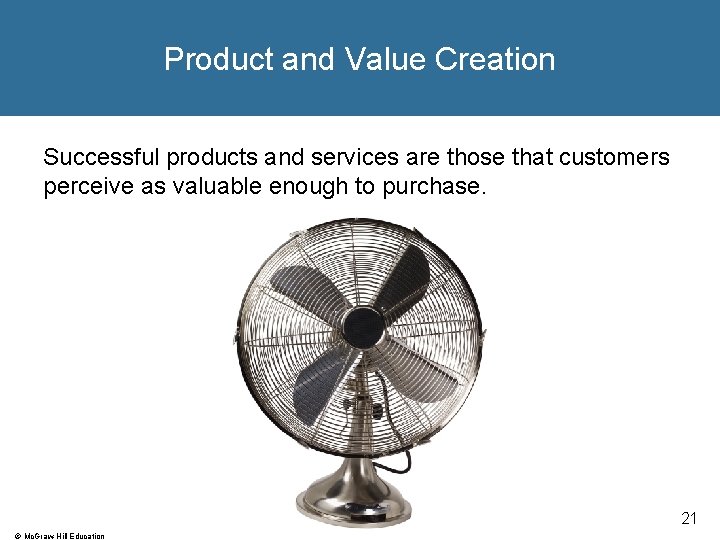
Product and Value Creation Successful products and services are those that customers perceive as valuable enough to purchase. 21 © Mc. Graw-Hill Education
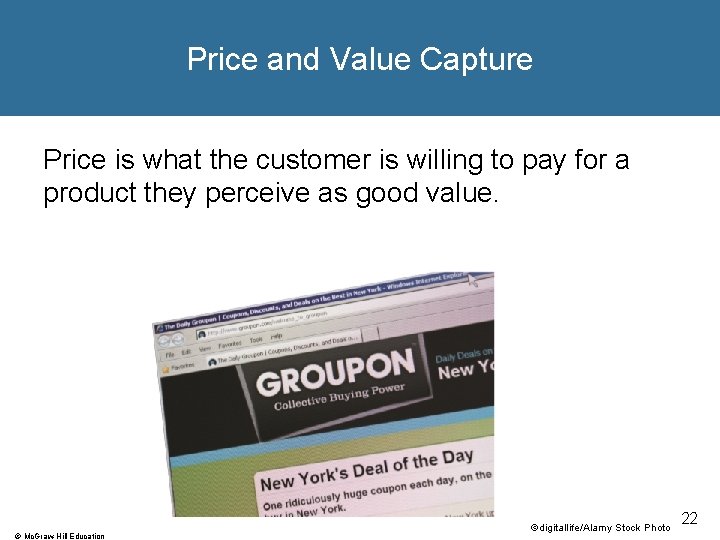
Price and Value Capture Price is what the customer is willing to pay for a product they perceive as good value. © Mc. Graw-Hill Education ©digitallife/Alamy Stock Photo 22
Place and Value Delivery The product must be readily accessible when and where the customer wants it. Dyson provides product and place value. Where are Dyson fans available? 23 © Mc. Graw-Hill Education
Promotion and Value Communication IMC: Integrated Marketing Communications • • • Advertising Personal selling Sales promotion Public relations Direct marketing Online marketing (including social media) 24 © Mc. Graw-Hill Education
Step 5: Evaluate Performance Using Marketing Metrics A metric is a measuring system that quantifies a trend, dynamic, or characteristic. Metrics are used to explain why things happened and also project the future. Social and Mobile Marketing 2. 1: Proctor & Gamble (P&G) devised a strategy to calculate the returns on Snapchat campaigns. 25 © Mc. Graw-Hill Education
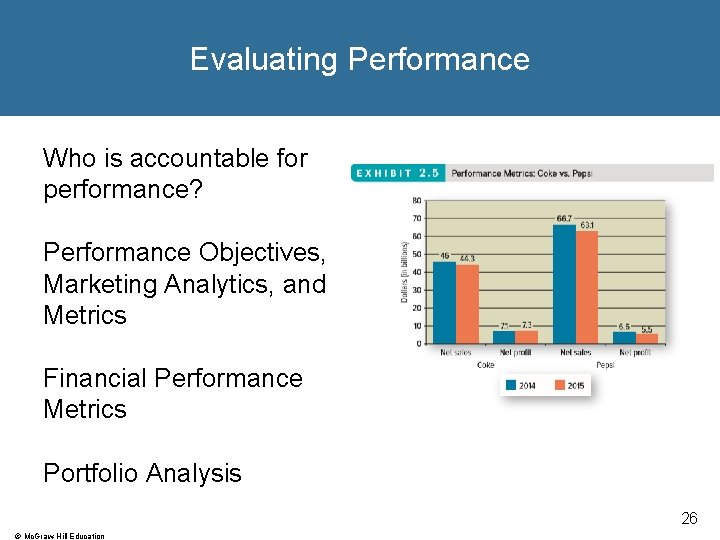
Evaluating Performance Who is accountable for performance? Performance Objectives, Marketing Analytics, and Metrics Financial Performance Metrics Portfolio Analysis 26 © Mc. Graw-Hill Education
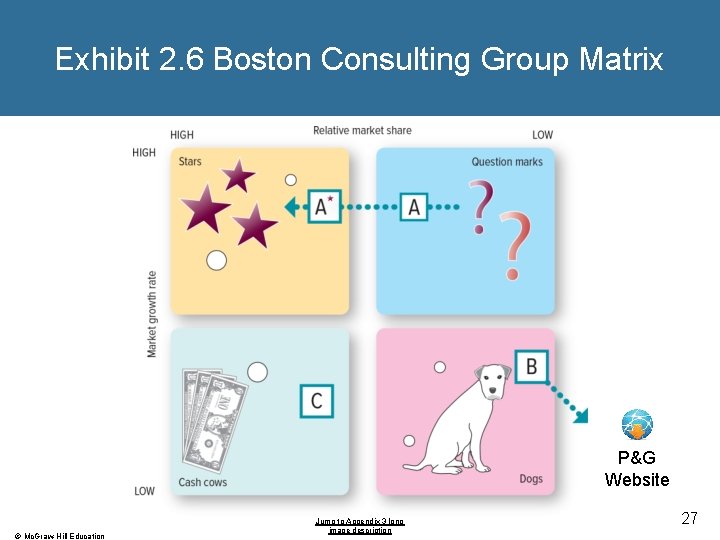
Exhibit 2. 6 Boston Consulting Group Matrix P&G Website © Mc. Graw-Hill Education Jump to Appendix 3 long image description 27
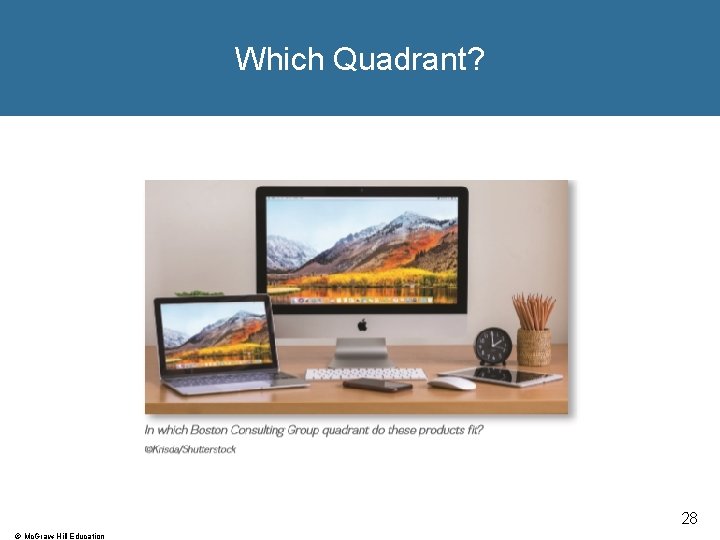
Which Quadrant? 28 © Mc. Graw-Hill Education
PROGRESS CHECK (2 of 3) 1. What are the five steps in creating a marketing plan? 2. What tool helps a marketer conduct a situation analysis? 3. What is STP? 4. What do the four quadrants of the portfolio analysis represent? 29 © Mc. Graw-Hill Education
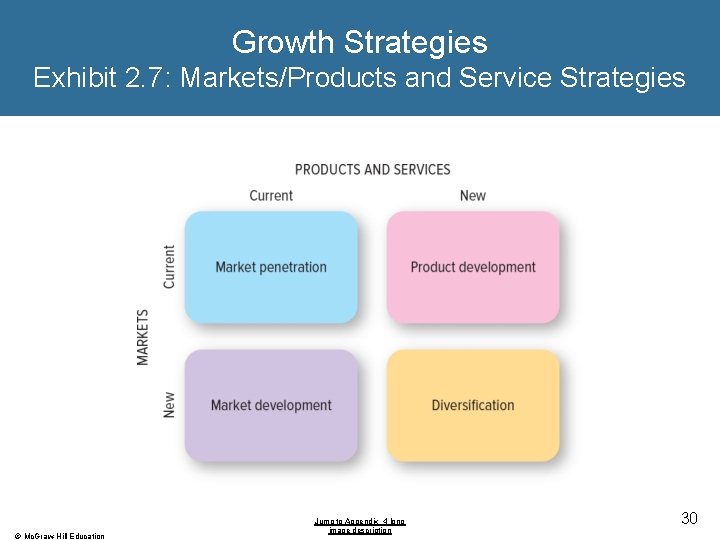
Growth Strategies Exhibit 2. 7: Markets/Products and Service Strategies © Mc. Graw-Hill Education Jump to Appendix 4 long image description 30
Market Penetration Existing marketing mix, Existing customers Marvel used a market penetration strategy by expanding the distribution of its films: • Theaters • Xfinity • DVDs (in a variety of retail locations) 31 © Mc. Graw-Hill Education
Market Development Current Products or Services New Markets What can a company do to continue to grow in a difficult retail environment? 32 © Mc. Graw-Hill Education
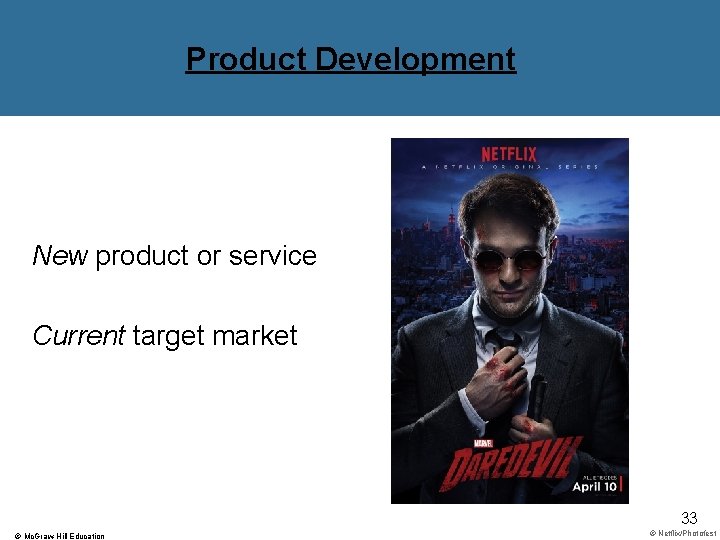
Product Development New product or service Current target market 33 © Mc. Graw-Hill Education © Netflix/Photofest
Diversification New product or service New market segment Related vs. unrelated diversification 34 © Mc. Graw-Hill Education
PROGRESS CHECK (3 of 3) 1. What are the four growth strategies? 2. What type of strategy is growing the business from existing customers? 3. Which strategy is the riskiest? 35 © Mc. Graw-Hill Education
Marketing Chapter 2 The End