
Chapter 2 Developing a Good Research Idea Characteristics

- Slides: 22
Chapter 2 Developing a Good Research Idea
Characteristics of a Good Research Idea § Observable/Testable § Repeatable § Realistic
Sources of Good Ideas Systematic vs. Non-systematic
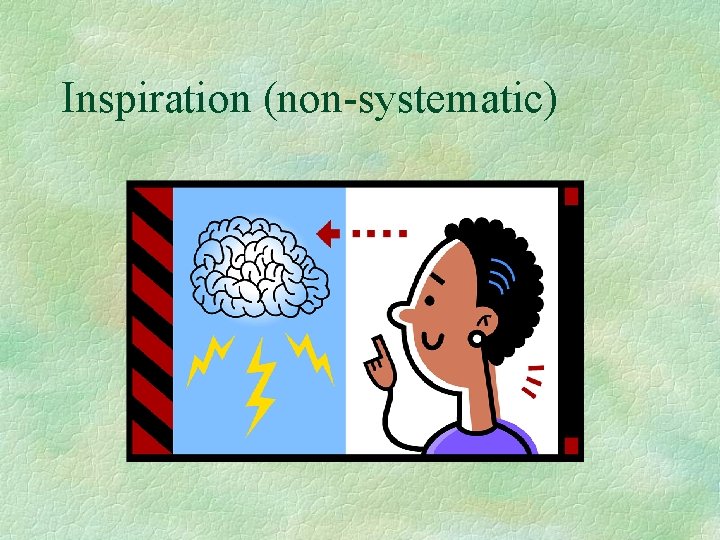
Inspiration (non-systematic)
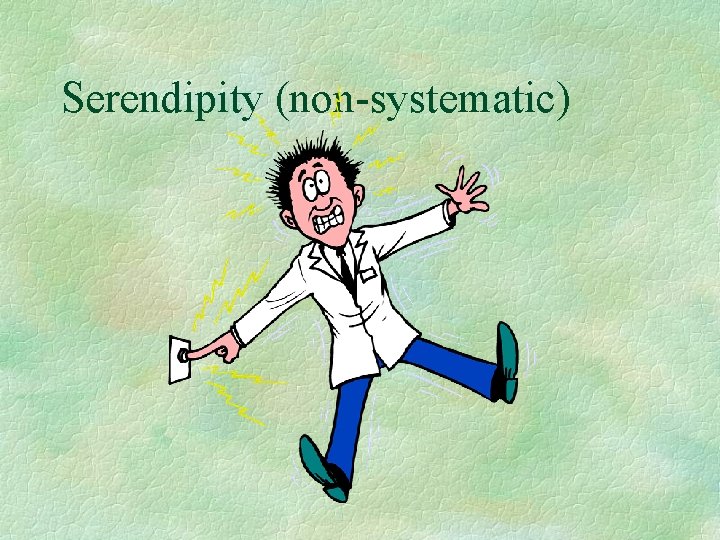
Serendipity (non-systematic)
Observation of Everyday Life (non-systematic)
Lectures (systematic)
Past Research (Systematic)
Necessity (non-systematic)
Funding (systematic & non)
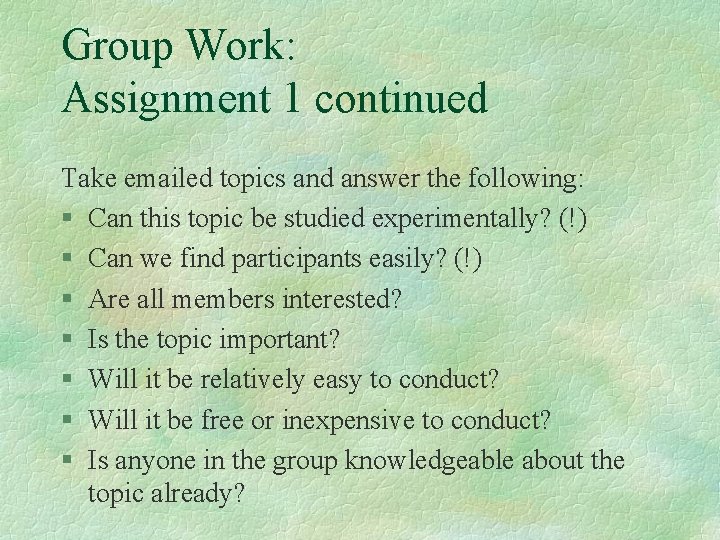
Group Work: Assignment 1 continued Take emailed topics and answer the following: § Can this topic be studied experimentally? (!) § Can we find participants easily? (!) § Are all members interested? § Is the topic important? § Will it be relatively easy to conduct? § Will it be free or inexpensive to conduct? § Is anyone in the group knowledgeable about the topic already?
Framing Your Study Theories and Hypotheses
Theory § Interrelated set of concepts that is used to explain data and to make predictions about future findings.
Hypothesis § Prediction about the relationship that exists between variables we are interested in. § Synthetic Statement: one which can be either true or false.
Deductive Reasoning § Reasoning from a theory to a more specific hypothesis.
Inductive Reasoning § Reasoning from more specific findings (hypothesis) to a general theory.
What makes a good theory? Why some theories are better than others? § Educated explanation for why we find some things and not others. § Allows for specific predictions (hypotheses)
What Makes a Good Hypothesis?
Principal of Falsifiability § Predictions must be potentially shown to be false. § Besides, you can’t ever prove that something is true forever.
Risky Predictions § General and easy to prove hypotheses aren’t very useful. Students who study will get better grades. Vs. Students who study in blocks of time will get better grades than those who cram.
Types of Hypotheses § Directional: specifically predicts which group will score higher relative to the other(s). Easier to find significance, but riskier. One-tailed statistical test § Non. Directional: only specifies that there will be a difference. Harder to find significance. Two-tailed statistical test
Group Activity § Find a journal § Look for