
Chapter 2 Determining Your Own Leadership Style Learning
- Slides: 27
Chapter 2 Determining Your Own Leadership Style
Learning Objectives • Name and describe at least four assessments related to leadership. • Explain your personality type, leadership style, principles and foundational skills as informed by leadership and leadership related assessment instruments. • Produce results of at least four leadership related assessments and prepare/apply those results to your leadership persona.
Learning Objectives • Identify and distinguish your leadership style, principles and foundational skills strengths and weaknesses based on leadership related assessment instruments’ results. • Based on self assessments of your personality type, leadership style, principles and foundational skills, devise an outline of a plan to improve your weaknesses while leveraging or enhancing your strengths. • Critique and interpret your unique leadership persona and relate your leadership persona with examples from your life experiences.
Determining Your Own Leadership Style • Know Thyself: What Kind of Leader Are You? – All leaders, regardless of natural abilities, experience, education, and training must be aware of their own personal areas for improvement in order to grow and become more successful.
Determining Your Own Leadership Style • Know Thyself: What Kind of Leader Are You? – As a result, we ask you to consider the following: • What kind of leader are you? • What are your strengths and weakness? • Are you aware of how those strengths and weakness contribute to your leadership style?
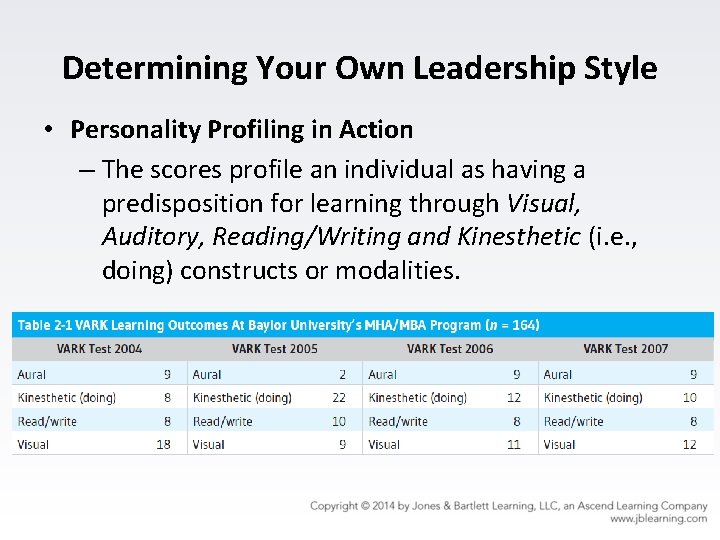
Determining Your Own Leadership Style • Personality Profiling in Action – The scores profile an individual as having a predisposition for learning through Visual, Auditory, Reading/Writing and Kinesthetic (i. e. , doing) constructs or modalities.
Determining Your Own Leadership Style • The Importance of Understanding Personalities in the Workforce – Understanding the personalities of subordinates, peers, and superiors in the health organization is imperative to the general success of healthcare leaders. – Understanding personalities makes it easier for the healthcare leader to recognize potential, motivation, competitiveness, team structure, coalition building, interpersonal relationships, and communication.
Determining Your Own Leadership Style • Leadership and Personality Self Assessment – The goal is to ‘know thyself’ as a healthcare leader and identify and leverage one’s strengths while improving weaknesses to create more potential for great leadership.
Determining Your Own Leadership Style • Leader and Personality Assessments ØEmotional Intelligence: • Four salient constructs of the emotional intelligence model are: 1) self-awareness; 2) self-management; 3) social awareness; and 4) social skills. – Lanser, Ellen G. (2000). “Why You Should Care About Your Emotional Intelligence: Strategies for Honing Important Emotional Competencies” Healthcare Executive, Vol. 15, No. 6, pgs. 7 - 9.
Determining Your Own Leadership Style • Leader and Personality Assessments ØHemisphere Dominance: This assessment determines brain hemisphere dominance (right or left). – Right brained individuals may be best suited for creating new product and service lines, developing long range strategic plans and forecasting threats on the environmental horizon. – Left brained individuals are more detail oriented, methodical and calculating, preferring to implement strategic plans over developing them.
Determining Your Own Leadership Style • Jungian Assessments: – Scholars suggest that all individuals are born with a personality archetype. – The dimensions are: extraversion or introversion, sensing or intuition, thinking or feeling and judging or perceiving.
Determining Your Own Leadership Style • Type “A” and “B” Personality Indicators: – Type “A” Individuals: competitive, inquisitive, easily bored with routine, have a short fuse, often feel impatient, and may be aggressive – Type “B” Individuals: directly opposite; easily relax, maintain focus on activities and projects, envision stability as comforting and can be perceived as more social and easy going. – Individuals that present with a combination of both characteristics are described as A/B personalities.
Determining Your Own Leadership Style • The VARK Test – This type of assessment provides an insight into an individual’s predisposition to learn based on learning style. • Visual learners • Aural learners • Reading and writing • Kinesthetic learners
Determining Your Own Leadership Style • The New Enneagram Test – Enneagrams can be divided up into 9 primary constructs or types. These are the Reformer, Helper, Motivator, Romantic, Thinker, Skeptic, Adventurers, Leader and Peacemaker.
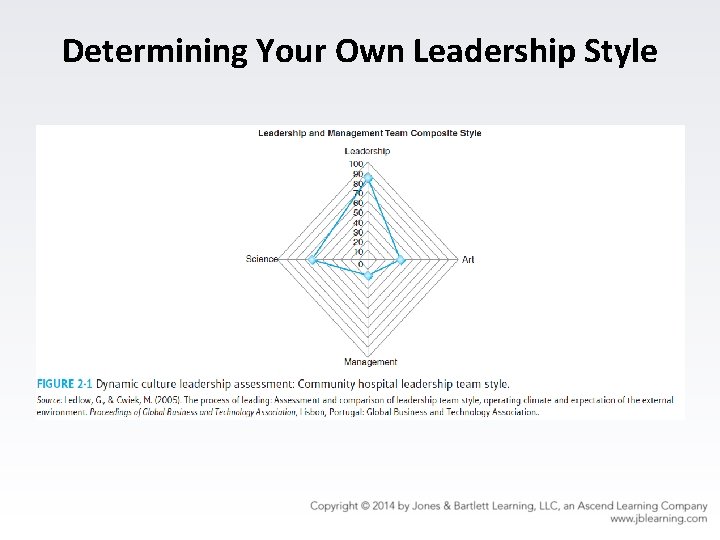
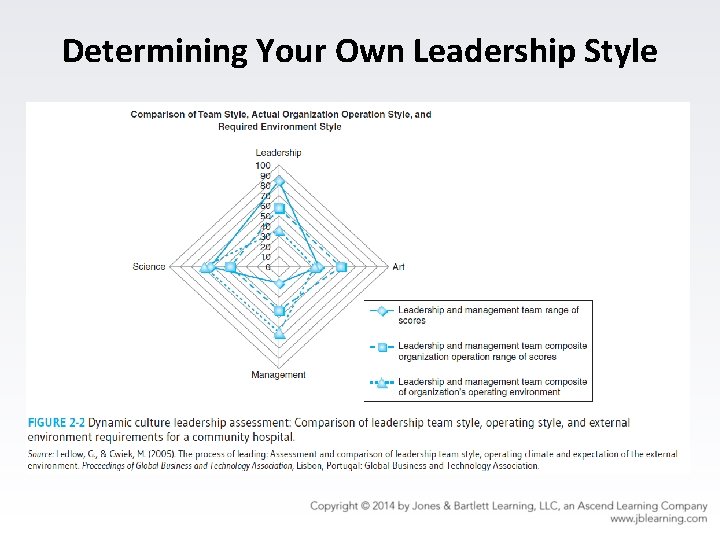
Determining Your Own Leadership Style • Dynamic Culture Leadership Alignment Assessment – This type of assessment evaluates the leadership styles and propensities of the leadership group, the organization’s operating style and the perceived external environment expectations of the organization. This assessment can also be used as an individual assessment for leadership, management, technical (science) and art (relationships) propensities, communication, planning, decision alignment, employee enhancement and knowledge management constructs.
Determining Your Own Leadership Style
Determining Your Own Leadership Style
Determining Your Own Leadership Style • Studer Group – The ‘Leader as Coach’ assessment is a quick evaluation of your coaching propensity. The instrument groups the assessment outcomes into one of three categories of high, middle or low coaching capabilities.
Determining Your Own Leadership Style • Additional Leadership Assessments – Leadership Diagnostics – Anthony J. Mayo – Dale Kurow – Price Group
Determining Your Own Leadership Style • The Relationship Between Personality Archetype and Leadership – Research is in agreement that personality archetypes do affect leadership style, success and outcomes in the workplace. – Equally, leadership can be learned and developed. – Malcolm Gladwell’s book, Outliers: The Story of Success suggests that 10, 000 hours of practice, experience, trial and error and self discovery are required to become a master or an expert in anything with rare exception to this standard.
Determining Your Own Leadership Style • Methods to Maximize Your Nature Versus Nurture Leadership State of Being § Education and Study § Experience § Professional Organizations § Mentoring
Discussion Questions • Describe four leadership, leadership-related or personality assessments that were most informative for you? Did others select the same assessments? Why or why not? • Distinguish the various typologies (categories) used in personality assessments and personality archetype assessments and explain the differences of the ‘types. ’
Discussion Questions • Relate two or more assessments from this chapter regarding your personal assessment; were the assessments complementary or contradictory and show why you think so? • From the assessments (two or more), identify the health leader most appealing to you (a real leader of one you contrive). Using the assessments’ constructs and typologies, why is that health leader appealing?
Discussion Questions • Compile and categorize your assessment results, explain the results in summary and tell the group your plan for leadership mastery. • Appraise the empirical strength of assessment instruments, critique two or more assessments and justify your critique.
Exercises • Name and describe at least four assessments related to leadership you used in two pages or less. • Explain your leadership style, principles and foundational skills as related to leadership assessment instruments using at least four assessments in a three page essay. • Produce results of at least four leadership related assessments and prepare/apply those results to your leadership persona and attach to your three page essay.
Exercises • Identify and distinguish your leadership style, principles and foundational skills strengths and weaknesses based on leadership related assessment instruments’ results in a two page document attached to your essay and results document. • Based on self assessments of your personality style, leadership style, principles and foundational skills, devise an outline of a plan to improve your weaknesses while leveraging or enhancing your strengths. Add this work to your essay, results and strengths and weaknesses document.
Exercises • Critique and interpret your unique leadership persona and relate your leadership persona with examples from your life experiences in a two to three page document. Attach this work to your previous work. Return and read this document once a month until you have achieved your goals for improving your leadership capabilities.