
Chapter 2 Determination of Tax Learning Objectives Use

Chapter 2 Determination of Tax
Learning Objectives • Use the tax formula to compute an individual’s taxable income • Determine the amount allowable for the standard deduction • Determine the amount and the correct number of personal and dependency deductions
Learning Objectives • • Determine the amount of child credit Determine the filing status of individuals Explain the tax formula for corporations Explain the basic concepts of property transactions
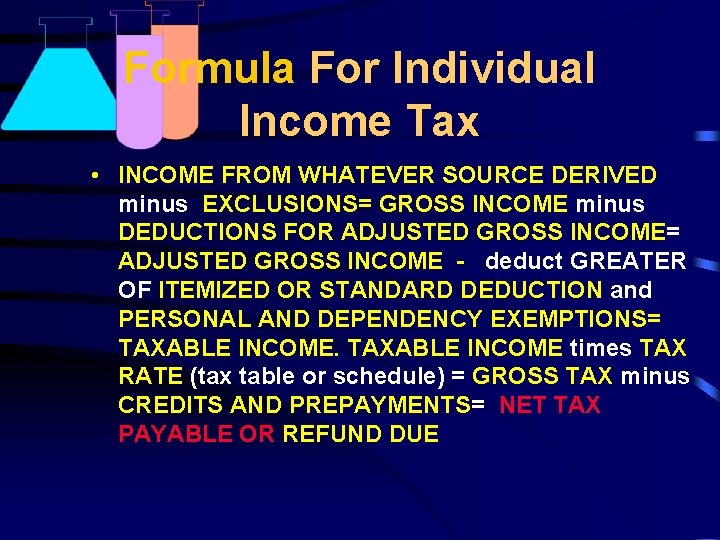
Formula For Individual Income Tax • INCOME FROM WHATEVER SOURCE DERIVED minus EXCLUSIONS= GROSS INCOME minus DEDUCTIONS FOR ADJUSTED GROSS INCOME= ADJUSTED GROSS INCOME - deduct GREATER OF ITEMIZED OR STANDARD DEDUCTION and PERSONAL AND DEPENDENCY EXEMPTIONS= TAXABLE INCOME times TAX RATE (tax table or schedule) = GROSS TAX minus CREDITS AND PREPAYMENTS= NET TAX PAYABLE OR REFUND DUE
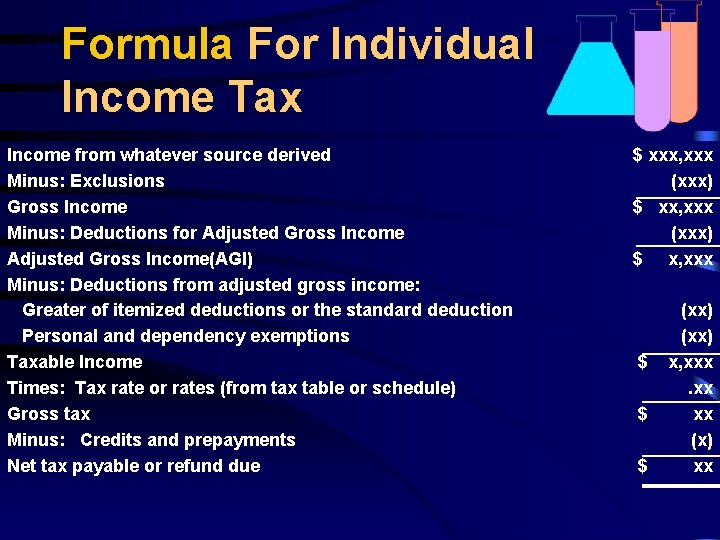
Formula For Individual Income Tax Income from whatever source derived Minus: Exclusions Gross Income Minus: Deductions for Adjusted Gross Income(AGI) Minus: Deductions from adjusted gross income: Greater of itemized deductions or the standard deduction Personal and dependency exemptions Taxable Income Times: Tax rate or rates (from tax table or schedule) Gross tax Minus: Credits and prepayments Net tax payable or refund due $ xxx, xxx (xxx) $ x, xxx $ $ $ (xx) x, xxx. xx xx (x) xx
Definitions • • Income Exclusion Gross income Deductions for adjusted gross income (AGI) • Adjusted gross income (AGI) • Deductions from AGI
Definitions • Itemized or standard deductions • Personal and dependency exemptions • Taxable income • Tax rates and gross tax • Credits and prepayments
Itemized Deductions • Qualifying medical expenses, taxes, investment and residential interest, charitable contributions, personal casualty and theft losses, & miscellaneous if greater than standard deduction • Some items limited by varying percentages of adjusted gross income • Maximum reduction in such itemized deductions is 80% of total itemized deductions
Standard Deduction • Varies based on: – – – Filing status Age Vision • Used when greater than Itemized • Loss of the Standard Deduction
Personal Exemptions • Unless claimed as dependent on another return, each allowed one • Additional allowed for spouse on joint return or separate return if no gross income/not dependent of another
Dependency Exemptions • Dependency exemption allowed if: – Provides over 50% support – Dependents gross income < exemption amount – No joint return filed by married dependent (except if sole purpose is refund) – Related to or resided with taxpayer for the entire tax year (no cousins) and – Dependent is U. S. Citizen, U. S. Resident, or they must resides in Canada or Mexico
Determine The Amount Of Child Credit • $1000 per qualifying child , falls to $700 in 2005 - 2008 – Must be US citizen, national, or resident under the age of 17 • Credit is reduced if MAGI exceeds threshold – 110, 000 for MFJ – 75, 000 for Single – 55, 000 for MFS
Determining The Amount Of Tax • Filing status – Joint – Surviving spouse – Head of household – Single – Married filing separately
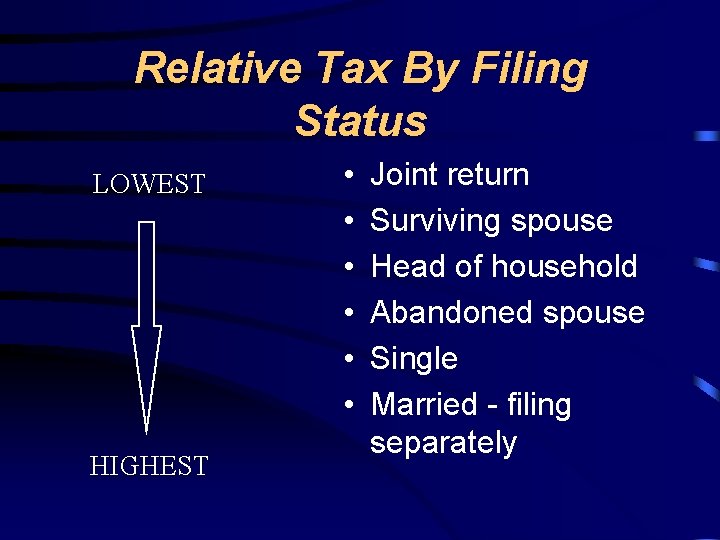
Relative Tax By Filing Status LOWEST HIGHEST • • • Joint return Surviving spouse Head of household Abandoned spouse Single Married - filing separately
Dependents With Unearned Income • Dependent does not receive a personal exemption on their own return. • A dependent’s standard deduction is reduced to the greater of earned income or $800 or the dependent’s earned income plus $250. • The tax on the net unearned income of a child under age 14 is figured by reference to the parents’ tax rate if it is higher than the child’s (known as the “kiddie tax”).
Corporate Tax Formula & Rates • “C” Corporations - Table I 2 -7 • “S” Corporations - no formula/based on ordinary income (Flow-through Entity)
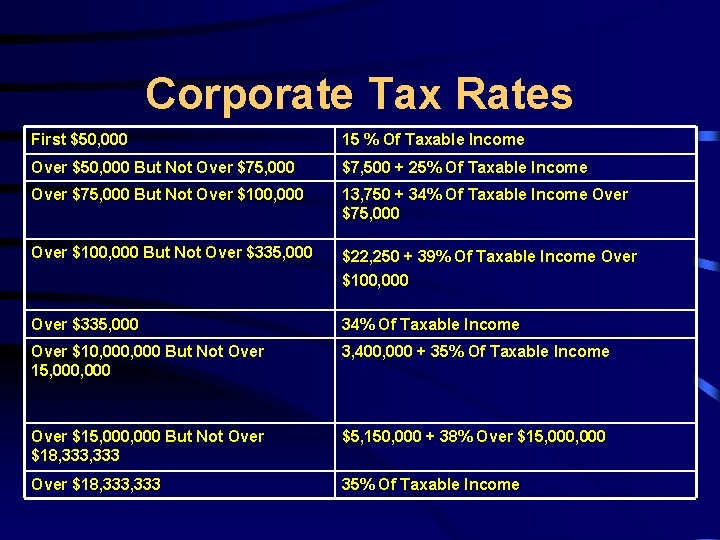
Corporate Tax Rates First $50, 000 15 % Of Taxable Income Over $50, 000 But Not Over $75, 000 $7, 500 + 25% Of Taxable Income Over $75, 000 But Not Over $100, 000 13, 750 + 34% Of Taxable Income Over $75, 000 Over $100, 000 But Not Over $335, 000 $22, 250 + 39% Of Taxable Income Over $100, 000 Over $335, 000 34% Of Taxable Income Over $10, 000 But Not Over 15, 000 3, 400, 000 + 35% Of Taxable Income Over $15, 000 But Not Over $18, 333 $5, 150, 000 + 38% Over $15, 000 Over $18, 333 35% Of Taxable Income
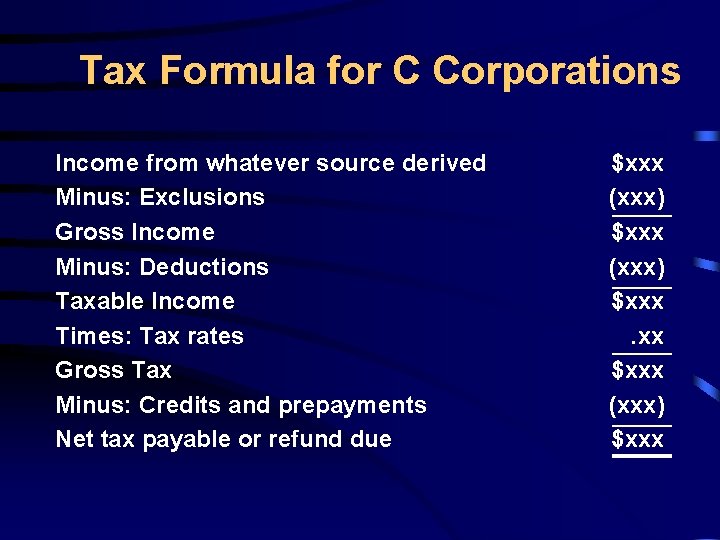
Tax Formula for C Corporations Income from whatever source derived Minus: Exclusions Gross Income Minus: Deductions Taxable Income Times: Tax rates Gross Tax Minus: Credits and prepayments Net tax payable or refund due $xxx (xxx) $xxx. xx $xxx (xxx) $xxx
Treatment Of Capital Gains And Losses • Capital gains and losses have been accorded favored tax treatment since 1922
Treatment Of Capital Gains And Losses • Definition of capital assets – Assets other than inventory, trade receivables, certain properties created by efforts of taxpayer, depreciable business property, business land, and certain government publications
Tax Treatment Of Gains And Losses • Capital gains and losses are divided into 2 categories – Long-term is held for over 12 months – Short-term is held less than 12 months
Tax Treatment Of Gains And Losses • Net long-term gain is taxed at 20% tax (10% if in the 15% tax bracket) • Net short-term gain is taxed at the same rate as other income
Tax Treatment Of Gains And Losses • Individuals who suffer net capital losses can deduct only up to $3, 000 of the losses from other income. • Losses over $3, 000 are carried over and offset against future gains.
Tax Planning Considerations • Shifting income between family members • Splitting income • Maximizing itemized deductions • Filing joint or separate returns • Innocent spouse provision
Compliance And Procedural Considerations • Who must file – See Chart on page 2 -31 • Due dates for filing return – Individuals and Partnerships (15 th day of 4 th month). – Corporations (15 th day of 3 rd month) • Use of forms 1040, 1040 EZ, and 1040 A
- Slides: 25