
Chapter 2 Design Tools Introduction Engineering Tools and
- Slides: 29
Chapter 2 Design Tools
Introduction • Engineering Tools and Skills: –Design processes –Brainstorming –Sketching –Modeling –Analysis tools –Presentation and communication tools
Design Process • The design process is a systematic problem-solving method for generating and developing ideas into solutions. • The 12 -step design process serves as a problem-solving approach and guide.
Design Process Step 1: Define the Problem • Design brief: a concise information tool that summarizes the most important information about a design project. • See Figure 2 -4: Typical Design Brief.
Design Process Step 1: Define the Problem (cont. ) • Problem statement: written to clearly and concisely identify a client’s problem, need, or want. • Design statement: describes what a design solution should do without describing how to solve the problem.
Design Process Step 2: Brainstorm • Brainstorming: any technique that is used by a design team to generate ideas. –Openly discuss the problem –Identify existing knowledge –Generate questions to be answered –Define areas of focus for research
Design Process Step 3: Research and Generate Ideas • Research: systematic study of materials and sources in order to establish facts and reach new conclusions. • Engineer’s notebook: a journal that serves as a record of engineering research and a repository for solution ideas that are generated throughout a design process.
Design Process Step 4: Identify Criteria and Constraints • Criteria: specific standards against which a design will be judged acceptable or unacceptable. • Constraint: a general limit that is imposed on a design project such as a project deadline, a budget, materials, or manufacturing processes.
Design Process Step 5: Explore Possibilities • Return to the initial solution ideas and sketches that were recorded in the engineer’s notebook during steps 2 and 3 and build from them. • Goal is to generate a mass of sketches to identify the most promising ideas for more detailed exploration.
Design Process Step 6: Select an Approach • Decision matrix: chart used by designers to quantify their opinions of two or more design ideas by assessing each idea according to a series of important considerations (see Figure 2 -7).
Design Process Step 7: Develop a Design Proposal • Design Proposal: –CAD part models and assemblies –Assembly drawings –Dimensioned multiview drawings of each manufactured component
Design Process Step 7: Develop a Design Proposal (cont. ) • The goal of a design proposal is to document the solution to the degree that a competent manufacturer could build a prototype without the need for further clarification on the part of the design team.
Design Process Step 8: Model or Prototype • Model: detailed three-dimensional representation of a design that is used to communicate, explore, or test an idea. • Prototype: one-of-a-kind working model of a solution that is developed for testing purposes.
Design Process Step 9: Test and Evaluate • Involves the client working with the engineering design team to determine what tests will be used to measure the quality of the design solution. • Data must be recorded, organized, and analyzed.
Design Process Step 10: Refine • Refine any issues or shortcomings that are identified through testing and analysis. • Ideas for changes to the design should be sketched out in an engineer’s notebook and accompanied by explanations.
Design Process Step 11: Create the Final Solution • The design statement will identify whether the final solution is a: –Custom (one-of-a-kind) design. –Limited-production item. –Mass-produced product.
Design Process Step 12: Communicate the Results • Technical report • Digital presentation • Demonstration of the actual working solution
Design Process • Brainstorming: –Allows team members to think creatively without judgments or constraints –Can be done in groups or as individuals –Involves five to seven individuals who have diverse backgrounds –Groups often have a facilitator
Design Process • Other Methods of Brainstorming: –Stepladder –Reverse-brainstorming process
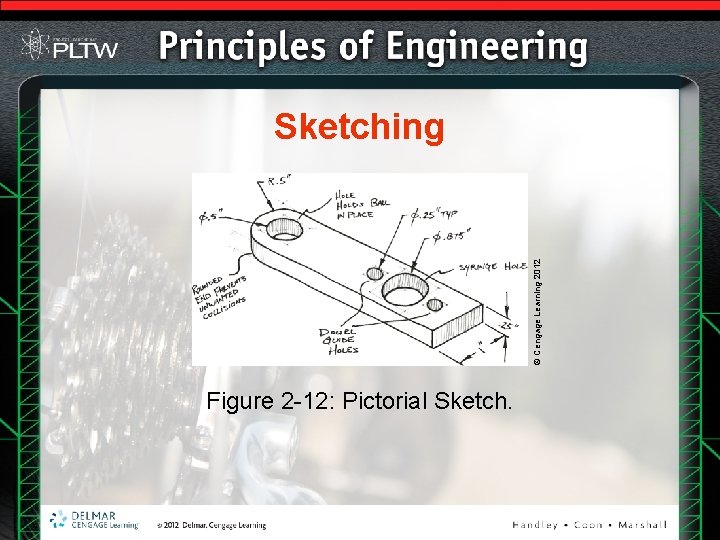
Sketching • Sketch: rough drawing that shows the main features of an object or scene. • Pictorial: gives the illusion of 3 -dimensions by showing an object’s height, width, and depth in a single view. • Multiview: portrays an object as a series of two or more 2 -dimensional views arranged in a specific pattern.
© Cengage Learning 2012 Sketching Figure 2 -12: Pictorial Sketch.
Modeling Ideas • Computer-aided design (CAD) software helps engineers in many industries design and manufacture products. • CAD models resemble the final product to a degree of geometric precision that is beyond that of a physical prototype.
Modeling Ideas • Finite element analysis (FEA): computerbased design analysis tool that allows the user to apply virtual forces and pressures to a 3 -D CAD model. • Computer-aided manufacturing (CAM): software that creates machine tool control programs.
Modeling Ideas • Rapid prototyping (RP): collection of CAD data-driven physical model construction technologies that utilize additive manufacturing processes. • Types of RP: stereolithography (SLA); fused deposition modeling (FDM); selective laser sintering (SLS); powderbinder printing.
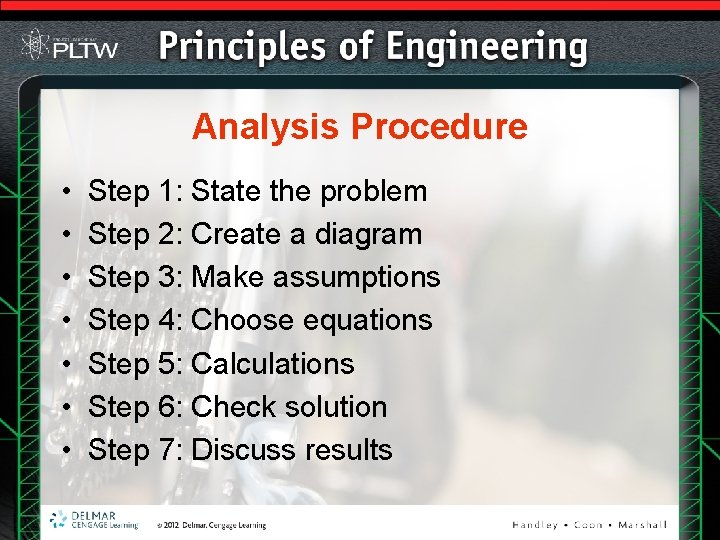
Analysis Procedure • • Step 1: State the problem Step 2: Create a diagram Step 3: Make assumptions Step 4: Choose equations Step 5: Calculations Step 6: Check solution Step 7: Discuss results
Presentation Tools • Digital Presentations: –Microsoft Power. Point: slide show should be eye-catching, well-organized, and informative. • Public Speaking
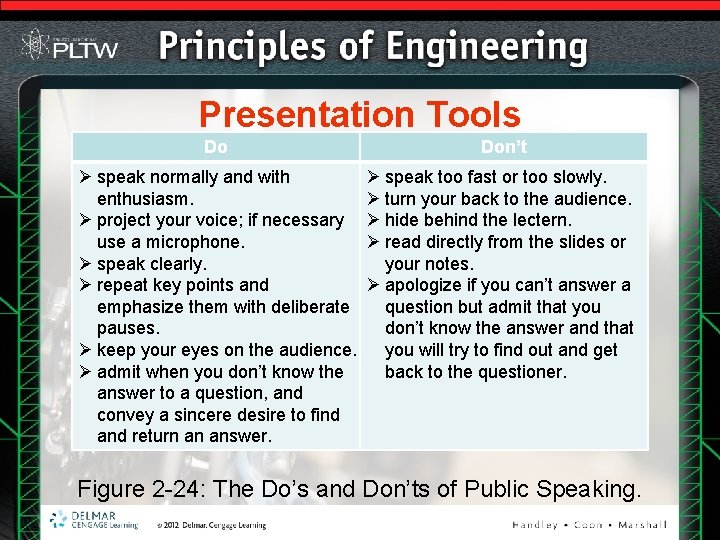
Presentation Tools Do Don’t Ø speak normally and with enthusiasm. Ø project your voice; if necessary use a microphone. Ø speak clearly. Ø repeat key points and emphasize them with deliberate pauses. Ø keep your eyes on the audience. Ø admit when you don’t know the answer to a question, and convey a sincere desire to find and return an answer. Ø speak too fast or too slowly. Ø turn your back to the audience. Ø hide behind the lectern. Ø read directly from the slides or your notes. Ø apologize if you can’t answer a question but admit that you don’t know the answer and that you will try to find out and get back to the questioner. Figure 2 -24: The Do’s and Don’ts of Public Speaking.
Summary • Engineers use the 12 -step design process method to solve problems. • Brainstorming combines individual brain power with human interaction to generate ideas for solving a design problem.
Summary • Sketching is a form of visual communication. • Engineers use computer-aided design (CAD) programs. • There are 7 steps in the systematic analysis procedure. • Digital presentations are the final step of the design process.