
Chapter 2 Design for Testability EE 141 VLSI
Chapter 2 Design for Testability EE 141 VLSI Test Principles and Architectures 1 Ch. 2 - Design for Testability -
Design For Testability contents Introduction Testability Analysis Design for Testability Basics Scan Cells Designs Scan Architectures Scan Design Rules Scan Design Flow Special-Purpose Scan Designs RTL Design for Testability Concluding Remarks EE 141 VLSI Test Principles and Architectures 2 Ch. 2 - Design for Testability -
Introduction History During early years, design and test were separate – The final quality of the test was determined by keeping track of the number of defective parts shipped to the customer – Defective parts per million (PPM) shipped was a final test score. – This approach worked well for small-scale integrated circuit During 1980 s, fault simulation was used – Failed to improve the circuit’s fault coverage beyond 80% Increased test cost and decreased test quality lead to DFT engineering EE 141 VLSI Test Principles and Architectures 3 Ch. 2 - Design for Testability -
Introduction History Various testability measures & ad hoc testability enhancement methods – To improve the testability of a design – To ease sequential ATPG (automatic test pattern generation) – Still quite difficult to reach more than 90% fault coverage Structured DFT – To conquer the difficulties in controlling and observing the internal states of sequential circuits – Scan design is the most popular structured DFT approach Design for testability (DFT) has migration recently – From gate level to register-transfer level (RTL) EE 141 VLSI Test Principles and Architectures Ch. 2 - Design for Testability -
Testability Analysis Testability: A relative measure of the effort or cost of testing a logic circuit Testability Analysis: The process of assessing the testability of a logic circuit Testability Analysis Techniques: Topology-based Testability Analysis – SCOAP - Sandia Controllability/Observability Analysis Program – Probability-based testability analysis Simulation-based Testability Analysis EE 141 VLSI Test Principles and Architectures Ch. 2 - Design for Testability -
Testability Analysis – SCOAP Controllability Reflects the difficulty of setting a signal line to a required logic value from primary inputs Observability Reflects the difficulty of propagating the logic value of the signal line to primary outputs EE 141 VLSI Test Principles and Architectures Ch. 2 - Design for Testability -
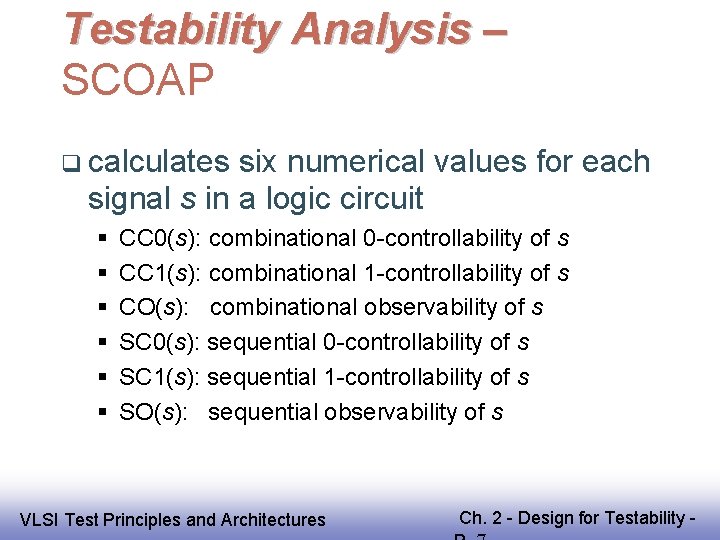
Testability Analysis – SCOAP calculates six numerical values for each signal s in a logic circuit CC 0(s): combinational 0 -controllability of s CC 1(s): combinational 1 -controllability of s CO(s): combinational observability of s SC 0(s): sequential 0 -controllability of s SC 1(s): sequential 1 -controllability of s SO(s): sequential observability of s EE 141 VLSI Test Principles and Architectures Ch. 2 - Design for Testability -
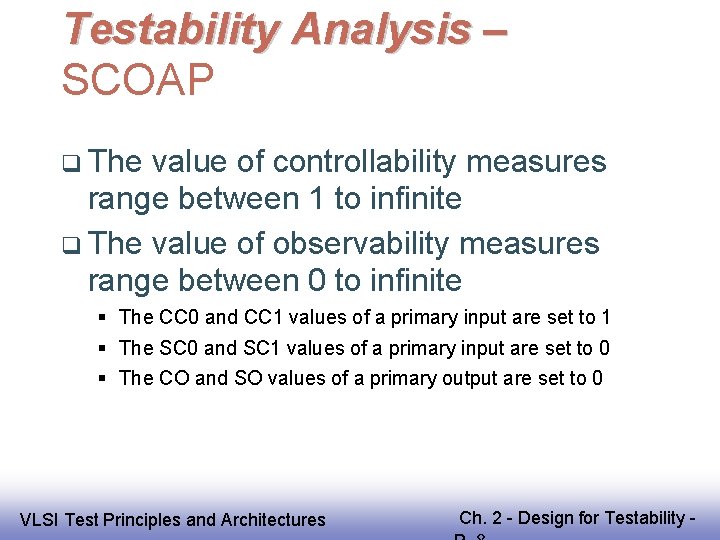
Testability Analysis – SCOAP The value of controllability measures range between 1 to infinite The value of observability measures range between 0 to infinite The CC 0 and CC 1 values of a primary input are set to 1 The SC 0 and SC 1 values of a primary input are set to 0 The CO and SO values of a primary output are set to 0 EE 141 VLSI Test Principles and Architectures Ch. 2 - Design for Testability -
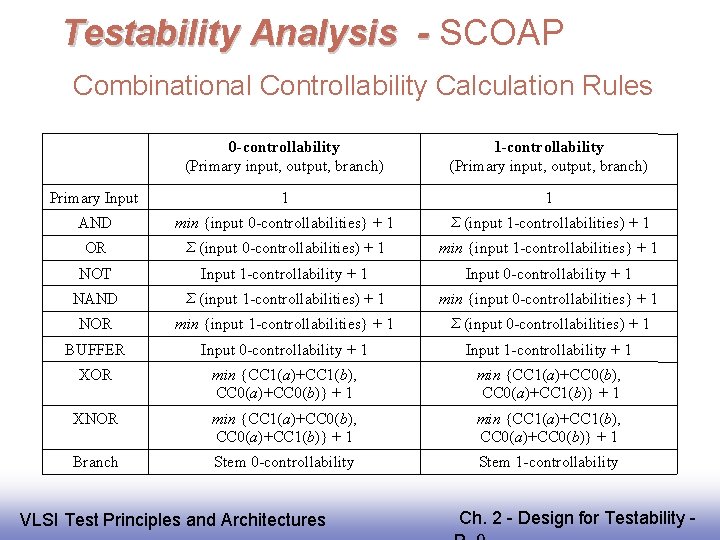
Testability Analysis - SCOAP Combinational Controllability Calculation Rules 0 -controllability (Primary input, output, branch) 1 -controllability (Primary input, output, branch) Primary Input 1 1 AND min {input 0 -controllabilities} + 1 Σ(input 1 -controllabilities) + 1 OR Σ(input 0 -controllabilities) + 1 min {input 1 -controllabilities} + 1 NOT Input 1 -controllability + 1 Input 0 -controllability + 1 NAND Σ(input 1 -controllabilities) + 1 min {input 0 -controllabilities} + 1 NOR min {input 1 -controllabilities} + 1 Σ(input 0 -controllabilities) + 1 BUFFER Input 0 -controllability + 1 Input 1 -controllability + 1 XOR min {CC 1(a)+CC 1(b), CC 0(a)+CC 0(b)} + 1 min {CC 1(a)+CC 0(b), CC 0(a)+CC 1(b)} + 1 XNOR min {CC 1(a)+CC 0(b), CC 0(a)+CC 1(b)} + 1 min {CC 1(a)+CC 1(b), CC 0(a)+CC 0(b)} + 1 Branch Stem 0 -controllability Stem 1 -controllability EE 141 VLSI Test Principles and Architectures Ch. 2 - Design for Testability -
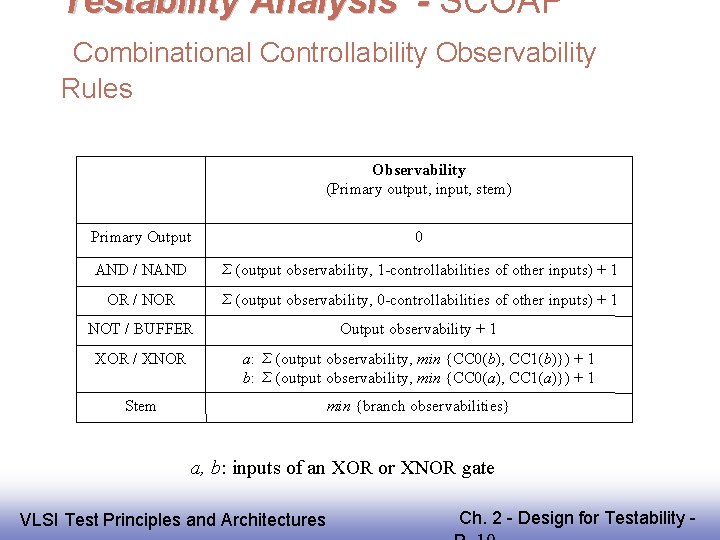
Testability Analysis - SCOAP Combinational Controllability Observability Rules Observability (Primary output, input, stem) Primary Output 0 AND / NAND Σ(output observability, 1 -controllabilities of other inputs) + 1 OR / NOR Σ(output observability, 0 -controllabilities of other inputs) + 1 NOT / BUFFER Output observability + 1 XOR / XNOR a: Σ(output observability, min {CC 0(b), CC 1(b)}) + 1 b: Σ(output observability, min {CC 0(a), CC 1(a)}) + 1 Stem min {branch observabilities} a, b: inputs of an XOR or XNOR gate EE 141 VLSI Test Principles and Architectures Ch. 2 - Design for Testability -
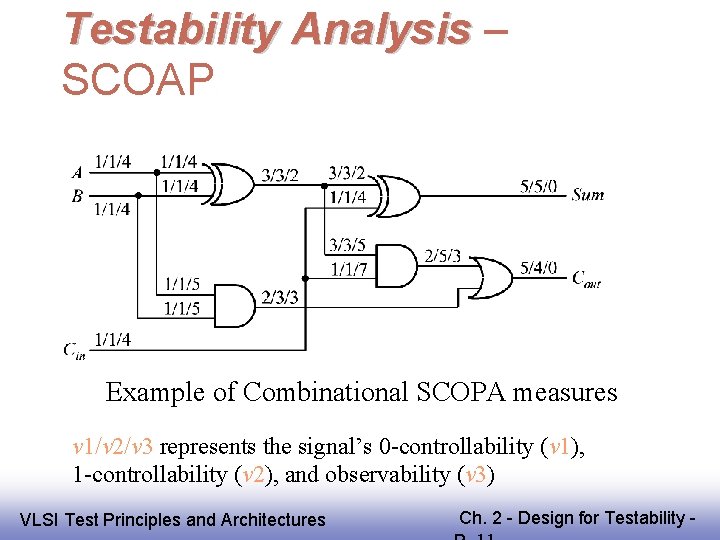
Testability Analysis – SCOAP Example of Combinational SCOPA measures v 1/v 2/v 3 represents the signal’s 0 -controllability (v 1), 1 -controllability (v 2), and observability (v 3) EE 141 VLSI Test Principles and Architectures Ch. 2 - Design for Testability -
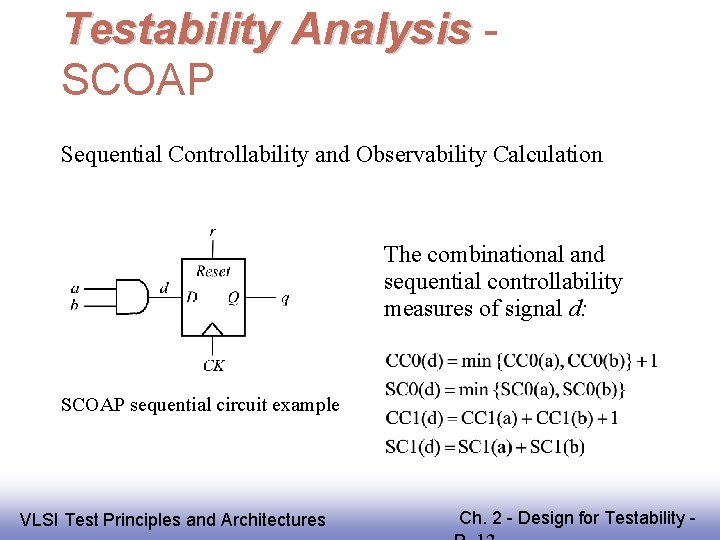
Testability Analysis SCOAP Sequential Controllability and Observability Calculation The combinational and sequential controllability measures of signal d: SCOAP sequential circuit example EE 141 VLSI Test Principles and Architectures Ch. 2 - Design for Testability -
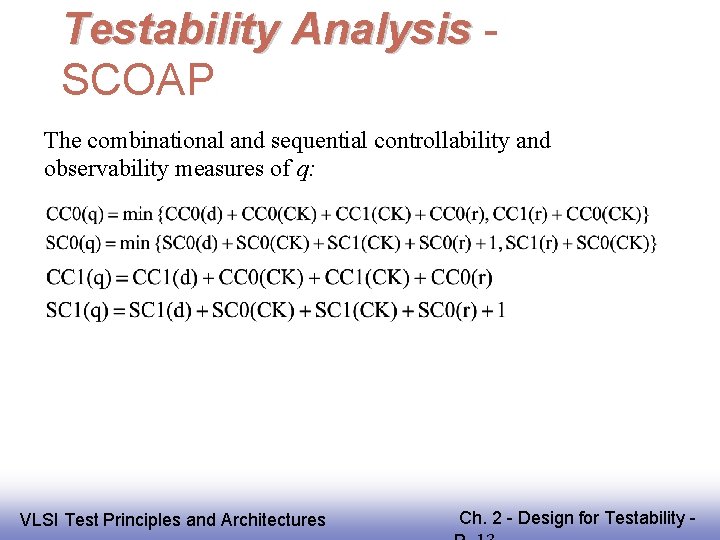
Testability Analysis SCOAP The combinational and sequential controllability and observability measures of q: EE 141 VLSI Test Principles and Architectures Ch. 2 - Design for Testability -
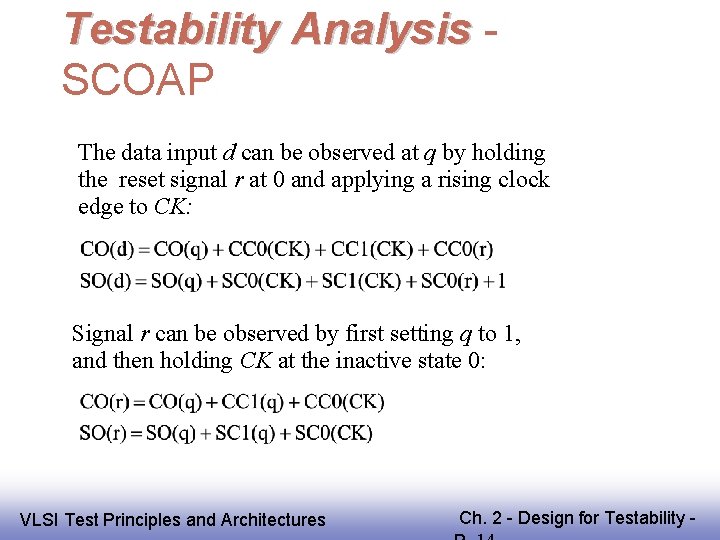
Testability Analysis SCOAP The data input d can be observed at q by holding the reset signal r at 0 and applying a rising clock edge to CK: Signal r can be observed by first setting q to 1, and then holding CK at the inactive state 0: EE 141 VLSI Test Principles and Architectures Ch. 2 - Design for Testability -
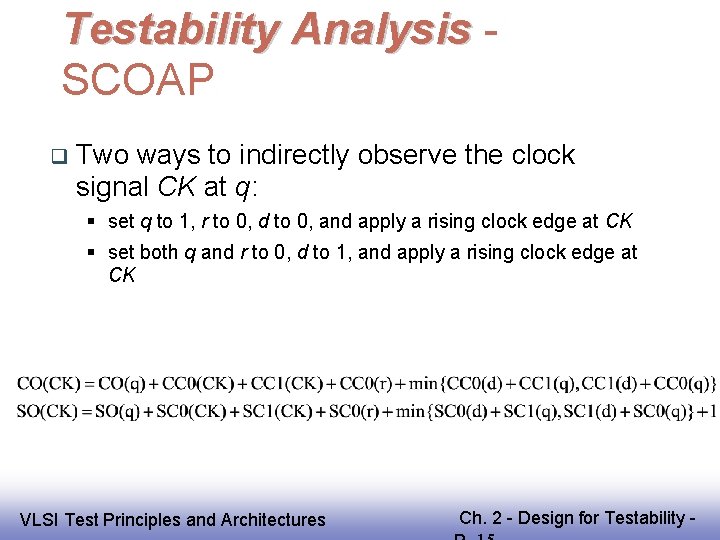
Testability Analysis SCOAP Two ways to indirectly observe the clock signal CK at q: set q to 1, r to 0, d to 0, and apply a rising clock edge at CK set both q and r to 0, d to 1, and apply a rising clock edge at CK EE 141 VLSI Test Principles and Architectures Ch. 2 - Design for Testability -
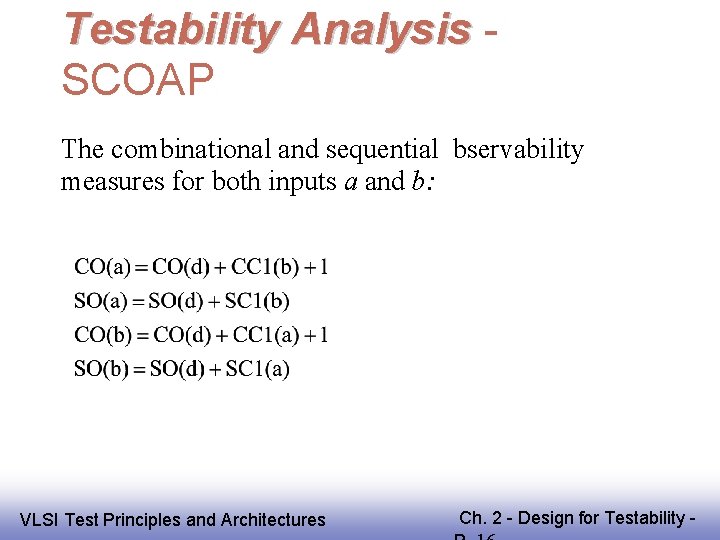
Testability Analysis SCOAP The combinational and sequential bservability measures for both inputs a and b: EE 141 VLSI Test Principles and Architectures Ch. 2 - Design for Testability -
Probability-Based Testability Analysis Used to analyze the random testability of the circuit C 0(s): probability-based 0 -controllability of s C 1(s): probability-based 1 -controllability of s O(s): probability-based observability of s Range between 0 and 1 C 0(s) + C 1(s) = 1 EE 141 VLSI Test Principles and Architectures Ch. 2 - Design for Testability -
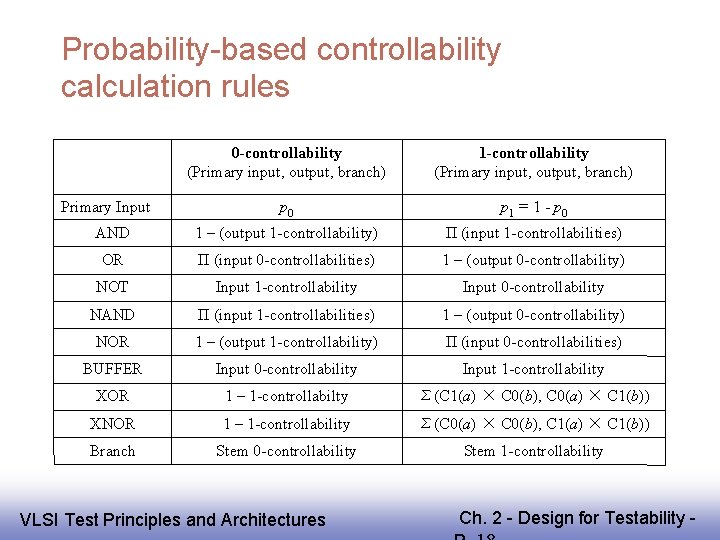
Probability-based controllability calculation rules 0 -controllability (Primary input, output, branch) 1 -controllability (Primary input, output, branch) p 0 p 1 = 1 - p 0 AND 1 – (output 1 -controllability) Π (input 1 -controllabilities) OR Π (input 0 -controllabilities) 1 – (output 0 -controllability) NOT Input 1 -controllability Input 0 -controllability NAND Π (input 1 -controllabilities) 1 – (output 0 -controllability) NOR 1 – (output 1 -controllability) Π (input 0 -controllabilities) BUFFER Input 0 -controllability Input 1 -controllability XOR 1 – 1 -controllabilty Σ(C 1(a) × C 0(b), C 0(a) × C 1(b)) XNOR 1 – 1 -controllability Σ(C 0(a) × C 0(b), C 1(a) × C 1(b)) Branch Stem 0 -controllability Stem 1 -controllability Primary Input EE 141 VLSI Test Principles and Architectures Ch. 2 - Design for Testability -
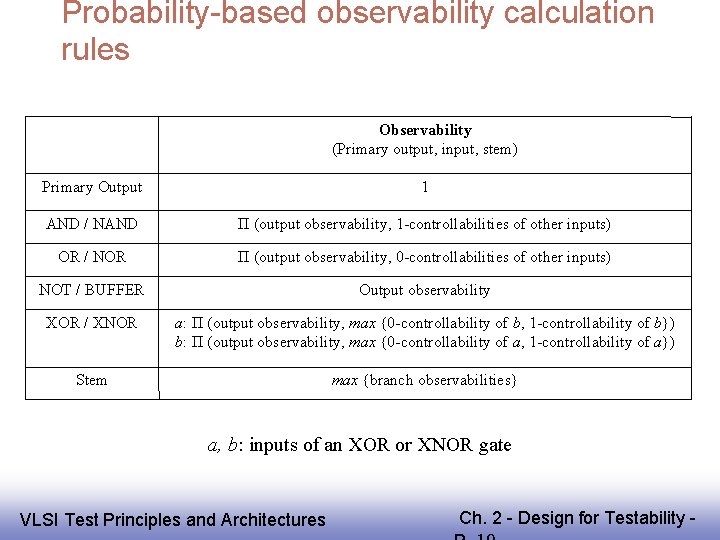
Probability-based observability calculation rules Observability (Primary output, input, stem) Primary Output 1 AND / NAND Π (output observability, 1 -controllabilities of other inputs) OR / NOR Π (output observability, 0 -controllabilities of other inputs) NOT / BUFFER Output observability XOR / XNOR a: Π (output observability, max {0 -controllability of b, 1 -controllability of b}) b: Π (output observability, max {0 -controllability of a, 1 -controllability of a}) Stem max {branch observabilities} a, b: inputs of an XOR or XNOR gate EE 141 VLSI Test Principles and Architectures Ch. 2 - Design for Testability -
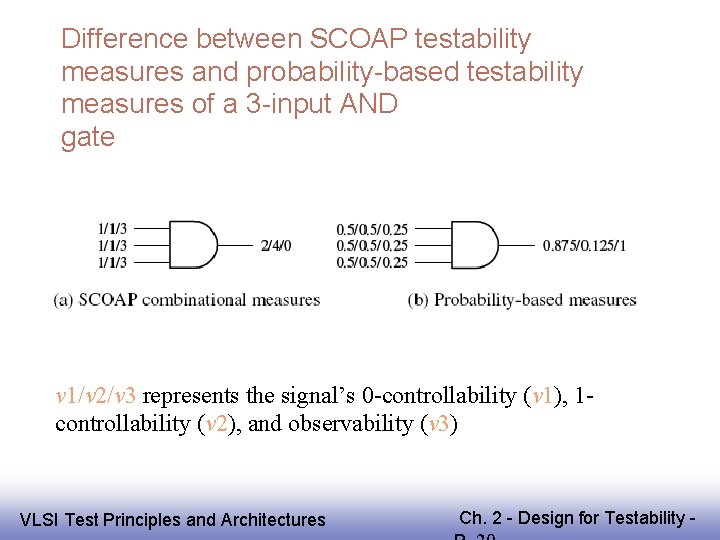
Difference between SCOAP testability measures and probability-based testability measures of a 3 -input AND gate v 1/v 2/v 3 represents the signal’s 0 -controllability (v 1), 1 controllability (v 2), and observability (v 3) EE 141 VLSI Test Principles and Architectures Ch. 2 - Design for Testability -
Simulation-Based Testability Analysis Supplement to static or topology-based testability analysis Performed through statistical sampling Guide testability enhancement in test generation or logic BIST Generate more accurate estimates Require a long simulation time EE 141 VLSI Test Principles and Architectures Ch. 2 - Design for Testability -
RTL Testability Analysis Disadvantages of Gate-Level Testability Analysis Costly in term of area overhead Possible performance degradation Require many DFT iterations Long test development time EE 141 VLSI Test Principles and Architectures Ch. 2 - Design for Testability -
RTL Testability Analysis Advantages of RTL Testability Analysis Improve data path testability Improve the random pattern testability of a scanbased logic BIST circuit Lead to more accurate results – The number of reconvergent fanouts is much less Become more time efficient – Much simpler than an equivalent gate-level model EE 141 VLSI Test Principles and Architectures Ch. 2 - Design for Testability -
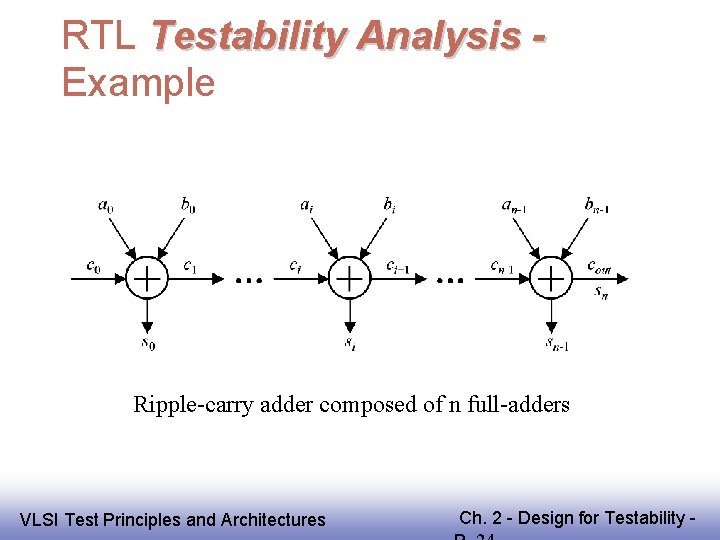
RTL Testability Analysis Example Ripple-carry adder composed of n full-adders EE 141 VLSI Test Principles and Architectures Ch. 2 - Design for Testability -
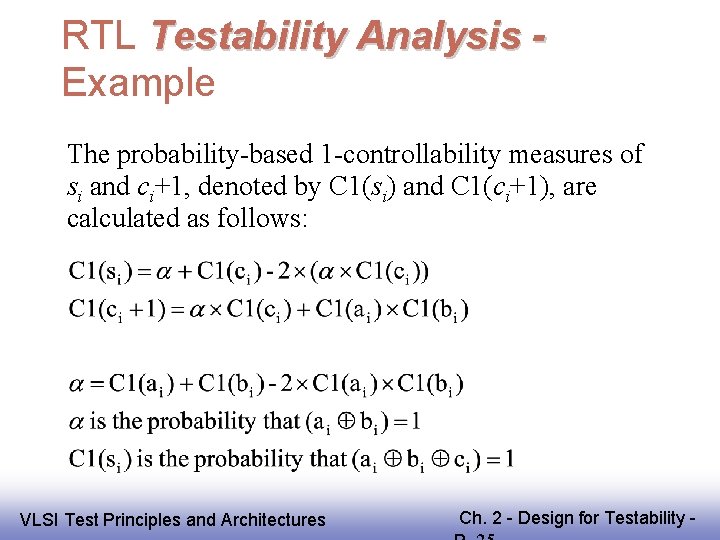
RTL Testability Analysis Example The probability-based 1 -controllability measures of si and ci+1, denoted by C 1(si) and C 1(ci+1), are calculated as follows: EE 141 VLSI Test Principles and Architectures Ch. 2 - Design for Testability -
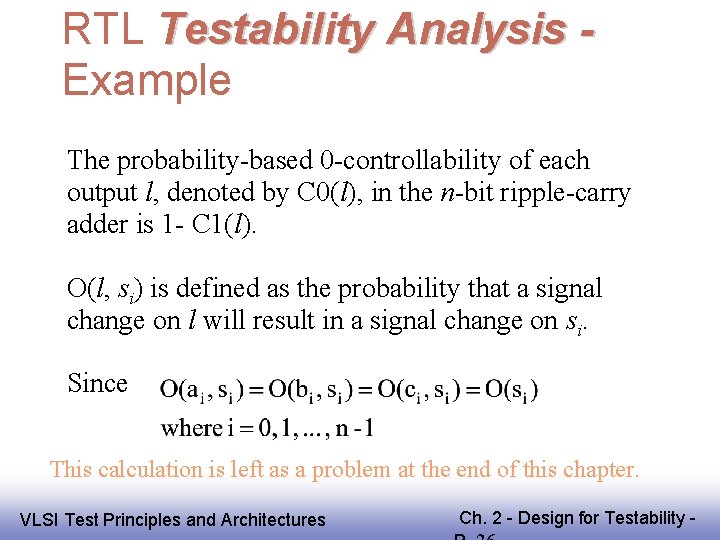
RTL Testability Analysis Example The probability-based 0 -controllability of each output l, denoted by C 0(l), in the n-bit ripple-carry adder is 1 - C 1(l). O(l, si) is defined as the probability that a signal change on l will result in a signal change on si. Since This calculation is left as a problem at the end of this chapter. EE 141 VLSI Test Principles and Architectures Ch. 2 - Design for Testability -
Design for Testability Basics Ad hoc DFT Effects are local and not systematic Not methodical Difficult to predict A structured DFT Easily incorporated and budgeted Yield the desired results Easy to automate EE 141 VLSI Test Principles and Architectures Ch. 2 - Design for Testability -
Ad Hoc Approach Typical ad hoc DFT techniques Insert test points Avoid asynchronous set/reset for storage elements Avoid combinational feedback loops Avoid redundant logic Avoid asynchronous logic Partition a large circuit into small blocks EE 141 VLSI Test Principles and Architectures Ch. 2 - Design for Testability -
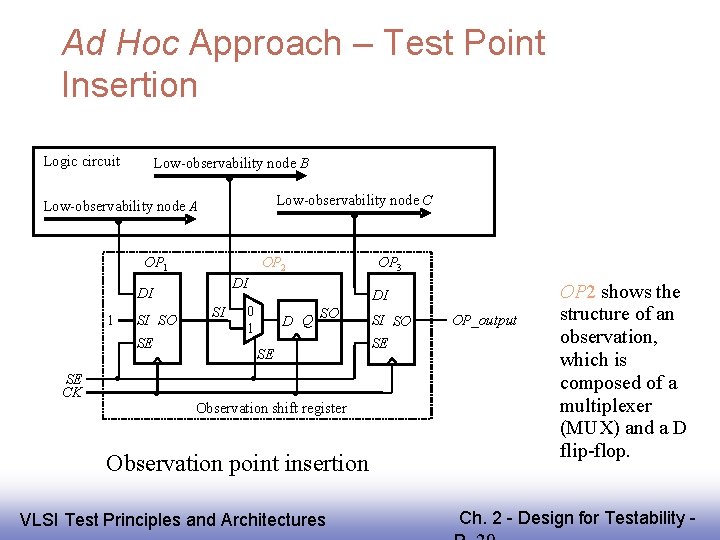
Ad Hoc Approach – Test Point Insertion . Logic circuit Low-observability node B . . Low-observability node C Low-observability node A OP 1 OP 2 DI DI 1 SI SO SE SE CK . . OP 3 SI DI 0 1 SO D Q SE . . Observation shift register Observation point insertion EE 141 VLSI Test Principles and Architectures SI SO SE OP_output OP 2 shows the structure of an observation, which is composed of a multiplexer (MUX) and a D flip-flop. Ch. 2 - Design for Testability -
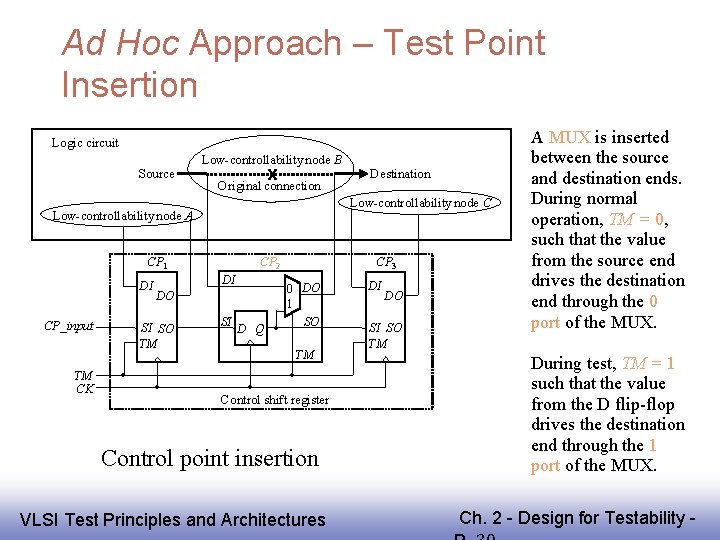
Ad Hoc Approach – Test Point Insertion Logic circuit Source Low-controllability node B x Original connection Low-controllability node C Low-controllability node A CP 1 DI CP_input TM CK CP 2 DI DO SI SO TM . . Destination SI D Q . CP 3 0 DO 1 SO TM . . Control shift register Control point insertion EE 141 VLSI Test Principles and Architectures DI DO SI SO TM A MUX is inserted between the source and destination ends. During normal operation, TM = 0, such that the value from the source end drives the destination end through the 0 port of the MUX. During test, TM = 1 such that the value from the D flip-flop drives the destination end through the 1 port of the MUX. Ch. 2 - Design for Testability -
Structured Approach Scan design Convert the sequential design into a scan design Three modes of operation – Normal mode All test signals are turned off The scan design operates in the original functional configuration – Shift mode – Capture mode In both shift and capture modes, a test mode signal TM is often used to turn on all test-related fixes EE 141 VLSI Test Principles and Architectures Ch. 2 - Design for Testability -
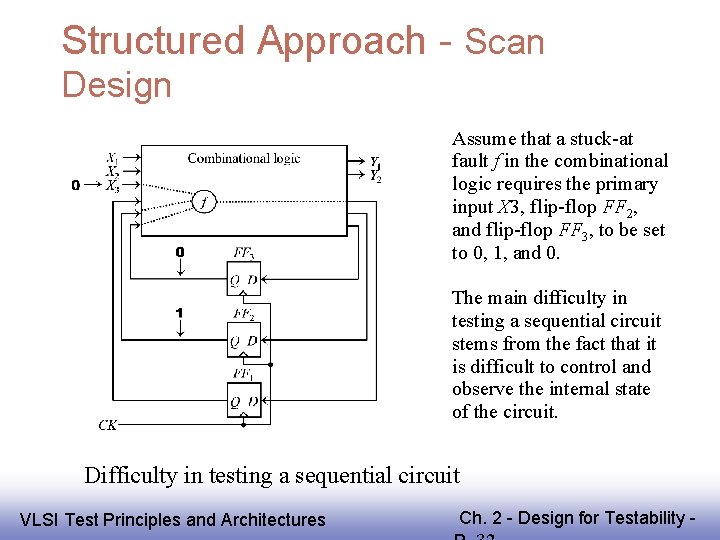
Structured Approach - Scan Design Assume that a stuck-at fault f in the combinational logic requires the primary input X 3, flip-flop FF 2, and flip-flop FF 3, to be set to 0, 1, and 0. The main difficulty in testing a sequential circuit stems from the fact that it is difficult to control and observe the internal state of the circuit. Difficulty in testing a sequential circuit EE 141 VLSI Test Principles and Architectures Ch. 2 - Design for Testability -
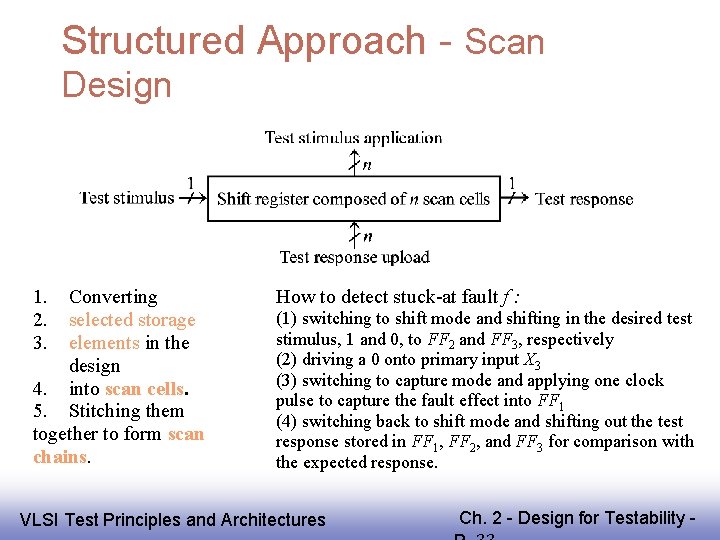
Structured Approach - Scan Design 1. 2. 3. Converting selected storage elements in the design 4. into scan cells. 5. Stitching them together to form scan chains. How to detect stuck-at fault f : (1) switching to shift mode and shifting in the desired test stimulus, 1 and 0, to FF 2 and FF 3, respectively (2) driving a 0 onto primary input X 3 (3) switching to capture mode and applying one clock pulse to capture the fault effect into FF 1 (4) switching back to shift mode and shifting out the test response stored in FF 1, FF 2, and FF 3 for comparison with the expected response. EE 141 VLSI Test Principles and Architectures Ch. 2 - Design for Testability -
Scan Cell Design A scan cell has two inputs: data input and scan input In normal/capture mode, data input is selected to update the output In shift mode, scan input is selected to update the output Three widely used scan cell designs Muxed-D Scan Cell Clocked-Scan Cell LSSD Scan Cell EE 141 VLSI Test Principles and Architectures Ch. 2 - Design for Testability -
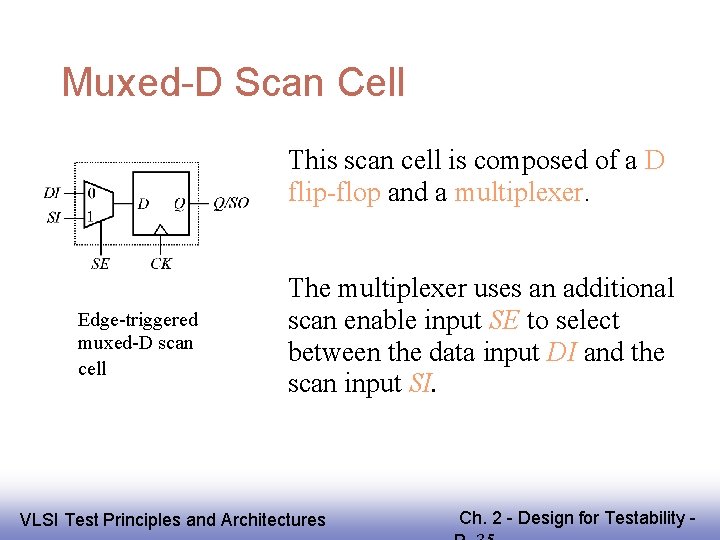
Muxed-D Scan Cell This scan cell is composed of a D flip-flop and a multiplexer. Edge-triggered muxed-D scan cell The multiplexer uses an additional scan enable input SE to select between the data input DI and the scan input SI. EE 141 VLSI Test Principles and Architectures Ch. 2 - Design for Testability -
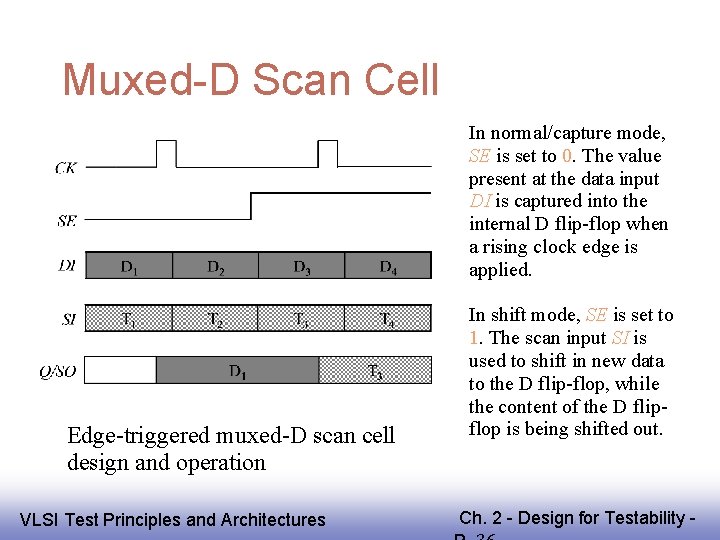
Muxed-D Scan Cell In normal/capture mode, SE is set to 0. The value present at the data input DI is captured into the internal D flip-flop when a rising clock edge is applied. Edge-triggered muxed-D scan cell design and operation EE 141 VLSI Test Principles and Architectures In shift mode, SE is set to 1. The scan input SI is used to shift in new data to the D flip-flop, while the content of the D flipflop is being shifted out. Ch. 2 - Design for Testability -
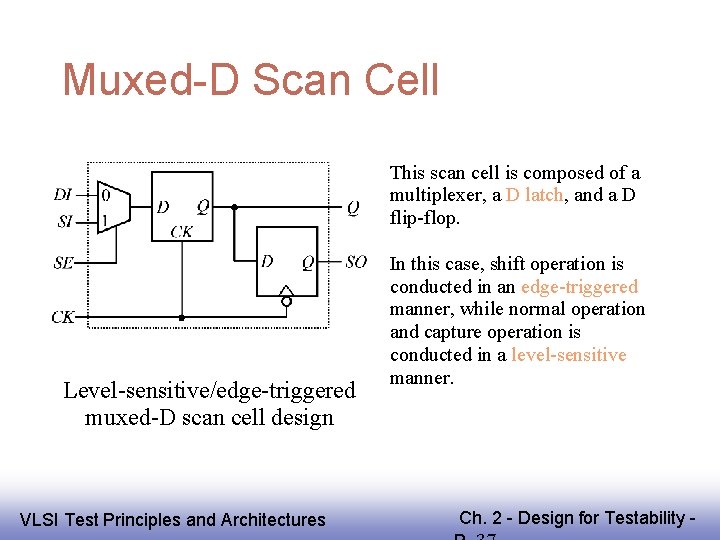
Muxed-D Scan Cell This scan cell is composed of a multiplexer, a D latch, and a D flip-flop. Level-sensitive/edge-triggered muxed-D scan cell design EE 141 VLSI Test Principles and Architectures In this case, shift operation is conducted in an edge-triggered manner, while normal operation and capture operation is conducted in a level-sensitive manner. Ch. 2 - Design for Testability -
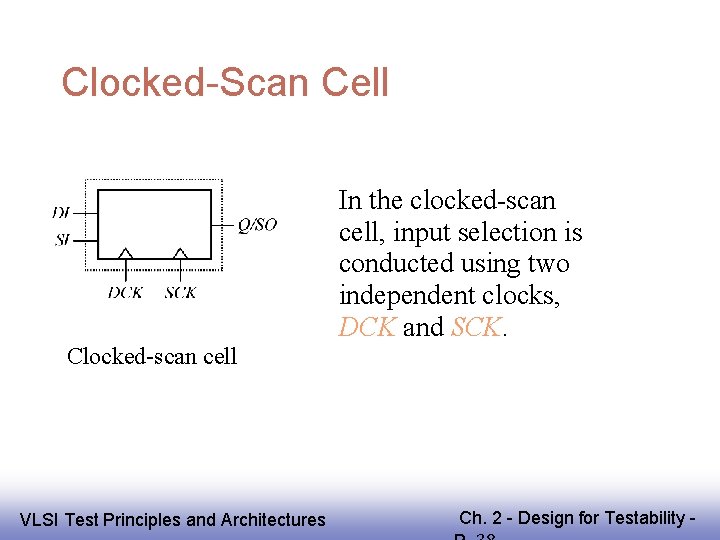
Clocked-Scan Cell Clocked-scan cell EE 141 VLSI Test Principles and Architectures In the clocked-scan cell, input selection is conducted using two independent clocks, DCK and SCK. Ch. 2 - Design for Testability -
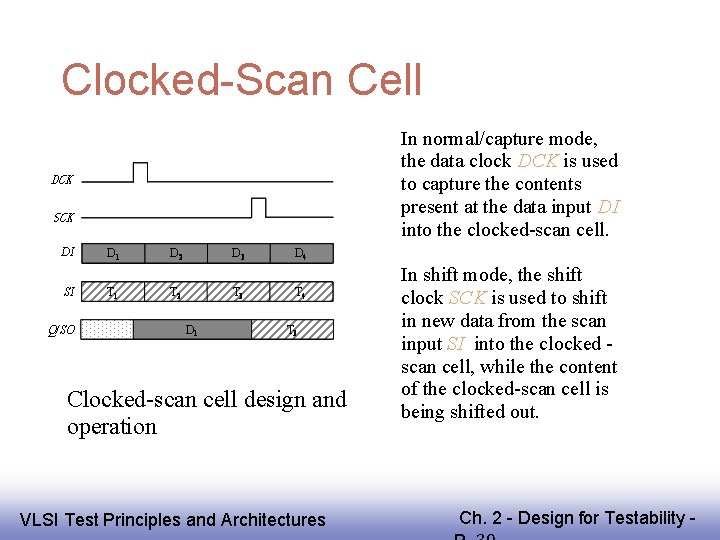
Clocked-Scan Cell In normal/capture mode, the data clock DCK is used to capture the contents present at the data input DI into the clocked-scan cell. Clocked-scan cell design and operation EE 141 VLSI Test Principles and Architectures In shift mode, the shift clock SCK is used to shift in new data from the scan input SI into the clocked scan cell, while the content of the clocked-scan cell is being shifted out. Ch. 2 - Design for Testability -
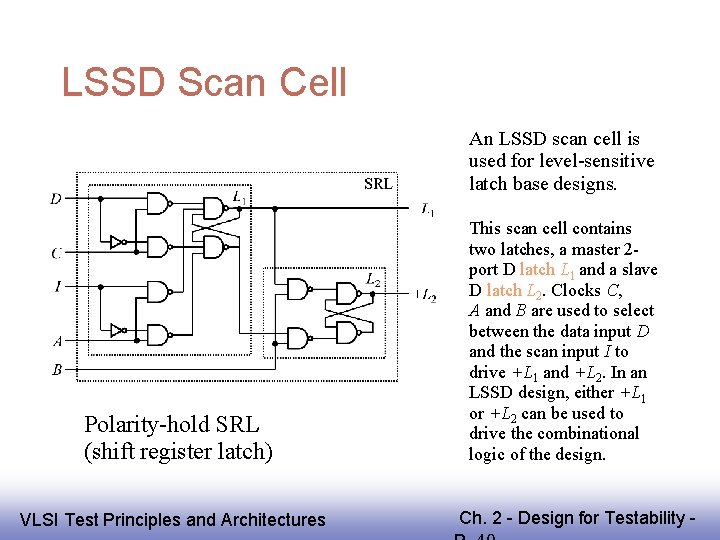
LSSD Scan Cell An LSSD scan cell is used for level-sensitive latch base designs. Polarity-hold SRL (shift register latch) EE 141 VLSI Test Principles and Architectures This scan cell contains two latches, a master 2 port D latch L 1 and a slave D latch L 2. Clocks C, A and B are used to select between the data input D and the scan input I to drive +L 1 and +L 2. In an LSSD design, either +L 1 or +L 2 can be used to drive the combinational logic of the design. Ch. 2 - Design for Testability -
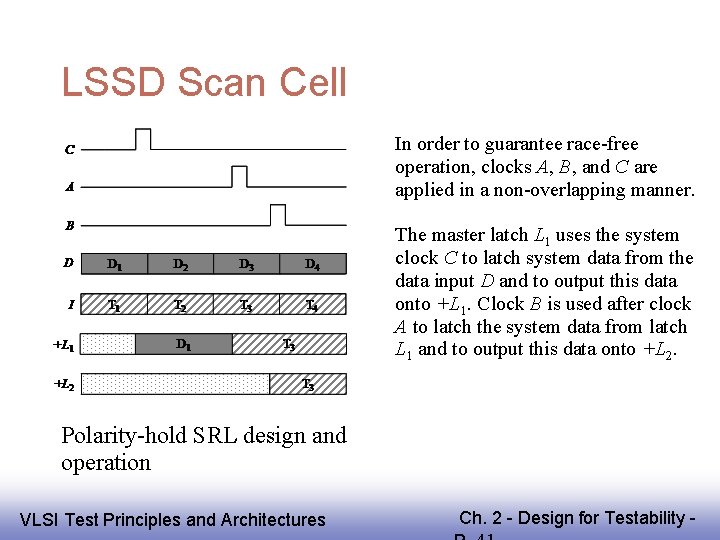
LSSD Scan Cell In order to guarantee race-free operation, clocks A, B, and C are applied in a non-overlapping manner. The master latch L 1 uses the system clock C to latch system data from the data input D and to output this data onto +L 1. Clock B is used after clock A to latch the system data from latch L 1 and to output this data onto +L 2. Polarity-hold SRL design and operation EE 141 VLSI Test Principles and Architectures Ch. 2 - Design for Testability -
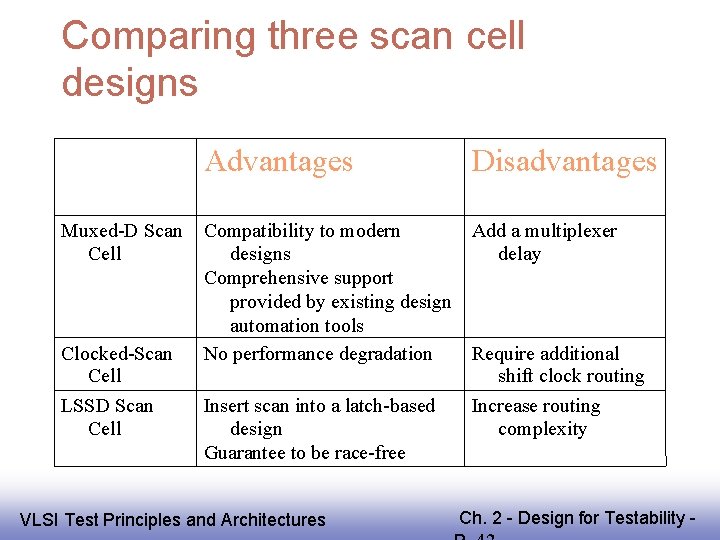
Comparing three scan cell designs Advantages Muxed-D Scan Cell Clocked-Scan Cell LSSD Scan Cell Disadvantages Compatibility to modern Add a multiplexer designs delay Comprehensive support provided by existing design automation tools No performance degradation Require additional shift clock routing Insert scan into a latch-based Increase routing design complexity Guarantee to be race-free EE 141 VLSI Test Principles and Architectures Ch. 2 - Design for Testability -

Scan Architectures Full-Scan Design All or almost all storage element are converted into scan cells and combinational ATPG is used for test generation Partial-Scan Design A subset of storage elements are converted into scan cells and sequential ATPG is typically used for test generation Random-Access Scan Design A random addressing mechanism, instead of serial scan chains, is used to provide direct access to read or write any scan cell EE 141 VLSI Test Principles and Architectures 43 Ch. 2 - Design for Testability -
Full-Scan Design All storage elements are replaced with scan cells All inputs can be controlled All outputs can be observed Advantage: Converts sequential ATPG into combinational ATPG Almost full-scan design A small percentage of storage elements are not replaced with scan cells – For performance reasons Storage elements that lie on critical paths – For functional reasons Storage elements driven by a small clock domain that are deemed too insignificant to be worth the additional scan insertion effort EE 141 VLSI Test Principles and Architectures Ch. 2 - Design for Testability -
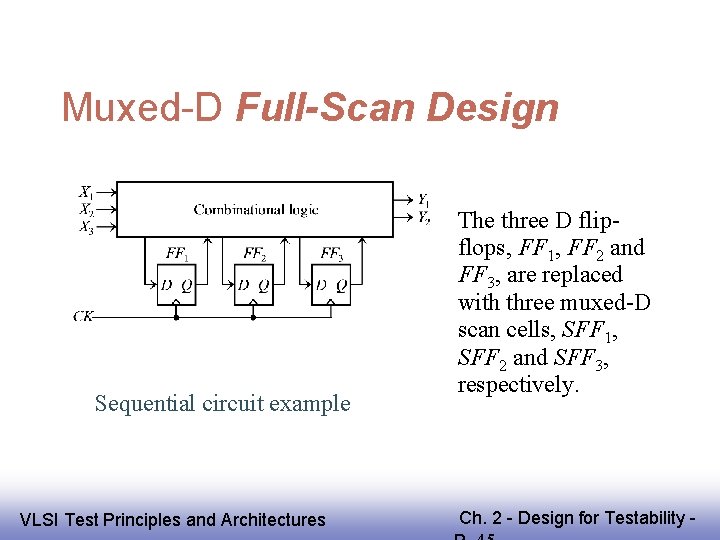
Muxed-D Full-Scan Design Sequential circuit example EE 141 VLSI Test Principles and Architectures The three D flipflops, FF 1, FF 2 and FF 3, are replaced with three muxed-D scan cells, SFF 1, SFF 2 and SFF 3, respectively. Ch. 2 - Design for Testability -
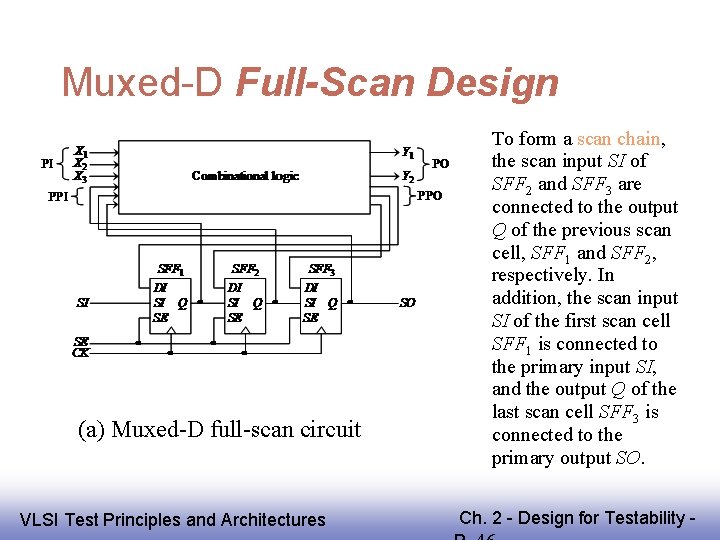
Muxed-D Full-Scan Design (a) Muxed-D full-scan circuit EE 141 VLSI Test Principles and Architectures To form a scan chain, the scan input SI of SFF 2 and SFF 3 are connected to the output Q of the previous scan cell, SFF 1 and SFF 2, respectively. In addition, the scan input SI of the first scan cell SFF 1 is connected to the primary input SI, and the output Q of the last scan cell SFF 3 is connected to the primary output SO. Ch. 2 - Design for Testability -
Muxed-D Full-Scan Design • Primary inputs (PIs) – the external inputs to the circuit – can be set to any required logic values – set directly in parallel from the external inputs • Pseudo primary inputs (PPIs) – the scan cell outputs – can be set to any required logic values – are set serially through scan chain inputs EE 141 VLSI Test Principles and Architectures • Primary outputs (POs) – the external outputs of the circuit – can be observed – are observed directly in – parallel from the external outputs • Pseudo primary outputs (PPOs) – the scan cell inputs – can be observed – are observed serially through scan chain outputs Ch. 2 - Design for Testability -
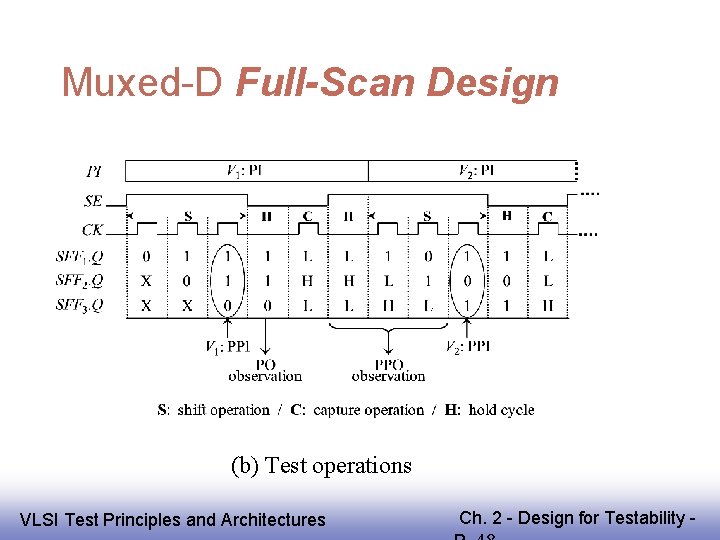
Muxed-D Full-Scan Design (b) Test operations EE 141 VLSI Test Principles and Architectures Ch. 2 - Design for Testability -
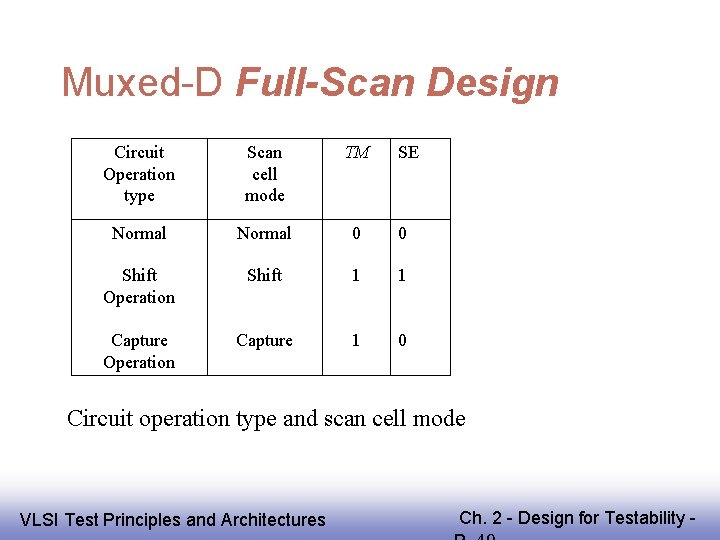
Muxed-D Full-Scan Design Circuit Operation type Scan cell mode TM SE Normal 0 0 Shift Operation Shift 1 1 Capture Operation Capture 1 0 Circuit operation type and scan cell mode EE 141 VLSI Test Principles and Architectures Ch. 2 - Design for Testability -
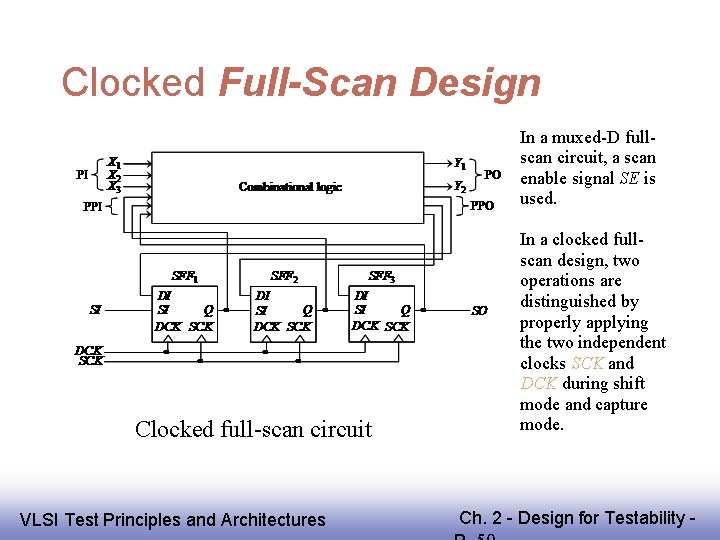
Clocked Full-Scan Design In a muxed-D fullscan circuit, a scan enable signal SE is used. Clocked full-scan circuit EE 141 VLSI Test Principles and Architectures In a clocked fullscan design, two operations are distinguished by properly applying the two independent clocks SCK and DCK during shift mode and capture mode. Ch. 2 - Design for Testability -
LSSD Full-Scan Design Single-latch design Double-latch design EE 141 VLSI Test Principles and Architectures Ch. 2 - Design for Testability -
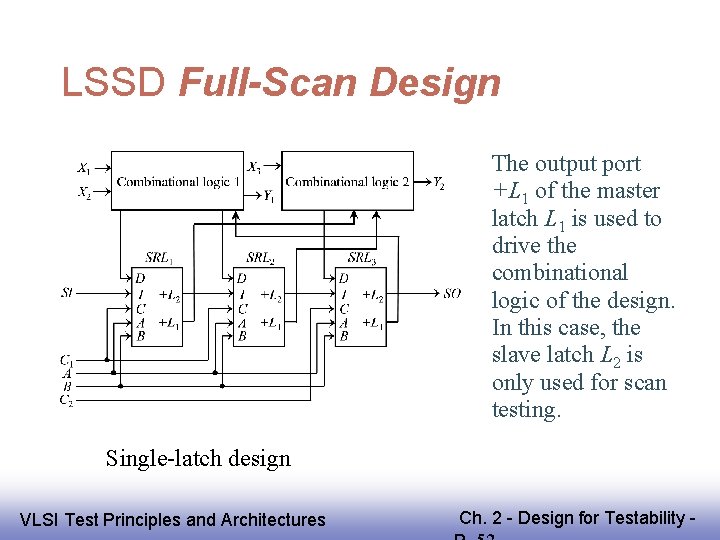
LSSD Full-Scan Design The output port +L 1 of the master latch L 1 is used to drive the combinational logic of the design. In this case, the slave latch L 2 is only used for scan testing. Single-latch design EE 141 VLSI Test Principles and Architectures Ch. 2 - Design for Testability -
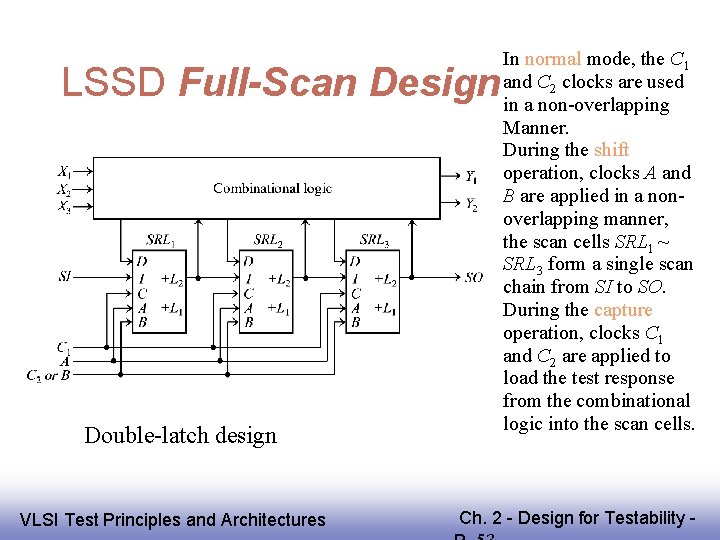
LSSD Full-Scan Design Double-latch design EE 141 VLSI Test Principles and Architectures In normal mode, the C 1 and C 2 clocks are used in a non-overlapping Manner. During the shift operation, clocks A and B are applied in a nonoverlapping manner, the scan cells SRL 1 ~ SRL 3 form a single scan chain from SI to SO. During the capture operation, clocks C 1 and C 2 are applied to load the test response from the combinational logic into the scan cells. Ch. 2 - Design for Testability -
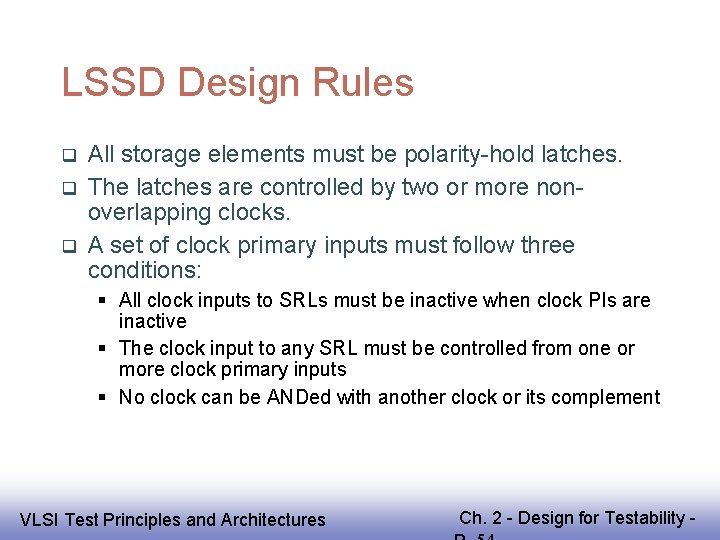
LSSD Design Rules All storage elements must be polarity-hold latches. The latches are controlled by two or more nonoverlapping clocks. A set of clock primary inputs must follow three conditions: All clock inputs to SRLs must be inactive when clock PIs are inactive The clock input to any SRL must be controlled from one or more clock primary inputs No clock can be ANDed with another clock or its complement EE 141 VLSI Test Principles and Architectures Ch. 2 - Design for Testability -
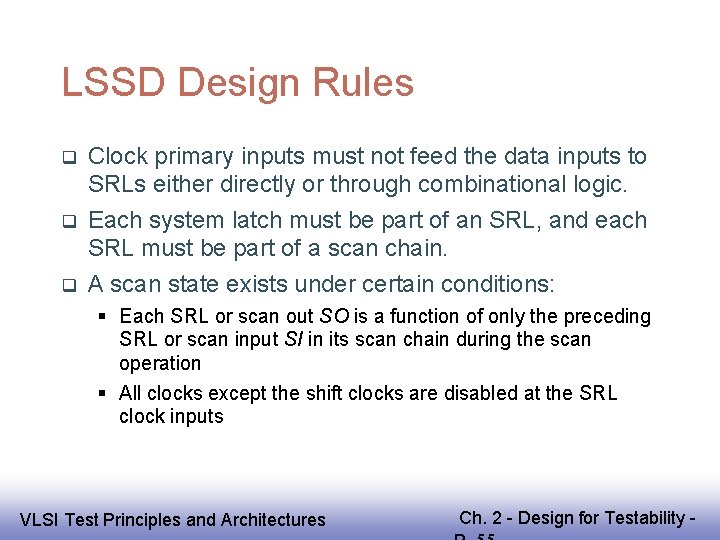
LSSD Design Rules Clock primary inputs must not feed the data inputs to SRLs either directly or through combinational logic. Each system latch must be part of an SRL, and each SRL must be part of a scan chain. A scan state exists under certain conditions: Each SRL or scan out SO is a function of only the preceding SRL or scan input SI in its scan chain during the scan operation All clocks except the shift clocks are disabled at the SRL clock inputs EE 141 VLSI Test Principles and Architectures Ch. 2 - Design for Testability -
Partial-Scan Design Was once used in the industry long before full -scan design became the dominant scan architecture. Can also be implemented using muxed-D scan cells, clocked-scan cells, or LSSD scan cells. Either combinational ATPG or sequential ATPG can be used. EE 141 VLSI Test Principles and Architectures Ch. 2 - Design for Testability -
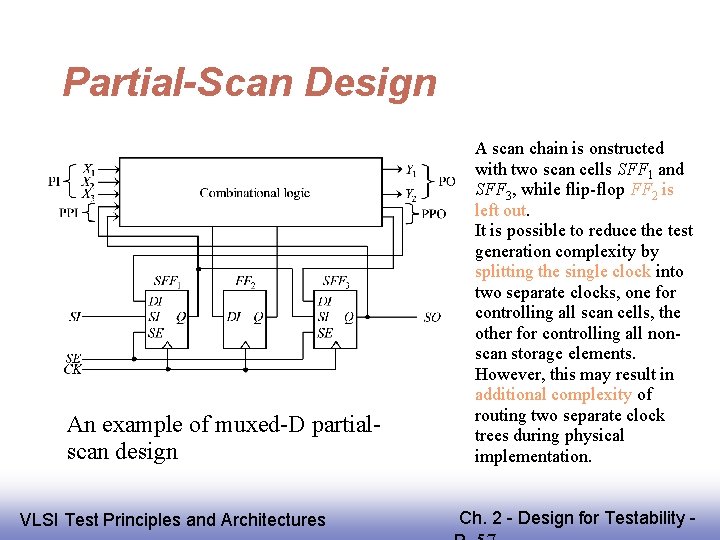
Partial-Scan Design An example of muxed-D partialscan design EE 141 VLSI Test Principles and Architectures A scan chain is onstructed with two scan cells SFF 1 and SFF 3, while flip-flop FF 2 is left out. It is possible to reduce the test generation complexity by splitting the single clock into two separate clocks, one for controlling all scan cells, the other for controlling all nonscan storage elements. However, this may result in additional complexity of routing two separate clock trees during physical implementation. Ch. 2 - Design for Testability -
Partial-Scan Design Scan cell selection A functional partitioning approach – A circuit is composed of a data path portion and a control portion – Storage elements on the data path are left out of the scan cell replacement process – Storage elements on the control path can be replaced with scan cells A pipelined or feed-forward partial-scan design approach – Make the sequential circuit feedback-free by selecting the storage elements to break all sequential feedback loops – First construct a structure graph for the sequential circuit A balanced partial-scan design approach – Use a target sequential depth to simply the test generation process for the pipelined or feed-forward partial-scan design EE 141 VLSI Test Principles and Architectures Ch. 2 - Design for Testability -
Partial-Scan Design - Structure Graph A feedback-free sequential circuit Use a directed acyclic graph (DAG) The maximum level in the structure graph is referred to as sequential depth A sequential circuit containing feedback loops Use a directed cyclic graph (DCG) EE 141 VLSI Test Principles and Architectures Ch. 2 - Design for Testability -
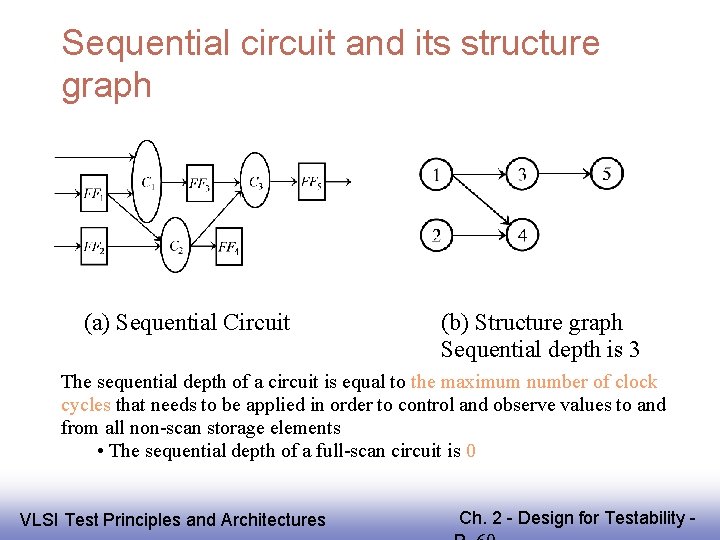
Sequential circuit and its structure graph (a) Sequential Circuit (b) Structure graph Sequential depth is 3 The sequential depth of a circuit is equal to the maximum number of clock cycles that needs to be applied in order to control and observe values to and from all non-scan storage elements • The sequential depth of a full-scan circuit is 0 EE 141 VLSI Test Principles and Architectures Ch. 2 - Design for Testability -
Partial-Scan Design Advantage: Reduce silicon area overhead Reduce performance degradation Disadvantage: Can result in lower fault coverage Longer test generation time Offers less support for debug, diagnosis and failure analysis EE 141 VLSI Test Principles and Architectures Ch. 2 - Design for Testability -
Random-Access Scan Design Advantages of RAS: Can control or observe individual scan cells without affecting others Reduce test power dissipation Simplify the process of performing delay test Disadvantages of traditional RAS: High overhead in scan design and routing No guarantee to reduce the test application time Progressive Random-Access Scan( PRAS ) was proposed to alleviate the disadvantages in traditional RAS EE 141 VLSI Test Principles and Architectures Ch. 2 - Design for Testability -
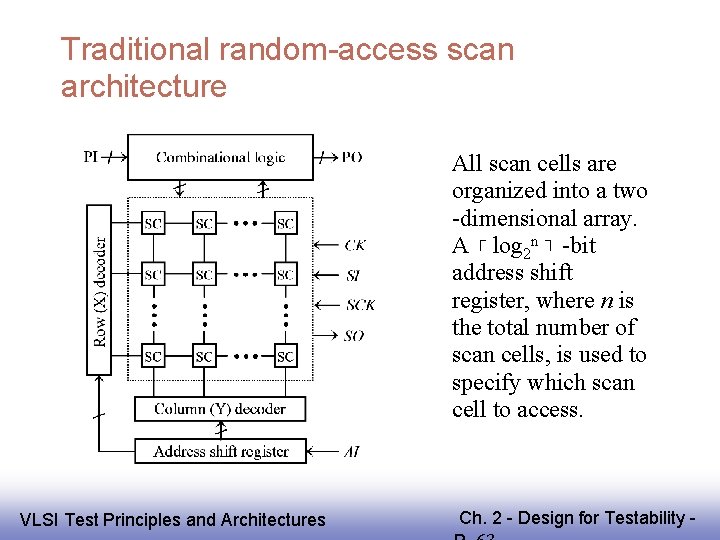
Traditional random-access scan architecture All scan cells are organized into a two -dimensional array. A ┌ log 2 n ┐ -bit address shift register, where n is the total number of scan cells, is used to specify which scan cell to access. EE 141 VLSI Test Principles and Architectures Ch. 2 - Design for Testability -
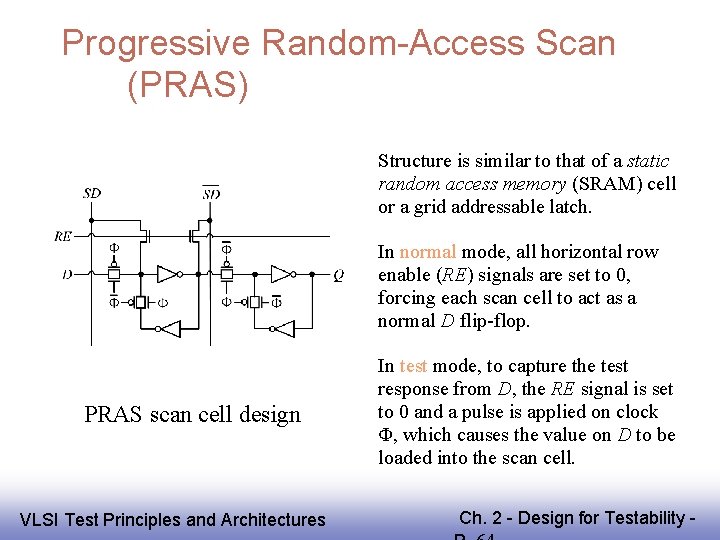
Progressive Random-Access Scan (PRAS) Structure is similar to that of a static random access memory (SRAM) cell or a grid addressable latch. In normal mode, all horizontal row enable (RE) signals are set to 0, forcing each scan cell to act as a normal D flip-flop. PRAS scan cell design EE 141 VLSI Test Principles and Architectures In test mode, to capture the test response from D, the RE signal is set to 0 and a pulse is applied on clock Φ, which causes the value on D to be loaded into the scan cell. Ch. 2 - Design for Testability -
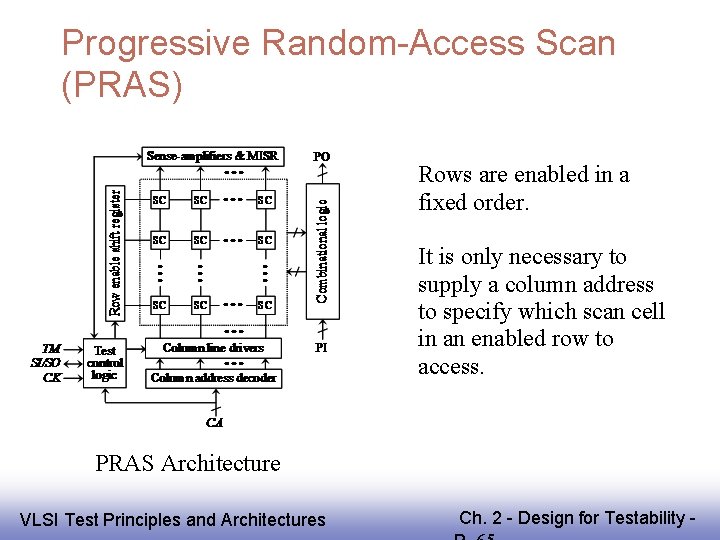
Progressive Random-Access Scan (PRAS) Rows are enabled in a fixed order. It is only necessary to supply a column address to specify which scan cell in an enabled row to access. PRAS Architecture EE 141 VLSI Test Principles and Architectures Ch. 2 - Design for Testability -
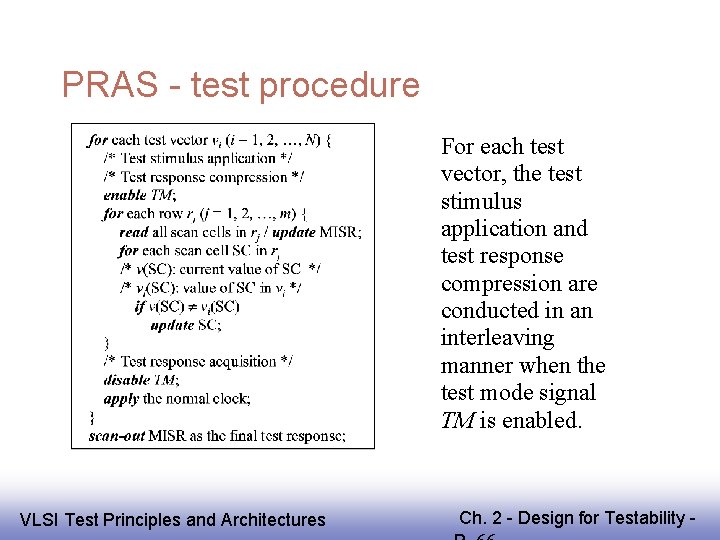
PRAS - test procedure For each test vector, the test stimulus application and test response compression are conducted in an interleaving manner when the test mode signal TM is enabled. EE 141 VLSI Test Principles and Architectures Ch. 2 - Design for Testability -
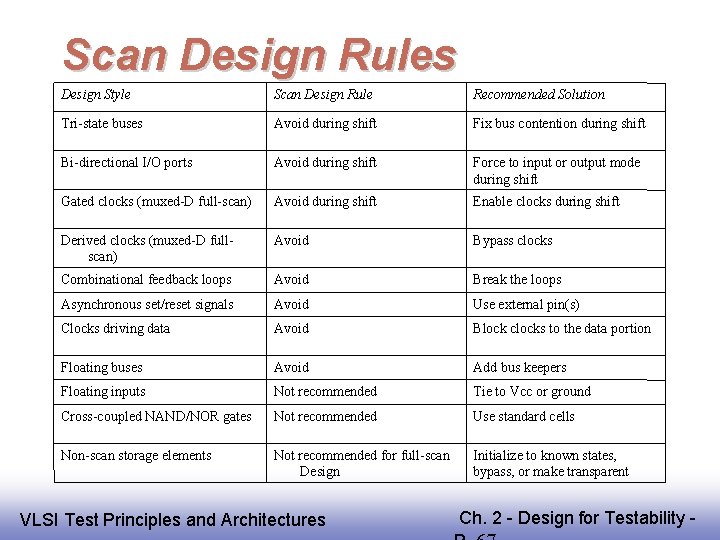
Scan Design Rules Design Style Scan Design Rule Recommended Solution Tri-state buses Avoid during shift Fix bus contention during shift Bi-directional I/O ports Avoid during shift Force to input or output mode during shift Gated clocks (muxed-D full-scan) Avoid during shift Enable clocks during shift Derived clocks (muxed-D fullscan) Avoid Bypass clocks Combinational feedback loops Avoid Break the loops Asynchronous set/reset signals Avoid Use external pin(s) Clocks driving data Avoid Block clocks to the data portion Floating buses Avoid Add bus keepers Floating inputs Not recommended Tie to Vcc or ground Cross-coupled NAND/NOR gates Not recommended Use standard cells Non-scan storage elements Not recommended for full-scan Design Initialize to known states, bypass, or make transparent EE 141 VLSI Test Principles and Architectures Ch. 2 - Design for Testability -
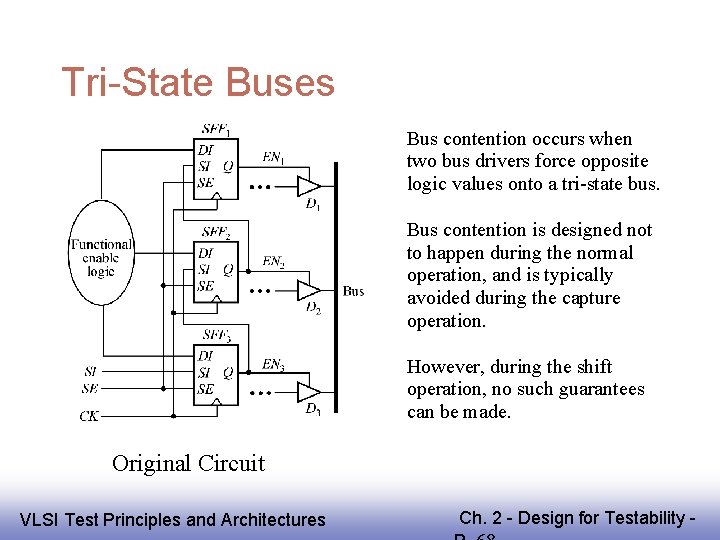
Tri-State Buses Bus contention occurs when two bus drivers force opposite logic values onto a tri-state bus. Bus contention is designed not to happen during the normal operation, and is typically avoided during the capture operation. However, during the shift operation, no such guarantees can be made. Original Circuit EE 141 VLSI Test Principles and Architectures Ch. 2 - Design for Testability -
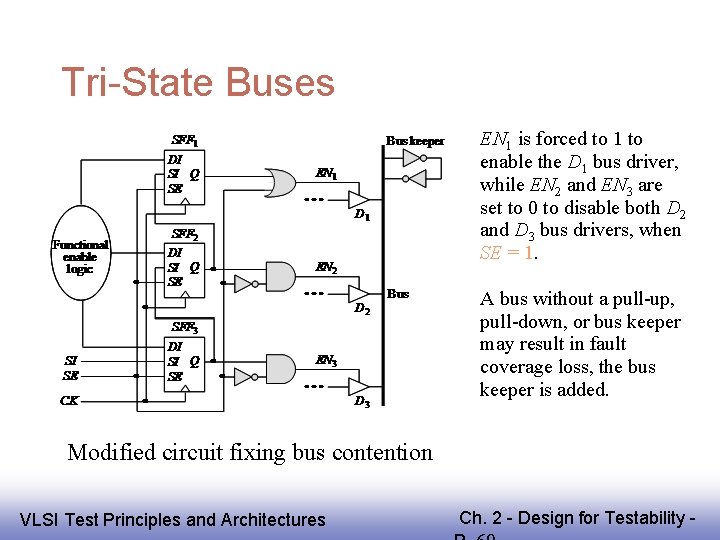
Tri-State Buses EN 1 is forced to 1 to enable the D 1 bus driver, while EN 2 and EN 3 are set to 0 to disable both D 2 and D 3 bus drivers, when SE = 1. A bus without a pull-up, pull-down, or bus keeper may result in fault coverage loss, the bus keeper is added. Modified circuit fixing bus contention EE 141 VLSI Test Principles and Architectures Ch. 2 - Design for Testability -
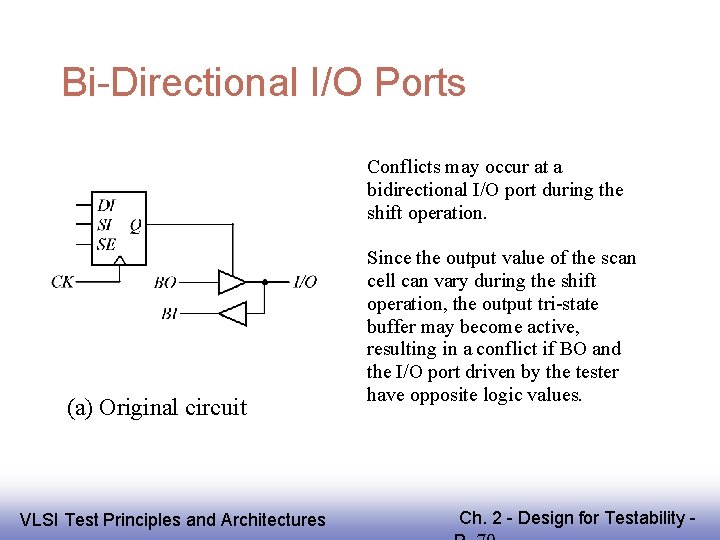
Bi-Directional I/O Ports Conflicts may occur at a bidirectional I/O port during the shift operation. (a) Original circuit EE 141 VLSI Test Principles and Architectures Since the output value of the scan cell can vary during the shift operation, the output tri-state buffer may become active, resulting in a conflict if BO and the I/O port driven by the tester have opposite logic values. Ch. 2 - Design for Testability -
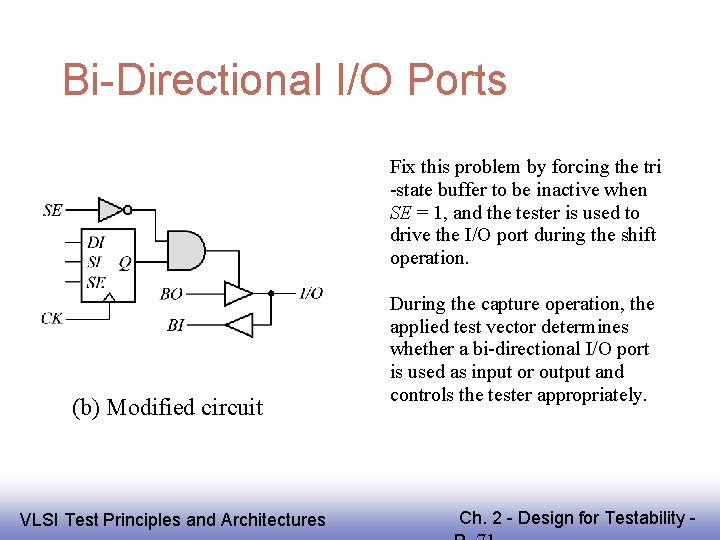
Bi-Directional I/O Ports Fix this problem by forcing the tri -state buffer to be inactive when SE = 1, and the tester is used to drive the I/O port during the shift operation. (b) Modified circuit EE 141 VLSI Test Principles and Architectures During the capture operation, the applied test vector determines whether a bi-directional I/O port is used as input or output and controls the tester appropriately. Ch. 2 - Design for Testability -
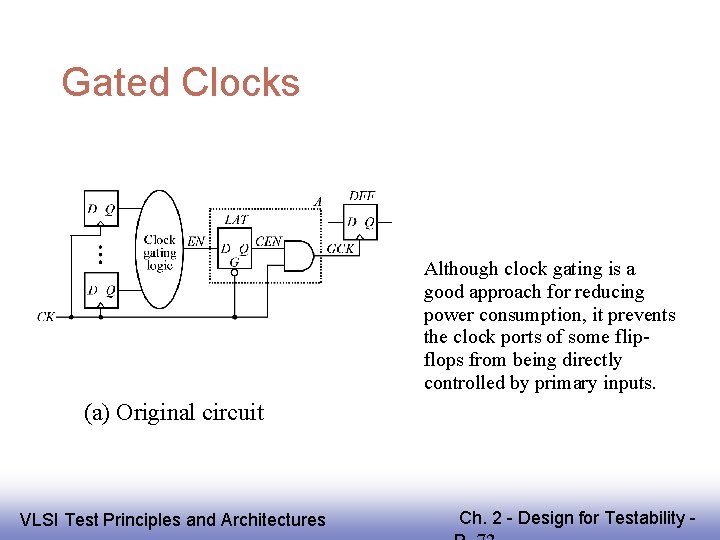
Gated Clocks Although clock gating is a good approach for reducing power consumption, it prevents the clock ports of some flipflops from being directly controlled by primary inputs. (a) Original circuit EE 141 VLSI Test Principles and Architectures Ch. 2 - Design for Testability -
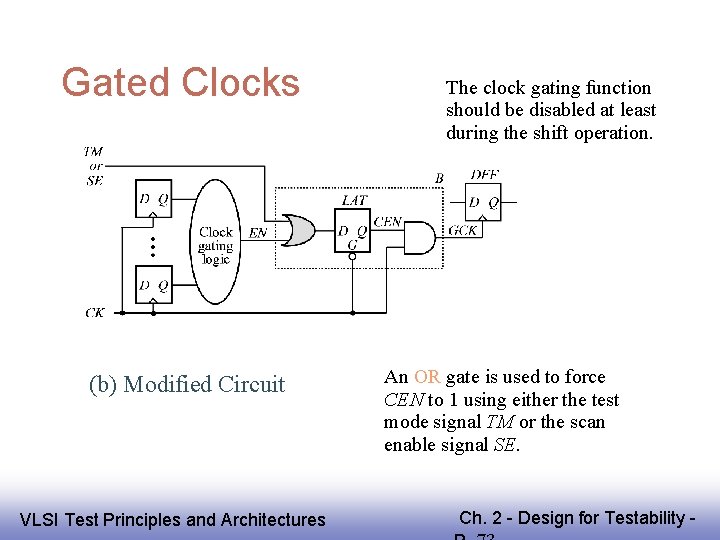
Gated Clocks (b) Modified Circuit EE 141 VLSI Test Principles and Architectures The clock gating function should be disabled at least during the shift operation. An OR gate is used to force CEN to 1 using either the test mode signal TM or the scan enable signal SE. Ch. 2 - Design for Testability -
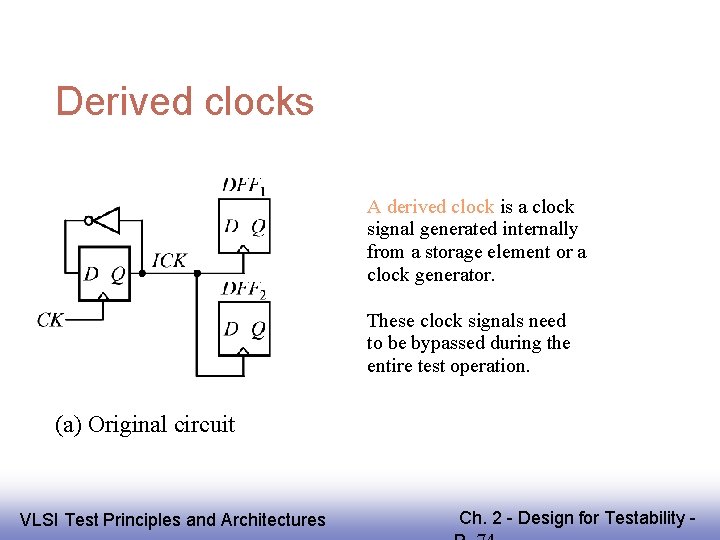
Derived clocks A derived clock is a clock signal generated internally from a storage element or a clock generator. These clock signals need to be bypassed during the entire test operation. (a) Original circuit EE 141 VLSI Test Principles and Architectures Ch. 2 - Design for Testability -
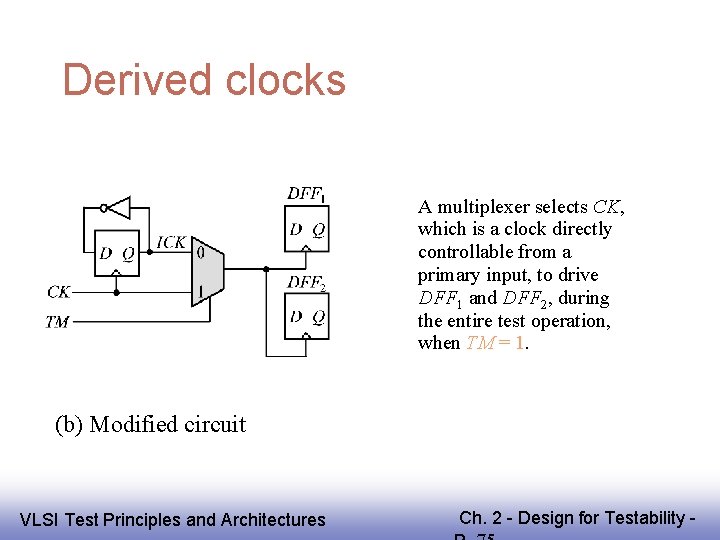
Derived clocks A multiplexer selects CK, which is a clock directly controllable from a primary input, to drive DFF 1 and DFF 2, during the entire test operation, when TM = 1. (b) Modified circuit EE 141 VLSI Test Principles and Architectures Ch. 2 - Design for Testability -
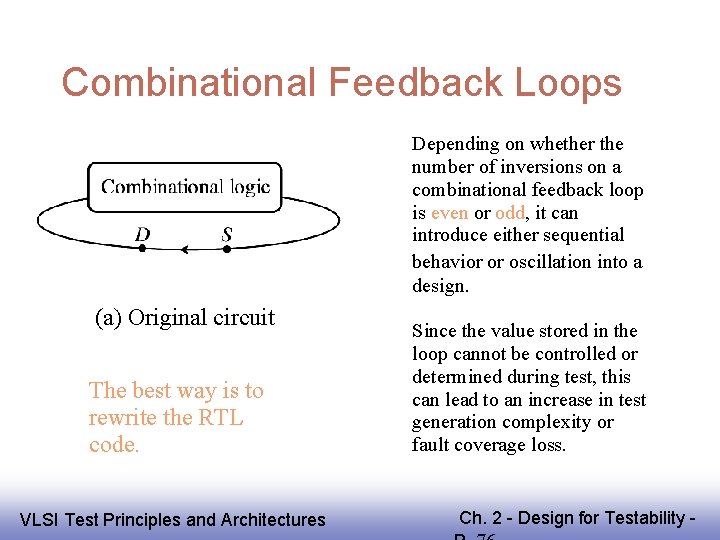
Combinational Feedback Loops Depending on whether the number of inversions on a combinational feedback loop is even or odd, it can introduce either sequential behavior or oscillation into a design. (a) Original circuit The best way is to rewrite the RTL code. EE 141 VLSI Test Principles and Architectures Since the value stored in the loop cannot be controlled or determined during test, this can lead to an increase in test generation complexity or fault coverage loss. Ch. 2 - Design for Testability -
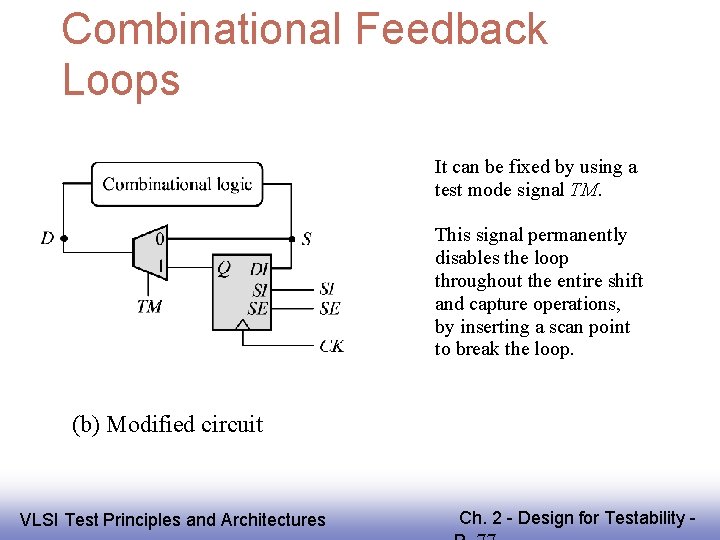
Combinational Feedback Loops It can be fixed by using a test mode signal TM. This signal permanently disables the loop throughout the entire shift and capture operations, by inserting a scan point to break the loop. (b) Modified circuit EE 141 VLSI Test Principles and Architectures Ch. 2 - Design for Testability -
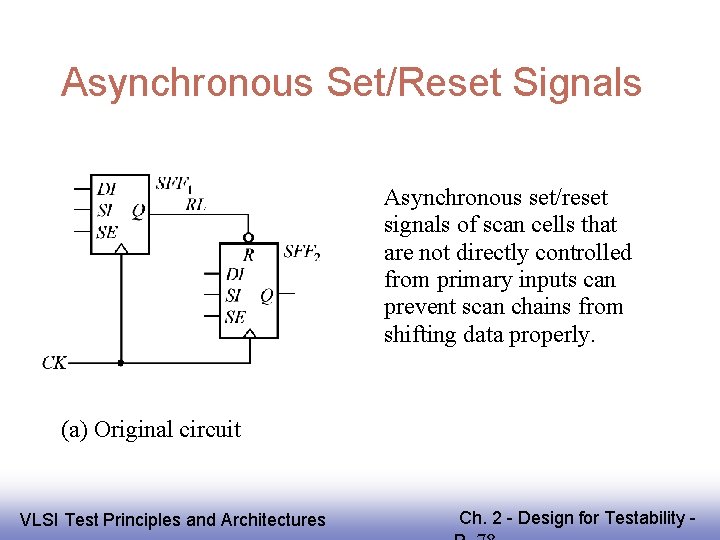
Asynchronous Set/Reset Signals Asynchronous set/reset signals of scan cells that are not directly controlled from primary inputs can prevent scan chains from shifting data properly. (a) Original circuit EE 141 VLSI Test Principles and Architectures Ch. 2 - Design for Testability -
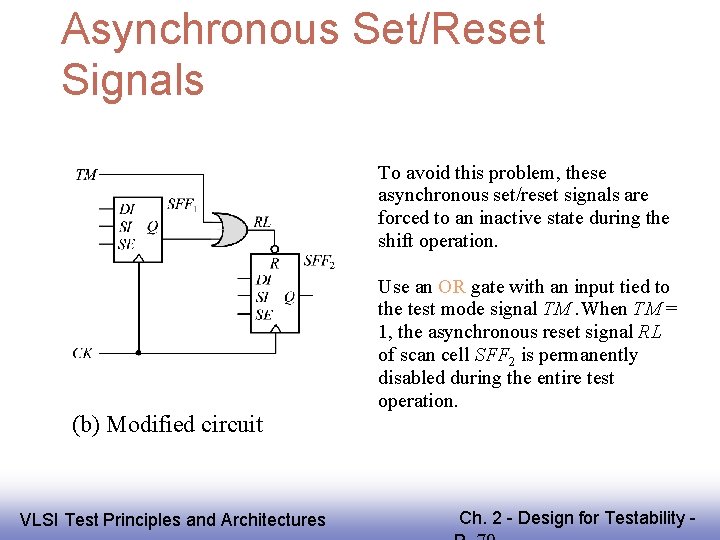
Asynchronous Set/Reset Signals To avoid this problem, these asynchronous set/reset signals are forced to an inactive state during the shift operation. (b) Modified circuit EE 141 VLSI Test Principles and Architectures Use an OR gate with an input tied to the test mode signal TM. When TM = 1, the asynchronous reset signal RL of scan cell SFF 2 is permanently disabled during the entire test operation. Ch. 2 - Design for Testability -
Scan Design Flow EE 141 VLSI Test Principles and Architectures Ch. 2 - Design for Testability -
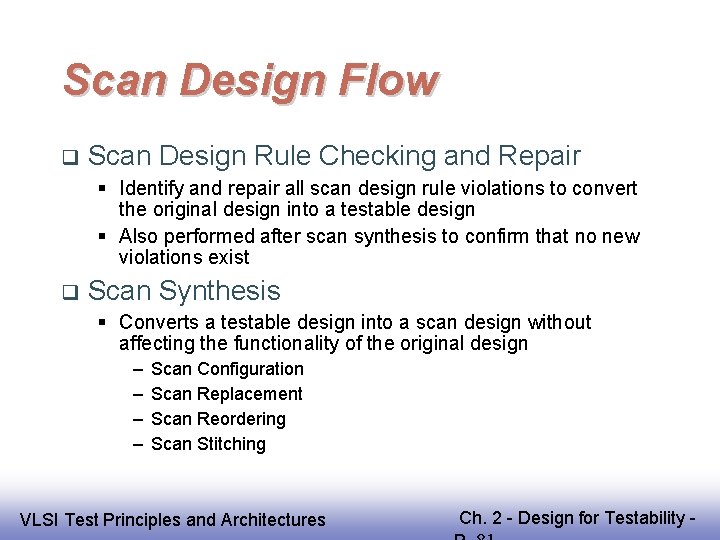
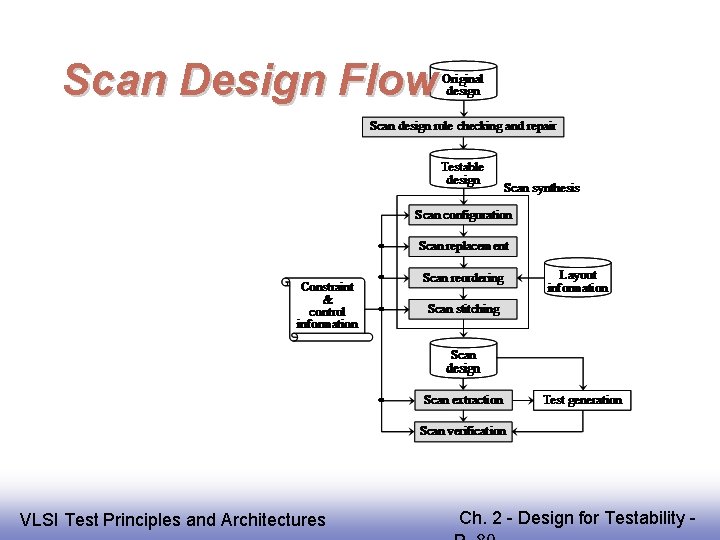
Scan Design Flow Scan Design Rule Checking and Repair Identify and repair all scan design rule violations to convert the original design into a testable design Also performed after scan synthesis to confirm that no new violations exist Scan Synthesis Converts a testable design into a scan design without affecting the functionality of the original design – – Scan Configuration Scan Replacement Scan Reordering Scan Stitching EE 141 VLSI Test Principles and Architectures Ch. 2 - Design for Testability -
Scan Design Flow Scan Extraction Is the process used for extracting all scan cell instances from all scan chains specified in the scan design Scan Verification A timing file in standard delay format (SDF) which resembles the timing behavior of the manufactured device is used to – Verifying the scan shift operation – Verifying the scan capture operation Scan Design Costs Area overhead cost: I/O pin cost Performance degradation cost Design effort cost EE 141 VLSI Test Principles and Architectures Ch. 2 - Design for Testability -
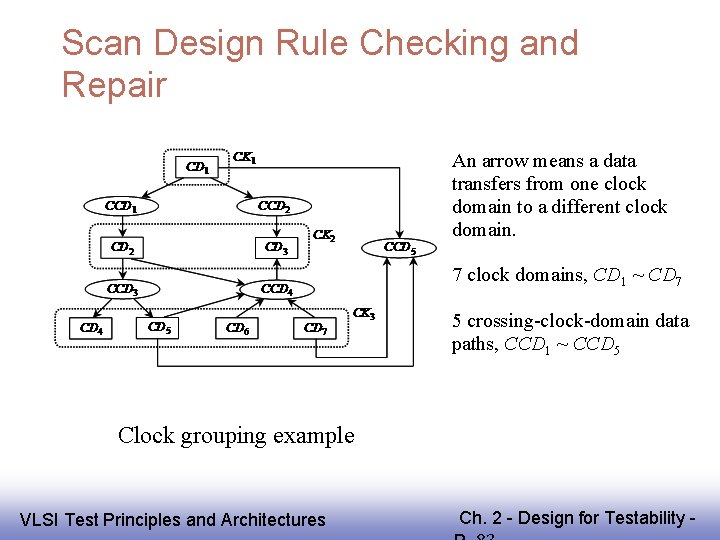
Scan Design Rule Checking and Repair An arrow means a data transfers from one clock domain to a different clock domain. 7 clock domains, CD 1 ~ CD 7 5 crossing-clock-domain data paths, CCD 1 ~ CCD 5 Clock grouping example EE 141 VLSI Test Principles and Architectures Ch. 2 - Design for Testability -
Scan Synthesis Includes four separate and distinct steps: Scan Configuration – – The number of scan chains used The types of scan cells used to implement these scan chains Which storage elements to exclude from the process How the scan cells are arranged Scan Replacement – Replaces all original storage elements in the testable design with their functionally-equivalent scan cells Scan Reordering – The process of reordering the scan chains based on the physical scan cell locations, in order to minimize the amount of interconnect wires used to implement the scan chains Scan Stitching – Stitch all scan cells together to form scan chains EE 141 VLSI Test Principles and Architectures Ch. 2 - Design for Testability -
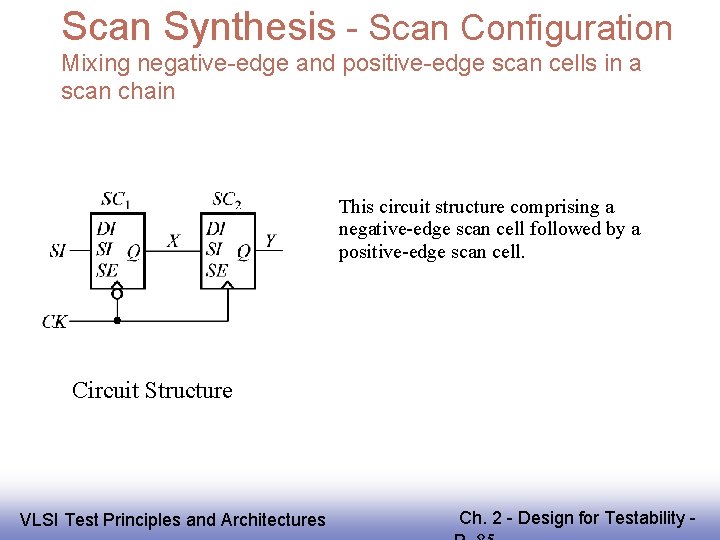
Scan Synthesis - Scan Configuration Mixing negative-edge and positive-edge scan cells in a scan chain This circuit structure comprising a negative-edge scan cell followed by a positive-edge scan cell. Circuit Structure EE 141 VLSI Test Principles and Architectures Ch. 2 - Design for Testability -
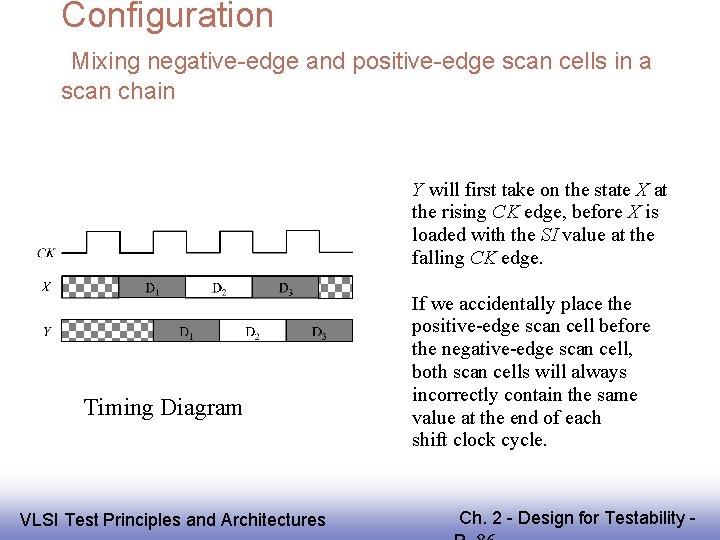
Configuration Mixing negative-edge and positive-edge scan cells in a scan chain Y will first take on the state X at the rising CK edge, before X is loaded with the SI value at the falling CK edge. Timing Diagram EE 141 VLSI Test Principles and Architectures If we accidentally place the positive-edge scan cell before the negative-edge scan cell, both scan cells will always incorrectly contain the same value at the end of each shift clock cycle. Ch. 2 - Design for Testability -
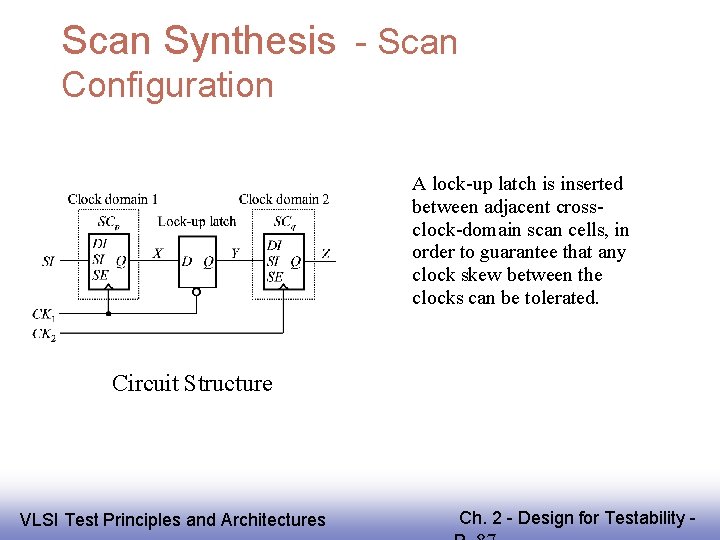
Scan Synthesis - Scan Configuration A lock-up latch is inserted between adjacent crossclock-domain scan cells, in order to guarantee that any clock skew between the clocks can be tolerated. Circuit Structure EE 141 VLSI Test Principles and Architectures Ch. 2 - Design for Testability -
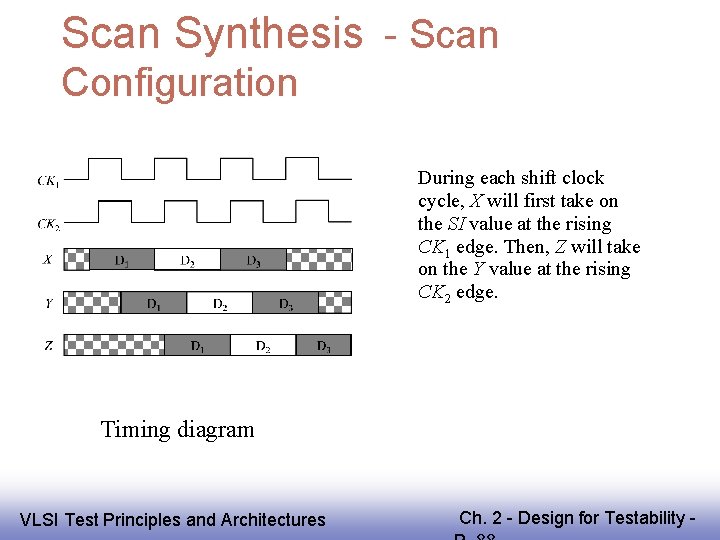
Scan Synthesis - Scan Configuration During each shift clock cycle, X will first take on the SI value at the rising CK 1 edge. Then, Z will take on the Y value at the rising CK 2 edge. Timing diagram EE 141 VLSI Test Principles and Architectures Ch. 2 - Design for Testability -
Special-Purpose Scan Designs Enhanced scan Snapshot scan Error-resilient scan EE 141 VLSI Test Principles and Architectures Ch. 2 - Design for Testability -
Enhanced Scan Why enhanced scan is introduced? Testing for a delay fault requires a pair of test vector at speed Be able to capture the response to the transiton at operating frequency What is new? Allow the typical scan cell to store two bits of data Achieved through the addition of a D latch EE 141 VLSI Test Principles and Architectures Ch. 2 - Design for Testability -
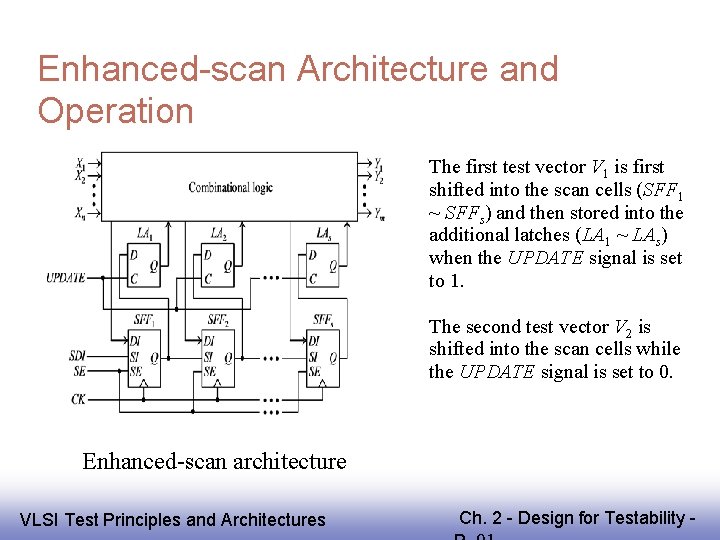
Enhanced-scan Architecture and Operation The first test vector V 1 is first shifted into the scan cells (SFF 1 ~ SFFs) and then stored into the additional latches (LA 1 ~ LAs) when the UPDATE signal is set to 1. The second test vector V 2 is shifted into the scan cells while the UPDATE signal is set to 0. Enhanced-scan architecture EE 141 VLSI Test Principles and Architectures Ch. 2 - Design for Testability -
Enhanced Scan - Advantages & Disadvantages Advantages High delay fault coverge achieved by applying any arbitrary pair of test vectors Disadvantages Requiring an additional scan-hold D latch Difficulty of maintaining the timing relationship between UPDATE and CK Over-test problem caused by false paths EE 141 VLSI Test Principles and Architectures Ch. 2 - Design for Testability -
Snapshot scan Why snapshot scan is introduced? Capture a snapshot of the internal states Without disruption of the functional operation What is new? Add a scan cell (2 -port D latches) to each storage element of interest Implement scan-set architecture EE 141 VLSI Test Principles and Architectures Ch. 2 - Design for Testability -
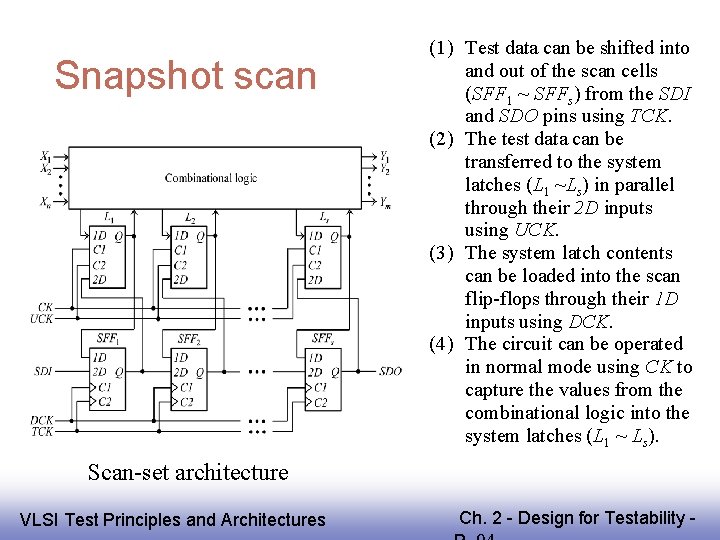
Snapshot scan (1) Test data can be shifted into and out of the scan cells (SFF 1 ~ SFFs) from the SDI and SDO pins using TCK. (2) The test data can be transferred to the system latches (L 1 ~Ls) in parallel through their 2 D inputs using UCK. (3) The system latch contents can be loaded into the scan flip-flops through their 1 D inputs using DCK. (4) The circuit can be operated in normal mode using CK to capture the values from the combinational logic into the system latches (L 1 ~ Ls). Scan-set architecture EE 141 VLSI Test Principles and Architectures Ch. 2 - Design for Testability -
Snapshot scan - Advantages & Disadvantage Advantages Significantly improve the circuit's diagnostic resolution and silicon debug capability Allow on-chip, on-board and in-system debug and diagnosis Disadvantage Increased area overhead EE 141 VLSI Test Principles and Architectures Ch. 2 - Design for Testability -
Error-Resilient scan Why is error-resilient scan introduced? Soft errors are transient single-event upsets with various causes Soft errors increase as shrinking IC geometry and increasing frequency Reliability concerns are created for protecting a device from soft errors What can error-resilient scan do? Observe soft errors occurring in memories and storage elements Observe a transient fault in a combinational gate captured by a memory or storage element EE 141 VLSI Test Principles and Architectures Ch. 2 - Design for Testability -
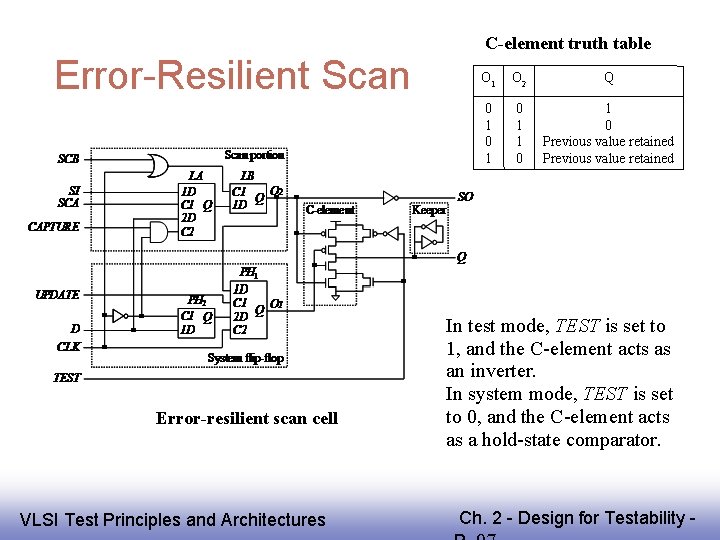
C-element truth table Error-Resilient Scan Error-resilient scan cell EE 141 VLSI Test Principles and Architectures O 1 O 2 Q 0 1 0 1 1 0 Previous value retained In test mode, TEST is set to 1, and the C-element acts as an inverter. In system mode, TEST is set to 0, and the C-element acts as a hold-state comparator. Ch. 2 - Design for Testability -
Error-Resilient scan - Advantages & Disadvantages Advantages Provide online detection and correction of soft errors Embed with scan testing capability Disadvantages Require many test signals and clocks Area overhead EE 141 VLSI Test Principles and Architectures Ch. 2 - Design for Testability -
RTL Design for Testability Why are RTL designs needed? Growth of device number Tight timing Potential yield loss Low-power issues Increased core reusability Time-to market pressure EE 141 VLSI Test Principles and Architectures Ch. 2 - Design for Testability -
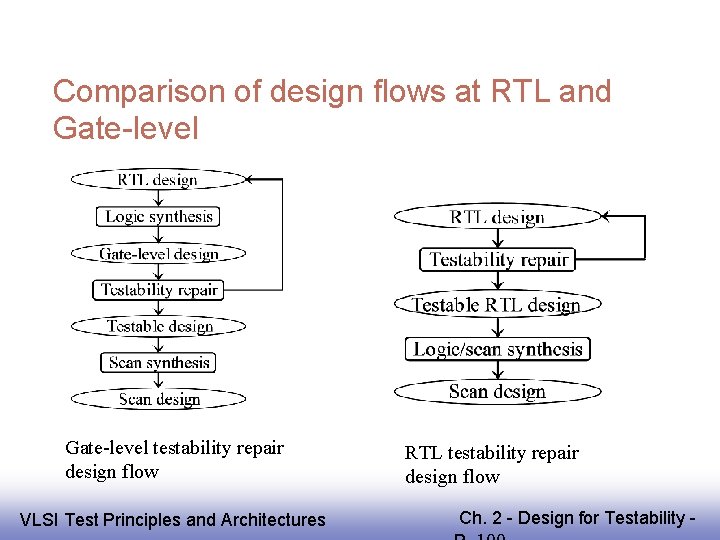
Comparison of design flows at RTL and Gate-level testability repair design flow EE 141 VLSI Test Principles and Architectures RTL testability repair design flow Ch. 2 - Design for Testability -
RTL Scan Design Rule Checking Fast synthesis Mapped onto combinational primitives and high-level models Identify testability problems Static solutions (without simulation) Dynamic solutions (with simulation) EE 141 VLSI Test Principles and Architectures Ch. 2 - Design for Testability -
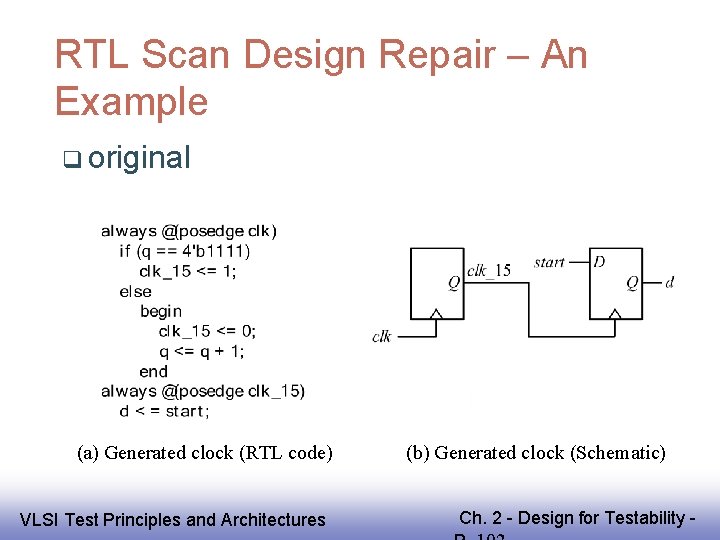
RTL Scan Design Repair – An Example original (a) Generated clock (RTL code) EE 141 VLSI Test Principles and Architectures (b) Generated clock (Schematic) Ch. 2 - Design for Testability -
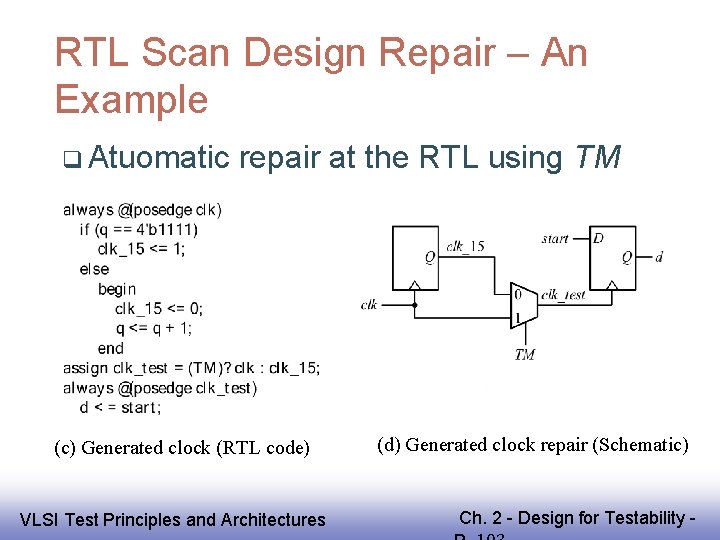
RTL Scan Design Repair – An Example Atuomatic repair at the RTL using TM (c) Generated clock (RTL code) EE 141 VLSI Test Principles and Architectures (d) Generated clock repair (Schematic) Ch. 2 - Design for Testability -
RTL Scan Synthesis RTL scan synthesis The scan equivalent of each storage element refers to an RTL structure The scan chains are inserted into the RTL design Pseudo RTL scan synthesis Specify pseudo primary inputs and pseudo primary outputs Can cope with many other DFT structures Perform one-pass or single-pass synthesis EE 141 VLSI Test Principles and Architectures Ch. 2 - Design for Testability -
RTL Scan Extraction and Verification Scan extraction Rely on performing fast synthesis on the RTL scan design Generate a software model for tracing the scan connection Scan verification Rely on generating a flush testbench to simulate flush tests The flush testbench can be used for both RTL and gate-level designs Apply broadside-load test for verifying the scan capture operation at RTL EE 141 VLSI Test Principles and Architectures Ch. 2 - Design for Testability -
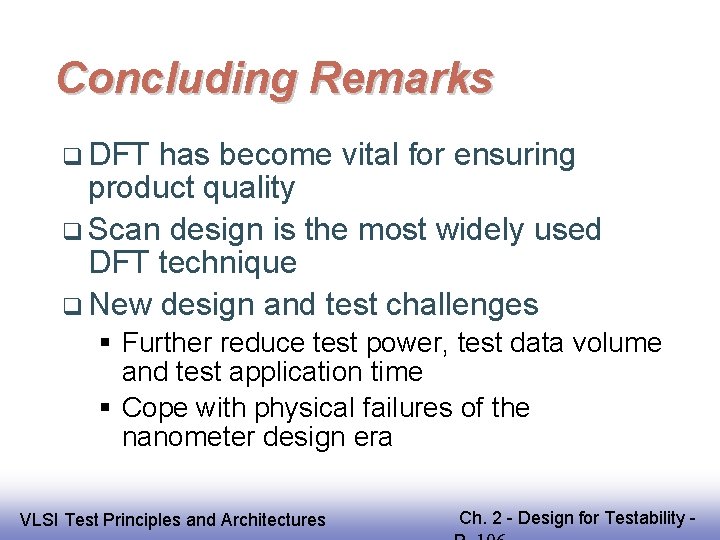
Concluding Remarks DFT has become vital for ensuring product quality Scan design is the most widely used DFT technique New design and test challenges Further reduce test power, test data volume and test application time Cope with physical failures of the nanometer design era EE 141 VLSI Test Principles and Architectures Ch. 2 - Design for Testability -
- Slides: 106