
CHAPTER 2 CULTURE AND INTERNATIONAL BUSINESS Text by
CHAPTER 2 CULTURE AND INTERNATIONAL BUSINESS Text by Profs. M. Czinkota, I. Ronkainen, and M. Moffett Multimedia Presentation by Prof. Milton Pressley The University of New Orleans milton. pressley@uno. edu © 2002 Thomson Learning, Inc.
LEARNING OBJECTIVES • • To define and demonstrate the effect of culture’s various dimensions on international business To examine ways in which cultural knowledge can be acquired and individuals and organizations prepared for cross-cultural interaction To illustrate ways in which cultural risk poses a challenge to the effective conduct of business communications and transactions To suggest ways in which international businesses act as change agents in the diverse cultural environments in which they operate © 2002 Thomson Learning, Inc.
U. S. and Them: Perceptions of American Managers • Different cultures share basic concepts. . . But view them from different angles and perspectives • They thus behave in ways that may • seem irrational or even inappropriate Cultural Risk © Photo. Disc © 2002 Thomson Learning, Inc.
Culture Defined • Acculturation • High-Context Cultures • Low-Context Cultures • Change Agent © Photo. Disc © 2002 Thomson Learning, Inc.
The Elements of Culture • Cultural Universals © Photo. Disc © 2002 Thomson Learning, Inc.
© 2002 Thomson Learning, Inc.
The Elements of Culture • Language © Photo. Disc © 2002 Thomson Learning, Inc.

Figure 2. 1 a – Example of Ads That Transferred Poorly © 2002 Thomson Learning, Inc.
The Elements of Culture • Backtranslation • Nonverbal Language • Religion • Christianity • Islam • Hinduism • Buddhism • Confucianism • Values and Attitudes © Photo. Disc © 2002 Thomson Learning, Inc.
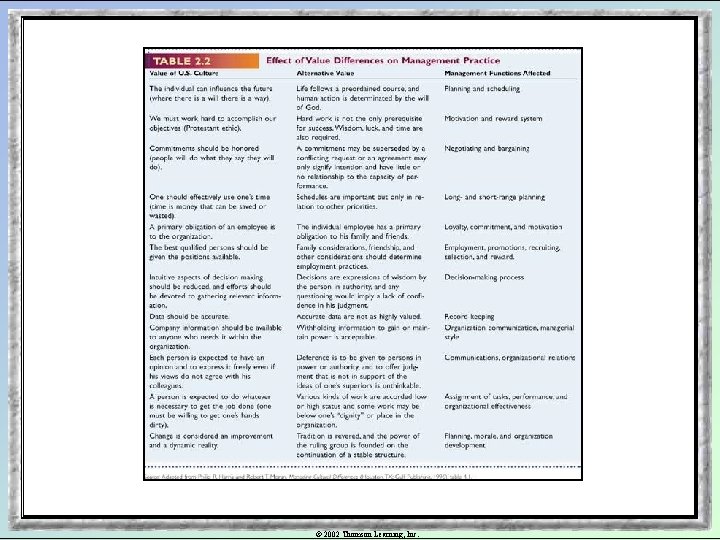
© 2002 Thomson Learning, Inc.
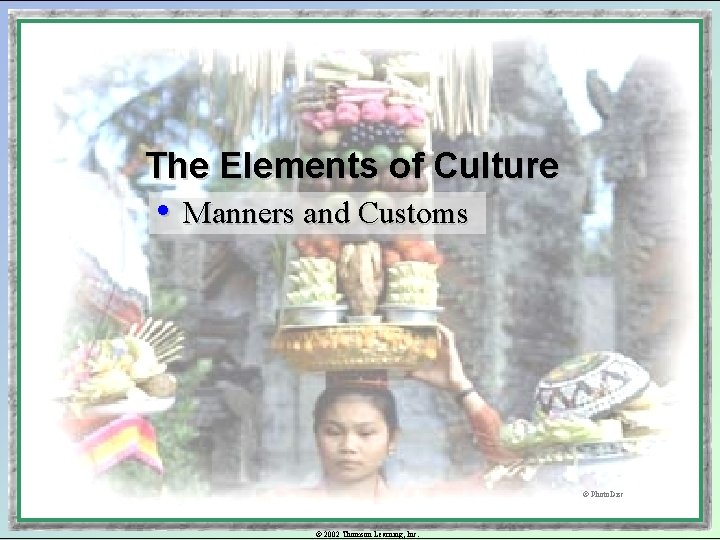
The Elements of Culture • Manners and Customs © Photo. Disc © 2002 Thomson Learning, Inc.
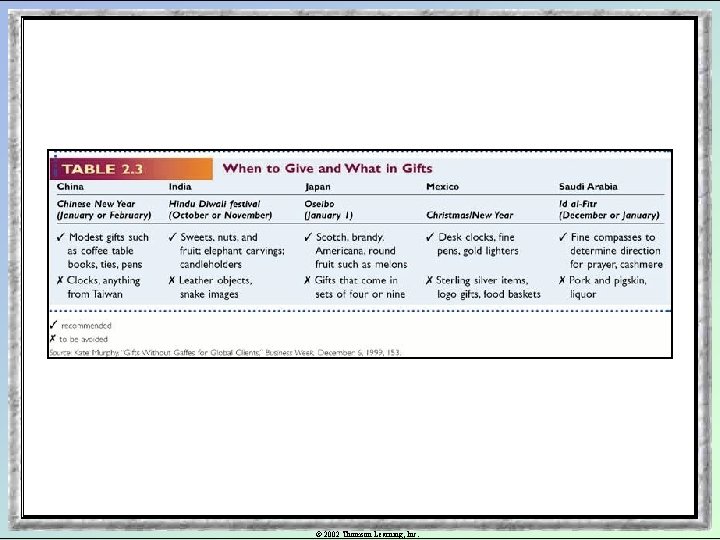
© 2002 Thomson Learning, Inc.
The Elements of Culture • Focus Groups • Material Elements • Economic Infrastructure • Social Infrastructure • Financial Infrastructure • Marketing Infrastructure • Cultural Convergence © Photo. Disc © 2002 Thomson Learning, Inc.
The Elements of Culture • Aesthetics • Education • Social Institutions • Social Stratification • Reference Groups © Photo. Disc © 2002 Thomson Learning, Inc.
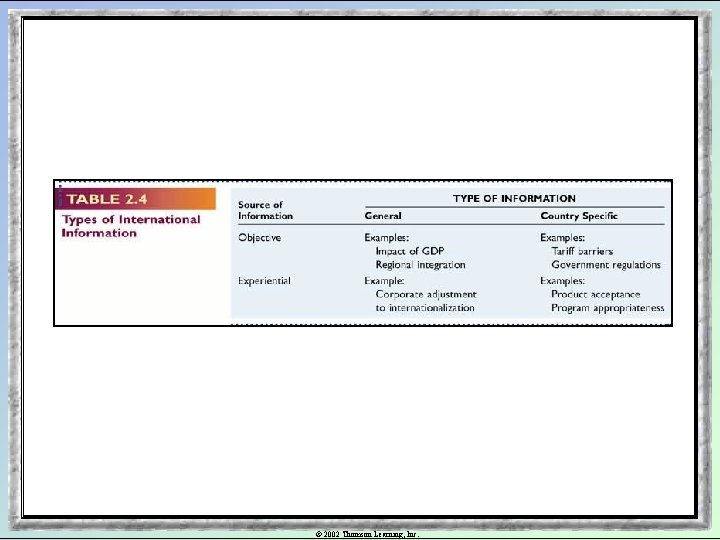
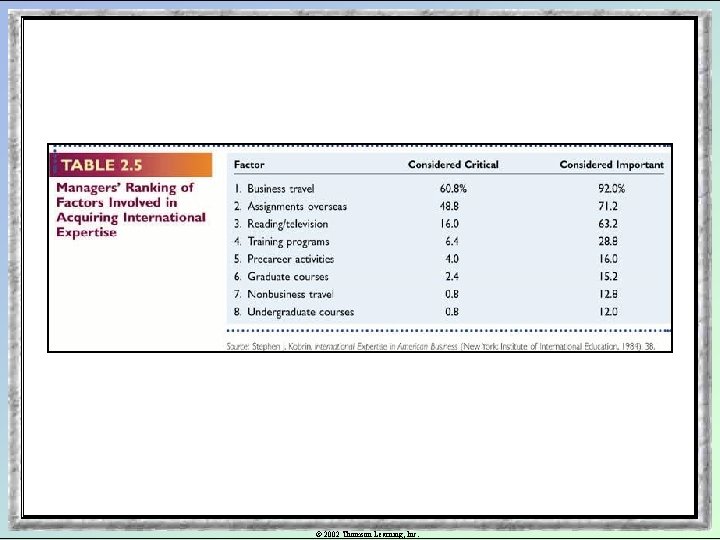
Sources of Cultural Knowledge • Experiential Knowledge © Photo. Disc © 2002 Thomson Learning, Inc.
© 2002 Thomson Learning, Inc.
© 2002 Thomson Learning, Inc.
Sources of Cultural Knowledge • Interpretive Knowledge © Photo. Disc © 2002 Thomson Learning, Inc.
Cultural Analysis • Checklists and Models Showing Pertinent Variables and Their Interaction © Photo. Disc © 2002 Thomson Learning, Inc.
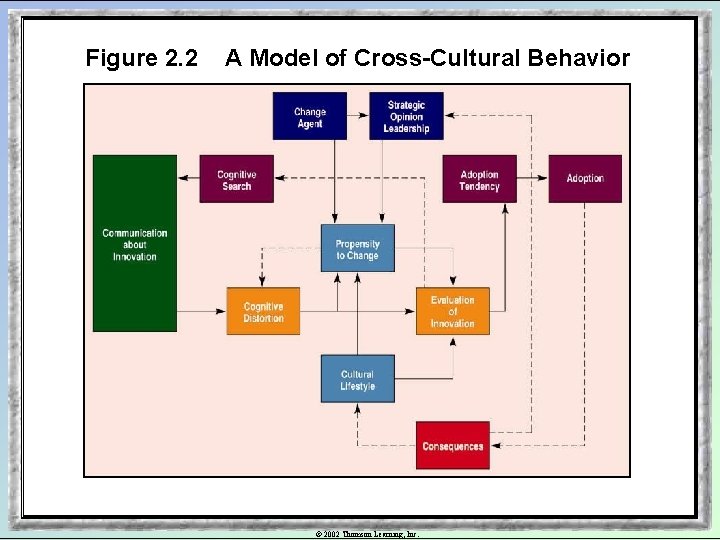
Figure 2. 2 A Model of Cross-Cultural Behavior © 2002 Thomson Learning, Inc.
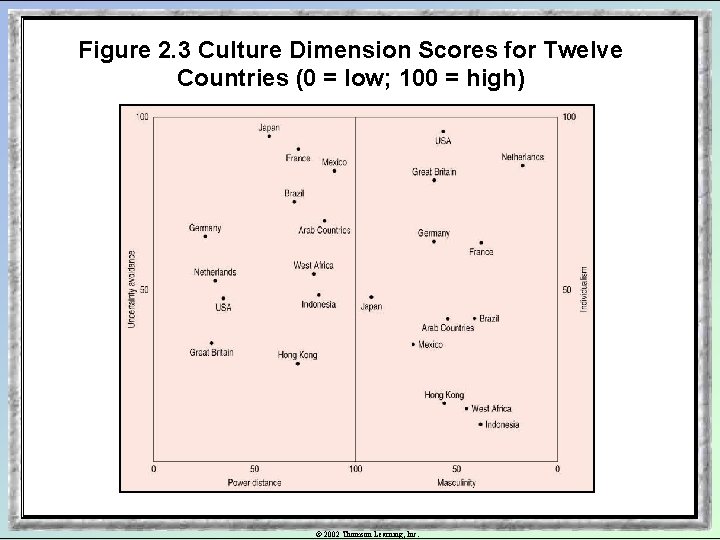
Figure 2. 3 Culture Dimension Scores for Twelve Countries (0 = low; 100 = high) © 2002 Thomson Learning, Inc.
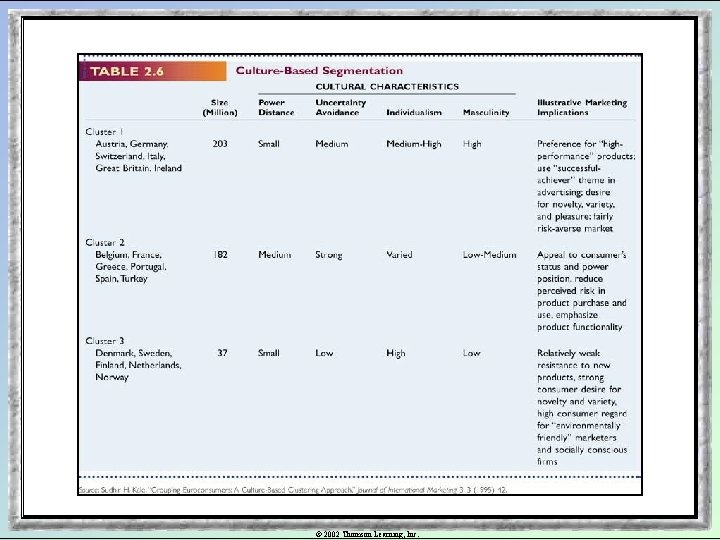
© 2002 Thomson Learning, Inc.
Cultural Analysis • Self-Reference Criterion • Ethnocentrism © Photo. Disc © 2002 Thomson Learning, Inc.
The Training Challenge • Objective of formal training programs is to foster four critical characteristics: • Preparedness • Sensitivity • Patience • Flexibility • Summary of the programs is provided on the next slide © Photo. Disc © 2002 Thomson Learning, Inc.
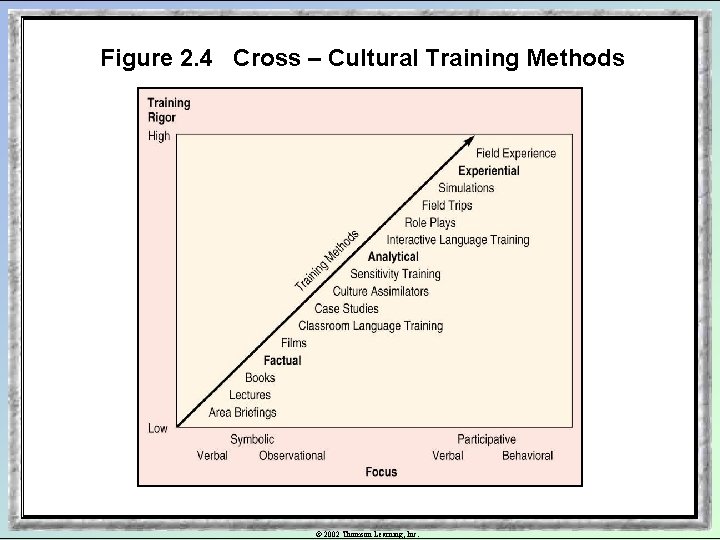
Figure 2. 4 Cross – Cultural Training Methods © 2002 Thomson Learning, Inc.
The Training Challenge • Area Studies • Cultural Assimilator • Sensitivity Training • Field Experience © Photo. Disc © 2002 Thomson Learning, Inc.
- Slides: 26