
Chapter 2 Cultural Patterns Cultural Patterns No object
Chapter 2 Cultural Patterns
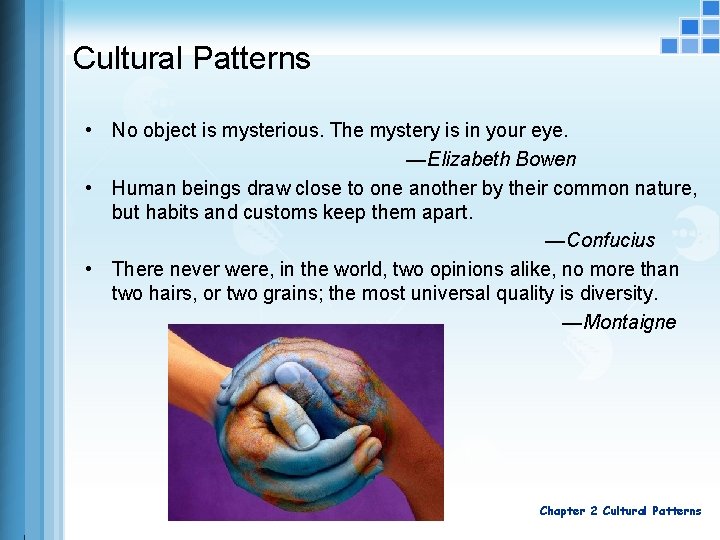
Cultural Patterns • No object is mysterious. The mystery is in your eye. —Elizabeth Bowen • Human beings draw close to one another by their common nature, but habits and customs keep them apart. —Confucius • There never were, in the world, two opinions alike, no more than two hairs, or two grains; the most universal quality is diversity. —Montaigne Chapter 2 Cultural Patterns
Learning Objectives • identify the distinctions between high and low context cultures • identify Kluckhohn and Strodtbeck’s value orientations • identify Hofstede’s cultural dimensions • understand the implications of cultural values for international communication Chapter 2 Cultural Patterns

Case 1 Wood and Food • • Why did the farmer do that? What values are reflected in this story? Chapter 2 Cultural Patterns
Cultural Patterns A An Introduction to Cultural Patterns B Components of Cultural Patterns C Hall’s High-Context and Low-Context Dimensions D Hofstede’s Value Dimension E Kluckhohn and Strodtbeck’s Value Orientation Chapter 2 Cultural Patterns
While-Class Learning: Text A An Introduction to Cultural Patterns • Members of a culture generally have a preferred set of responses to the world. • People from other cultures differ in both obvious and subtle ways. Chapter 2 Cultural Patterns
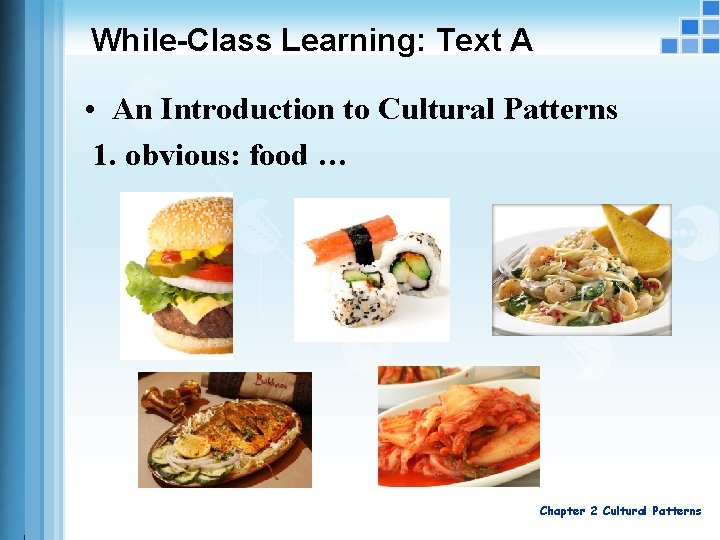
While-Class Learning: Text A • An Introduction to Cultural Patterns 1. obvious: food … Chapter 2 Cultural Patterns
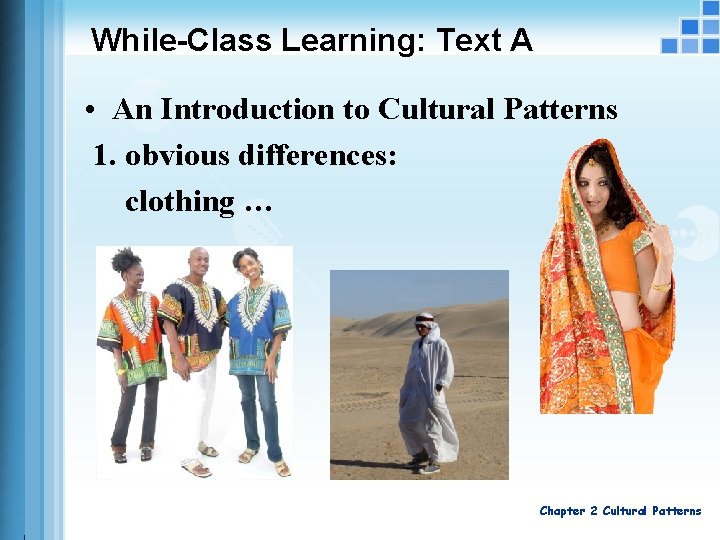
While-Class Learning: Text A • An Introduction to Cultural Patterns 1. obvious differences: clothing … Chapter 2 Cultural Patterns
While-Class Learning: Text A • An Introduction to Cultural Patterns 2. subtle, less visible differences: culture’s collective assumptions: what the world is shared judgments: what it should be widely held expectations: how people should behave predictable behavior patterns … Cultural Patterns: beliefs, values, norms, and social practices Chapter 2 Cultural Patterns
Case 2 Enquiry Kim: an immigrant Judy: an American neighbor • Why did Judy feel that was something strange about the conversation? Chapter 2 Cultural Patterns
While-Class Learning: Text B • Components of Cultural Patterns 1. Beliefs 2. Values 3. Norms 4. Social Practices Chapter 2 Cultural Patterns
B. 1 Beliefs • Ideas people assume to be true about the world 1) a set of learned interpretations: basis to decide what is and what is not logical and correct 2) difficult to discuss: people are usually not conscious of them 3) much of what you consider to be reality may, in fact, not be reality to people from other cultures Chapter 2 Cultural Patterns
B. 1 Beliefs • Different cultures, different realities and beliefs Christian: Christianity 基督教 Islamist: Islam 伊斯兰教 Buddhist: Buddhism 佛教 Jew: Judaism 犹太教 Hindu: Hinduism 印度教(崇拜几位天神,相信轮回转 世) Shintoist: Shinto 神道教(1945年前为日本国教) Chapter 2 Cultural Patterns
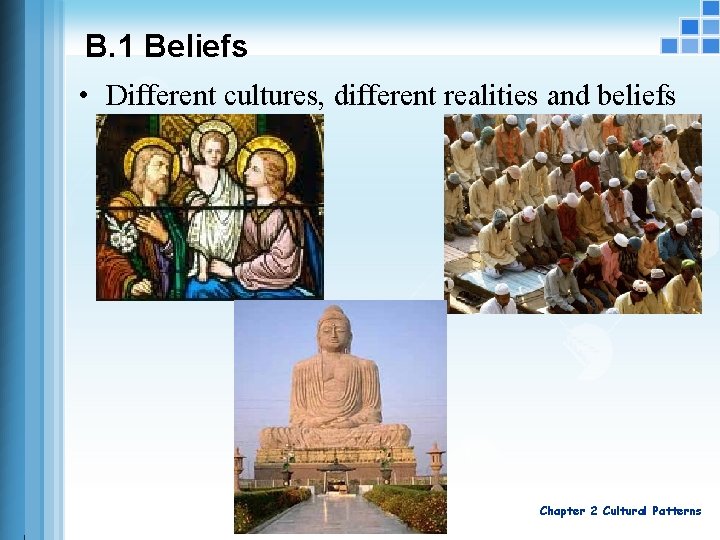
B. 1 Beliefs • Different cultures, different realities and beliefs Chapter 2 Cultural Patterns
B. 2 Values • involve what a culture regards as good or bad, right or wrong, fair or unfair, just or unjust, beautiful or ugly, clean or dirty, valuable or worthless, appropriate or inappropriate, and kind or cruel. • transmitted by a variety of sources family, proverbs, school, church, state … • provide the foundation that underlies a people’s entire way of life • broad based, enduring, relatively stable Chapter 2 Cultural Patterns
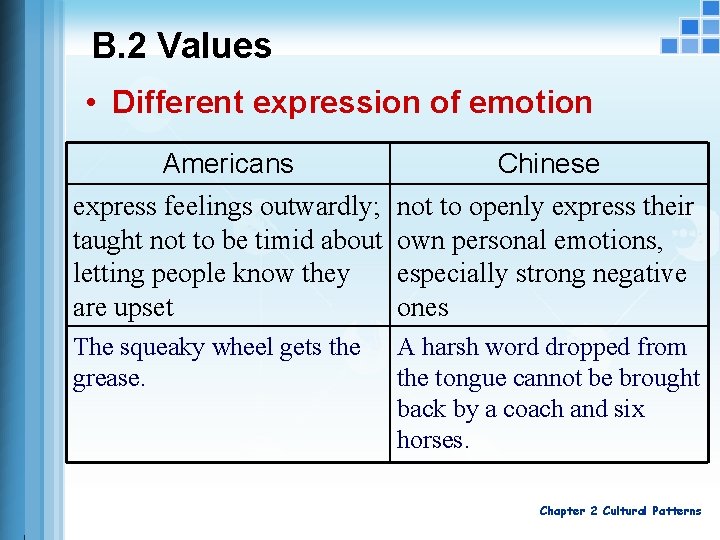
B. 2 Values • Different expression of emotion Americans express feelings outwardly; taught not to be timid about letting people know they are upset Chinese not to openly express their own personal emotions, especially strong negative ones The squeaky wheel gets the grease. A harsh word dropped from the tongue cannot be brought back by a coach and six horses. Chapter 2 Cultural Patterns
B. 3 Norms • Socially shared expressions of appropriate behaviors • Vary within a culture • Change over a period of time • A wide variety of behaviors: greetings, good manners, interactions … Chapter 2 Cultural Patterns
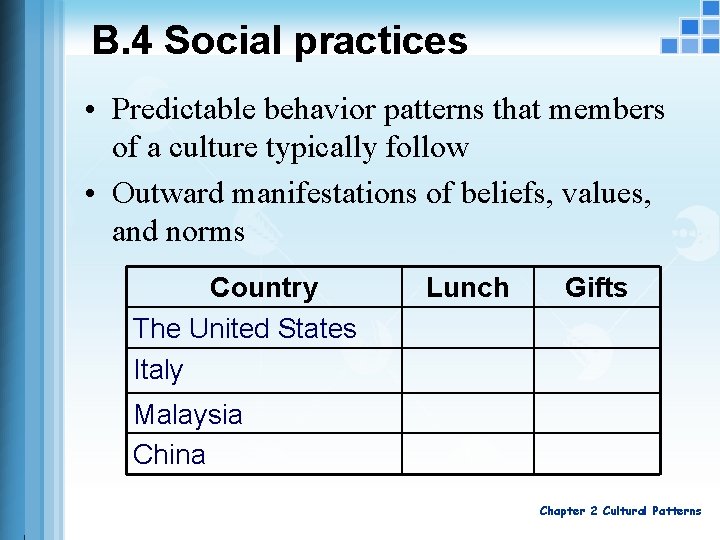
B. 4 Social practices • Predictable behavior patterns that members of a culture typically follow • Outward manifestations of beliefs, values, and norms Country The United States Italy Lunch Gifts Malaysia China Chapter 2 Cultural Patterns
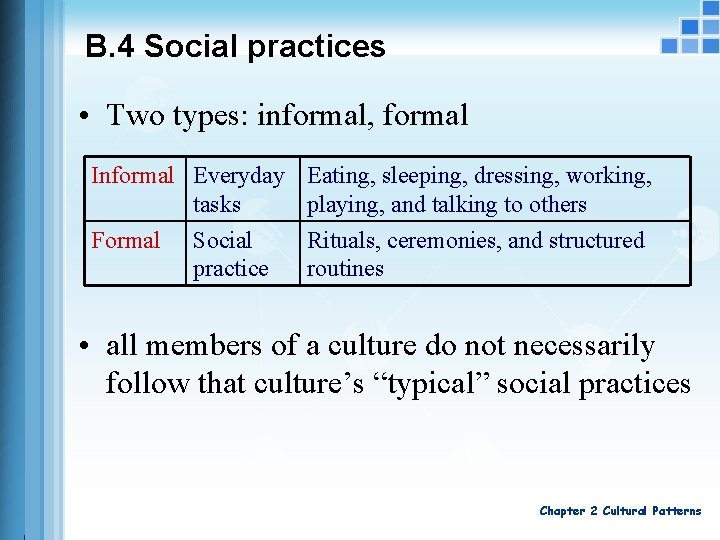
B. 4 Social practices • Two types: informal, formal Informal Everyday Eating, sleeping, dressing, working, tasks playing, and talking to others Formal Social practice Rituals, ceremonies, and structured routines • all members of a culture do not necessarily follow that culture’s “typical” social practices Chapter 2 Cultural Patterns
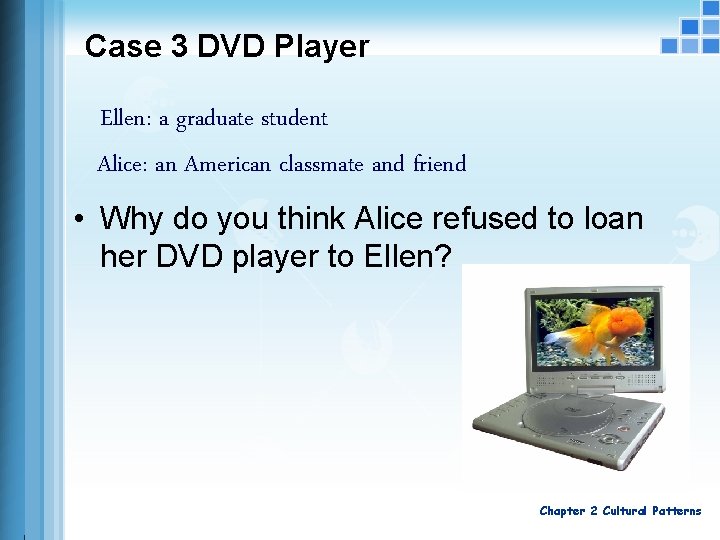
Case 3 DVD Player Ellen: a graduate student Alice: an American classmate and friend • Why do you think Alice refused to loan her DVD player to Ellen? Chapter 2 Cultural Patterns
While-Class Learning: Text C Hall’s High-Context and Low-Context Dimensions • context: setting or environment • meanings: not come from the verbal language alone, also implied from the context • context determines: 1) the words and actions we generate; 2) the meanings we give to the words and actions of other people • continuum: cultures differ ranging from high to low context Chapter 2 Cultural Patterns
While-Class Learning: Text C High-context cultures • prefer to use high-context messages • most of the meaning is either implied by the physical setting or presumed to be part of the individual’s internalized beliefs, values, norms, and social practices; • very little is provided in the coded, explicit, transmitted part of the message Low-context cultures • prefer to use low-context messages • the majority of the information is vested in the explicit code Chapter 2 Cultural Patterns
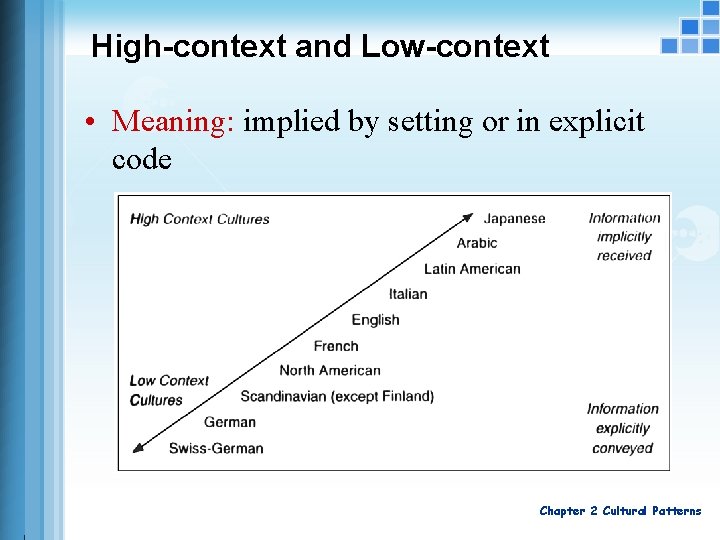
High-context and Low-context • Meaning: implied by setting or in explicit code Chapter 2 Cultural Patterns
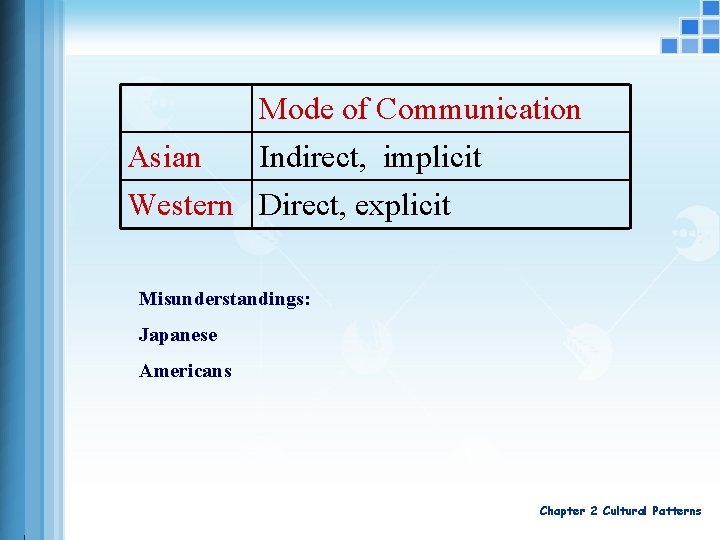
Mode of Communication Asian Indirect, implicit Western Direct, explicit Misunderstandings: Japanese Americans Chapter 2 Cultural Patterns
Case 4 Wrong Signal? Ning Tong: a Chinese student Tom: an American student • What is the problem shown in this case? • Why did Ning Tong keep silent? What information do you think he wanted to convey? • What is Tom’s interpretation of Ning Tong’s silence? Chapter 2 Cultural Patterns
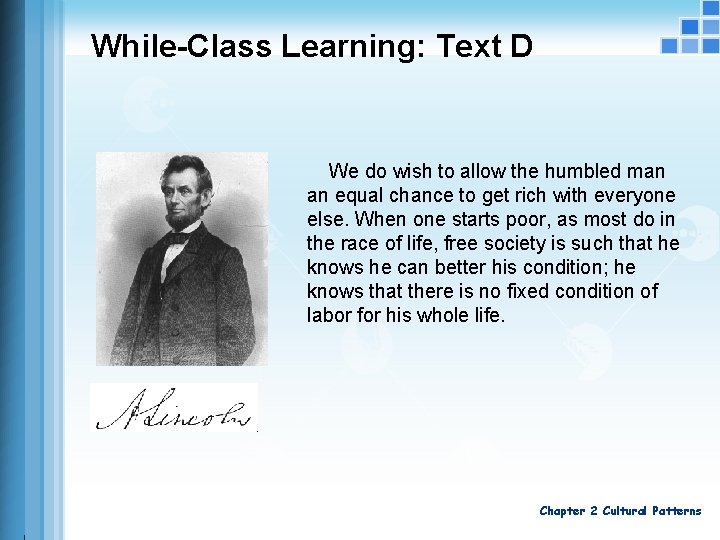
While-Class Learning: Text D We do wish to allow the humbled man an equal chance to get rich with everyone else. When one starts poor, as most do in the race of life, free society is such that he knows he can better his condition; he knows that there is no fixed condition of labor for his whole life. Chapter 2 Cultural Patterns
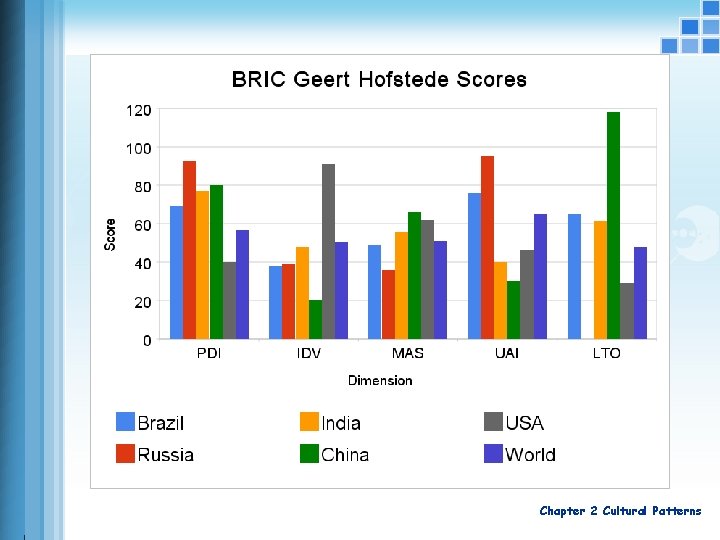
While-Class Learning: Text D • Hofstede’s Value Dimensions 1. Individualism versus Collectivism 2. Uncertainty Avoidance 3. Power Distance 4. Masculinity versus Femininity 5. Long-term versus Short-term Time Orientation Chapter 2 Cultural Patterns
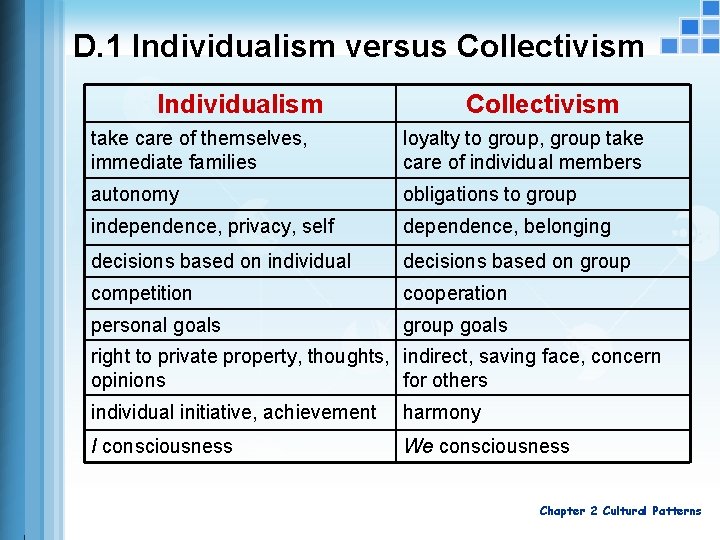
D. 1 Individualism versus Collectivism Individualism Collectivism take care of themselves, immediate families loyalty to group, group take care of individual members autonomy obligations to group independence, privacy, self dependence, belonging decisions based on individual decisions based on group competition cooperation personal goals group goals right to private property, thoughts, indirect, saving face, concern opinions for others individual initiative, achievement harmony I consciousness We consciousness Chapter 2 Cultural Patterns
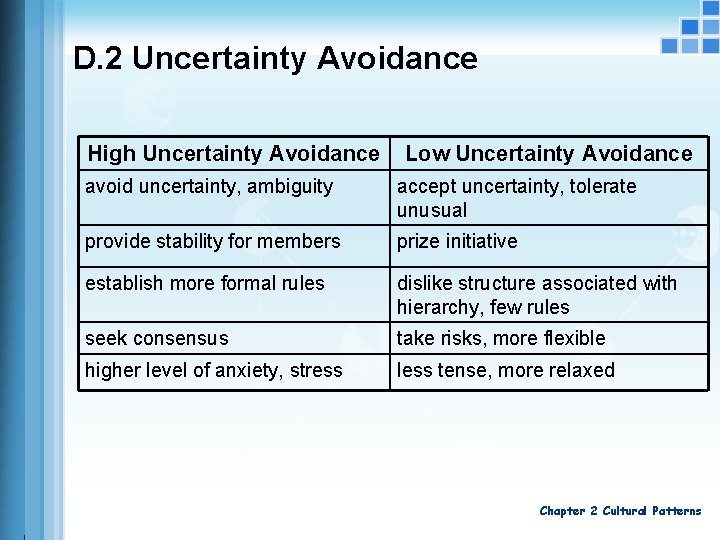
D. 2 Uncertainty Avoidance High Uncertainty Avoidance Low Uncertainty Avoidance avoid uncertainty, ambiguity accept uncertainty, tolerate unusual provide stability for members prize initiative establish more formal rules dislike structure associated with hierarchy, few rules seek consensus take risks, more flexible higher level of anxiety, stress less tense, more relaxed Chapter 2 Cultural Patterns
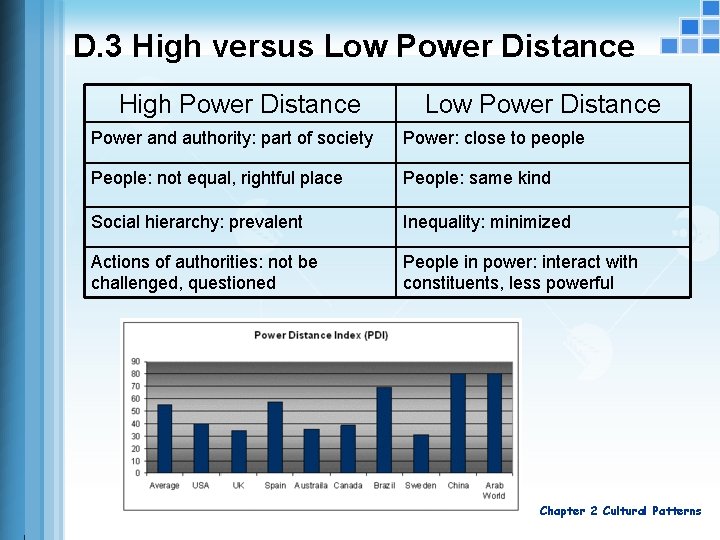
D. 3 High versus Low Power Distance High Power Distance Low Power Distance Power and authority: part of society Power: close to people People: not equal, rightful place People: same kind Social hierarchy: prevalent Inequality: minimized Actions of authorities: not be challenged, questioned People in power: interact with constituents, less powerful Chapter 2 Cultural Patterns
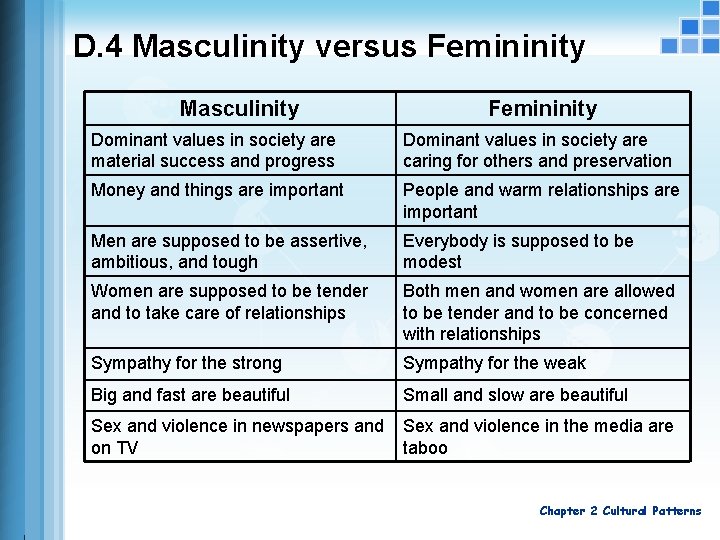
D. 4 Masculinity versus Femininity Masculinity Femininity Dominant values in society are material success and progress Dominant values in society are caring for others and preservation Money and things are important People and warm relationships are important Men are supposed to be assertive, ambitious, and tough Everybody is supposed to be modest Women are supposed to be tender and to take care of relationships Both men and women are allowed to be tender and to be concerned with relationships Sympathy for the strong Sympathy for the weak Big and fast are beautiful Small and slow are beautiful Sex and violence in newspapers and on TV Sex and violence in the media are taboo Chapter 2 Cultural Patterns
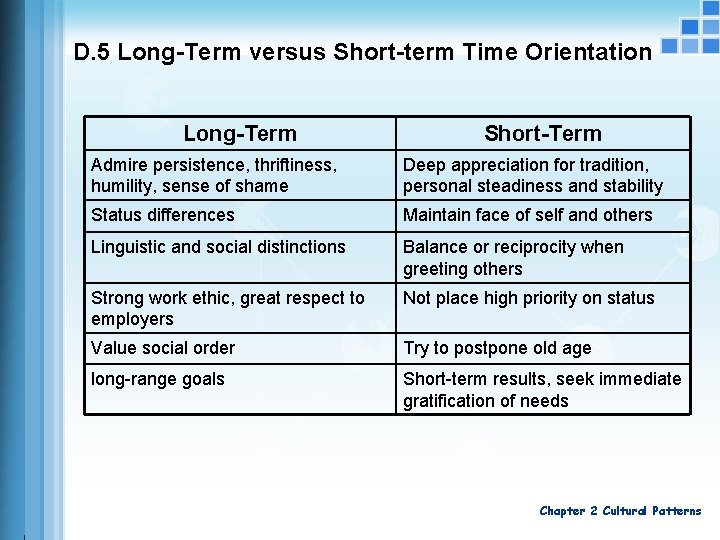
D. 5 Long-Term versus Short-term Time Orientation Long-Term Short-Term Admire persistence, thriftiness, humility, sense of shame Deep appreciation for tradition, personal steadiness and stability Status differences Maintain face of self and others Linguistic and social distinctions Balance or reciprocity when greeting others Strong work ethic, great respect to employers Not place high priority on status Value social order Try to postpone old age long-range goals Short-term results, seek immediate gratification of needs Chapter 2 Cultural Patterns
Chapter 2 Cultural Patterns
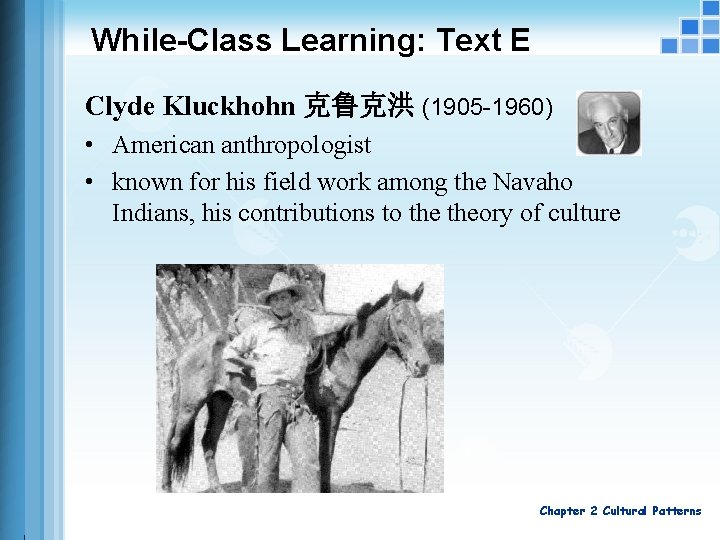
While-Class Learning: Text E Clyde Kluckhohn 克鲁克洪 (1905 -1960) • American anthropologist • known for his field work among the Navaho Indians, his contributions to theory of culture Chapter 2 Cultural Patterns
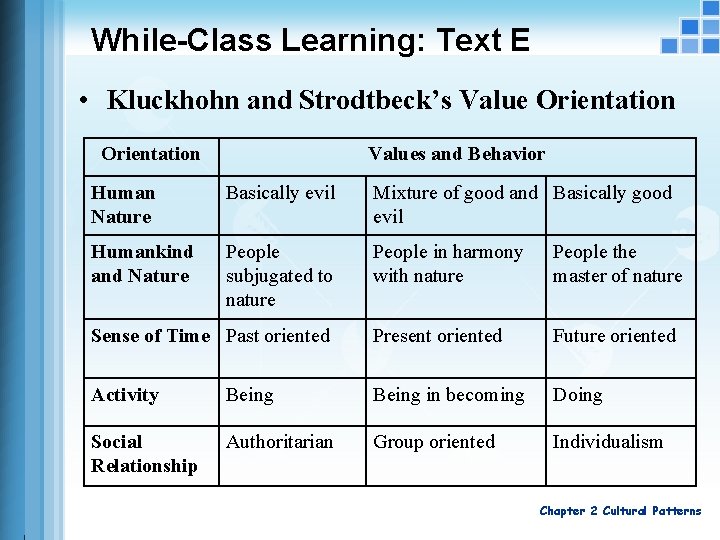
While-Class Learning: Text E • Kluckhohn and Strodtbeck’s Value Orientation Values and Behavior Human Nature Basically evil Mixture of good and Basically good evil Humankind and Nature People subjugated to nature People in harmony with nature People the master of nature Sense of Time Past oriented Present oriented Future oriented Activity Being in becoming Doing Social Relationship Authoritarian Group oriented Individualism Chapter 2 Cultural Patterns
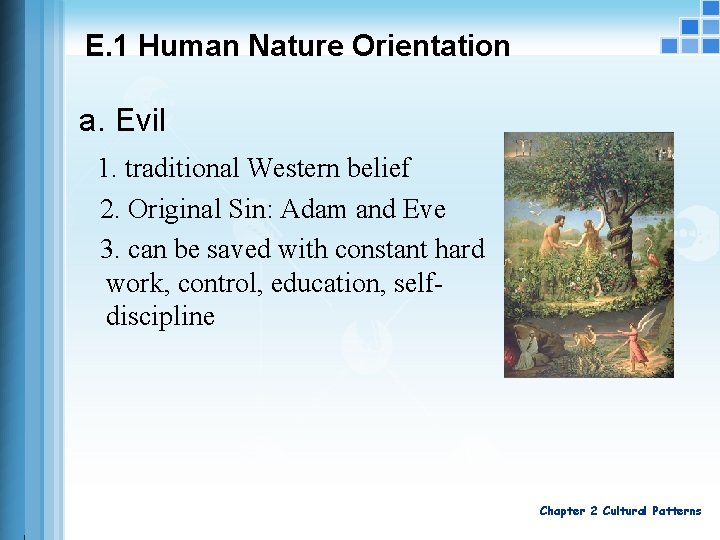
E. 1 Human Nature Orientation a. Evil 1. traditional Western belief 2. Original Sin: Adam and Eve 3. can be saved with constant hard work, control, education, selfdiscipline Chapter 2 Cultural Patterns
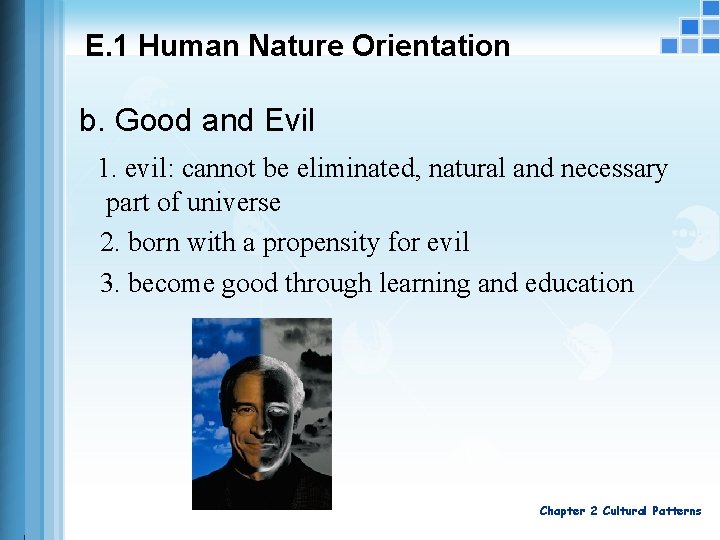
E. 1 Human Nature Orientation b. Good and Evil 1. evil: cannot be eliminated, natural and necessary part of universe 2. born with a propensity for evil 3. become good through learning and education Chapter 2 Cultural Patterns
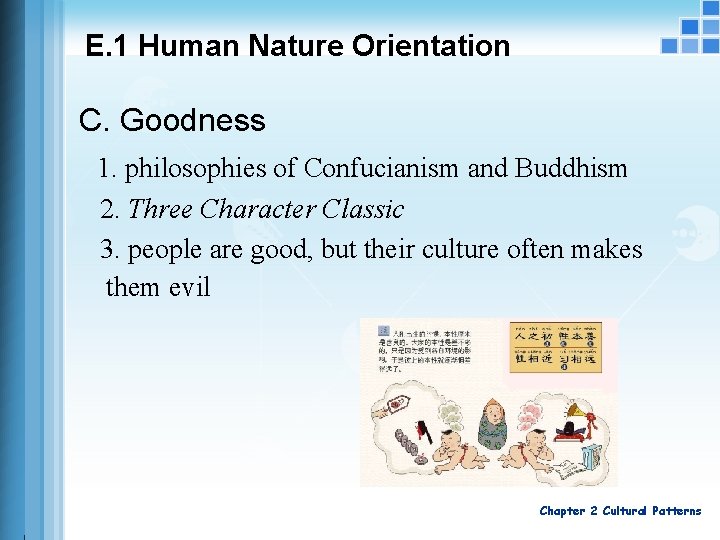
E. 1 Human Nature Orientation C. Goodness 1. philosophies of Confucianism and Buddhism 2. Three Character Classic 3. people are good, but their culture often makes them evil Chapter 2 Cultural Patterns
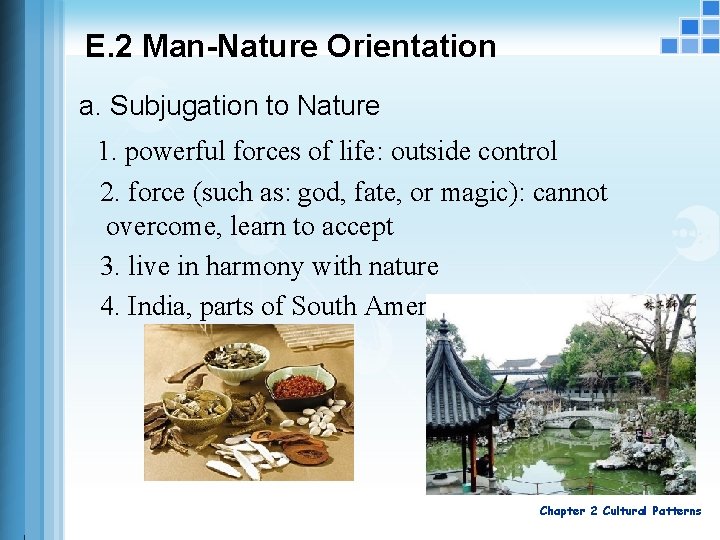
E. 2 Man-Nature Orientation a. Subjugation to Nature 1. powerful forces of life: outside control 2. force (such as: god, fate, or magic): cannot overcome, learn to accept 3. live in harmony with nature 4. India, parts of South America, China… Chapter 2 Cultural Patterns
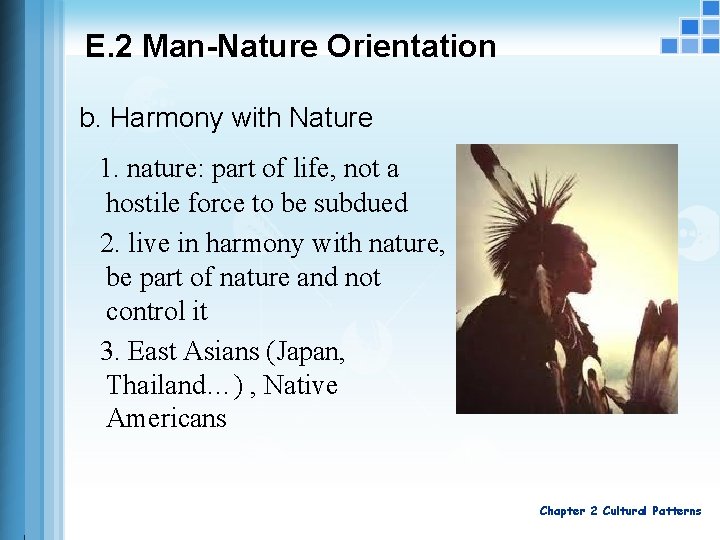
E. 2 Man-Nature Orientation b. Harmony with Nature 1. nature: part of life, not a hostile force to be subdued 2. live in harmony with nature, be part of nature and not control it 3. East Asians (Japan, Thailand…) , Native Americans Chapter 2 Cultural Patterns
E. 2 Man-Nature Orientation c. Mastery over Nature 1. forces of nature: conquer, direct, master 2. value: technology, change, science 3. contribute development of Western science and technology 4. Greenpeace Organization (绿 色和平组织 a non-governmental environmental organization) : environment protect Chapter 2 Cultural Patterns
E. 3 Time Orientation a. Past Orientation 1. believe in significance of prior events 2. religions, tradition: extremely important 3. past: guide for decisions and truth 4. respect: ancestors, predecessors, older people 5. time: cycle, repeating Chapter 2 Cultural Patterns
E. 3 Time Orientation b. Present Orientation 1. moment: most significance 2. future: vague, ambiguous, unknown 3. enjoyment: in the present 4. time: cycle, repeating Chapter 2 Cultural Patterns
E. 3 Time Orientation c. Future Orientation 1. future: emphasize, expect to be grander and nicer 2. If at first you don’t succeed, try, and try again. 3. time: linear Chapter 2 Cultural Patterns
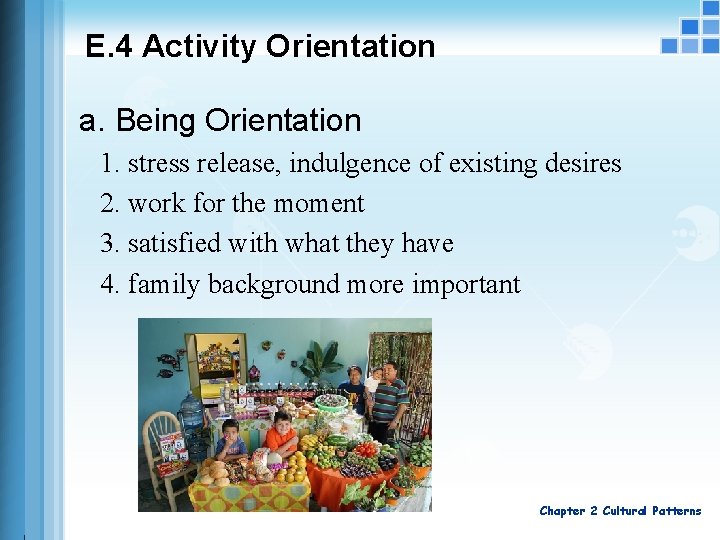
E. 4 Activity Orientation a. Being Orientation 1. stress release, indulgence of existing desires 2. work for the moment 3. satisfied with what they have 4. family background more important Chapter 2 Cultural Patterns
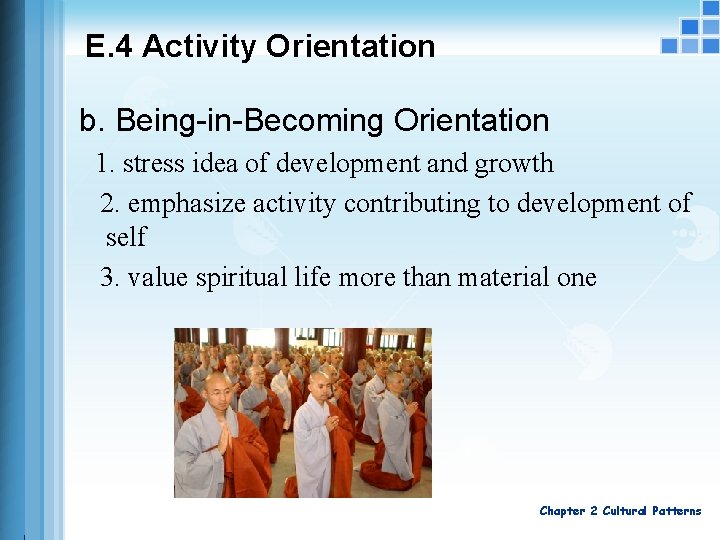
E. 4 Activity Orientation b. Being-in-Becoming Orientation 1. stress idea of development and growth 2. emphasize activity contributing to development of self 3. value spiritual life more than material one Chapter 2 Cultural Patterns
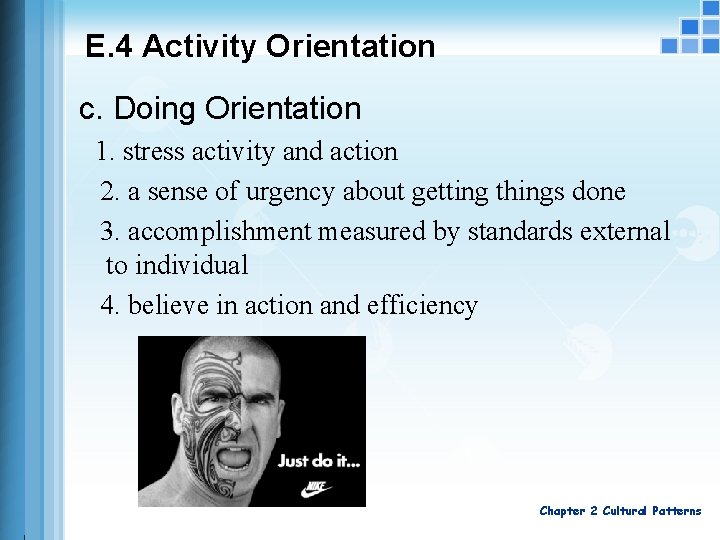
E. 4 Activity Orientation c. Doing Orientation 1. stress activity and action 2. a sense of urgency about getting things done 3. accomplishment measured by standards external to individual 4. believe in action and efficiency Chapter 2 Cultural Patterns
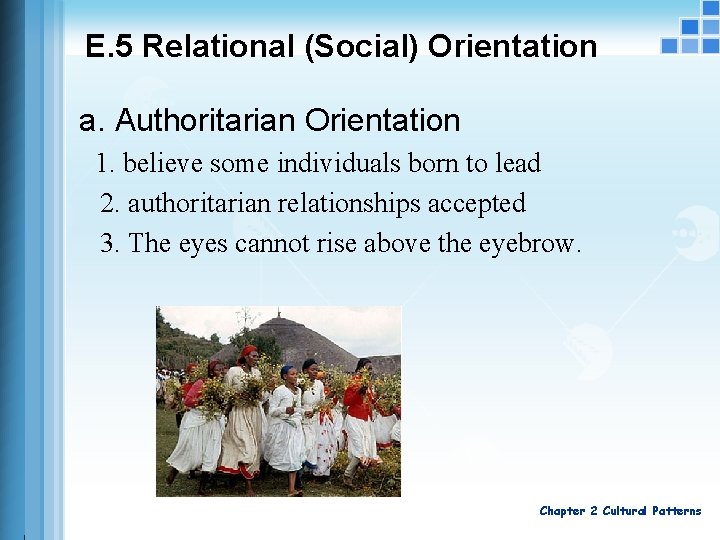
E. 5 Relational (Social) Orientation a. Authoritarian Orientation 1. believe some individuals born to lead 2. authoritarian relationships accepted 3. The eyes cannot rise above the eyebrow. Chapter 2 Cultural Patterns
E. 5 Relational (Social) Orientation b. Collective Orientation 1. group: most important of all social entities 2. feel dependent on group, safe within it, proud 3. competitive with other groups 4. group concern for all its members, make decisions by consensus 5. China, India, Africa, Latin America Chapter 2 Cultural Patterns
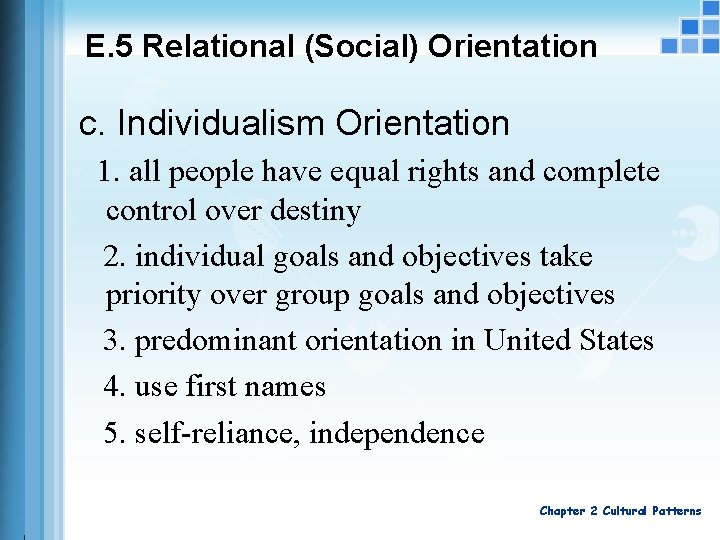
E. 5 Relational (Social) Orientation c. Individualism Orientation 1. all people have equal rights and complete control over destiny 2. individual goals and objectives take priority over group goals and objectives 3. predominant orientation in United States 4. use first names 5. self-reliance, independence Chapter 2 Cultural Patterns

Thank You Chapter 2 Cultural Patterns
- Slides: 51