
Chapter 2 Conventional Encryption Message Confidentiality Henric Johnson
- Slides: 26
Chapter 2 Conventional Encryption Message Confidentiality Henric Johnson Blekinge Institute of Technology, Sweden http: //www. its. bth. se/staff/hjo/ henric. johnson@bth. se Henric Johnson 1
Outline • • • Conventional Encryption Principles Conventional Encryption Algorithms Cipher Block Modes of Operation Location of Encryption Devices Key Distribution Henric Johnson 2
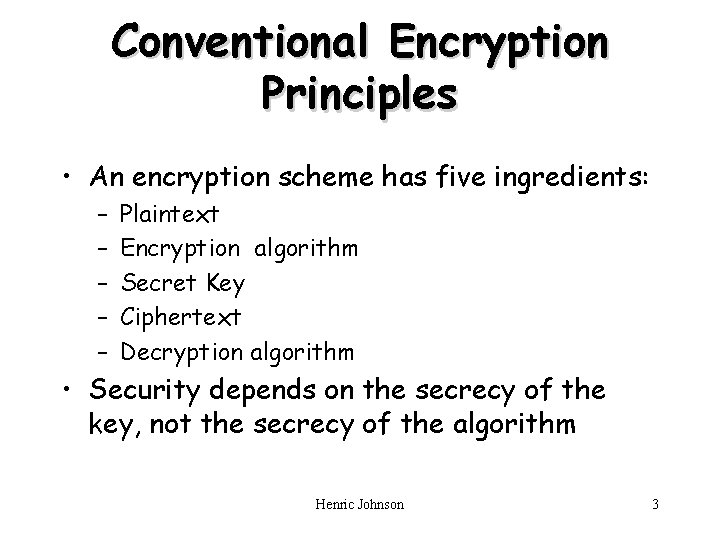
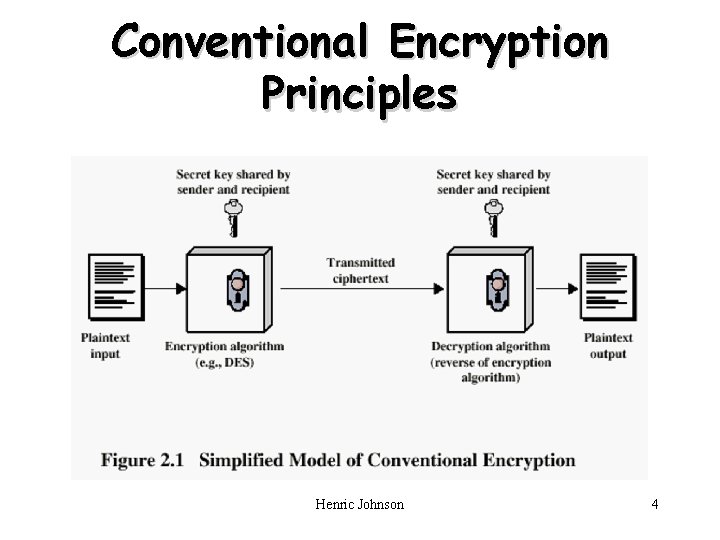
Conventional Encryption Principles • An encryption scheme has five ingredients: – – – Plaintext Encryption algorithm Secret Key Ciphertext Decryption algorithm • Security depends on the secrecy of the key, not the secrecy of the algorithm Henric Johnson 3
Conventional Encryption Principles Henric Johnson 4
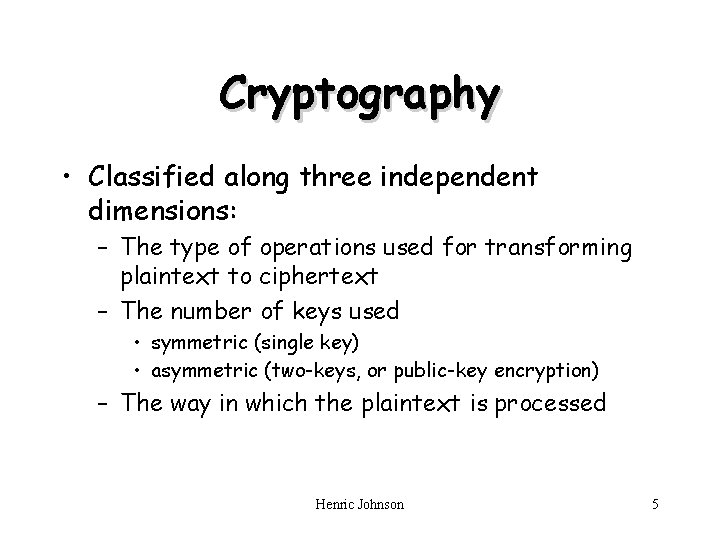
Cryptography • Classified along three independent dimensions: – The type of operations used for transforming plaintext to ciphertext – The number of keys used • symmetric (single key) • asymmetric (two-keys, or public-key encryption) – The way in which the plaintext is processed Henric Johnson 5
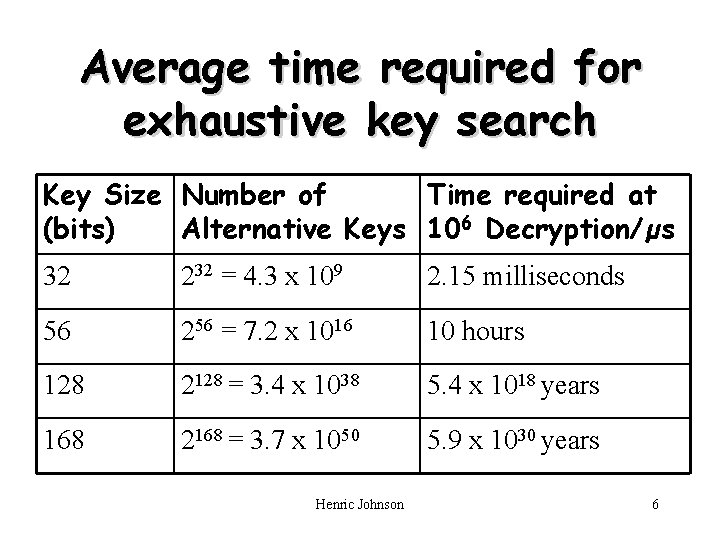
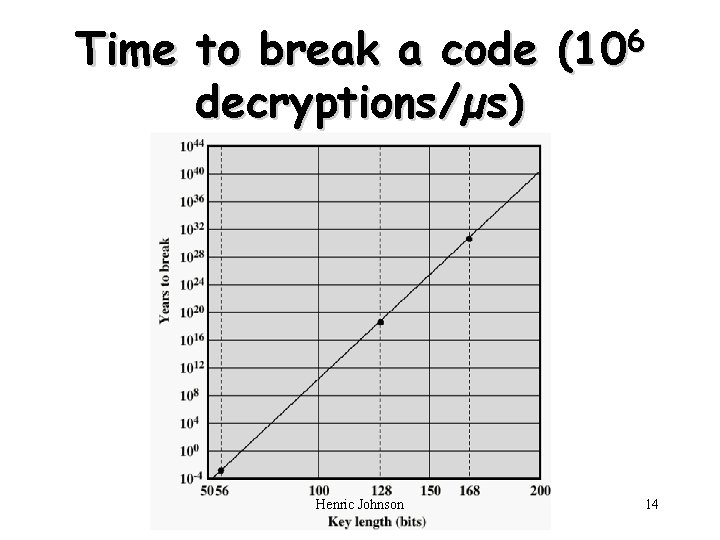
Average time required for exhaustive key search Key Size Number of Time required at (bits) Alternative Keys 106 Decryption/µs 32 232 = 4. 3 x 10⁹ 2. 15 milliseconds 56 256 = 7. 2 x 10¹⁶ 10 hours 128 2128 = 3. 4 x 1038 5. 4 x 10¹⁸ years 168 2168 = 3. 7 x 1050 5. 9 x 1030 years Henric Johnson 6
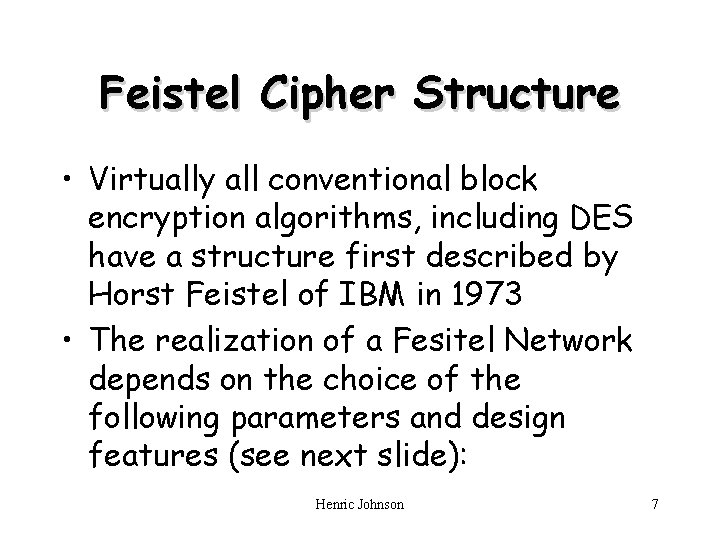
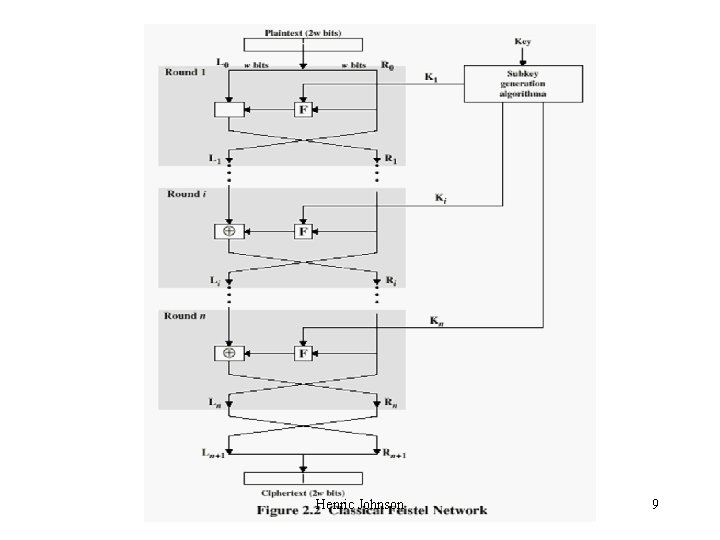
Feistel Cipher Structure • Virtually all conventional block encryption algorithms, including DES have a structure first described by Horst Feistel of IBM in 1973 • The realization of a Fesitel Network depends on the choice of the following parameters and design features (see next slide): Henric Johnson 7
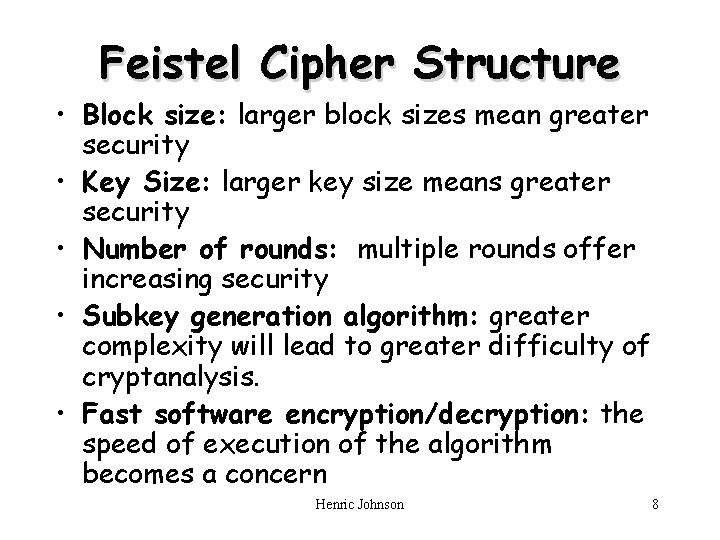
Feistel Cipher Structure • Block size: larger block sizes mean greater security • Key Size: larger key size means greater security • Number of rounds: multiple rounds offer increasing security • Subkey generation algorithm: greater complexity will lead to greater difficulty of cryptanalysis. • Fast software encryption/decryption: the speed of execution of the algorithm becomes a concern Henric Johnson 8
Henric Johnson 9
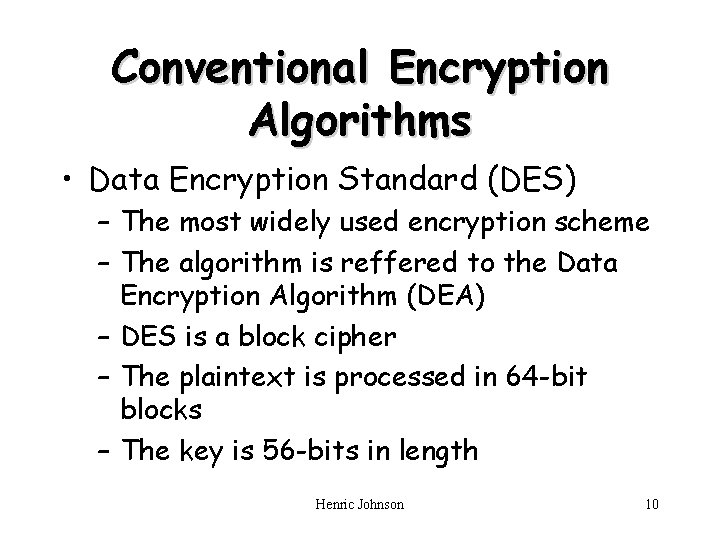
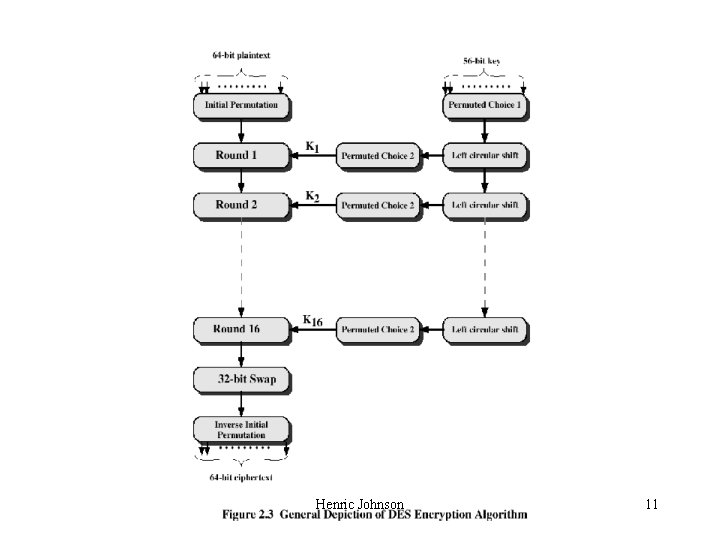
Conventional Encryption Algorithms • Data Encryption Standard (DES) – The most widely used encryption scheme – The algorithm is reffered to the Data Encryption Algorithm (DEA) – DES is a block cipher – The plaintext is processed in 64 -bit blocks – The key is 56 -bits in length Henric Johnson 10
Henric Johnson 11
Henric Johnson 12
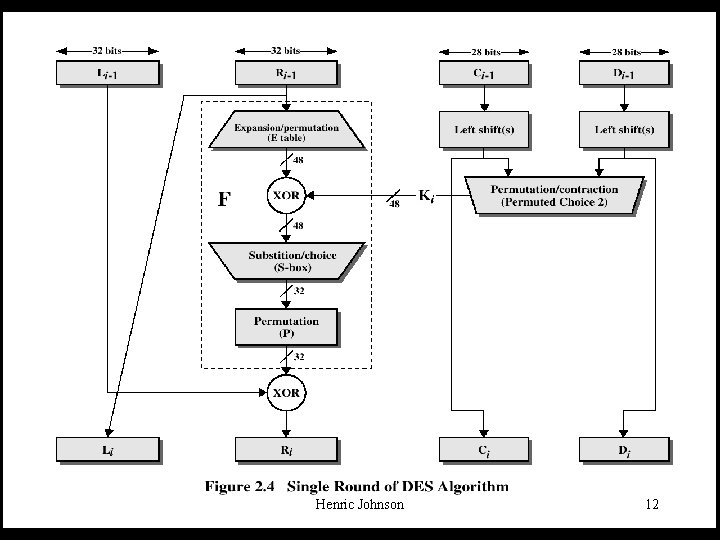
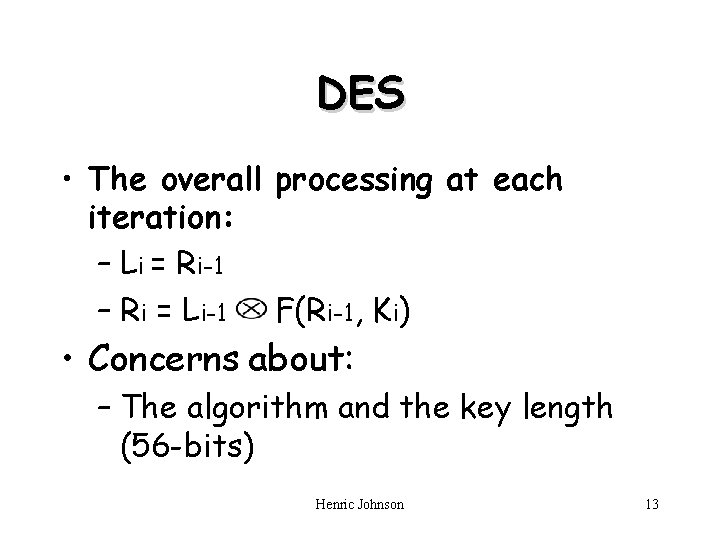
DES • The overall processing at each iteration: – Li = Ri-1 – Ri = Li-1 F(Ri-1, Ki) • Concerns about: – The algorithm and the key length (56 -bits) Henric Johnson 13
Time to break a code (106 decryptions/µs) Henric Johnson 14
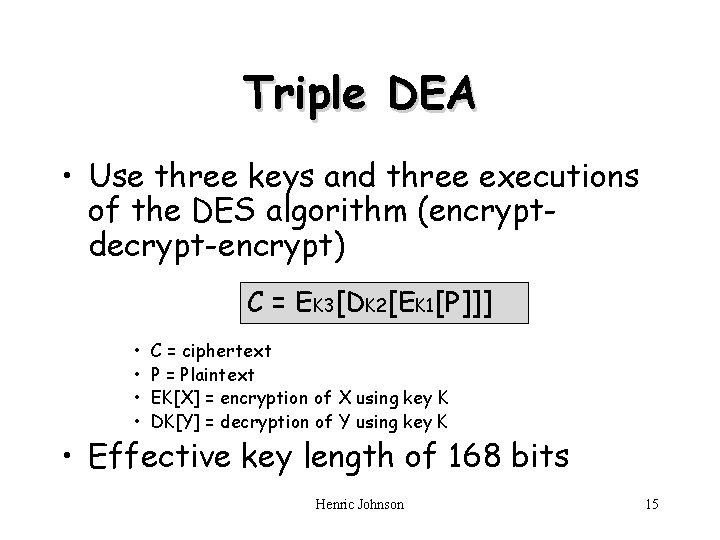
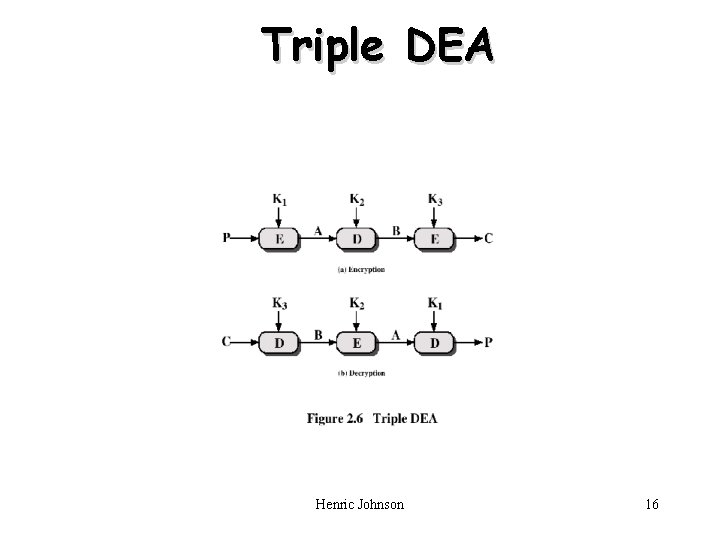
Triple DEA • Use three keys and three executions of the DES algorithm (encryptdecrypt-encrypt) C = EK 3[DK 2[EK 1[P]]] • • C = ciphertext P = Plaintext EK[X] = encryption of X using key K DK[Y] = decryption of Y using key K • Effective key length of 168 bits Henric Johnson 15
Triple DEA Henric Johnson 16
Other Symmetric Block Ciphers • International Data Encryption Algorithm (IDEA) – 128 -bit key – Used in PGP • Blowfish – Easy to implement – High execution speed – Run in less than 5 K of memory Henric Johnson 17
Other Symmetric Block Ciphers • RC 5 – Suitable for hardware and software – Fast, simple – Adaptable to processors of different word lengths – Variable number of rounds – Variable-length key – Low memory requirement – High security – Data-dependent rotations • Cast-128 – Key size from 40 to 128 bits – The round function differs from round to round Henric Johnson 18
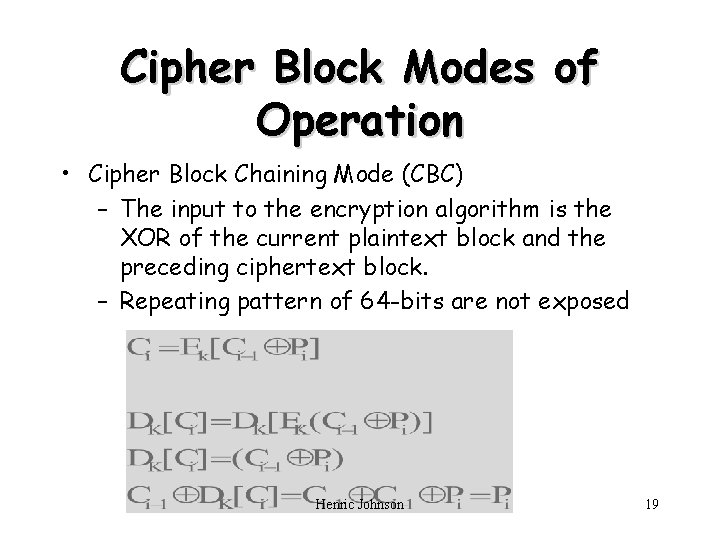
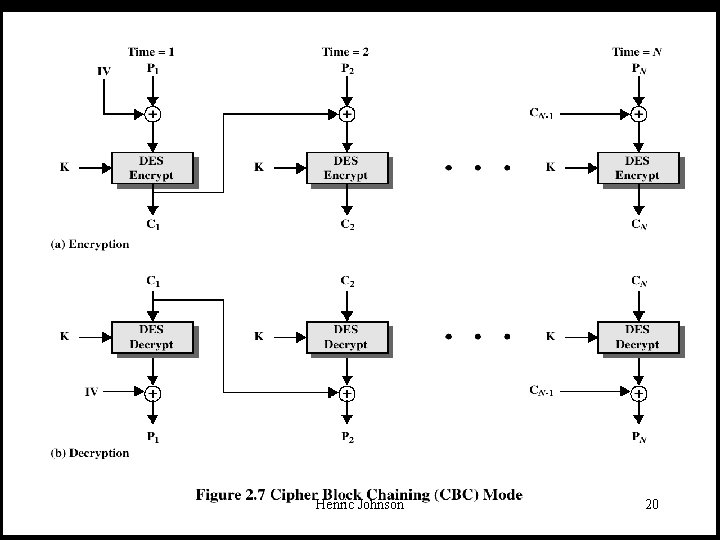
Cipher Block Modes of Operation • Cipher Block Chaining Mode (CBC) – The input to the encryption algorithm is the XOR of the current plaintext block and the preceding ciphertext block. – Repeating pattern of 64 -bits are not exposed Henric Johnson 19
Henric Johnson 20
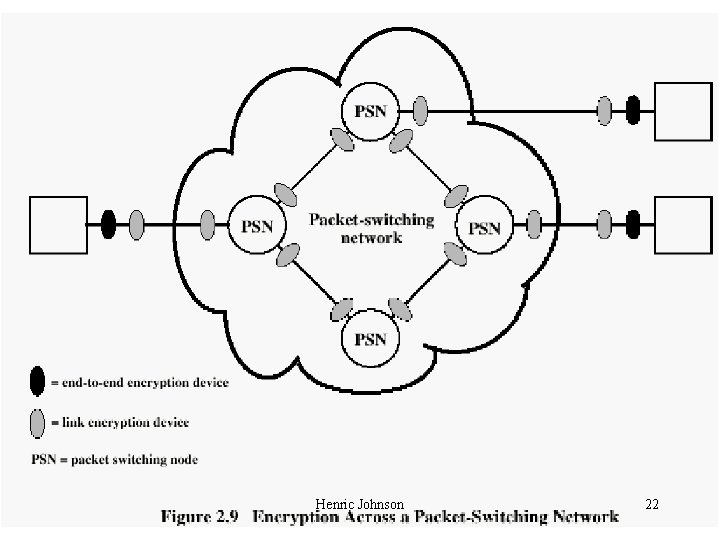
Location of Encryption Device • Link encryption: – A lot of encryption devices – High level of security – Decrypt each packet at every switch • End-to-end encryption – The source encrypt and the receiver decrypts – Payload encrypted – Header in the clear • High Security: Both link and end-to-end encryption are needed (see Figure 2. 9) Henric Johnson 21
Henric Johnson 22
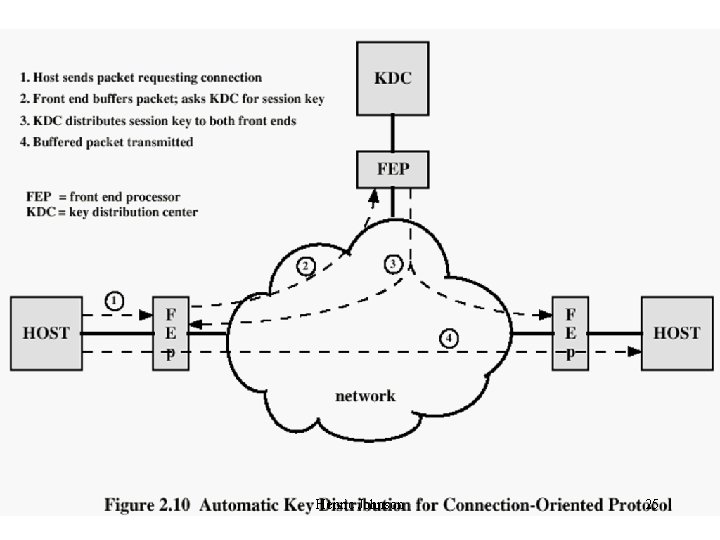
Key Distribution 1. A key could be selected by A and physically delivered to B. 2. A third party could select the key and physically deliver it to A and B. 3. If A and B have previously used a key, one party could transmit the new key to the other, encrypted using the old key. 4. If A and B each have an encrypted connection to a third party C, C could deliver a key on the encrypted links to A and B. Henric Johnson 23
Key Distribution (See Figure 2. 10) • Session key: – Data encrypted with a one-time session key. At the conclusion of the session the key is destroyed • Permanent key: – Used between entities for the purpose of distributing session keys Henric Johnson 24
Henric Johnson 25
Recommended Reading • Stallings, W. Cryptography and Network Security: Principles and Practice, 2 nd edition. Prentice Hall, 1999 • Scneier, B. Applied Cryptography, New York: Wiley, 1996 • Mel, H. X. Baker, D. Cryptography Decrypted. Addison Wesley, 2001 Henric Johnson 26