
CHAPTER 2 CONSUMER RESEARCH CHAPTER OUTLINE Introduction to


- Slides: 26
CHAPTER 2 CONSUMER RESEARCH
CHAPTER OUTLINE Introduction to Quantitative and Qualitative Research Overview of the Consumer Decision Process Quantitative Research Qualitative Research COPYRIGHT 2007 BY PRENTICE HALL
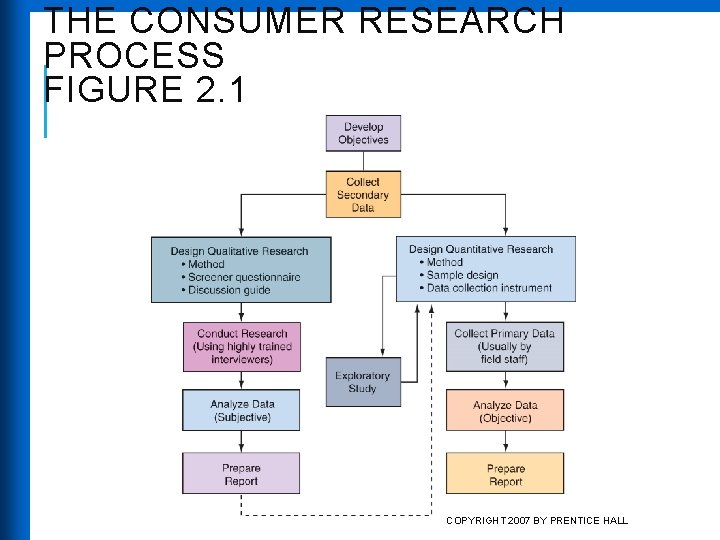
THE CONSUMER RESEARCH PROCESS FIGURE 2. 1 COPYRIGHT 2007 BY PRENTICE HALL
QUANTITATIVE RESEARCH Descriptive in nature. Enables marketers to “predict” consumer behavior (positivism). Research methods include experiments, survey techniques, and observation. Findings are descriptive, empirical, and can be generalized to larger populations. COPYRIGHT 2007 BY PRENTICE HALL
QUALITATIVE RESEARCH Consists of depth interviews, focus groups, metaphor analysis, collage research, and projective techniques. Administered by highly trained interviewer-analysts. Findings tend to be subjective. Small sample sizes. COPYRIGHT 2007 BY PRENTICE HALL
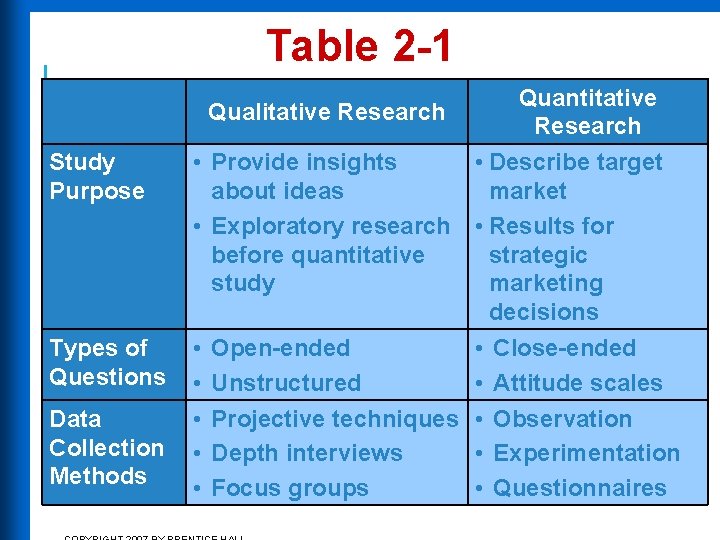
Table 2 -1 Qualitative Research Study Purpose • Provide insights about ideas • Exploratory research before quantitative study Types of Questions • • • Data Collection Methods Open-ended Unstructured Projective techniques Depth interviews Focus groups Quantitative Research • Describe target market • Results for strategic marketing decisions • • • Close-ended Attitude scales Observation Experimentation Questionnaires
Table 2 -1 (continued) Qualitative Research Quantitative Research • Large • Probability samples Sampling Methods • Small • Nonprobability samples Data Analysis • Analyzed by • Coded, tabulated, researchers who and entered into collected database • Look for “key words” • Use of statistical methods • Subjective
DEVELOPING RESEARCH OBJECTIVES Defining purposes and objectives helps ensure an appropriate research design. A statement of objectives helps to define the type and level of information needed. COPYRIGHT 2007 BY PRENTICE HALL
SECONDARY DATA Data that has been collected for reasons other than the specific research project at hand Includes internal and external data COPYRIGHT 2007 BY PRENTICE HALL
TYPES OF SECONDARY DATA Internal Data generated in-house May include analysis of customer files Useful for calculating customer lifetime value External Data collected by an outside organization Includes federal government, periodicals, newspapers, books, search engines Commercial data is also available from market research firms COPYRIGHT 2007 BY PRENTICE HALL
DESIGNING PRIMARY RESEARCH Quantitative Research Designs Include research design, data collection methods, instruments to be used, and the sample design Qualitative Research Designs Include depth interviews, focus groups, projective techniques, and metaphor analysis COPYRIGHT 2007 BY PRENTICE HALL
DATA COLLECTION METHODS OBSERVATIONAL RESEARCH Helps marketers gain an in-depth understanding of the relationship between people and products by watching them buying and using products Helps researchers gain a better understanding of what the product symbolizes COPYRIGHT 2007 BY PRENTICE HALL
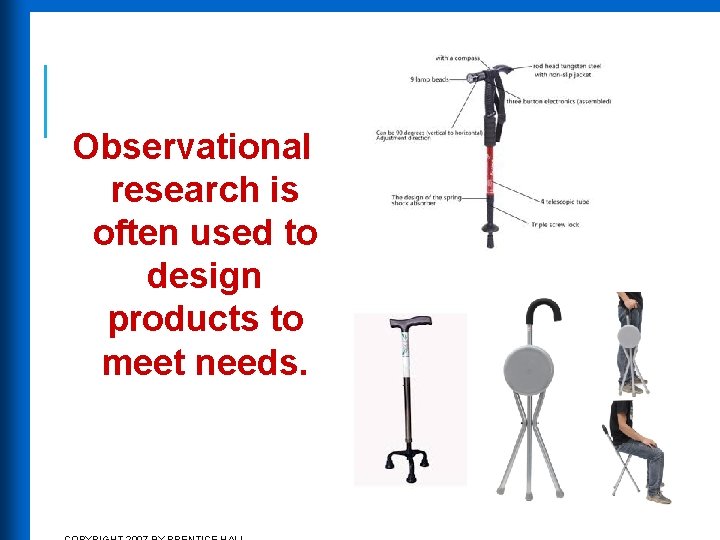
Observational research is often used to design products to meet needs.
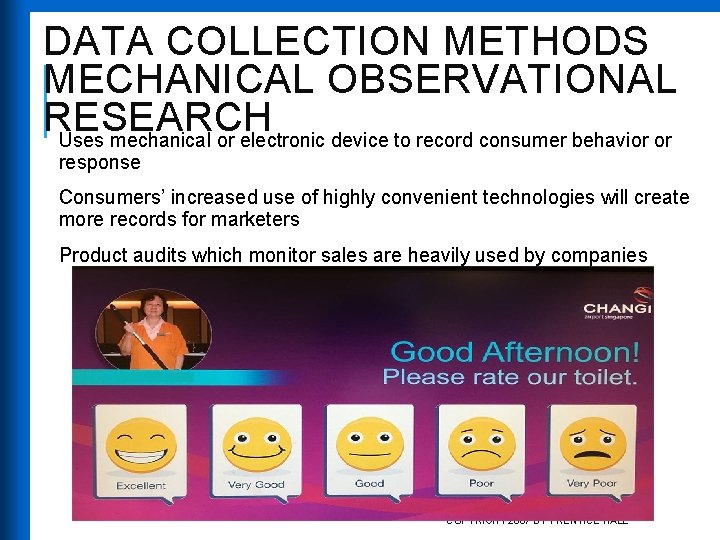
DATA COLLECTION METHODS MECHANICAL OBSERVATIONAL RESEARCH Uses mechanical or electronic device to record consumer behavior or response Consumers’ increased use of highly convenient technologies will create more records for marketers Product audits which monitor sales are heavily used by companies COPYRIGHT 2007 BY PRENTICE HALL
In line with World Toilet day on 19 November Changi has an interactive easy-to-use touchscreen, located next to the exit of the washroom, which enables users to tap their feedback. This technology-driven initiative, Instant Feedback System (IFS), is capable of sending an immediate alert to the cleaning crew for swift action, if needed! The IFS works by first asking customers to rate the cleanliness of the washroom on a five-point scale from Excellent to Very Poor. A less than satisfactory rating will then prompt users to indicate the reasons for their rating with a list of eight on-screen icons such as “Wet floor”, “Foul Smell” and “No Toilet Paper”, amongst others. Subsequently, a mobile alert will be transmitted to the cleaning supervisor’s smartphone, who can then initiate immediate action such as cleaning up a wet floor or replenishing toilet paper. With his, users’ feedback is addressed soonest possible and service disruption is minimized. Apart from the IFS, other washroom features that have been designed to enhance the customer experience include locating the paper towel holders near the sink to make it easier for wet hands to find, and linking the entire soap dispenser under the taps to circumvent the situation where one dispenser runs completely out of soap. COPYRIGHT 2007 BY PRENTICE HALL
DATA COLLECTION METHODS EXPERIMENTATION Can be used to test the relative sales appeal of many types of variables An experiment is usually controlled with only some variables manipulated at a time while the others are constant Can be conducted in laboratories or in the field COPYRIGHT 2007 BY PRENTICE HALL
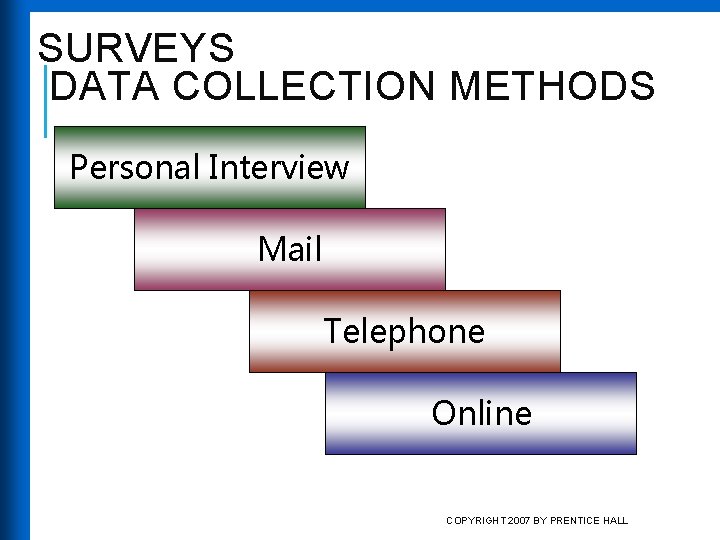
SURVEYS DATA COLLECTION METHODS Personal Interview Mail Telephone Online COPYRIGHT 2007 BY PRENTICE HALL
VALIDITY AND RELIABILITY If a study has validity it collects the appropriate data for the study. A study has reliability if the same questions, asked of a similar sample, produce the same findings. COPYRIGHT 2007 BY PRENTICE HALL
QUALITATIVE COLLECTION METHOD DEPTH INTERVIEW Usually 30 minutes to 1 hour Nonstructured Interpreted by trained researcher Listen to words as well as “body language” COPYRIGHT 2007 BY PRENTICE HALL
QUALITATIVE COLLECTION METHOD FOCUS GROUP 8 -10 participants Lasts about 2 hours Always taped or videotaped to assist analysis Often held in front of two-way mirrors COPYRIGHT 2007 BY PRENTICE HALL
QUALITATIVE COLLECTION METHOD PROJECTIVE TECHNIQUES Research procedures designed to identify consumers’ subconscious feelings and motivations Consist of a variety of disguised “tests” incomplete sentence, untitled picture COPYRIGHT 2007 BY PRENTICE HALL
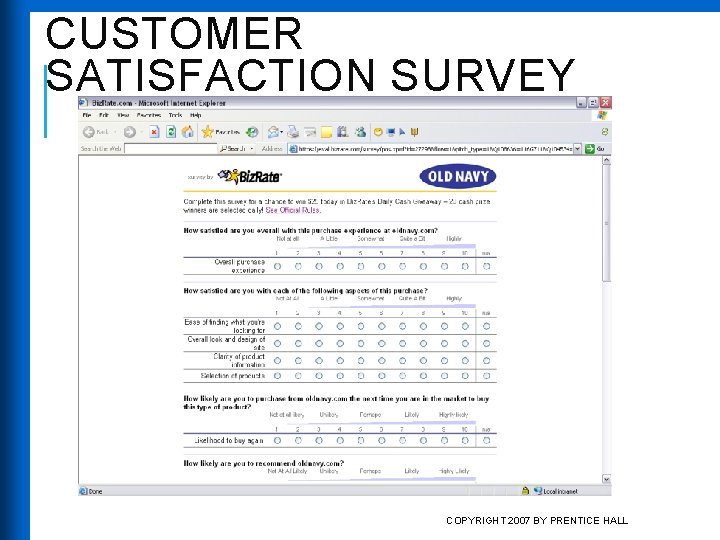
CUSTOMER SATISFACTION SURVEY COPYRIGHT 2007 BY PRENTICE HALL
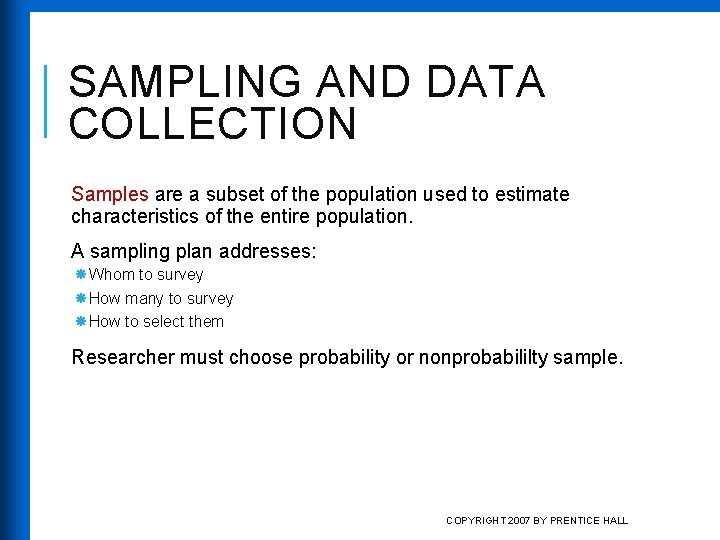
SAMPLING AND DATA COLLECTION Samples are a subset of the population used to estimate characteristics of the entire population. A sampling plan addresses: Whom to survey How many to survey How to select them Researcher must choose probability or nonprobabililty sample. COPYRIGHT 2007 BY PRENTICE HALL
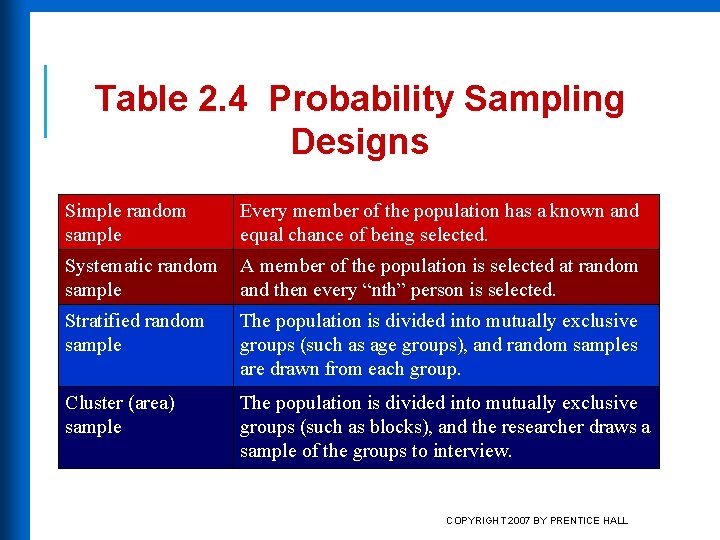
Table 2. 4 Probability Sampling Designs Simple random sample Every member of the population has a known and equal chance of being selected. Systematic random sample A member of the population is selected at random and then every “nth” person is selected. Stratified random sample The population is divided into mutually exclusive groups (such as age groups), and random samples are drawn from each group. Cluster (area) sample The population is divided into mutually exclusive groups (such as blocks), and the researcher draws a sample of the groups to interview. COPYRIGHT 2007 BY PRENTICE HALL
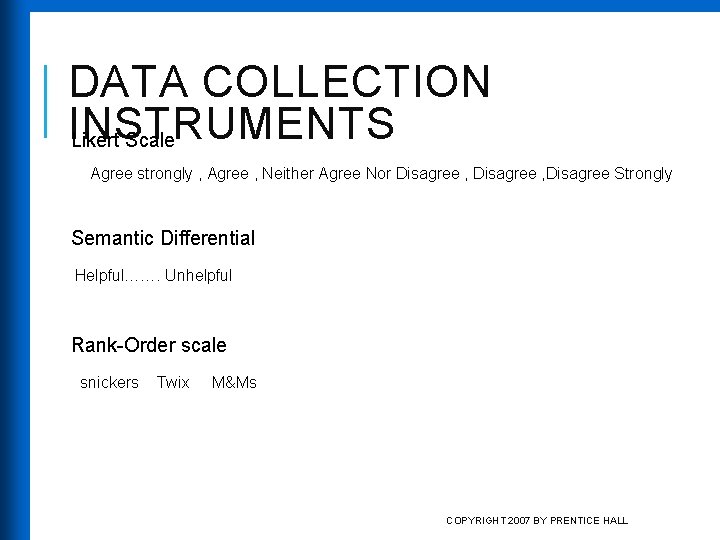
DATA COLLECTION INSTRUMENTS Likert Scale Agree strongly , Agree , Neither Agree Nor Disagree , Disagree Strongly Semantic Differential Helpful……. Unhelpful Rank-Order scale snickers Twix M&Ms COPYRIGHT 2007 BY PRENTICE HALL
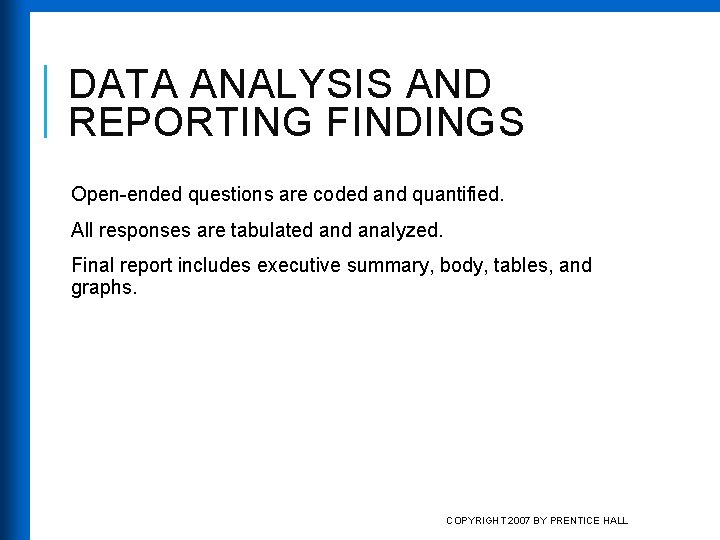
DATA ANALYSIS AND REPORTING FINDINGS Open-ended questions are coded and quantified. All responses are tabulated analyzed. Final report includes executive summary, body, tables, and graphs. COPYRIGHT 2007 BY PRENTICE HALL