
Chapter 2 Competitiveness Strategy and Productivity Copyright 2018

- Slides: 39
Chapter 2 Competitiveness, Strategy, and Productivity Copyright © 2018 Mc. Graw-Hill Higher Education. All rights reserved. No reproduction or distribution without the prior written consent of Mc. Graw-Hill Education 2 -1
Chapter 2: Learning Objectives You should be able to: LO 2. 1 List several ways that business organizations compete LO 2. 2 Name several reasons that business organizations fail LO 2. 3 Define the terms mission and strategy and explain why they are important LO 2. 4 Discuss and compare organization strategy and operations strategy, and explain why it is important to link the two LO 2. 5 Describe and give examples of time-based strategies LO 2. 6 Define the term productivity and explain why it is important to organizations and to countries LO 2. 7 Describe several factors that affect productivity Copyright © 2018 Mc. Graw-Hill Higher Education. All rights reserved. No reproduction or distribution without the prior written consent of Mc. Graw-Hill Education 2 -2
A Cold Hard Fact Better quality, higher productivity, lower costs, and the ability to respond quickly to customer needs are more important than ever, and… the bar is getting higher LO 2. 1 Copyright © 2018 Mc. Graw-Hill Higher Education. All rights reserved. No reproduction or distribution without the prior written consent of Mc. Graw-Hill Education 2 -3
Chapter Focus �This chapter focuses on three separate, but related ideas that are vitally important to business organizations � Competitiveness � Strategy � Productivity LO 2. 1 Copyright © 2018 Mc. Graw-Hill Higher Education. All rights reserved. No reproduction or distribution without the prior written consent of Mc. Graw-Hill Education 2 -4
Competitiveness �Competitiveness: � How effectively an organization meets the wants and needs of customers relative to others that offer similar goods or services � Organizations compete through some combination of their marketing and operations functions • What do customers want? • How can these customer needs best be satisfied? LO 2. 1 Copyright © 2018 Mc. Graw-Hill Higher Education. All rights reserved. No reproduction or distribution without the prior written consent of Mc. Graw-Hill Education 2 -5
Marketing’s Influence �Identifying consumer wants and/or needs �Pricing and quality �Advertising and promotion LO 2. 1 Copyright © 2018 Mc. Graw-Hill Higher Education. All rights reserved. No reproduction or distribution without the prior written consent of Mc. Graw-Hill Education 2 -6
Businesses Compete Using Operations Product and service design 2. Cost 3. Location 4. Quality 5. Quick response 6. Flexibility 7. Inventory management 8. Supply chain management 9. Service 10. Managers and workers 1. LO 2. 1 Copyright © 2018 Mc. Graw-Hill Higher Education. All rights reserved. No reproduction or distribution without the prior written consent of Mc. Graw-Hill Education 2 -7
Why Some Organizations Fail 1. 2. 3. 4. 5. 6. 7. Neglecting operations strategy Failing to take advantage of strengths and opportunities and/or failing to recognize competitive threats Too much emphasis on short-term financial performance at the expense of R&D Too much emphasis in product and service design and not enough on process design and improvement Neglecting investments in capital and human resources Failing to establish good internal communications and cooperation Failing to consider customer wants and needs LO 2. 2 Copyright © 2018 Mc. Graw-Hill Higher Education. All rights reserved. No reproduction or distribution without the prior written consent of Mc. Graw-Hill Education 2 -8
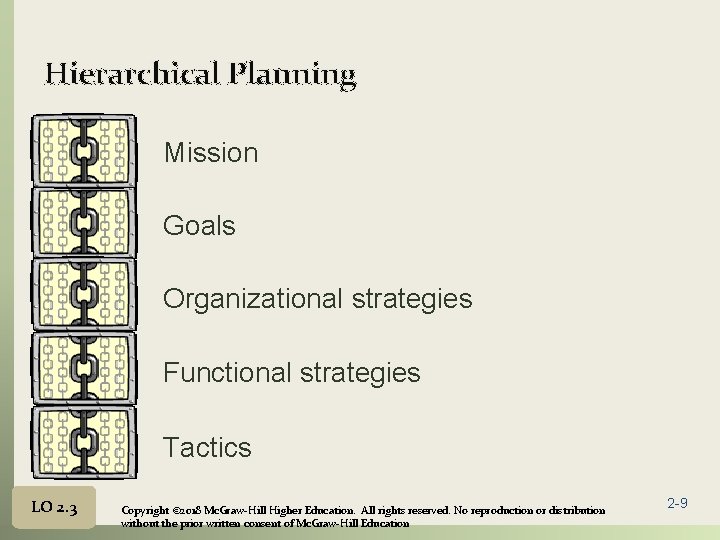
Hierarchical Planning Mission Goals Organizational strategies Functional strategies Tactics LO 2. 3 Copyright © 2018 Mc. Graw-Hill Higher Education. All rights reserved. No reproduction or distribution without the prior written consent of Mc. Graw-Hill Education 2 -9
Mission, Goals, and Strategy � Mission � The reason for an organization’s existence � It answers the question “What business are we in? ” � Goals � Provide detail and the scope of the mission �Goals can be viewed as organizational destinations � Strategy � A plan for achieving organizational goals �Serves as a roadmap for reaching the organizational destinations � The organizational strategy guides the organization by providing direction for, and alignment of, the goals and strategies of the functional units � The organizational strategy is a major success/failure factor LO 2. 3 Copyright © 2018 Mc. Graw-Hill Higher Education. All rights reserved. No reproduction or distribution without the prior written consent of Mc. Graw-Hill Education 2 -10
Mission � The reason for an organization’s existence �Mission statement � States the purpose of the organization � The mission statement should answer the question of “What business are we in? ” LO 2. 3 Copyright © 2018 Mc. Graw-Hill Higher Education. All rights reserved. No reproduction or distribution without the prior written consent of Mc. Graw-Hill Education 2 -11
Fed. Ex Mission Statement � Fed. Ex Corporation will produce superior financial returns for its shareowners by providing high value-added logistics, transportation and related information services through focused operating companies. Customer requirements will be met in the highest quality manner appropriate to each market segment served. Fed. Ex Corporation will strive to develop mutually rewarding relationships with its employees, partners and suppliers. Safety will be the first consideration in all operations. Corporate activities will be conducted to the highest ethical and professional standards. LO 2. 3 Copyright © 2018 Mc. Graw-Hill Higher Education. All rights reserved. No reproduction or distribution without the prior written consent of Mc. Graw-Hill Education 2 -12
Goals �The mission statement serves as the basis for organizational goals �Goals � Provide detail and the scope of the mission �Goals can be viewed as organizational destinations � Goals serve as the basis for organizational strategies LO 2. 3 Copyright © 2018 Mc. Graw-Hill Higher Education. All rights reserved. No reproduction or distribution without the prior written consent of Mc. Graw-Hill Education 2 -13
Strategies � Strategy � A plan for achieving organizational goals �Serves as a roadmap for reaching the organizational destinations � Organizations have �Organizational strategies Overall strategies that relate to the entire organization Support the achievement of organizational goals and mission �Functional level strategies Strategies that relate to each of the functional areas and that support achievement of the organizational strategy LO 2. 3 Copyright © 2018 Mc. Graw-Hill Higher Education. All rights reserved. No reproduction or distribution without the prior written consent of Mc. Graw-Hill Education 2 -14
Tactics and Operations �Tactics � The methods and actions taken to accomplish strategies � The “how to” part of the process �Operations � The actual “doing” part of the process LO 2. 3 Copyright © 2018 Mc. Graw-Hill Higher Education. All rights reserved. No reproduction or distribution without the prior written consent of Mc. Graw-Hill Education 2 -15
Core Competencies �Core competencies The special attributes or abilities that give an organization a competitive edge � To be effective core competencies and strategies need to be aligned LO 2. 3 Copyright © 2018 Mc. Graw-Hill Higher Education. All rights reserved. No reproduction or distribution without the prior written consent of Mc. Graw-Hill Education 2 -16
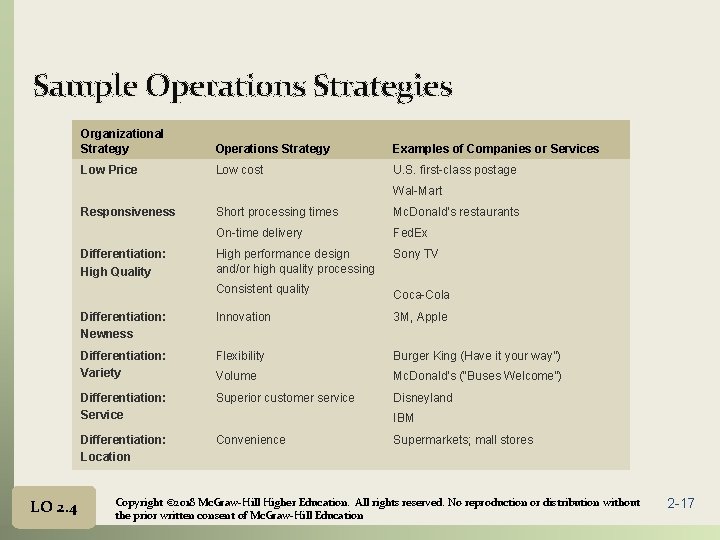
Sample Operations Strategies Organizational Strategy Operations Strategy Examples of Companies or Services Low Price Low cost U. S. first-class postage Wal-Mart Responsiveness Short processing times Mc. Donald’s restaurants On-time delivery Fed. Ex High performance design and/or high quality processing Sony TV Consistent quality Coca-Cola Differentiation: Newness Innovation 3 M, Apple Differentiation: Variety Flexibility Burger King (Have it your way”) Volume Mc. Donald’s (“Buses Welcome”) Differentiation: Service Superior customer service Disneyland Differentiation: Location Convenience Differentiation: High Quality LO 2. 4 IBM Supermarkets; mall stores Copyright © 2018 Mc. Graw-Hill Higher Education. All rights reserved. No reproduction or distribution without the prior written consent of Mc. Graw-Hill Education 2 -17
Strategy Formulation �Effective strategy formulation requires taking into account: � Core competencies � Environmental scanning �SWOT �Successful strategy formulation also requires taking into account: � Order qualifiers � Order winners LO 2. 4 Copyright © 2018 Mc. Graw-Hill Higher Education. All rights reserved. No reproduction or distribution without the prior written consent of Mc. Graw-Hill Education 2 -18
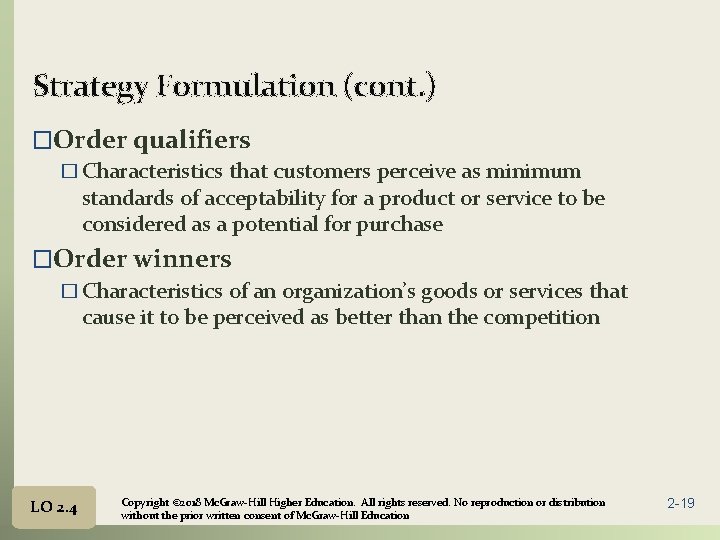
Strategy Formulation (cont. ) �Order qualifiers � Characteristics that customers perceive as minimum standards of acceptability for a product or service to be considered as a potential for purchase �Order winners � Characteristics of an organization’s goods or services that cause it to be perceived as better than the competition LO 2. 4 Copyright © 2018 Mc. Graw-Hill Higher Education. All rights reserved. No reproduction or distribution without the prior written consent of Mc. Graw-Hill Education 2 -19
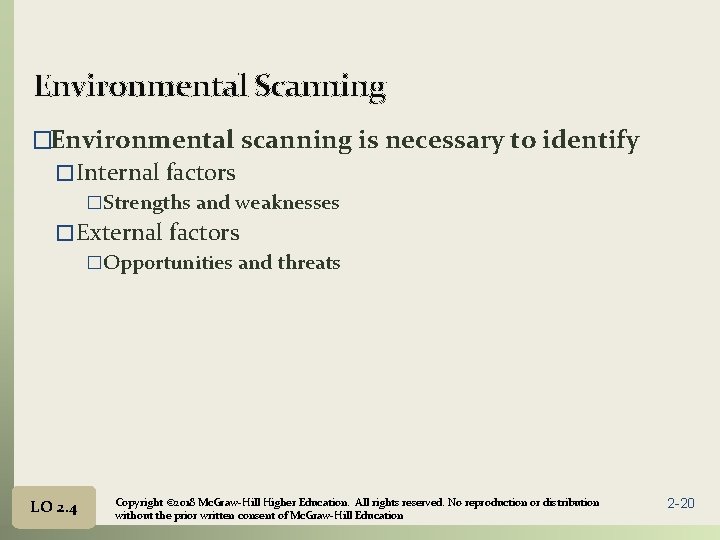
Environmental Scanning �Environmental scanning is necessary to identify � Internal factors �Strengths and weaknesses � External factors �Opportunities and threats LO 2. 4 Copyright © 2018 Mc. Graw-Hill Higher Education. All rights reserved. No reproduction or distribution without the prior written consent of Mc. Graw-Hill Education 2 -20
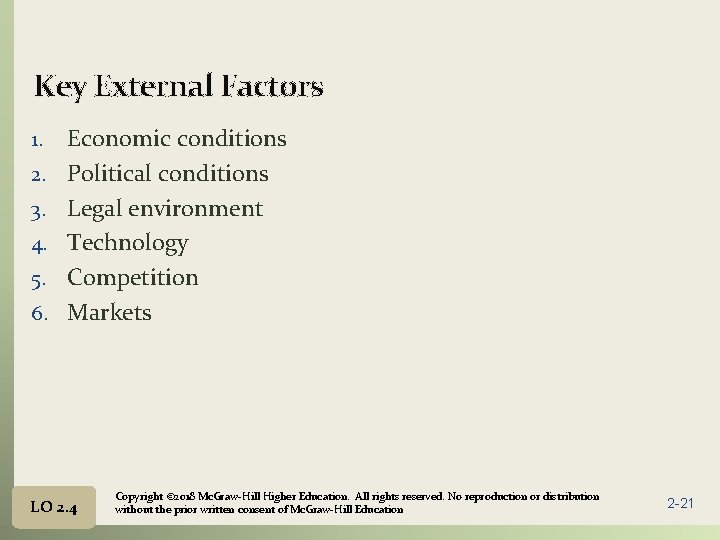
Key External Factors 1. 2. 3. 4. 5. 6. Economic conditions Political conditions Legal environment Technology Competition Markets LO 2. 4 Copyright © 2018 Mc. Graw-Hill Higher Education. All rights reserved. No reproduction or distribution without the prior written consent of Mc. Graw-Hill Education 2 -21
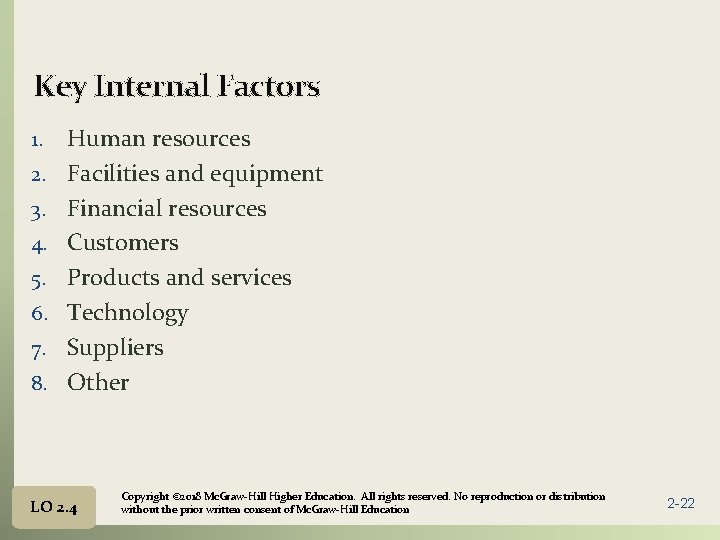
Key Internal Factors 1. 2. 3. 4. 5. 6. 7. 8. Human resources Facilities and equipment Financial resources Customers Products and services Technology Suppliers Other LO 2. 4 Copyright © 2018 Mc. Graw-Hill Higher Education. All rights reserved. No reproduction or distribution without the prior written consent of Mc. Graw-Hill Education 2 -22
Operations Strategy �Operations strategy � The approach, consistent with organization strategy, that is used to guide the operations function LO 2. 4 Copyright © 2018 Mc. Graw-Hill Higher Education. All rights reserved. No reproduction or distribution without the prior written consent of Mc. Graw-Hill Education 2 -23
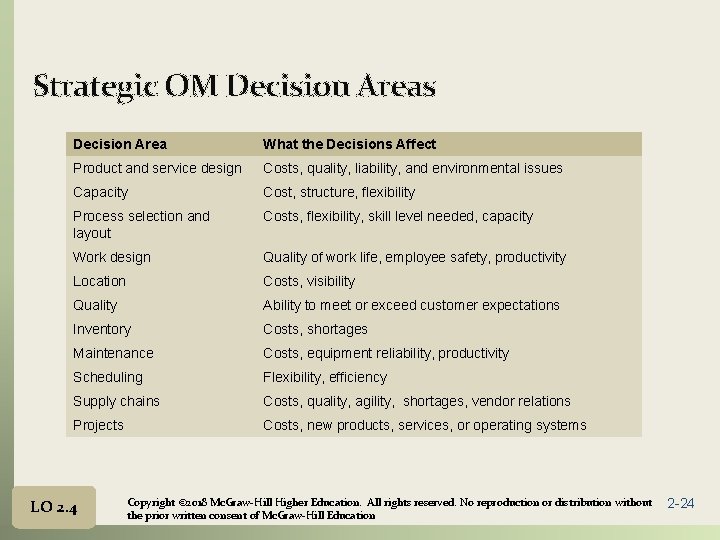
Strategic OM Decision Areas Decision Area What the Decisions Affect Product and service design Costs, quality, liability, and environmental issues Capacity Cost, structure, flexibility Process selection and layout Costs, flexibility, skill level needed, capacity Work design Quality of work life, employee safety, productivity Location Costs, visibility Quality Ability to meet or exceed customer expectations Inventory Costs, shortages Maintenance Costs, equipment reliability, productivity Scheduling Flexibility, efficiency Supply chains Costs, quality, agility, shortages, vendor relations Projects Costs, new products, services, or operating systems LO 2. 4 Copyright © 2018 Mc. Graw-Hill Higher Education. All rights reserved. No reproduction or distribution without the prior written consent of Mc. Graw-Hill Education 2 -24
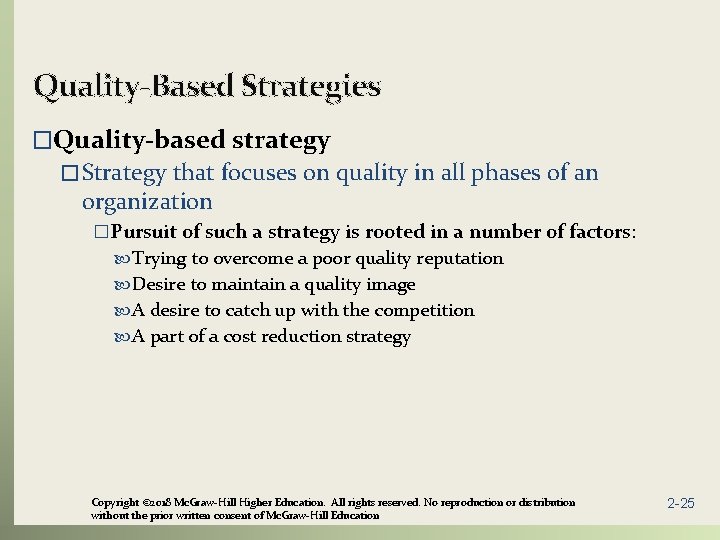
Quality-Based Strategies �Quality-based strategy � Strategy that focuses on quality in all phases of an organization �Pursuit of such a strategy is rooted in a number of factors: Trying to overcome a poor quality reputation Desire to maintain a quality image A desire to catch up with the competition A part of a cost reduction strategy Copyright © 2018 Mc. Graw-Hill Higher Education. All rights reserved. No reproduction or distribution without the prior written consent of Mc. Graw-Hill Education 2 -25
Time-Based Strategies �Time-based strategies � Strategies that focus on the reduction of time needed to accomplish tasks �It is believed that by reducing time, costs are lower, quality is higher, productivity is higher, time-to-market is faster, and customer service is improved LO 2. 5 Copyright © 2018 Mc. Graw-Hill Higher Education. All rights reserved. No reproduction or distribution without the prior written consent of Mc. Graw-Hill Education 2 -26
Time-Based Strategies (cont. ) �Areas where organizations have achieved time reductions: � Planning time � Product/service design time � Processing time � Changeover time � Delivery time � Response time for complaints LO 2. 5 Copyright © 2018 Mc. Graw-Hill Higher Education. All rights reserved. No reproduction or distribution without the prior written consent of Mc. Graw-Hill Education 2 -27
Agile Operations �Agile operations � A strategic approach for competitive advantage that emphasizes the use of flexibility to adapt and prosper in an environment of change �Involves the blending of several core competencies: Cost Quality Reliability Flexibility Copyright © 2018 Mc. Graw-Hill Higher Education. All rights reserved. No reproduction or distribution without the prior written consent of Mc. Graw-Hill Education 2 -28
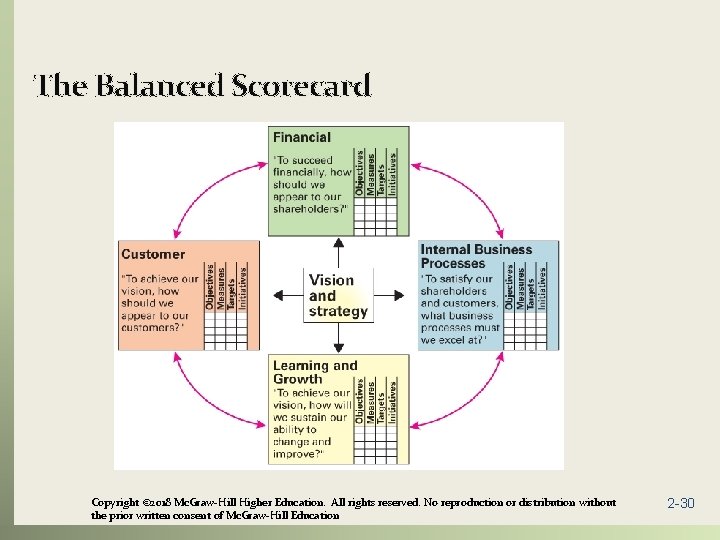
The Balanced Scorecard Approach � A top-down management system that organizations can use to clarify their vision and strategy and transform them into action � Develop objectives � Develop metrics and targets for each objective � Develop initiatives to achieve objectives � Identify links among the various perspectives � Finance � Customer � Internal business processes � Learning and growth � Monitor results Copyright © 2018 Mc. Graw-Hill Higher Education. All rights reserved. No reproduction or distribution without the prior written consent of Mc. Graw-Hill Education 2 -29
The Balanced Scorecard Copyright © 2018 Mc. Graw-Hill Higher Education. All rights reserved. No reproduction or distribution without the prior written consent of Mc. Graw-Hill Education 2 -30
Productivity � A measure of the effective use of resources, usually expressed as the ratio of output to input �Productivity measures are useful for � Tracking an operating unit’s performance over time � Judging the performance of an entire industry or country LO 2. 6 Copyright © 2018 Mc. Graw-Hill Higher Education. All rights reserved. No reproduction or distribution without the prior written consent of Mc. Graw-Hill Education 2 -31
Why Productivity Matters � High productivity is linked to higher standards of living � As an economy replaces manufacturing jobs with lower productivity service jobs, it is more difficult to maintain high standards of living � Higher productivity relative to the competition leads to competitive advantage in the marketplace � Pricing and profit effects � For an industry, high relative productivity makes it less likely it will be supplanted by foreign industry LO 2. 6 Copyright © 2018 Mc. Graw-Hill Higher Education. All rights reserved. No reproduction or distribution without the prior written consent of Mc. Graw-Hill Education 2 -32
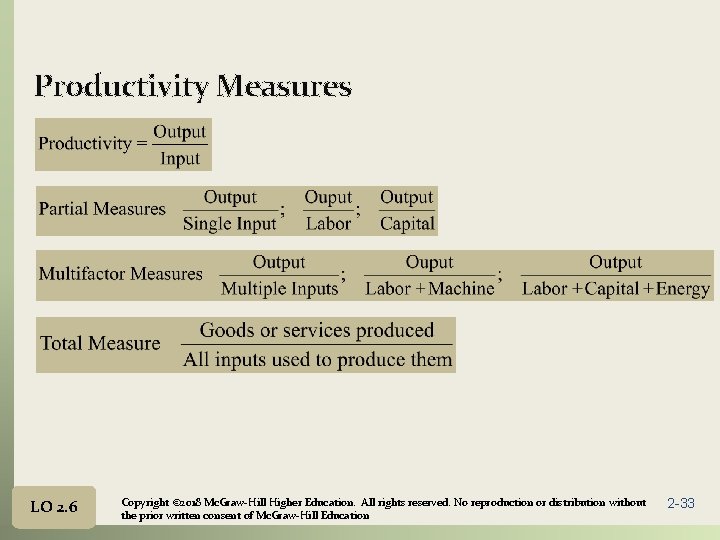
Productivity Measures LO 2. 6 Copyright © 2018 Mc. Graw-Hill Higher Education. All rights reserved. No reproduction or distribution without the prior written consent of Mc. Graw-Hill Education 2 -33
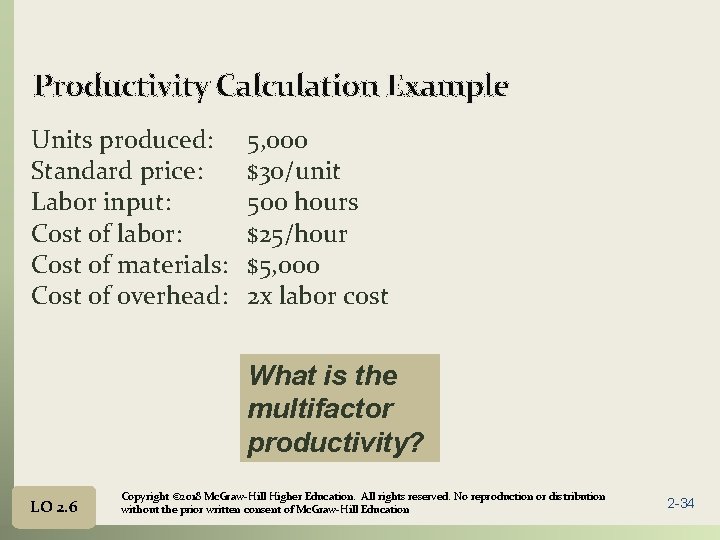
Productivity Calculation Example Units produced: Standard price: Labor input: Cost of labor: Cost of materials: Cost of overhead: 5, 000 $30/unit 500 hours $25/hour $5, 000 2 x labor cost What is the multifactor productivity? LO 2. 6 Copyright © 2018 Mc. Graw-Hill Higher Education. All rights reserved. No reproduction or distribution without the prior written consent of Mc. Graw-Hill Education 2 -34
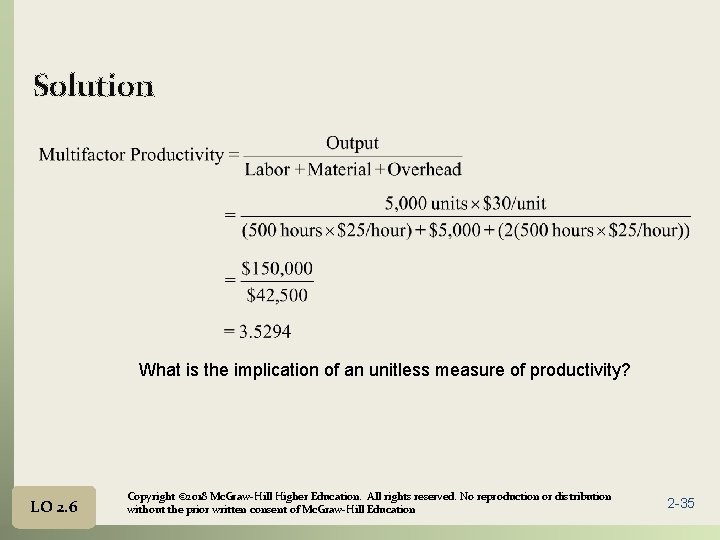
Solution What is the implication of an unitless measure of productivity? LO 2. 6 Copyright © 2018 Mc. Graw-Hill Higher Education. All rights reserved. No reproduction or distribution without the prior written consent of Mc. Graw-Hill Education 2 -35
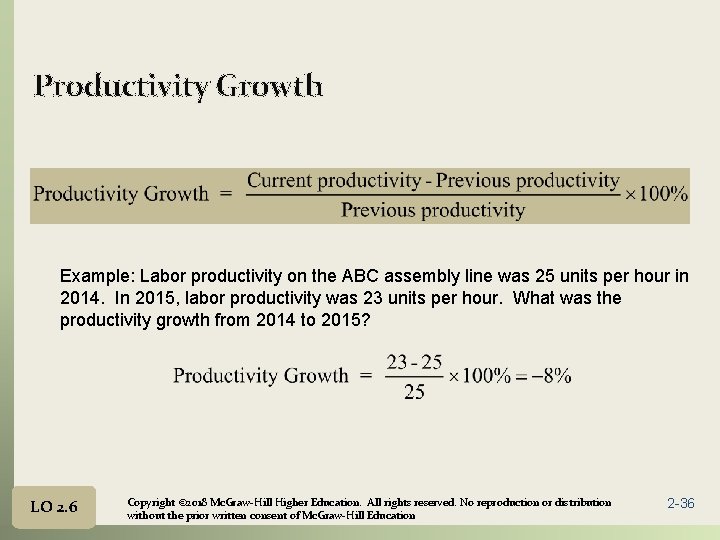
Productivity Growth Example: Labor productivity on the ABC assembly line was 25 units per hour in 2014. In 2015, labor productivity was 23 units per hour. What was the productivity growth from 2014 to 2015? LO 2. 6 Copyright © 2018 Mc. Graw-Hill Higher Education. All rights reserved. No reproduction or distribution without the prior written consent of Mc. Graw-Hill Education 2 -36
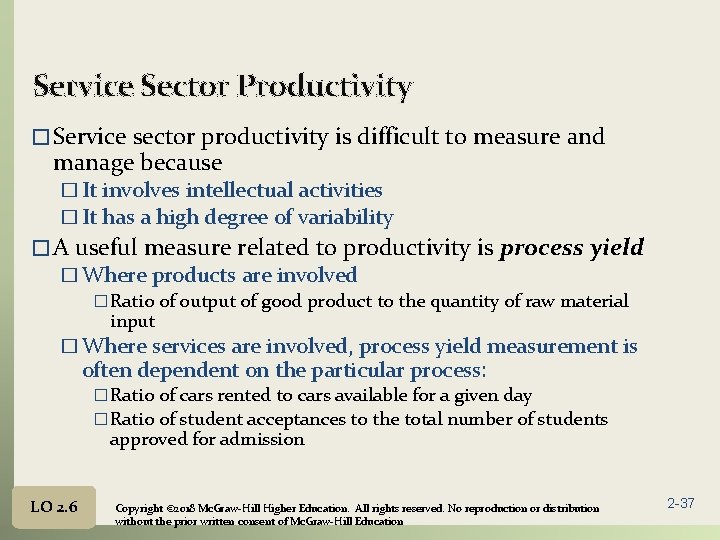
Service Sector Productivity � Service sector productivity is difficult to measure and manage because � It involves intellectual activities � It has a high degree of variability � A useful measure related to productivity is process yield � Where products are involved � Ratio of output of good product to the quantity of raw material input � Where services are involved, process yield measurement is often dependent on the particular process: � Ratio of cars rented to cars available for a given day � Ratio of student acceptances to the total number of students approved for admission LO 2. 6 Copyright © 2018 Mc. Graw-Hill Higher Education. All rights reserved. No reproduction or distribution without the prior written consent of Mc. Graw-Hill Education 2 -37
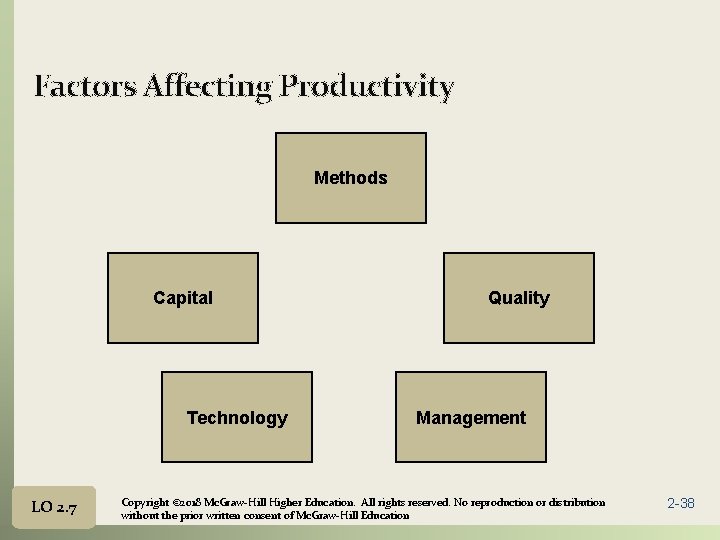
Factors Affecting Productivity Methods Capital Technology LO 2. 7 Quality Management Copyright © 2018 Mc. Graw-Hill Higher Education. All rights reserved. No reproduction or distribution without the prior written consent of Mc. Graw-Hill Education 2 -38
Improving Productivity 1. Develop productivity measures for all operations 2. Determine critical (bottleneck) operations 3. Develop methods for productivity improvements 4. Establish reasonable goals 5. Make it clear that management supports and encourages productivity improvement 6. Measure and publicize improvements 7. Don’t confuse productivity with efficiency LO 2. 7 Copyright © 2018 Mc. Graw-Hill Higher Education. All rights reserved. No reproduction or distribution without the prior written consent of Mc. Graw-Hill Education 2 -39