
Chapter 2 Comparing Political Systems Comparison is the
- Slides: 15
Chapter 2 “Comparing Political Systems” Comparison is the scientific study of politics Theories are developed on political processes
Comparative Analysis…. . • Helps us choose among strategies, reduce costs and increase benefits • Helps us describe political processes and change; • Provides a point of reference
We use functional approach • Comparing countries according to a set of functions which are performed in every political system • Functions interact in a domestic & international environment
Why We Compare • Enables us to develop explanations and test theories • Draw comparisons among societies and states • Form general theories of political relationships • Traditional practice
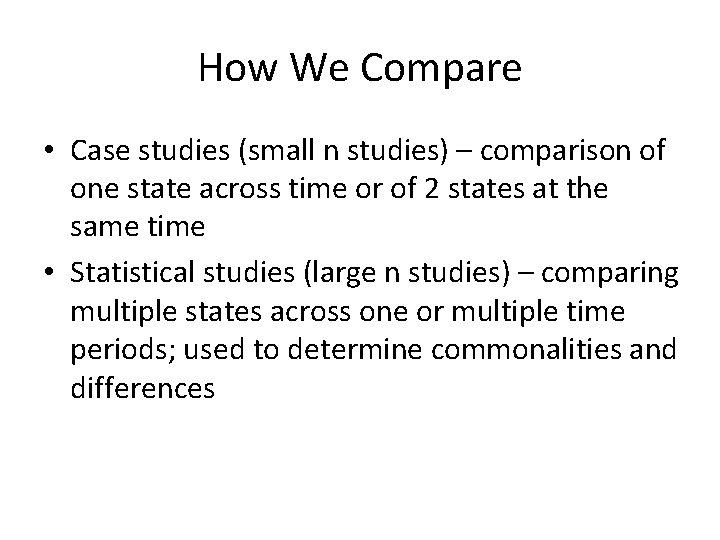
How We Compare • Case studies (small n studies) – comparison of one state across time or of 2 states at the same time • Statistical studies (large n studies) – comparing multiple states across one or multiple time periods; used to determine commonalities and differences
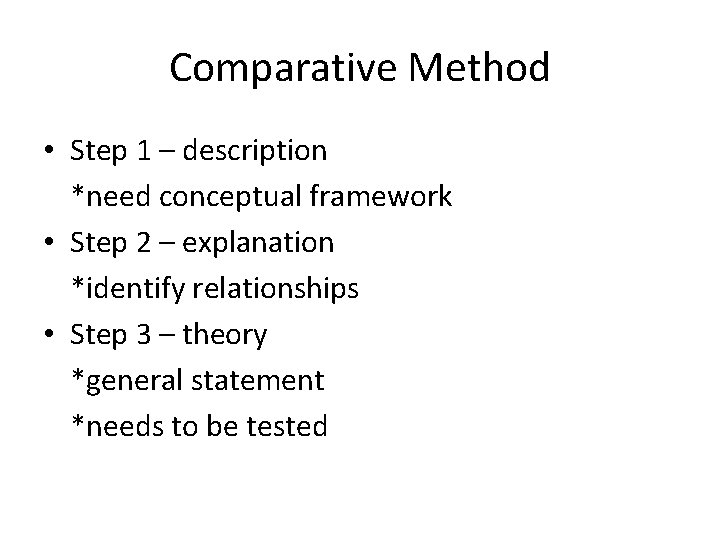
Comparative Method • Step 1 – description *need conceptual framework • Step 2 – explanation *identify relationships • Step 3 – theory *general statement *needs to be tested
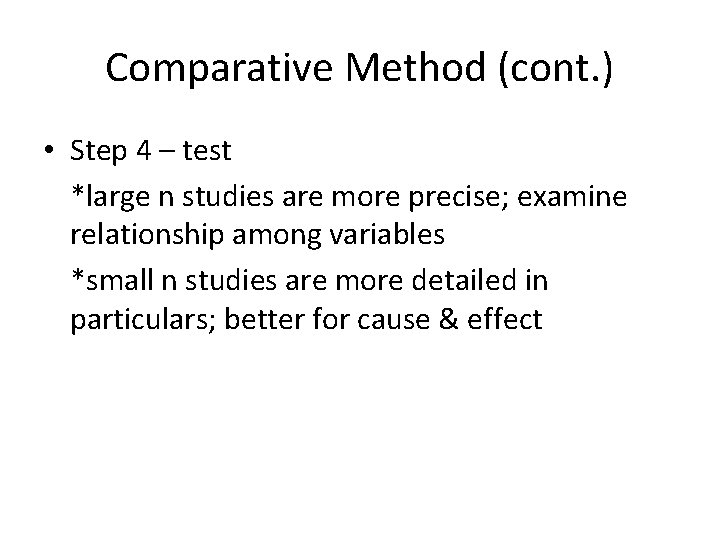
Comparative Method (cont. ) • Step 4 – test *large n studies are more precise; examine relationship among variables *small n studies are more detailed in particulars; better for cause & effect
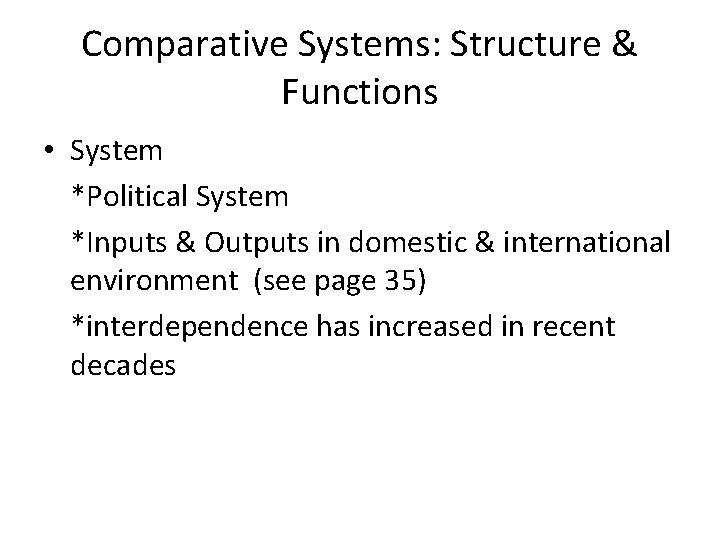
Comparative Systems: Structure & Functions • System *Political System *Inputs & Outputs in domestic & international environment (see page 35) *interdependence has increased in recent decades
Comparative Systems (cont. ) • Structure *Structures perform functions *Structures are specific agencies such as courts, bureaucracies, administrative agencies *Functions enable the government to formulate, implement and enforce policies *Policies reflect goals, agencies provide means *6 Common structures in all systems, but function differently
Comparative Systems (cont. ) • Function *System – maintain the system, keep it stable and running; fundamentally important *Process – converts inputs of demands arising from society and the international environment into policy outputs; necessary for policy to be made and implemented *Policy – effect domestic society and international environment
System Functions • Socialization – families, schools, media, churches, etc. that develop, reinforce and transform attitudes in society • Recruitment – selection of people for government activity • Communication – flow of information through society and political structures
Process Functions • Interest Articulation – expressing interests to the government • Interest Aggregation – overall views of people; combination of demands • Interest Adjudication – justification of policies (consequences, order, decree) Process functions are performed by political parties, legislatures, executives and courts
Policy Functions • Leads to inputs & outputs
Analysis • Structural Analysis – tells how the number of political parties, organization of legislature, branches of government, media, interest groups, etc. are set up and how they operate • Functional Analysis – how the institutions and organizations interact to produce and implement policies
Policy Level: Performance, Outcome & Evaluation • How are goals of welfare, justice, freedom and equality affected? • Effectiveness is measured in culture, economy, technology and environment • Outputs of a political system are its performance