
Chapter 2 Community Care The Family and Culture


- Slides: 34
Chapter 2 Community Care: The Family and Culture Copyright © 2016 by Elsevier Inc. All rights reserved.
Learning Objectives Describe the main characteristics of contemporary family forms. Identify key factors influencing family health. Compare theoretic approaches for working with childbearing families. Relate the impact of culture on childbearing families. Discuss cultural competence in relation to one’s own nursing practice. Identify key components of the community assessment process. List indicators of community health status and their relevance to perinatal health. Describe data sources and methods for obtaining information about community health status. Identify predisposing factors and characteristics of vulnerable populations. List the potential advantages and disadvantages of home visits. Explore telephonic nursing care options in perinatal nursing. Describe how home care fits into the maternity continuum of care. Describe the nurse’s role in perinatal home care. Copyright © 2016 by Elsevier Inc. All rights reserved. 2
Introduction to Family, Culture, Community, and Home Care The composition, structure, and function of the American family have changed dramatically in recent years. Significant barriers exist in accessing needed services. Nurses must become culturally competent in order to recognize and reduce or eliminate health disparities. Copyright © 2016 by Elsevier Inc. All rights reserved. 3
Introduction to Family, Culture, Community, and Home Care (Cont. ) Notable gaps in Healthy People 2010 target goals Rates of LBW Preterm births Infant mortality Persistent disparities based on ethnic group These will be carried over and included in Healthy People 2020. Copyright © 2016 by Elsevier Inc. All rights reserved. 4
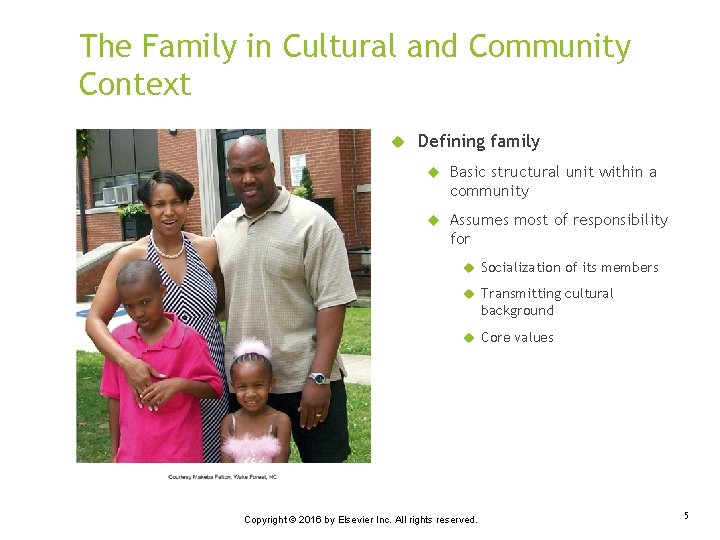
The Family in Cultural and Community Context Defining family Basic structural unit within a community Assumes most of responsibility for Socialization of its members Transmitting cultural background Core values Copyright © 2016 by Elsevier Inc. All rights reserved. 5
The Family in Cultural and Community Context (Cont. ) Family organization and structure Nuclear families Multigenerational families Married-parent families Extended families Married-blended families Cohabitating-parent families Single-parent families Homosexual parent families No-parent families Copyright © 2016 by Elsevier Inc. All rights reserved. 6
The Family in Cultural and Community Context (Cont. ) Family in society Racial and ethnic diversity has grown dramatically. 36% of all U. S. citizens belong to a minority group. Copyright © 2016 by Elsevier Inc. All rights reserved. 7
Theoretic Approaches to Understanding Families Family nursing Family plays a pivotal role in health care. Change in one member affects all family members. Health care providers must listen to and honor the perspectives and choices of clients and their families. Copyright © 2016 by Elsevier Inc. All rights reserved. 8
Theoretic Approaches to Understanding Families (Cont. ) Family theories Family systems theory Family life cycle (developmental theory) Family stress theory Mc. Gill model of nursing Health belief model Human developmental ecology Copyright © 2016 by Elsevier Inc. All rights reserved. 9
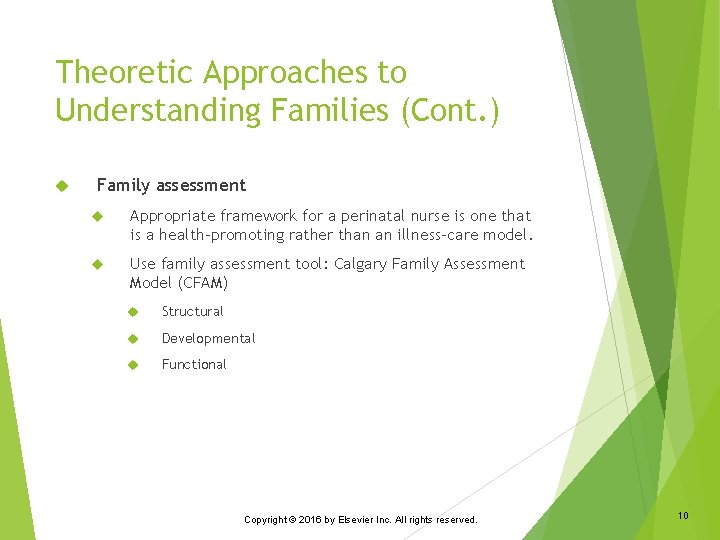
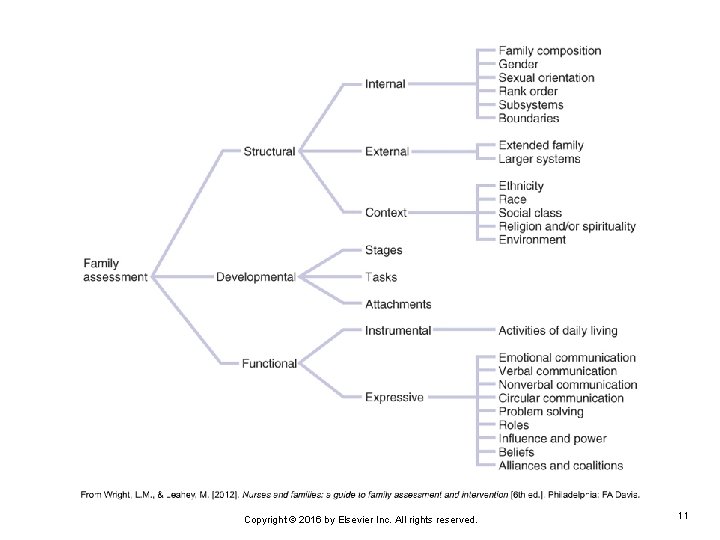
Theoretic Approaches to Understanding Families (Cont. ) Family assessment Appropriate framework for a perinatal nurse is one that is a health-promoting rather than an illness-care model. Use family assessment tool: Calgary Family Assessment Model (CFAM) Structural Developmental Functional Copyright © 2016 by Elsevier Inc. All rights reserved. 10
Copyright © 2016 by Elsevier Inc. All rights reserved. 11
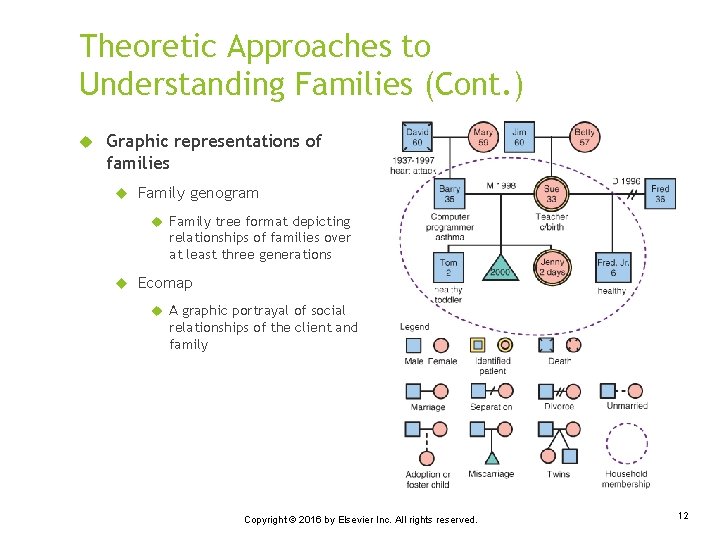
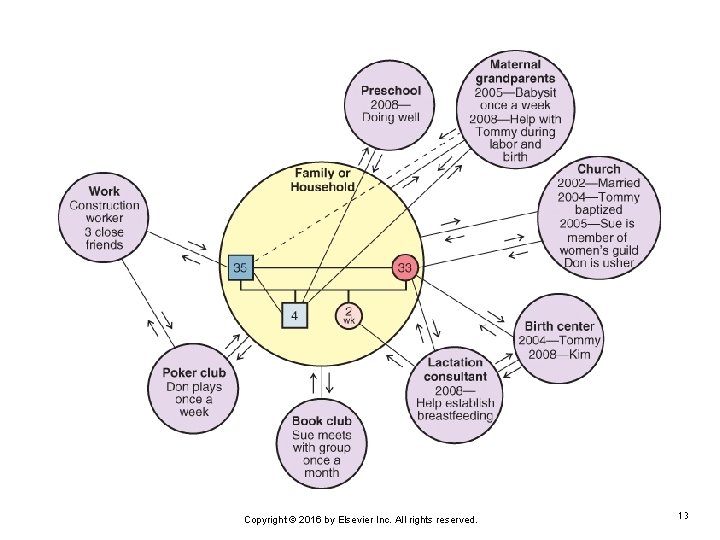
Theoretic Approaches to Understanding Families (Cont. ) Graphic representations of families Family genogram Family tree format depicting relationships of families over at least three generations Ecomap A graphic portrayal of social relationships of the client and family Copyright © 2016 by Elsevier Inc. All rights reserved. 12
Copyright © 2016 by Elsevier Inc. All rights reserved. 13
The Family in a Cultural Context Cultural factors related to family health Culture Subculture Acculturation Assimilation Implications for nursing Ethnocentrism vs. cultural relativism Copyright © 2016 by Elsevier Inc. All rights reserved. 14
The Family in a Cultural Context (Cont. ) Childbearing beliefs and practices Communication Use of interpreters Address questions to the woman, not the interpreter Personal space Time orientation Family roles Copyright © 2016 by Elsevier Inc. All rights reserved. 15
Developing Cultural Competence Key components of cultural competence Recognizing disparity between one’s own culture and that of the client Educating and promoting healthy behaviors in a cultural context Taking abstract knowledge about other cultures and applying it in a practical way Copyright © 2016 by Elsevier Inc. All rights reserved. 16
Developing Cultural Competence (Cont. ) Key components of cultural competence Communicating respectfulness for a wide range of differences Nontraditional healing practices Alternative therapies Recognizing culturally different communication styles Anticipating the need to address language ability and literacy Copyright © 2016 by Elsevier Inc. All rights reserved. 17
Community Health Promotion Levels of preventive care Primary prevention: immunizations, encouraging exercise and healthy nutrition Secondary prevention: targets populations at risk for certain diseases Tertiary prevention: treatment and rehabilitation to prevent complications and further deterioration Promoting family health Copyright © 2016 by Elsevier Inc. All rights reserved. 18
Community Health Promotion Levels of preventive care Primary prevention: immunizations, car seats, etc. Secondary prevention: screenings, testing, early treatments Tertiary prevention: treatment and rehabilitation to prevent complications and further deterioration 19 Copyright © 2016 by Elsevier Inc. All rights reserved. 19
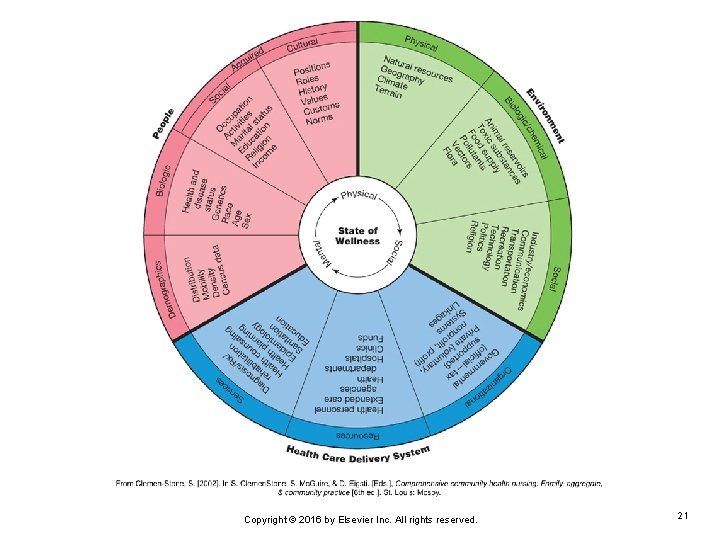
Assessing the Community Methods of community assessment Data collection and sources of community health data Key informants Community gatekeepers Walking survey Participant observation Copyright © 2016 by Elsevier Inc. All rights reserved. 20
Copyright © 2016 by Elsevier Inc. All rights reserved. 21
Vulnerable Populations Women Racial and ethnic minorities Adolescent girls Older women Incarcerated women Immigrant, refugee, and migrant women Copyright © 2016 by Elsevier Inc. All rights reserved. 22
Vulnerable Populations (Cont. ) Rural versus urban community settings Homeless women Homeless families Implications for nursing Cultural sensitivity and compassion Awareness of family and social stressors Treat with dignity and respect Helps woman reconnect with social support system Copyright © 2016 by Elsevier Inc. All rights reserved. 23
Home Care in the Community Growing demand for home care based on Interest in family birthing alternatives Shortened hospital stays New technologies that facilitate home-based assessment and treatment Reimbursement by third-party payers Copyright © 2016 by Elsevier Inc. All rights reserved. 24
Home Care in the Community (Cont. ) Growing demand for home care Goals of clinically integrated health care delivery networks Improved coordination of care and care outcomes Better communication among health care providers Increased client, payer, and provider satisfaction Reduced cost Copyright © 2016 by Elsevier Inc. All rights reserved. 25
Home Care in the Community (Cont. ) Communication and technology applications Nurse advice lines Warm lines Telephonic nursing assessments Guidelines for home care nursing practice AWHONN definition and standards for practice Perinatal services Client selection and referral Copyright © 2016 by Elsevier Inc. All rights reserved. 26
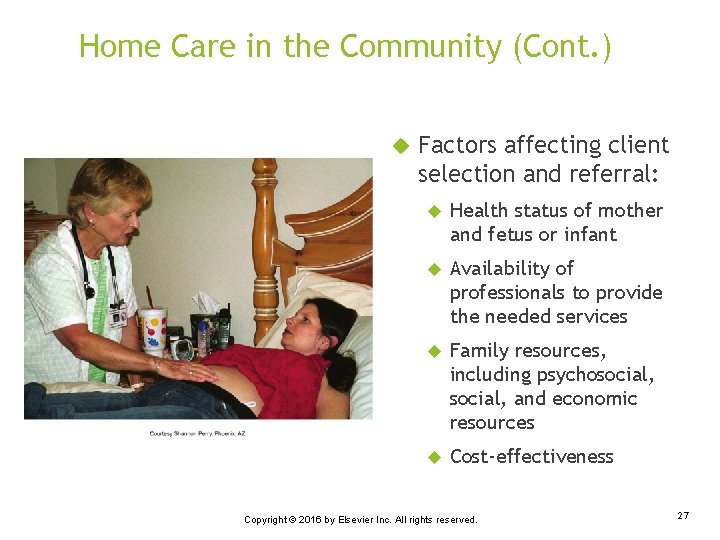
Home Care in the Community (Cont. ) Factors affecting client selection and referral: Health status of mother and fetus or infant Availability of professionals to provide the needed services Family resources, including psychosocial, and economic resources Cost-effectiveness Copyright © 2016 by Elsevier Inc. All rights reserved. 27
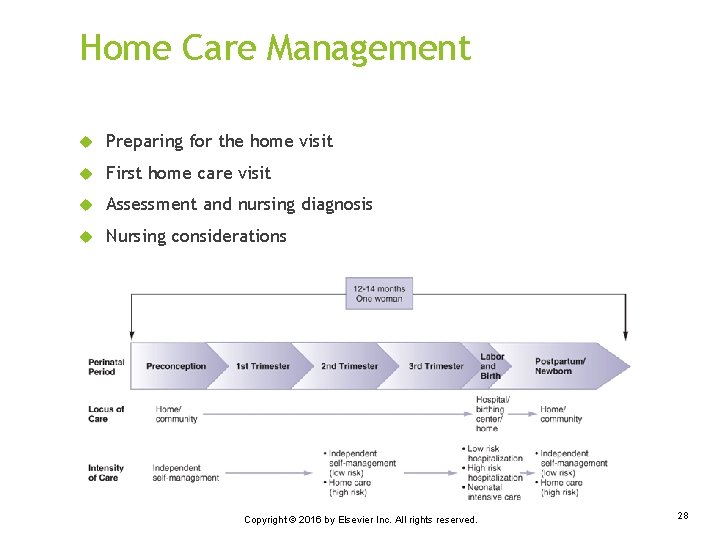
Home Care Management Preparing for the home visit First home care visit Assessment and nursing diagnosis Nursing considerations Copyright © 2016 by Elsevier Inc. All rights reserved. 28
Home Care Management (Cont. ) Safety issues for the home care nurse Follow OSHA guidelines Personal safety Infection control Strict handwashing techniques Sharps containers Gloves, personal protective equipment (PPE) Proper equipment Copyright © 2016 by Elsevier Inc. All rights reserved. 29
Key Points The family is a social network that acts as an important support system for its members. Family theories provide nurses with useful guidelines for understanding family function. Family socioeconomics, response to stress, and culture are key factors influencing family health. Copyright © 2016 by Elsevier Inc. All rights reserved. 30
Key Points (Cont. ) The economic, religious, kinship, and political structures are embedded in the reproductive beliefs and practices of a culture. Nurses must develop cultural competence and must integrate it into the nursing plan of care. Of necessity, most changes aimed at improving community health involve partnerships among community residents and health workers. Copyright © 2016 by Elsevier Inc. All rights reserved. 31
Key Points (Cont. ) Methods of collecting data useful to the nurse working in the community include walking surveys, analysis of existing data, informant interviews, and participant observation. Vulnerable populations are groups who are at higher risk for development of physical, mental, or social health problems. Social and economic factors affect the scope of perinatal nursing practice. Copyright © 2016 by Elsevier Inc. All rights reserved. 32
Key Points (Cont. ) Perinatal home care is a unique nursing practice that incorporates knowledge from community health nursing, acute care nursing, family therapy, health promotion, and client education. Telephonic nurse advice lines, telephonic nursing assessments, and warmlines are low-cost health care services that facilitate continuous client education, support, and health care decision making, even though health care is delivered in multiple sites. Copyright © 2016 by Elsevier Inc. All rights reserved. 33
Question 1. In what form do families tend to be most socially vulnerable? a. Married-blended family b. Extended family c. Nuclear family d. Single-parent family Copyright © 2016 by Elsevier Inc. All rights reserved. 34