
CHAPTER 2 CNC 5 Axis and Ultrasonic Machining
- Slides: 16
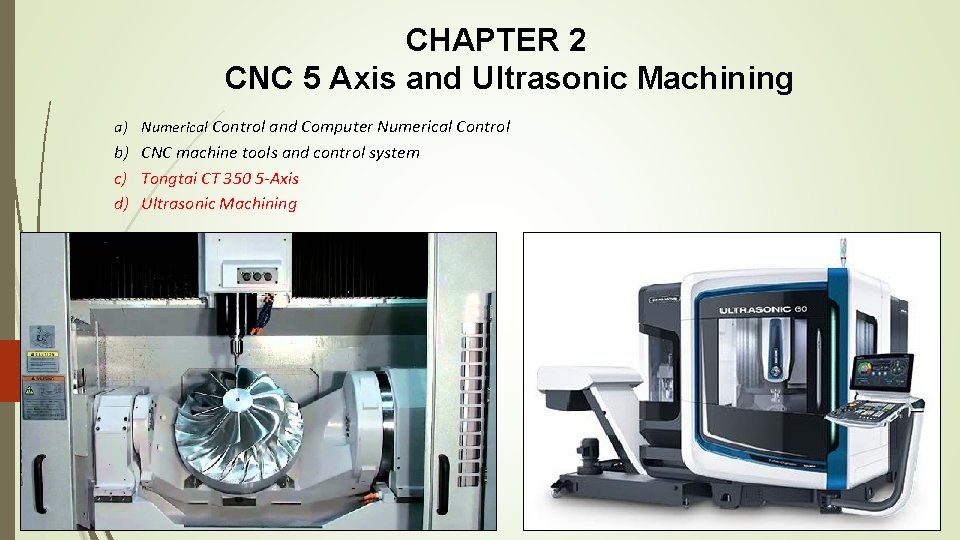
CHAPTER 2 CNC 5 Axis and Ultrasonic Machining a) Numerical Control and Computer Numerical Control b) CNC machine tools and control system c) Tongtai CT 350 5 -Axis d) Ultrasonic Machining
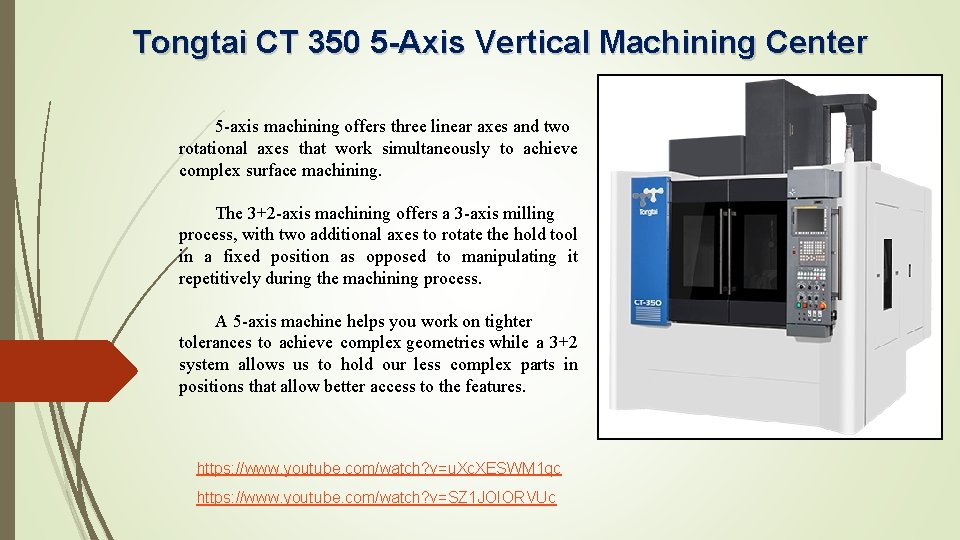
Tongtai CT 350 5 -Axis Vertical Machining Center 5 -axis machining offers three linear axes and two rotational axes that work simultaneously to achieve complex surface machining. The 3+2 -axis machining offers a 3 -axis milling process, with two additional axes to rotate the hold tool in a fixed position as opposed to manipulating it repetitively during the machining process. A 5 -axis machine helps you work on tighter tolerances to achieve complex geometries while a 3+2 system allows us to hold our less complex parts in positions that allow better access to the features. https: //www. youtube. com/watch? v=u. Xc. XESWM 1 qc https: //www. youtube. com/watch? v=SZ 1 JOIORVUc
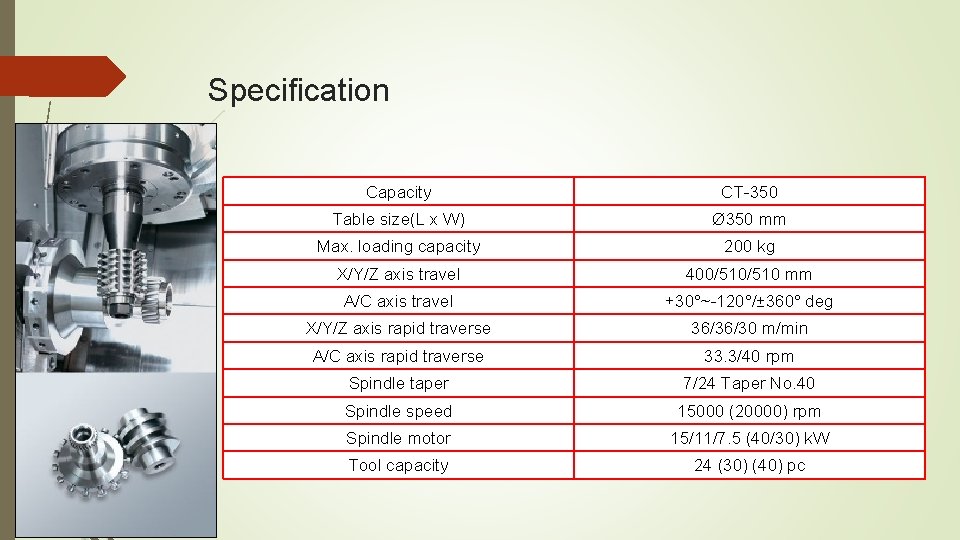
Specification Capacity CT-350 Table size(L x W) Ø 350 mm Max. loading capacity 200 kg X/Y/Z axis travel 400/510 mm A/C axis travel +30°~-120°/± 360° deg X/Y/Z axis rapid traverse 36/36/30 m/min A/C axis rapid traverse 33. 3/40 rpm Spindle taper 7/24 Taper No. 40 Spindle speed 15000 (20000) rpm Spindle motor 15/11/7. 5 (40/30) k. W Tool capacity 24 (30) (40) pc
Strategies to Get the Most from 5 -axis machining Collect Information Get as much information as possible before deciding whether to apply 3 -axis or 5 -axis machining. Check the data we collect from customer for correctness and accuracy. Look at the part closely, and decide if you need a pretest to ensure accuracy. Additionally, do a cost analysis to determine the best machining for the job. Simulation Software Make full use of our simulation software to verify any process before sending it from the CAD system to the machine to avoid collisions. When working on a 5 -axis machine, it is hard to visualize collision points; with the software, we can closely monitor the length of the tool, the interference of the tool and the size of the part. Creative Workholding Rethink your workloading by using an approach that eliminates setups and reduces handling; unique workloading options give you better access to all sides of the part. A creative approach improves the production process and helps us improve accuracy and the overall finish of our products. Tooling Work with tools made for 5 -axis machining especially in high-speed applications. At the end of the process, the final part should come off the machine without the use of manual force. Run Kinetics When working to achieve the specifics for each part, run kinetics to help us improve accuracy. Run the kinetics before going into an accurate application to understand the positioning of the ends of the cutting tool in relation to the turning point of the axes. As technology changes, the application of 5 -axis machining is on the rise. Ultimately, your workload and productions targets determine the machining equipment we choose. Work closely with our clients to understand their expectations and select the machine that delivers to the best of their expectations.
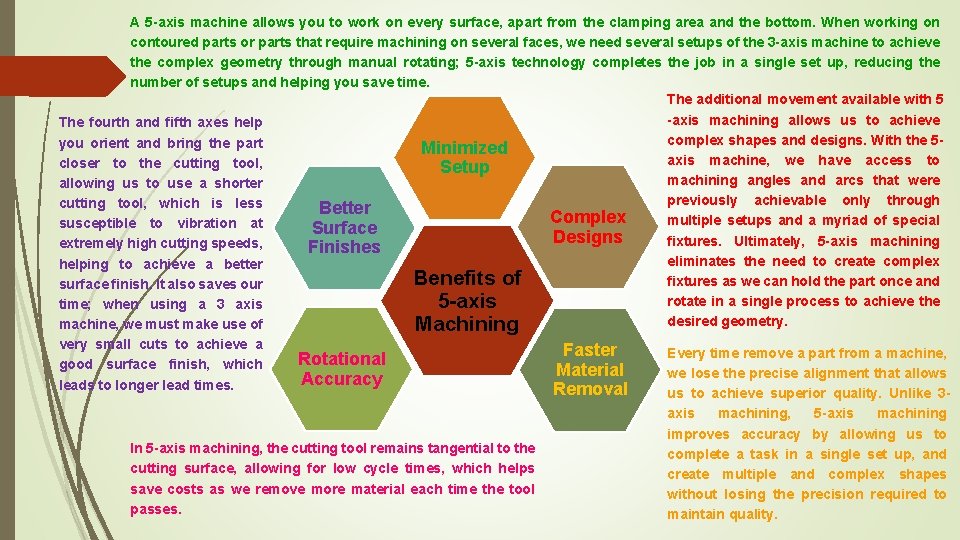
A 5 -axis machine allows you to work on every surface, apart from the clamping area and the bottom. When working on contoured parts or parts that require machining on several faces, we need several setups of the 3 -axis machine to achieve the complex geometry through manual rotating; 5 -axis technology completes the job in a single set up, reducing the number of setups and helping you save time. The additional movement available with 5 -axis machining allows us to achieve The fourth and fifth axes help complex shapes and designs. With the 5 you orient and bring the part Minimized axis machine, we have access to closer to the cutting tool, Setup machining angles and arcs that were allowing us to use a shorter previously achievable only through cutting tool, which is less Better Complex multiple setups and a myriad of special susceptible to vibration at Surface Designs fixtures. Ultimately, 5 -axis machining extremely high cutting speeds, Finishes eliminates the need to create complex helping to achieve a better Benefits of fixtures as we can hold the part once and surface finish. It also saves our rotate in a single process to achieve the 5 -axis time; when using a 3 axis desired geometry. machine, we must make use of Machining very small cuts to achieve a good surface finish, which leads to longer lead times. Rotational Accuracy In 5 -axis machining, the cutting tool remains tangential to the cutting surface, allowing for low cycle times, which helps save costs as we remove more material each time the tool passes. Faster Material Removal Every time remove a part from a machine, we lose the precise alignment that allows us to achieve superior quality. Unlike 3 axis machining, 5 -axis machining improves accuracy by allowing us to complete a task in a single set up, and create multiple and complex shapes without losing the precision required to maintain quality.
Disadvantages 1. 2. 3. 4. 5. 6. The cost of CNC machine tool is much high. Cost and skill of the people required to operate a CNC machine is generally high. Special training needed to the personnel manning the CNC machine tools. Requires higher investments for maintenance. The automatic operation of CNC machines implies relatively higher running cost. High utilization required.
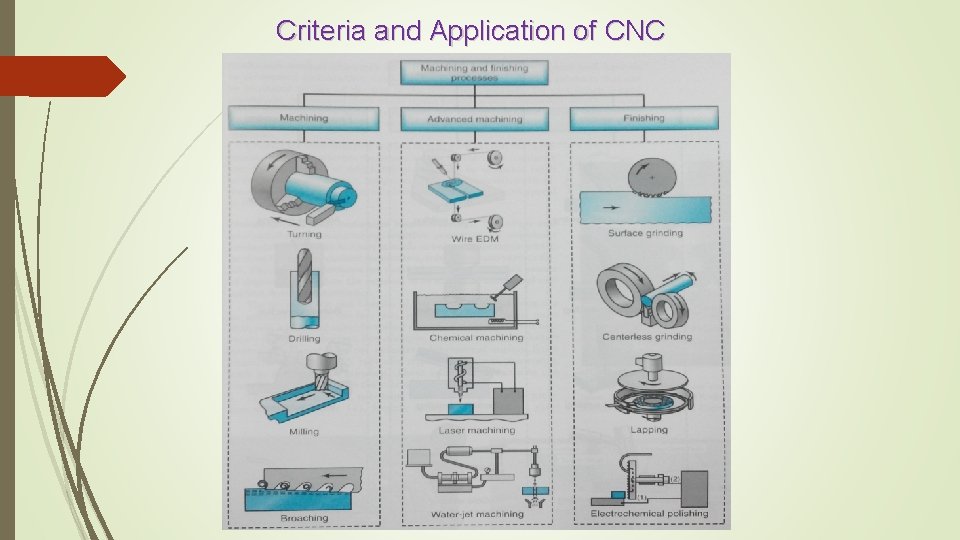
Criteria and Application of CNC
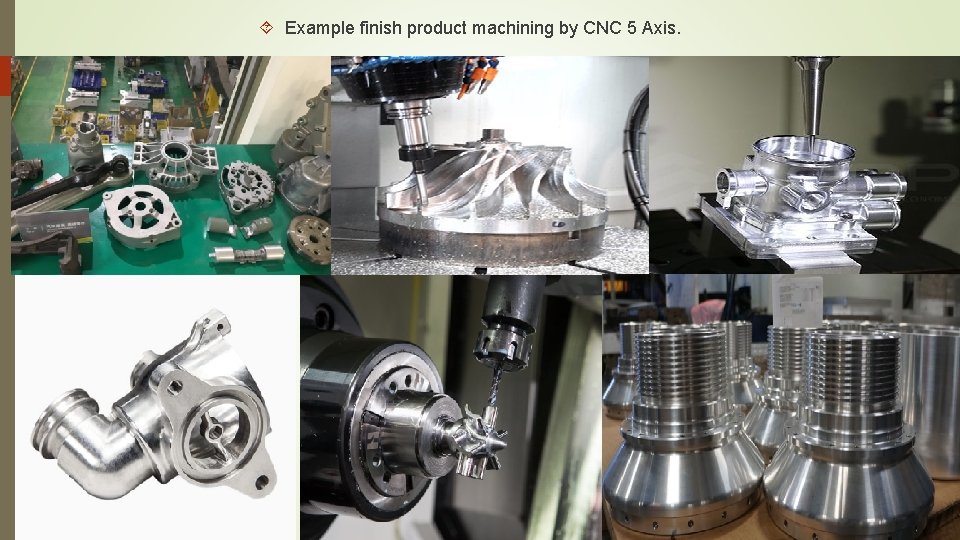
Example finish product machining by CNC 5 Axis.
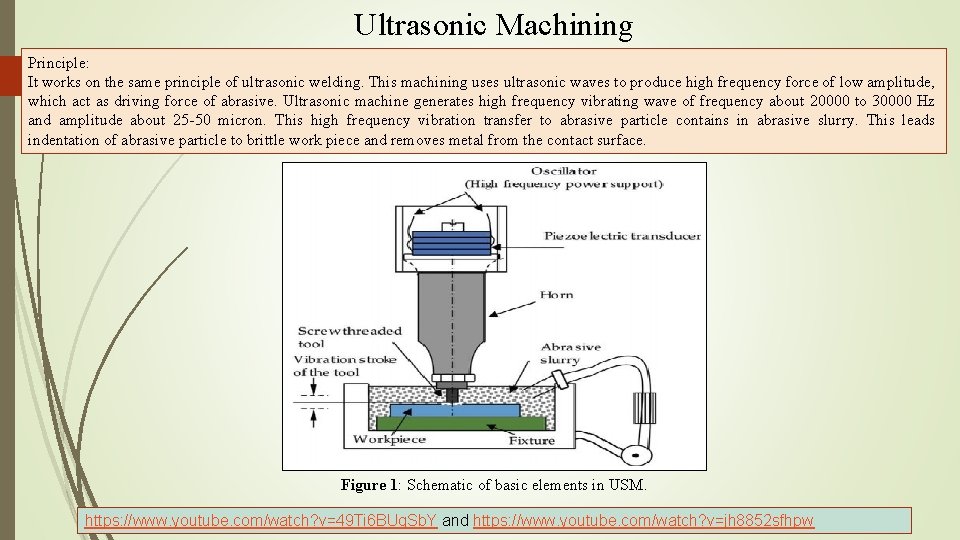
Ultrasonic Machining Principle: It works on the same principle of ultrasonic welding. This machining uses ultrasonic waves to produce high frequency force of low amplitude, which act as driving force of abrasive. Ultrasonic machine generates high frequency vibrating wave of frequency about 20000 to 30000 Hz and amplitude about 25 -50 micron. This high frequency vibration transfer to abrasive particle contains in abrasive slurry. This leads indentation of abrasive particle to brittle work piece and removes metal from the contact surface. Figure 1: Schematic of basic elements in USM. https: //www. youtube. com/watch? v=49 Ti 6 BUg. Sb. Y and https: //www. youtube. com/watch? v=jh 8852 sfhpw
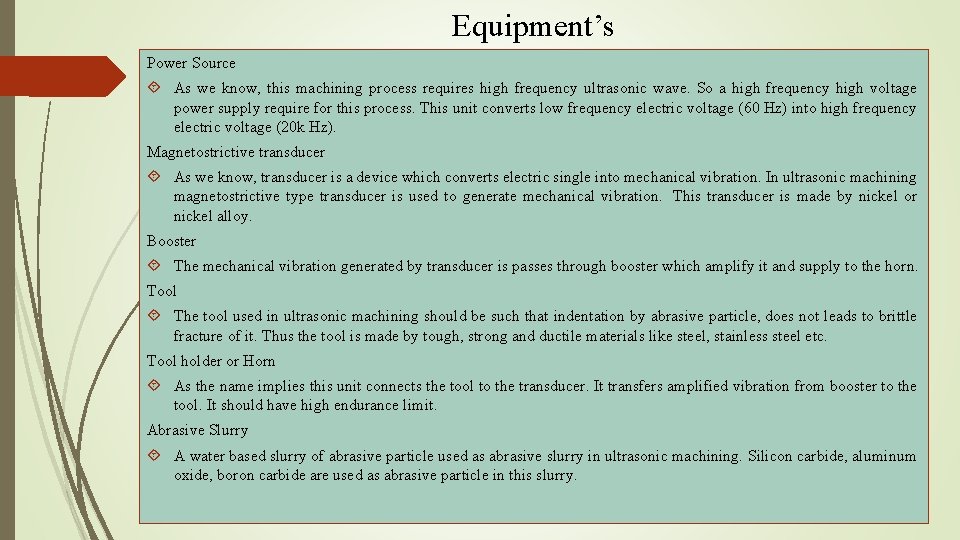
Equipment’s Power Source As we know, this machining process requires high frequency ultrasonic wave. So a high frequency high voltage power supply require for this process. This unit converts low frequency electric voltage (60 Hz) into high frequency electric voltage (20 k Hz). Magnetostrictive transducer As we know, transducer is a device which converts electric single into mechanical vibration. In ultrasonic machining magnetostrictive type transducer is used to generate mechanical vibration. This transducer is made by nickel or nickel alloy. Booster The mechanical vibration generated by transducer is passes through booster which amplify it and supply to the horn. Tool The tool used in ultrasonic machining should be such that indentation by abrasive particle, does not leads to brittle fracture of it. Thus the tool is made by tough, strong and ductile materials like steel, stainless steel etc. Tool holder or Horn As the name implies this unit connects the tool to the transducer. It transfers amplified vibration from booster to the tool. It should have high endurance limit. Abrasive Slurry A water based slurry of abrasive particle used as abrasive slurry in ultrasonic machining. Silicon carbide, aluminum oxide, boron carbide are used as abrasive particle in this slurry.
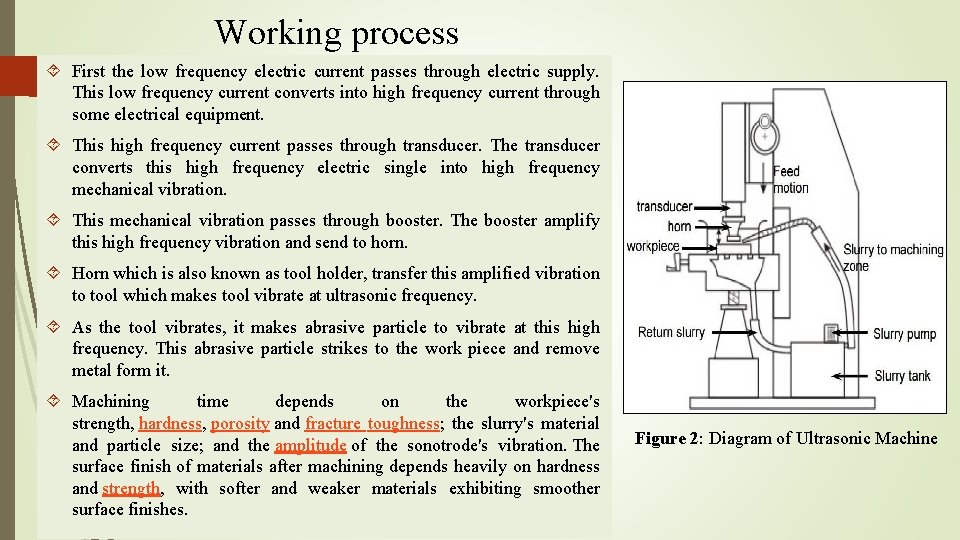
Working process First the low frequency electric current passes through electric supply. This low frequency current converts into high frequency current through some electrical equipment. This high frequency current passes through transducer. The transducer converts this high frequency electric single into high frequency mechanical vibration. This mechanical vibration passes through booster. The booster amplify this high frequency vibration and send to horn. Horn which is also known as tool holder, transfer this amplified vibration to tool which makes tool vibrate at ultrasonic frequency. As the tool vibrates, it makes abrasive particle to vibrate at this high frequency. This abrasive particle strikes to the work piece and remove metal form it. Machining time depends on the workpiece's strength, hardness, porosity and fracture toughness; the slurry's material and particle size; and the amplitude of the sonotrode's vibration. The surface finish of materials after machining depends heavily on hardness and strength, with softer and weaker materials exhibiting smoother surface finishes. Figure 2: Diagram of Ultrasonic Machine
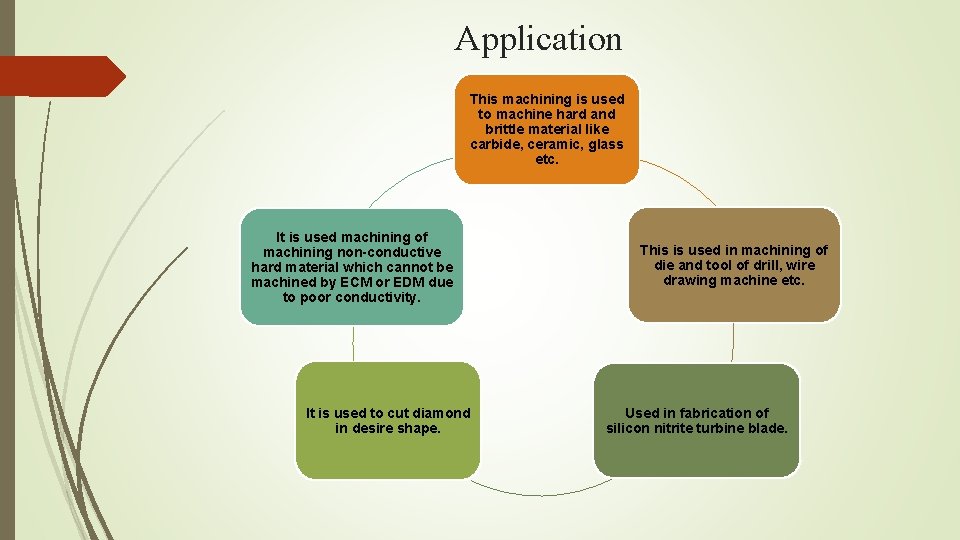
Application This machining is used to machine hard and brittle material like carbide, ceramic, glass etc. It is used machining of machining non-conductive hard material which cannot be machined by ECM or EDM due to poor conductivity. It is used to cut diamond in desire shape. This is used in machining of die and tool of drill, wire drawing machine etc. Used in fabrication of silicon nitrite turbine blade.
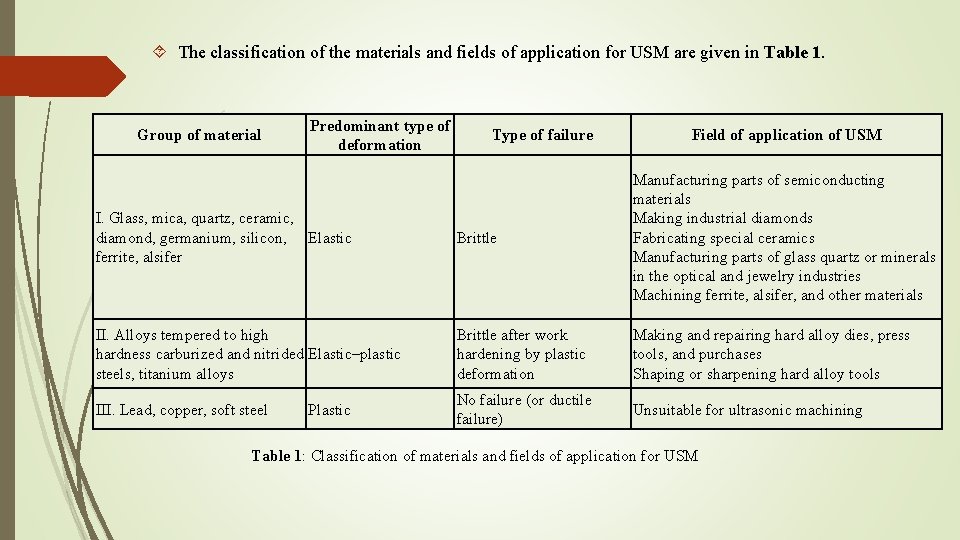
The classification of the materials and fields of application for USM are given in Table 1. Group of material Predominant type of deformation Type of failure Field of application of USM I. Glass, mica, quartz, ceramic, diamond, germanium, silicon, Elastic ferrite, alsifer Brittle Manufacturing parts of semiconducting materials Making industrial diamonds Fabricating special ceramics Manufacturing parts of glass quartz or minerals in the optical and jewelry industries Machining ferrite, alsifer, and other materials II. Alloys tempered to high hardness carburized and nitrided Elastic–plastic steels, titanium alloys Brittle after work hardening by plastic deformation Making and repairing hard alloy dies, press tools, and purchases Shaping or sharpening hard alloy tools III. Lead, copper, soft steel No failure (or ductile failure) Unsuitable for ultrasonic machining Plastic Table 1: Classification of materials and fields of application for USM
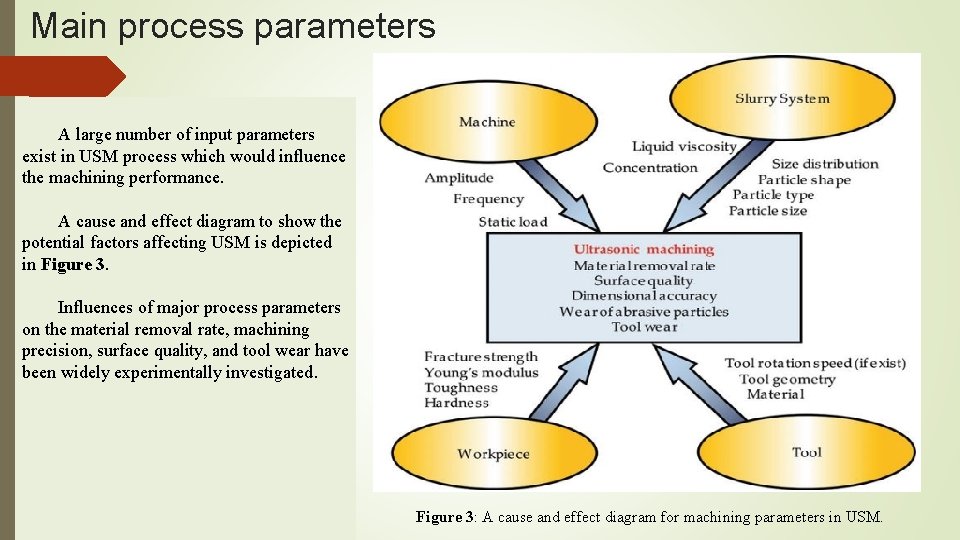
Main process parameters A large number of input parameters exist in USM process which would influence the machining performance. A cause and effect diagram to show the potential factors affecting USM is depicted in Figure 3. Influences of major process parameters on the material removal rate, machining precision, surface quality, and tool wear have been widely experimentally investigated. Figure 3: A cause and effect diagram for machining parameters in USM.
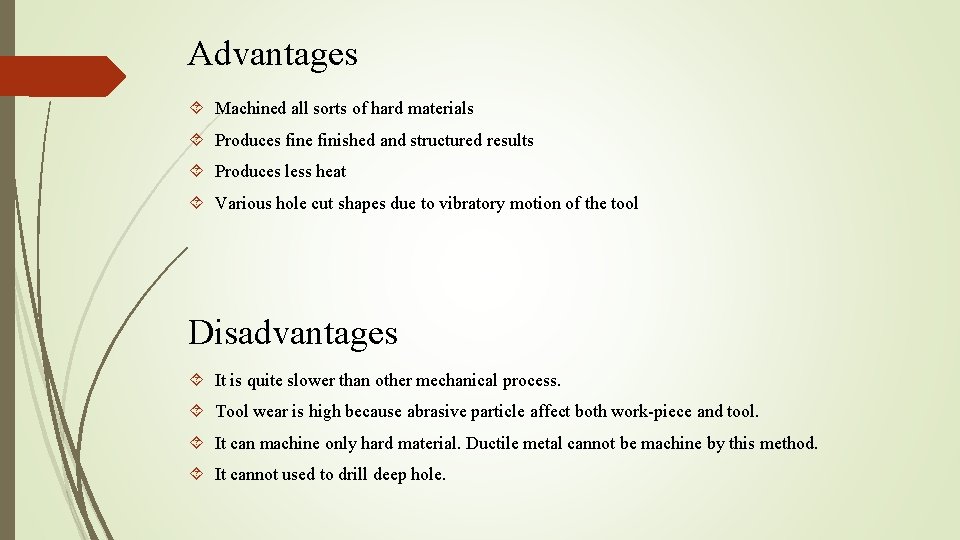
Advantages Machined all sorts of hard materials Produces fine finished and structured results Produces less heat Various hole cut shapes due to vibratory motion of the tool Disadvantages It is quite slower than other mechanical process. Tool wear is high because abrasive particle affect both work-piece and tool. It can machine only hard material. Ductile metal cannot be machine by this method. It cannot used to drill deep hole.
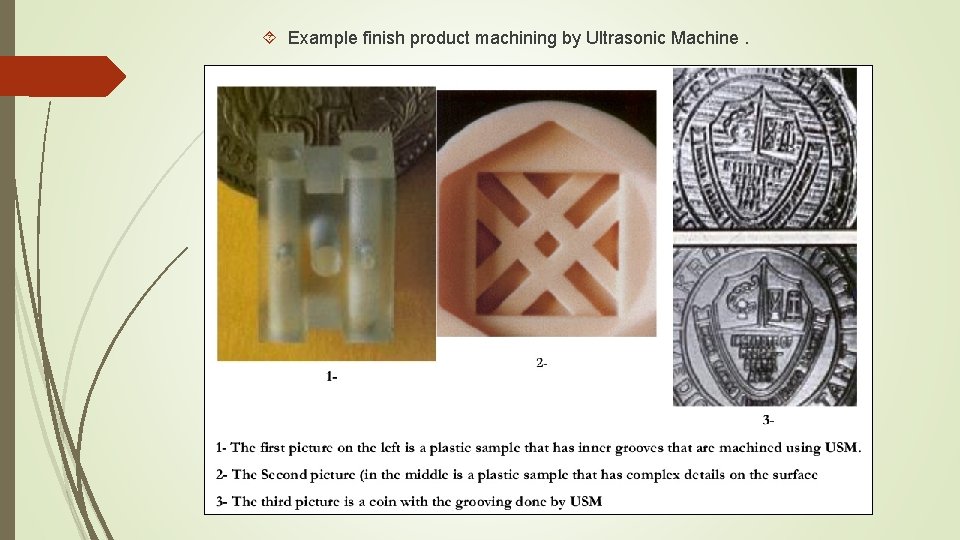
Example finish product machining by Ultrasonic Machine.