
Chapter 2 Classical Views of Leadership and Management



- Slides: 33
Chapter 2 Classical Views of Leadership and Management Copyright © 2015 Wolters Kluwer Health | Lippincott Williams & Wilkins
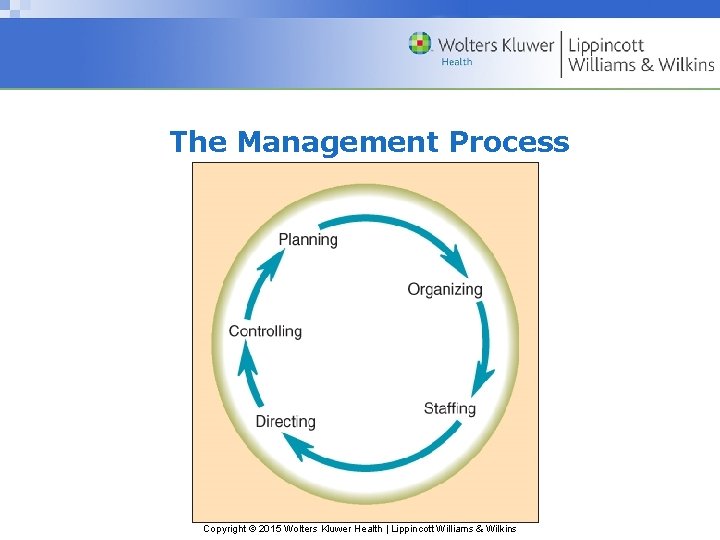
Management Functions • Planning • Organizing • Staffing • Directing • Controlling Copyright © 2015 Wolters Kluwer Health | Lippincott Williams & Wilkins
Leadership versus Management • Leaders – Empower others; maximize workforce effectiveness – Needed to implement the planned change that is part of system improvement • Managers – Guide, direct, and motivate others – Intervene when goals are threatened – Emphasize control Copyright © 2015 Wolters Kluwer Health | Lippincott Williams & Wilkins
Characteristics of Managers • Have an assigned position within the formal organization • Have a legitimate source of power due to the delegated authority that accompanies their position • Are expected to carry out specific functions, duties, and responsibilities • Emphasize control, decision making, decision analysis, and results • Manipulate the environment, money, time, and other resources to achieve organizational goals • Have a greater formal responsibility and accountability for rationality and control than leaders • Direct willing and unwilling subordinates Copyright © 2015 Wolters Kluwer Health | Lippincott Williams & Wilkins
Question What aspect of business should managers emphasize? A. Decision making B. Analysis C. Results D. Control E. All of the above Copyright © 2015 Wolters Kluwer Health | Lippincott Williams & Wilkins
Answer E. All of the above Rationale: Control, decision making, analysis, and results are all crucial elements of successful management Copyright © 2015 Wolters Kluwer Health | Lippincott Williams & Wilkins
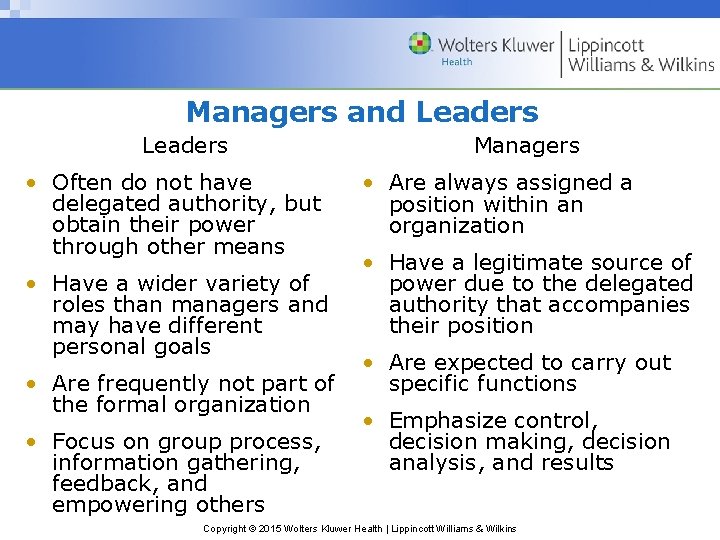
Managers and Leaders • Often do not have delegated authority, but obtain their power through other means • Have a wider variety of roles than managers and may have different personal goals • Are frequently not part of the formal organization • Focus on group process, information gathering, feedback, and empowering others Managers • Are always assigned a position within an organization • Have a legitimate source of power due to the delegated authority that accompanies their position • Are expected to carry out specific functions • Emphasize control, decision making, decision analysis, and results Copyright © 2015 Wolters Kluwer Health | Lippincott Williams & Wilkins
Question Which is a characteristic of a leader? A. Always assigned a position of authority B. Usually part of a formal organization C. Focus on group process, information gathering, and feedback D. Focus on decision making and results Copyright © 2015 Wolters Kluwer Health | Lippincott Williams & Wilkins
Answer C. Focus on group process, information gathering, and feedback Rationale: While managers are more often part of a formal organization and focus more on resultoriented tasks, leaders tend to focus more on things such as group process Copyright © 2015 Wolters Kluwer Health | Lippincott Williams & Wilkins
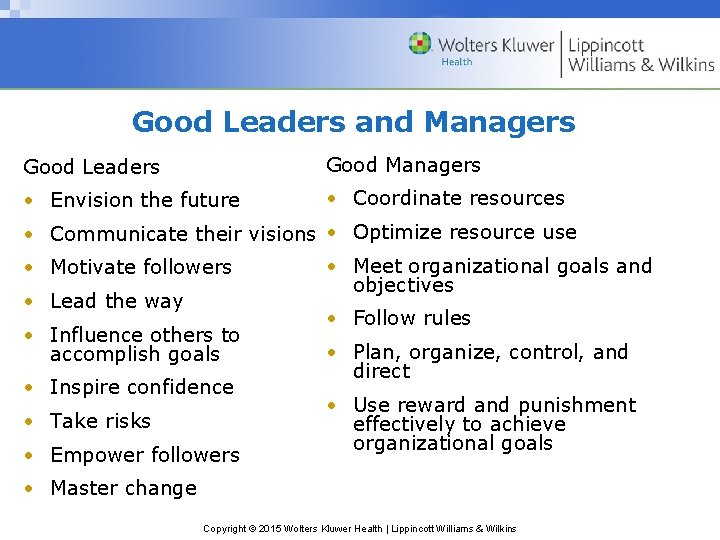
Good Leaders and Managers Good Leaders Good Managers • Envision the future • Coordinate resources • Communicate their visions • Optimize resource use • Motivate followers • Lead the way • Influence others to accomplish goals • Inspire confidence • Take risks • Empower followers • Meet organizational goals and objectives • Follow rules • Plan, organize, control, and direct • Use reward and punishment effectively to achieve organizational goals • Master change Copyright © 2015 Wolters Kluwer Health | Lippincott Williams & Wilkins
Ten Fatal Leadership Flaws • 1. A lack of energy and enthusiasm • 2. Acceptance of their own mediocre performance • 3. Lack of a clear vision and direction • 4. Having poor judgment • 5. Not collaborating • 6. Not walking the talk • 7. Resisting new ideas • 8. Not learning from mistakes • 9. A lack of interpersonal skills • 10. Failing to develop others Copyright © 2015 Wolters Kluwer Health | Lippincott Williams & Wilkins
Management Theory Development Taylor—scientific management Weber—bureaucratic functions Fayol—management organizations Gulick—activities of management Follett—participative management Mayo—Hawthorne effect Mc. Gregor—theory X and theory Y Argyris—employee participation Copyright © 2015 Wolters Kluwer Health | Lippincott Williams & Wilkins
Question Which was the focus of Weber’s management theory? A. Bureaucratic functions B. Management functions C. Scientific management D. Activities of management Copyright © 2015 Wolters Kluwer Health | Lippincott Williams & Wilkins
Answer A. Bureaucratic functions Rationale: Weber developed theory of bureaucratic organizations. Management functions theory was developed by Fayol. Taylor developed scientific management theory and Gulick developed activities of management theory Copyright © 2015 Wolters Kluwer Health | Lippincott Williams & Wilkins
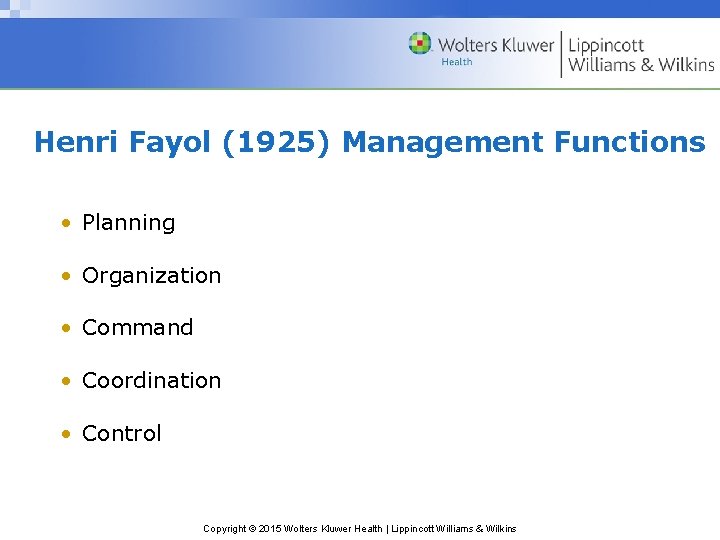
Henri Fayol (1925) Management Functions • Planning • Organization • Command • Coordination • Control Copyright © 2015 Wolters Kluwer Health | Lippincott Williams & Wilkins
The Management Process Copyright © 2015 Wolters Kluwer Health | Lippincott Williams & Wilkins
Planning Encompasses determining philosophy, goals, objectives, policies, procedures, and rules; carrying out long- and short-range projections; determining a fiscal course of action; and managing planned change Copyright © 2015 Wolters Kluwer Health | Lippincott Williams & Wilkins
Organizing Includes establishing the structure to carry out plans, determining the most appropriate type of patient care delivery, and grouping activities to meet unit goals Other functions involve working within the structure of the organization and understanding and using power and authority appropriately Copyright © 2015 Wolters Kluwer Health | Lippincott Williams & Wilkins
Staffing Consists of recruiting, interviewing, hiring, and orienting staff. Scheduling, staff development, employee socialization, and team building are also often included as staffing functions Copyright © 2015 Wolters Kluwer Health | Lippincott Williams & Wilkins
Directing Usually entails human resource management responsibilities, such as motivating, managing conflict, delegating, communicating, and facilitating collaboration Copyright © 2015 Wolters Kluwer Health | Lippincott Williams & Wilkins
Controlling Includes performance appraisals, fiscal accountability, quality control, legal and ethical control, and professional and collegial control Copyright © 2015 Wolters Kluwer Health | Lippincott Williams & Wilkins
Question Tell whether the following statement is True or False: Team building is an aspect of staffing. A. True B. False Copyright © 2015 Wolters Kluwer Health | Lippincott Williams & Wilkins
Answer A. True Rationale: While recruiting, interviewing, and hiring are the tasks most often associated with staffing, team building is also an important aspect of the job Copyright © 2015 Wolters Kluwer Health | Lippincott Williams & Wilkins
The Human Relations Era • Participatory management • Humanistic management • Emphasizes people rather than machines – Produced the “Hawthorne effect” Copyright © 2015 Wolters Kluwer Health | Lippincott Williams & Wilkins
Leadership • Leadership is the art of getting work done through others willingly • Leaders are in the front, moving forward, taking risks and challenging the status quo • A job title alone does not make a person a leader. Only a person’s behavior determines if he or she occupies a leadership position Copyright © 2015 Wolters Kluwer Health | Lippincott Williams & Wilkins
Leadership Roles • Decision maker • Coach • Communicator • Counselor • Evaluator • Teacher • Facilitator • Forecaster • Risk-taker • Visionary • Energizer • Influencer • Mentor • Creative problem solver • Critical thinker • Change agent • Buffer • Diplomat • Advocate • Role model Copyright © 2015 Wolters Kluwer Health | Lippincott Williams & Wilkins
The Evolution of Leadership Theories • Great Man theory/trait theories • Behavioral theories – Authoritarian leader – Democratic leader – Laissez-faire leader • Situational and contingency leadership theories • Interactional leadership theories • Transactional and transformational leadership • Full-range leadership theories Copyright © 2015 Wolters Kluwer Health | Lippincott Williams & Wilkins
Kouzes and Posner’s Five Practices for Exemplary Leadership • Modeling the way: requires value clarification and selfawareness so that behavior is congruent with values • Inspiring a shared vision: entails visioning that inspires followers to want to participate in goal attainment • Challenging the process: identifying opportunities and taking action • Enabling others to act: fostering collaboration, trust, and the sharing of power • Encouraging the heart: recognize, appreciate, and celebrate followers and the achievement of shared goals Copyright © 2015 Wolters Kluwer Health | Lippincott Williams & Wilkins
Transactional Leader • Focuses on management tasks • Is a caretaker • Uses trade-offs to meet goals • Does not identify shared values • Examines causes • Uses contingency reward Copyright © 2015 Wolters Kluwer Health | Lippincott Williams & Wilkins
Question Tell whether the following statement is True or False: A characteristic of leadership management is to use trade -offs to meet goals. A. True B. False Copyright © 2015 Wolters Kluwer Health | Lippincott Williams & Wilkins
Answer A. True Rationale: Trade-offs can be a useful tool to achieve goals Copyright © 2015 Wolters Kluwer Health | Lippincott Williams & Wilkins
Transformational Leader • Identifies common values • Is committed • Inspires others with vision • Has long-term vision • Looks at effects • Empowers others Copyright © 2015 Wolters Kluwer Health | Lippincott Williams & Wilkins
Integrated Leader/Managers (Gardner, 1990) • Think longer term • Look outward, toward the larger organization • Influence others beyond their own group • Emphasize vision, values, and motivation • Are politically astute • Think in terms of change and renewal Copyright © 2015 Wolters Kluwer Health | Lippincott Williams & Wilkins