
Chapter 2 Chemistry of Life Mosby items and
Chapter 2 Chemistry of Life Mosby items and derived items © 2012 by Mosby, Inc. , an affiliate of Elsevier Inc. Slide 1
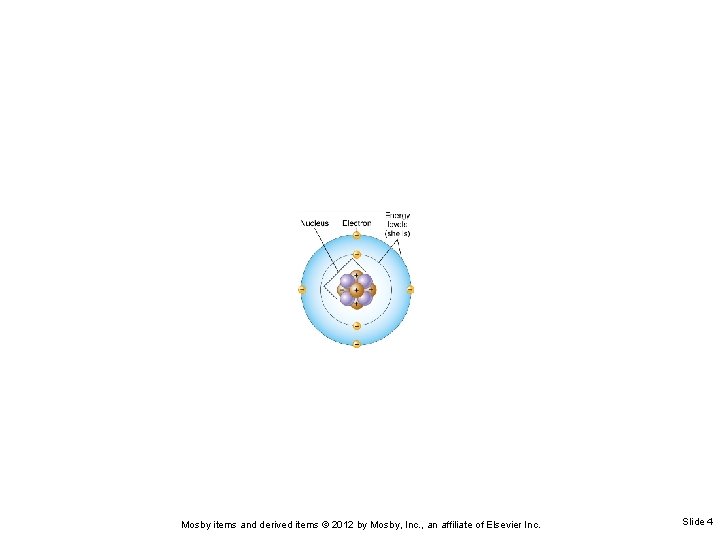
LEVELS OF CHEMICAL ORGANIZATION Atoms (Figures 2 -1 and 2 -2) Ø Nucleus—central core of atom • Proton—positively charged particle in nucleus • Neutron—non-charged particle in nucleus • Atomic number—number of protons in the nucleus; determines type of atom • Atomic mass—number of protons and neutrons combined Ø Energy levels—regions surrounding atomic nucleus that contain electrons • Electron—negatively charged particle • May contain up to eight electrons in each level • Energy increases with distance from nucleus Mosby items and derived items © 2012 by Mosby, Inc. , an affiliate of Elsevier Inc. Slide 2
Mosby items and derived items © 2012 by Mosby, Inc. , an affiliate of Elsevier Inc. Slide 3
Mosby items and derived items © 2012 by Mosby, Inc. , an affiliate of Elsevier Inc. Slide 4
LEVELS OF CHEMICAL ORGANIZATION (cont. ) Elements, molecules, and compounds Element—a pure substance; made up of only one kind of atom Ø Molecule—a group of atoms bound together in a group Ø Compound—substances whose molecules have more than one kind of atom Ø Mosby items and derived items © 2012 by Mosby, Inc. , an affiliate of Elsevier Inc. Slide 5
CHEMICAL BONDING Chemical bonds form to make atoms more stable Outermost energy level of each atom becomes full Ø Atoms may share electrons, or donate or borrow them to become stable Ø Mosby items and derived items © 2012 by Mosby, Inc. , an affiliate of Elsevier Inc. Slide 6
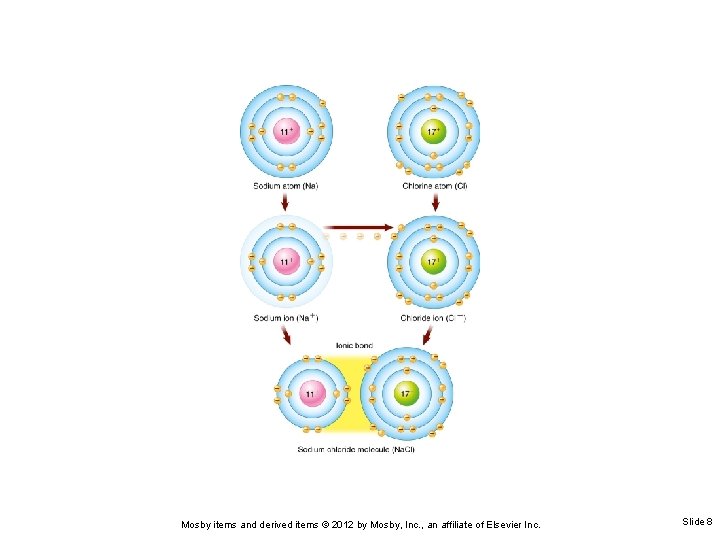
CHEMICAL BONDING (cont. ) Ionic bonds (Figure 2 -3) Ø Ions form when an atom gains or loses electrons in its outer energy level to become stable • Positive ion—has lost electrons; indicated by superscript positive sign(s), as in Na+ or Ca++ • Negative ion—has gained electrons; indicated by superscript negative sign(s), as in Cl Ionic bonds form when oppositely charged ions attract each other because of electrical attraction Ø Electrolyte—molecule that dissociates (breaks apart) in water to form individual ions; an ionic compound Ø Mosby items and derived items © 2012 by Mosby, Inc. , an affiliate of Elsevier Inc. Slide 7
Mosby items and derived items © 2012 by Mosby, Inc. , an affiliate of Elsevier Inc. Slide 8
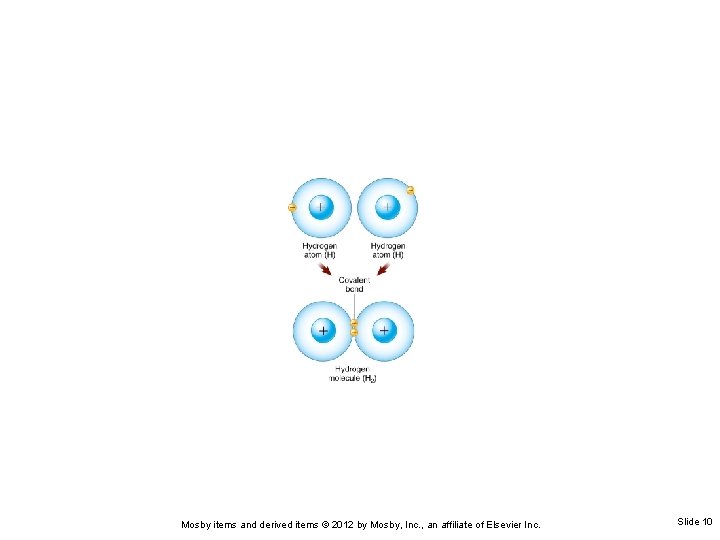
CHEMICAL BONDING (cont. ) Covalent bonds (Figure 2 -4) Covalent bonds form when atoms share their outer energy to fill up and thus become stable Ø Covalent bonds do not ordinarily easily dissociate in water Ø Hydrogen bonds Weak forces hold molecules in folded shapes (Figure 2 -12) or in groups (Figure 2 -5) Ø Do not form new molecules Ø Mosby items and derived items © 2012 by Mosby, Inc. , an affiliate of Elsevier Inc. Slide 9
Mosby items and derived items © 2012 by Mosby, Inc. , an affiliate of Elsevier Inc. Slide 10
INORGANIC CHEMISTRY Organic molecules contain carbon-carbon covalent bonds or carbon-hydrogen covalent bonds; inorganic molecules do not Examples of inorganic molecules: water and some acids, bases, and salts Mosby items and derived items © 2012 by Mosby, Inc. , an affiliate of Elsevier Inc. Slide 11
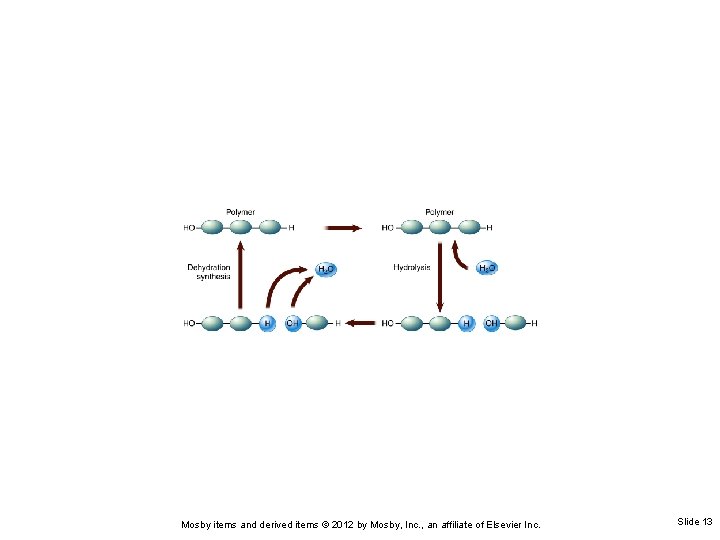
INORGANIC CHEMISTRY (cont. ) Water Ø Ø Water is essential to life Water's slightly gluelike nature helps hold the body together Water is a solvent (liquid into which solutes are dissolved), forming aqueous solutions in the body Water is involved in chemical reactions (Figure 2 -6) • Dehydration synthesis—chemical reaction in which water is removed • • from small molecules and then strung together to form a larger molecule Hydrolysis—chemical reaction in which water is added to the subunits of a large molecule to break it apart into smaller molecules All major organic molecules are formed through dehydration synthesis and are broken apart by hydrolysis Chemical reactions always involve energy transfers, as when energy is used to build ATP molecules Chemical equations show reactants interact to form products; arrows separate the reactants from the products Mosby items and derived items © 2012 by Mosby, Inc. , an affiliate of Elsevier Inc. Slide 12
Mosby items and derived items © 2012 by Mosby, Inc. , an affiliate of Elsevier Inc. Slide 13
INORGANIC CHEMISTRY (cont. ) Acids, bases, and salts Water molecules dissociate to form equal amounts of H+ (hydrogen ion) and OH (hydroxide ion) Ø Acid—substance that shifts the H+/OH balance in favor of H+; opposite of base Ø Base—substance that shifts the H+/OH balance against H+; also known as an alkaline; opposite of acid Ø Mosby items and derived items © 2012 by Mosby, Inc. , an affiliate of Elsevier Inc. Slide 14
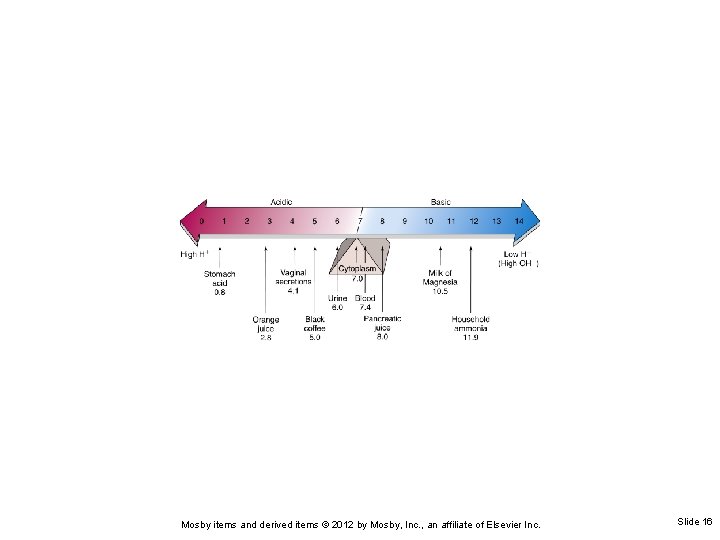
INORGANIC CHEMISTRY (cont. ) Acids, bases, and salts (cont. ) Ø p. H—mathematical expression of relative H+ concentration in an aqueous solution (Figure 2 -7) • p. H 7 is neutral (neither acid nor base) • p. H values above 7 are basic; p. H values below 7 are acidic Neutralization—acids and bases mix to form salts Ø Buffers—chemical systems that absorb excess acids or bases and thus maintain a relatively stable p. H Ø Mosby items and derived items © 2012 by Mosby, Inc. , an affiliate of Elsevier Inc. Slide 15
Mosby items and derived items © 2012 by Mosby, Inc. , an affiliate of Elsevier Inc. Slide 16
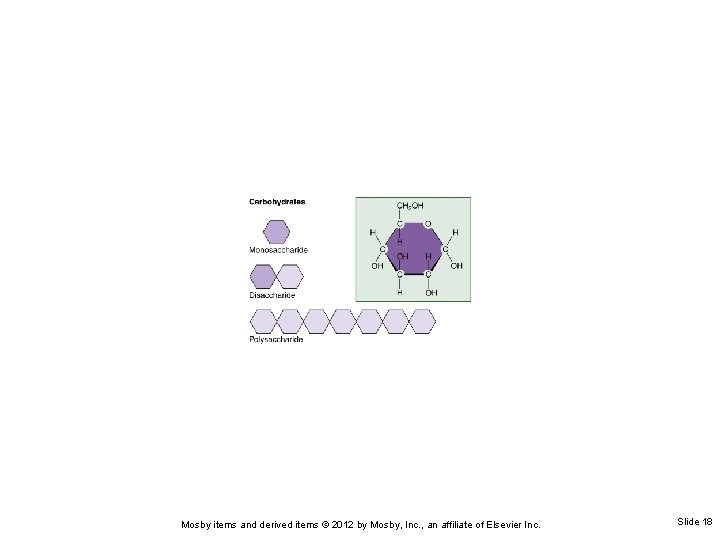
ORGANIC CHEMISTRY Carbohydrates—sugars and complex carbohydrates (Figure 2 -8) Ø Ø Ø Contain carbon (C), hydrogen (H), oxygen (O) Made up of six-carbon subunits called monosaccharides or single sugars (e. g. , glucose) Disaccharide—double sugar made up of two monosaccharide units (e. g. , sucrose, lactose) Polysaccharide—complex carbohydrate made up of many monosaccharide units (e. g. , glycogen made up of many glucose units) Function of carbohydrates is to store energy for later use Mosby items and derived items © 2012 by Mosby, Inc. , an affiliate of Elsevier Inc. Slide 17
Mosby items and derived items © 2012 by Mosby, Inc. , an affiliate of Elsevier Inc. Slide 18
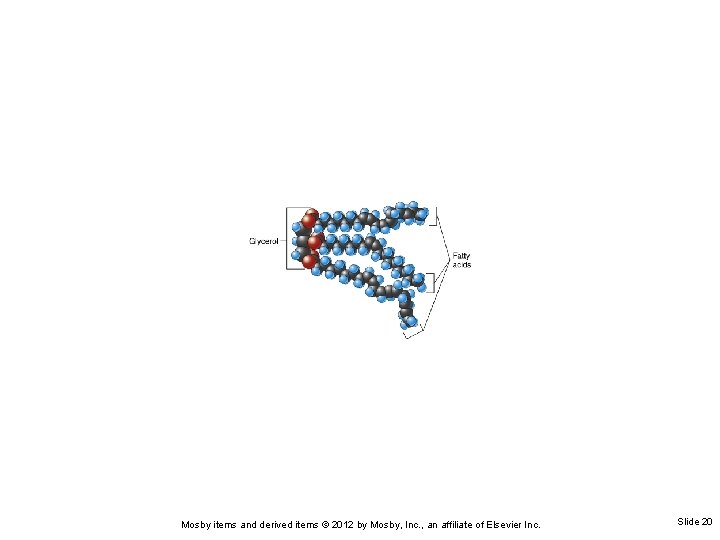
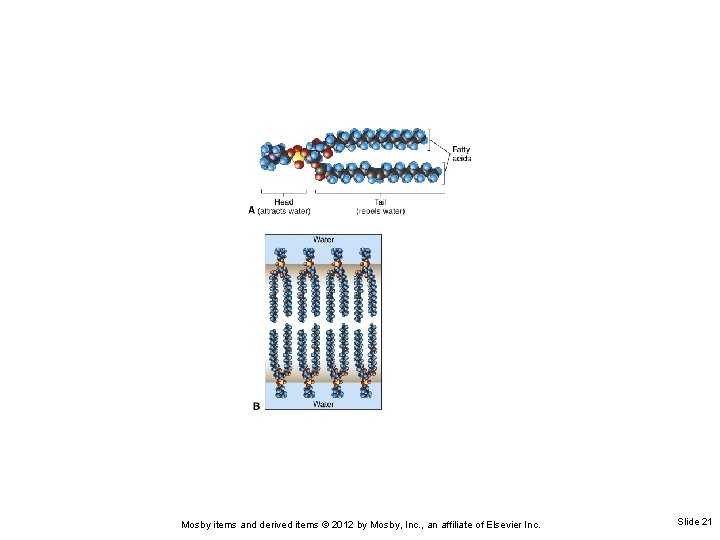
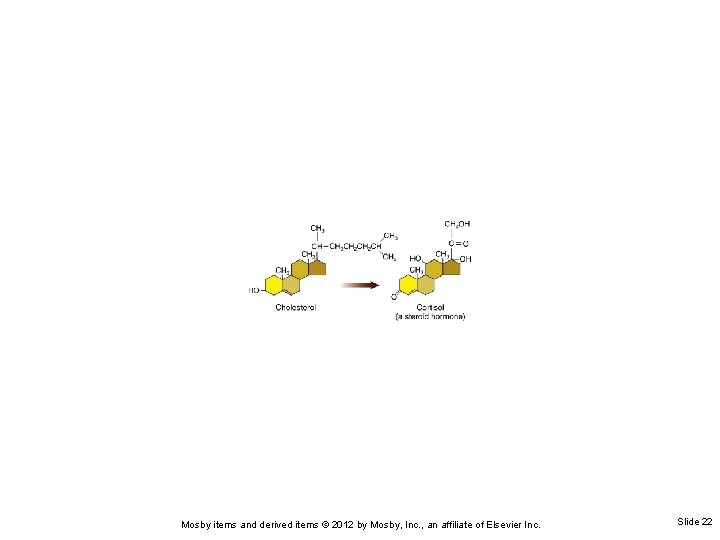
ORGANIC CHEMISTRY (cont. ) Lipids—fats and oils Ø Triglycerides (Figure 2 -9) • Made up of one glycerol unit and three fatty acids • Store energy for later use Ø Phospholipids (Figure 2 -10) • Similar to triglyceride structure, except with only two fatty acids, and with a phosphorus-containing group attached to glycerol • The head attracts water and the double tail does not, thus forming stable double layers (bilayers) in water • Form membranes of cells Ø Cholesterol (Figure 2 -11) • Molecules have a steroid structure made up of multiple rings • Cholesterol stabilizes the phospholipid tails in cellular membranes • Cholesterol is converted into steroid hormones by the body Mosby items and derived items © 2012 by Mosby, Inc. , an affiliate of Elsevier Inc. Slide 19
Mosby items and derived items © 2012 by Mosby, Inc. , an affiliate of Elsevier Inc. Slide 20
Mosby items and derived items © 2012 by Mosby, Inc. , an affiliate of Elsevier Inc. Slide 21
Mosby items and derived items © 2012 by Mosby, Inc. , an affiliate of Elsevier Inc. Slide 22
ORGANIC CHEMISTRY (cont. ) Proteins Very large molecules made up of amino acids held together in long, folded chains by peptide bonds (Figure 2 -12) Ø Structural proteins Ø • Form various structures of the body • Collagen—a fibrous protein that holds many tissues together • Keratin—forms tough, waterproof fibers in the outer layer of the skin Mosby items and derived items © 2012 by Mosby, Inc. , an affiliate of Elsevier Inc. Slide 23
Mosby items and derived items © 2012 by Mosby, Inc. , an affiliate of Elsevier Inc. Slide 24
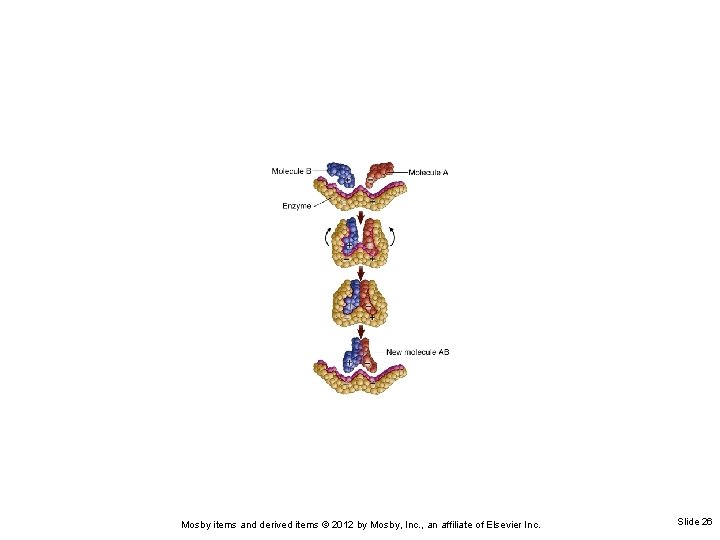
ORGANIC CHEMISTRY (cont. ) Proteins (cont. ) Ø Functional proteins • Participate in chemical processes of the body • Examples: hormones, cell membrane channels and receptors, enzymes • Enzymes (Figure 2 -12) Catalysts—help chemical reactions occur Lock-and-key model—each enzyme fits a particular molecule like a key fits into a lock Ø Proteins can combine with other organic molecules to form glycoproteins or lipoproteins Mosby items and derived items © 2012 by Mosby, Inc. , an affiliate of Elsevier Inc. Slide 25
Mosby items and derived items © 2012 by Mosby, Inc. , an affiliate of Elsevier Inc. Slide 26
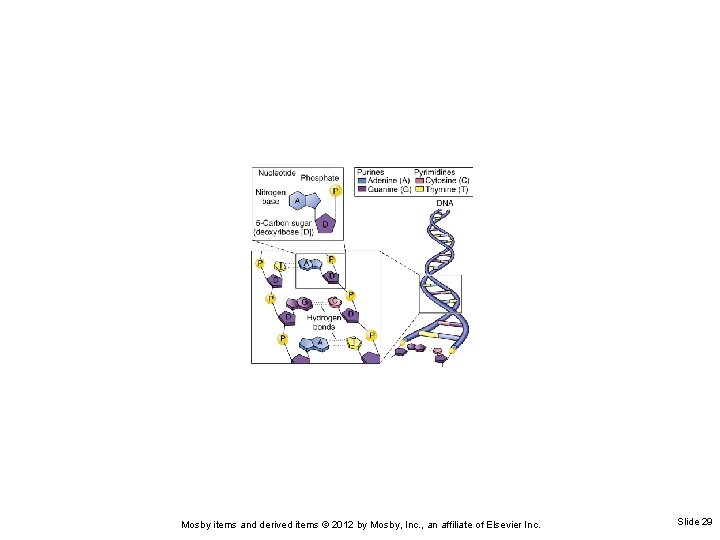
ORGANIC CHEMISTRY (cont. ) Nucleic acids Ø Made up of nucleotide units: • • • Sugar (ribose or deoxyribose) Phosphate Nitrogen base (adenine, thymine or uracil, guanine, cytosine) Mosby items and derived items © 2012 by Mosby, Inc. , an affiliate of Elsevier Inc. Slide 27
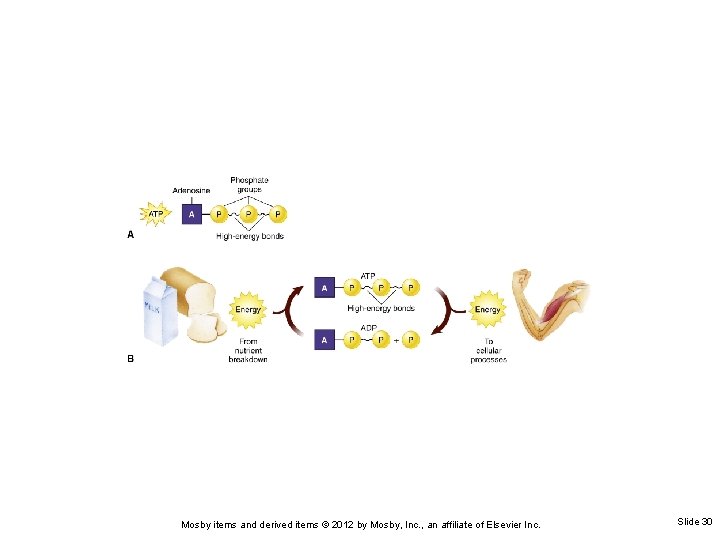
ORGANIC CHEMISTRY (cont. ) Nucleic acids (cont. ) Ø DNA (deoxyribonucleic acid) (Figure 2 -14) • Used as the cell’s “master code” for assembling proteins • Uses deoxyribose as the sugar and A, T (not U), C, and G as bases • Forms a double helix shape Ø RNA (ribonucleic acid) • Used as a temporary “working copy” of a gene (portion of the DNA code) • Uses ribose as the sugar and A, U (not T), C, and G as bases By directing the formation of structural and functional proteins, nucleic acids ultimately direct overall body structure and function Ø ATP (adenosine triphosphate)—a modified nucleotide used to transfer energy from nutrients to cellular processes, thus acting as an energy-transfer “battery” (Figure 2 -15) Ø Mosby items and derived items © 2012 by Mosby, Inc. , an affiliate of Elsevier Inc. Slide 28
Mosby items and derived items © 2012 by Mosby, Inc. , an affiliate of Elsevier Inc. Slide 29
Mosby items and derived items © 2012 by Mosby, Inc. , an affiliate of Elsevier Inc. Slide 30
- Slides: 30