
Chapter 2 Chemistry of Life 2 1 Matter
- Slides: 12
Chapter 2 Chemistry of Life 2. 1 Matter and Organic Compounds Learning Objectives for section 2. 1 (part one): a. Matter b. Atoms c. Elements d. Compounds e. Bonding f. Chemical reactions
In Chapter 1 we learned that to be considered a living thing an object must show all of the six characteristics of life. One of those characteristics states that all living things are made up of cells. If that is true, if we learn what cells are made of then we can learn what all organisms are made of. MATTER I don’t expect many of you appreciate that in previous years I taught you that all things are made up of Matter and matter is anything that has mass and takes up space.
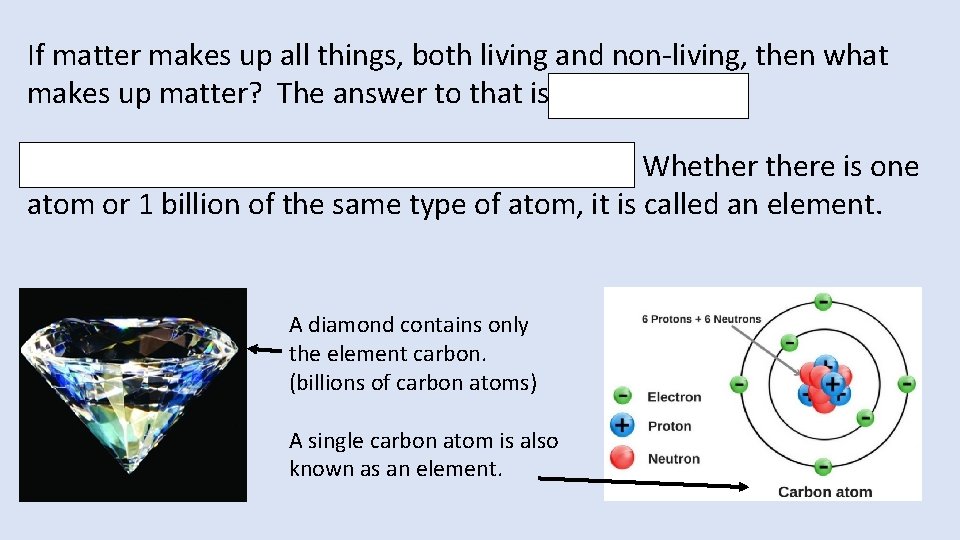
If matter makes up all things, both living and non-living, then what makes up matter? The answer to that is ATOMS. Atoms are the smallest particle of an element. Whethere is one atom or 1 billion of the same type of atom, it is called an element. A diamond contains only the element carbon. (billions of carbon atoms) A single carbon atom is also known as an element.
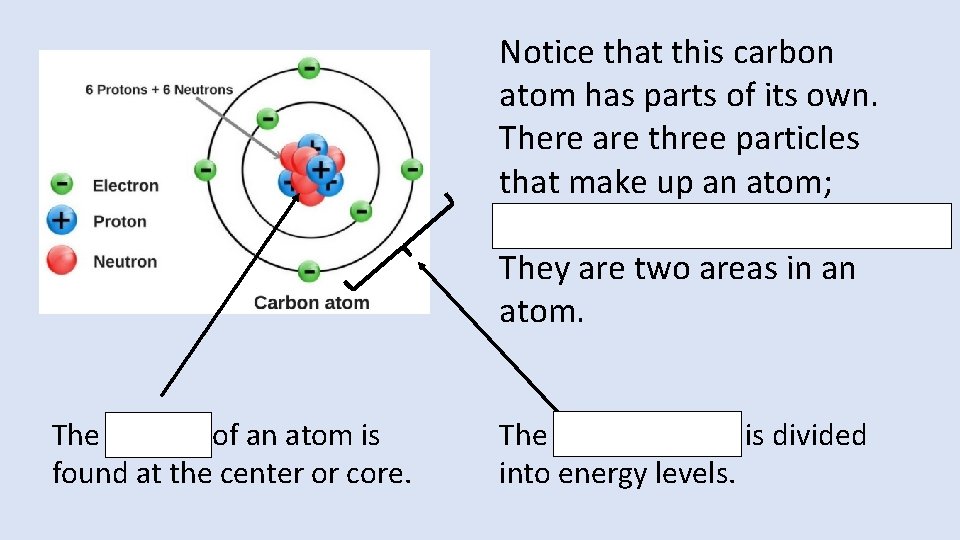
Notice that this carbon atom has parts of its own. There are three particles that make up an atom; proton, neutron, electron. They are two areas in an atom. The nucleus of an atom is found at the center or core. The electron cloud is divided into energy levels.
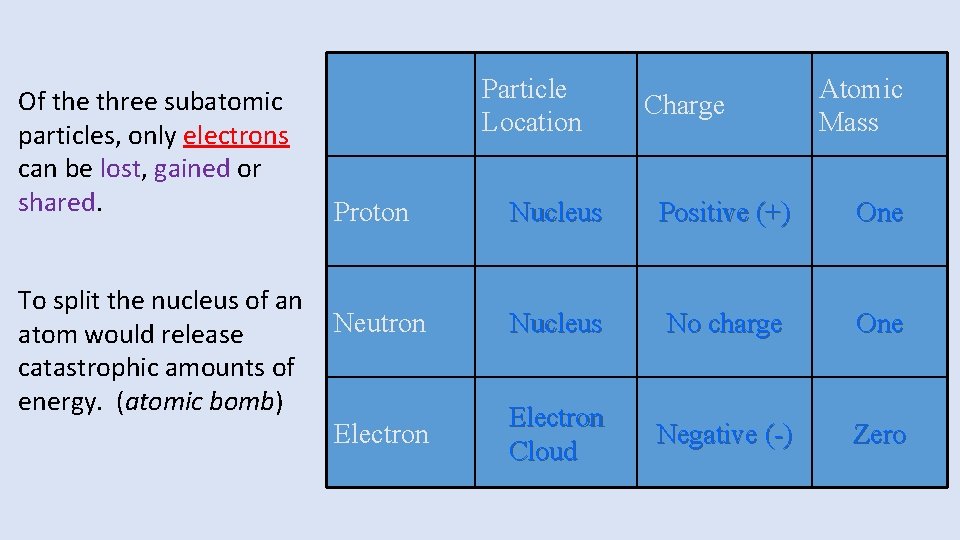
Of the three subatomic particles, only electrons can be lost, gained or shared. To split the nucleus of an atom would release catastrophic amounts of energy. (atomic bomb) Particle Location Charge Atomic Mass Proton Nucleus Positive (+) One Neutron Nucleus No charge One Electron Cloud Negative (-) Zero
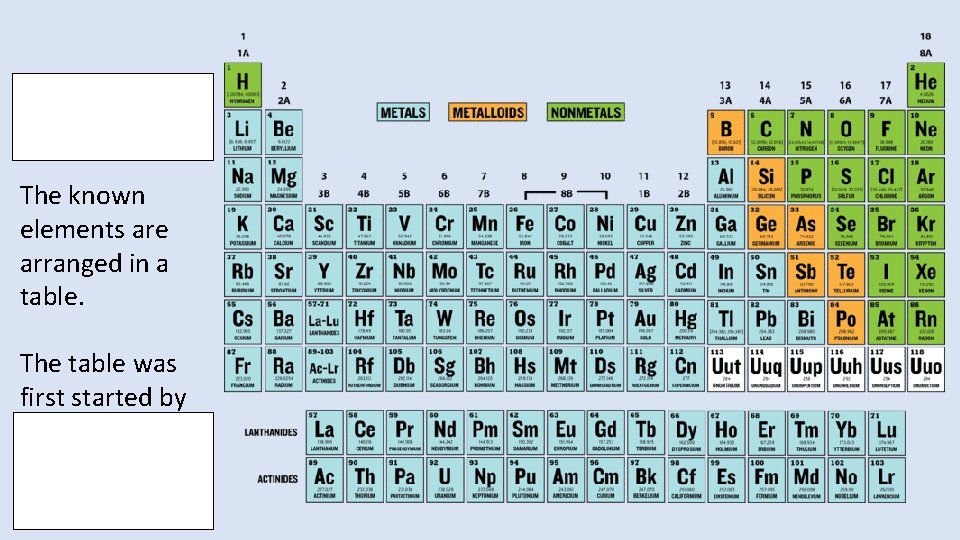
Periodic Table of Elements The known elements are arranged in a table. The table was first started by Dimitri Mendeleev in 1869.
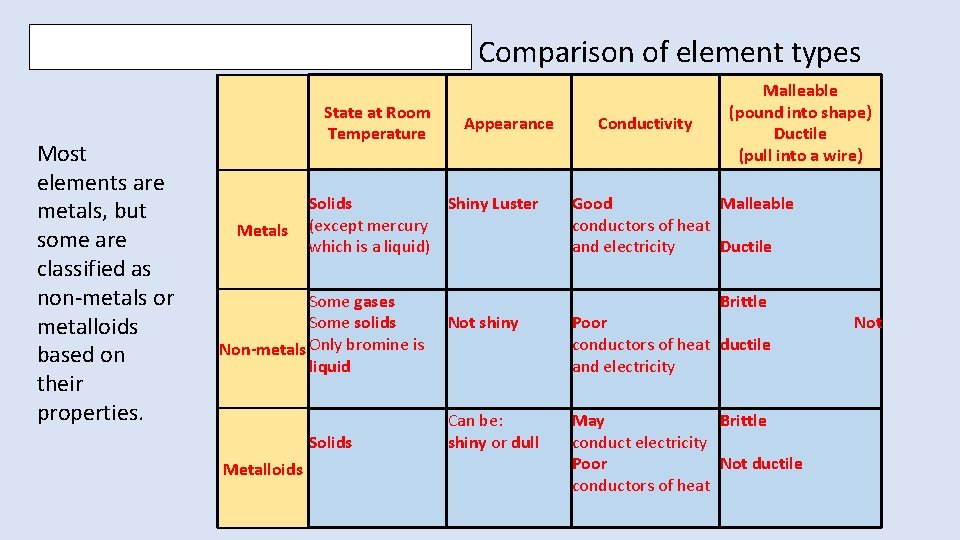
Periodic Table of Elements Most elements are metals, but some are classified as non-metals or metalloids based on their properties. State at Room Temperature Metals Appearance Solids Shiny Luster (except mercury which is a liquid) Some gases Some solids Non-metals Only bromine is liquid Solids Metalloids Comparison of element types Conductivity Malleable (pound into shape) Ductile (pull into a wire) Good Malleable conductors of heat and electricity Ductile Brittle Not shiny Poor conductors of heat ductile and electricity Can be: shiny or dull May Brittle conduct electricity Poor Not ductile conductors of heat Not
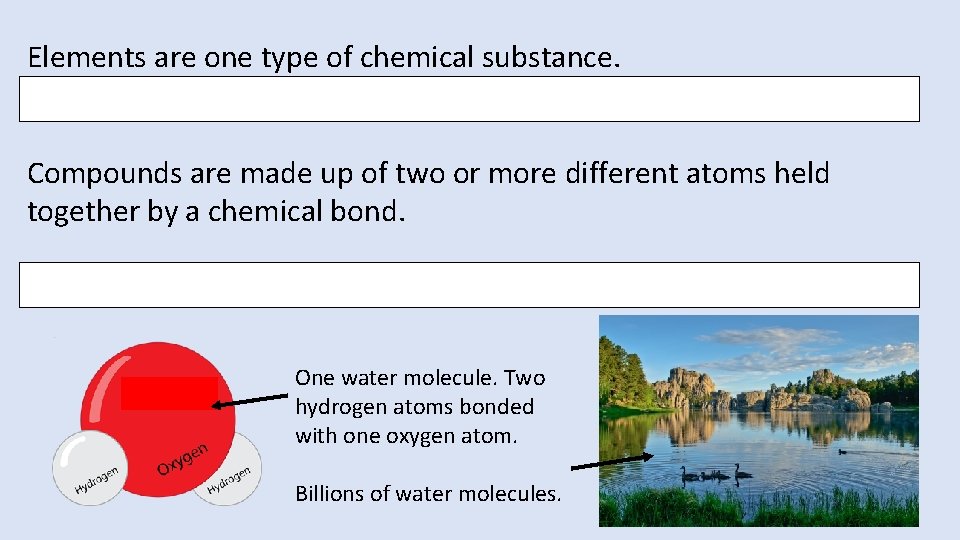
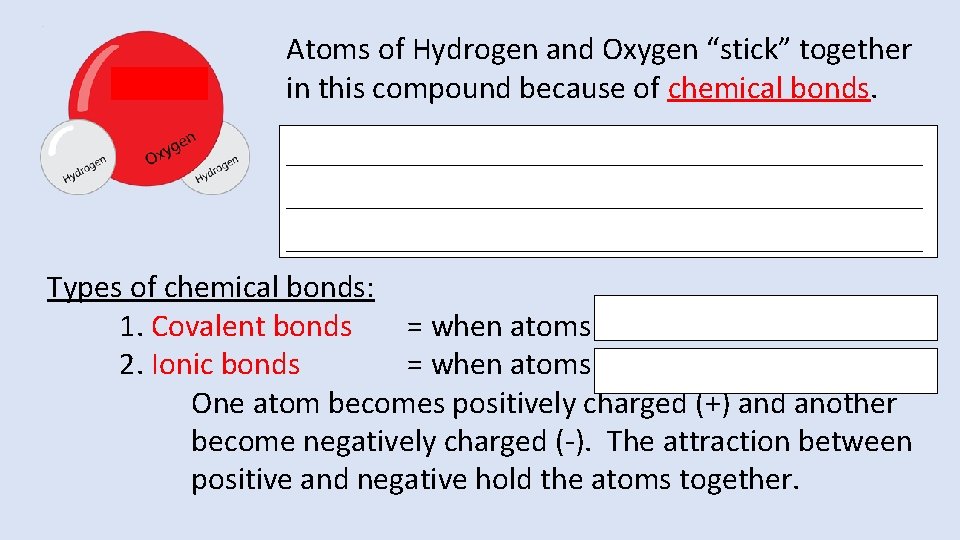
Elements are one type of chemical substance. Another type of chemical substance is a compound. Compounds are made up of two or more different atoms held together by a chemical bond. The smallest particle of a compound is called a molecule. One water molecule. Two hydrogen atoms bonded with one oxygen atom. Billions of water molecules.
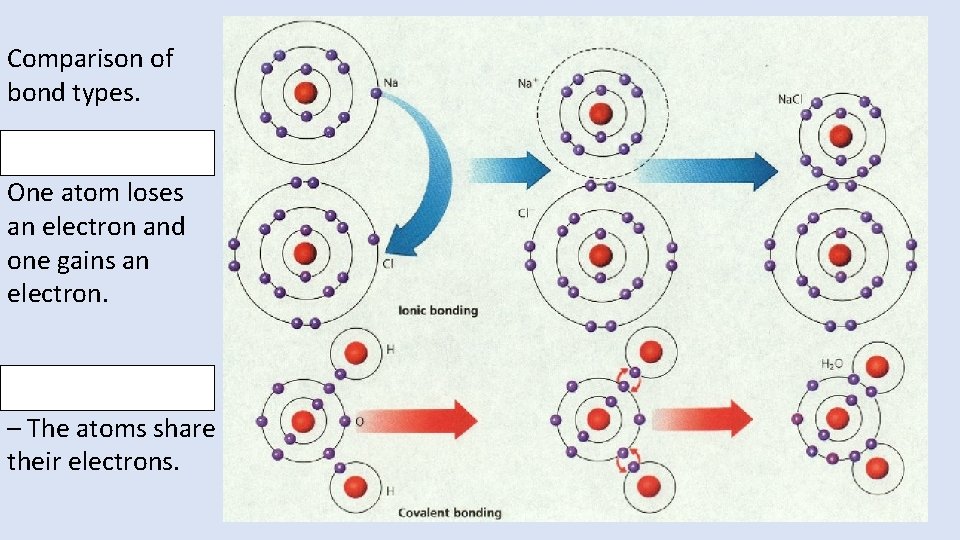
Atoms of Hydrogen and Oxygen “stick” together in this compound because of chemical bonds. A chemical bond is a force that holds molecules ____________________________________ together. These bonds form when chemical ____________________________________ substances react with one another. ____________________________________ Types of chemical bonds: 1. Covalent bonds = when atoms share electrons. 2. Ionic bonds = when atoms lose or gain electrons. One atom becomes positively charged (+) and another become negatively charged (-). The attraction between positive and negative hold the atoms together.
Comparison of bond types. Ionic bonding One atom loses an electron and one gains an electron. Covalent bonding – The atoms share their electrons.
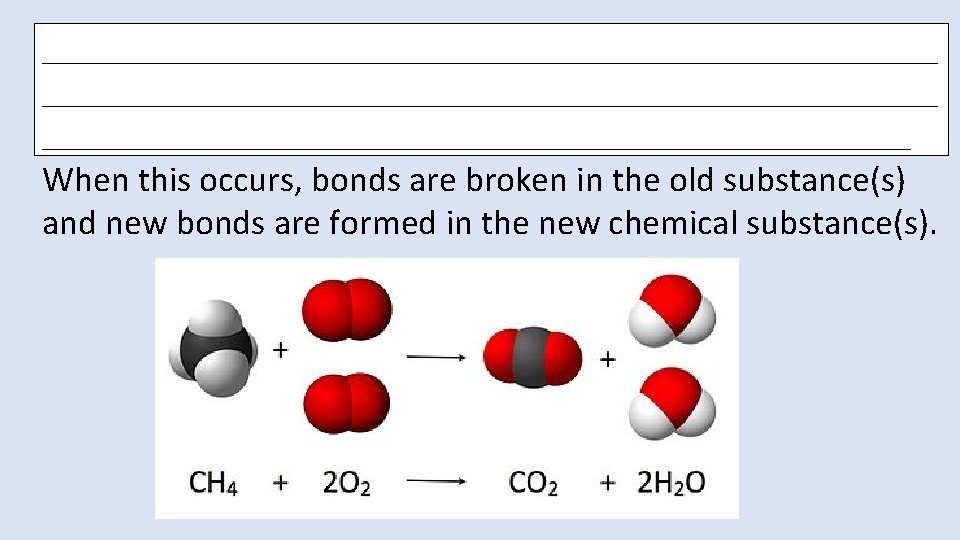
A chemical reaction is a process that changes some chemical __________________________________________________ substances into other chemical substances. __________________________________________________ When this occurs, bonds are broken in the old substance(s) and new bonds are formed in the new chemical substance(s).
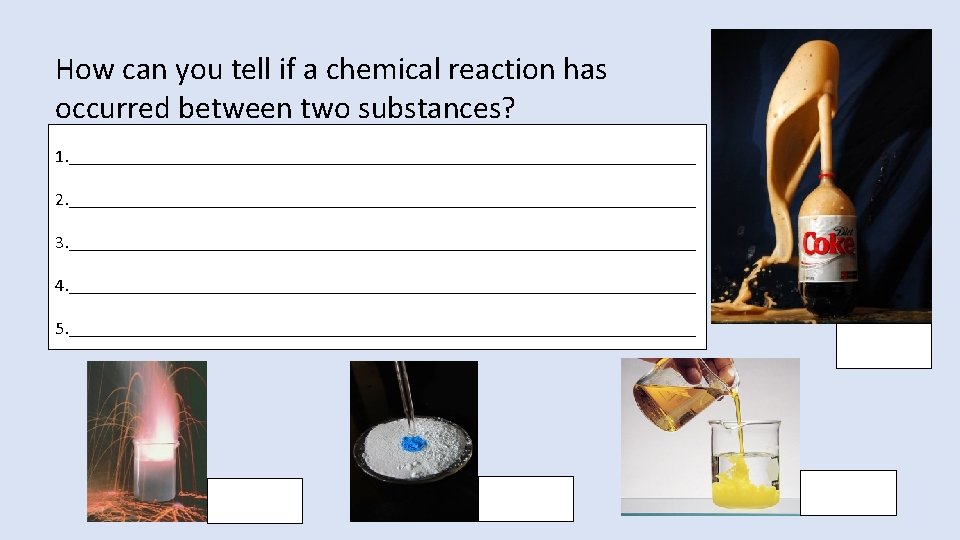
How can you tell if a chemical reaction has occurred between two substances? 1. ___________________________________ 1. Color change of a substance or substances. 2. ___________________________________ 2. Change in temperature, light, or sound. 3. ___________________________________ 3. Detection of an odor. 4. Formation of a gas (bubbles present). 4. ___________________________________ 5. Formation of a precipitate (a solid). 5. ___________________________________