
Chapter 2 Cells Section 1 Cell Structure Cell
- Slides: 19
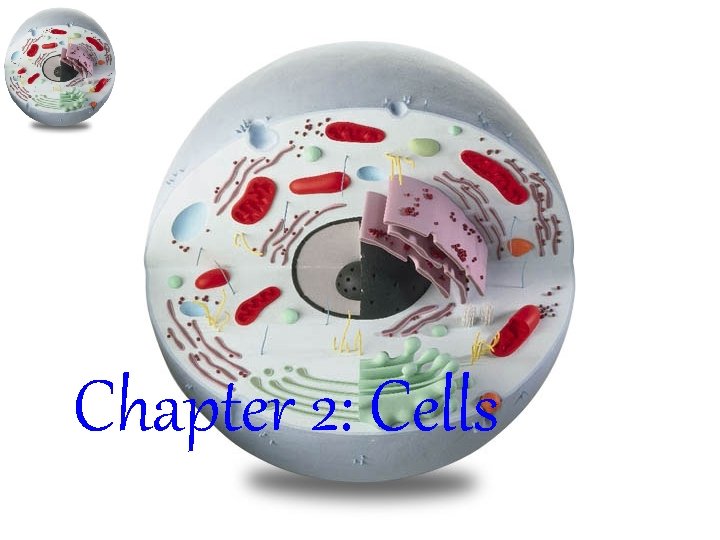
Chapter 2: Cells
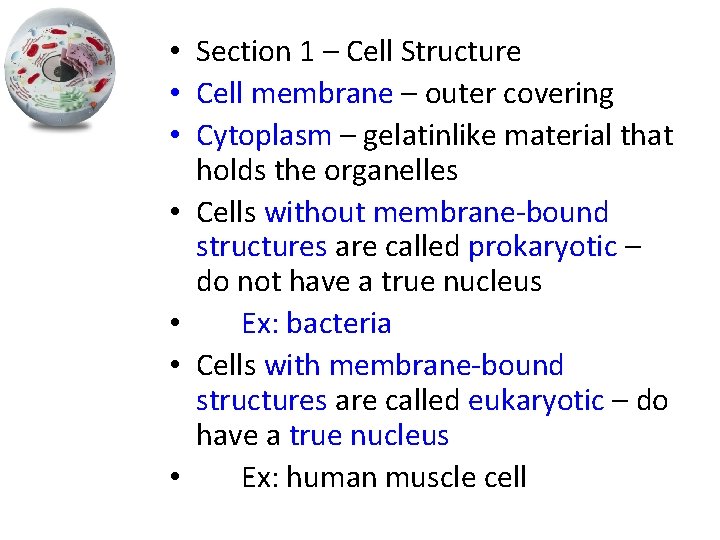
• Section 1 – Cell Structure • Cell membrane – outer covering • Cytoplasm – gelatinlike material that holds the organelles • Cells without membrane-bound structures are called prokaryotic – do not have a true nucleus • Ex: bacteria • Cells with membrane-bound structures are called eukaryotic – do have a true nucleus • Ex: human muscle cell
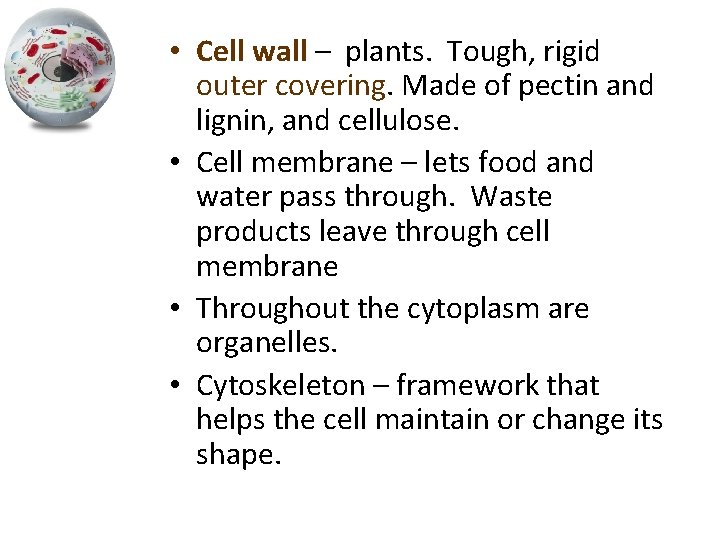
• Cell wall – plants. Tough, rigid outer covering. Made of pectin and lignin, and cellulose. • Cell membrane – lets food and water pass through. Waste products leave through cell membrane • Throughout the cytoplasm are organelles. • Cytoskeleton – framework that helps the cell maintain or change its shape.
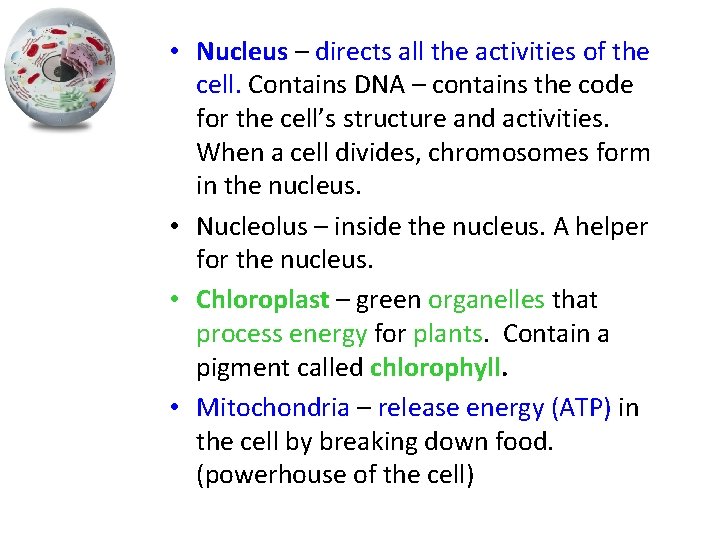
• Nucleus – directs all the activities of the cell. Contains DNA – contains the code for the cell’s structure and activities. When a cell divides, chromosomes form in the nucleus. • Nucleolus – inside the nucleus. A helper for the nucleus. • Chloroplast – green organelles that process energy for plants. Contain a pigment called chlorophyll. • Mitochondria – release energy (ATP) in the cell by breaking down food. (powerhouse of the cell)
• Ribosomes – make proteins. Sometimes they float freely in the cytoplasm, and sometimes they are attached to the endoplasmic reticulum. • Endoplasmic reticulum – series of folded membranes where materials can be processed and moved around inside the cell. -smooth – does not have ribosomes - rough – does have ribosomes • Golgi bodies – stacked, flattened membranes that sort and package proteins and other substances into vesicles.
• Vesicles – deliver substances to areas inside the cell. • Vacuole – temporary storage area for materials of the cell – water, food, waste products. • the vacuole in a plant cell is much larger than one in an animal cell. • Lysosome – recycles substances. Breaks down worn-out cells. (suicide sacks)
Organization of CELLS smallest to largest • Cell- basic unit of life • Tissue – group of similar cells working together to do a job. • Organ – made of two or more different types of tissues working together. • Organ system – group of organ (veins, arteries, heart, capillaries – cardiovascular system) • Organism (Multicellular)
• Antonie Von Leeuwenhoek – made the first simple microscope • Microscopes make images larger. • The total magnification is determined by multiplying the power of the eyepiece lens by the power of the objective lens. – Ex: eyepiece = 10 X Objective = 40 X Total magnification = 10 x 40 = 400 X
• Things that are too small to be seen with other microscopes can be viewed on an electron microscope. • The Cell Theory states that: – All organisms are made up of one or more cells – The cell is the basic unit of organization in organisms – All cells come from cells
• Robert Hooke – looked at cork under a microscope and named the boxes he saw cells. • Matthias Schleiden –concluded that all plants are made of cells • Theodor Schwann – concluded all animals are made of cells • Rudolf Virchow – hypothesized that cells divide to form new cells
• Section 3 • Virus – strand of hereditary material surrounded by a protein coating. • does not have a nucleus • does not have a cell membrane • A virus must have a host cell – a living cell that a virus lives inside. • Active – causes the host cell to make new viruses. Immediately destroys the cell • Latent – Does not immediately make new viruses or destroy the host cell. • Ex: cold sores
• How do viruses affect organisms? • Some viruses affect more than one kind of organism Ex: rabies • Some viruses infect bacteria – bacteriophages • Bacterium – one bacteria • Fighting Viruses – First Vaccine • smallpox
• Treating Viruses – antibiotics will not work on viruses • Your body will naturally respond to viruses with interferons • Antiviral drugs • Vaccines – injected with either a living or a dead virus (small amount) so your body will build immunity to the virus • Gene therapy – good DNA is put into a virus and sent into a person’s cells. • P. 52 & 53 - Draw
Cell Organelle Review • Packaging & distribution center of the cell. Golgi Body ( flattened membranes) • In the cell, proteins are made on the Ribosomes • In plants, a large membrane bound space where water, nutrients, and waste can be stored – Vacuole • Temporary storage in cells - Vacuole • Usually the largest organelle – Nucleus (control center- directs all activities of the cell)
Materials enter and leave the nucleus through the nuclear membrane Nucleus – will identify a cell as a Eukaryote In eukaryote cells, the nucleus is where chromosomes are found Most of the cell’s ATP (energy) is produced by – Mitochondria Lysosome- contain digestive enzymes (chemicals) Smallest units of life are - Cells Cell membrane – regulates what enters & leaves the cell Cell membrane – protective layer around ALL cells
• Organelle – structure in cytoplasm of eukaryote cells that perform specific functions. • Eukaryote cells – membrane bound organelles – have a nucleus • Prokaryote cells – NO membrane bound structures – NO nucleus
Can magnify images up to a million times – Electron Microscope Three dimensional view of an object – scanning electron microscope Gelatin-like substance inside the cell Cytoplasm
• Plant Vs Animal Cell • Plants: – Chloroplast ( photosynthesis occurs) – Cell Wall (support & protection) – Large central vacuole – No centrioles – Vascular plants have long hollow tubes that transport food and water through out the cell.
Animal Cell • Be able to Identify organelles from an animal cell – Centrioles – Mitochondria – Nucleus – Cell membrane – Endoplasmic reticulum – Golgi Body