
CHAPTER 2 CELLS AND THE MICROSCOPE The main
- Slides: 11
CHAPTER 2 CELLS AND THE MICROSCOPE • The main parts in plant and animal cells are: – The cell membrane which controls what passes in or out of the cell – The nucleus which controls the cell – Cytoplasm which carries out many cell reactions. © Edco 2007 Exploring Science Biology
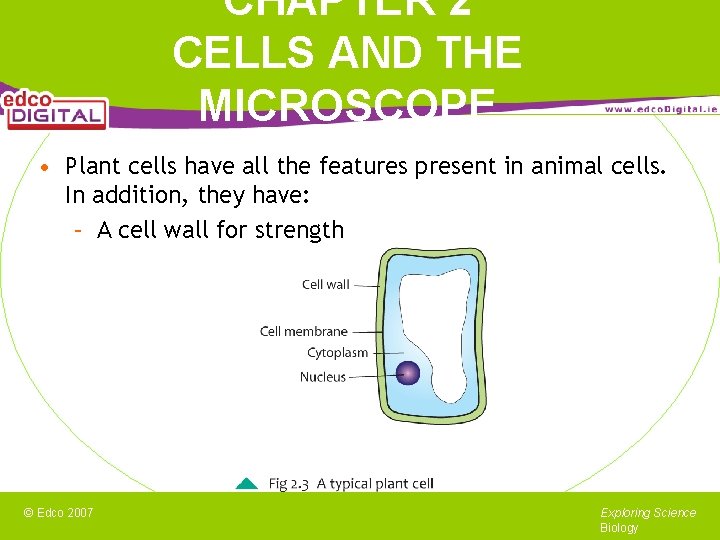
CHAPTER 2 CELLS AND THE MICROSCOPE • Plant cells have all the features present in animal cells. In addition, they have: – A cell wall for strength © Edco 2007 Exploring Science Biology
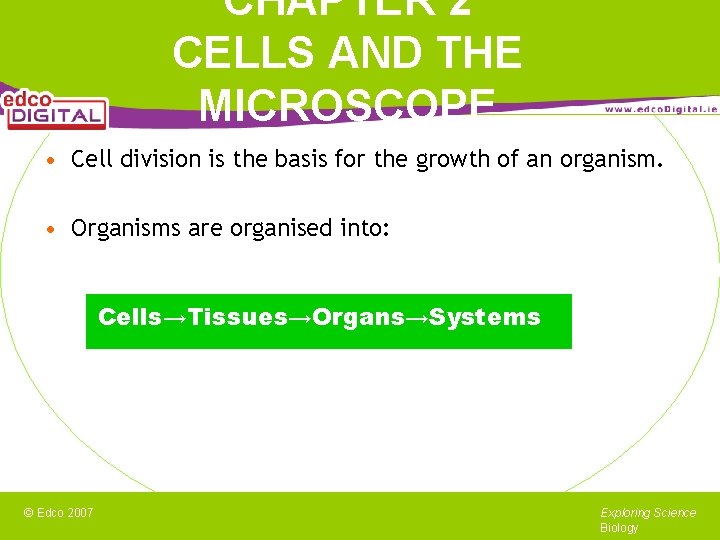
CHAPTER 2 CELLS AND THE MICROSCOPE • Cell division is the basis for the growth of an organism. • Organisms are organised into: Cells→Tissues→Organs→Systems © Edco 2007 Exploring Science Biology
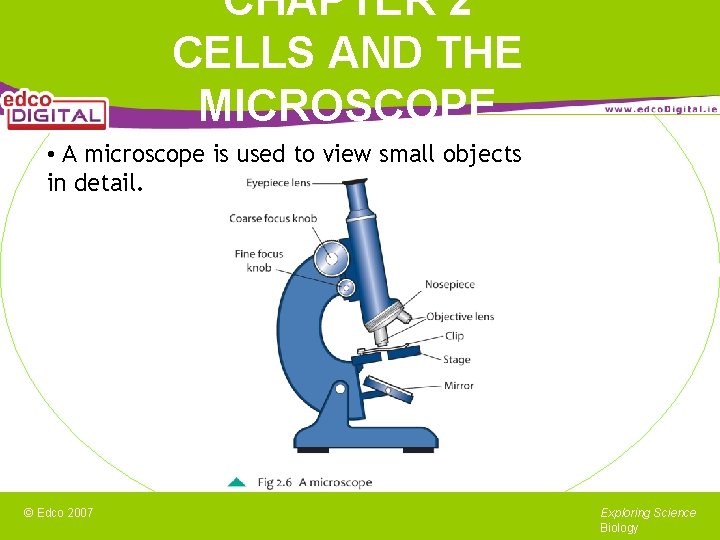
CHAPTER 2 CELLS AND THE MICROSCOPE • A microscope is used to view small objects in detail. © Edco 2007 Exploring Science Biology
CHAPTER 2 CELLS AND THE MICROSCOPE • The parts of a microscope and their functions are as follows: – Eyepiece: this lens enlarges the image of the object. – Focus knobs: these allow a clear sharp image to be seen. – Nosepiece: this can rotate so that different lenses can be used. © Edco 2007 Exploring Science Biology
CHAPTER 2 CELLS AND THE MICROSCOPE – Objective lens: this lens on the nosepiece enlarges the image of the object. – Stage: the slide is placed on the stage for viewing. – Mirror: this is used to shine a light source through the slide. © Edco 2007 Exploring Science Biology
CHAPTER 2 CELLS AND THE MICROSCOPE • The total magnification is calculated by multiplying the power of the eyepiece by the power of the objective lens being used. © Edco 2007 Exploring Science Biology
CHAPTER 2 CELLS AND THE MICROSCOPE • To examine animal or plant cells under a microscope: – Make sure there is light passing through the opening in the stage. – Use the lowest power lens on the nosepiece. – Clip the slide onto the stage. – Turn the coarse focus knob to bring the stage close to the slide. © Edco 2007 Exploring Science Biology
CHAPTER 2 CELLS AND THE MICROSCOPE – Turn the coarse focus knob to bring the lens away from the slide. – Move the slide so that the cells of interest are in the centre. – Adjust the amount of light passing through the slide. – Change the objective lens to a higher power and refocus using the fine focus knob. – Draw labelled diagrams of the cells at each magnification. © Edco 2007 Exploring Science Biology
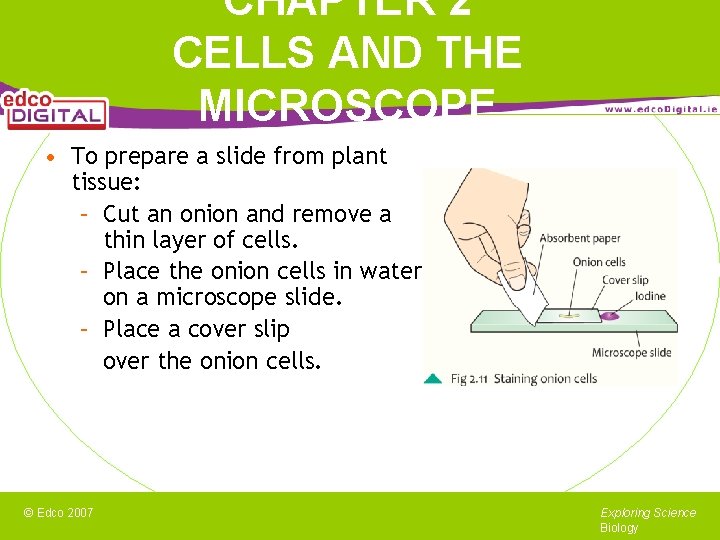
CHAPTER 2 CELLS AND THE MICROSCOPE • To prepare a slide from plant tissue: – Cut an onion and remove a thin layer of cells. – Place the onion cells in water on a microscope slide. – Place a cover slip over the onion cells. © Edco 2007 Exploring Science Biology
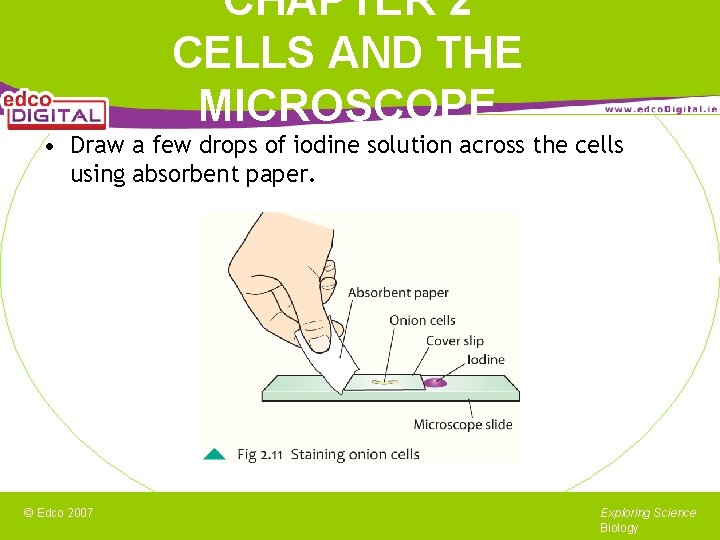
CHAPTER 2 CELLS AND THE MICROSCOPE • Draw a few drops of iodine solution across the cells using absorbent paper. © Edco 2007 Exploring Science Biology