
Chapter 2 Carbohydrates 1 Monosaccharides 2 Disaccharides 3
Chapter 2 Carbohydrates 1 - Monosaccharides 2 - Disaccharides 3 - Polysaccharides 4 - Digestion of carbohydrates
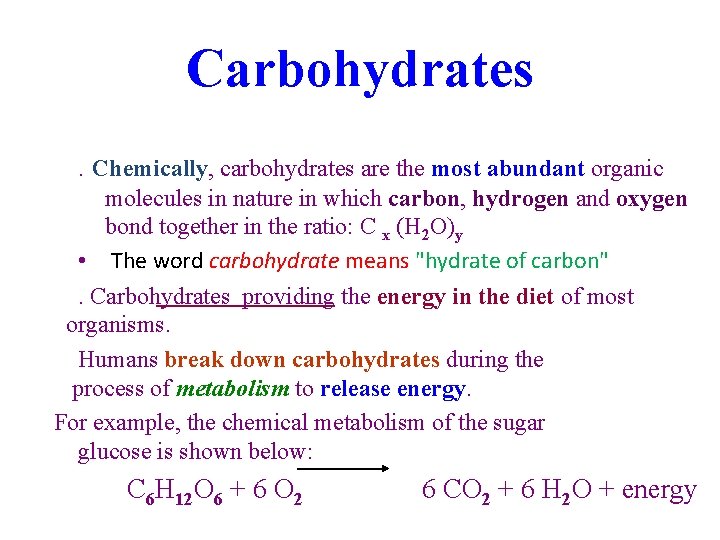
Carbohydrates. Chemically, carbohydrates are the most abundant organic molecules in nature in which carbon, hydrogen and oxygen bond together in the ratio: C x (H 2 O)y • The word carbohydrate means "hydrate of carbon" . Carbohydrates providing the energy in the diet of most organisms. Humans break down carbohydrates during the process of metabolism to release energy. For example, the chemical metabolism of the sugar glucose is shown below: C 6 H 12 O 6 + 6 O 2 6 CO 2 + 6 H 2 O + energy
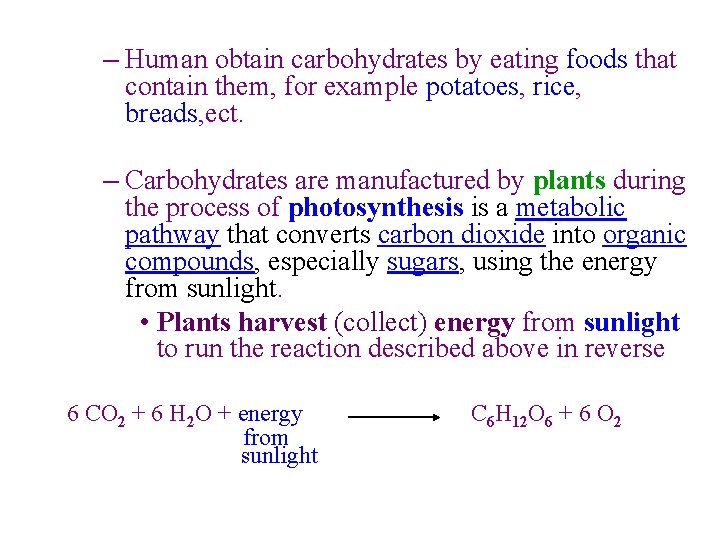
– Human obtain carbohydrates by eating foods that contain them, for example potatoes, rice, breads, ect. – Carbohydrates are manufactured by plants during the process of photosynthesis is a metabolic pathway that converts carbon dioxide into organic compounds, especially sugars, using the energy from sunlight. • Plants harvest (collect) energy from sunlight to run the reaction described above in reverse 6 CO 2 + 6 H 2 O + energy C 6 H 12 O 6 + 6 O 2 from sunlight
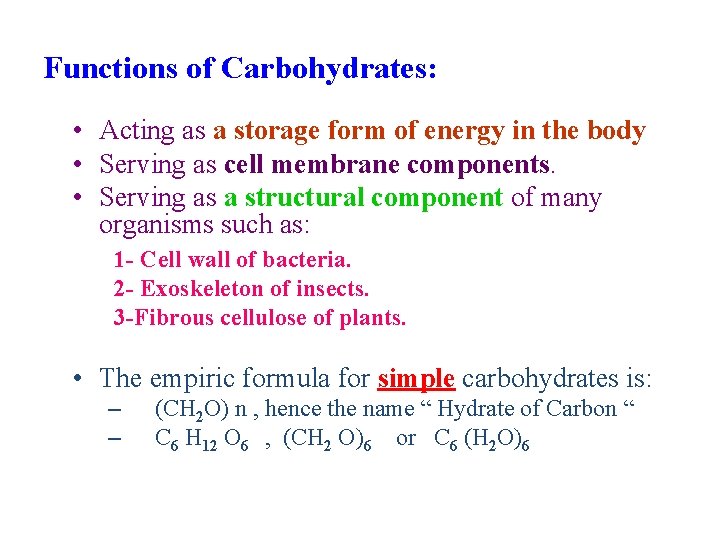
Functions of Carbohydrates: • Acting as a storage form of energy in the body • Serving as cell membrane components. • Serving as a structural component of many organisms such as: 1 - Cell wall of bacteria. 2 - Exoskeleton of insects. 3 -Fibrous cellulose of plants. • The empiric formula for simple carbohydrates is: – (CH 2 O) n , hence the name “ Hydrate of Carbon “ – C 6 H 12 O 6 , (CH 2 O)6 or C 6 (H 2 O)6
Classification and structure of Carbohydrates • There are four classes of Carbohydrates, Based on the number of sugar units: – Monosaccharides – Disaccharides. – Oligosaccharides. – Polysaccharides:
● most carbohydrates are polyhydroxyaldehydes, polyhydroxyketones, or compounds that yield them after hydrolysis. ●The simpler members of the carbohydrate family are often referred to as saccharides. ● Carbohydrates are classified as monosaccharides, disaccharides, oligosaccharides, or polysaccharides depending on the number of simple sugars they contain.
• Monosaccharides (simple sugars) cannot be broken down into simpler sugars under mild conditions • Oligosaccharides = "a few" - usually 2 to 10 • Polysaccharides are polymers of the simple sugars
Monosaccharides: (simple sugar) Definition: – Monosaccharides are colorless crystalline solids – Freely soluble in water – Insoluble in non polar solvents – It is the basic units of Carbohydrates – Most have a sweet taste.
– Also many of Monosaccaharides are synthesized from simpler (non carbohydrate) substances in a process named gluconeogenesis (is a metabolic pathway that results in the generation of glucose from non carbohydrate carbon substrates such as lactate, glycerol, and glucogenic amino acids). – Monosaccaharides are aldehyde or ketone derivatives of straight - chain polyhydroxy alcohols.

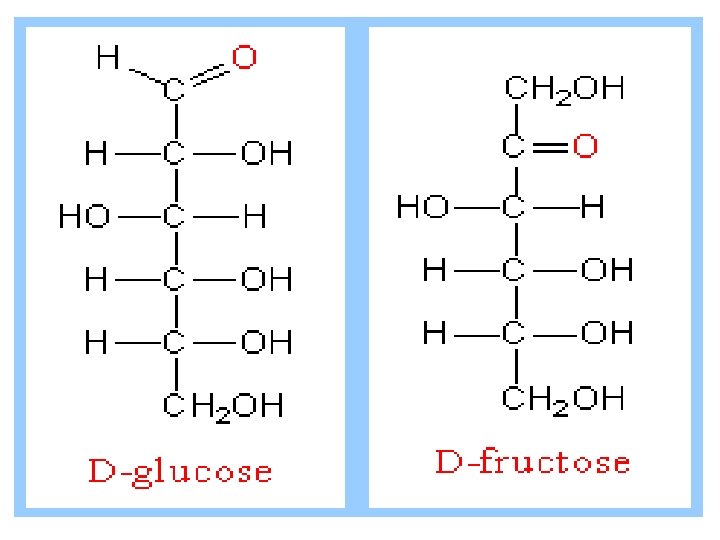
Classification of monosacharides: 1) Monosaccharides are classified according to the chemical nature of their carbonyl group, which (is the carbon atom that is doubled bounded to an oxygen atom to form a carbonyl group ) while each of other carbon atoms has a hydroxyl group : – If the carbonyl group is an aldehyde the sugar is an aldose as in glyceraldehyde and glucose. – If the carbonyl group is a ketone the sugar is an ketose as in Dihydroxyacetone and fructose

●Mono saccharides containing an aldehyde group are classified as aldoses; those containing a ketone group are classified as ketoses. The suffix –ose indicates that a molecule is a carbohydrate, and the prefixes tri , tetr , and so forth indicate the number of carbon atoms in the chain.
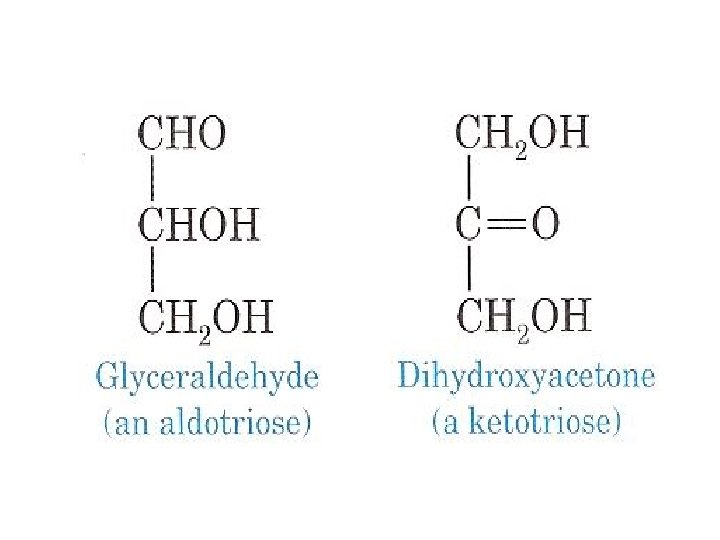
●There are only two trioses: the aldotriose glyceraldehyde the ketotriose dihydroxyacetone.

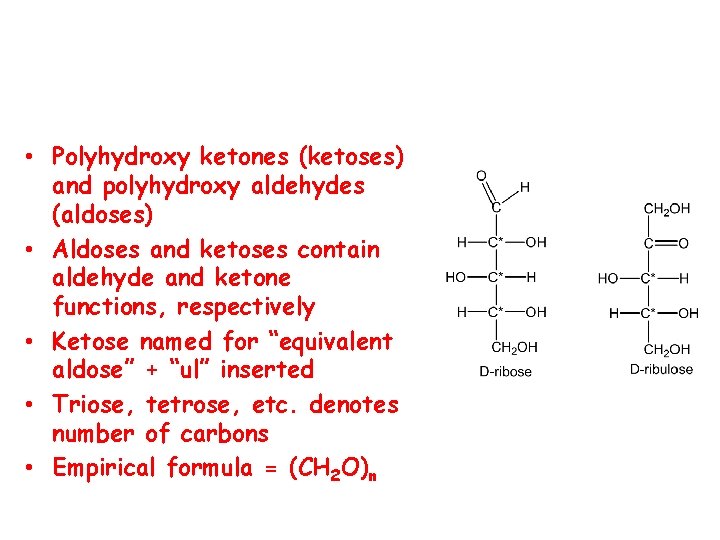
• Polyhydroxy ketones (ketoses) and polyhydroxy aldehydes (aldoses) • Aldoses and ketoses contain aldehyde and ketone functions, respectively • Ketose named for “equivalent aldose” + “ul” inserted • Triose, tetrose, etc. denotes number of carbons • Empirical formula = (CH 2 O)n

2. Monosaccharides can be classified according to the number of carbon atoms they contain: – The smallest monosaccharide, those with three carbon atoms are trioses – Those with 4, 5, 6 and 7 carbon atoms are called tetroses, pentoses, hexoses, and heptoses respectively.
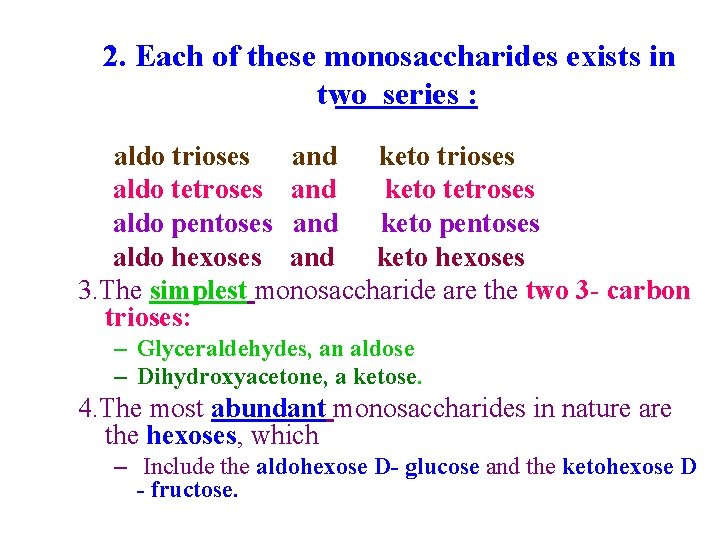
2. Each of these monosaccharides exists in two series : aldo trioses and keto trioses aldo tetroses and keto tetroses aldo pentoses and keto pentoses aldo hexoses and keto hexoses 3. The simplest monosaccharide are the two 3 - carbon trioses: – Glyceraldehydes, an aldose – Dihydroxyacetone, a ketose. 4. The most abundant monosaccharides in nature are the hexoses, which – Include the aldohexose D- glucose and the ketohexose D - fructose.
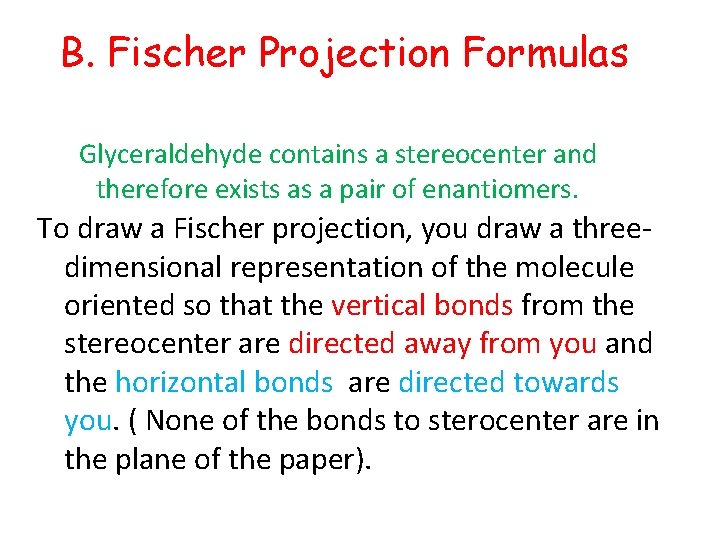
B. Fischer Projection Formulas Glyceraldehyde contains a stereocenter and therefore exists as a pair of enantiomers. To draw a Fischer projection, you draw a three dimensional representation of the molecule oriented so that the vertical bonds from the stereocenter are directed away from you and the horizontal bonds are directed towards you. ( None of the bonds to sterocenter are in the plane of the paper).
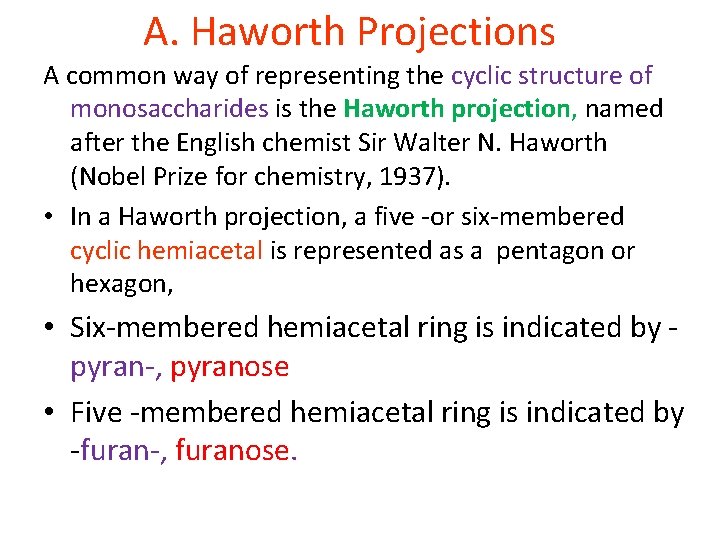
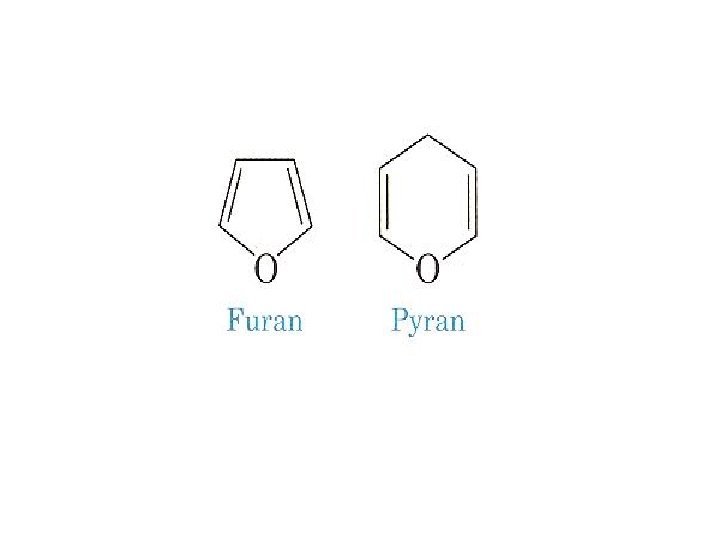
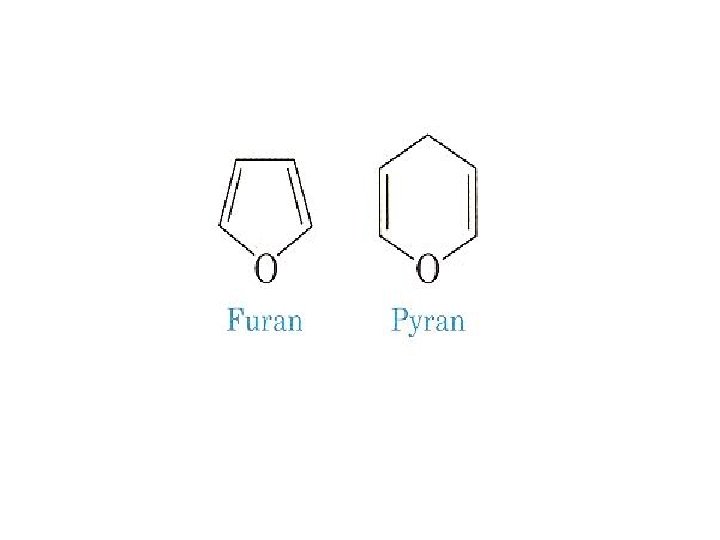
A. Haworth Projections A common way of representing the cyclic structure of monosaccharides is the Haworth projection, named after the English chemist Sir Walter N. Haworth (Nobel Prize for chemistry, 1937). • In a Haworth projection, a five or six membered cyclic hemiacetal is represented as a pentagon or hexagon, • Six membered hemiacetal ring is indicated by pyran , pyranose • Five membered hemiacetal ring is indicated by furan , furanose.

• Groups bonded to the carbons of the ring then lie either above or below the plane of the ring. • The new carbon stereocenter created in forming the cyclic structure is called an anomeric carbon. • Stereoisomers that differ in configuration only at the anomeric carbon are called anomers. • The anomeric carbon of an aldose is carbon 1; that of the most common ketoses is carbon 2.
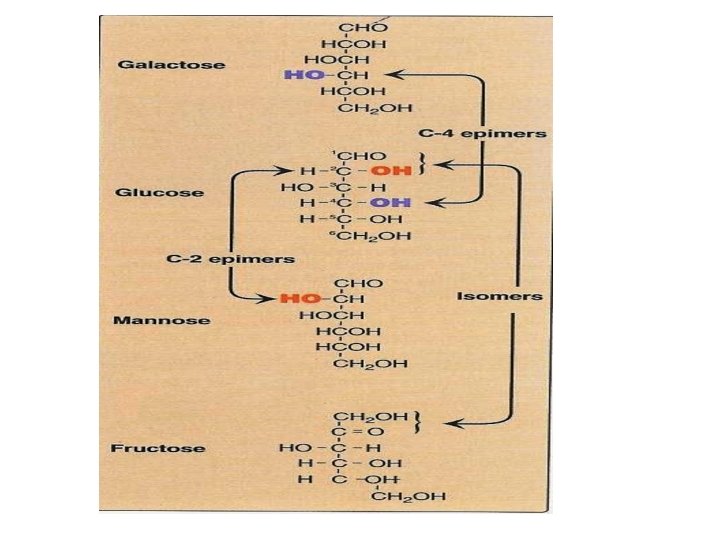
Isomers and epimers • Isomers: – Are compounds that have • The same chemical formula • Have different structures – Example : • Fructose, glucose, mannose, and galactose. • Are all isomers of each other having the same chemical formula C 6 H 12 O 6
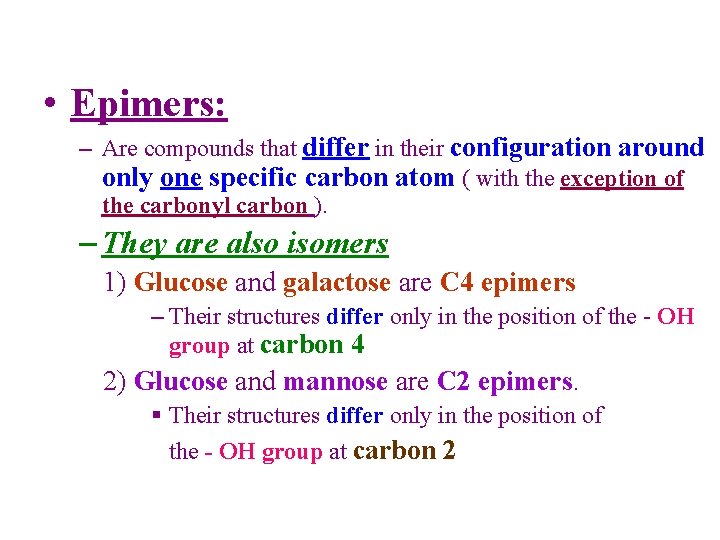
• Epimers: – Are compounds that differ in their configuration around only one specific carbon atom ( with the exception of the carbonyl carbon ). – They are also isomers 1) Glucose and galactose are C 4 epimers – Their structures differ only in the position of the OH group at carbon 4 2) Glucose and mannose are C 2 epimers. § Their structures differ only in the position of the - OH group at carbon 2
• Enantiomers : – A special type of isomers is found in the pairs of structures that are mirror images of each other. – The two members of the pair are designated as a D- and L- sugar. – The vast majority of the sugars in humans are D- sugars.
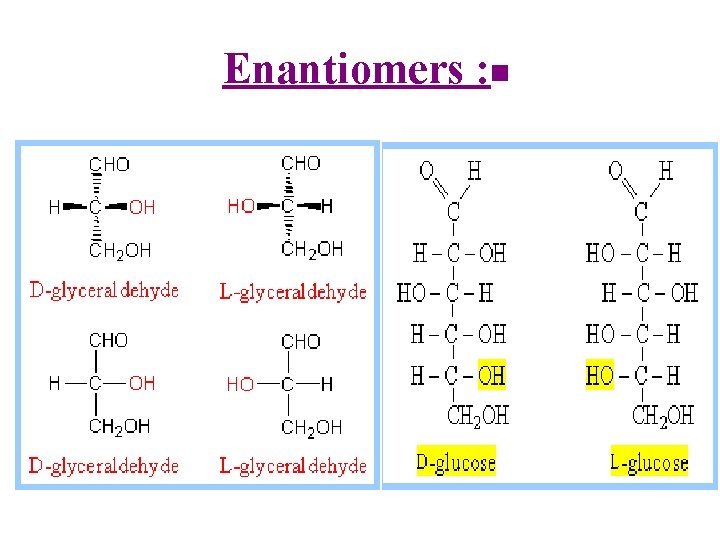
Enantiomers : n
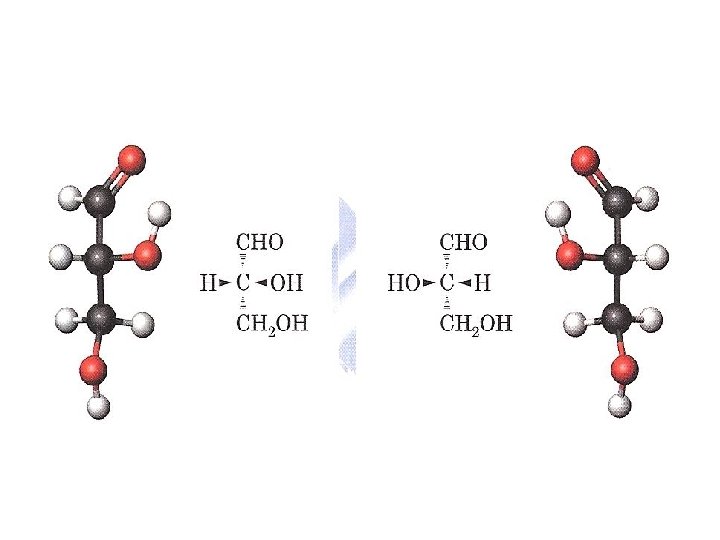

Stereochemistry • Enantiomers = mirror images Pairs of isomers that have opposite configurations at one or more chiral centers but are NOT mirror images are diastereomers • Epimers = Two sugars that differ in configuration at only one chiral center
The following table shows the configuration relationships among D Aldotriose, D Aldotetroses, D Aldopentoses, and D Aldohexose.
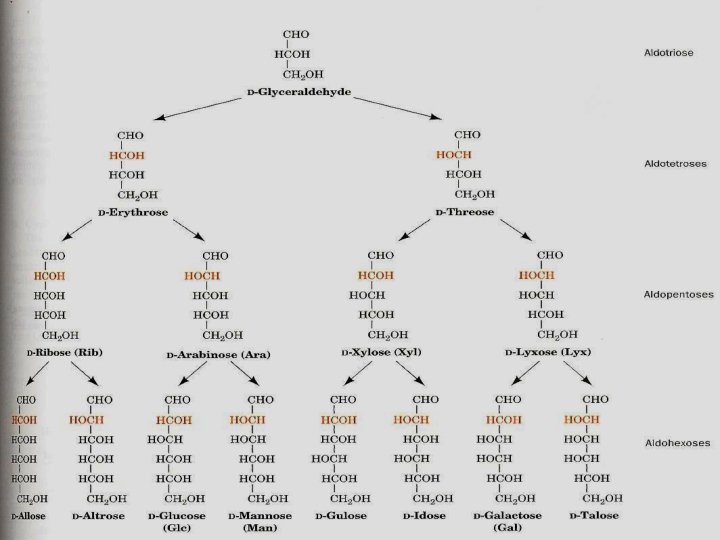
Each name consists of three parts. The D specifies the configuration at the sterocenter farthest from the carbonyl group. Prefixes such as rib , arabin , and glu specify the configuration of all other sterocenter in monosaccharide relative to one another. The suffix ose indicates that the compound is a charbohydrate.
• Cyclization of monosaccharides – Monosaccharides are predominantly found in a ring form: • In which the aldehyde ( or ketone ) group has reacted with an alcohol group on the same sugar, and form a covalent bond – While less than 1 % exists in the open - chain ( acyclic ) form.
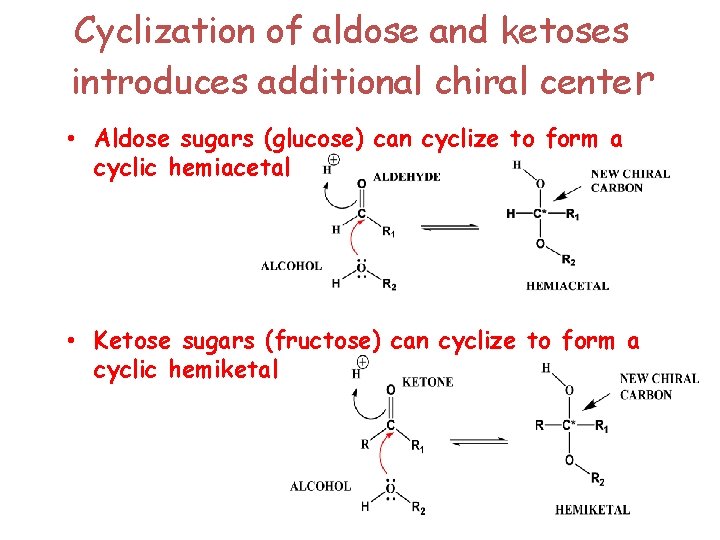
Cyclization of aldose and ketoses introduces additional chiral center • Aldose sugars (glucose) can cyclize to form a cyclic hemiacetal • Ketose sugars (fructose) can cyclize to form a cyclic hemiketal
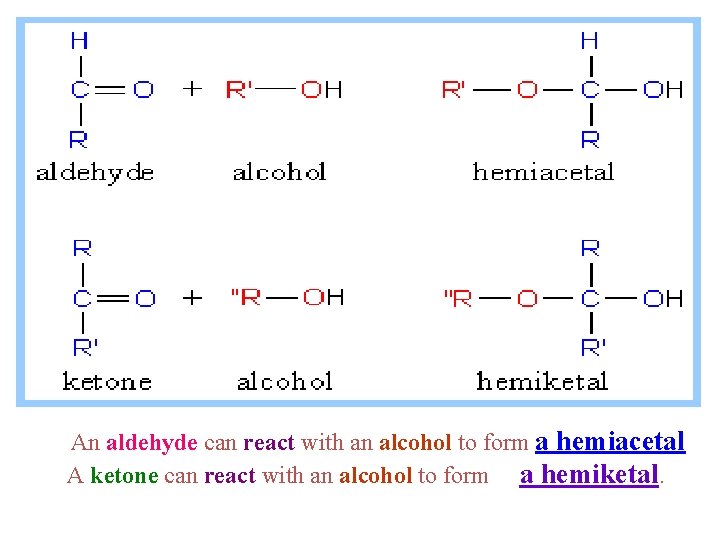
An aldehyde can react with an alcohol to form a hemiacetal A ketone can react with an alcohol to form a hemiketal.
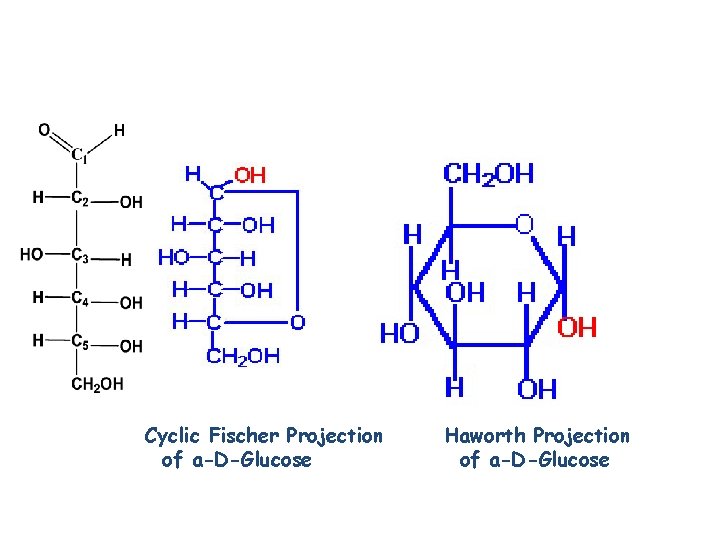
Cyclic Fischer Projection of a-D-Glucose Haworth Projection of a-D-Glucose
Haworth Projections A common way of representing the cyclic structure of monosaccharides is the Haworth projection, named after the English chemist Sir Walter N. Haworth (Nobel Prize for chemistry, 1937). • In a Haworth projection, a five or six membered cyclic hemiacetal is represented as a pentagon or hexagon, • Six membered hemiacetal ring is indicated by pyran , pyranose • Five membered hemiacetal ring is indicated by furan , furanose.
• Groups bonded to the carbons of the ring then lie either above or below the plane of the ring. • The new carbon stereocenter created in forming the cyclic structure is called an anomeric carbon. • Stereoisomers that differ in configuration only at the anomeric carbon are called anomers. • The anomeric carbon of an aldose is carbon 1; that of the most common ketoses is carbon 2.
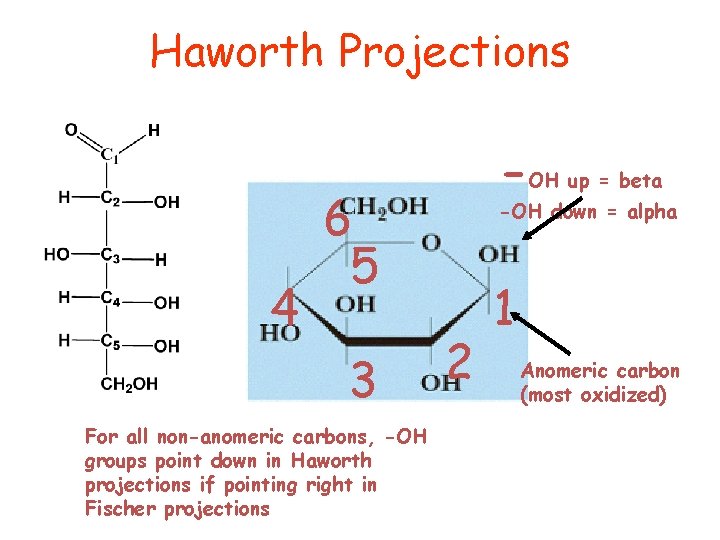
Haworth Projections 4 -OH up = beta 6 5 3 For all non-anomeric carbons, -OH groups point down in Haworth projections if pointing right in Fischer projections -OH down = alpha 2 1 Anomeric carbon (most oxidized)

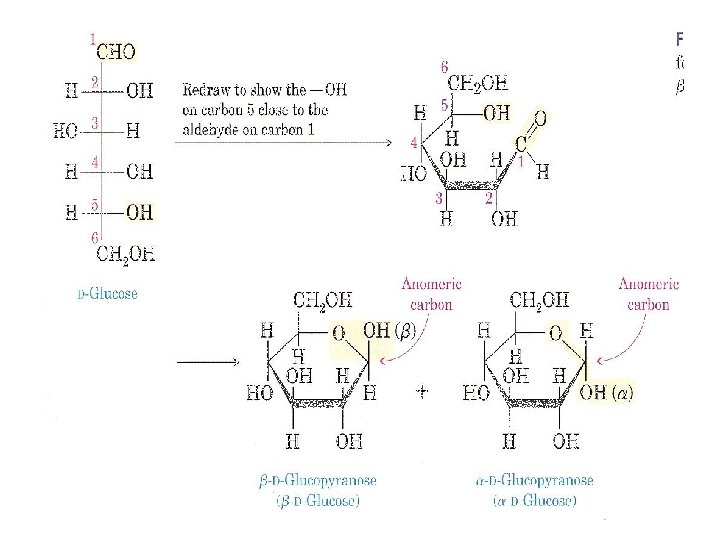
1)Anomeric carbon • Formation of a ring results in the creation of an anomeric carbon: – At carbon 1 of an aldose or – At carbon 2 of a ketoses. • Many simple sugars can exist in a chain form or a ring form. • The ring form is favored in aqueous solutions, and the mechanism of ring formation is similar for most sugars.
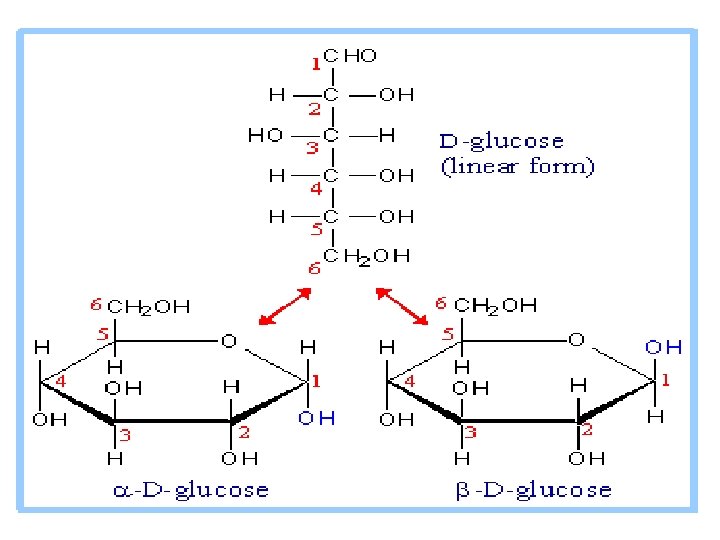
The glucose ring form is created when: • The oxygen on carbon number 5 links with the carbon having the carbonyl group (carbon number 1) • And transfers its hydrogen to the carbonyl oxygen to create a hydroxyl group. • The rearrangement produces alpha glucose when the hydroxyl group is on the opposite side of the CH 2 OH group, • or beta glucose when the hydroxyl group is on the same side as the -CH 2 OH group.
Anomers: α or β – Are isomers which differ only in their configuration about their carbonyl carbon atom. – These structures are designated the α or β configuration of the sugar. For example: – α - D - glucose and β - D – glucose. These two sugars are both glucose, but they are anomers of each other.
Fructose can form either: • A six member pyranose ring, – By reaction of the C 2 keto group with the hydroxyl on C 6 • A 5 member furanose ring, – By reaction of the C 2 keto group with the hydroxyl on C 5.
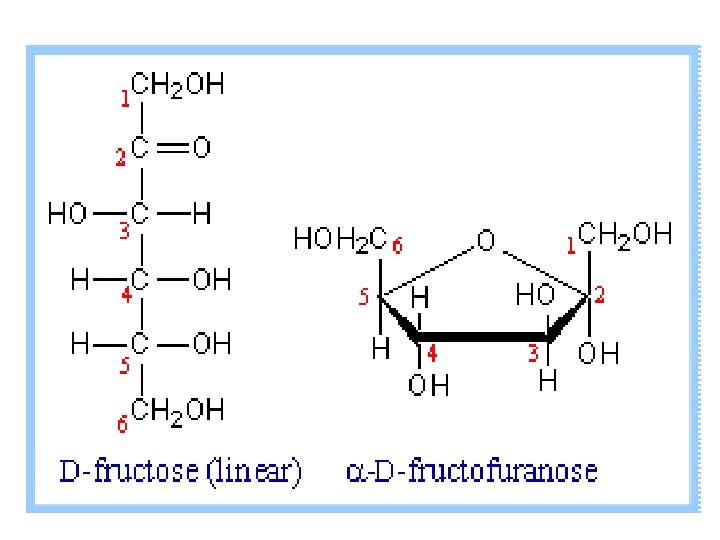
2) Mutarotation process: • Is when cyclic α and β anomers of a sugar in solution are in equilibrium with each other, and can be spontaneously interconverted. • The cyclic form of glucose known as glucopyranose. • The cyclic form of fructose known as fructofuranose.

§Haworth projections: §Represent the cyclic sugars as having essentially planar rings, with the OH at the anomeric C 1 extending either: §Below the ring (a) §Above the ring (b).
What Are the Characteristic Reactions of Monosaccharides?
A. Formation of Glycosides (Acetals) • Treatment of an aldehyde or ketone with one molecule of alcohol yields a hemiacetal, and treatment of the hemiacetal with a molecule of alcohol yields an acetal. • Similarly, treatment of a monosaccharide , (all forms of which exist almost exclusively as cyclic hemiacetals ), with an alcohol also yields an acetal,
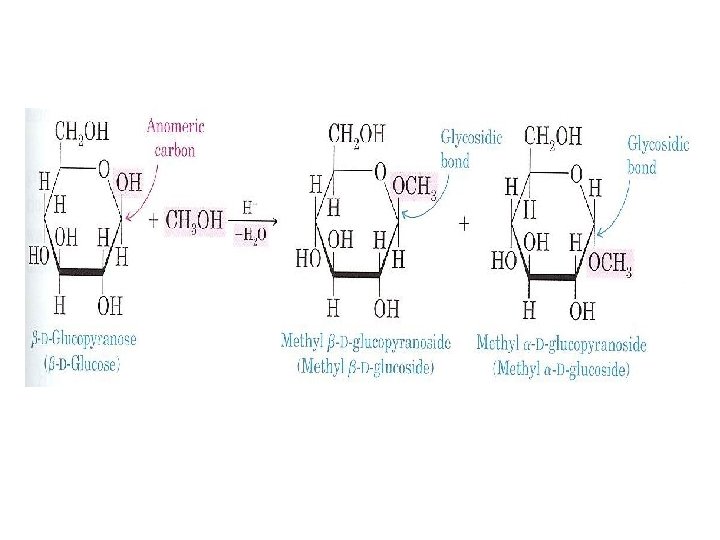
. ●Glycosides are stable in water and aqueous base; however, they are hydrolyzed in aqueous acid to an alcohol and a monosaccharide.
B. Reduction to Alditols The carbonyl group of a monosaccharide can be reduced to a hydroxyl group by a variety of reducing agents, including hydrogen in the presence of a transition metal catalyst and sodium borohydride. The reduction products are known as alditols.
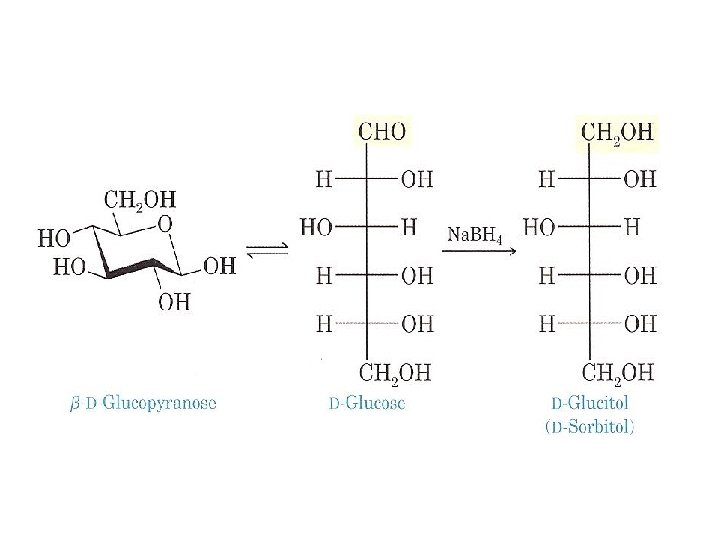
• Sorbitol is found in the plant world in many berries and in cherries, plums, pears, apples, seaweed, and algae. • It is about 60% as sweet as sucrose (table sugar) and is used in the manufacture of candies and as a sugar substitute for diabetics. Other alditols commonly found in the biological world.
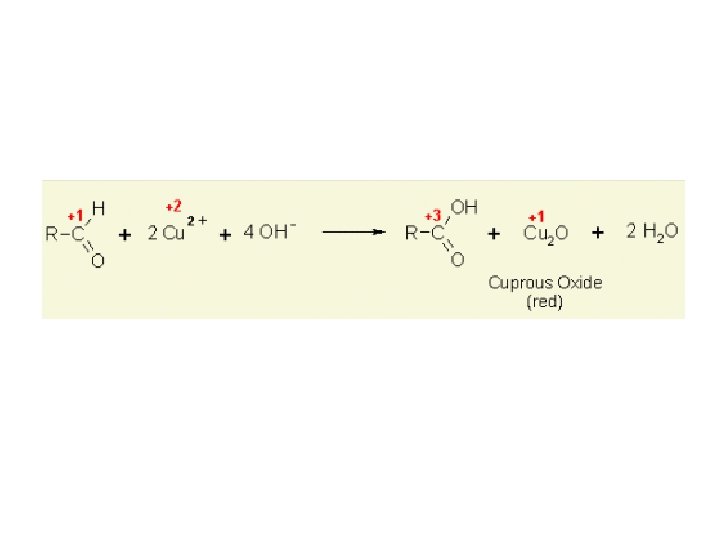
C. Oxidation to Aldonic Acids (Reducing Sugars) Aldehydes (RCHO) are oxidized to carboxylic acids (RCOOH) by several agents, including oxygen, O 2.
• Reducing sugars is when the oxygen on the anomeric carbon (the carbonyl group) of a sugar is not attached to any other structure. • Reducing agents are electron donors. . A reducing sugar can react with chemical reagents. For example, – (Benedict’s solution) and reduce the reactive component, with the anomeric carbon becoming oxidized.
• Similarly, the aldehyde group of an aldose can be oxidized, under basic conditions, to a carboxylate group. • D Glucose, for example, is oxidized to D gluconate (D gluconic acid).
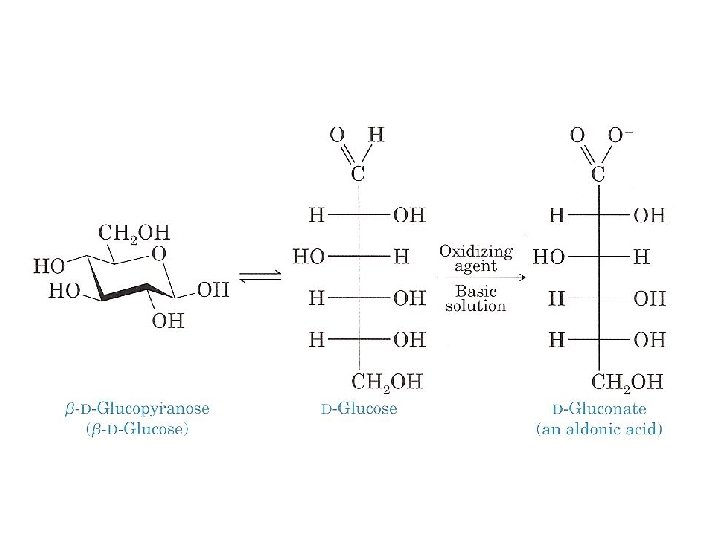

• Any carbohydrate that reacts with an oxidizing agent to form an aldonic acid is classified as a reducing sugar (it reduces the oxidizing agent). • Reducing sugar when in the uncyclized form, monosaccharides act as reducing agents. • Also, free carbonyl group from aldoses or ketoses can reduce Cu 2+ and Ag+ ions to insoluble products
D. Oxidation to Uronic Acids. Enzyme catalyzed oxidation of D glucose, yields D glucuronic acids,
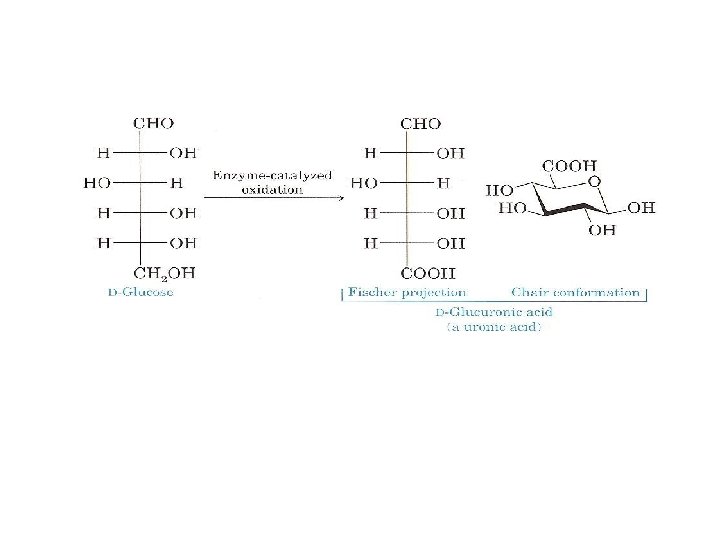
D Glucuronic acid is widely distributed in both the plant and animal worlds. In humans, it serves as an important component of the ■ acidic poly saccharides of connective tissues, ■ to detoxify foreign phenols and alcohols.
II. Disaccharides • Consist of two monosaccharides covalently bound to each other. • In disaccharides the chemical bond that joins the two monosaccharide units is called a glycosidic bond. • Glycosidic bond : – Is formed when the hydroxyl group on one of the sugars reacts with the anomeric carbon on the second sugar. – Is readily hydrolyzed by acid. – It resists cleavage by base.
• Disaccharides can be hydrolyzed to yield their free monosaccharide components by boiling with dilute acid. • They are also abundant in nature. • The most common disaccharides are: – Maltose – Lactose – Sucrose
Maltose
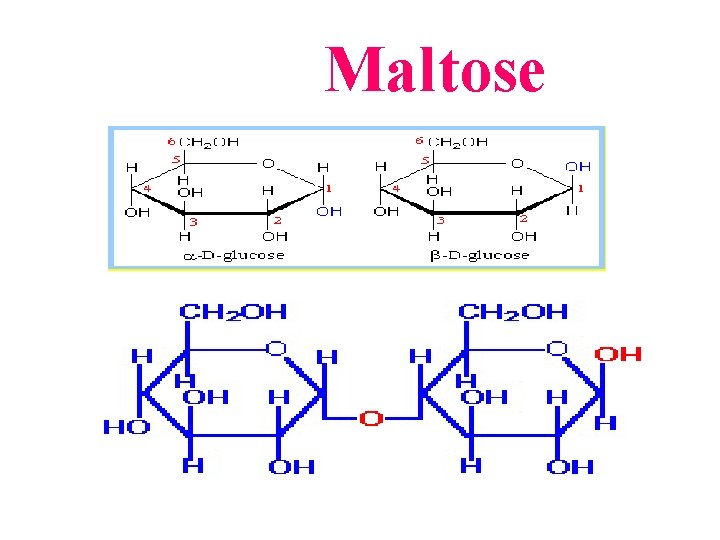
Maltose • Contain two D- glucose residues joined by a glycosidic linkage between carbon atom 1 ( the anomeric carbon ) of the first glucose residue and carbon atom 4 of the second glucose. • The configuration of the anomeric carbon atom in the glycosidic linkage between the two D glucose residues is α – The linkage is thus symbolized α (1 - 4) • The monosaccharide unit bearing the anomeric carbon is designated by the first number in this symbol.
• Both the glucose residues of maltose are in pyranose form • Maltose is a reducing sugar since it has one free carbonyl group that can be oxidized. • Maltose is hydrolyzed to two molecules of D glucose by the intestinal enzyme Maltase that is specific for the α (1 - 4) bond
Lactose
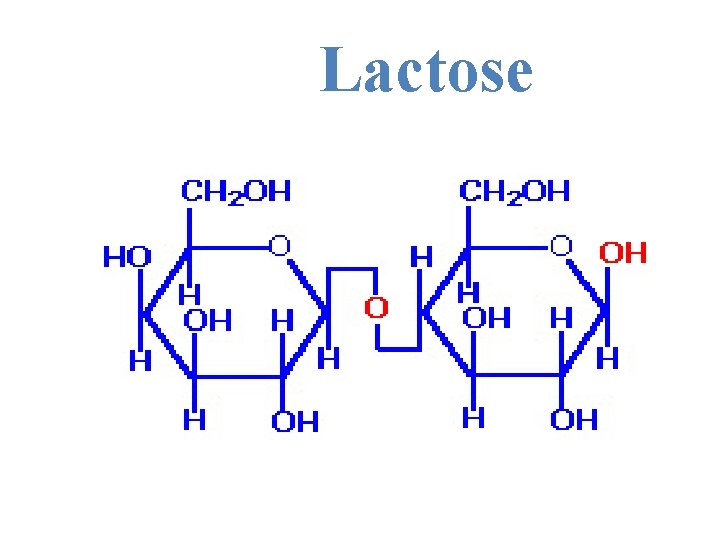
Lactose • Found in milk • Contain D-galactose and D- glucose joined by a glycosidics linkage between carbon atom 1 (the anomeric carbon )of galactose residue and carbon atom 4 of the glucose. • The configuration of the anomeric carbon atom in the glycosidic linkage between the D galactose residues and the glucose residue is – β and the linkage is thus symbolized β (1 - 4)
• Both the galactose and glucose residues of lactose are in pyranose form • Lactose is a reducing sugar since it has one free carbonyl group on the glucose residue that can be oxidized. • During digestion lactose undergoes enzymatic hydrolysis by the Lactase enzyme of the intestinal mucosal cells.
• The aldose, the carbon 1 of which (or ketose, the carbon 2 of which ) participates in the glycosidic link, is called a glycosyl residue. • For example: – If the anomeric carbon of glucose participates in such a bond, that sugar is called a glucosyl residue • Thus. The disaccharide lactose is galactosyl- glucose.
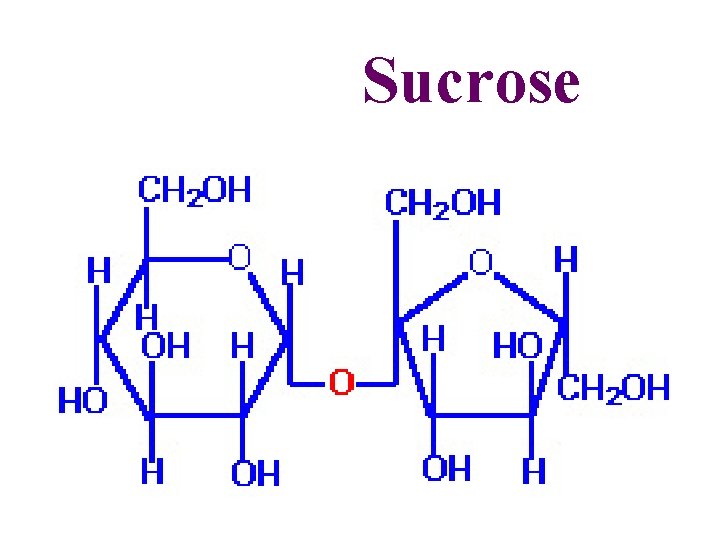
Sucrose
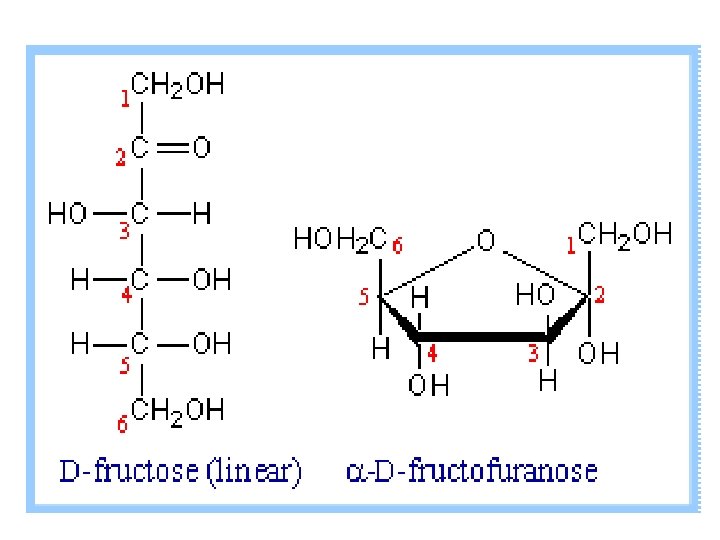
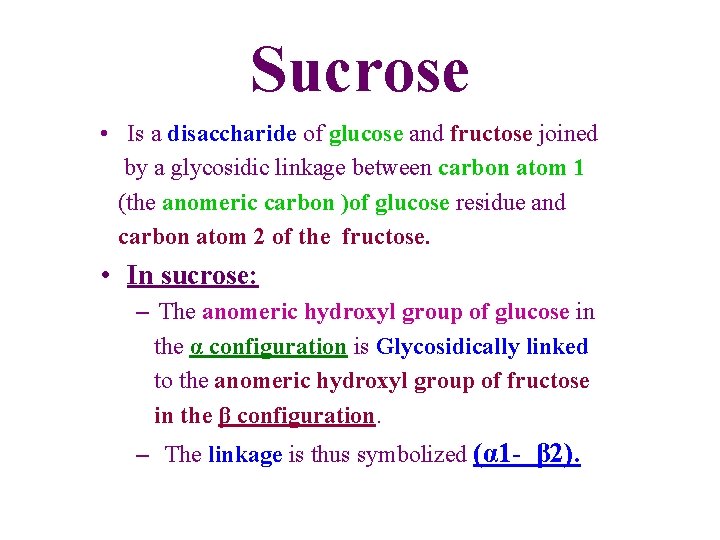
Sucrose • Is a disaccharide of glucose and fructose joined by a glycosidic linkage between carbon atom 1 (the anomeric carbon )of glucose residue and carbon atom 2 of the fructose. • In sucrose: – The anomeric hydroxyl group of glucose in the α configuration is Glycosidically linked to the anomeric hydroxyl group of fructose in the β configuration. – The linkage is thus symbolized (α 1 - β 2).
• Sucrose is Not a reducing sugar – Because it contains No free anomeric carbon • Since the anomeric carbons of both glucose and fructose residues are linked to each other. • Sucrose is hydrolyzed in the small intestine to glucose and fructose by action of the enzyme sucrase (invertase). • It is the sweetest of the three common disaccharides.
III. Polysaccharides • Polysaccharides are polymer of twenty or more monosaccharide units. • The polysaccharides can be: – Homopolymers: • Composed of a single type of monosaccharide – Glucans : are homopolymers of glucose – Mannans: are homopolymers of mannose – Levans : are homopolymers of fructose – Hetropolymers: • Made up from a variety of different monosaccharides.
• In addition they can have – Linear – Branched • The glycosidic bonds between the monosaccharide units can be – – – – – 1 2 1 3 1 4 1 6 2 1 2 3 2 4 2 6 with the anomeric carbon in either the α of β configuration.
CELLULOSE • Is the main structural element of plant cells. – – • • • It is part of the cell wall and Is a major component of wood. Cellulose is a linear polymer of glucose linked by β (1 - 4) glycosidic bonds. The glucose β (1 4) glucose glycosidic bond in cellulose results in a rigid linear polymer of glucose. The rigid nature of this polymer makes it an excellent structural element.
• The glucose β (1 - 4) glucose bond are – Very stable – Difficult to hydrolyzed by chemical means. • A very few species of bacteria contain an enzyme that can hydrolyzed the β (1 - 4) bond. • Animals, such as cow that derive most of their nutrients from plant material it: – Contain bacteria in their gut that can hydrolyze the glucose β (1 - 4) glucose bond of cellulose.
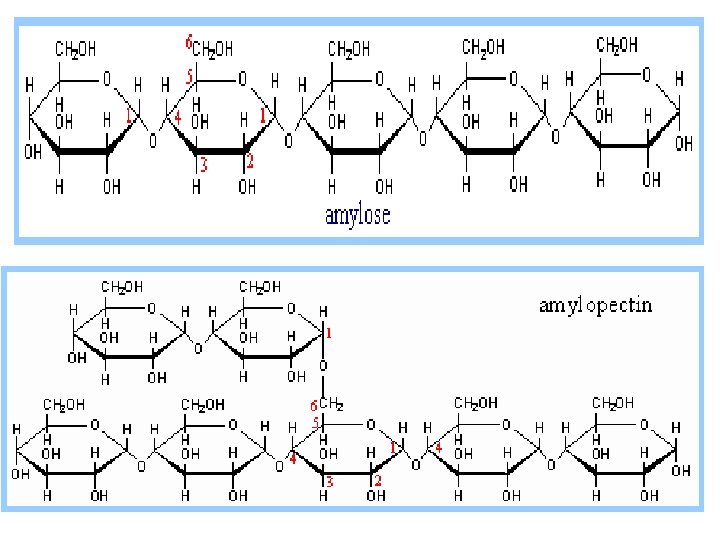
STARCH • • Is the storage form of glucose units in plant cells When a plant seed, tuber, and / or bulb is in an energy poor state: • The starch is broken down and used for energy and / or precursors. Starch as isolated from plants is a mixture of two polymers : • – – AMYLOSE AMYLOPECTIN.
AMYLOSE: – Is a linear polymer of glucose units liked α (1 - 4) glycosidic bond. AMYLOPECTIN: – Is a branched polymer. – It has a backbone of glucose units linked in α (1 - 4) glycosidic bond. – Every 24 to 30 residues along a backbone there is a branch point. – At the branch points the glucose residues are linked in and α (1 - 6 )configuration.
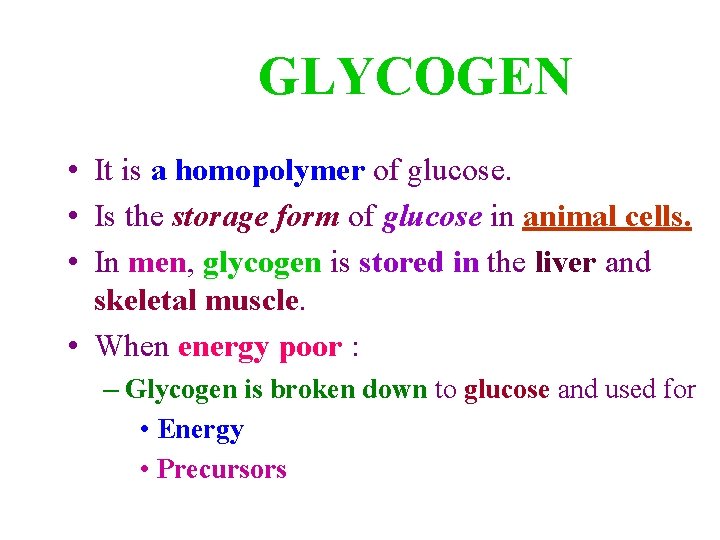
GLYCOGEN • It is a homopolymer of glucose. • Is the storage form of glucose in animal cells. • In men, glycogen is stored in the liver and skeletal muscle. • When energy poor : – Glycogen is broken down to glucose and used for • Energy • Precursors
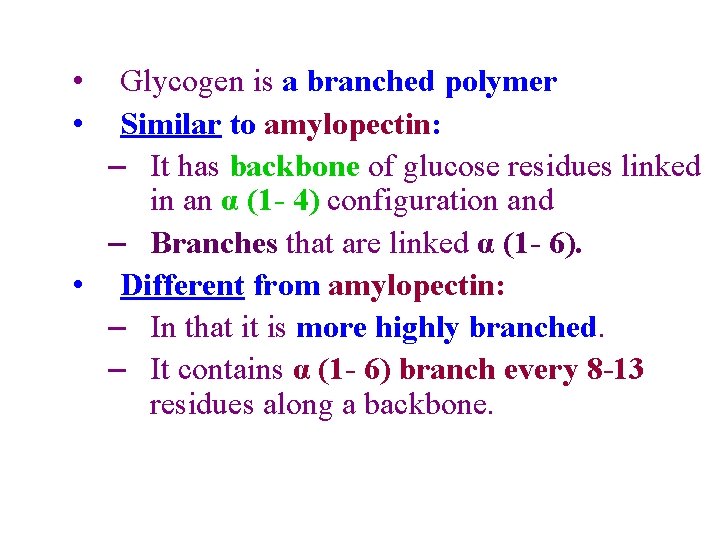
• • Glycogen is a branched polymer Similar to amylopectin: – It has backbone of glucose residues linked in an α (1 - 4) configuration and – Branches that are linked α (1 - 6). • Different from amylopectin: – In that it is more highly branched. – It contains α (1 - 6) branch every 8 -13 residues along a backbone.
• The branched polysaccharides (Amylopectin and Glycogen: – Have only one reducing end and numerous non reducing ends
DEXTRANS • Are an important family of storage polysaccharides in – Bacteria and yeast. • The glycosidic linkage along the backbone of these polysaccharides is α (1 - 6) – Dextrans are usually branched polysaccharides – Dextrans produced by oral bacteria are usually glucans
Heteropolysaccharides • The heteropolysaccharides can be divided into two major types: 1) There are heteropolysaccharides of repeating modified disaccharides units. Example: • Glycosaminoglycans 2) The other type of heteropolysaccharides are composed of – A wide assortment of monosaccharide – Modified monosaccharide units arranged in random order this group is often branched.
Complex carbohydrates • Glycosidic bonds to non carbohydrate structures can attach carbohydrates to: – Purines and Pyrimidines (found in nucleic acids) – Aromatic rings (such as those found in steroids and bilirubin) – Proteins (found in glycoproteins and glycosaminoglycans) – Lipids (found in glycolipids)
• The aldose, the carbon 1 of which (or ketose, the carbon 2 of which ) participates in the glycosidic link, is called a glycosyl residue. For example: – If the anomeric carbon of glucose participates in such a bond, that sugar is called a glucosyl residue • Thus. The disaccharide lactose is galactosyl- glucose.

O- and N-glycosides • If the group on the non-carbohydrate molecule to which the sugar is attached – Is an - OH group, the structure is an O-glycoside – Is an NH 2, the structure is an N-glycoside
Naming glycosidic bonds • Glycosidic bonds between sugars are named According: – To the numbers of the connected carbons – To the position of the anomeric hydroxyl group of the sugar involved in the bond. • If this anomeric hydroxyl group is in the α configuration, the linkage is an α-bond. • If it is in the β configuration, the linkage is a β -bond.
• Lactose, for example: – Is synthesized by forming a glycosidic bond between • Carbon 1 of β galactose and • Carbon 4 of glucose. – The linkage is, therefore, β (1 - 4) glycosidic bond
Other Biologically Important Sugar Derivatives • Monosaccharide units, which an OH group is replaced by H are known as deoxy sugars. – The biologically most important of these is • β-D-2 -deoxyribose, the sugar component of DNAs sugar phosphate backbone.

D Ribose 2 Deoxy D Ribose L Ribose α D deoxyribose

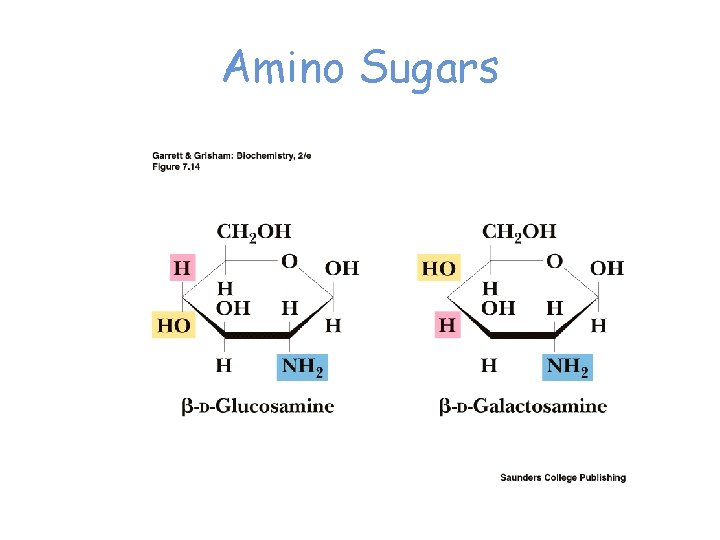
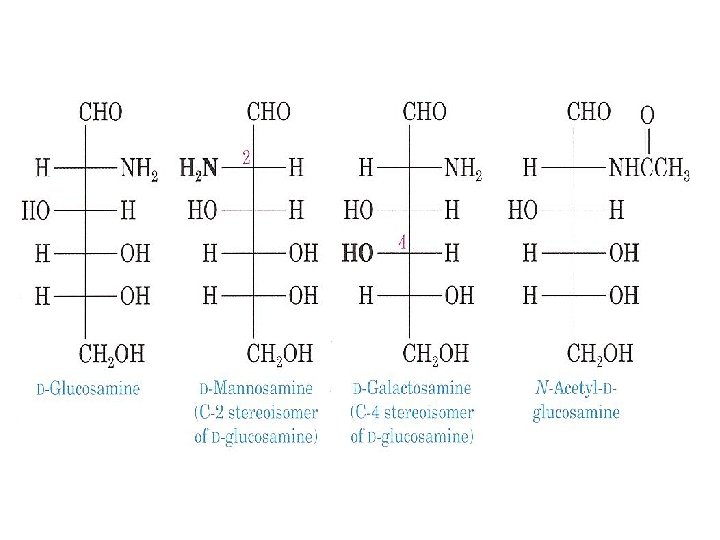
• In amino sugars: – One or more OH groups are replaced by an • Acetylated amino group: – D-Glucosamine – D-galactosamine • are components of numerous biologically important polysaccharide.
Amino Sugars
N Acetyl D glucosamine, (a derivative of D glucosamine), is a component of many polysaccharides, including connective tissue such as cartilage, chitin, the hard, shell like exoskeleton of lobsters, crabs, shrimp, and other shellfish. Several other amino sugars are components of naturally occurring antibiotics.
DIGESTION OF CARBOHYDRATES • The principal sites of dietary carbohydrate digestion are – The mouth – Intestinal lumen • This digestion is rapid and is generally completed by the time: – The stomach contents reach the junction of the duodenum and jejunum • There is little monosaccharide present in diets of mixed animal and plant origin.
• The enzymes needed for degradation of most dietary carbohydrates are primarily: – Disaccharidases – Endoglycosidases: • That break oligosaccharides and polysaccharides
• Hydrolysis of glycosidic bond is catalyzed by a family of glycosidases that – Degrade carbohydrates into reducing sugar components. – These enzymes are usually specific for the: • Structure and configuration of the glycosyl residue to be removed • Type of bond to be broken.
A. Digestion of carbohydrates begins in the mouth • The major dietary polysaccharides are of : – Animal (glycogen) – Plant origin (starch, composed of amylose and amylopectin). • During mastication, salivary α-amylase acts briefly on dietary starch in a random manner, breaking some α (1 -4) bonds. • There are both α (1 -4)- and β (1 -4)endoglucosidases in nature.
• But humans Do not produce and secret β (1 -4)endoglucosidases in digestive juices. Therefore, – They are unable to digest cellulose a carbohydrate of plant origin containing β (1 -4) glycosidic bonds between glucose residues. – Because branched amylopectin and glycogen also contain α (1 -6) bonds, • The digest resulting from the action of α-amylase contains a mixture of smaller, branched oligosaccharide molecules.
• Carbohydrate digestion halts (stop) temporarily in the stomach, – Because the high acidity • Inactivates the salivary α-amylase
B) Further digestion of carbohydrates by pancreatic enzymes occurs in the small intestine • When the acidic stomach contents reach the small intestine: – They are neutralized by bicarbonate secreted by the pancreas – Pancreatic α-amylase continues the process of starch digestion.
C. Final carbohydrate digestion by enzymes synthesized by the intestinal mucosal Cells • The final digestive processes occur at the mucosal lining of the upper jejunum declining as they proceed down the small intestine, and include the action of several: – Disaccharidases – Oligosaccharidases. For example: 1)Isomaltase cleaves the α (1 -6) bond in isomaltose 2)Maltase cleaves maltose • Both producing glucose
3) Sucrase cleaves sucrose producing glucose and fructose 4) Lactase (β-galactosidase) cleaves lactose producing galactose and glucose.
D. Absorption of monosaccharides by intestinal mucosal cells • The duodenum and upper jejunum – Absorb the bulk of the dietary sugars. – Insulin is not required for the uptake of glucose by intestinal cells – Different sugars have different mechanisms of absorption.

- Slides: 113