
CHAPTER 2 BUILDING A NATION 1840 1867 1
CHAPTER #2 – BUILDING A NATION (1840 – 1867) 1 DAY #3 – CONFEDERATION ACHIEVED
THE CHARLOTTETOWN CONFERENCE • Leaders of Maritime colonies (except Newfoundland) plan meeting in Charlottetown, PEI • Purpose: to discuss a Maritime Union • Canadian leaders of Great Coalition ask to join, be able to propose wider union 2 • Canada East: Cartier and Alexander Galt (Minister of Finance) • Canada West: Macdonald, Brown, and D’Arcy Mc. Gee (politician and poet)
THE CHARLOTTETOWN CONFERENCE • Conference held Sept. 1864 • Schmooze-fest: lavish parties, banquets, elegant balls, much wine and champagne • Confederation Salesmen: Macdonald & Cartier (general arguments), Brown (constitutional details), Galt (economic reasons), Mc. Gee (emotional argument) 3 • Canadians convince Maritimers to forget about Maritime Union (too small), consider Confederation instead
THE CHARLOTTETOWN CONFERENCE • Maritimers agree to discuss Confederation further • Another conference arranged for next month in Quebec City 4 • Details to be hammered out • Make sure all colonies’ concerns addressed

5 THE CHARLOTTETOWN CONFERENCE
THE QUEBEC CONFERENCE • Held in Oct. 1864 • Purpose: To hammer out the details of Confederation • Maritime Demands 6 • Nova Scotia and New Brunswick: railway to link them to cities in Canada • PEI: money to buy back land owned by absentee landowners • Newfoundland: not interested in Confed. , but pressured by British government to attend

7 THE QUEBEC CONFERENCE

8 THE QUEBEC CONFERENCE
THE QUEBEC CONFERENCE • The Plan 9 • The union must be strong, with a strong central government to hold everything together • The central government must have stronger authority than the provincial governments • Macdonald wanted more power for the central government, but Maritime delegates wanted provinces to keep many powers • Macdonald compromised, powers to be shared
THE QUEBEC CONFERENCE 10 • Issues for Debate • How many representatives would each province have? • Where would the central government get money to govern? • What kind of parliamentary system would it have? • Could other colonies (ie. BC) join later? • Would the central government make all the laws for the country, with no more provincial legislative assemblies?
THE QUEBEC CONFERENCE • Delegates finally agree on 72 Resolutions • Blueprint for Canada • Each colony’s legislature needs to approve the 72 Resolutions to join Confed. 11 • Much debate in most colonies, would take time • Once colonies decide, British government would be asked to approve Confederation • Who would be in, who would be out?

12 72 RESOLUTIONS
AFTER THE QUEBEC CONFERENCES • Oct. 1864: Colonial delegates head home 13 • Colonies must decide whether or not to accept 72 Resolutions and join Confederation • Not going to be an easy decision for most colonies
COLONIAL DECISIONS • Province of Canada – YES • Confederation more popular in Canada West than Canada East • New Brunswick – YES • Nova Scotia – YES • Prince Edward Island – NO 14 • Newfoundland - NO
LONDON CONFERENCES • Early 1867: Colonial delegates travel to London, England to get Confederation approved by British Government • March 29: Queen Victoria signs the British North America (BNA) Act 15 • Dominion of Canada becomes official July 1 • Canada not fully independent, but getting there • Still member of the British Empire

16 LONDON CONFERENCES
CONFEDERATION! • July 1, 1867: celebrations across country • First Prime Minister –John A. Macdonald • Four Provinces • Ontario (formerly Canada West) • Quebec (formerly Canada East) • New Brunswick and Nova Scotia • Capital City –Ottawa 17 • Parliament buildings in Montreal burned down • Ottawa right on border between Ont. and Que. • Inland from US, linked to Great Lakes by canal
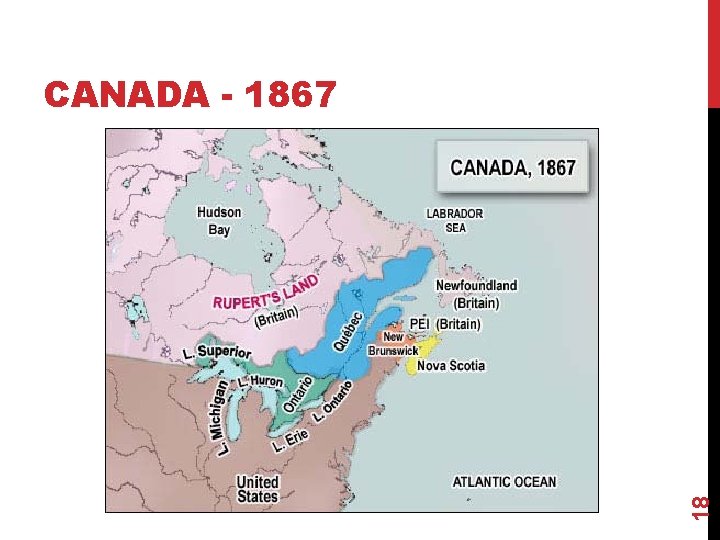
18 CANADA - 1867
SOME LOOMING ISSUES • Aboriginal peoples not consulted during Confederation process • Metis especially were frustrated, angry • Transcontinental railway very expensive • English-French relations still tense • Efforts being made to convince PEI and Newfoundland to join 19 • Next step is to bring Western territories and BC into Canada before US got them
- Slides: 19