
Chapter 2 Budgets Intermediate Microeconomics A ToolBuilding Approach
Chapter 2 Budgets Intermediate Microeconomics: A Tool-Building Approach Routledge, UK © 2016 Samiran Banerjee
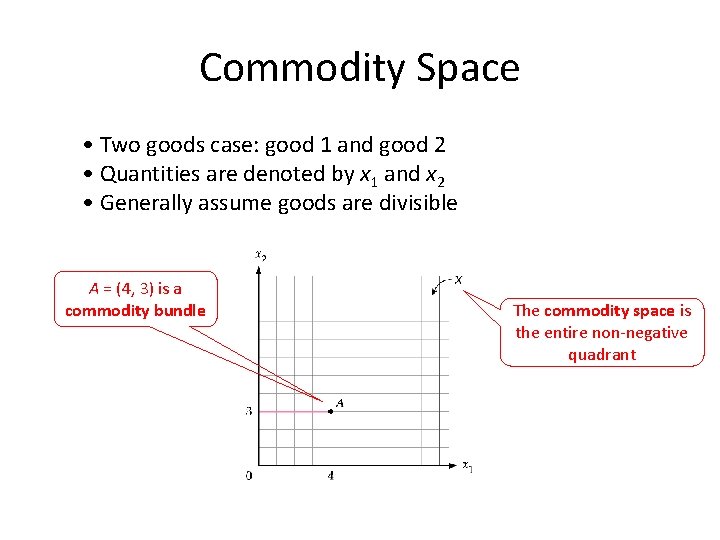
Commodity Space • Two goods case: good 1 and good 2 • Quantities are denoted by x 1 and x 2 • Generally assume goods are divisible A = (4, 3) is a commodity bundle The commodity space is the entire non-negative quadrant
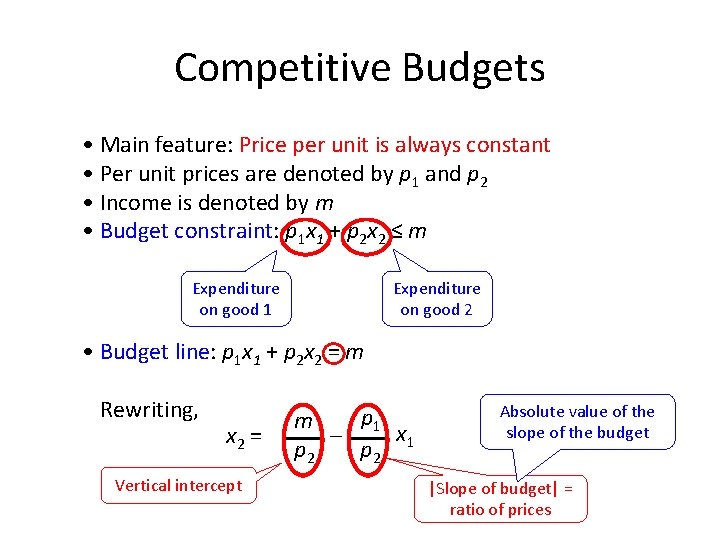
Competitive Budgets • Main feature: Price per unit is always constant • Per unit prices are denoted by p 1 and p 2 • Income is denoted by m • Budget constraint: p 1 x 1 + p 2 x 2 ≤ m Expenditure on good 1 Expenditure on good 2 • Budget line: p 1 x 1 + p 2 x 2 = m Rewriting, x 2 = Vertical intercept p 1 m x 1 – p 2 Absolute value of the slope of the budget |Slope of budget| = ratio of prices
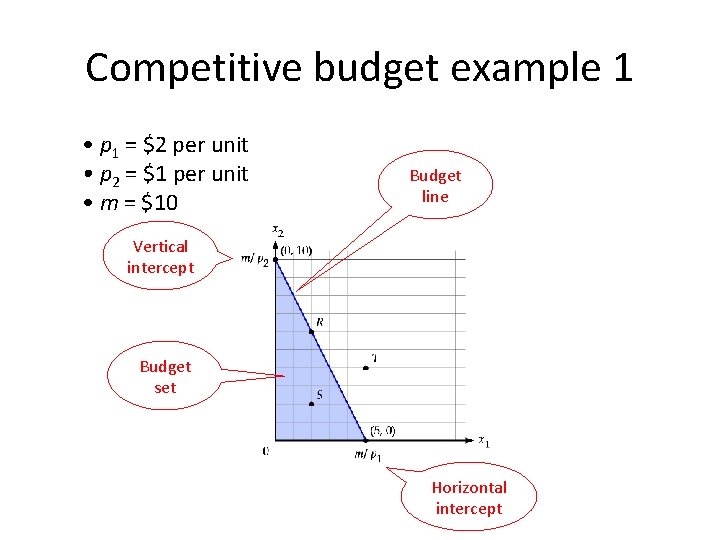
Competitive budget example 1 • p 1 = $2 per unit • p 2 = $1 per unit • m = $10 Budget line Vertical intercept Budget set Horizontal intercept
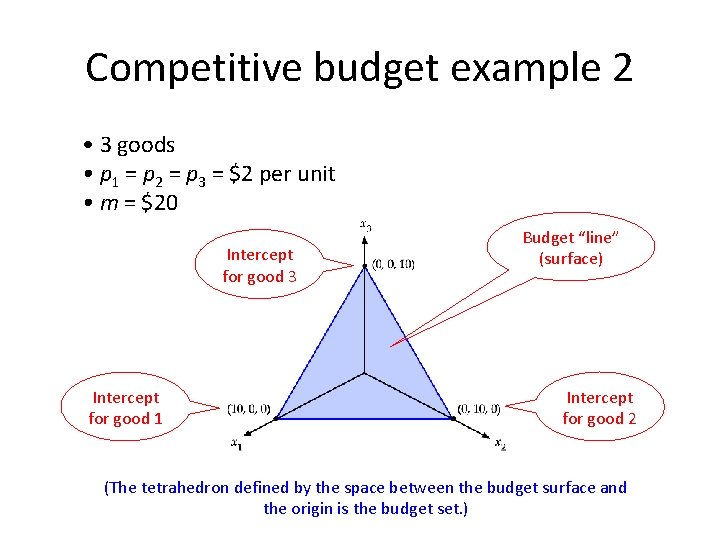
Competitive budget example 2 • 3 goods • p 1 = p 2 = p 3 = $2 per unit • m = $20 Intercept for good 3 Intercept for good 1 Budget “line” (surface) Intercept for good 2 (The tetrahedron defined by the space between the budget surface and the origin is the budget set. )
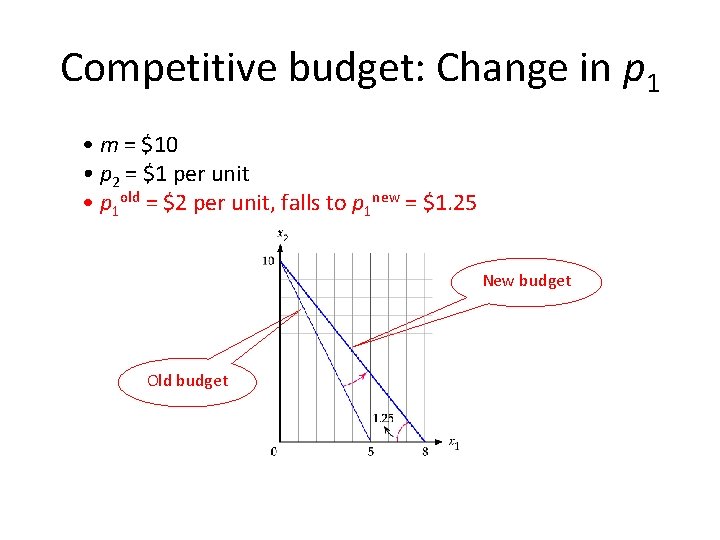
Competitive budget: Change in p 1 • m = $10 • p 2 = $1 per unit • p 1 old = $2 per unit, falls to p 1 new = $1. 25 New budget Old budget
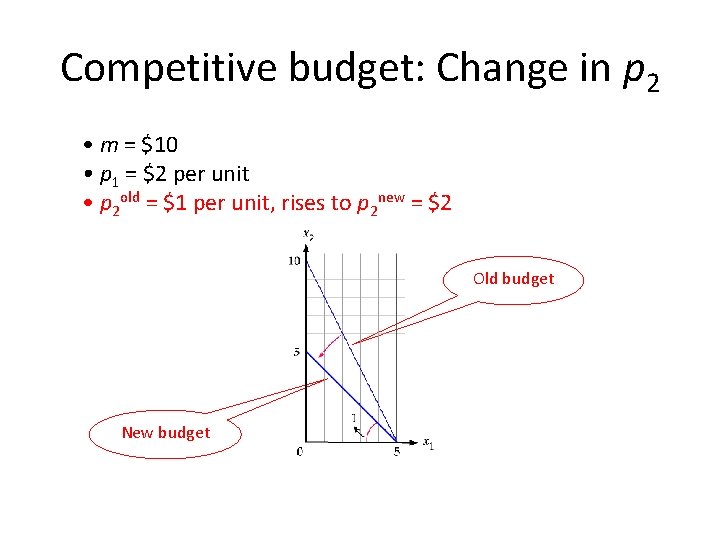
Competitive budget: Change in p 2 • m = $10 • p 1 = $2 per unit • p 2 old = $1 per unit, rises to p 2 new = $2 Old budget New budget
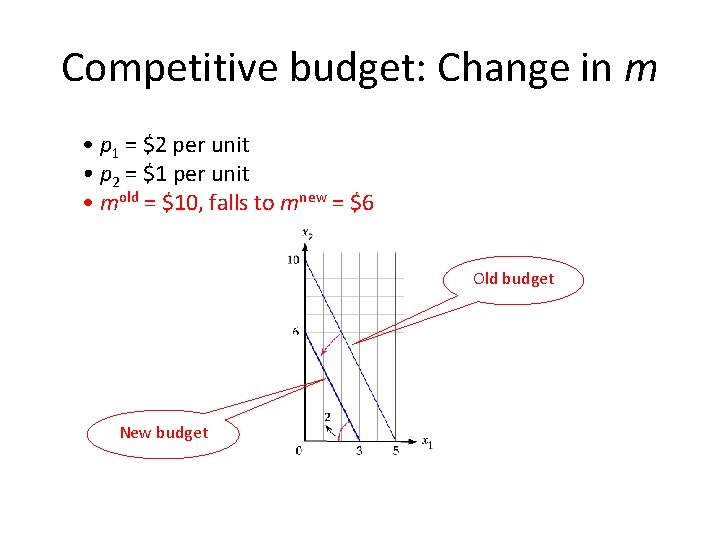
Competitive budget: Change in m • p 1 = $2 per unit • p 2 = $1 per unit • mold = $10, falls to mnew = $6 Old budget New budget
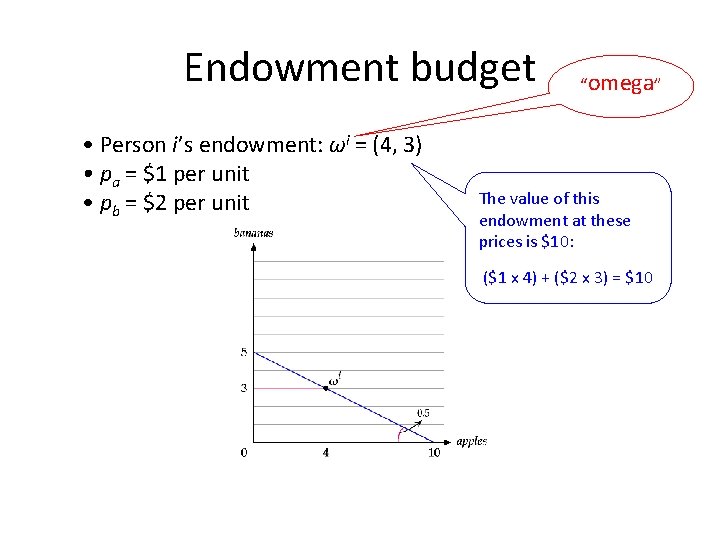
Endowment budget • Person i’s endowment: ωi = (4, 3) • pa = $1 per unit • pb = $2 per unit “omega” The value of this endowment at these prices is $10: ($1 x 4) + ($2 x 3) = $10
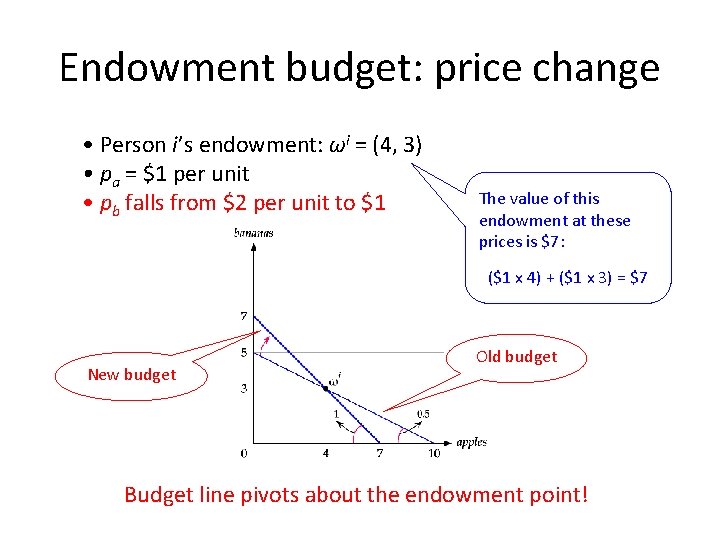
Endowment budget: price change • Person i’s endowment: ωi = (4, 3) • pa = $1 per unit • pb falls from $2 per unit to $1 The value of this endowment at these prices is $7: ($1 x 4) + ($1 x 3) = $7 New budget Old budget Budget line pivots about the endowment point!
Non-Competitive Budgets • Main feature: Price per unit is NOT always constant • Some examples: – price discounts on incremental purchases – price discounts with bulk purchases – buying and selling at different prices – food stamps – coupons • Assume goods are divisible!
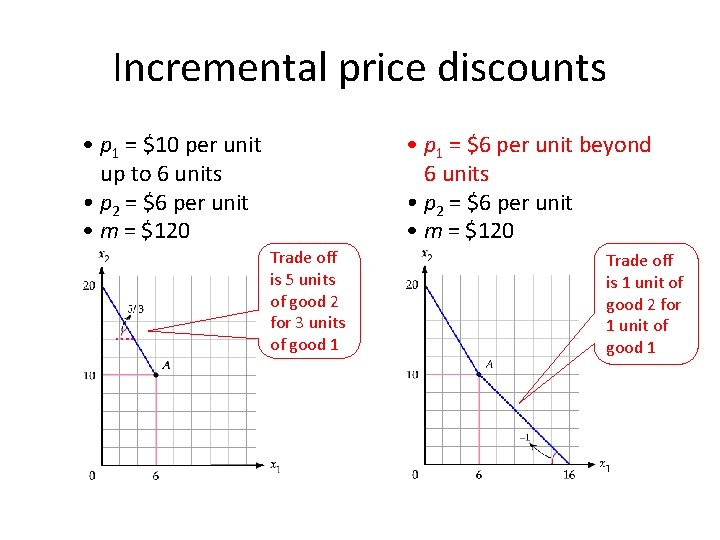
Incremental price discounts • p 1 = $10 per unit up to 6 units • p 2 = $6 per unit • m = $120 • p 1 = $6 per unit beyond 6 units • p 2 = $6 per unit • m = $120 Trade off is 5 units of good 2 for 3 units of good 1 Trade off is 1 unit of good 2 for 1 unit of good 1
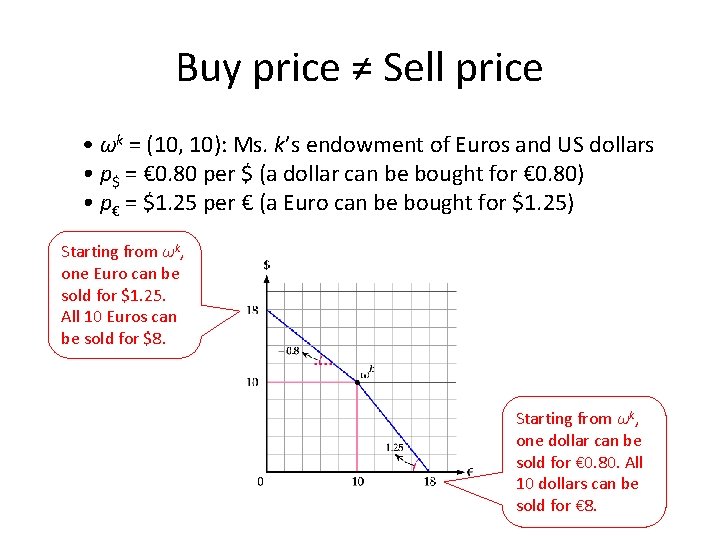
Buy price ≠ Sell price • ωk = (10, 10): Ms. k’s endowment of Euros and US dollars • p$ = € 0. 80 per $ (a dollar can be bought for € 0. 80) • p€ = $1. 25 per € (a Euro can be bought for $1. 25) Starting from ωk, one Euro can be sold for $1. 25. All 10 Euros can be sold for $8. Starting from ωk, one dollar can be sold for € 0. 80. All 10 dollars can be sold for € 8.
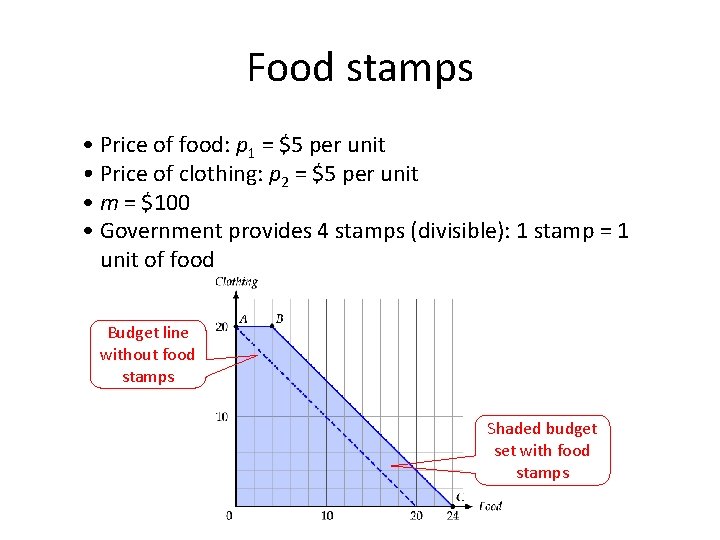
Food stamps • Price of food: p 1 = $5 per unit • Price of clothing: p 2 = $5 per unit • m = $100 • Government provides 4 stamps (divisible): 1 stamp = 1 unit of food Budget line without food stamps Shaded budget set with food stamps

BOGO* coupons • p 1 = p 2 = $1 per unit • m = $10 • Buy one whole unit of good 2 and get one free Budget line after using coupon Cannot redeem coupon since x 2 < 1 in this range *Buy one get one
- Slides: 15