
CHAPTER 2 BHC 703 THE PURCHASE DECISION PROCESS
CHAPTER 2 BHC 703 THE PURCHASE DECISION PROCESS PREPARED BY: NURZEHAN ABU BAKAR SCHOOL OF TOURISM MANAGEMENT FACULTY OF HOSPITALITY AND TOURISM MANAGEMENT
Chapter 2 : The Purchase Decision Process LEARNING OUTCOMES At the end of this chapter, students will be able to: distinguish the motivators and determinants which are the factors which influence the tourist to purchase a particular tourism product Illustrate the ways in which models can be translated into the final purchase decision Distinctly separate tourism product from those of other industries such as hospitality and transport Slide 2 of 41
Chapter 2 : The Purchase Decision Process TOPIC OUTLINES Introduction 2. 1 Motivator 2. 2 Determinants 2. 3 Models of the Purchase Decision Making Process Slide 3 of 41

Chapter 2 : The Purchase Decision Process INTRODUCTION A V I OT M ? R TO DETERMINANT? Slide 4 of 41
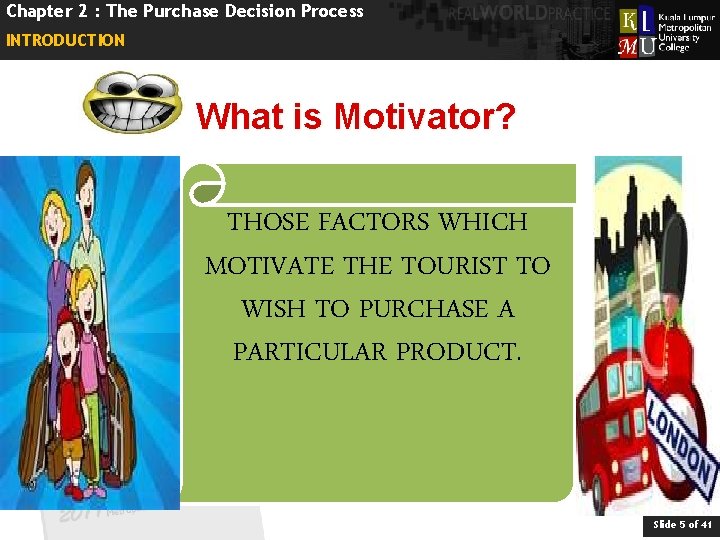
Chapter 2 : The Purchase Decision Process INTRODUCTION What is Motivator? THOSE FACTORS WHICH MOTIVATE THE TOURIST TO WISH TO PURCHASE A PARTICULAR PRODUCT. Slide 5 of 41
Chapter 2 : The Purchase Decision Process INTRODUCTION What is Determinant? THOSE FACTORS WHICH DETERMINE TO WHAT EXTENT TOURIST ARE ABLE TO PURCHASE THEY DESIRE. Slide 6 of 41
Chapter 2 : The Purchase Decision Process 1. 0 The Purchase Decision Process Wait…. we should begin with a few words about tourism product itself. 1. The product is complex and multilayered in that: a) It has both tangible elements (hotel beds, food etc) and intangible elements. (service delivery) b) It can range from a simple one night stay in a hotel or a day trip to a theme park to a tailor-made eight week roundthe-world itinerary. Slide 7 of 41
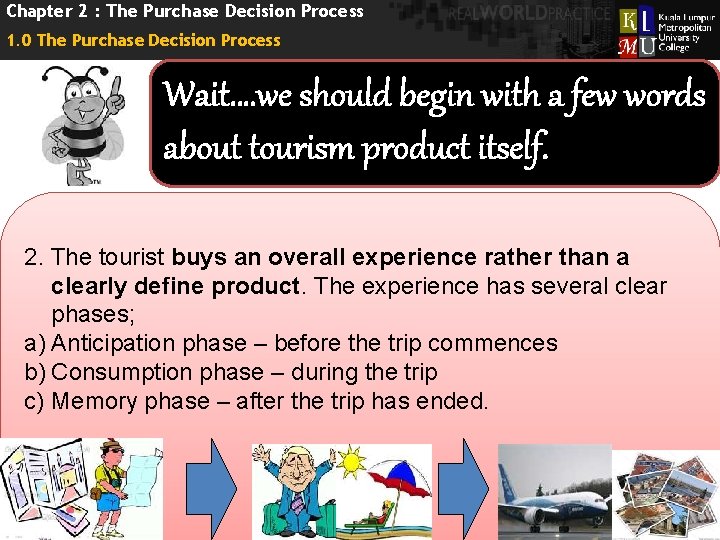
Chapter 2 : The Purchase Decision Process 1. 0 The Purchase Decision Process Wait…. we should begin with a few words about tourism product itself. 2. The tourist buys an overall experience rather than a clearly define product. The experience has several clear phases; a) Anticipation phase – before the trip commences b) Consumption phase – during the trip c) Memory phase – after the trip has ended. Slide 8 of 41
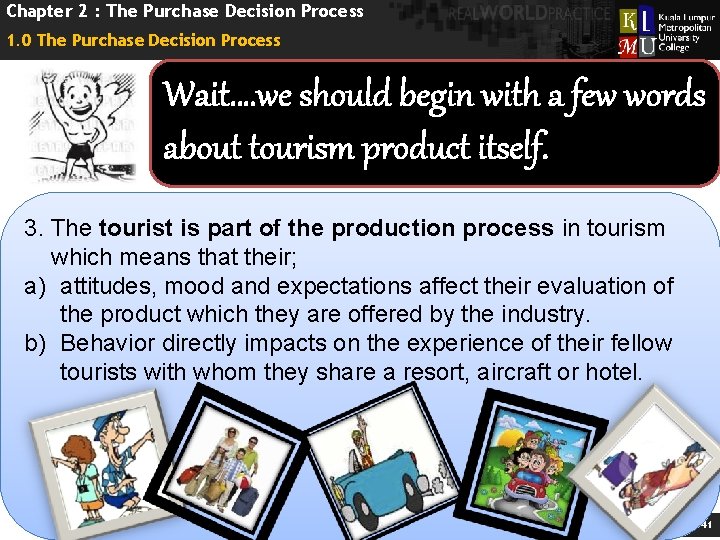
Chapter 2 : The Purchase Decision Process 1. 0 The Purchase Decision Process Wait…. we should begin with a few words about tourism product itself. 3. The tourist is part of the production process in tourism which means that their; a) attitudes, mood and expectations affect their evaluation of the product which they are offered by the industry. b) Behavior directly impacts on the experience of their fellow tourists with whom they share a resort, aircraft or hotel. Slide 9 of 41
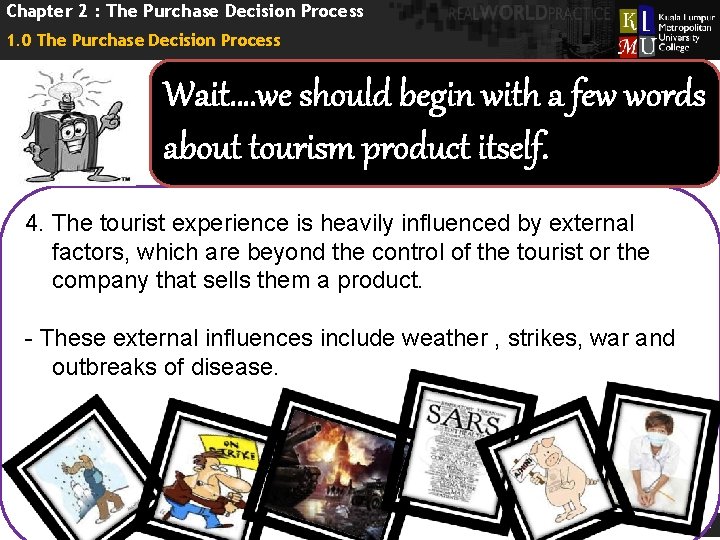
Chapter 2 : The Purchase Decision Process 1. 0 The Purchase Decision Process Wait…. we should begin with a few words about tourism product itself. 4. The tourist experience is heavily influenced by external factors, which are beyond the control of the tourist or the company that sells them a product. - These external influences include weather , strikes, war and outbreaks of disease. Slide 10 of 41
Chapter 2 : The Purchase Decision Process 1. 1 Motivators MOTIVATORS Slide 11 of 41
Chapter 2 : The Purchase Decision Process Definition of Motivators � In this section, we examine the motivators which encourage tourists to make particular purchase decision. � We begin, by outlining the motivators that influence tourists and then discuss how motivators vary between different types of tourism product and different groups of people. � This study area is concerned on with what motivates tourists, how to make decisions, what tourists thinks of the product they buy, how much they enjoy and learn during their holiday experiences, how they interact with local people and environment & how satisfied they are with the holidays Slide 12 of 41
Chapter 2 : The Purchase Decision Process THE NUMBER AND RANGE OF MOTIVATORS Those which motivate a person to take a holiday Those which motivate a person to take a particular holiday to a specific destination at a particular time. Slide 13 of 41
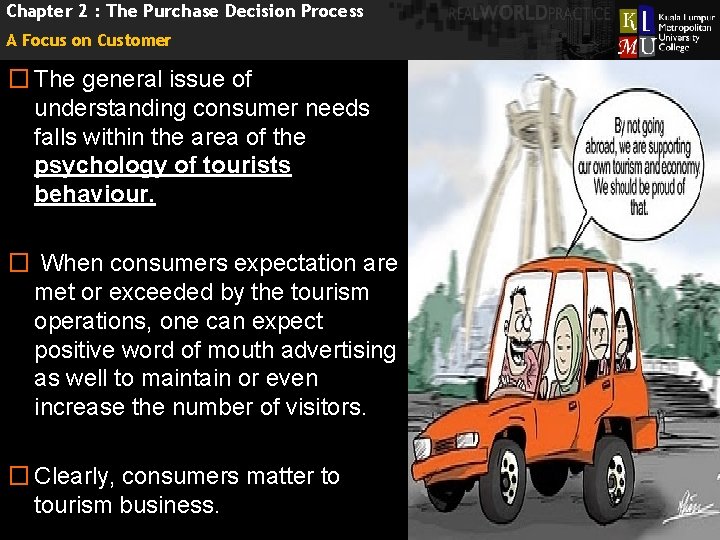
Chapter 2 : The Purchase Decision Process A Focus on Customer � The general issue of understanding consumer needs falls within the area of the psychology of tourists behaviour. � When consumers expectation are met or exceeded by the tourism operations, one can expect positive word of mouth advertising as well to maintain or even increase the number of visitors. � Clearly, consumers matter to tourism business. Slide 14 of 41
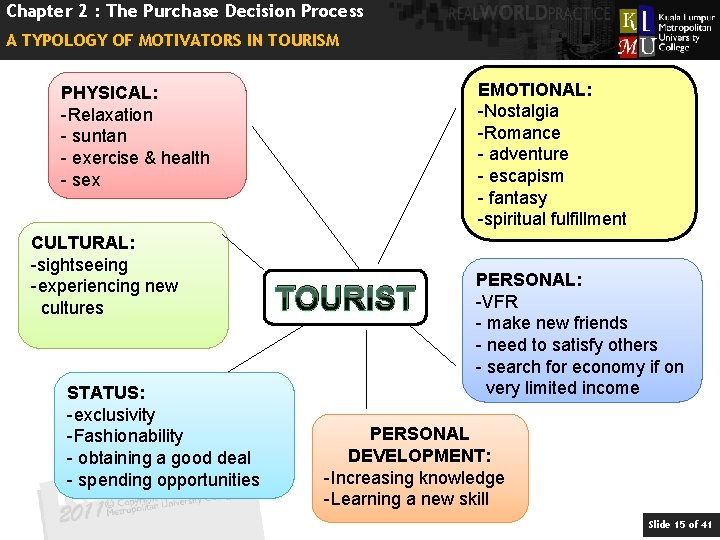
Chapter 2 : The Purchase Decision Process A TYPOLOGY OF MOTIVATORS IN TOURISM EMOTIONAL: -Nostalgia -Romance - adventure - escapism - fantasy -spiritual fulfillment PHYSICAL: -Relaxation - suntan - exercise & health - sex CULTURAL: -sightseeing -experiencing new cultures STATUS: -exclusivity -Fashionability - obtaining a good deal - spending opportunities TOURIST PERSONAL: -VFR - make new friends - need to satisfy others - search for economy if on very limited income PERSONAL DEVELOPMENT: -Increasing knowledge -Learning a new skill Slide 15 of 41
Chapter 2 : The Purchase Decision Process THE LEISURE MOTIVATION SCALE a) Intellectual component – assesses the extent to which individuals are motivated to engage in leisure activities which involve mental activities such as learning, exploring, discovery, thought or imagery. b) Social Component – assesses the extent to which individuals engage in leisure activities for social reasons. Include two basic needs; the need for friendship and inter-personal relationships, while the second is the need for the esteem of others. c) Competence-mastery component – which assesses the extent to which individuals engage in leisure activities in order to achieve, master , challenge and compete. The activities are usually physical in nature. b) Stimulus-avoidance component – assesses the desire to escape and get away from over stimulating life situations. It is the need for some individuals to avoid social contact, to seek solitude and calm conditions and for others it is to seek to rest and to unwind themselves Slide 16 of 41
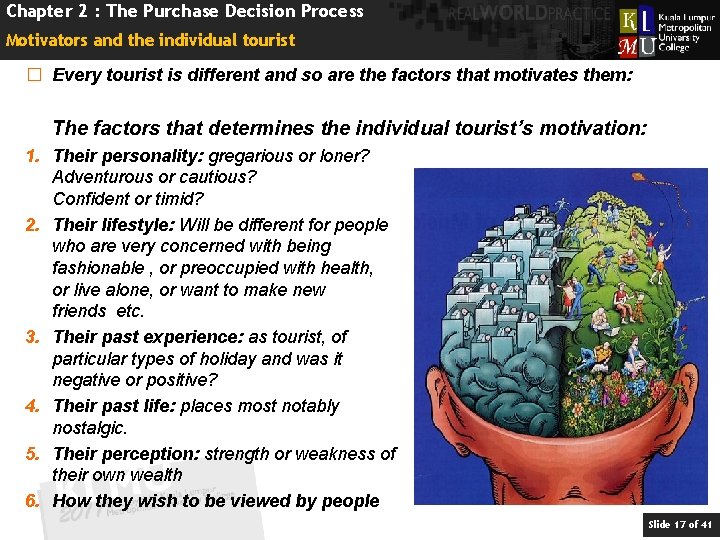
Chapter 2 : The Purchase Decision Process Motivators and the individual tourist � Every tourist is different and so are the factors that motivates them: The factors that determines the individual tourist’s motivation: 1. Their personality: gregarious or loner? Adventurous or cautious? Confident or timid? 2. Their lifestyle: Will be different for people who are very concerned with being fashionable , or preoccupied with health, or live alone, or want to make new friends etc. 3. Their past experience: as tourist, of particular types of holiday and was it negative or positive? 4. Their past life: places most notably nostalgic. 5. Their perception: strength or weakness of their own wealth 6. How they wish to be viewed by people Slide 17 of 41
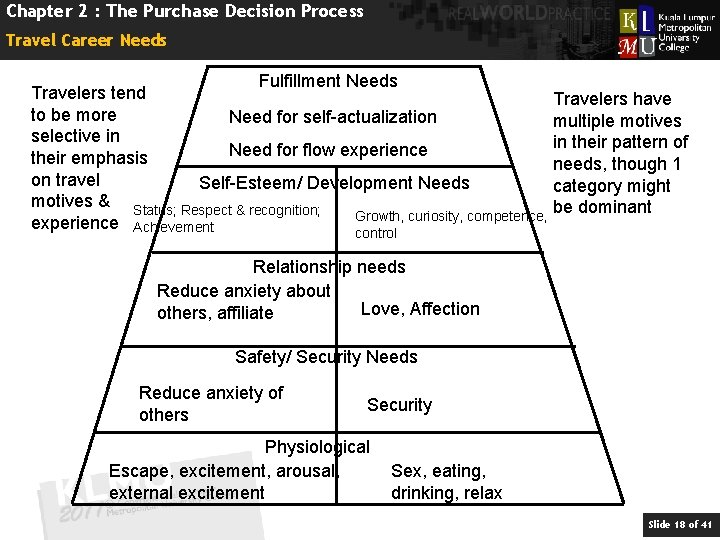
Chapter 2 : The Purchase Decision Process Travel Career Needs Fulfillment Needs Travelers tend to be more Need for self-actualization selective in Need for flow experience their emphasis on travel Self-Esteem/ Development Needs motives & Status; Respect & recognition; Growth, curiosity, competence, experience Achievement Travelers have multiple motives in their pattern of needs, though 1 category might be dominant control Relationship needs Reduce anxiety about Love, Affection others, affiliate Safety/ Security Needs Reduce anxiety of others Security Physiological Escape, excitement, arousal, external excitement Sex, eating, drinking, relax Slide 18 of 41
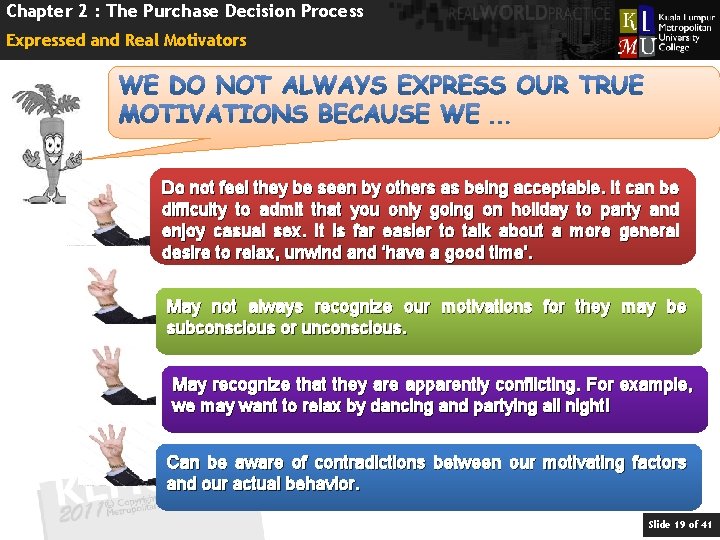
Chapter 2 : The Purchase Decision Process Expressed and Real Motivators Do not feel they be seen by others as being acceptable. It can be difficulty to admit that you only going on holiday to party and enjoy casual sex. It is far easier to talk about a more general desire to relax, unwind and ‘have a good time’. May not always recognize our motivations for they may be subconscious or unconscious. May recognize that they are apparently conflicting. For example, we may want to relax by dancing and partying all night! Can be aware of contradictions between our motivating factors and our actual behavior. Slide 19 of 41
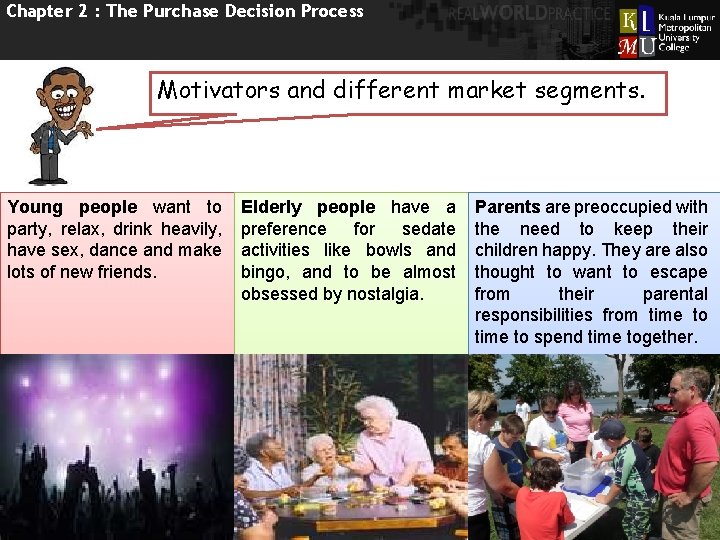
Chapter 2 : The Purchase Decision Process Motivators and different market segments. Young people want to party, relax, drink heavily, have sex, dance and make lots of new friends. Elderly people have a preference for sedate activities like bowls and bingo, and to be almost obsessed by nostalgia. Parents are preoccupied with the need to keep their children happy. They are also thought to want to escape from their parental responsibilities from time to spend time together. Slide 20 of 41
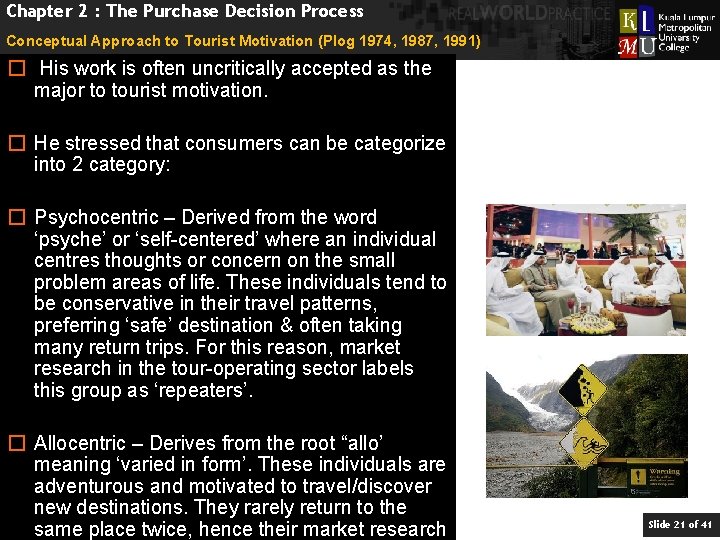
Chapter 2 : The Purchase Decision Process Conceptual Approach to Tourist Motivation (Plog 1974, 1987, 1991) � His work is often uncritically accepted as the major to tourist motivation. � He stressed that consumers can be categorize into 2 category: � Psychocentric – Derived from the word ‘psyche’ or ‘self-centered’ where an individual centres thoughts or concern on the small problem areas of life. These individuals tend to be conservative in their travel patterns, preferring ‘safe’ destination & often taking many return trips. For this reason, market research in the tour-operating sector labels this group as ‘repeaters’. � Allocentric – Derives from the root “allo’ meaning ‘varied in form’. These individuals are adventurous and motivated to travel/discover new destinations. They rarely return to the same place twice, hence their market research Slide 21 of 41
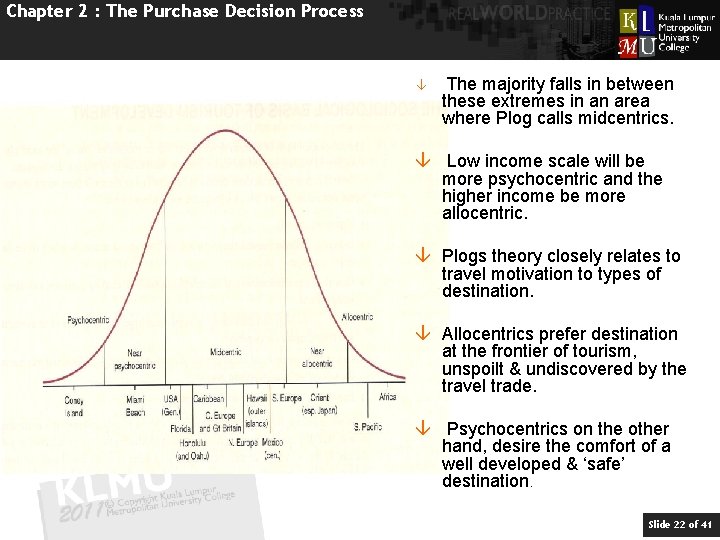
Chapter 2 : The Purchase Decision Process The majority falls in between these extremes in an area where Plog calls midcentrics. Low income scale will be more psychocentric and the higher income be more allocentric. Plogs theory closely relates to travel motivation to types of destination. Allocentrics prefer destination at the frontier of tourism, unspoilt & undiscovered by the travel trade. Psychocentrics on the other hand, desire the comfort of a well developed & ‘safe’ destination. Slide 22 of 41
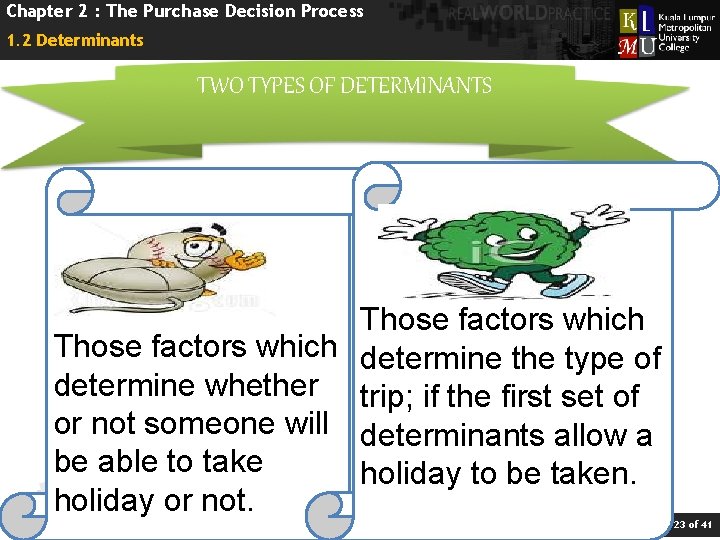
Chapter 2 : The Purchase Decision Process 1. 2 Determinants TWO TYPES OF DETERMINANTS Those factors which determine the type of determine whether trip; if the first set of or not someone will determinants allow a be able to take holiday to be taken. holiday or not. Slide 23 of 41
Chapter 2 : The Purchase Decision Process The types of trip taken can encompass a huge range of variables, including; 1. 2. 3. 4. 5. 6. 7. 8. The destination for the trip When the trip will be taken The mode of travel to be used The duration of the trip Who will comprise the holiday party or group The types of accommodation that will be used. The activities undertaken by the tourist during the holiday How much will be spent on the trip. Slide 24 of 41
Chapter 2 : The Purchase Decision Process Those which are personal to the tourist. Those which are external to the tourist. We can further subdivide determinants into: Slide 25 of 41
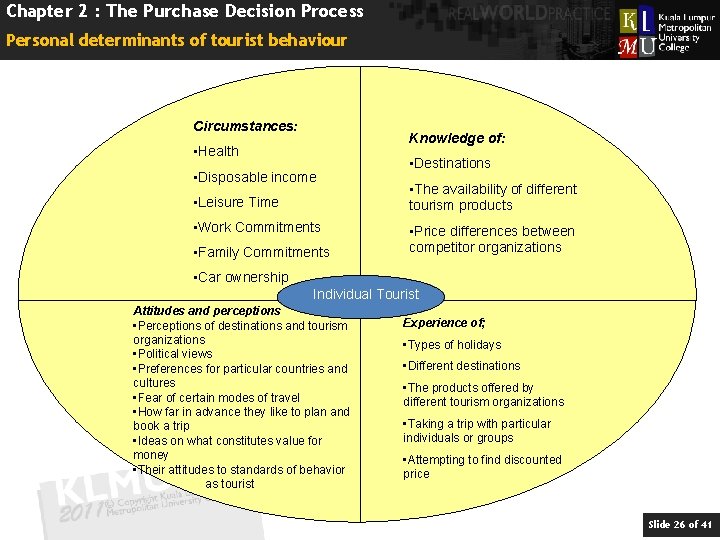
Chapter 2 : The Purchase Decision Process Personal determinants of tourist behaviour Circumstances: Knowledge of: • Health • Disposable income • Leisure Time • Work Commitments • Family Commitments • Destinations • The availability of different tourism products • Price differences between competitor organizations • Car ownership Individual Tourist Attitudes and perceptions • Perceptions of destinations and tourism organizations • Political views • Preferences for particular countries and cultures • Fear of certain modes of travel • How far in advance they like to plan and book a trip • Ideas on what constitutes value for money • Their attitudes to standards of behavior as tourist Experience of; • Types of holidays • Different destinations • The products offered by different tourism organizations • Taking a trip with particular individuals or groups • Attempting to find discounted price Slide 26 of 41
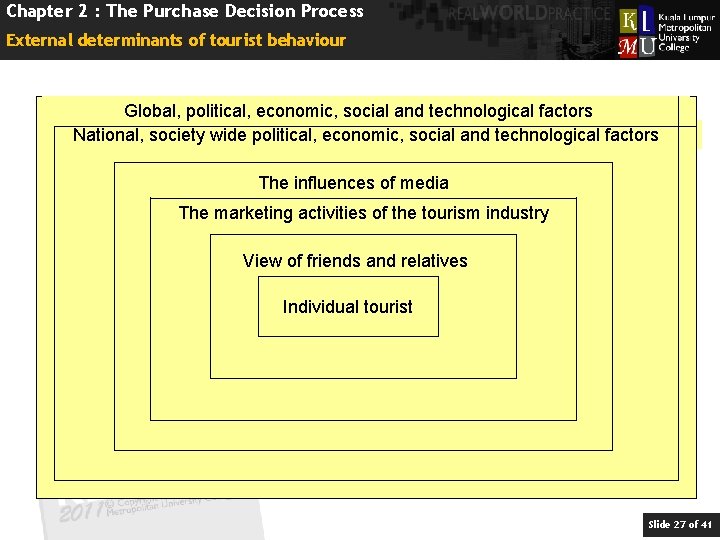
Chapter 2 : The Purchase Decision Process External determinants of tourist behaviour Global, political, economic, social and technological factors National, society wide political, economic, social and technological factors The influences of media The marketing activities of the tourism industry View of friends and relatives Individual tourist Slide 27 of 41
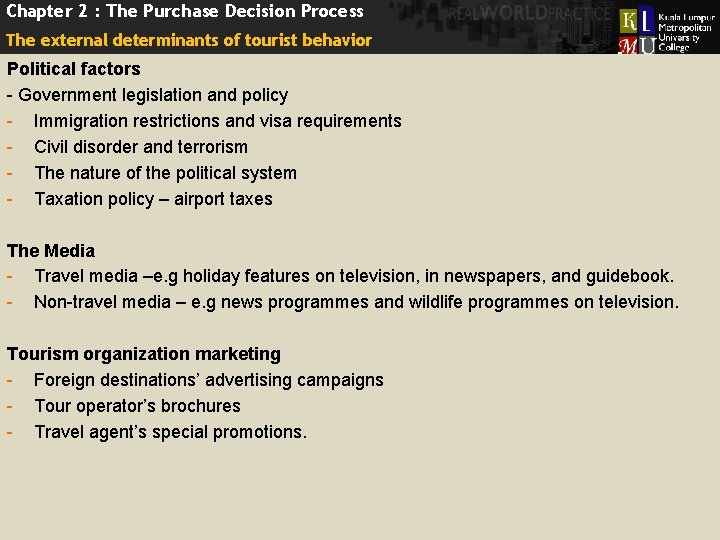
Chapter 2 : The Purchase Decision Process The external determinants of tourist behavior Political factors - Government legislation and policy - Immigration restrictions and visa requirements - Civil disorder and terrorism - The nature of the political system - Taxation policy – airport taxes The Media - Travel media –e. g holiday features on television, in newspapers, and guidebook. - Non-travel media – e. g news programmes and wildlife programmes on television. Tourism organization marketing - Foreign destinations’ advertising campaigns - Tour operator’s brochures - Travel agent’s special promotions. Slide 28 of 41
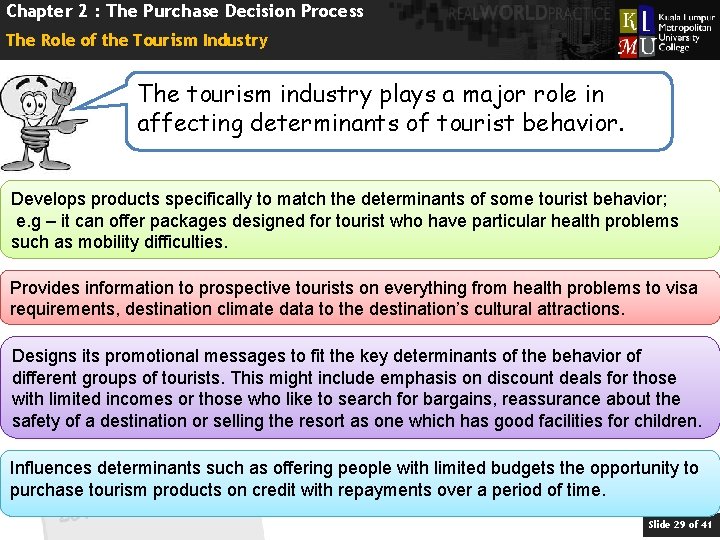
Chapter 2 : The Purchase Decision Process The Role of the Tourism Industry The tourism industry plays a major role in affecting determinants of tourist behavior. Develops products specifically to match the determinants of some tourist behavior; e. g – it can offer packages designed for tourist who have particular health problems such as mobility difficulties. Provides information to prospective tourists on everything from health problems to visa requirements, destination climate data to the destination’s cultural attractions. Designs its promotional messages to fit the key determinants of the behavior of different groups of tourists. This might include emphasis on discount deals for those with limited incomes or those who like to search for bargains, reassurance about the safety of a destination or selling the resort as one which has good facilities for children. Influences determinants such as offering people with limited budgets the opportunity to purchase tourism products on credit with repayments over a period of time. Slide 29 of 41
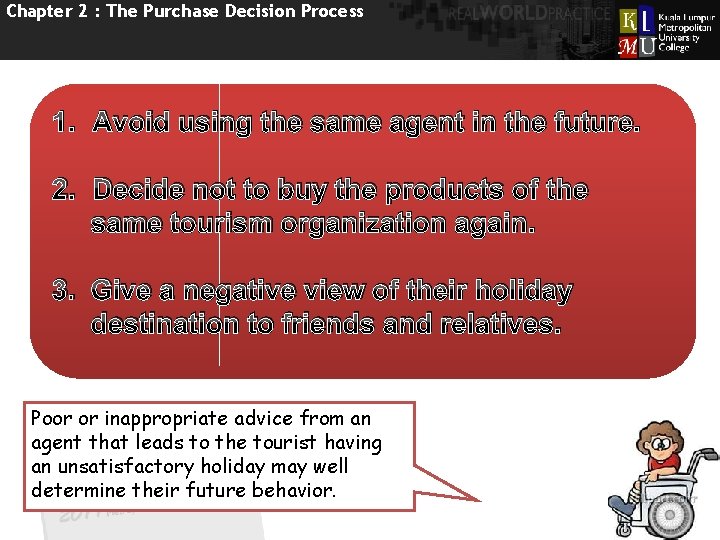
Chapter 2 : The Purchase Decision Process 1. Avoid using the same agent in the future. 2. Decide not to buy the products of the same tourism organization again. 3. Give a negative view of their holiday destination to friends and relatives. Poor or inappropriate advice from an agent that leads to the tourist having an unsatisfactory holiday may well determine their future behavior. Slide 30 of 41
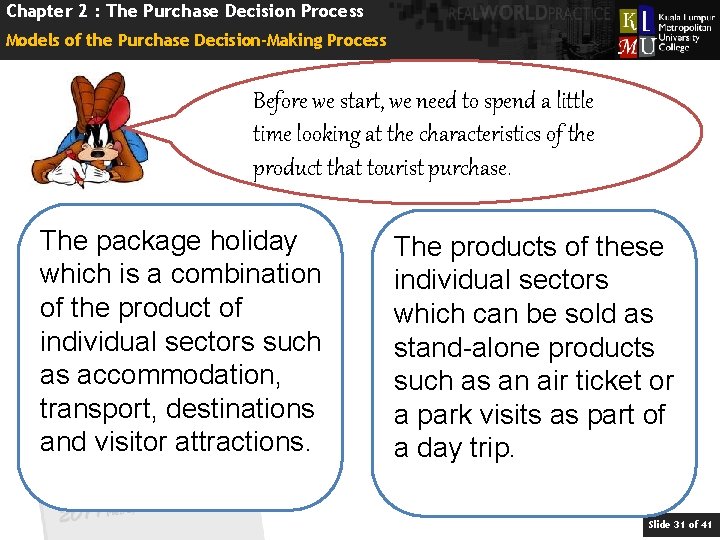
Chapter 2 : The Purchase Decision Process Models of the Purchase Decision-Making Process Before we start, we need to spend a little time looking at the characteristics of the product that tourist purchase. The package holiday which is a combination of the product of individual sectors such as accommodation, transport, destinations and visitor attractions. The products of these individual sectors which can be sold as stand-alone products such as an air ticket or a park visits as part of a day trip. Slide 31 of 41
Chapter 2 : The Purchase Decision Process Tourism Product and Services Tourism product are largely services. Marketing theorists have attempted to define services in relation to their intangibility and the fact that purchase of a service never results in the ownership of anything. Slide 32 of 41
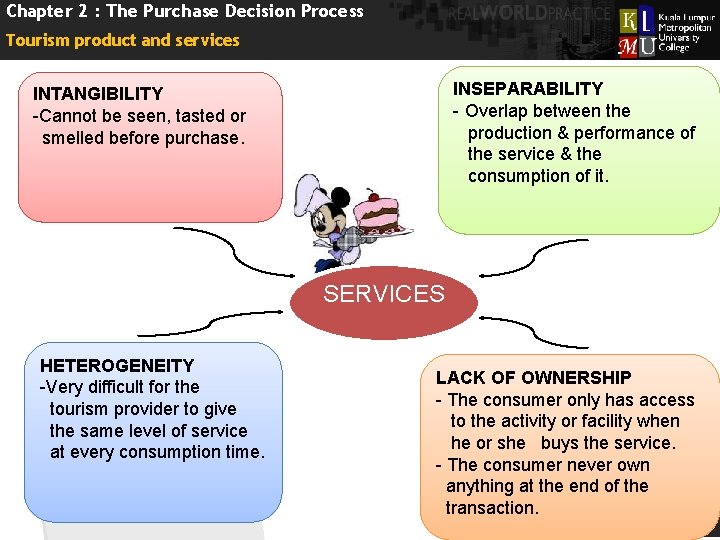
Chapter 2 : The Purchase Decision Process Tourism product and services INSEPARABILITY - Overlap between the production & performance of the service & the consumption of it. INTANGIBILITY -Cannot be seen, tasted or smelled before purchase. SERVICES HETEROGENEITY -Very difficult for the tourism provider to give the same level of service at every consumption time. LACK OF OWNERSHIP - The consumer only has access to the activity or facility when he or she buys the service. - The consumer never own anything at the end of the transaction. Slide 33 of 41
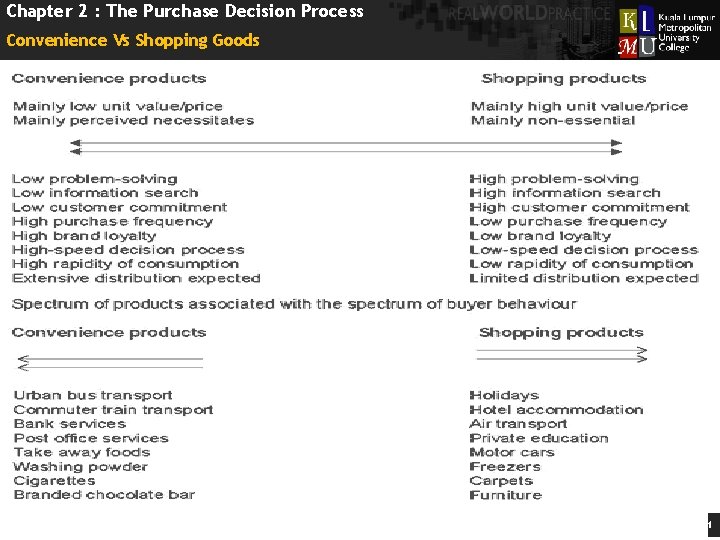
Chapter 2 : The Purchase Decision Process Convenience Vs Shopping Goods Slide 34 of 41
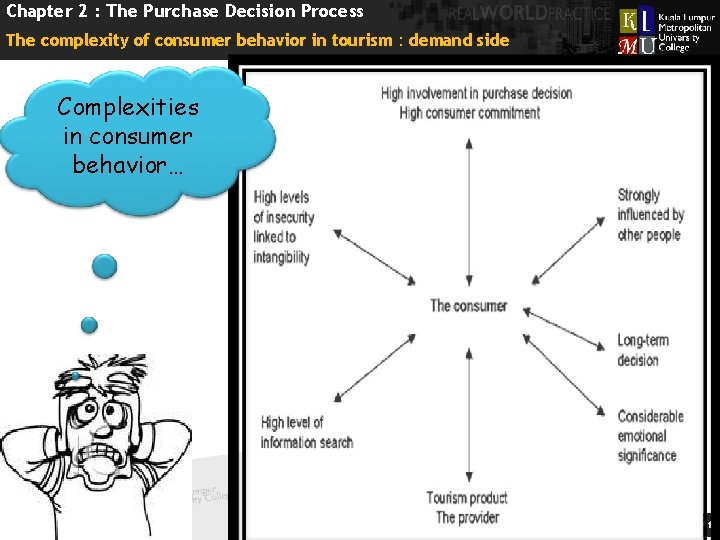
Chapter 2 : The Purchase Decision Process The complexity of consumer behavior in tourism : demand side Complexities in consumer behavior… Slide 35 of 41
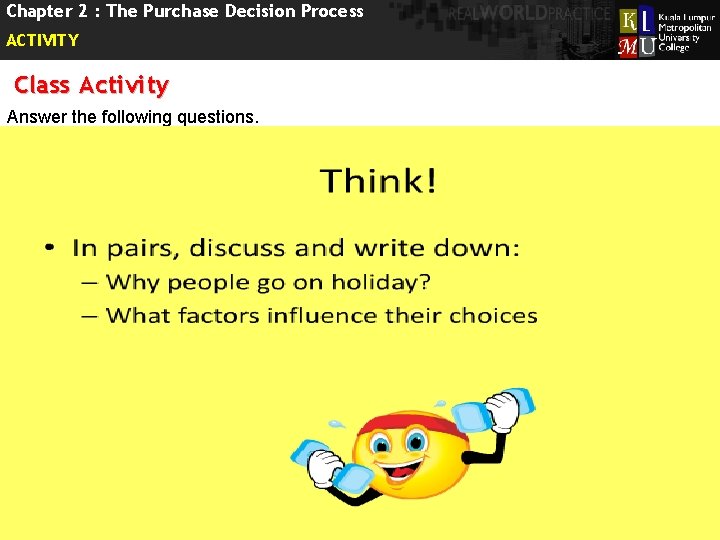
Chapter 2 : The Purchase Decision Process ACTIVITY Class Activity Answer the following questions. Slide 36 of 41
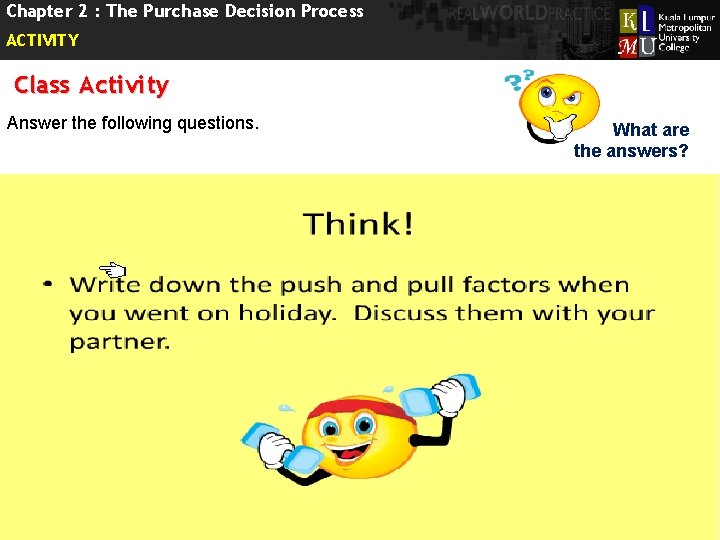
Chapter 2 : The Purchase Decision Process ACTIVITY Class Activity Answer the following questions. What are the answers? Slide 37 of 41
Chapter 2 : The Purchase Decision Process SUMMARY It appears that the issue of motivation is highly complex and depends on a range of factors, including; i) iii) iv) v) The personality and lifestyle of the potential tourists Their past experiences Who they are planning to take a vacation with Their demographic characteristics How far in advance they book their trip. Highlighted the potential links which exist between purchase decision models and market segmentation techniques. Slide 38 of 41
Chapter 2 : The Purchase Decision Process NEXT SESSION PREVIEW Slide 39 of 41
Chapter 2 : The Purchase Decision Process LIST OF REFERENCES 1. Swarbrooke, J. and Horner, S. (2008) Consumer Behaviour in Tourism 2 nd Edition, Butterworth Heinemann. 2. Cooper, C. , Fletcher, J. , Fyall, A. , Gilbert, D. and Wanhill, S. (2009) Tourism Principles and Practice 4 th Edition, Prentice Hall. 3. Ashworth, G. J. and Gooddallm B. ; “ Consumer Behaviour & Marketing Action” International Thomson Publishing, 2001 Slide 40 of 41
- Slides: 40