
Chapter 2 Beginnings of American Government Section 2
Chapter 2 Beginnings of American Government Section 2
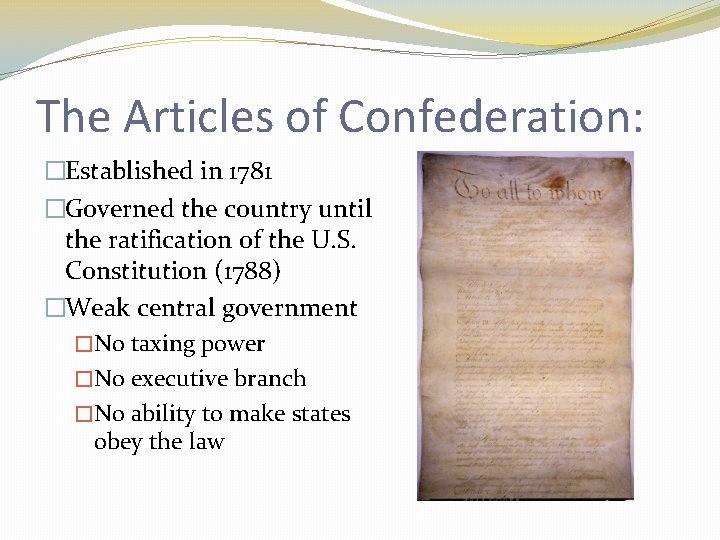
The Articles of Confederation: �Established in 1781 �Governed the country until the ratification of the U. S. Constitution (1788) �Weak central government �No taxing power �No executive branch �No ability to make states obey the law
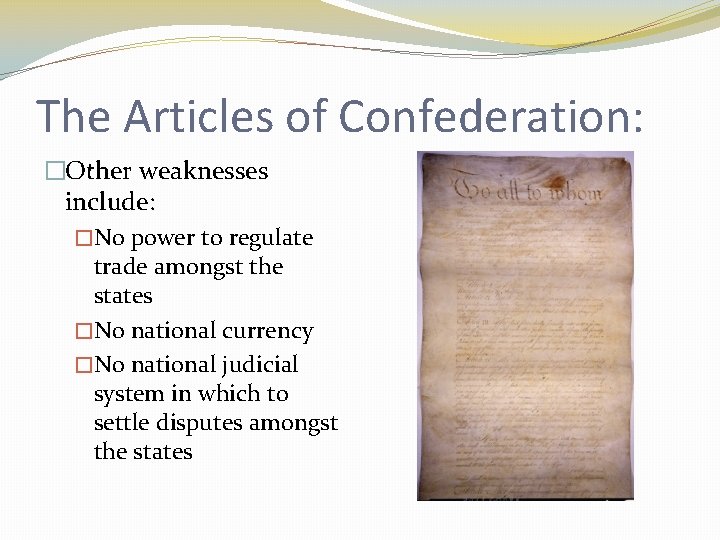
The Articles of Confederation: �Other weaknesses include: �No power to regulate trade amongst the states �No national currency �No national judicial system in which to settle disputes amongst the states
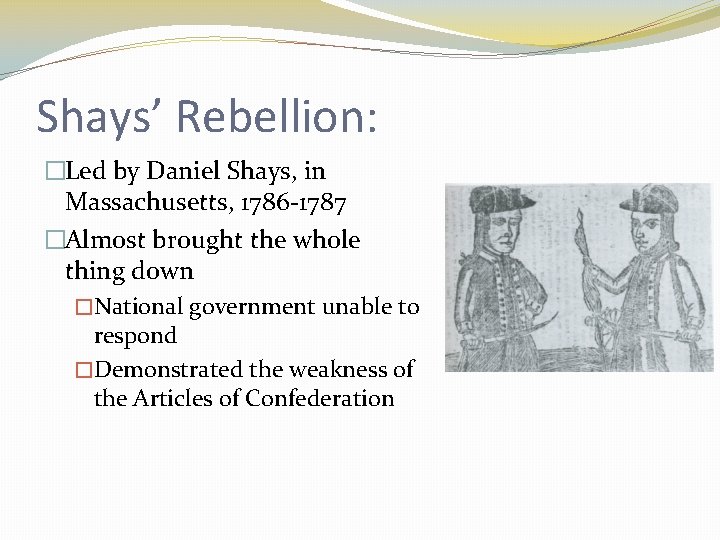
Shays’ Rebellion: �Led by Daniel Shays, in Massachusetts, 1786 -1787 �Almost brought the whole thing down �National government unable to respond �Demonstrated the weakness of the Articles of Confederation
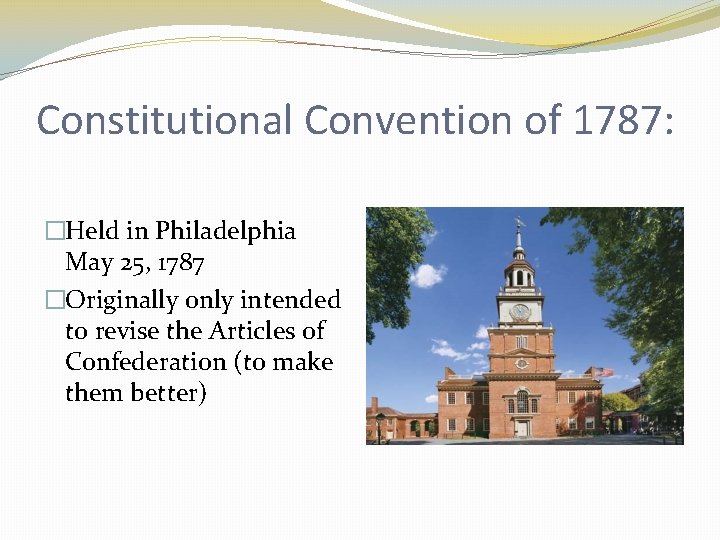
Constitutional Convention of 1787: �Held in Philadelphia May 25, 1787 �Originally only intended to revise the Articles of Confederation (to make them better)
Constitutional Convention of 1787: Compromises between the big and small states for representation: �The Virginia Plan: �Bicameral legislature �Representation determined by population (or money contributed to the federal government) �The New Jersey Plan: �Unicameral legislature �Equal representation for all states (regardless of population or money given)
The Great Compromise: �Congress would be bicameral �Equal representation for all states (regardless of population) in the upper house – Senate �Representation based on population in the lower house – House of Representatives �Additionally there was the three-fifths compromise �Dealt with how to count slaves in regards to population �Said that each slave would count as 3/5 of a person
Ratification: �The document, now completed needed to be ratified by the states �Ratification: The formal approval, or act of validating, a constitutional amendment, or a treaty �At least 9 of 13 states needed to approve in order to ratify �Process took over 2 years �Spawned many debates that still rage today (size and scope of government)
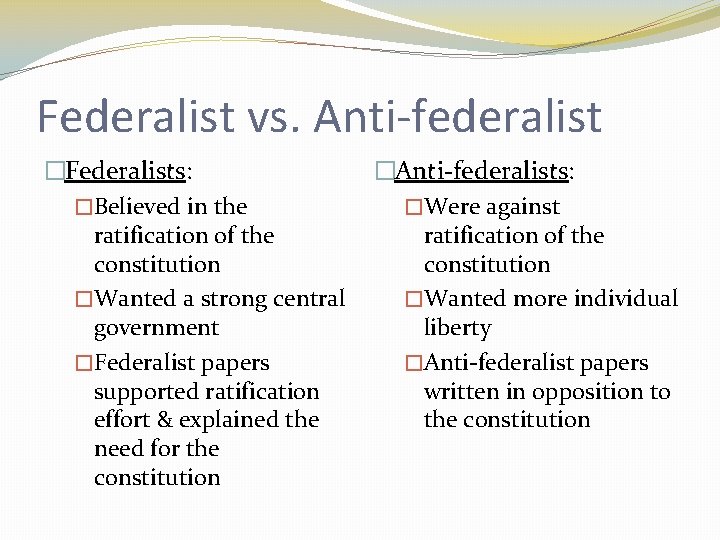
Federalist vs. Anti-federalist �Federalists: �Believed in the ratification of the constitution �Wanted a strong central government �Federalist papers supported ratification effort & explained the need for the constitution �Anti-federalists: �Were against ratification of the constitution �Wanted more individual liberty �Anti-federalist papers written in opposition to the constitution
- Slides: 9