
Chapter 2 Basic Data Structures Spring 2003 CS
Chapter 2: Basic Data Structures Spring 2003 CS 315
Basic Data Structures Stacks Queues Vectors, Linked Lists Trees (Including Balanced Trees) Priority Queues and Heaps Dictionaries and Hash Tables Spring 2003 CS 315 2
Two Definitions Depth of a node v in a tree is: n n 0 if v is root, else 1 + depth of parent of v Height of a tree is the maximum depth of an internal node of the tree Height of a node v is: n n 0 if external node 1 + max height of child of v Spring 2003 CS 315 3
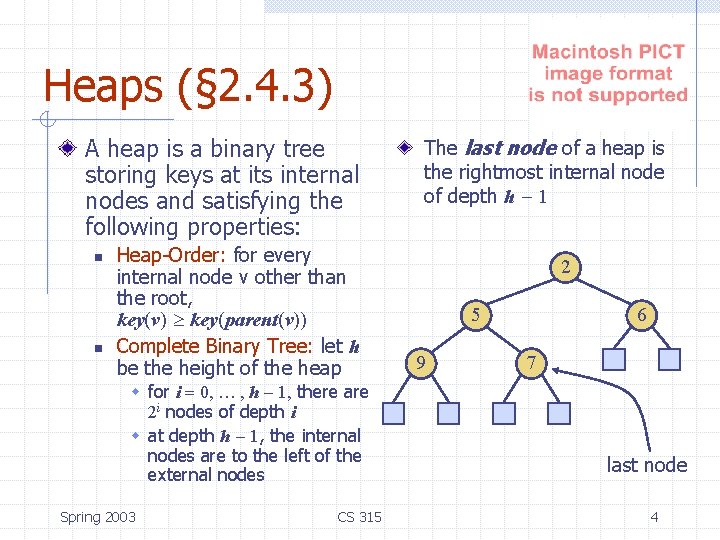
Heaps (§ 2. 4. 3) A heap is a binary tree storing keys at its internal nodes and satisfying the following properties: n n Heap-Order: for every internal node v other than the root, key(v) key(parent(v)) Complete Binary Tree: let h be the height of the heap w for i = 0, … , h - 1, there are 2 i nodes of depth i w at depth h - 1, the internal nodes are to the left of the external nodes Spring 2003 CS 315 The last node of a heap is the rightmost internal node of depth h - 1 2 5 9 6 7 last node 4
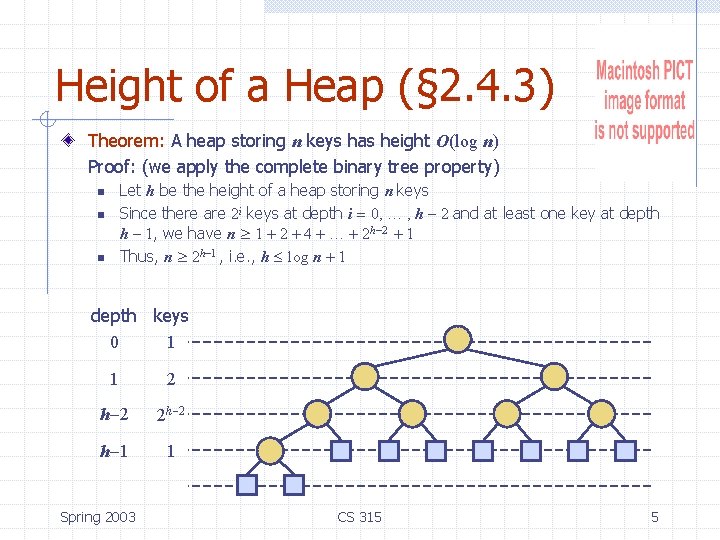
Height of a Heap (§ 2. 4. 3) Theorem: A heap storing n keys has height O(log n) Proof: (we apply the complete binary tree property) Let h be the height of a heap storing n keys Since there are 2 i keys at depth i = 0, … , h - 2 and at least one key at depth h - 1, we have n 1 + 2 + 4 + … + 2 h-2 + 1 Thus, n 2 h-1 , i. e. , h log n + 1 n n n depth keys 0 1 1 2 h-2 2 h-2 h-1 1 Spring 2003 CS 315 5
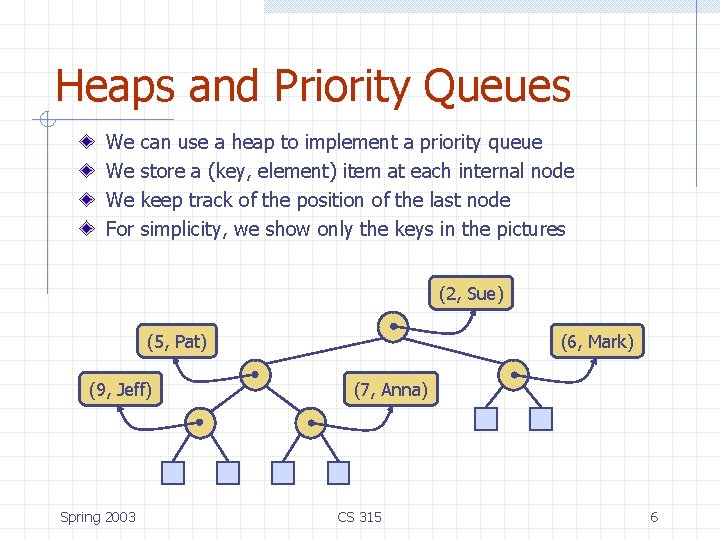
Heaps and Priority Queues We We We For can use a heap to implement a priority queue store a (key, element) item at each internal node keep track of the position of the last node simplicity, we show only the keys in the pictures (2, Sue) (5, Pat) (9, Jeff) Spring 2003 (6, Mark) (7, Anna) CS 315 6
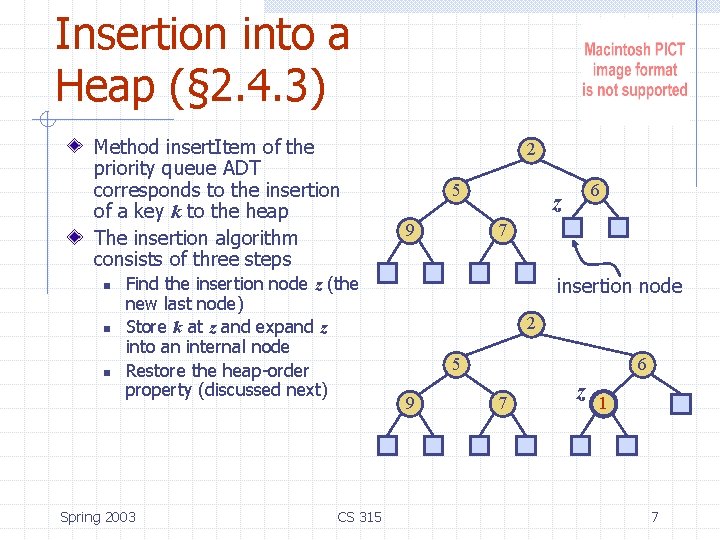
Insertion into a Heap (§ 2. 4. 3) Method insert. Item of the priority queue ADT corresponds to the insertion of a key k to the heap The insertion algorithm consists of three steps n n n Find the insertion node z (the new last node) Store k at z and expand z into an internal node Restore the heap-order property (discussed next) Spring 2003 CS 315 2 5 9 6 z 7 insertion node 2 5 9 6 7 z 1 7
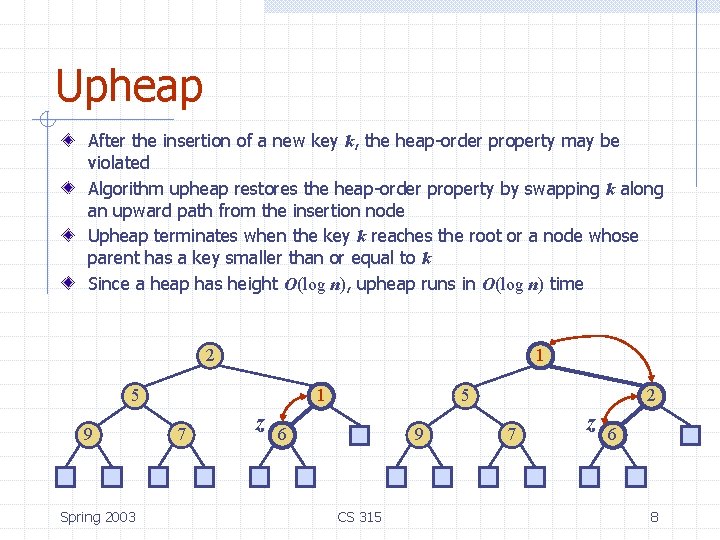
Upheap After the insertion of a new key k, the heap-order property may be violated Algorithm upheap restores the heap-order property by swapping k along an upward path from the insertion node Upheap terminates when the key k reaches the root or a node whose parent has a key smaller than or equal to k Since a heap has height O(log n), upheap runs in O(log n) time 2 1 5 9 Spring 2003 1 7 z 5 6 9 CS 315 2 7 z 6 8
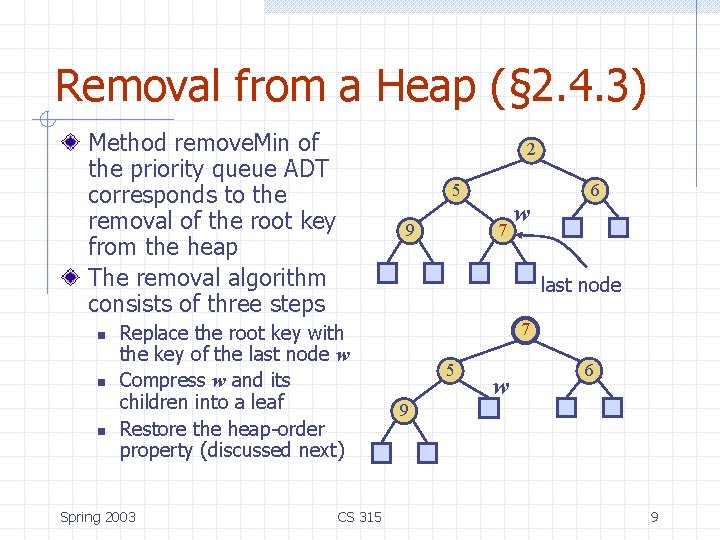
Removal from a Heap (§ 2. 4. 3) Method remove. Min of the priority queue ADT corresponds to the removal of the root key from the heap The removal algorithm consists of three steps n n n 2 5 9 7 w last node Replace the root key with the key of the last node w Compress w and its children into a leaf Restore the heap-order property (discussed next) Spring 2003 6 CS 315 7 5 w 6 9 9
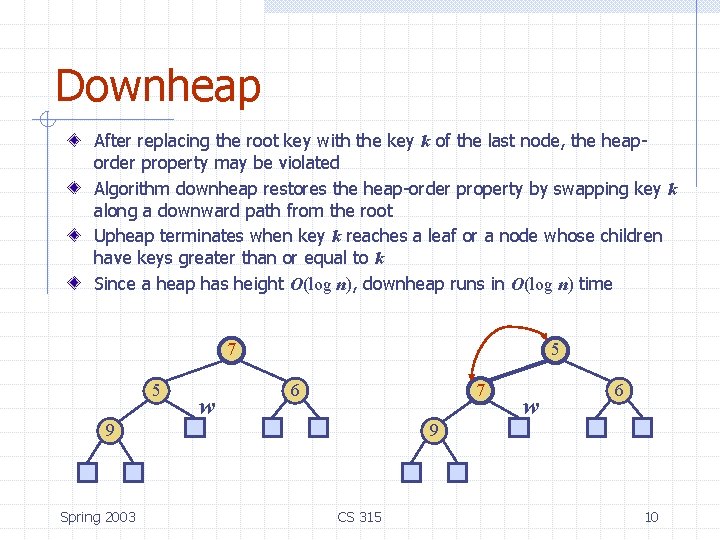
Downheap After replacing the root key with the key k of the last node, the heaporder property may be violated Algorithm downheap restores the heap-order property by swapping key k along a downward path from the root Upheap terminates when key k reaches a leaf or a node whose children have keys greater than or equal to k Since a heap has height O(log n), downheap runs in O(log n) time 7 5 w 5 6 7 9 Spring 2003 w 6 9 CS 315 10
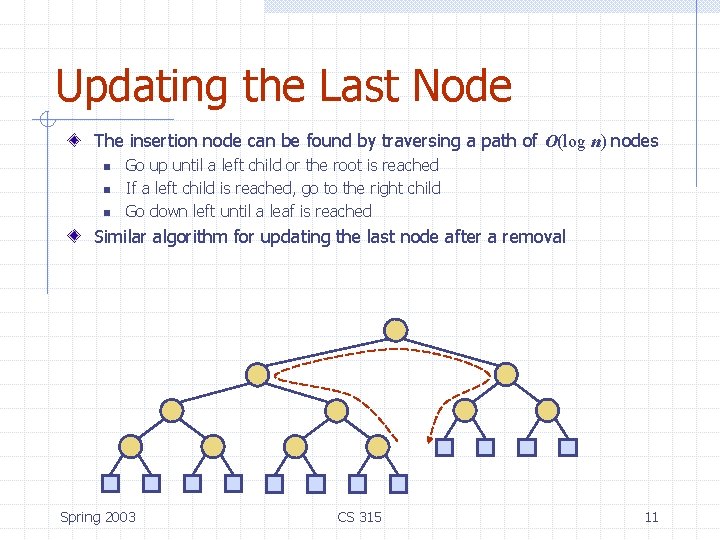
Updating the Last Node The insertion node can be found by traversing a path of O(log n) nodes n n n Go up until a left child or the root is reached If a left child is reached, go to the right child Go down left until a leaf is reached Similar algorithm for updating the last node after a removal Spring 2003 CS 315 11
Heap-Sort (§ 2. 4. 4) Consider a priority queue with n items implemented by means of a heap n n n the space used is O(n) methods insert. Item and remove. Min take O(log n) time methods size, is. Empty, min. Key, and min. Element take time O(1) time Spring 2003 CS 315 Using a heap-based priority queue, we can sort a sequence of n elements in O(n log n) time The resulting algorithm is called heap-sort Heap-sort is much faster than quadratic sorting algorithms, such as insertion-sort and selection-sort 12
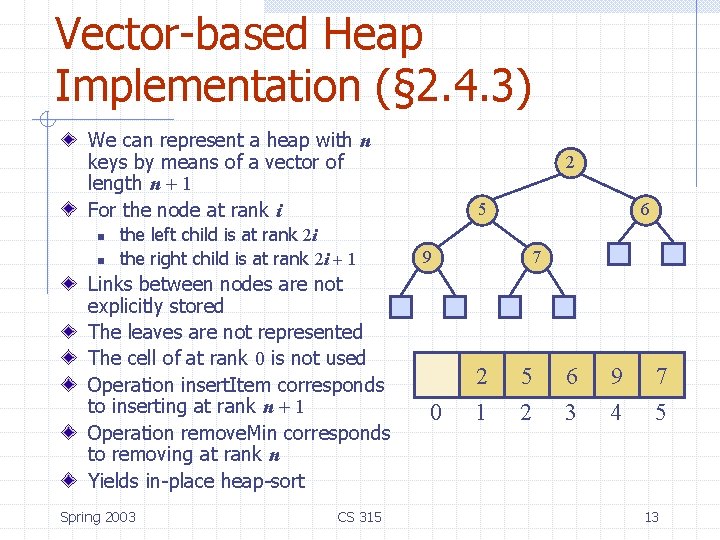
Vector-based Heap Implementation (§ 2. 4. 3) We can represent a heap with n keys by means of a vector of length n + 1 For the node at rank i n n the left child is at rank 2 i the right child is at rank 2 i + 1 Links between nodes are not explicitly stored The leaves are not represented The cell of at rank 0 is not used Operation insert. Item corresponds to inserting at rank n + 1 Operation remove. Min corresponds to removing at rank n Yields in-place heap-sort Spring 2003 CS 315 2 5 6 9 0 7 2 5 6 9 7 1 2 3 4 5 13
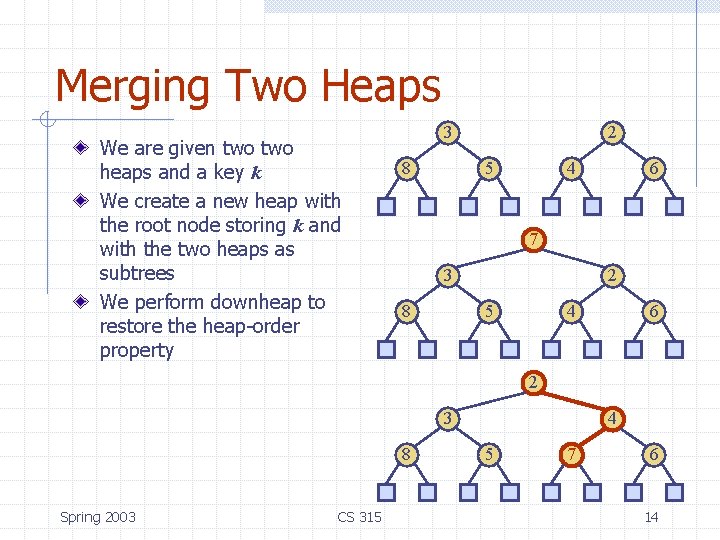
Merging Two Heaps We are given two heaps and a key k We create a new heap with the root node storing k and with the two heaps as subtrees We perform downheap to restore the heap-order property 3 8 2 5 4 6 7 3 8 2 5 4 6 2 3 8 Spring 2003 CS 315 4 5 7 6 14
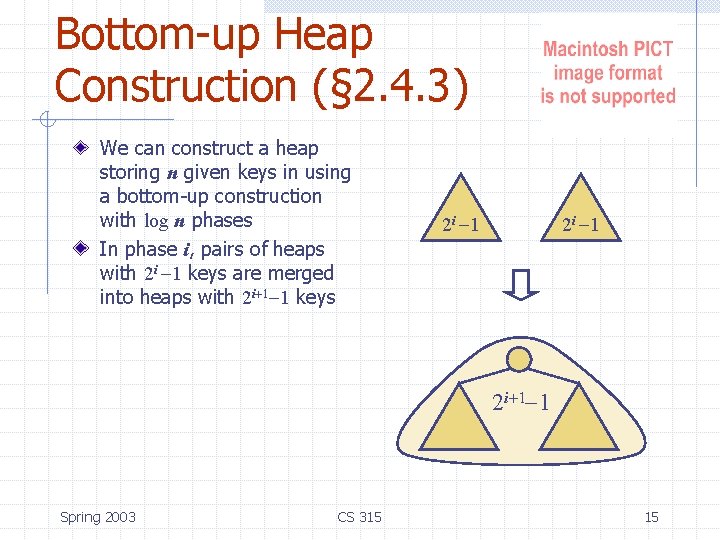
Bottom-up Heap Construction (§ 2. 4. 3) We can construct a heap storing n given keys in using a bottom-up construction with log n phases In phase i, pairs of heaps with 2 i -1 keys are merged into heaps with 2 i+1 -1 keys 2 i -1 2 i+1 -1 Spring 2003 CS 315 15
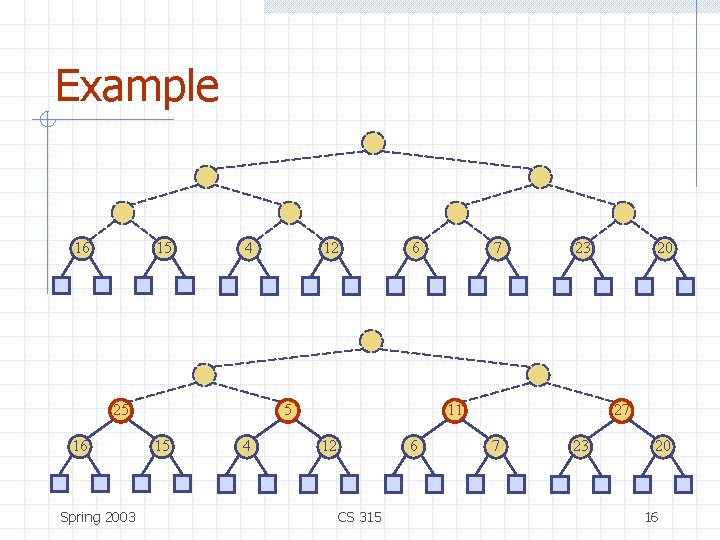
Example 16 15 4 25 16 Spring 2003 12 6 5 15 4 7 23 11 12 6 CS 315 20 27 7 23 20 16
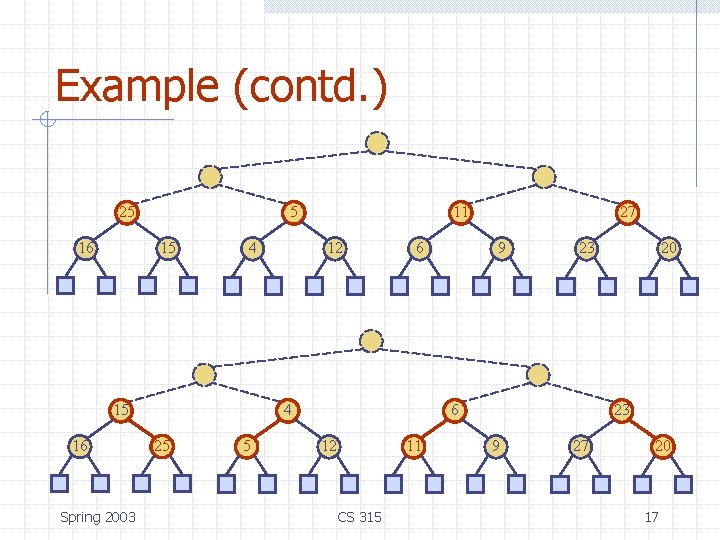
Example (contd. ) 25 16 5 15 4 15 16 Spring 2003 11 12 6 4 25 5 27 9 23 6 12 11 CS 315 20 23 9 27 20 17
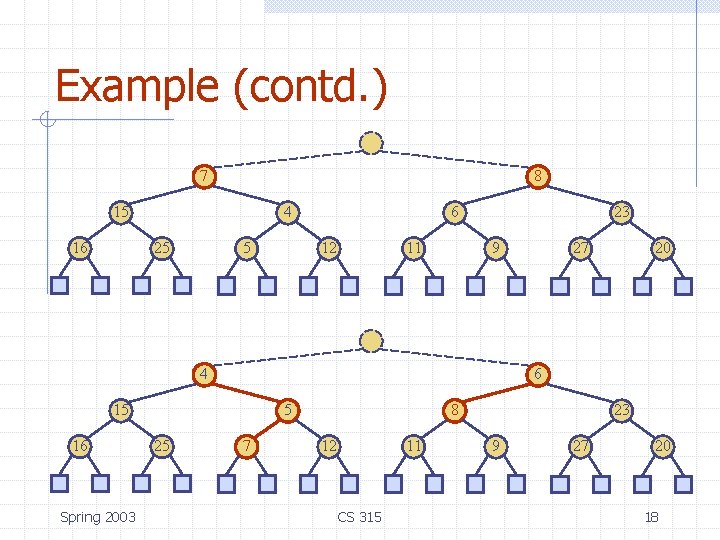
Example (contd. ) 7 8 15 16 4 25 5 6 12 11 23 9 4 Spring 2003 5 25 20 6 15 16 27 7 8 12 11 CS 315 23 9 27 20 18
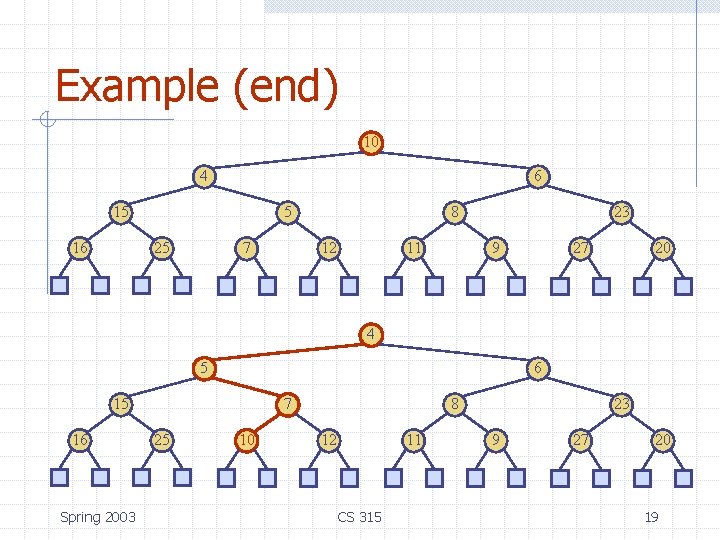
Example (end) 10 4 6 15 16 5 25 7 8 12 11 23 9 27 20 4 5 6 15 16 Spring 2003 7 25 10 8 12 11 CS 315 23 9 27 20 19
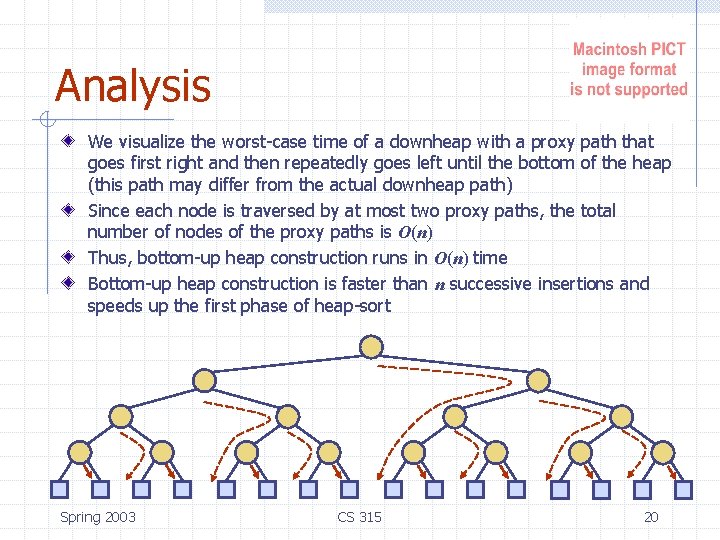
Analysis We visualize the worst-case time of a downheap with a proxy path that goes first right and then repeatedly goes left until the bottom of the heap (this path may differ from the actual downheap path) Since each node is traversed by at most two proxy paths, the total number of nodes of the proxy paths is O(n) Thus, bottom-up heap construction runs in O(n) time Bottom-up heap construction is faster than n successive insertions and speeds up the first phase of heap-sort Spring 2003 CS 315 20
- Slides: 20