
Chapter 2 Atoms and Elements Elements and Symbols
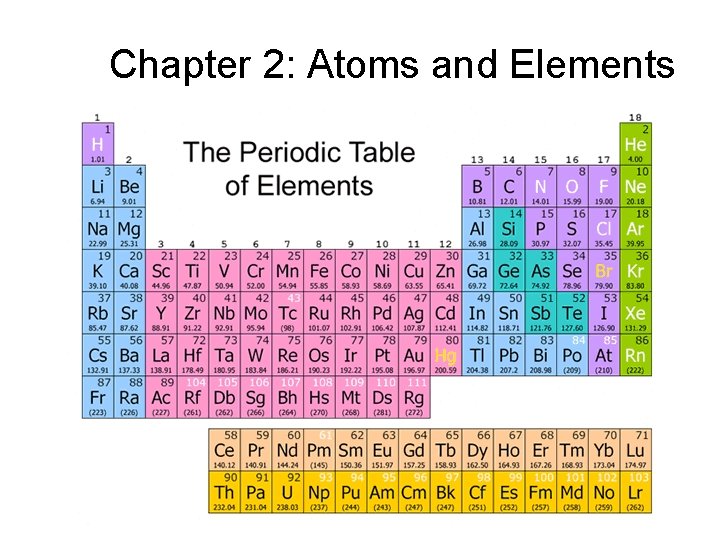
Chapter 2: Atoms and Elements
Elements and Symbols Element – Pure substance that can not be broken down into simpler substances by a chemical reaction • 1 letter symbols • C = Carbon • N = Nitrogen • O = Oxygen • 1 Capital letter • 2 letter symbols • Cl = Chlorine • Ba = Barium • Au = Gold • 1 Capital and 1 lower case letter
Compound • Pure substance formed by chemically combining two or more elements –H element + O element can make H 2 O compound –CO 2, HCl, C 3 H 8 • Atom smallest unit of an element • Molecule smallest unit of a compound
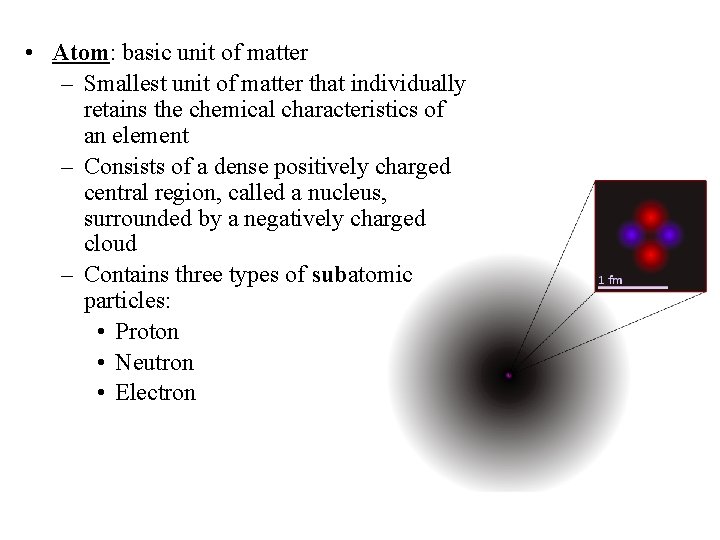
• Atom: basic unit of matter – Smallest unit of matter that individually retains the chemical characteristics of an element – Consists of a dense positively charged central region, called a nucleus, surrounded by a negatively charged cloud – Contains three types of subatomic particles: • Proton • Neutron • Electron
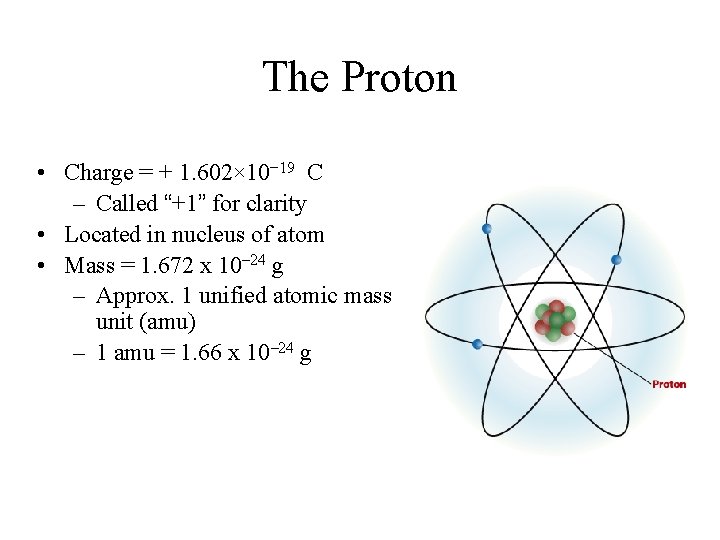
The Proton • Charge = + 1. 602× 10− 19 C – Called “+1” for clarity • Located in nucleus of atom • Mass = 1. 672 x 10– 24 g – Approx. 1 unified atomic mass unit (amu) – 1 amu = 1. 66 x 10– 24 g
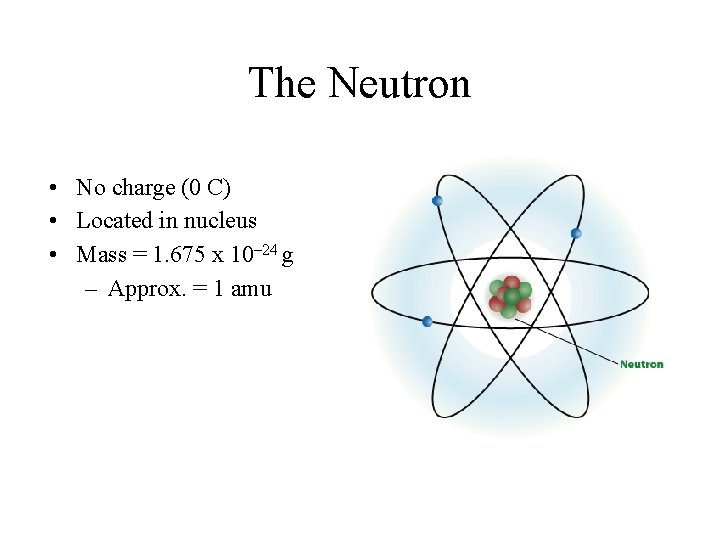
The Neutron • No charge (0 C) • Located in nucleus • Mass = 1. 675 x 10– 24 g – Approx. = 1 amu
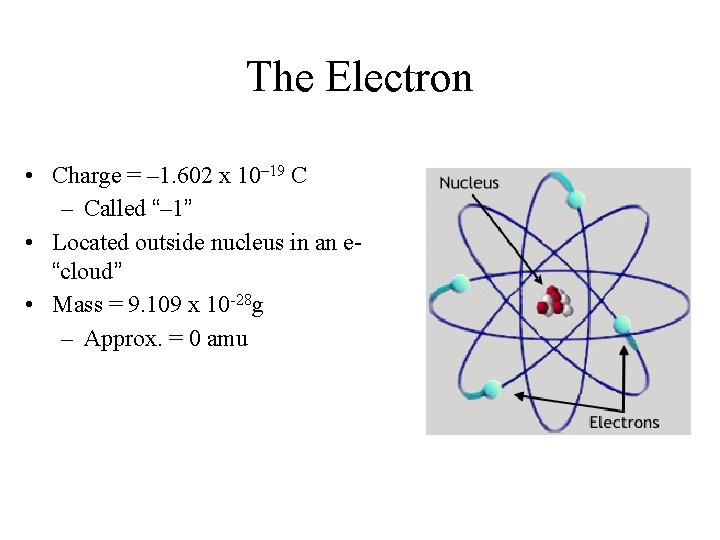
The Electron • Charge = – 1. 602 x 10– 19 C – Called “– 1” • Located outside nucleus in an e“cloud” • Mass = 9. 109 x 10 -28 g – Approx. = 0 amu
Recap • What are three subatomic particles? • Where are they located in the atom? • What are their weights in atomic mass units • What are their charges?
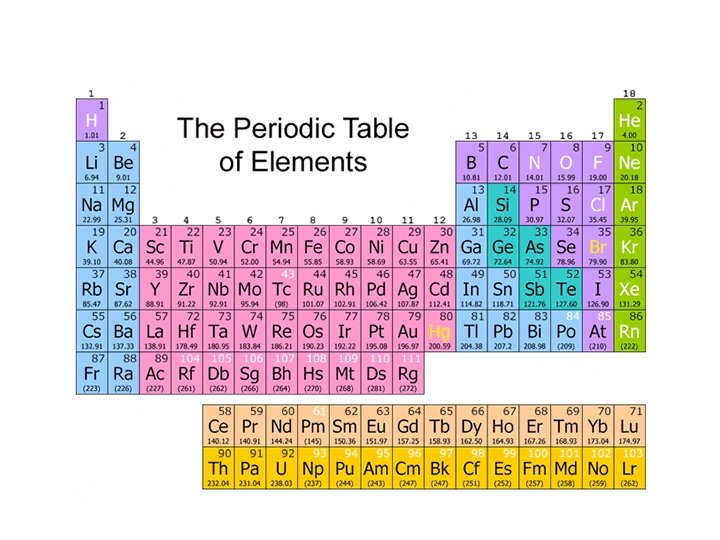
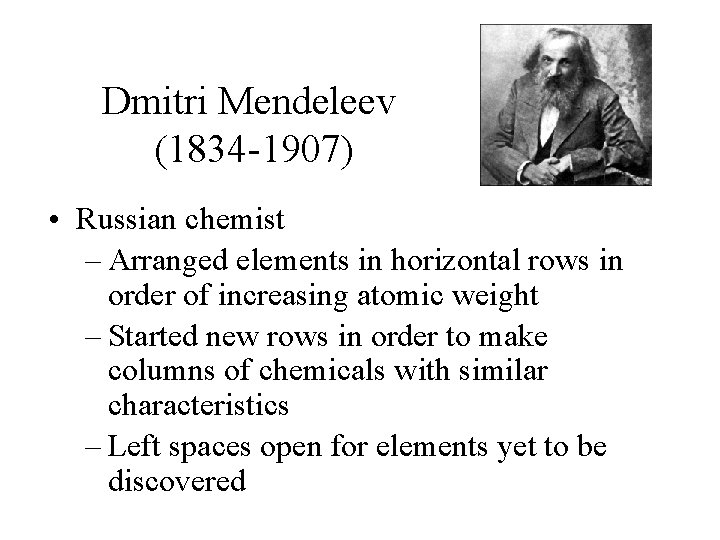
Dmitri Mendeleev (1834 -1907) • Russian chemist – Arranged elements in horizontal rows in order of increasing atomic weight – Started new rows in order to make columns of chemicals with similar characteristics – Left spaces open for elements yet to be discovered
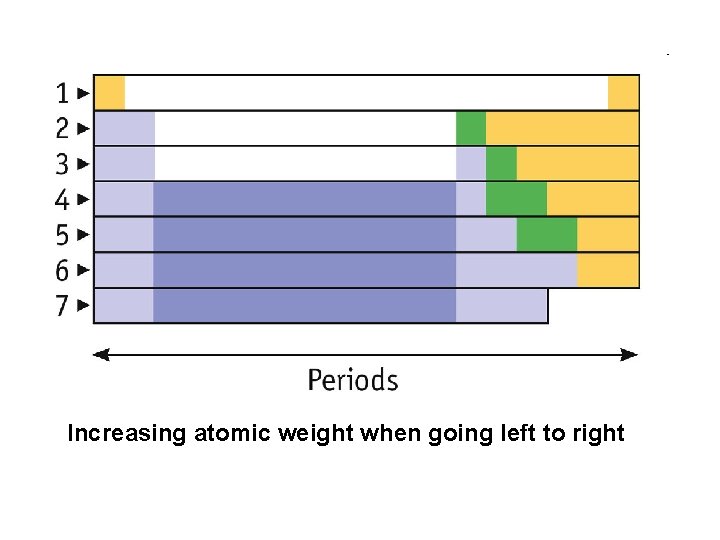
Increasing atomic weight when going left to right
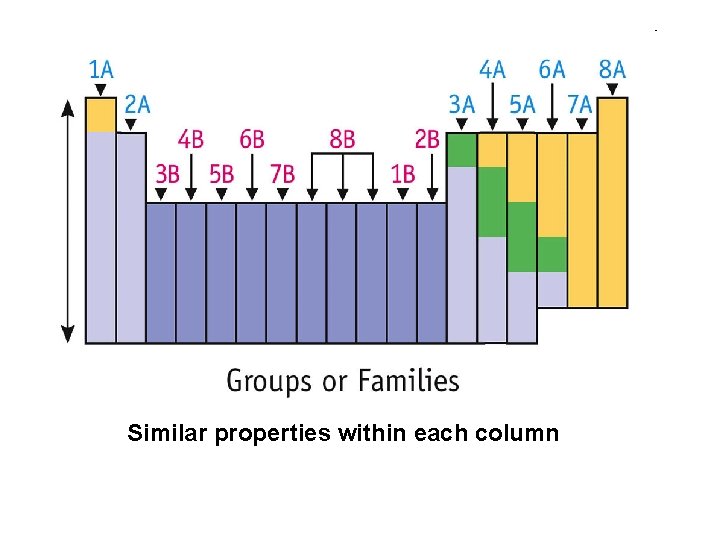
Similar properties within each column
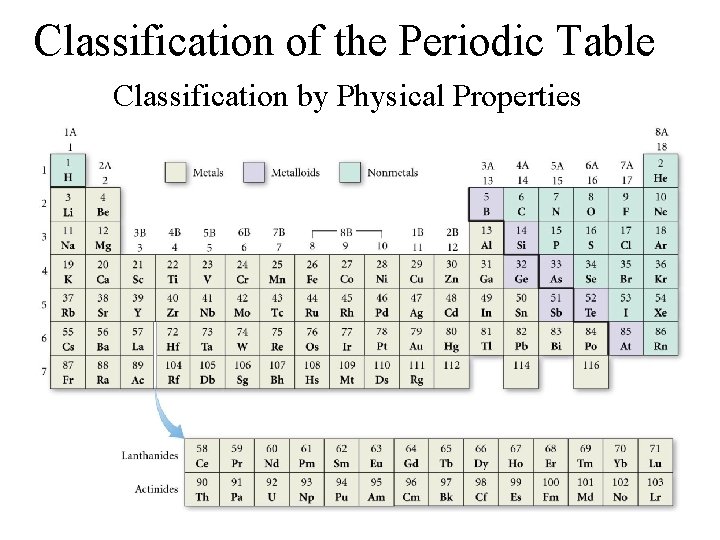
Classification of the Periodic Table Classification by Physical Properties
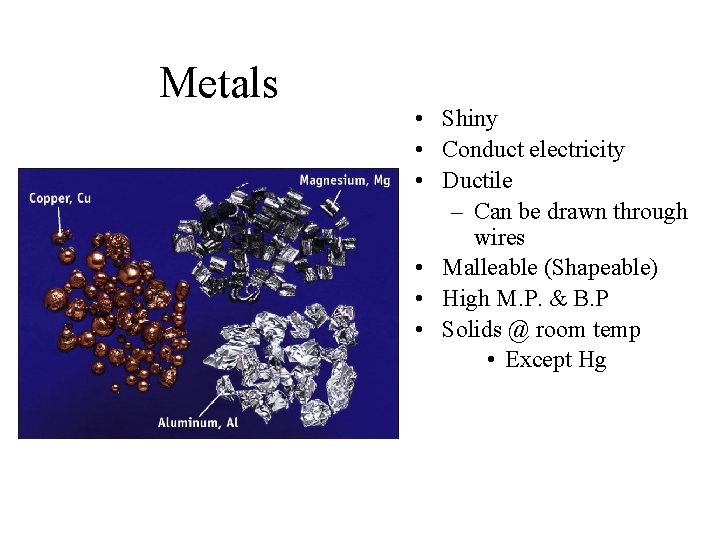
Metals • Shiny • Conduct electricity • Ductile – Can be drawn through wires • Malleable (Shapeable) • High M. P. & B. P • Solids @ room temp • Except Hg
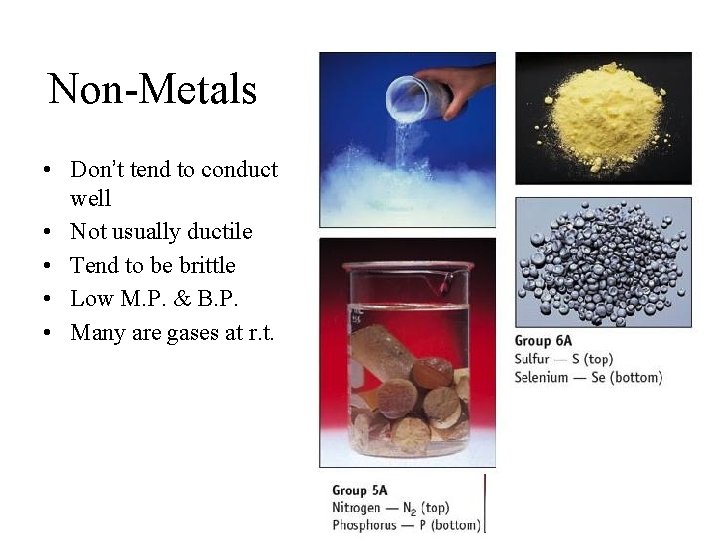
Non-Metals • Don’t tend to conduct well • Not usually ductile • Tend to be brittle • Low M. P. & B. P. • Many are gases at r. t.
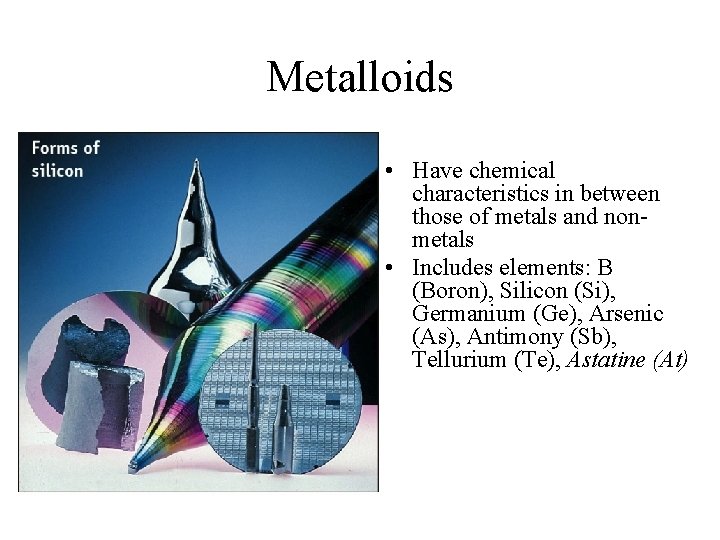
Metalloids • Have chemical characteristics in between those of metals and nonmetals • Includes elements: B (Boron), Silicon (Si), Germanium (Ge), Arsenic (As), Antimony (Sb), Tellurium (Te), Astatine (At)
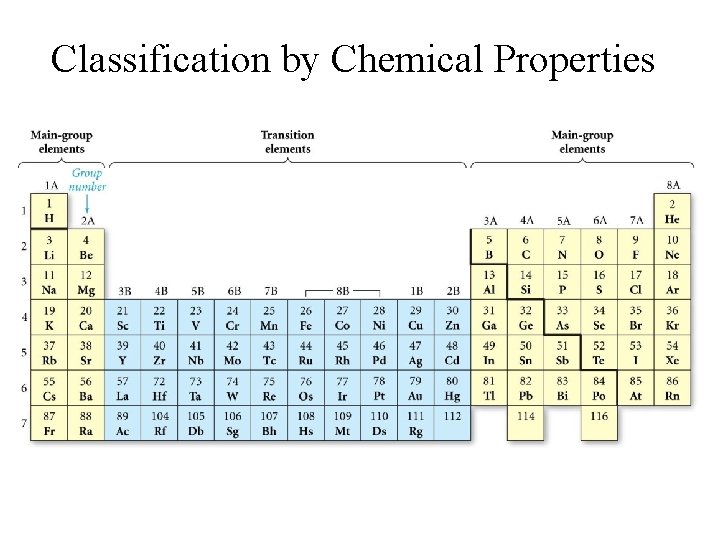
Classification by Chemical Properties
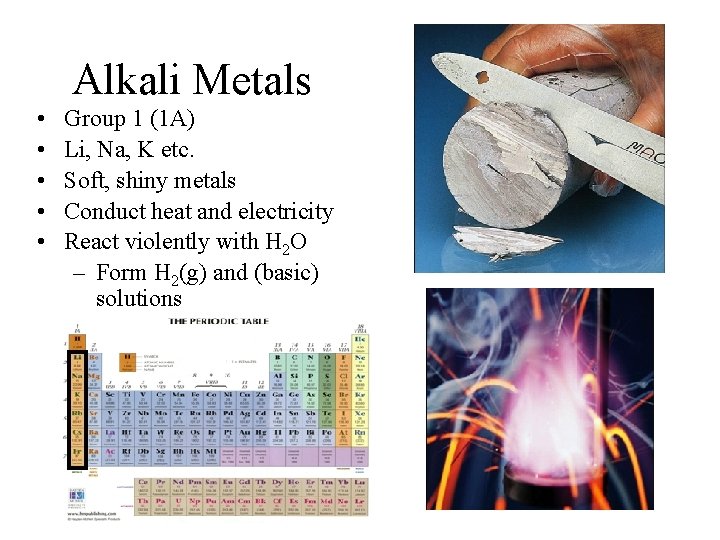
Alkali Metals • • • Group 1 (1 A) Li, Na, K etc. Soft, shiny metals Conduct heat and electricity React violently with H 2 O – Form H 2(g) and (basic) solutions
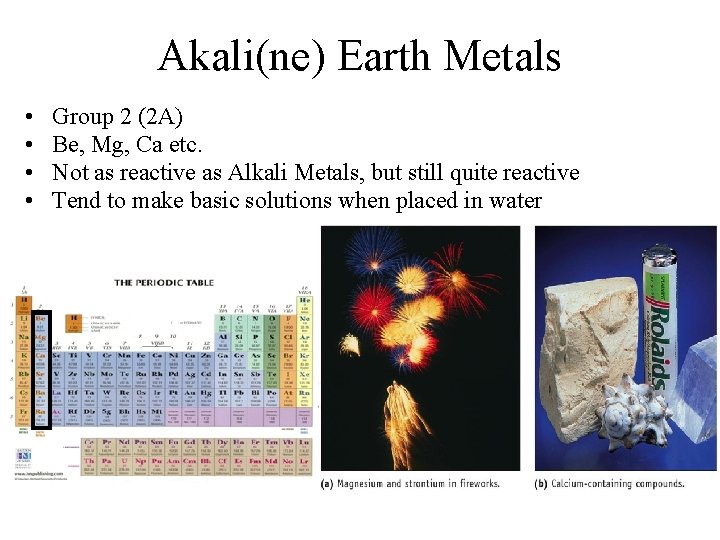
Akali(ne) Earth Metals • • Group 2 (2 A) Be, Mg, Ca etc. Not as reactive as Alkali Metals, but still quite reactive Tend to make basic solutions when placed in water
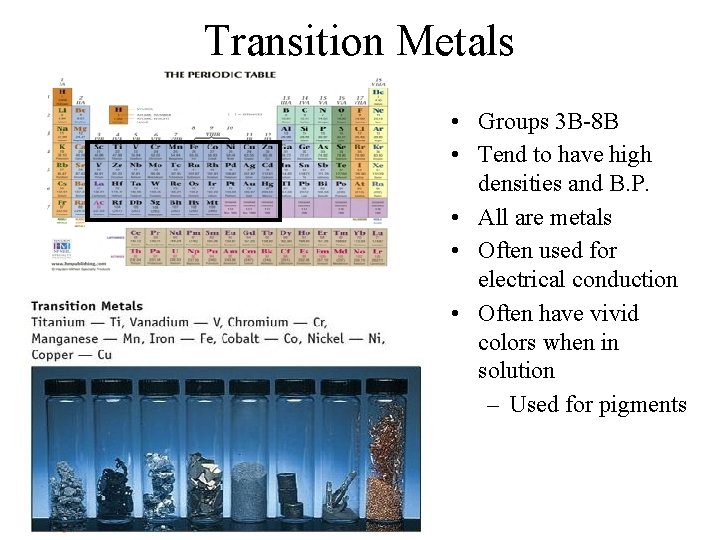
Transition Metals • Groups 3 B-8 B • Tend to have high densities and B. P. • All are metals • Often used for electrical conduction • Often have vivid colors when in solution – Used for pigments
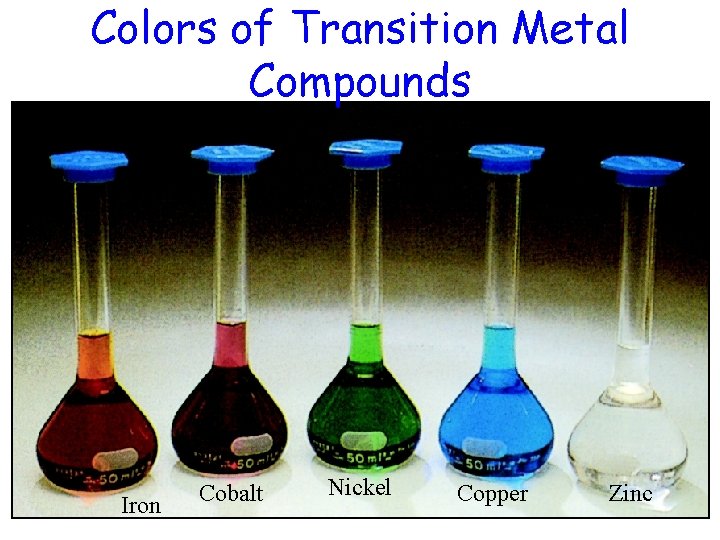
Colors of Transition Metal Compounds Iron Cobalt Nickel Copper Zinc
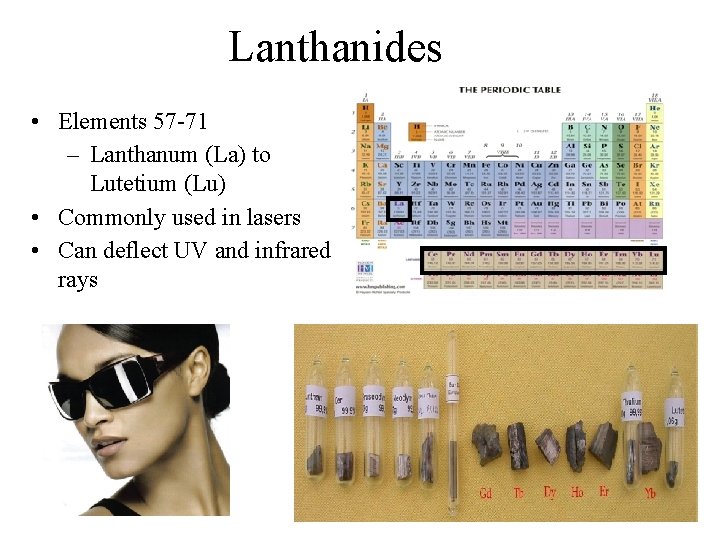
Lanthanides • Elements 57 -71 – Lanthanum (La) to Lutetium (Lu) • Commonly used in lasers • Can deflect UV and infrared rays
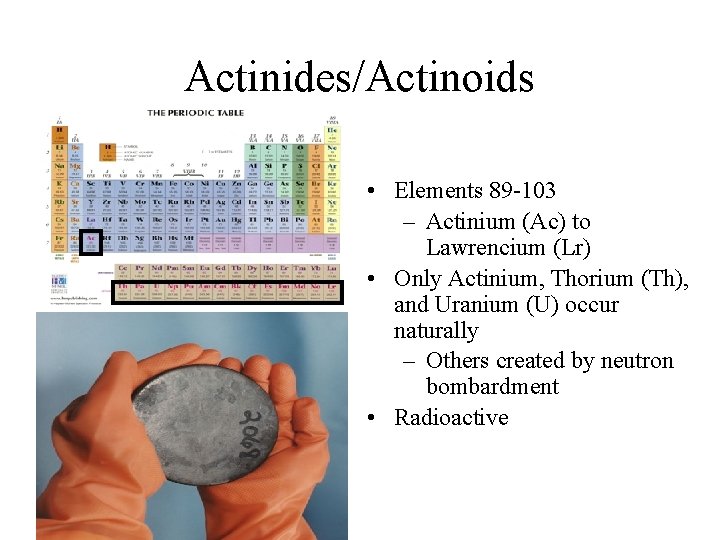
Actinides/Actinoids • Elements 89 -103 – Actinium (Ac) to Lawrencium (Lr) • Only Actinium, Thorium (Th), and Uranium (U) occur naturally – Others created by neutron bombardment • Radioactive
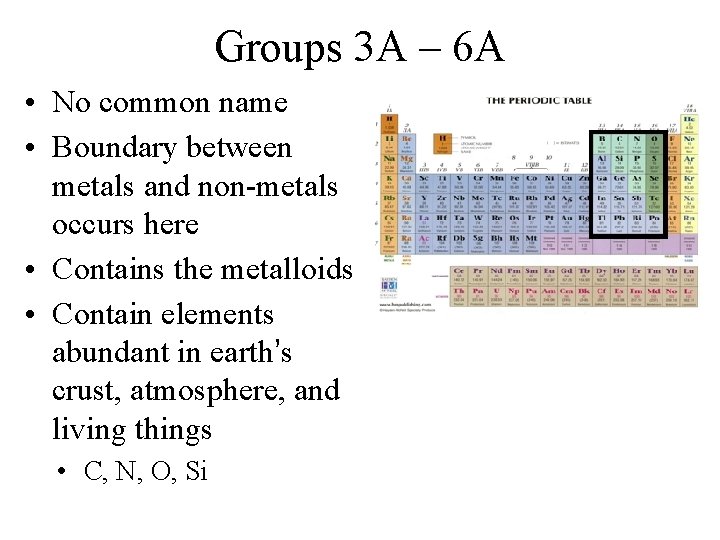
Groups 3 A – 6 A • No common name • Boundary between metals and non-metals occurs here • Contains the metalloids • Contain elements abundant in earth’s crust, atmosphere, and living things • C, N, O, Si
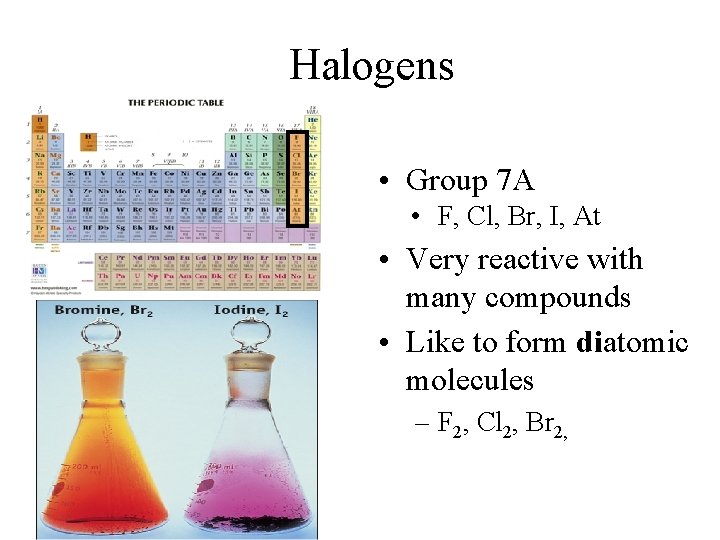
Halogens • Group 7 A • F, Cl, Br, I, At • Very reactive with many compounds • Like to form diatomic molecules – F 2, Cl 2, Br 2,
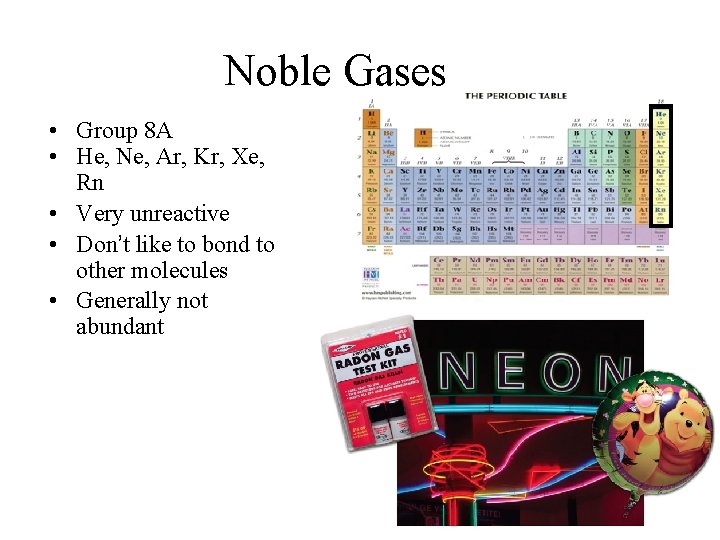
Noble Gases • Group 8 A • He, Ne, Ar, Kr, Xe, Rn • Very unreactive • Don’t like to bond to other molecules • Generally not abundant
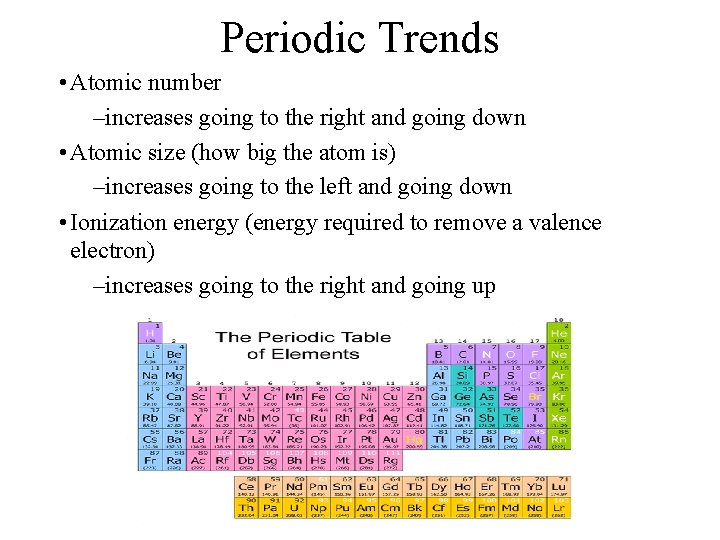
Periodic Trends • Atomic number –increases going to the right and going down • Atomic size (how big the atom is) –increases going to the left and going down • Ionization energy (energy required to remove a valence electron) –increases going to the right and going up
Problems • Identify an element from each of the groups 1. Noble Gas (example-- He aka Helium) 2. Lathanide 3. Alkali metals 4. Halogens 5. Actinides 6. Alkaline metals 7. Element that is abundant in living organisms
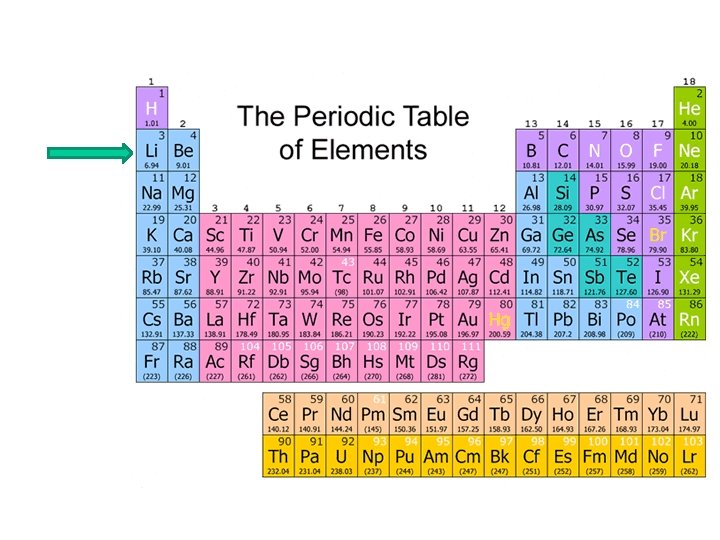
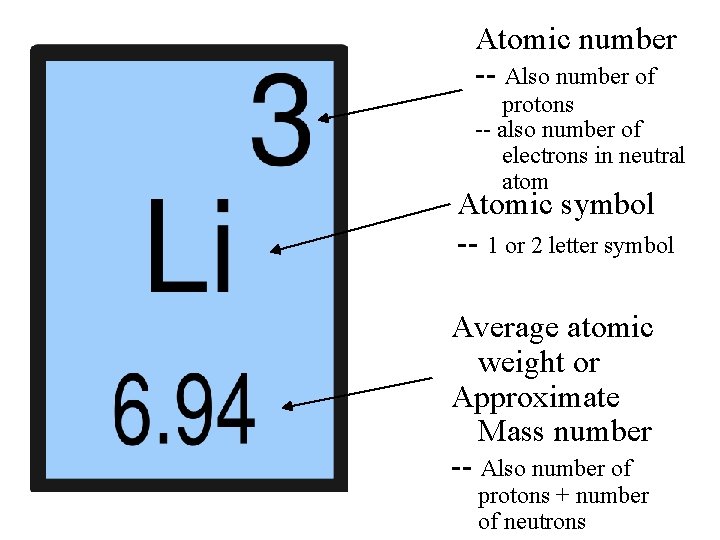
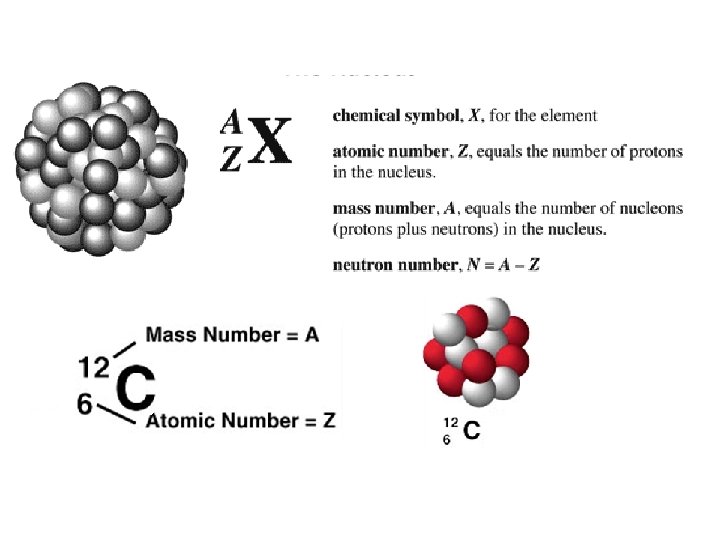
Atomic number -- Also number of protons -- also number of electrons in neutral atom Atomic symbol -- 1 or 2 letter symbol Average atomic weight or Approximate Mass number -- Also number of protons + number of neutrons
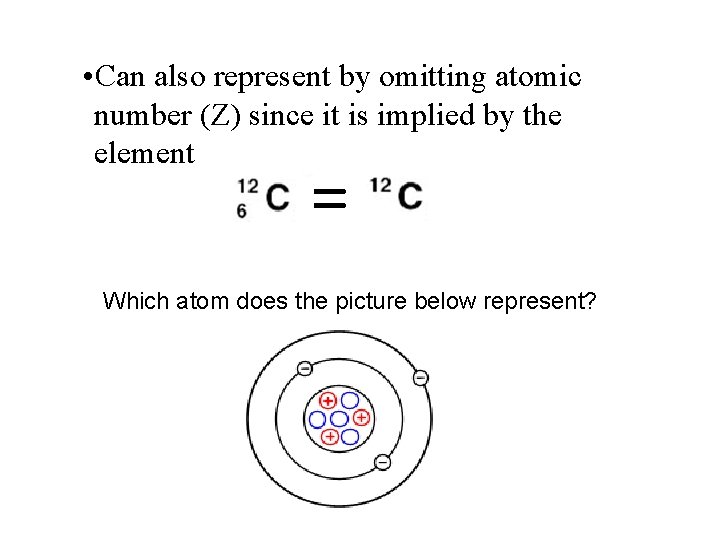
• Can also represent by omitting atomic number (Z) since it is implied by the element Which atom does the picture below represent?
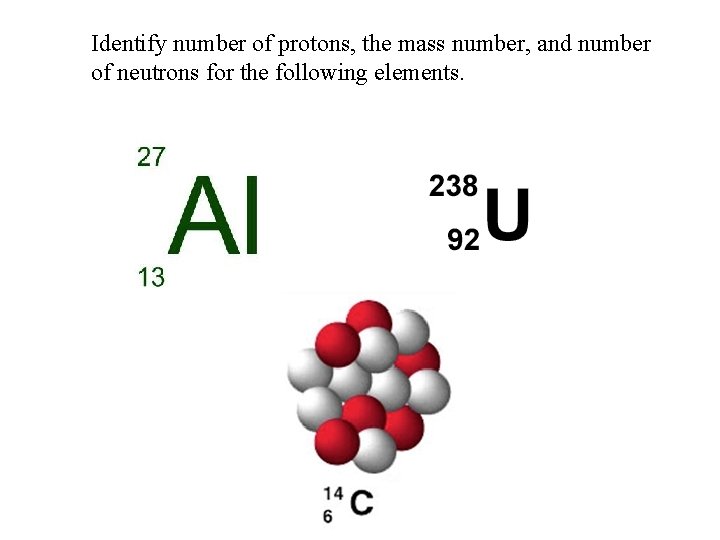
Identify number of protons, the mass number, and number of neutrons for the following elements.
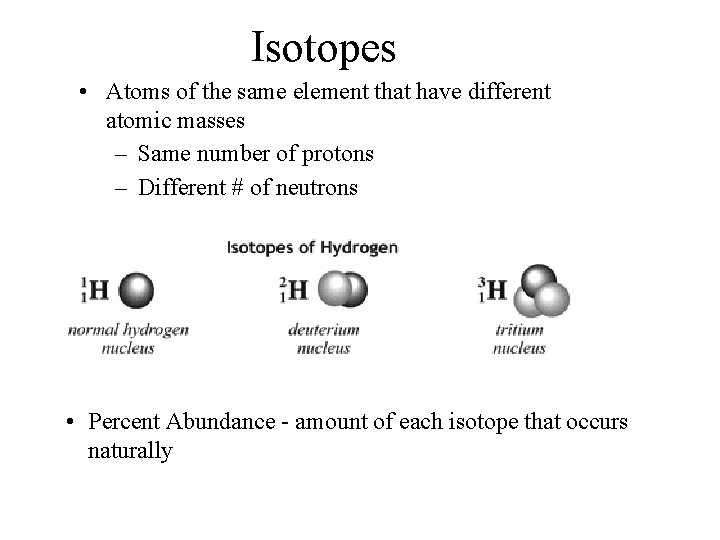
Isotopes • Atoms of the same element that have different atomic masses – Same number of protons – Different # of neutrons • Percent Abundance - amount of each isotope that occurs naturally
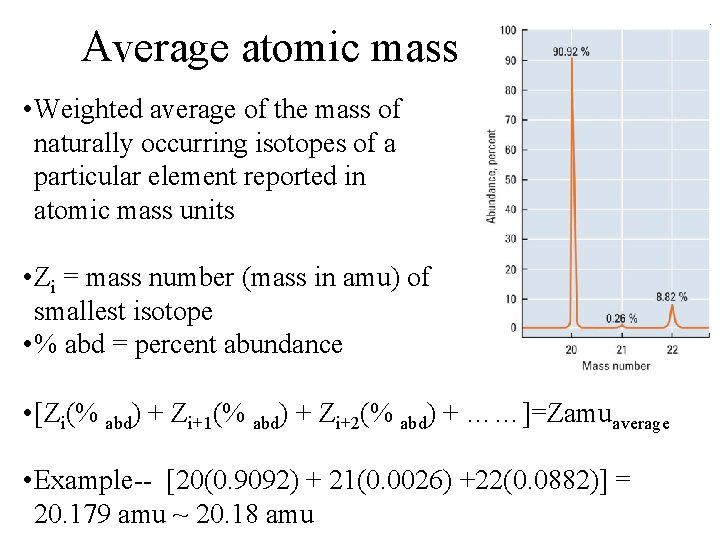
Average atomic mass • Weighted average of the mass of naturally occurring isotopes of a particular element reported in atomic mass units • Zi = mass number (mass in amu) of smallest isotope • % abd = percent abundance • [Zi(% abd) + Zi+1(% abd) + Zi+2(% abd) + ……]=Zamuaverage • Example-- [20(0. 9092) + 21(0. 0026) +22(0. 0882)] = 20. 179 amu ~ 20. 18 amu
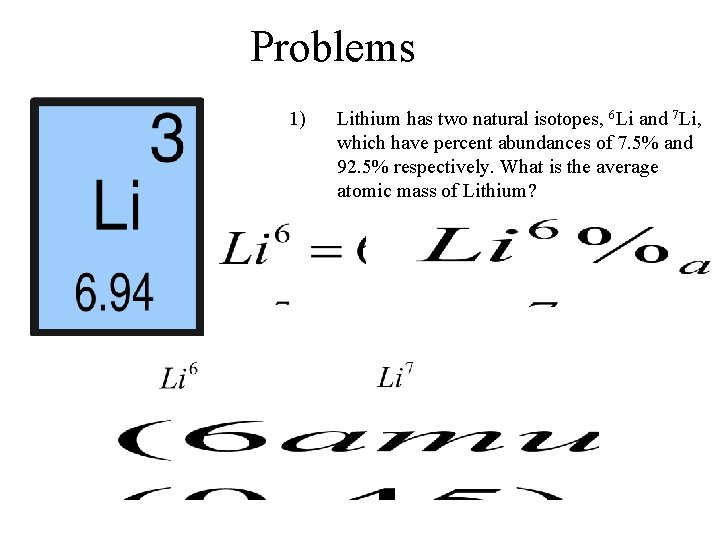
Problems 1) Lithium has two natural isotopes, 6 Li and 7 Li, which have percent abundances of 7. 5% and 92. 5% respectively. What is the average atomic mass of Lithium?
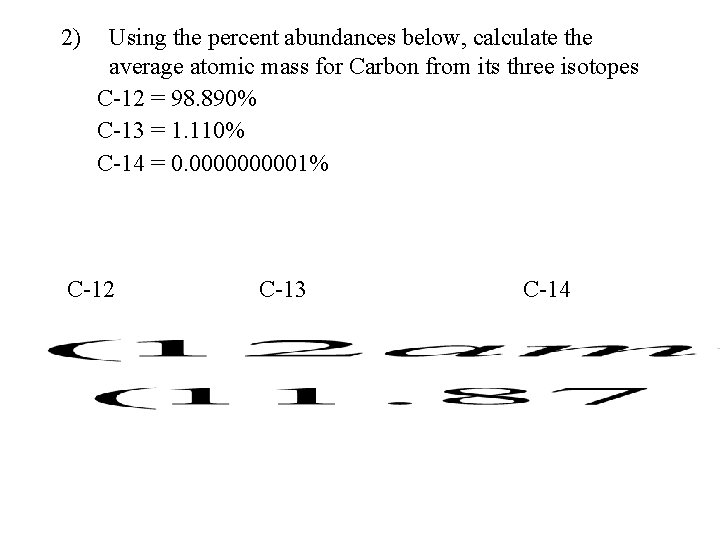
2) Using the percent abundances below, calculate the average atomic mass for Carbon from its three isotopes C-12 = 98. 890% C-13 = 1. 110% C-14 = 0. 000001% C-12 C-13 C-14
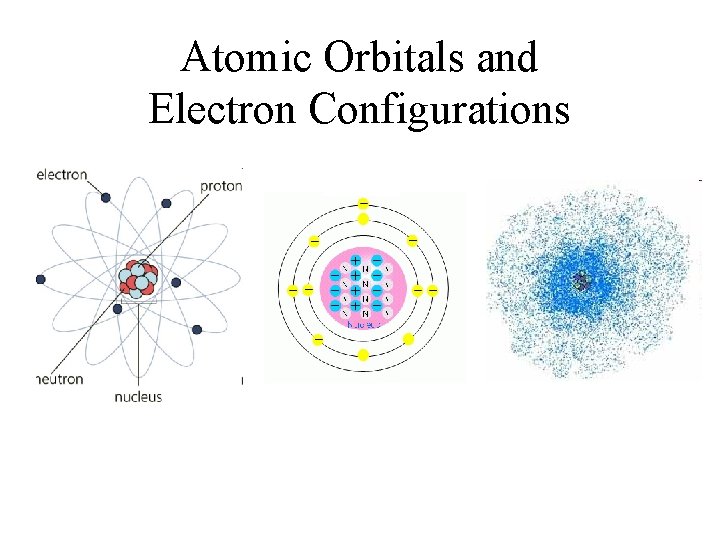
Atomic Orbitals and Electron Configurations
Electronic Structure • An electron is confined to a specific region around the nucleus, giving it a particular energy. • The regions occupied by electrons are called principal energy levels or shells (n). • The shells are numbered n = 1, 2, 3, etc. • Electrons in lower numbered shells are closer to the nucleus and are lower in energy. • Electrons in higher numbered shells are further from the nucleus and are higher in energy. 44
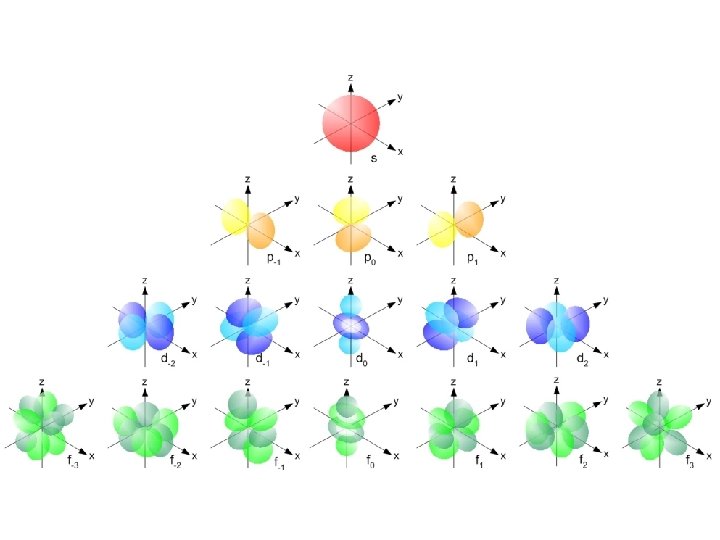
Electronic Structure • Shells are divided into subshells, identified by the letters s, p, d, and f. • The subshells consist of orbitals. • An orbital is a region of space where the probability of finding an electron is high. • Each orbital can hold two electrons. increasing energy Subshell s p Number of Orbitals 1 3 d 5 f 7 45
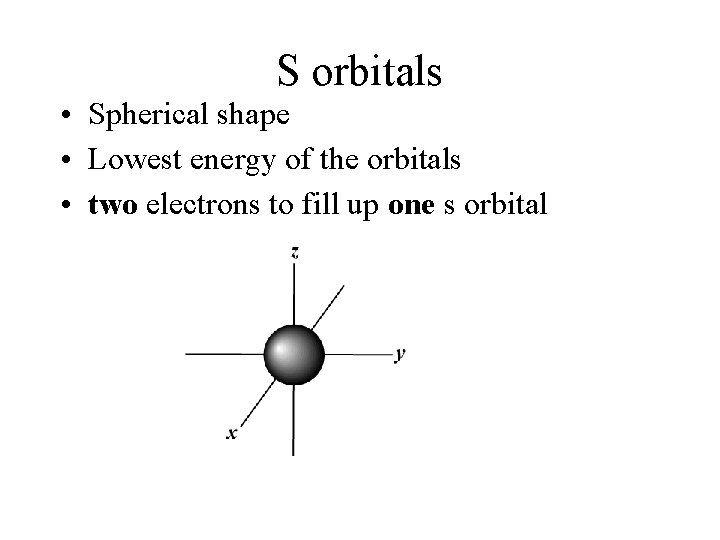
S orbitals • Spherical shape • Lowest energy of the orbitals • two electrons to fill up one s orbital
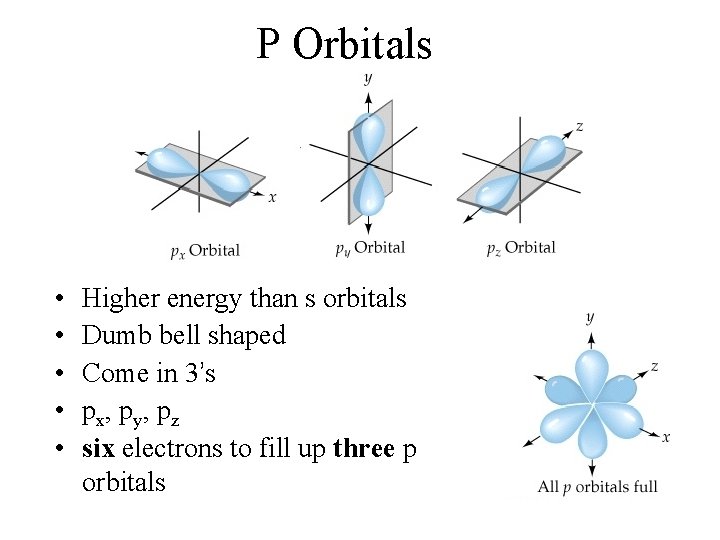
P Orbitals • • • Higher energy than s orbitals Dumb bell shaped Come in 3’s px, py, pz six electrons to fill up three p orbitals
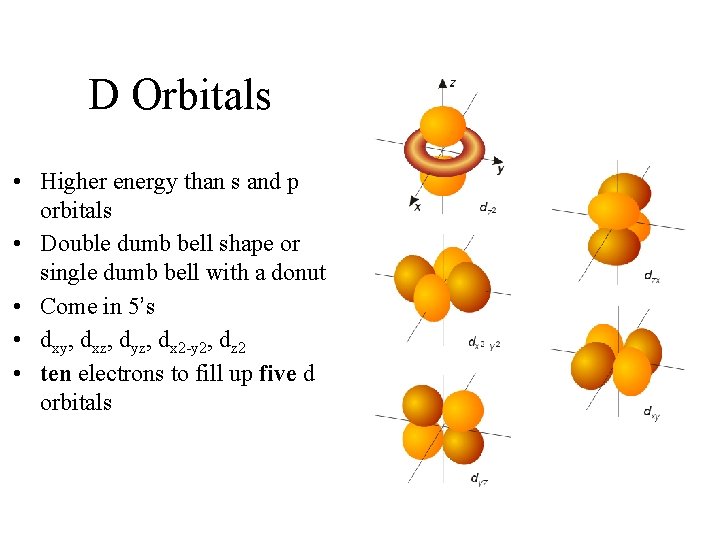
D Orbitals • Higher energy than s and p orbitals • Double dumb bell shape or single dumb bell with a donut • Come in 5’s • dxy, dxz, dyz, dx 2 -y 2, dz 2 • ten electrons to fill up five d orbitals
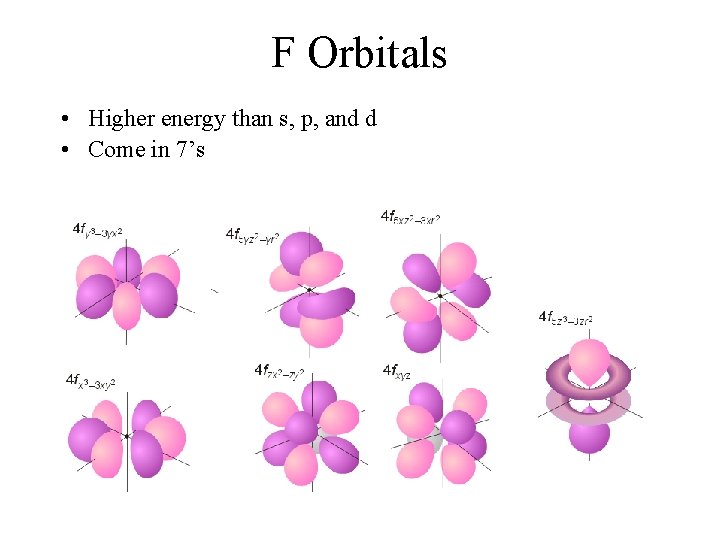
F Orbitals • Higher energy than s, p, and d • Come in 7’s
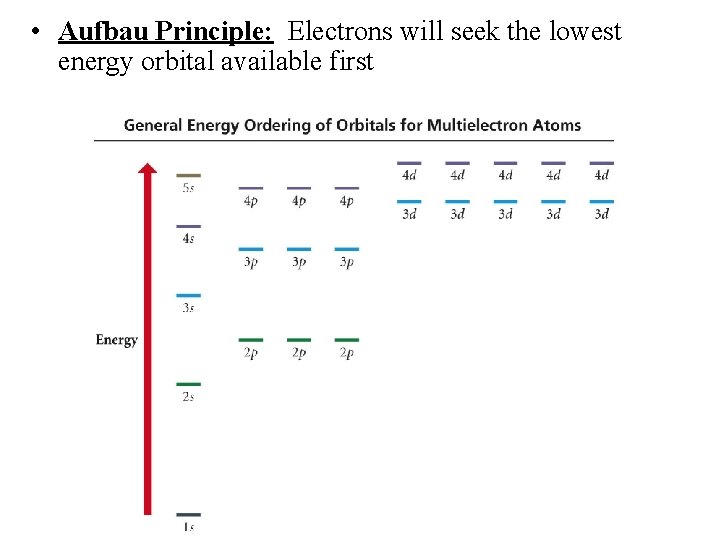
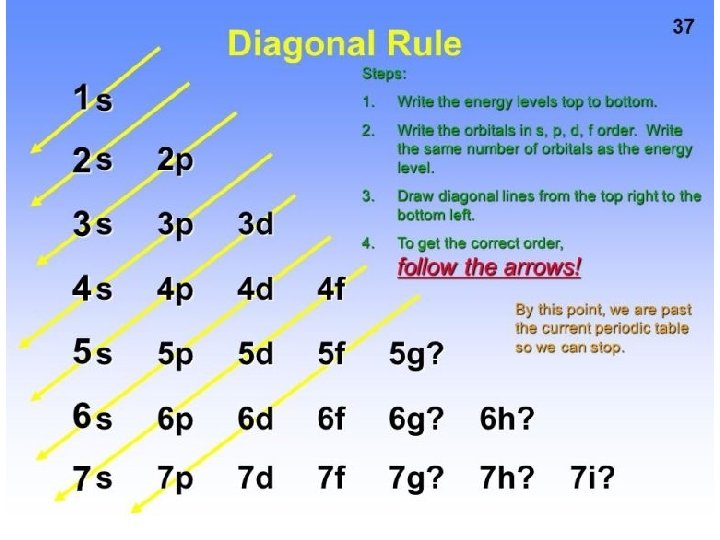
• Aufbau Principle: Electrons will seek the lowest energy orbital available first
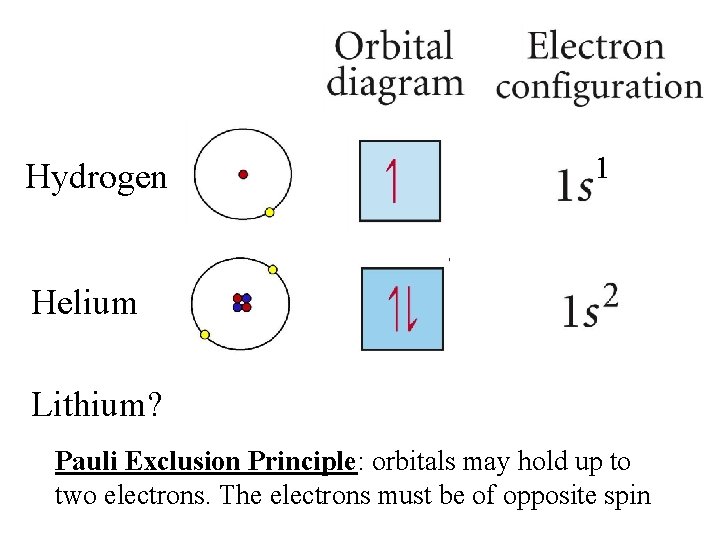
Hydrogen 1 Helium Lithium? Pauli Exclusion Principle: orbitals may hold up to two electrons. The electrons must be of opposite spin
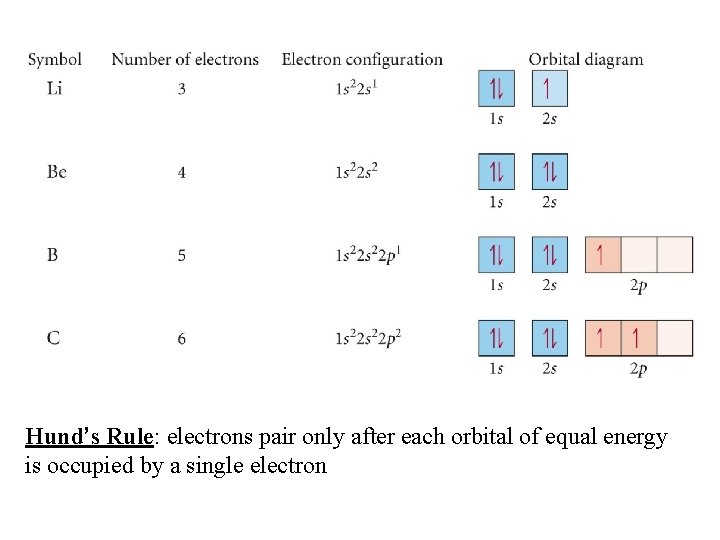
Hund’s Rule: electrons pair only after each orbital of equal energy is occupied by a single electron
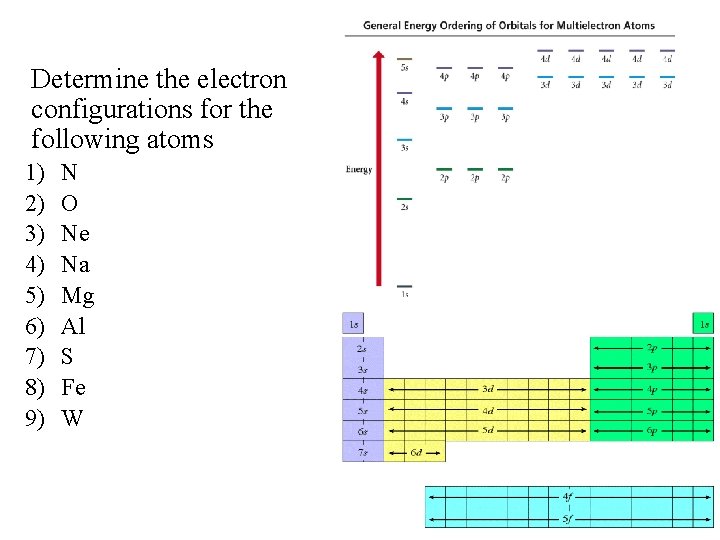
Determine the electron configurations for the following atoms 1) 2) 3) 4) 5) 6) 7) 8) 9) N O Ne Na Mg Al S Fe W
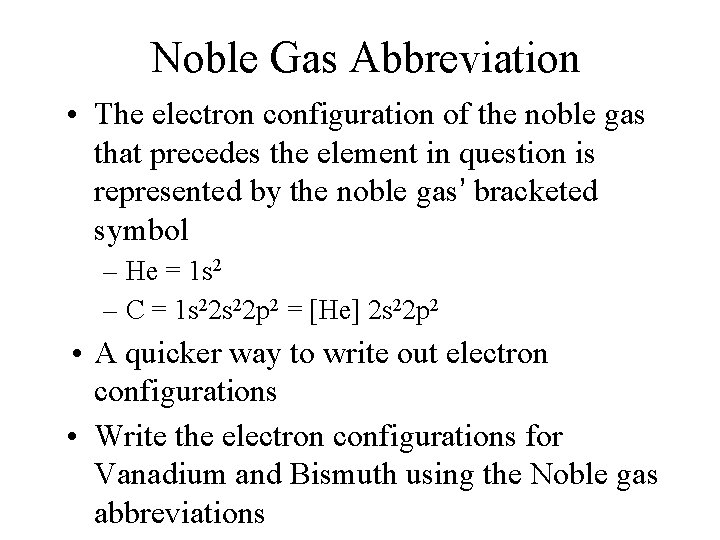
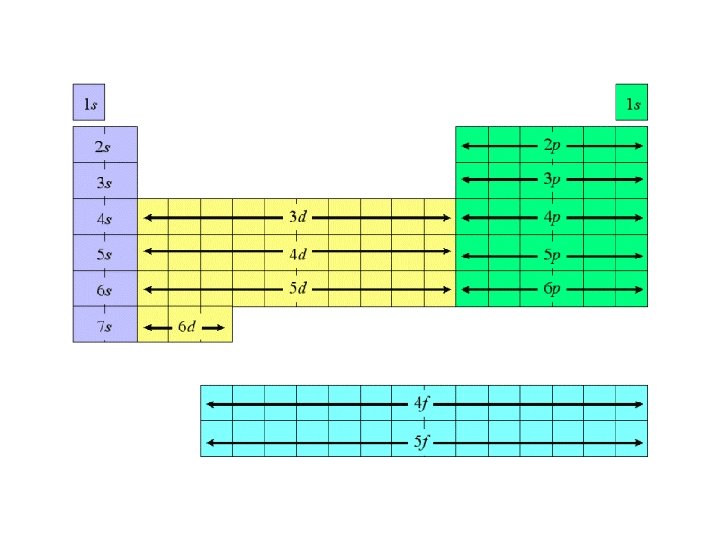
Noble Gas Abbreviation • The electron configuration of the noble gas that precedes the element in question is represented by the noble gas’ bracketed symbol – He = 1 s 2 – C = 1 s 22 p 2 = [He] 2 s 22 p 2 • A quicker way to write out electron configurations • Write the electron configurations for Vanadium and Bismuth using the Noble gas abbreviations
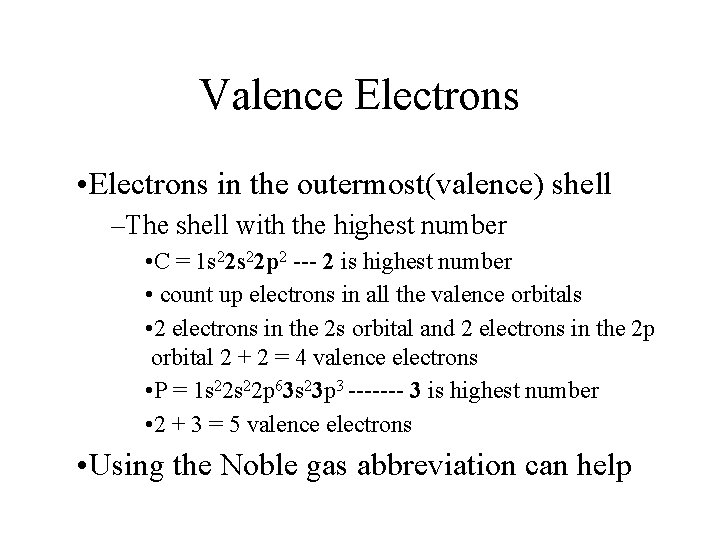
Valence Electrons • Electrons in the outermost(valence) shell –The shell with the highest number • C = 1 s 22 p 2 --- 2 is highest number • count up electrons in all the valence orbitals • 2 electrons in the 2 s orbital and 2 electrons in the 2 p orbital 2 + 2 = 4 valence electrons • P = 1 s 22 p 63 s 23 p 3 ------- 3 is highest number • 2 + 3 = 5 valence electrons • Using the Noble gas abbreviation can help
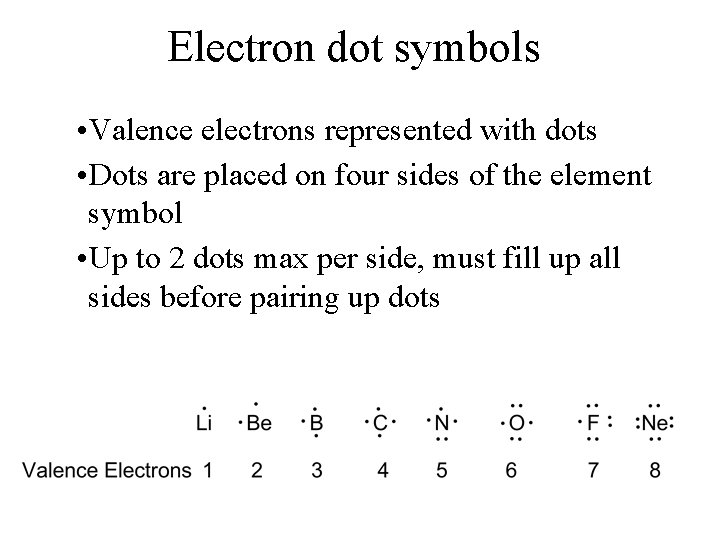
Electron dot symbols • Valence electrons represented with dots • Dots are placed on four sides of the element symbol • Up to 2 dots max per side, must fill up all sides before pairing up dots
Problems • Determine valence electrons for the following elements and draw the electron dot symbol for each 1. H 2. Li 3. Si 4. Br 5. Ar 6. P
Chapter 2 Checklist • Know how to write out elements and compounds • Know the 3 subatomic particles that make up an atom –Mass in amu –Location in the atom –Charge • Master the periodic table of elements • Know what a period and a row is, and how to locate and element using them • Be able to classify an element by its physical properties (is it a metal, metalloid or nonmetal • Be able to identify the chemical properties of an element based on its group/family • Understand the information given on the periodic table inside each element box • Know how to write out isotopes of an element using the correct notation • Know how to calculate the average atomic mass for an element
Chapter 2 Checklist continued • Know the periodic trends for atomic size and ionization energy • Know the different types of orbitals – Their relative energies – Their general shape (s, p, d) f excluded – How many orbitals are possible for each type • Know how to write out electron configurations using orbital diagrams and the noble gas abbreviations • Know the three rules (Aufbau principle, pauli exclusion principle, Hunds rule) their definition and how to use them • Know the order of atomic orbitals (1 s, 2 p, 3 s, 3 p, 4 s, 3 d, 4 p, etc…. ) • Know how to determine the number of valence electrons for an element • Know how to write the electron dot symbol for an element
- Slides: 59