
Chapter 2 Atomic Structure Bonding in Solids 1

Chapter 2 Atomic Structure & Bonding in Solids 1
Issues to address What promotes bonding? What types of bonds are there? What properties are inferred from bonding? 2
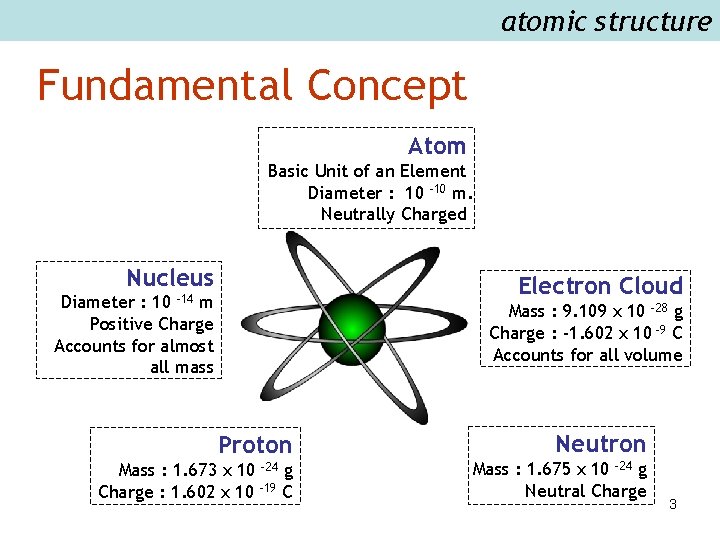
atomic structure Fundamental Concept Atom Basic Unit of an Element Diameter : 10 – 10 m. Neutrally Charged Nucleus Electron Cloud Diameter : 10 m Positive Charge Accounts for almost all mass – 14 Mass : 9. 109 x 10 – 28 g Charge : -1. 602 x 10 – 9 C Accounts for all volume Proton Neutron Mass : 1. 673 x 10 – 24 g Charge : 1. 602 x 10 – 19 C Mass : 1. 675 x 10 – 24 g Neutral Charge 3
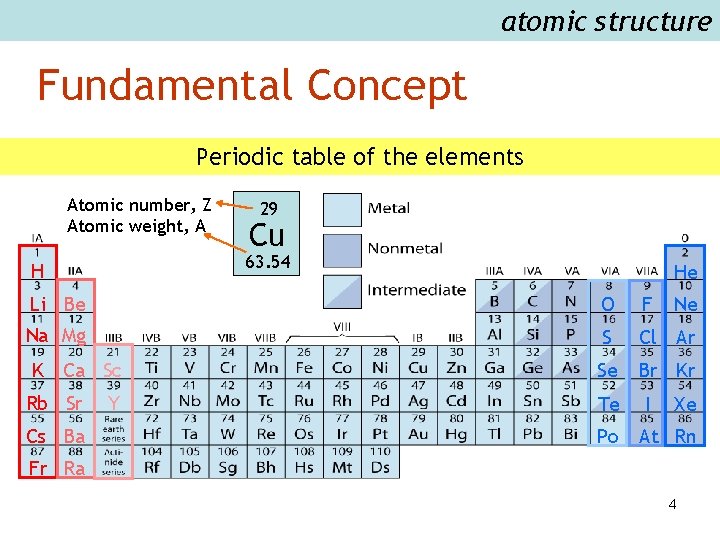
atomic structure Fundamental Concept Periodic table of the elements Atomic number, Z Atomic weight, A 29 Cu 63. 54 H He Li Be O F Na Mg S Cl Ar K Ca Sc Se Br Kr Rb Sr Te Cs Ba Y Po I Ne Xe At Rn Fr Ra 4
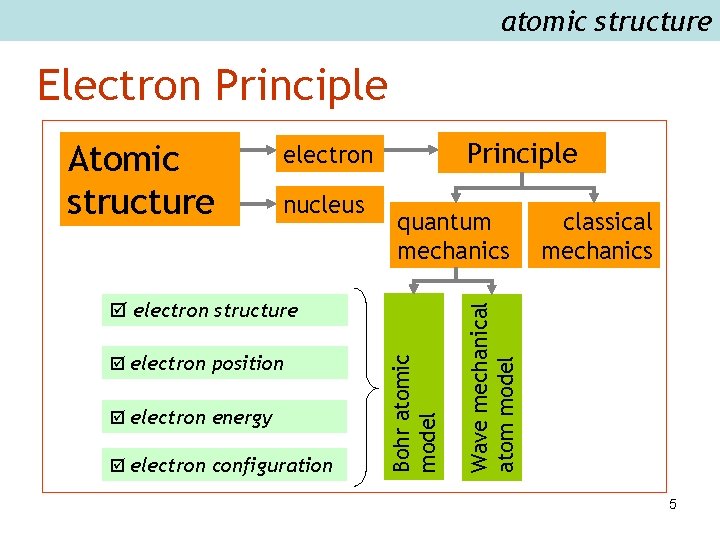
atomic structure Electron Principle electron nucleus quantum mechanics electron position electron energy electron configuration Bohr atomic model electron structure classical mechanics Wave mechanical atom model Atomic structure 5
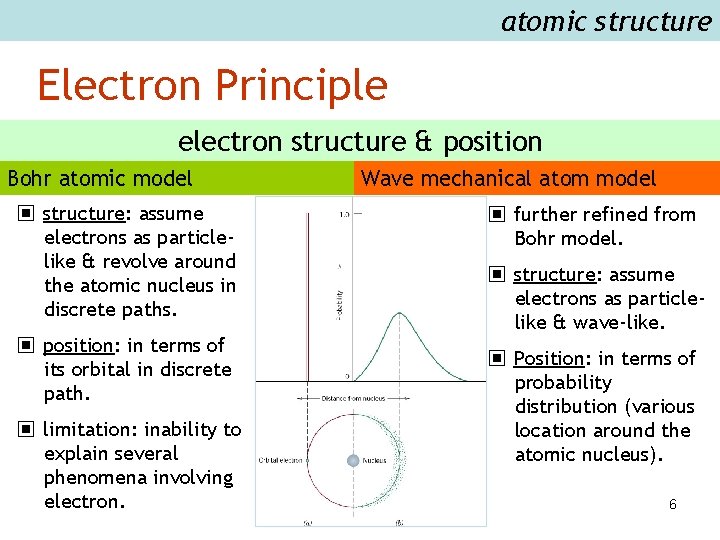
atomic structure Electron Principle electron structure & position Bohr atomic model ▣ structure: assume electrons as particlelike & revolve around the atomic nucleus in discrete paths. ▣ position: in terms of its orbital in discrete path. ▣ limitation: inability to explain several phenomena involving electron. Wave mechanical atom model ▣ further refined from Bohr model. ▣ structure: assume electrons as particlelike & wave-like. ▣ Position: in terms of probability distribution (various location around the atomic nucleus). 6
atomic structure Electron Principle electron energy Bohr atomic model Wave mechanical atom model Both model assume: ▣ Energy are quantized. ▣ Electrons are permitted to have only specific values of energy (have energy levels @ states). ▣ Each adjacent orbital/state are separated by finite energies. ▣ Electron may change energy by make a quantum jump. ▣ Energy is absorbed to move to higher energy level. ▣ Energy is emitted during transition to lower level. 7
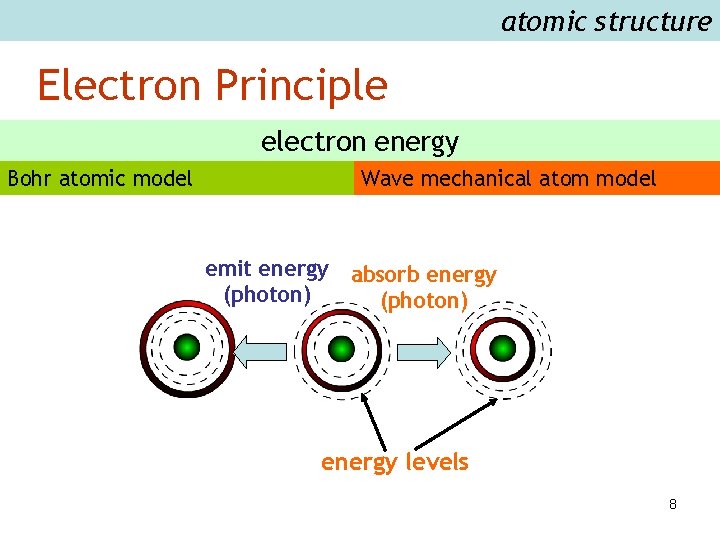
atomic structure Electron Principle electron energy Bohr atomic model Wave mechanical atom model emit energy (photon) absorb energy (photon) energy levels 8
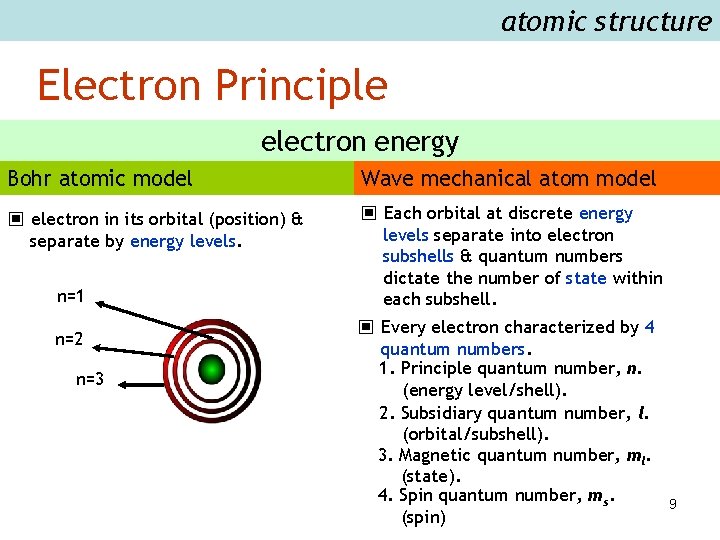
atomic structure Electron Principle electron energy Bohr atomic model Wave mechanical atom model ▣ electron in its orbital (position) & separate by energy levels. ▣ Each orbital at discrete energy levels separate into electron subshells & quantum numbers dictate the number of state within each subshell. n=1 n=2 n=3 ▣ Every electron characterized by 4 quantum numbers. 1. Principle quantum number, n. (energy level/shell). 2. Subsidiary quantum number, l. (orbital/subshell). 3. Magnetic quantum number, ml. (state). 4. Spin quantum number, ms. (spin) 9
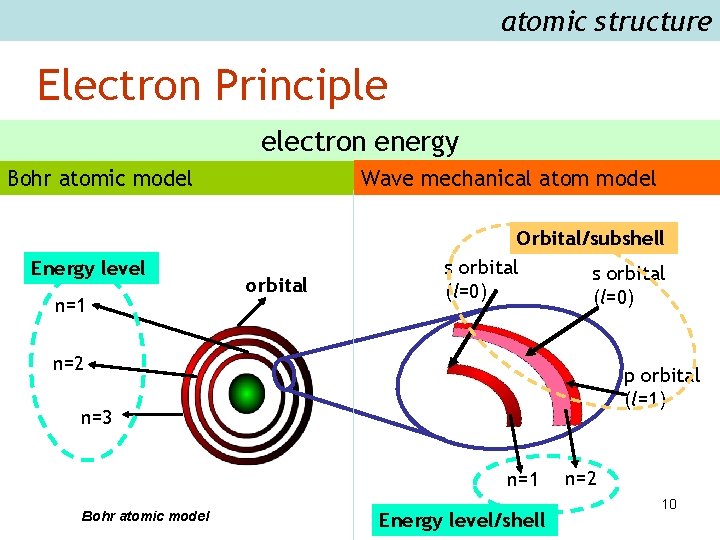
atomic structure Electron Principle electron energy Bohr atomic model Energy level n=1 Wave mechanical atom model orbital Orbital/subshell s orbital (l=0) n=2 p orbital (l=1) n=3 n=1 Bohr atomic model Energy level/shell n=2 10
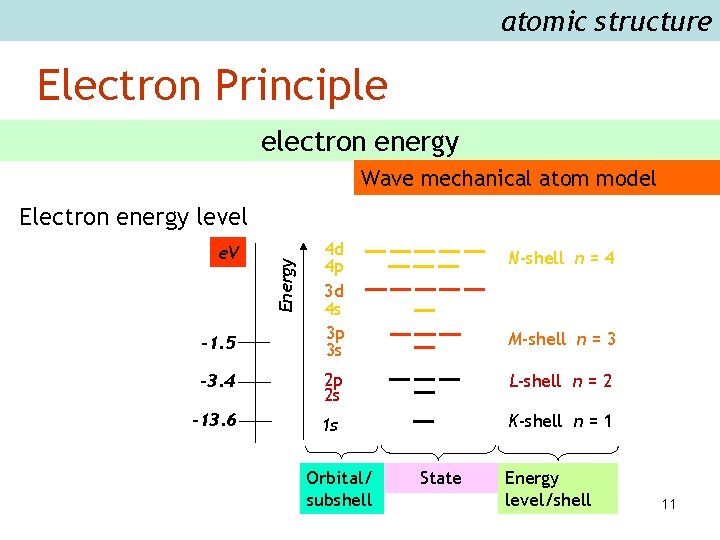
atomic structure Electron Principle electron energy Wave mechanical atom model e. V -1. 5 Energy Electron energy level 4 d 4 p 3 d 4 s 3 p 3 s N-shell n = 4 M-shell n = 3 -3. 4 2 p 2 s L-shell n = 2 -13. 6 1 s K-shell n = 1 Orbital/ subshell State Energy level/shell 11
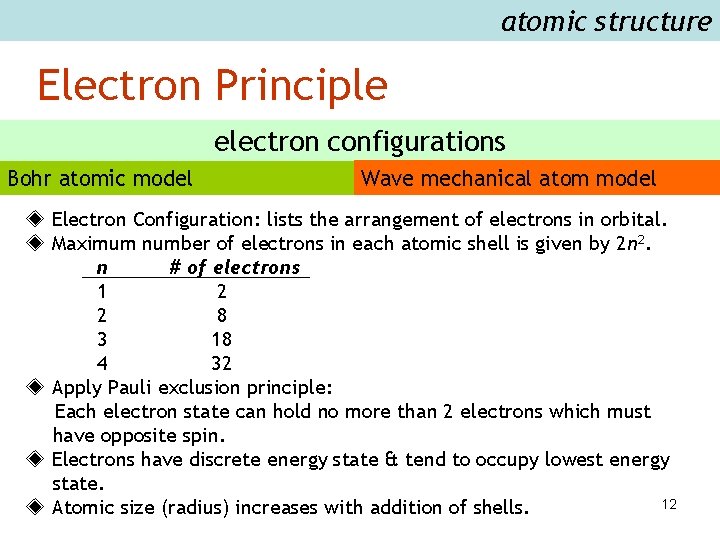
atomic structure Electron Principle electron configurations Bohr atomic model Wave mechanical atom model ◈ Electron Configuration: lists the arrangement of electrons in orbital. ◈ Maximum number of electrons in each atomic shell is given by 2 n 2. n # of electrons 1 2 2 8 3 18 4 32 ◈ Apply Pauli exclusion principle: Each electron state can hold no more than 2 electrons which must have opposite spin. ◈ Electrons have discrete energy state & tend to occupy lowest energy state. 12 ◈ Atomic size (radius) increases with addition of shells.
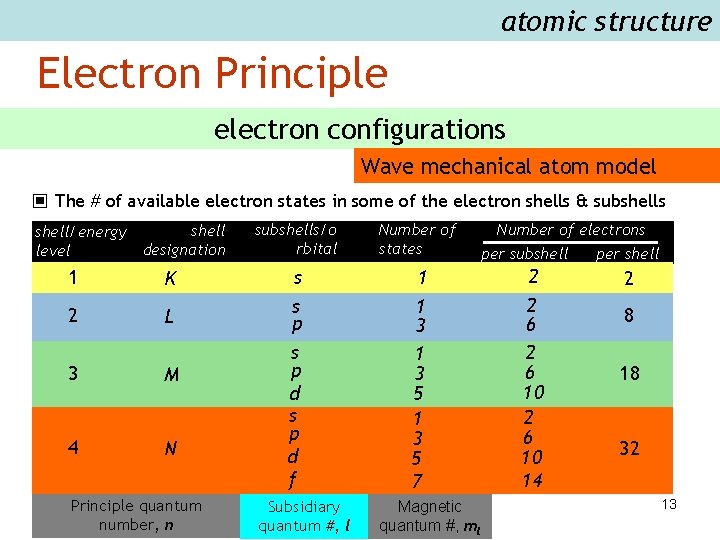
atomic structure Electron Principle electron configurations Wave mechanical atom model ▣ The # of available electron states in some of the electron shells & subshells shell/energy level shell designation 1 K 2 L 3 M 4 N Principle quantum number, n subshells/o rbital Number of states s s p d f 1 1 3 5 7 Subsidiary quantum #, l Magnetic quantum #, ml Number of electrons per subshell per shell 2 2 6 10 14 2 8 18 32 13
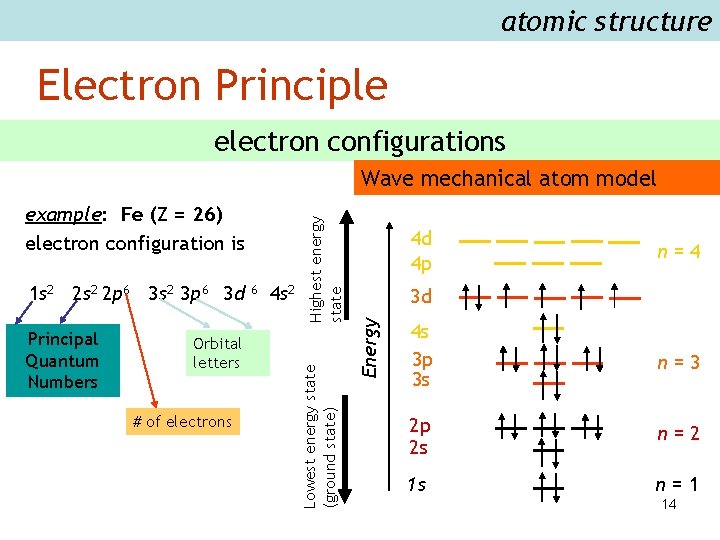
atomic structure Electron Principle electron configurations Principal Quantum Numbers Orbital letters # of electrons 6 4 s 2 4 d 4 p n=4 3 d Energy 1 s 2 2 p 6 3 s 2 3 p 6 3 d Lowest energy state (ground state) example: Fe (Z = 26) electron configuration is Highest energy state Wave mechanical atom model 4 s 3 p 3 s n=3 2 p 2 s n=2 1 s n=1 14
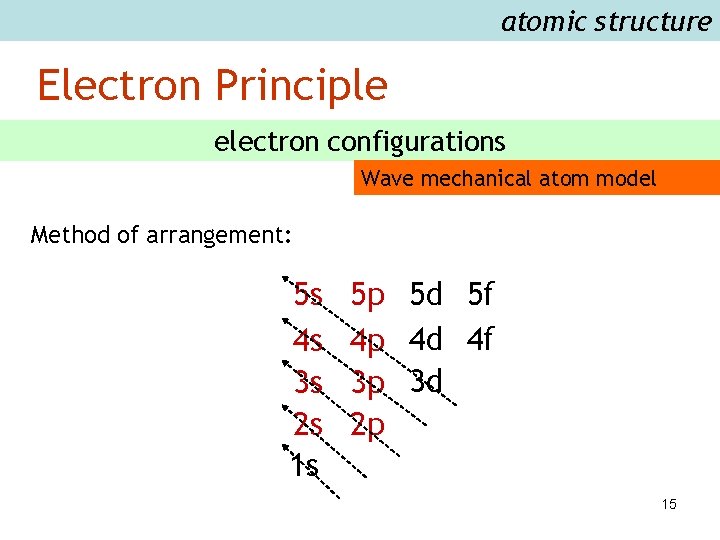
atomic structure Electron Principle electron configurations Wave mechanical atom model Method of arrangement: 5 s 4 s 3 s 2 s 1 s 5 p 5 d 5 f 4 p 4 d 4 f 3 p 3 d 2 p 15
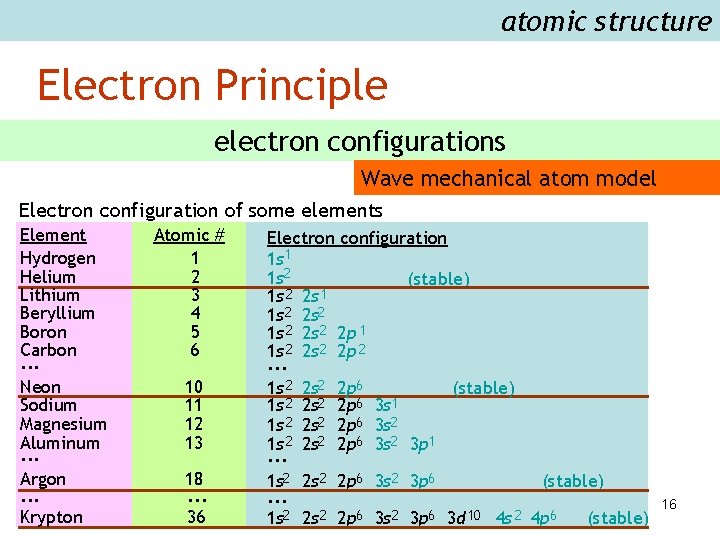
atomic structure Electron Principle electron configurations Wave mechanical atom model Electron configuration of some elements Element Hydrogen Helium Lithium Beryllium Boron Carbon. . . Neon Sodium Magnesium Aluminum. . . Argon. . . Krypton Atomic # 1 2 3 4 5 6 10 11 12 13 18. . . 36 Electron configuration 1 s 1 1 s 2 (stable) 2 1 1 s 2 s 1 s 2 2 s 2 2 p 1 1 s 2 2 p 2. . . 1 s 2 2 p 6 (stable) 2 2 6 1 1 s 2 s 2 p 3 s 1 s 2 2 s 2 2 p 6 3 s 2 3 p 1. . . 1 s 2 2 p 6 3 s 2 3 p 6 (stable). . . 1 s 2 2 p 6 3 s 2 3 p 6 3 d 10 4 s 2 4 p 6 (stable) 16
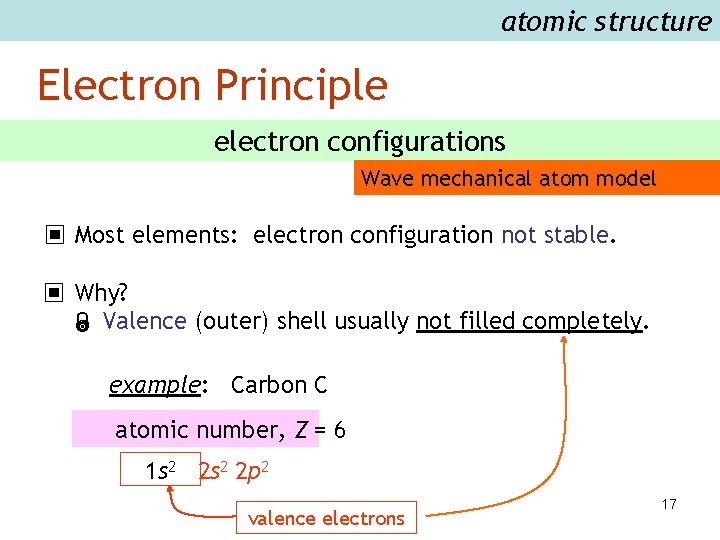
atomic structure Electron Principle electron configurations Wave mechanical atom model ▣ Most elements: electron configuration not stable. ▣ Why? Valence (outer) shell usually not filled completely. example: Carbon C atomic number, Z = 6 1 s 2 2 p 2 valence electrons 17
atomic structure Electron Principle Valence electron ▣ Electron that occupy the outermost (valence) shell. ▣ Valence electrons ▷ those in unfilled shells (most elements) not stable & filled shells (inert gases) more stable. ▣ Participate in the bonding (unfilled shell) between atoms to form atomic & molecular aggregates. ▷ determine physical (optical, thermal & electrical) & chemical properties. 18
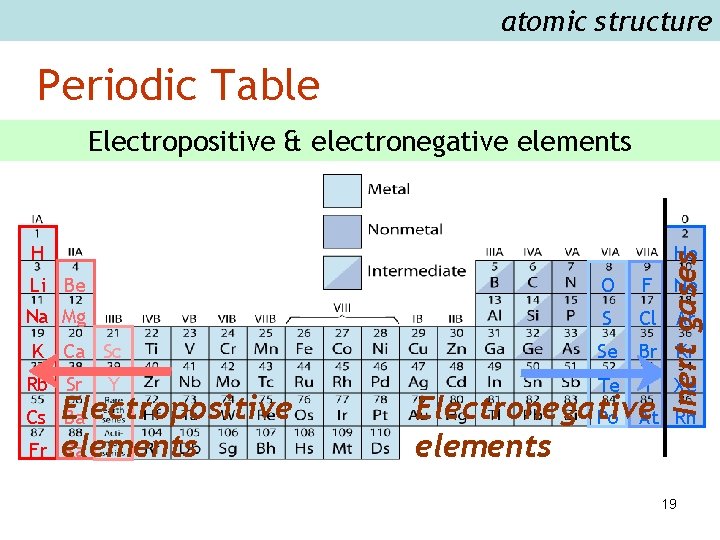
atomic structure Periodic Table Electropositive & electronegative elements H Inert gases He Li Be O F Na Mg S Cl Ar K Ca Sc Se Br Kr Rb Sr Te Electropositive Ra elements Cs Ba Fr Y I Electronegative Po At elements Ne Xe Rn 19
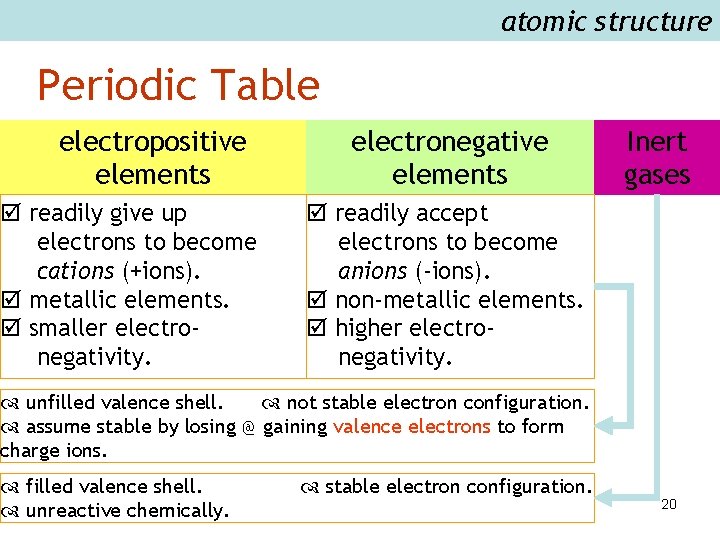
atomic structure Periodic Table electropositive elements readily give up electrons to become cations (+ions). metallic elements. smaller electronegativity. electronegative elements Inert gases readily accept electrons to become anions (-ions). non-metallic elements. higher electronegativity. unfilled valence shell. not stable electron configuration. assume stable by losing @ gaining valence electrons to form charge ions. filled valence shell. unreactive chemically. stable electron configuration. 20
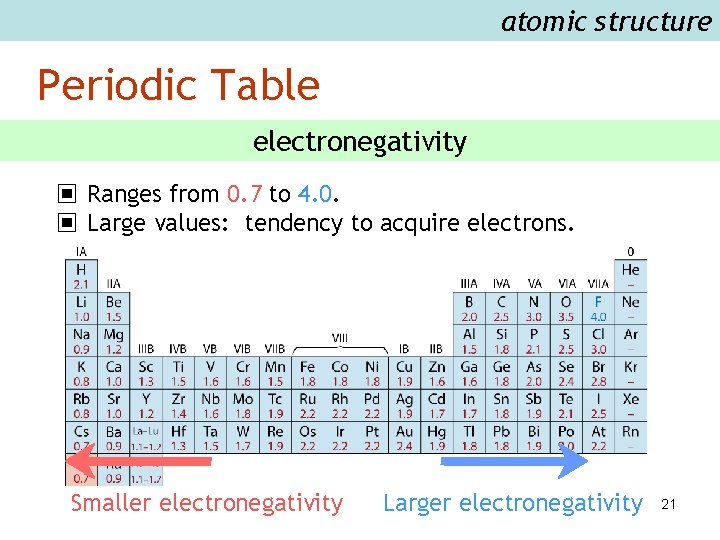
atomic structure Periodic Table electronegativity ▣ Ranges from 0. 7 to 4. 0. ▣ Large values: tendency to acquire electrons. Smaller electronegativity Larger electronegativity 21
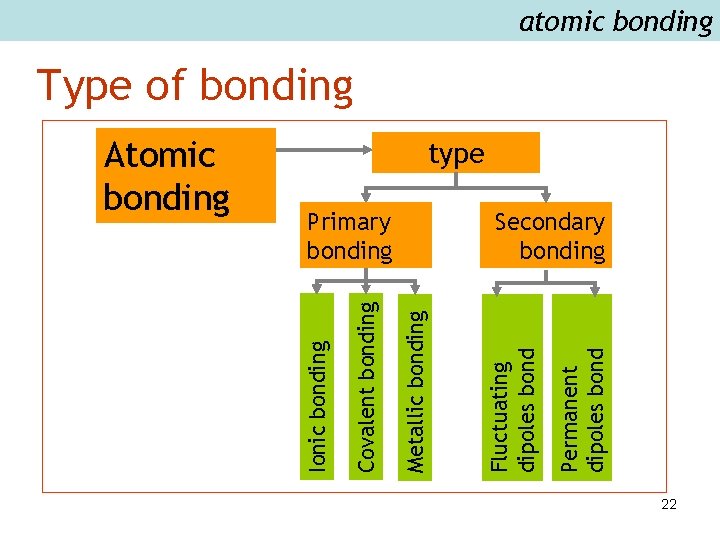
Permanent dipoles bond Primary bonding Fluctuating dipoles bond Metallic bonding Covalent bonding Atomic bonding Ionic bonding atomic bonding Type of bonding type Secondary bonding 22
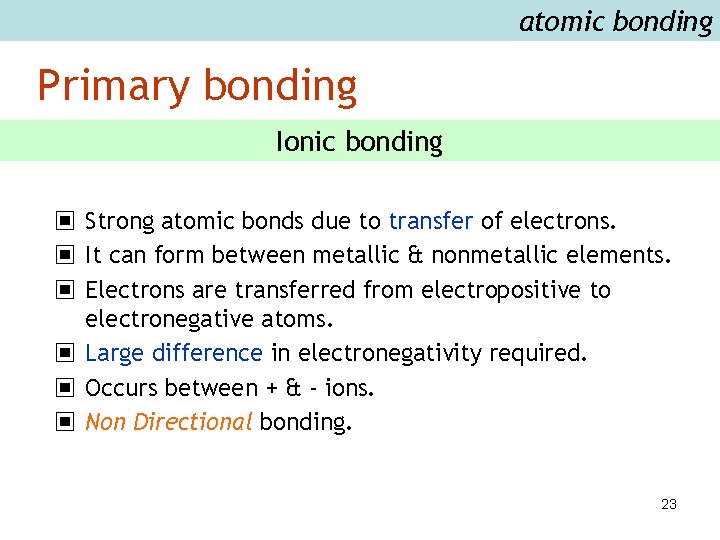
atomic bonding Primary bonding Ionic bonding ▣ Strong atomic bonds due to transfer of electrons. ▣ It can form between metallic & nonmetallic elements. ▣ Electrons are transferred from electropositive to electronegative atoms. ▣ Large difference in electronegativity required. ▣ Occurs between + & - ions. ▣ Non Directional bonding. 23
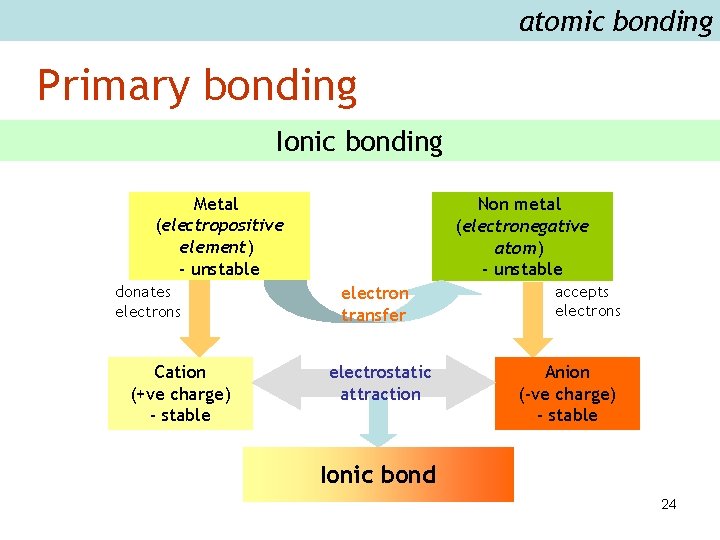
atomic bonding Primary bonding Ionic bonding Metal (electropositive element) - unstable donates electrons Cation (+ve charge) - stable Non metal (electronegative atom) - unstable electron transfer electrostatic attraction accepts electrons Anion (-ve charge) - stable Ionic bond 24
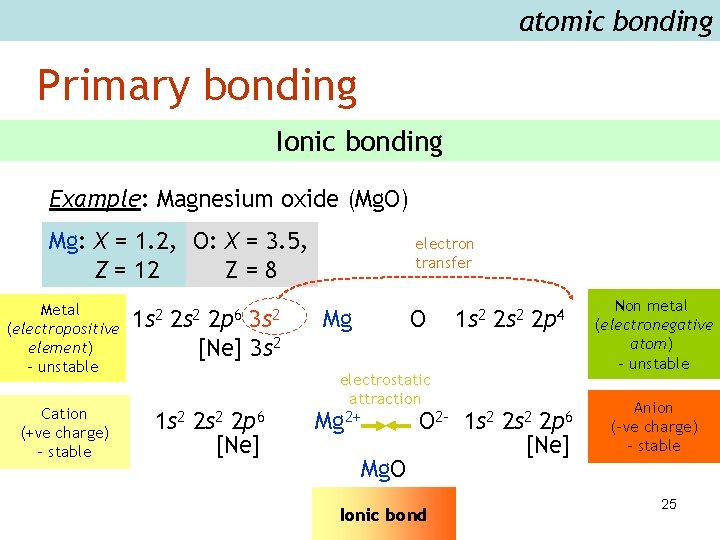
atomic bonding Primary bonding Ionic bonding Example: Magnesium oxide (Mg. O) Mg: X = 1. 2, O: X = 3. 5, Z = 12 Z=8 Metal (electropositive element) - unstable Cation (+ve charge) - stable 1 s 2 2 p 6 3 s 2 electron transfer Mg O 1 s 2 2 p 4 [Ne] 3 s 2 1 s 2 2 p 6 [Ne] electrostatic attraction Mg 2+ O 2 - Mg. O Ionic bond 1 s 2 2 p 6 [Ne] Non metal (electronegative atom) - unstable Anion (-ve charge) - stable 25
atomic bonding Primary bonding Ionic bonding Bonding Force ▣ due to electrostatic attraction. 26
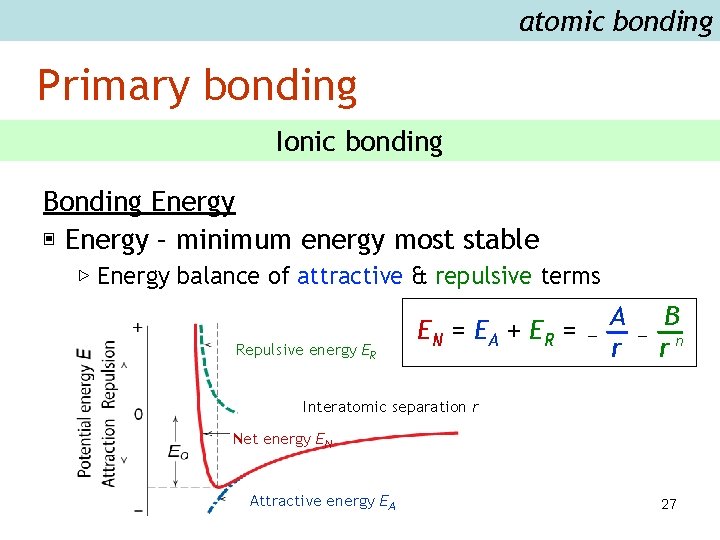
atomic bonding Primary bonding Ionic bonding Bonding Energy ▣ Energy – minimum energy most stable ▷ Energy balance of attractive & repulsive terms Repulsive energy ER EN = EA + ER = _ A r _ B rn Interatomic separation r Net energy EN Attractive energy EA 27
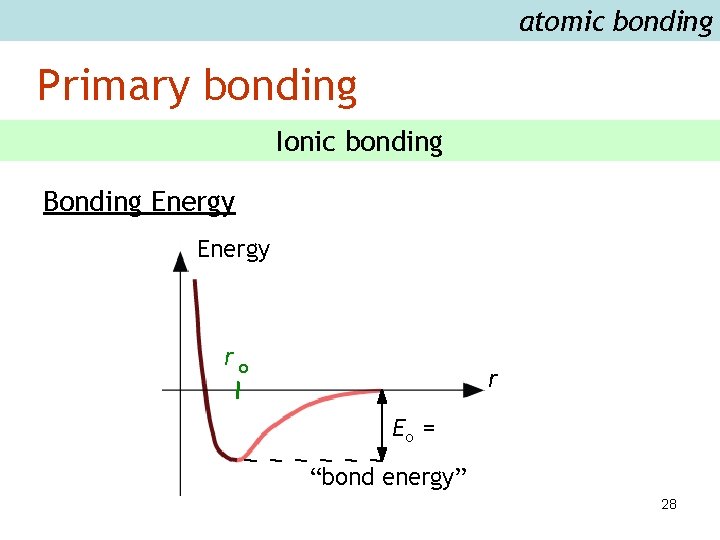
atomic bonding Primary bonding Ionic bonding Bonding Energy ro r Eo = “bond energy” 28
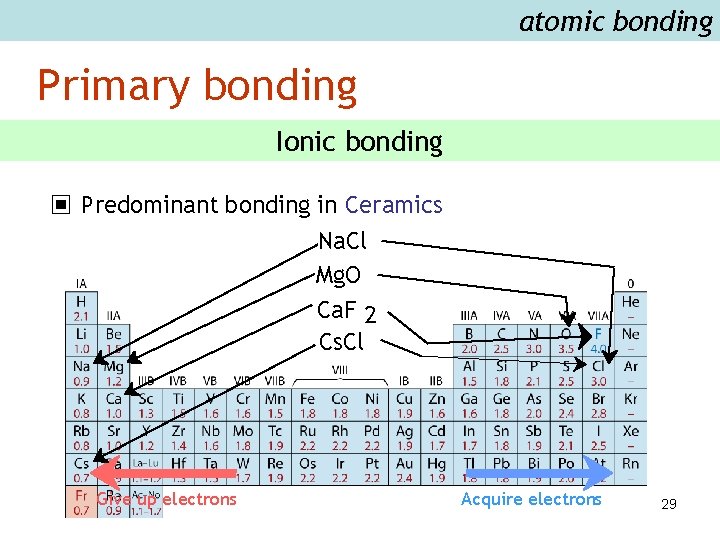
atomic bonding Primary bonding Ionic bonding ▣ Predominant bonding in Ceramics Na. Cl Mg. O Ca. F 2 Cs. Cl Give up electrons Acquire electrons 29
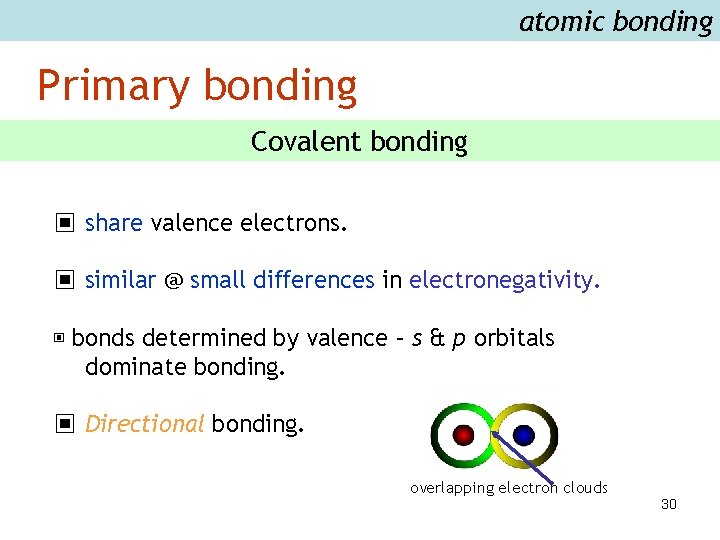
atomic bonding Primary bonding Covalent bonding ▣ share valence electrons. ▣ similar @ small differences in electronegativity. ▣ bonds determined by valence – s & p orbitals dominate bonding. ▣ Directional bonding. overlapping electron clouds 30
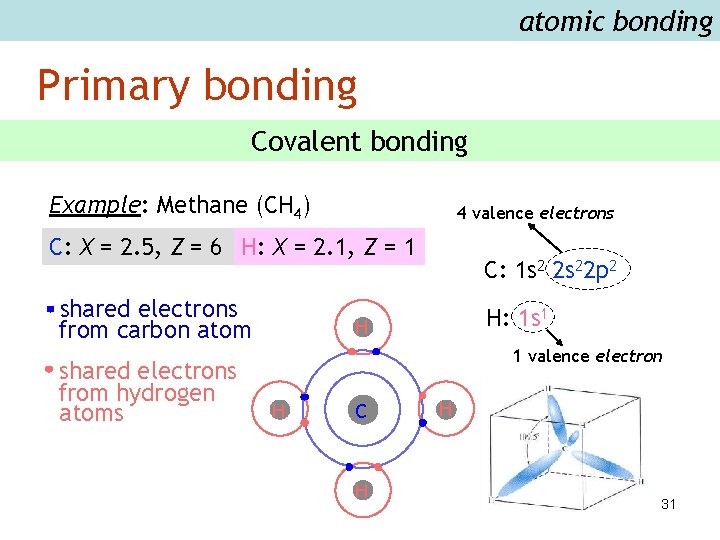
atomic bonding Primary bonding Covalent bonding Example: Methane (CH 4) 4 valence electrons C: X = 2. 5, Z = 6 H: X = 2. 1, Z = 1 shared electrons from carbon atom shared electrons from hydrogen atoms C: 1 s 2 2 s 22 p 2 H: 1 s 1 H 1 valence electron H C H H 31
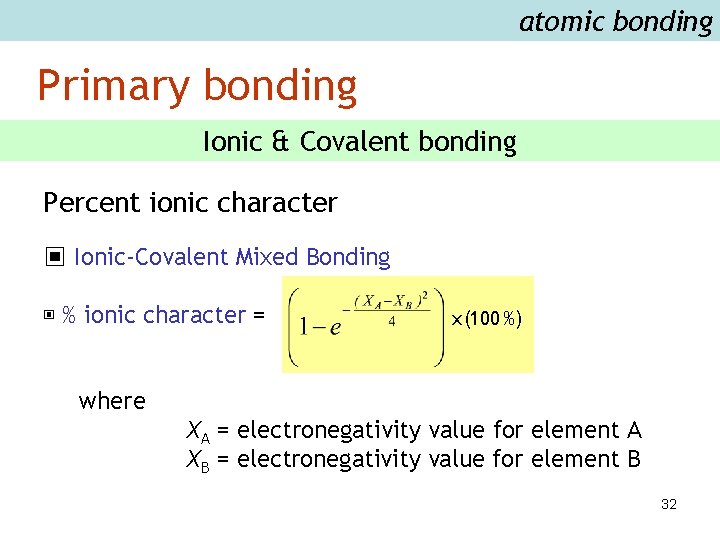
atomic bonding Primary bonding Ionic & Covalent bonding Percent ionic character ▣ Ionic-Covalent Mixed Bonding ▣ % ionic character = x (100 %) where XA = electronegativity value for element A XB = electronegativity value for element B 32
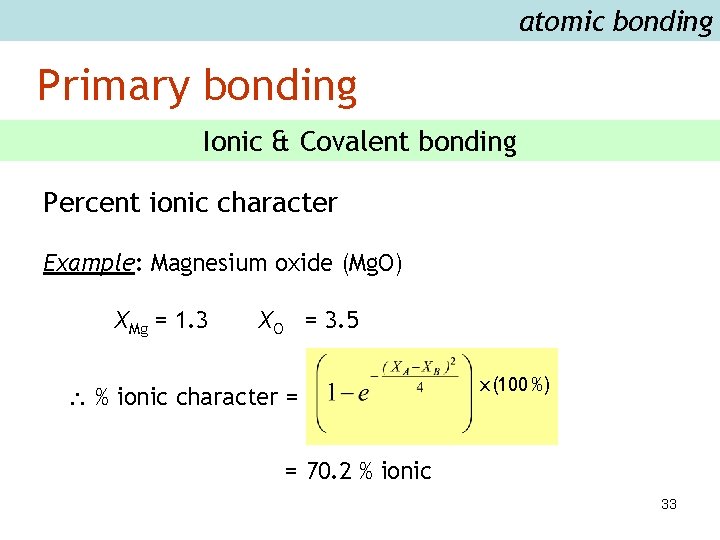
atomic bonding Primary bonding Ionic & Covalent bonding Percent ionic character Example: Magnesium oxide (Mg. O) XMg = 1. 3 XO = 3. 5 % ionic character = x (100 %) = 70. 2 % ionic 33
atomic bonding Primary bonding Metallic bonding ▣ Atoms in metals are closely packed in crystal structure. ▣ Loosely bounded valence electrons are attracted towards nucleus of other atoms. ▣ Electrons spread out among atoms forming electron clouds. ▷ these free electrons are reason for a good electric conductivity & ductility. ▣ Non-directional bonding ▷ outer electrons are shared by many atoms. 34
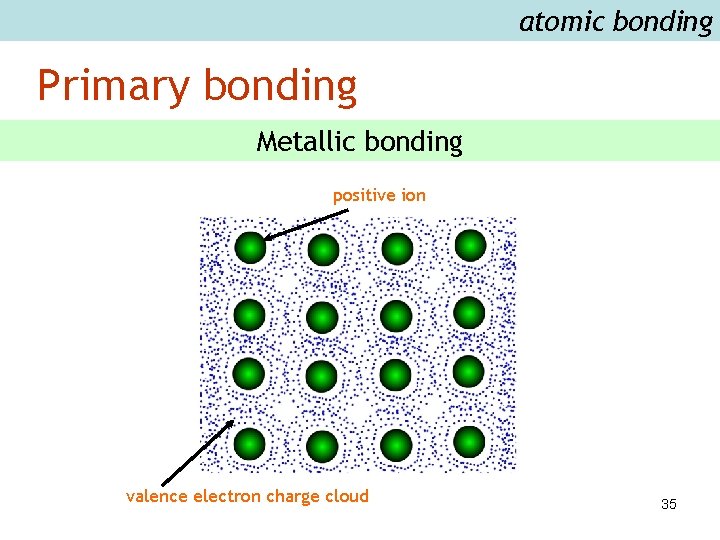
atomic bonding Primary bonding Metallic bonding positive ion valence electron charge cloud 35
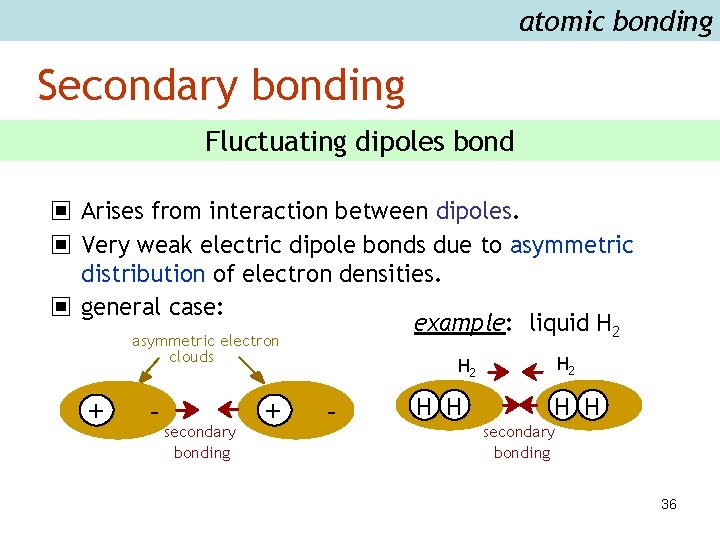
atomic bonding Secondary bonding Fluctuating dipoles bond ▣ Arises from interaction between dipoles. ▣ Very weak electric dipole bonds due to asymmetric distribution of electron densities. ▣ general case: example: liquid H 2 asymmetric electron clouds + - secondary bonding + H 2 - H H secondary bonding 36
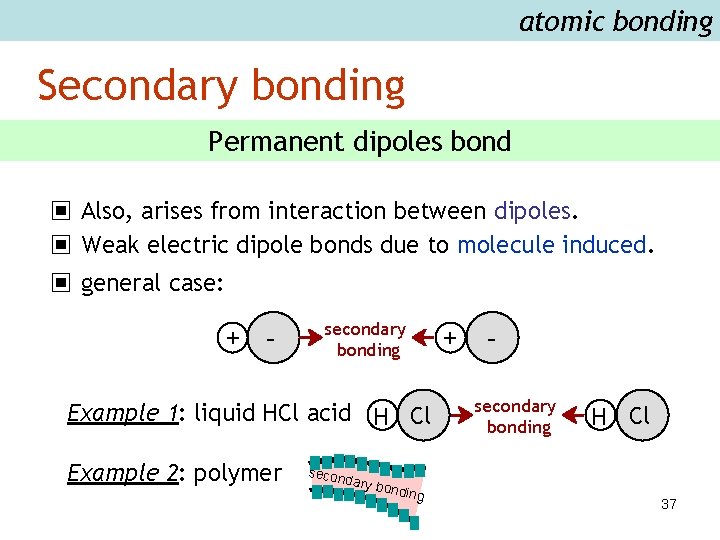
atomic bonding Secondary bonding Permanent dipoles bond ▣ Also, arises from interaction between dipoles. ▣ Weak electric dipole bonds due to molecule induced. ▣ general case: + - secondary bonding + Example 1: liquid HCl acid H Cl Example 2: polymer secon dary b ondin g secondary bonding H Cl 37
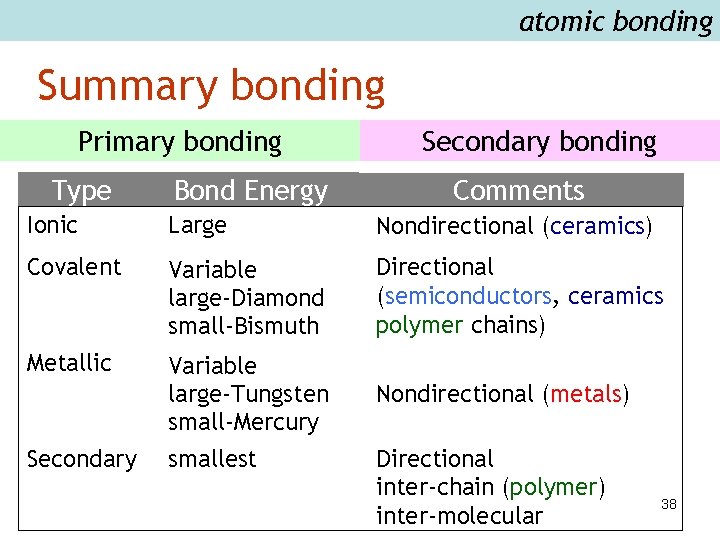
atomic bonding Summary bonding Primary bonding Type Bond Energy Secondary bonding Comments Ionic Large Nondirectional (ceramics) Covalent Variable large-Diamond small-Bismuth Directional (semiconductors, ceramics polymer chains) Metallic Variable large-Tungsten small-Mercury Nondirectional (metals) Secondary smallest Directional inter-chain (polymer) inter-molecular 38
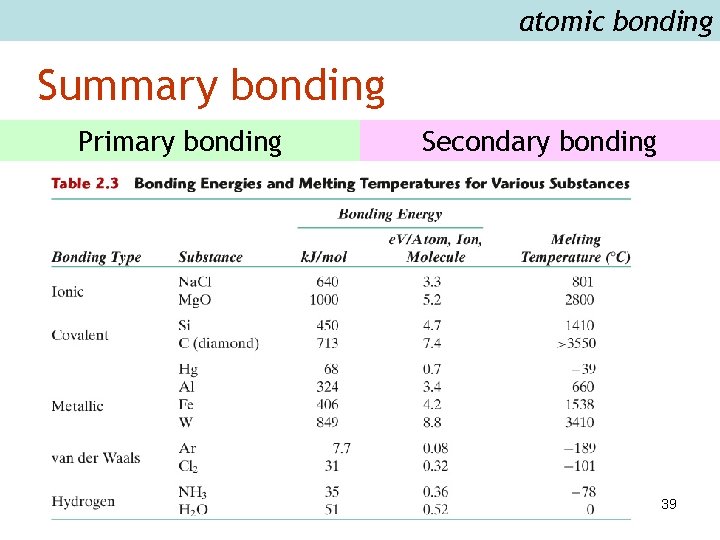
atomic bonding Summary bonding Primary bonding Secondary bonding 39
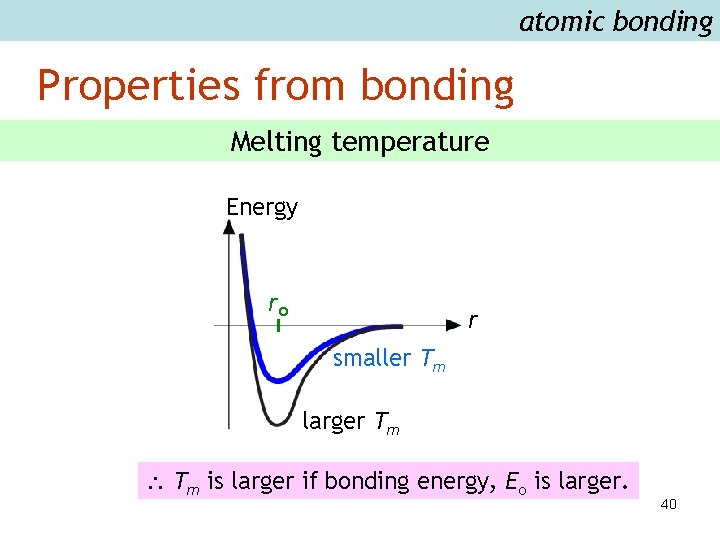
atomic bonding Properties from bonding Melting temperature Energy ro r smaller Tm larger Tm is larger if bonding energy, Eo is larger. 40
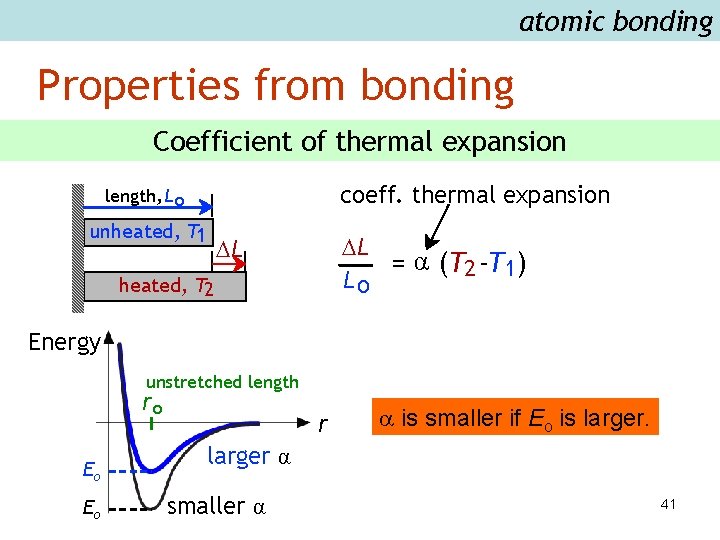
atomic bonding Properties from bonding Coefficient of thermal expansion coeff. thermal expansion length, L o unheated, T 1 L = α (T 2 -T 1) Lo L heated, T 2 Energy unstretched length ro Eo Eo r a is smaller if Eo is larger α smaller α 41
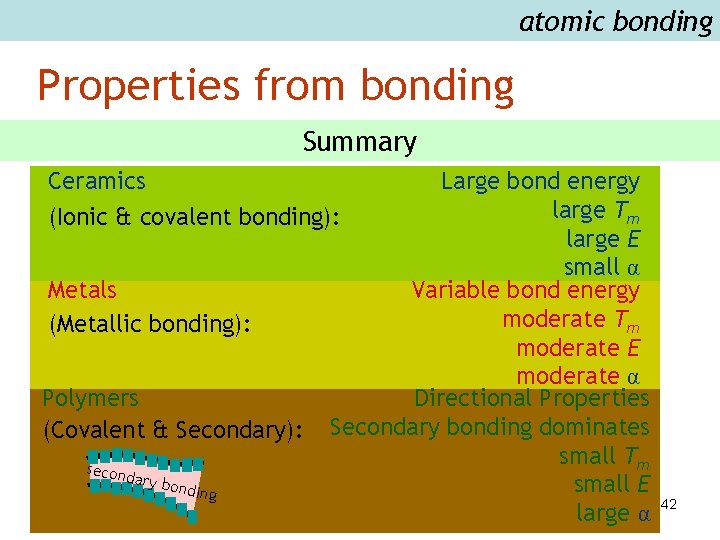
atomic bonding Properties from bonding Summary Ceramics Large bond energy large Tm (Ionic & covalent bonding): large E small α Metals Variable bond energy moderate Tm (Metallic bonding): moderate E moderate α Polymers Directional Properties (Covalent & Secondary): Secondary bonding dominates small Tm secon dary b ondin small E g large α 42
End of Chapter 2 43
- Slides: 43