
CHAPTER 2 ATOMIC STRUCTURE AND INTERATOMIC BONDING ATOMIC
CHAPTER 2: ATOMIC STRUCTURE AND INTERATOMIC BONDING ATOMIC STRUCTURE Atomic Number (Z): Equals to the number of protons in the nucleus. For a neutral element, atomic number also equals to the number of electrons. Atomic Mass (A): Equals to the masses of protons and neutrons in the nucleus. (A = N + Z ) Atomic mass unit is defined as 1/12 of the atomic mass of Carbon-12. In one mole of a material, there are 6. 02 1023 (Avogadro’s Number) atoms or molecules. 1
CHAPTER 2: ATOMIC STRUCTURE AND INTERATOMIC BONDING ATOMIC STRUCTURE Quantum Mechanics: A set of principles and laws that govern systems of atomic and subatomic particles that cannot be explained by Classical Physics Laws. One aspect of quantum mechanics is that energy is composed of discrete levels unlike in classical physics. 2
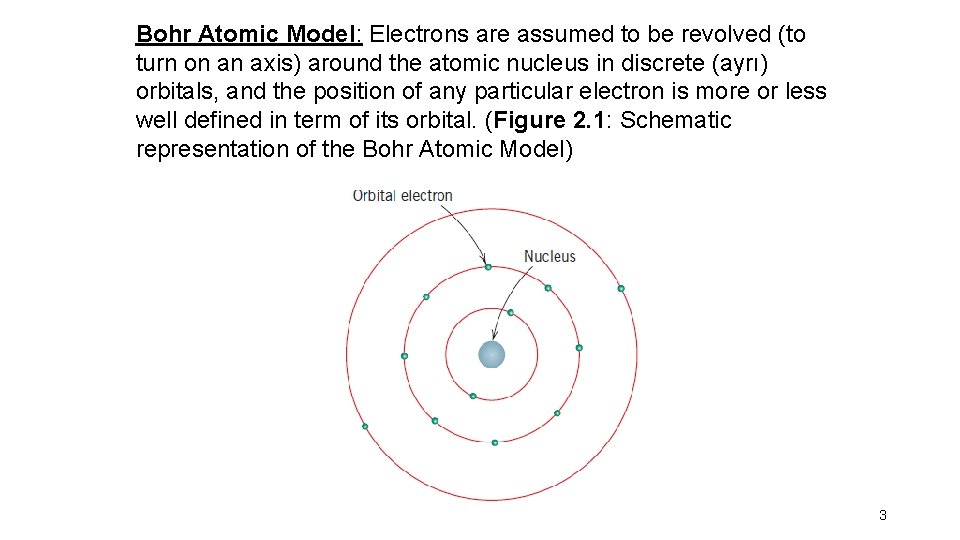
Bohr Atomic Model: Electrons are assumed to be revolved (to turn on an axis) around the atomic nucleus in discrete (ayrı) orbitals, and the position of any particular electron is more or less well defined in term of its orbital. (Figure 2. 1: Schematic representation of the Bohr Atomic Model) 3

Quantum Numbers: Every electron in an atom is characterized by 4 quantum numbers. Principal quantum number (n): n=1, 2, 3, 4, 5, … or n=K, L, M, N, O, … Second quantum number (l): It signifies the subshell and takes the values of l=0, 1, 2, 3, …, (n-1). Magnetic quantum number (ml) : Takes the values of (–l, 0, +l). Spin quantum number (ms): Two values are possible which are -1/2 and +1/2. 4
Pauli Exclusion (dışında bırakma) Principle: This states that each electron state can hold no more than two electrons, which must have opposite spins. Ground state: When all the electrons occupy the lowest possible energies, an atom is said to be in its ground state. Valance electrons: They occupy the outermost (en dıştaki) filled shell. 5
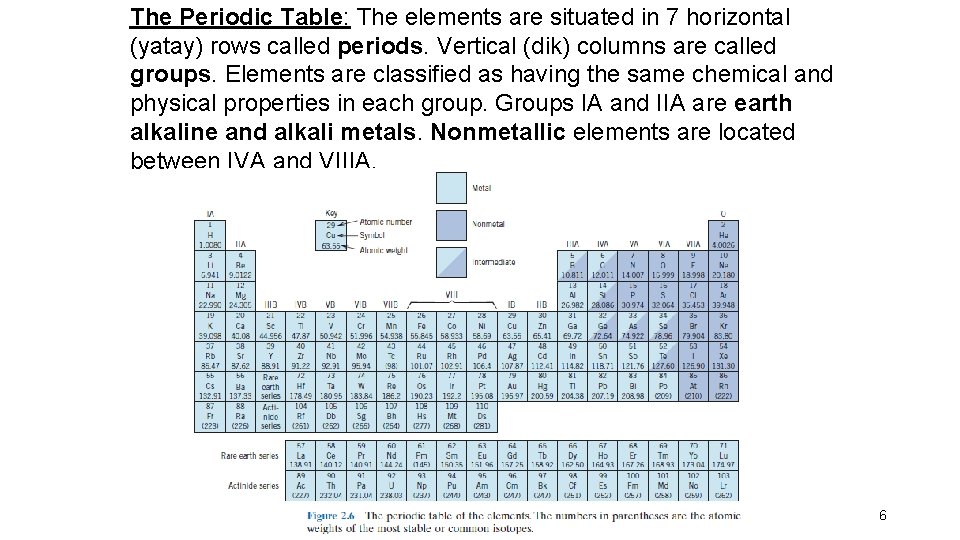
The Periodic Table: The elements are situated in 7 horizontal (yatay) rows called periods. Vertical (dik) columns are called groups. Elements are classified as having the same chemical and physical properties in each group. Groups IA and IIA are earth alkaline and alkali metals. Nonmetallic elements are located between IVA and VIIIA. 6
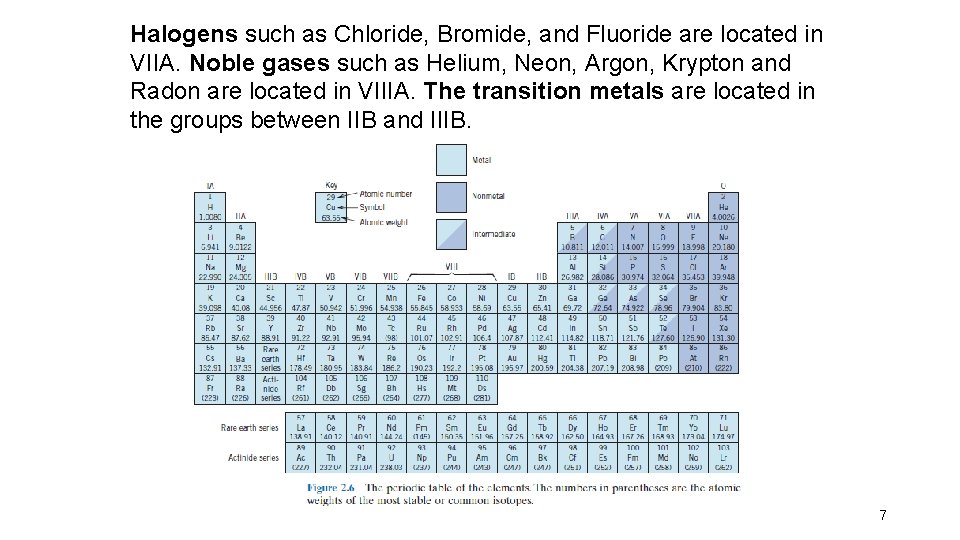
Halogens such as Chloride, Bromide, and Fluoride are located in VIIA. Noble gases such as Helium, Neon, Argon, Krypton and Radon are located in VIIIA. The transition metals are located in the groups between IIB and IIIB. 7
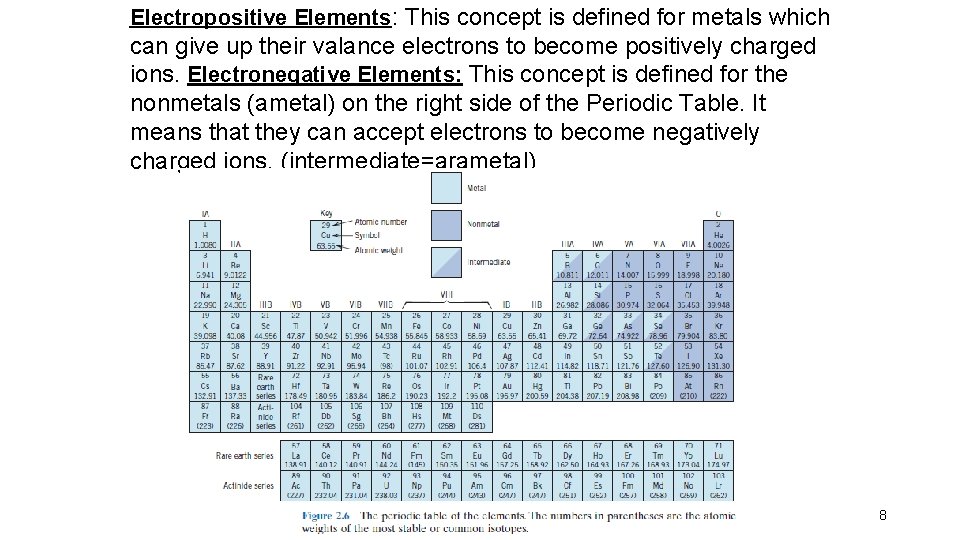
Electropositive Elements: This concept is defined for metals which can give up their valance electrons to become positively charged ions. Electronegative Elements: This concept is defined for the nonmetals (ametal) on the right side of the Periodic Table. It means that they can accept electrons to become negatively charged ions. (intermediate=arametal) 8
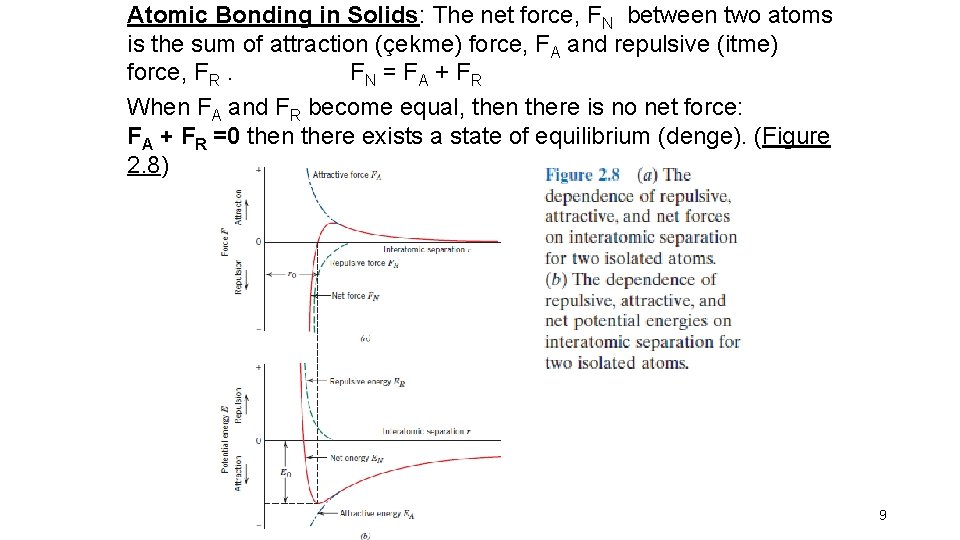
Atomic Bonding in Solids: The net force, FN between two atoms is the sum of attraction (çekme) force, FA and repulsive (itme) force, FR. FN = F A + F R When FA and FR become equal, then there is no net force: FA + FR =0 then there exists a state of equilibrium (denge). (Figure 2. 8) 9
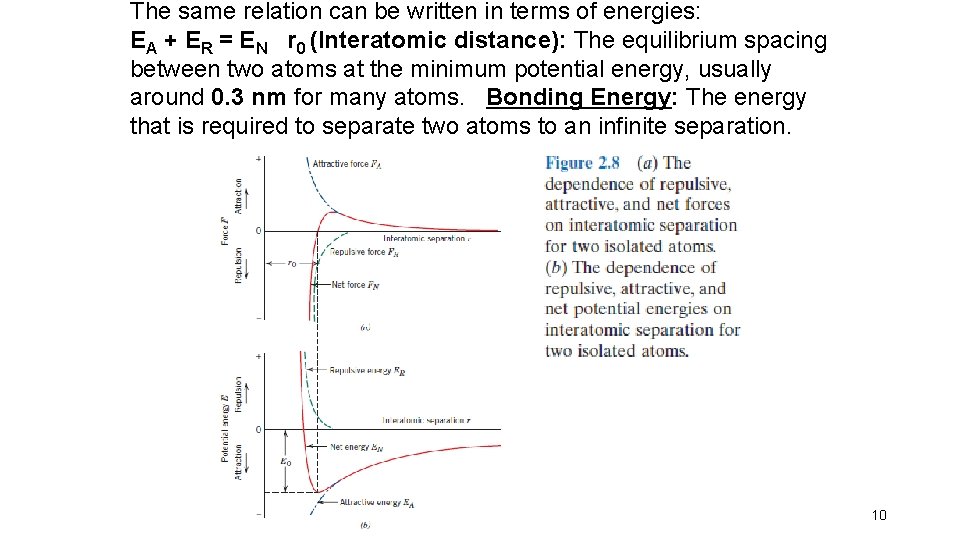
The same relation can be written in terms of energies: EA + ER = EN r 0 (Interatomic distance): The equilibrium spacing between two atoms at the minimum potential energy, usually around 0. 3 nm for many atoms. Bonding Energy: The energy that is required to separate two atoms to an infinite separation. 10
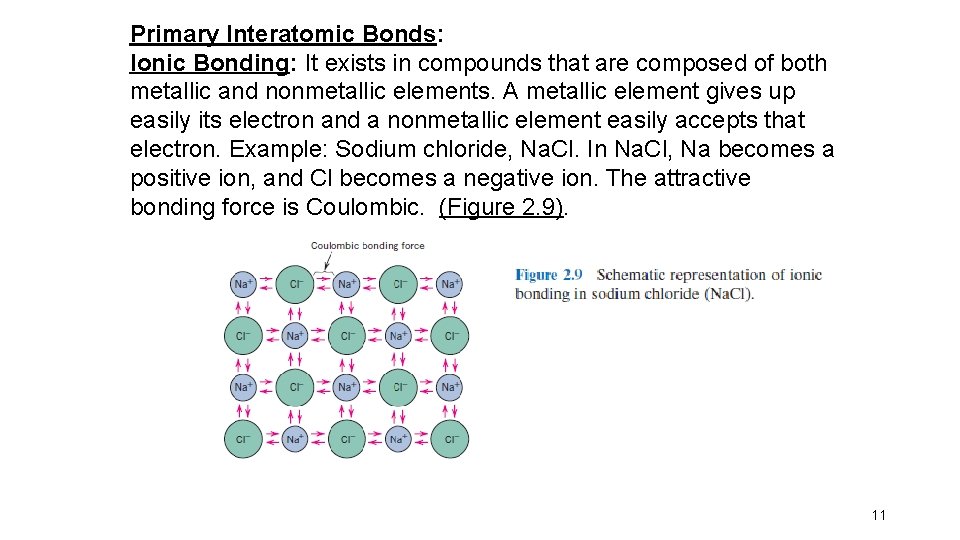
Primary Interatomic Bonds: Ionic Bonding: It exists in compounds that are composed of both metallic and nonmetallic elements. A metallic element gives up easily its electron and a nonmetallic element easily accepts that electron. Example: Sodium chloride, Na. Cl. In Na. Cl, Na becomes a positive ion, and Cl becomes a negative ion. The attractive bonding force is Coulombic. (Figure 2. 9). 11
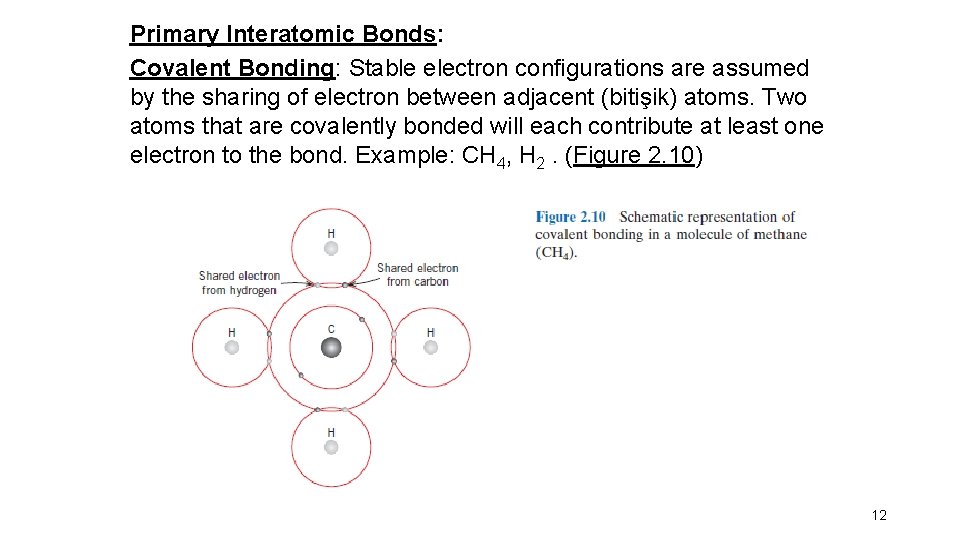
Primary Interatomic Bonds: Covalent Bonding: Stable electron configurations are assumed by the sharing of electron between adjacent (bitişik) atoms. Two atoms that are covalently bonded will each contribute at least one electron to the bond. Example: CH 4, H 2. (Figure 2. 10) 12
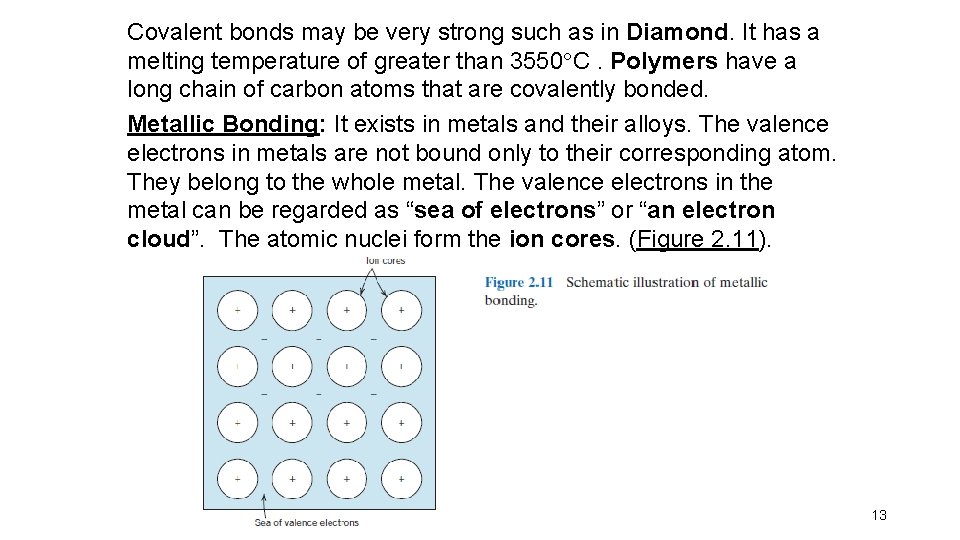
Covalent bonds may be very strong such as in Diamond. It has a melting temperature of greater than 3550 C. Polymers have a long chain of carbon atoms that are covalently bonded. Metallic Bonding: It exists in metals and their alloys. The valence electrons in metals are not bound only to their corresponding atom. They belong to the whole metal. The valence electrons in the metal can be regarded as “sea of electrons” or “an electron cloud”. The atomic nuclei form the ion cores. (Figure 2. 11). 13
Secondary Bonding (Van der Waals Bonding): It is weak compared to primary bonding. Inert (soy, hareketsiz) gases has secondary bonding. Secondary bonding arises from atomic or molecular dipole interactions. Hydrogen bonding is a special type of secondary bonding that exist between molecules containing Hydrogen atoms. For example: H 2 O, HF and HCl, etc. 14
Polar molecules: They have an asymetrical arrangement of positively and negatively charged regions. Example: HCl, HF and H 2 O. Molecule: It is a group of atoms that are bonded together by strong primary bonds. 15
- Slides: 15