
Chapter 2 Atmosphere Origin Composition and Structure Driving
- Slides: 19
Chapter 2 Atmosphere: Origin, Composition and Structure
Driving Question n What is the composition and structure of the atmosphere?
Key Terms n n n Atmosphere – a thin envelope of gases that encircles the earth and other particles (aerosols) Weather – the state of the atmosphere at a specific place and time Meteorology – the study of the atmosphere and the processes that cause weather Climate – weather conditions at some place averaged over a specific time period Climatology – the study of the climate
Various Models n Scientific Model – an approximate representation of a real system (Earth. Atmosphere System) n n n Conceptual Graphical – weather map Physical Numerical – run by computers (used to predict weather) All models simulate reality and are subject to error
Primeval Atmosphere n n Initially Hydrogen and Helium Outgassing – release of gases from rock via volcanoes and meteorites n n Added CO 2, N 2, water vapor, Ar, among others Photosynthesis converts CO 2 to O 2 Presence of O 2 allowed ozone layer to form Atmospheres of Venus and Mars are predominately CO 2
Modern Atmosphere n n Homosphere – lowest 80 km of the atmosphere where principal gas ratios remain relatively constant Heterosphere – above 80 km where concentrations of heavier gases decrease more rapidly
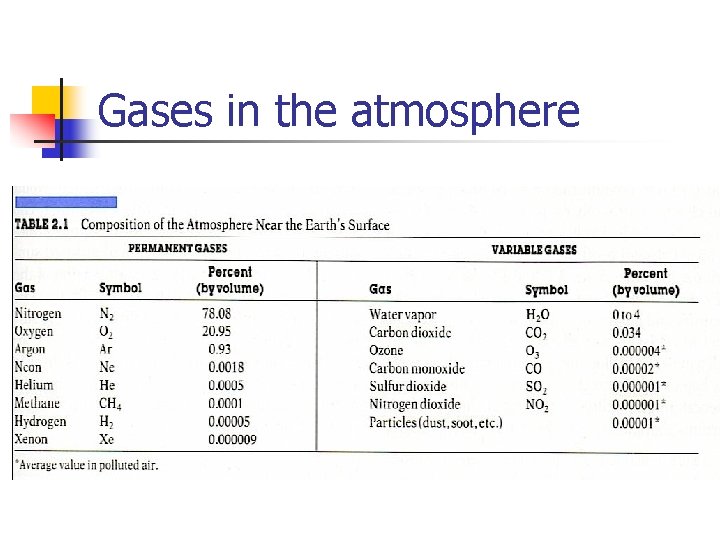
Important Gases n n Nitrogen (N 2) ~ 78% Oxygen (O 2) ~ 21% Argon (Ar) ~ 1% Greenhouse Gases – trace amounts but important role on Earth n n Water Vapor (H 2 O) ~ 0 -4% Carbon Dioxide (CO 2) Ozone (O 3) Methane (CH 4)
Aerosols n Tiny solid and liquid particles suspended in the atmosphere n n n Wind erosion of soil Ocean spray Forest fires Volcanic eruptions Agricultural and industrial activities
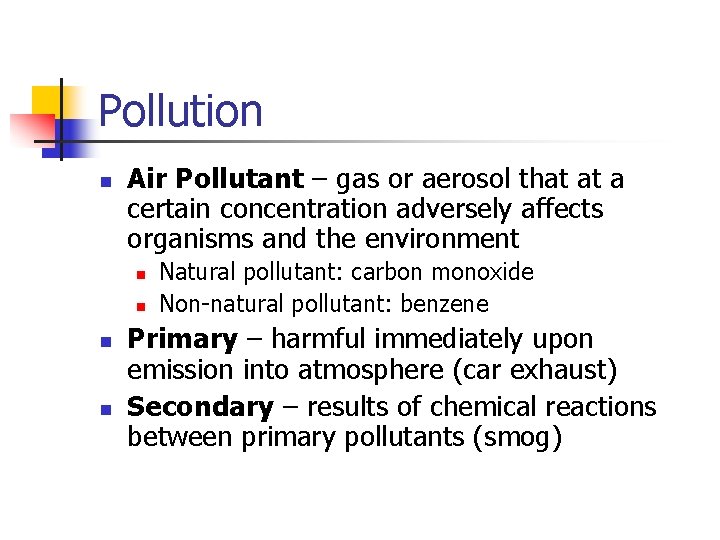
Pollution n Air Pollutant – gas or aerosol that at a certain concentration adversely affects organisms and the environment n n Natural pollutant: carbon monoxide Non-natural pollutant: benzene Primary – harmful immediately upon emission into atmosphere (car exhaust) Secondary – results of chemical reactions between primary pollutants (smog)
Gases in the atmosphere
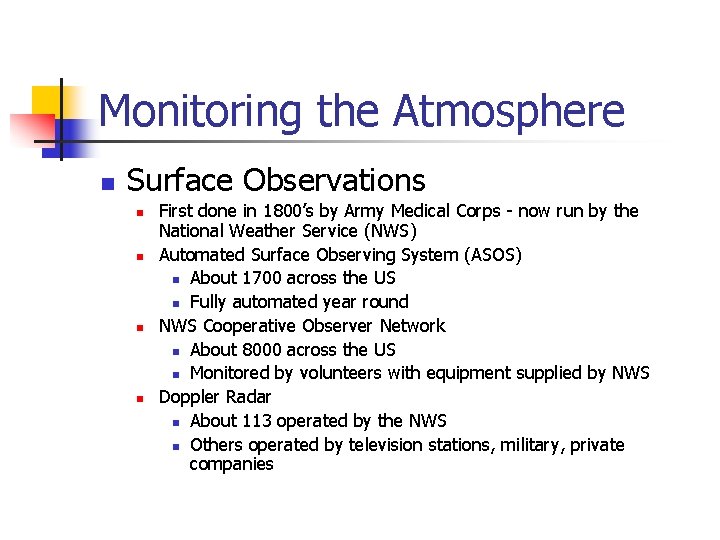
Monitoring the Atmosphere n Surface Observations n n First done in 1800’s by Army Medical Corps - now run by the National Weather Service (NWS) Automated Surface Observing System (ASOS) n About 1700 across the US n Fully automated year round NWS Cooperative Observer Network n About 8000 across the US n Monitored by volunteers with equipment supplied by NWS Doppler Radar n About 113 operated by the NWS n Others operated by television stations, military, private companies
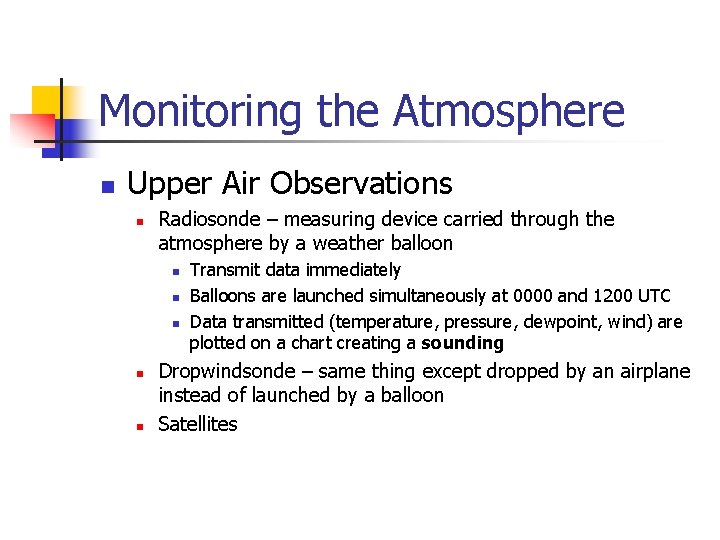
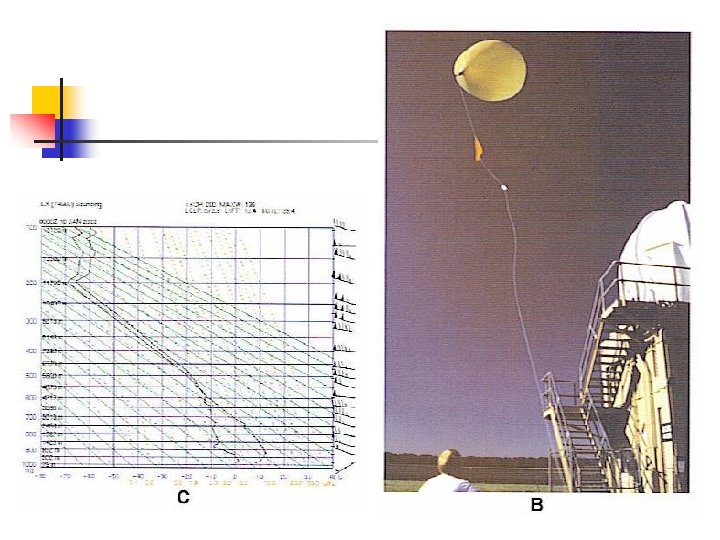
Monitoring the Atmosphere n Upper Air Observations n Radiosonde – measuring device carried through the atmosphere by a weather balloon n n Transmit data immediately Balloons are launched simultaneously at 0000 and 1200 UTC Data transmitted (temperature, pressure, dewpoint, wind) are plotted on a chart creating a sounding Dropwindsonde – same thing except dropped by an airplane instead of launched by a balloon Satellites
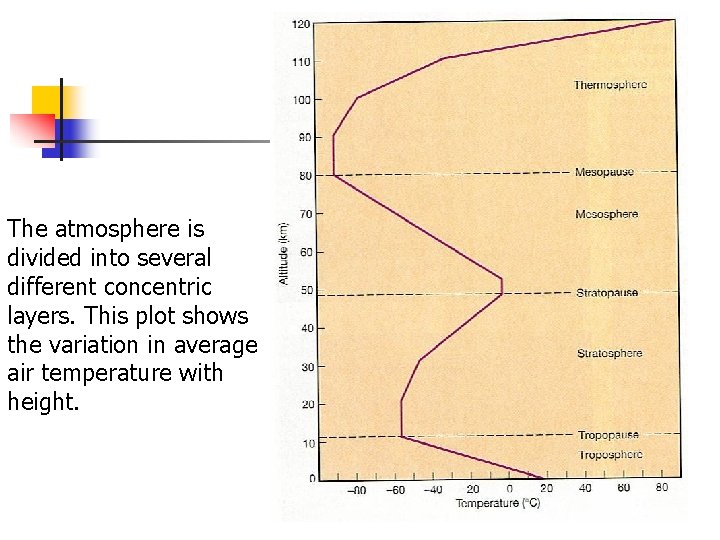
The atmosphere is divided into several different concentric layers. This plot shows the variation in average air temperature with height.
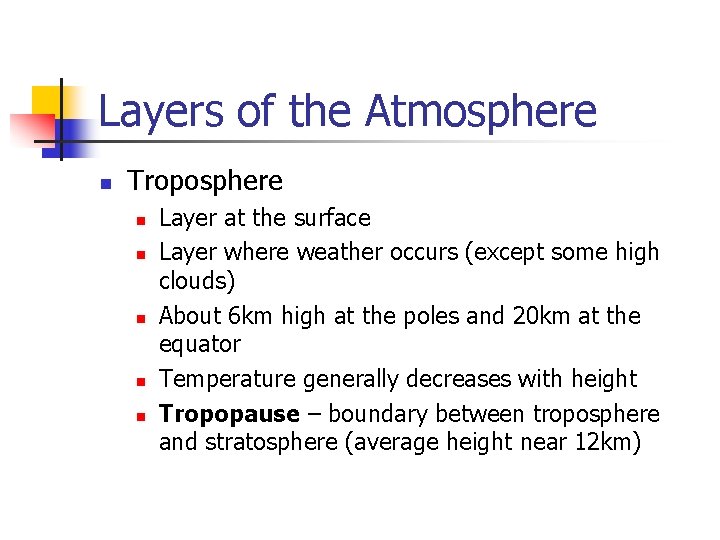
Layers of the Atmosphere n Troposphere n n n Layer at the surface Layer where weather occurs (except some high clouds) About 6 km high at the poles and 20 km at the equator Temperature generally decreases with height Tropopause – boundary between troposphere and stratosphere (average height near 12 km)
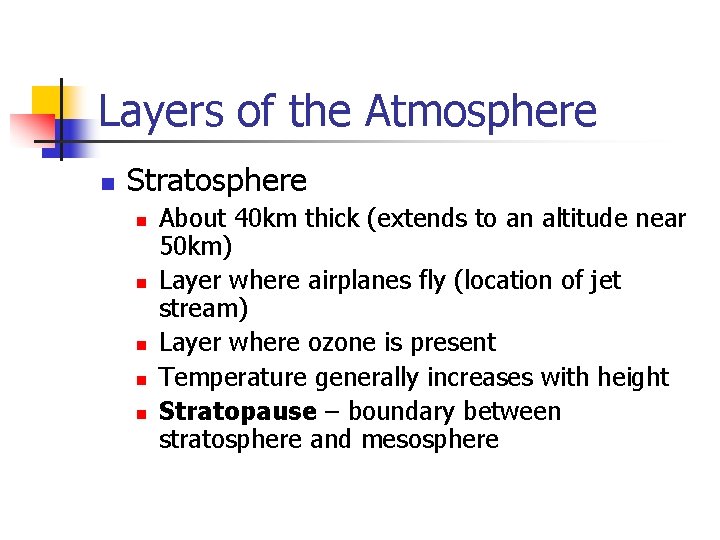
Layers of the Atmosphere n Stratosphere n n n About 40 km thick (extends to an altitude near 50 km) Layer where airplanes fly (location of jet stream) Layer where ozone is present Temperature generally increases with height Stratopause – boundary between stratosphere and mesosphere
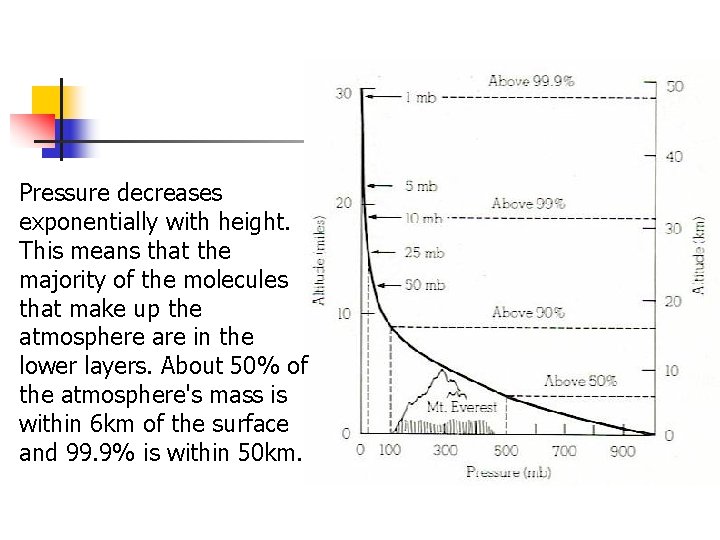
Pressure decreases exponentially with height. This means that the majority of the molecules that make up the atmosphere are in the lower layers. About 50% of the atmosphere's mass is within 6 km of the surface and 99. 9% is within 50 km.
Layers of the Atmosphere n Mesosphere n n n Thermosphere n n Base is about 50 km above the surface Temperature again decreases with height Coldest layer of the atmosphere Extends to the mesopause which is about 80 km above the surface of the earth Extremely thin air (particles range from 1 -10 km apart) Increasing temperature because first particles to receive sun’s energy Estimated top is about 500 km Exosphere (outer space)
Ionosphere n n Base is about 70 -80 km above surface Primarily located in thermosphere Home to a high concentration of ions and electrons Location of the Aurora Borealis