
Chapter 2 Assimilation and Pluralism From Immigrants to


- Slides: 28
Chapter 2 Assimilation and Pluralism: From Immigrants to White ethnics Healey, Race, Ethnicity, Gender, and Class 8 e. © SAGE Publishing, 2018. 2
Assimilation and Pluralism Assimilation: the process in which separate groups come to share a common culture and merge socially o. As a society undergoes assimilation, differences among groups decrease Pluralism exists when groups maintain their individual identities o. In a pluralistic society, groups remain separate, and their cultural and social differences persist over time Healey, Race, Ethnicity, Gender, and Class 8 e. © SAGE Publishing, 2018. 3
Assimilation and Pluralism Assimilation and pluralism are contrary processes They are not mutually exclusive They may occur together in a variety of combinations o. Some groups may be assimilating o. Others are maintaining or even increasing differences Healey, Race, Ethnicity, Gender, and Class 8 e. © SAGE Publishing, 2018. 4
Types of Assimilation can follow a number of different pathways Americanization or Anglo-conformity is a type of assimilation in which the dominant culture pressures others to conform The melting pot is a form in which different groups come together and contribute in roughly equal amounts Ø This view emphasizes sharing and inclusion Healey, Race, Ethnicity, Gender, and Class 8 e. © SAGE Publishing, 2018. 5
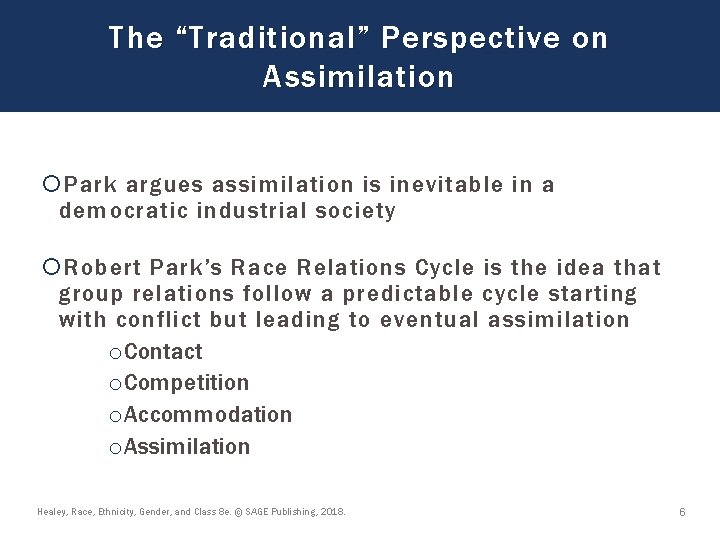
The “Traditional” Perspective on Assimilation Park argues assimilation is inevitable in a democratic industrial society Robert Park’s Race Relations Cycle is the idea that group relations follow a predictable cycle starting with conflict but leading to eventual assimilation o. Contact o. Competition o. Accommodation o. Assimilation Healey, Race, Ethnicity, Gender, and Class 8 e. © SAGE Publishing, 2018. 6
The “Traditional” Perspective on Assimilation Milton Gordon broke down the overall process of assimilation into different processes in Assimilation in American Life (1964) There is a distinction between the cultural and structural components of society Gordon’s earliest stages of assimilation: o Acculturation or cultural assimilation o Integration or structural assimilation o Intermarriage or marital assimilation Healey, Race, Ethnicity, Gender, and Class 8 e. © SAGE Publishing, 2018. 7
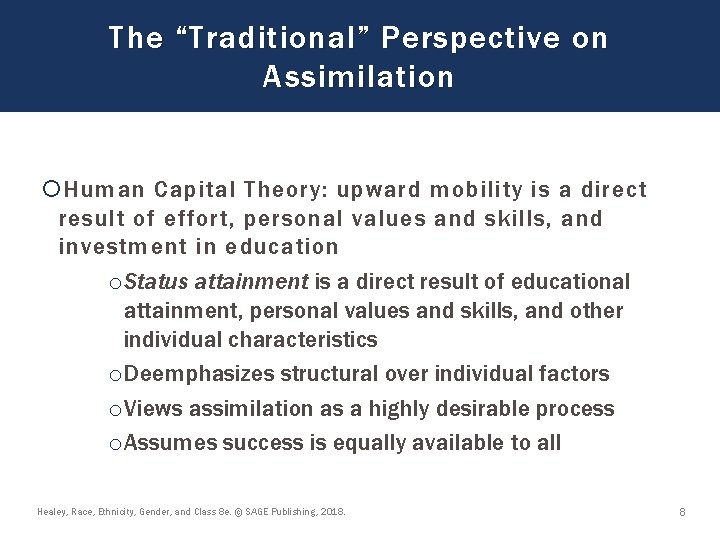
The “Traditional” Perspective on Assimilation Human Capital Theory: upward mobility is a direct result of effort, personal values and skills, and investment in education o. Status attainment is a direct result of educational attainment, personal values and skills, and other individual characteristics o. Deemphasizes structural over individual factors o. Views assimilation as a highly desirable process o. Assumes success is equally available to all Healey, Race, Ethnicity, Gender, and Class 8 e. © SAGE Publishing, 2018. 8
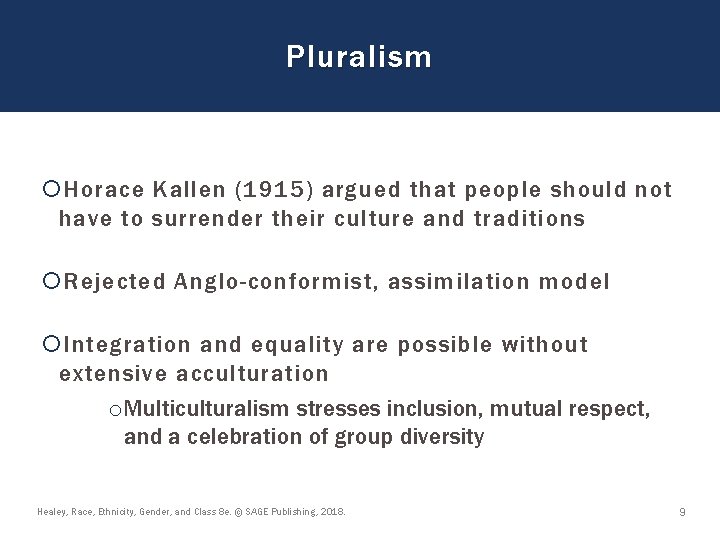
Pluralism Horace Kallen (1915) argued that people should not have to surrender their culture and traditions Rejected Anglo-conformist, assimilation model Integration and equality are possible without extensive acculturation o. Multiculturalism stresses inclusion, mutual respect, and a celebration of group diversity Healey, Race, Ethnicity, Gender, and Class 8 e. © SAGE Publishing, 2018. 9
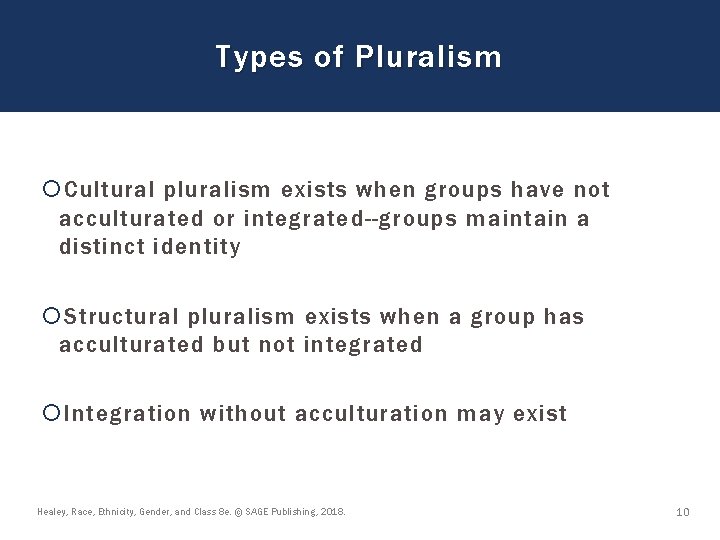
Types of Pluralism Cultural pluralism exists when groups have not acculturated or integrated--groups maintain a distinct identity Structural pluralism exists when a group has acculturated but not integrated Integration without acculturation may exist Healey, Race, Ethnicity, Gender, and Class 8 e. © SAGE Publishing, 2018. 10
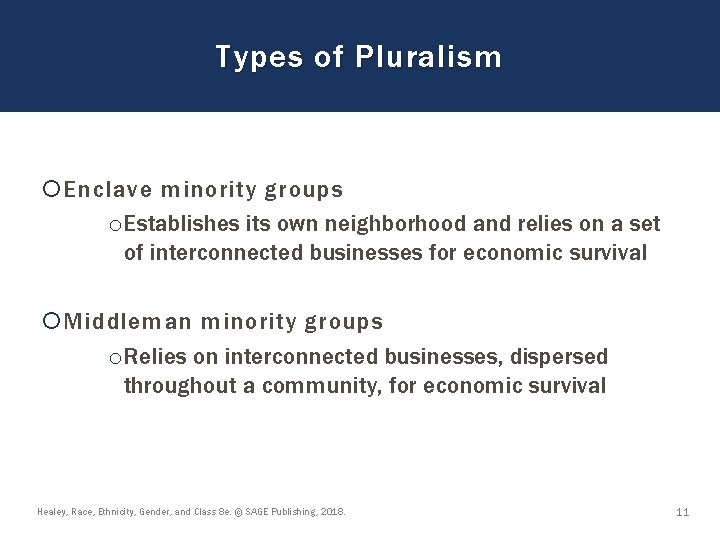
Types of Pluralism Enclave minority groups o. Establishes its own neighborhood and relies on a set of interconnected businesses for economic survival Middleman minority groups o. Relies on interconnected businesses, dispersed throughout a community, for economic survival Healey, Race, Ethnicity, Gender, and Class 8 e. © SAGE Publishing, 2018. 11
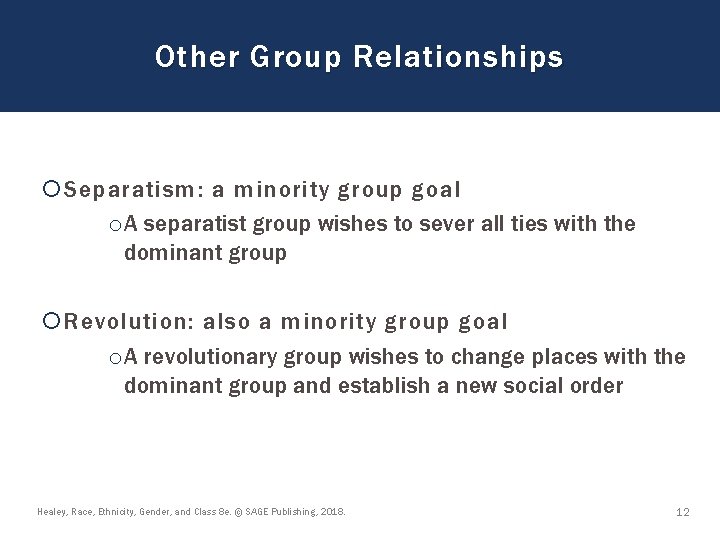
Other Group Relationships Separatism: a minority group goal o. A separatist group wishes to sever all ties with the dominant group Revolution: also a minority group goal o. A revolutionary group wishes to change places with the dominant group and establish a new social order Healey, Race, Ethnicity, Gender, and Class 8 e. © SAGE Publishing, 2018. 12
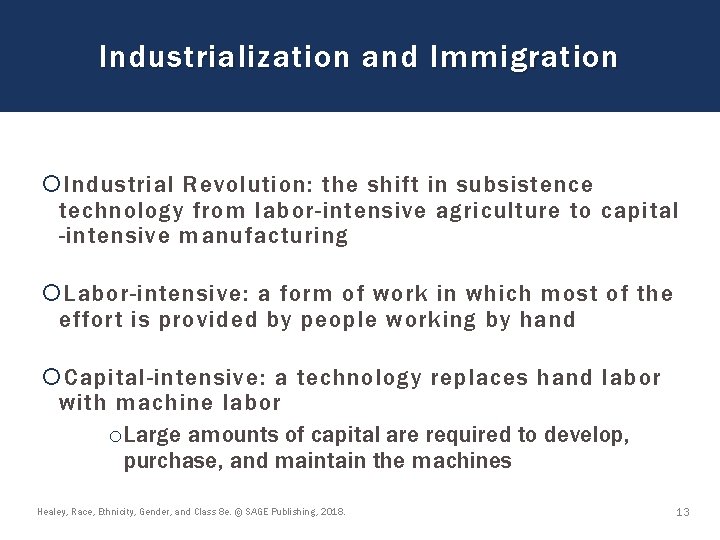
Industrialization and Immigration Industrial Revolution: the shift in subsistence technology from labor-intensive agriculture to capital -intensive manufacturing Labor-intensive: a form of work in which most of the effort is provided by people working by hand Capital-intensive: a technology replaces hand labor with machine labor o. Large amounts of capital are required to develop, purchase, and maintain the machines Healey, Race, Ethnicity, Gender, and Class 8 e. © SAGE Publishing, 2018. 13
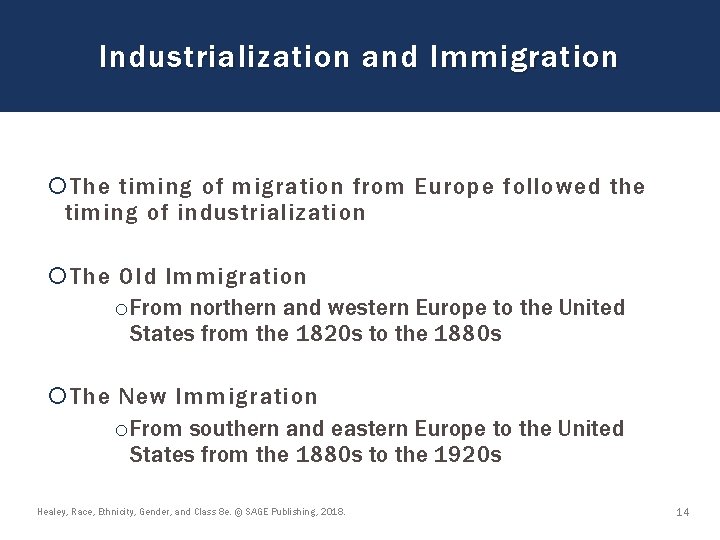
Industrialization and Immigration The timing of migration from Europe followed the timing of industrialization The Old Immigration o. From northern and western Europe to the United States from the 1820 s to the 1880 s The New Immigration o. From southern and eastern Europe to the United States from the 1880 s to the 1920 s Healey, Race, Ethnicity, Gender, and Class 8 e. © SAGE Publishing, 2018. 14
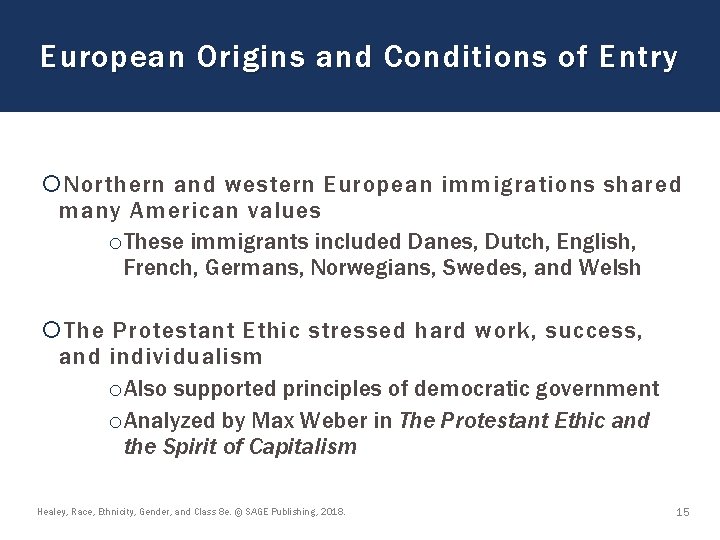
European Origins and Conditions of Entry Northern and western European immigrations shared many American values o. These immigrants included Danes, Dutch, English, French, Germans, Norwegians, Swedes, and Welsh The Protestant Ethic stressed hard work, success, and individualism o. Also supported principles of democratic government o. Analyzed by Max Weber in The Protestant Ethic and the Spirit of Capitalism Healey, Race, Ethnicity, Gender, and Class 8 e. © SAGE Publishing, 2018. 15
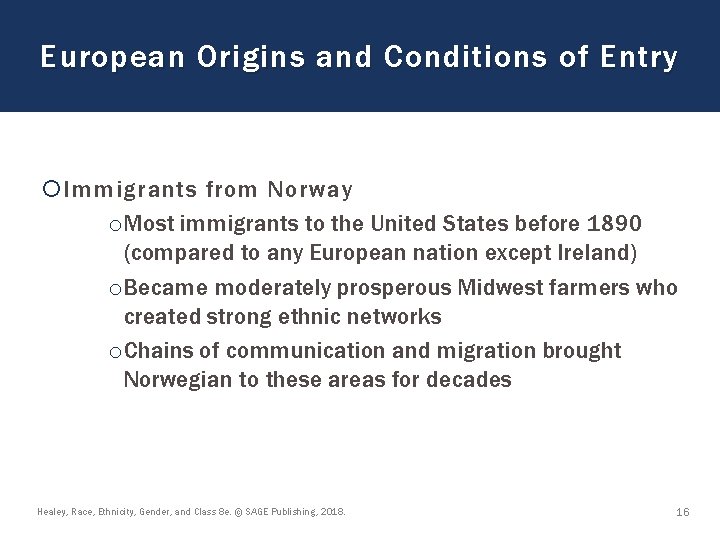
European Origins and Conditions of Entry Immigrants from Norway o. Most immigrants to the United States before 1890 (compared to any European nation except Ireland) o. Became moderately prosperous Midwest farmers who created strong ethnic networks o. Chains of communication and migration brought Norwegian to these areas for decades Healey, Race, Ethnicity, Gender, and Class 8 e. © SAGE Publishing, 2018. 16
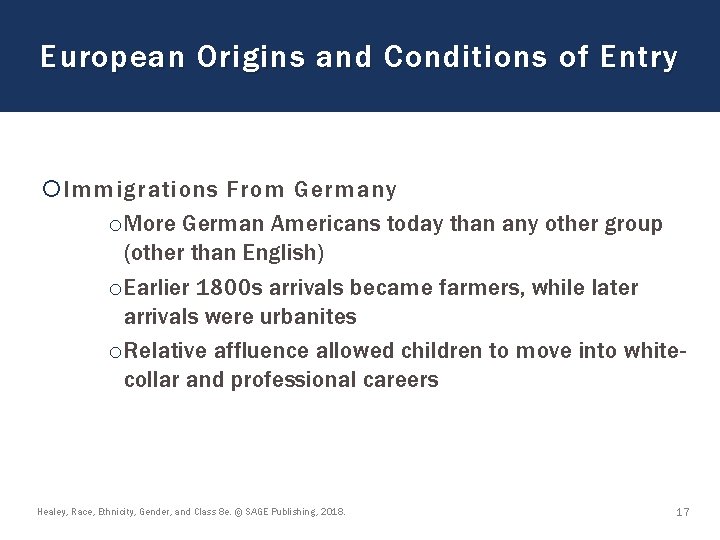
European Origins and Conditions of Entry Immigrations From Germany o. More German Americans today than any other group (other than English) o. Earlier 1800 s arrivals became farmers, while later arrivals were urbanites o. Relative affluence allowed children to move into whitecollar and professional careers Healey, Race, Ethnicity, Gender, and Class 8 e. © SAGE Publishing, 2018. 17
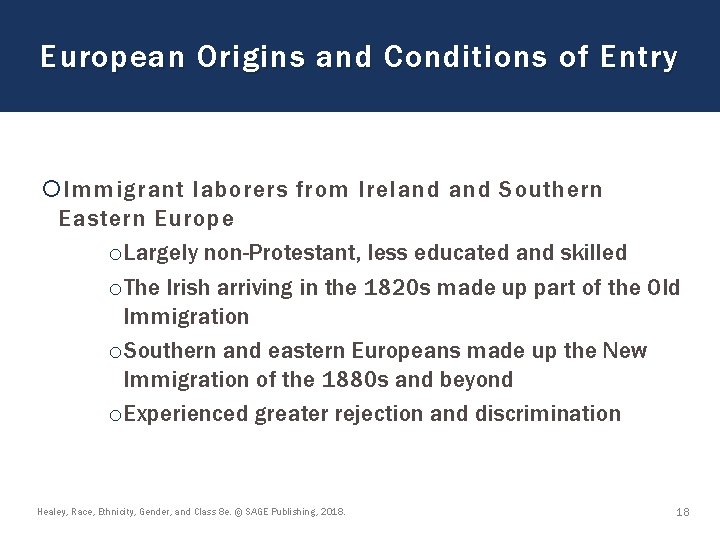
European Origins and Conditions of Entry Immigrant laborers from Ireland Southern Eastern Europe o. Largely non-Protestant, less educated and skilled o. The Irish arriving in the 1820 s made up part of the Old Immigration o. Southern and eastern Europeans made up the New Immigration of the 1880 s and beyond o. Experienced greater rejection and discrimination Healey, Race, Ethnicity, Gender, and Class 8 e. © SAGE Publishing, 2018. 18
European Origins and Conditions of Entry Jewish immigrants from Russia and other parts of Eastern Europe followed a third party pathway into U. S. society o. These immigrants were a part of the New Immigration and began arriving in the 1880 s Unlike most European immigrant groups, Jewish Americans became heavily involved in commerce o. Capitalizing on their residential concentration, Jewish immigrants created an enclave economy o. The garment industry became the lifeblood of the Jewish community Healey, Race, Ethnicity, Gender, and Class 8 e. © SAGE Publishing, 2018. 19
European Origins and Conditions of Entry Jewish Americans today surpass the national averages in income, levels of education, and occupational prestige Eastern European Jewish immigrants and the Ethnic Enclave o. Enclave success due to group cohesiveness, family labor, and commercial ability o. Economic advancement preceded acculturation o. The Americanized children helped preserve and expand the family enterprise Healey, Race, Ethnicity, Gender, and Class 8 e. © SAGE Publishing, 2018. 20
Chains of Immigration All immigrant groups tend to follow chains established and maintained by group members Immigrants often responded to U. S. society by attempting to recreate as much of their old word as possible o. For example, Little Italys, Chinatowns, and Little Tokyos o. They did so, in part, to avoid harsher forms of rejection and discrimination o. They also did this for solidarity and mutual support Healey, Race, Ethnicity, Gender, and Class 8 e. © SAGE Publishing, 2018. 21
The Campaign Against Immigration: Prejudice, Racism, and Discrimination Anti-Catholicism o Much of the prejudice against the Irish and other new immigrants was expressed in this way o Threatened Protestant social, economic, and political hegemony Although Catholics were often stereotyped as a single group, they also varied along a number of dimensions o Intra-Catholic group differences also caused conflict for resources Healey, Race, Ethnicity, Gender, and Class 8 e. © SAGE Publishing, 2018. 22
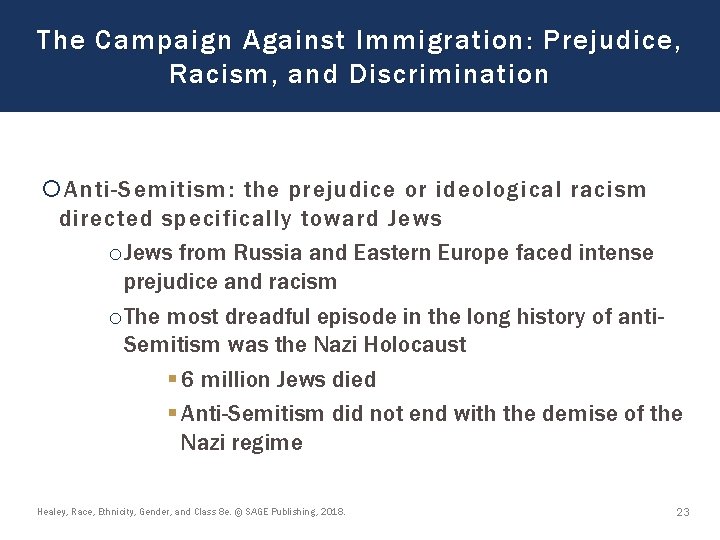
The Campaign Against Immigration: Prejudice, Racism, and Discrimination Anti-Semitism: the prejudice or ideological racism directed specifically toward Jews o. Jews from Russia and Eastern Europe faced intense prejudice and racism o. The most dreadful episode in the long history of anti. Semitism was the Nazi Holocaust § 6 million Jews died § Anti-Semitism did not end with the demise of the Nazi regime Healey, Race, Ethnicity, Gender, and Class 8 e. © SAGE Publishing, 2018. 23
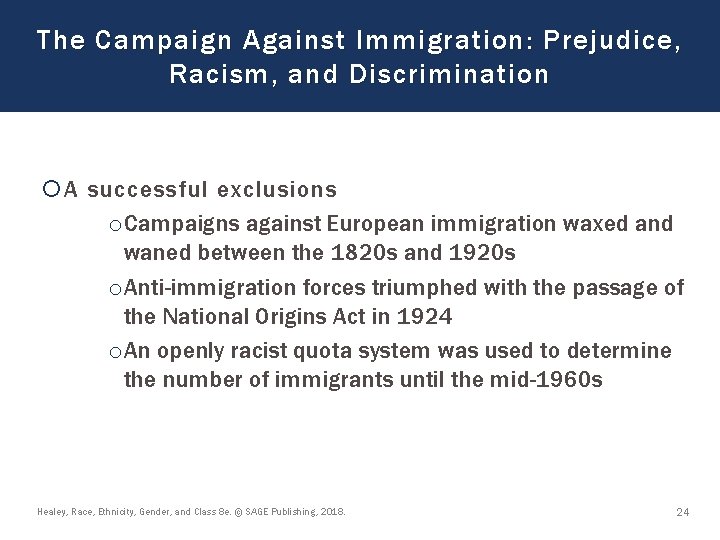
The Campaign Against Immigration: Prejudice, Racism, and Discrimination A successful exclusions o. Campaigns against European immigration waxed and waned between the 1820 s and 1920 s o. Anti-immigration forces triumphed with the passage of the National Origins Act in 1924 o. An openly racist quota system was used to determine the number of immigrants until the mid-1960 s Healey, Race, Ethnicity, Gender, and Class 8 e. © SAGE Publishing, 2018. 24
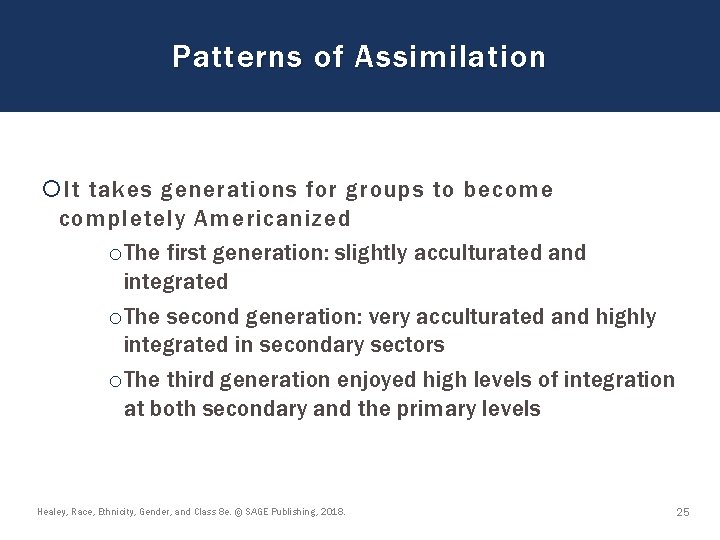
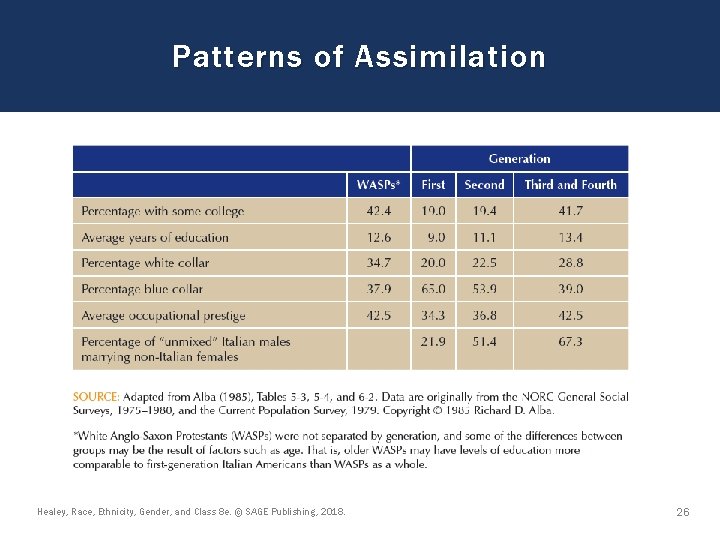
Patterns of Assimilation It takes generations for groups to become completely Americanized o. The first generation: slightly acculturated and integrated o. The second generation: very acculturated and highly integrated in secondary sectors o. The third generation enjoyed high levels of integration at both secondary and the primary levels Healey, Race, Ethnicity, Gender, and Class 8 e. © SAGE Publishing, 2018. 25
Patterns of Assimilation Healey, Race, Ethnicity, Gender, and Class 8 e. © SAGE Publishing, 2018. 26
Variations in Assimilation Sojourners v Birds of passage v No intention of becoming citizens v Return to the old country once enough capital accumulated § Italian immigrants Healey, Race, Ethnicity, Gender, and Class 8 e. © SAGE Publishing, 2018. 27
The Evolution of White Ethnicity The principle of third-generation interest is the idea that the grandchildren of immigrants will stress their ethnicity much more than will the second generation The ethnic revival was an increase in the interest in heritage that occurred among White ethnics in the 1960 s and 1970 s Healey, Race, Ethnicity, Gender, and Class 8 e. © SAGE Publishing, 2018. 28