
Chapter 2 Application layer 2 1 Principles of
- Slides: 11
Chapter 2: Application layer • 2. 1 Principles of network applications • 2. 2 Web and HTTP • 2. 3 FTP • 2. 4 Electronic Mail • 2. 6 P 2 P file sharing • 2. 7 Socket programming with TCP • 2. 8 Socket programming with UDP – SMTP, POP 3, IMAP • 2. 5 DNS 2: Application Layer 1
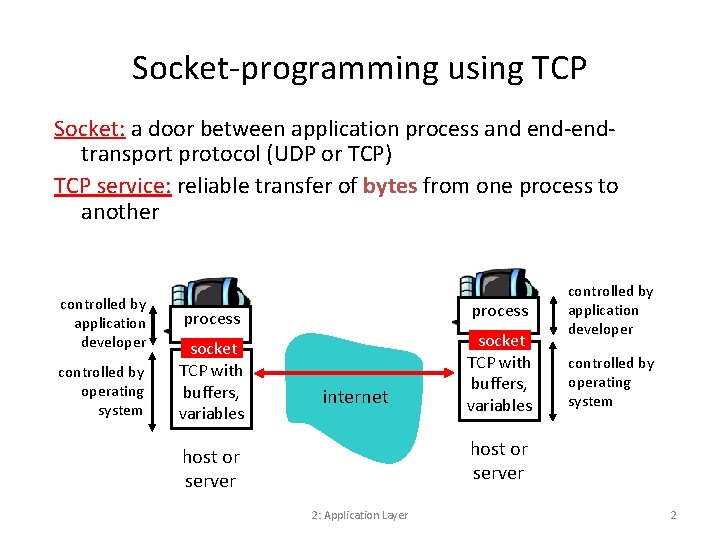
Socket-programming using TCP Socket: a door between application process and end-endtransport protocol (UDP or TCP) TCP service: reliable transfer of bytes from one process to another controlled by application developer controlled by operating system process socket TCP with buffers, variables internet socket TCP with buffers, variables controlled by application developer controlled by operating system host or server 2: Application Layer 2
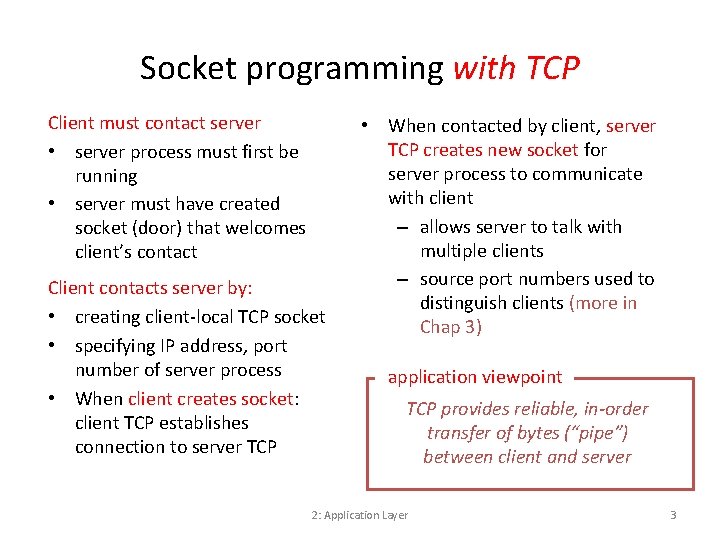
Socket programming with TCP Client must contact server • server process must first be running • server must have created socket (door) that welcomes client’s contact Client contacts server by: • creating client-local TCP socket • specifying IP address, port number of server process • When client creates socket: client TCP establishes connection to server TCP • When contacted by client, server TCP creates new socket for server process to communicate with client – allows server to talk with multiple clients – source port numbers used to distinguish clients (more in Chap 3) application viewpoint TCP provides reliable, in-order transfer of bytes (“pipe”) between client and server 2: Application Layer 3
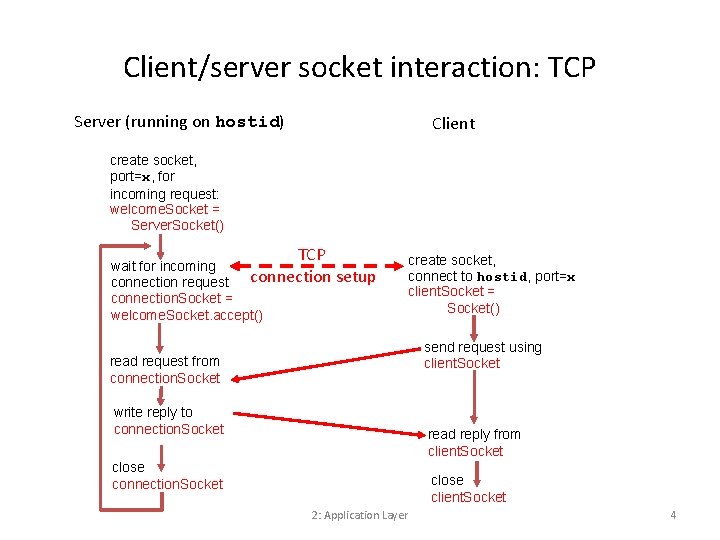
Client/server socket interaction: TCP Server (running on hostid) Client create socket, port=x, for incoming request: welcome. Socket = Server. Socket() TCP wait for incoming connection setup connection request connection. Socket = welcome. Socket. accept() create socket, connect to hostid, port=x client. Socket = Socket() send request using client. Socket read request from connection. Socket write reply to connection. Socket read reply from client. Socket close connection. Socket close client. Socket 2: Application Layer 4
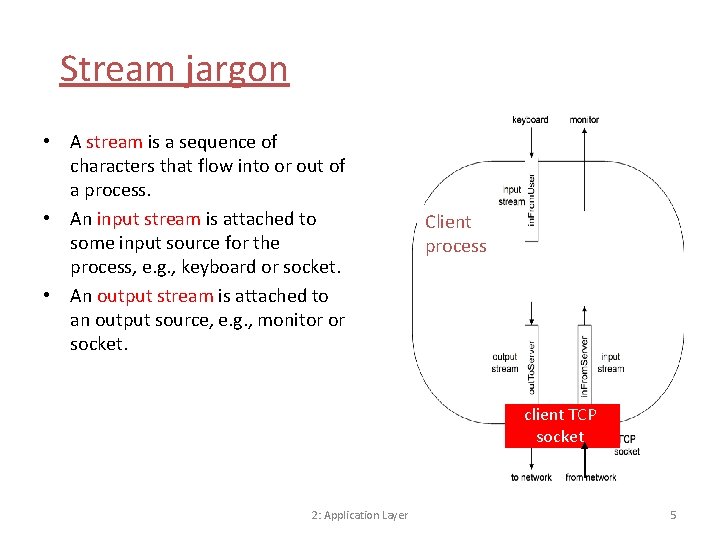
Stream jargon • A stream is a sequence of characters that flow into or out of a process. • An input stream is attached to some input source for the process, e. g. , keyboard or socket. • An output stream is attached to an output source, e. g. , monitor or socket. Client process client TCP socket 2: Application Layer 5
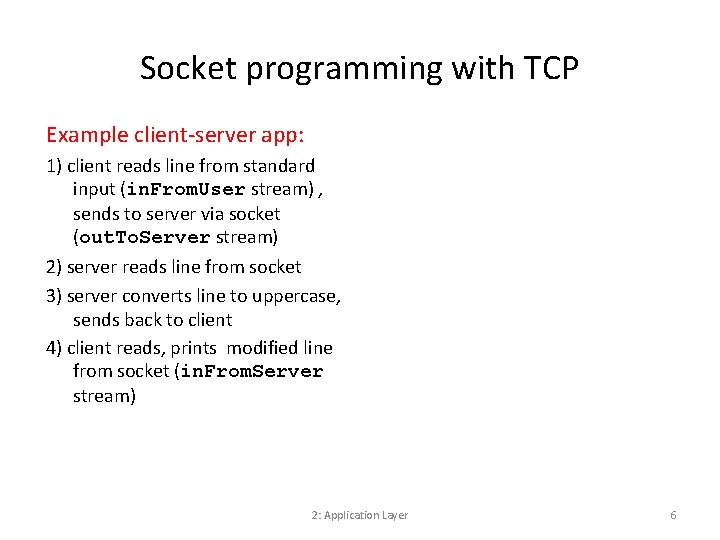
Socket programming with TCP Example client-server app: 1) client reads line from standard input (in. From. User stream) , sends to server via socket (out. To. Server stream) 2) server reads line from socket 3) server converts line to uppercase, sends back to client 4) client reads, prints modified line from socket (in. From. Server stream) 2: Application Layer 6
Chapter 2: Application layer • 2. 1 Principles of network applications • 2. 2 Web and HTTP • 2. 3 FTP • 2. 4 Electronic Mail – SMTP, POP 3, IMAP • 2. 6 P 2 P file sharing • 2. 7 Socket programming with TCP • 2. 8 Socket programming with UDP • 2. 9 Building a Web server • 2. 5 DNS 2: Application Layer 11
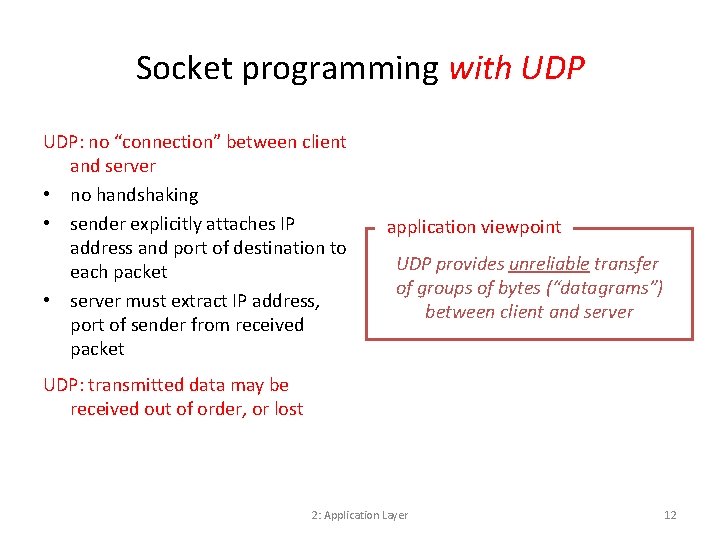
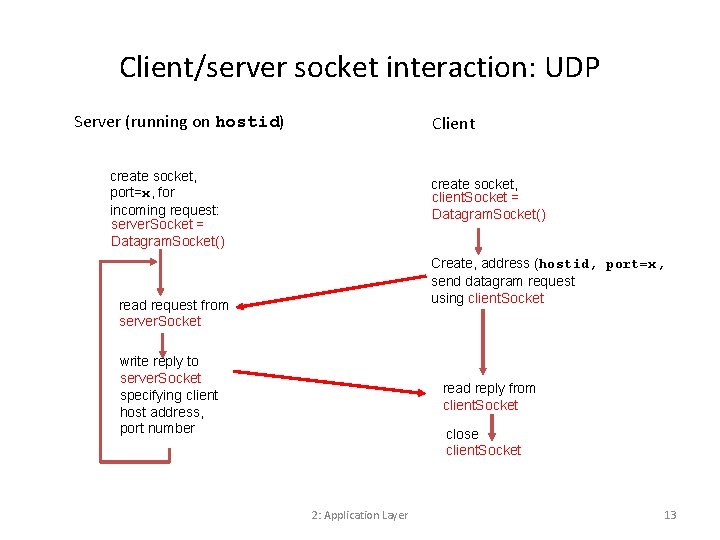
Socket programming with UDP: no “connection” between client and server • no handshaking • sender explicitly attaches IP address and port of destination to each packet • server must extract IP address, port of sender from received packet application viewpoint UDP provides unreliable transfer of groups of bytes (“datagrams”) between client and server UDP: transmitted data may be received out of order, or lost 2: Application Layer 12
Client/server socket interaction: UDP Server (running on hostid) Client create socket, port=x, for incoming request: server. Socket = Datagram. Socket() create socket, client. Socket = Datagram. Socket() Create, address (hostid, port=x, send datagram request using client. Socket read request from server. Socket write reply to server. Socket specifying client host address, port number read reply from client. Socket close client. Socket 2: Application Layer 13
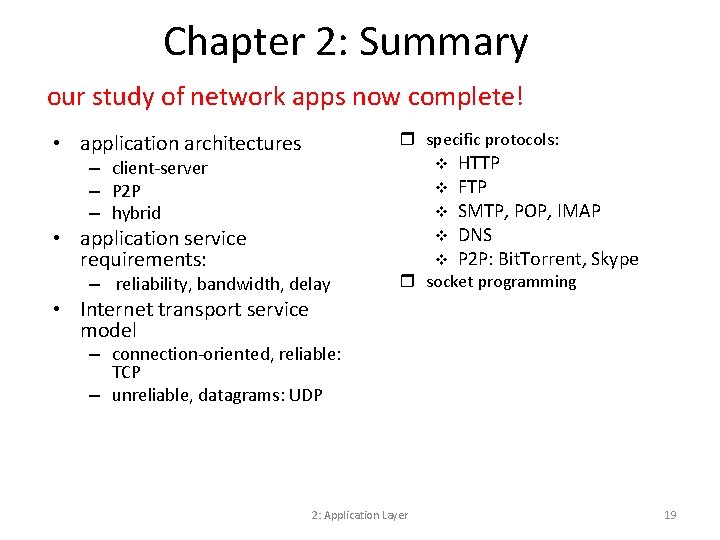
Chapter 2: Summary our study of network apps now complete! r specific protocols: • application architectures v – client-server – P 2 P – hybrid v v • application service requirements: v v – reliability, bandwidth, delay HTTP FTP SMTP, POP, IMAP DNS P 2 P: Bit. Torrent, Skype r socket programming • Internet transport service model – connection-oriented, reliable: TCP – unreliable, datagrams: UDP 2: Application Layer 19
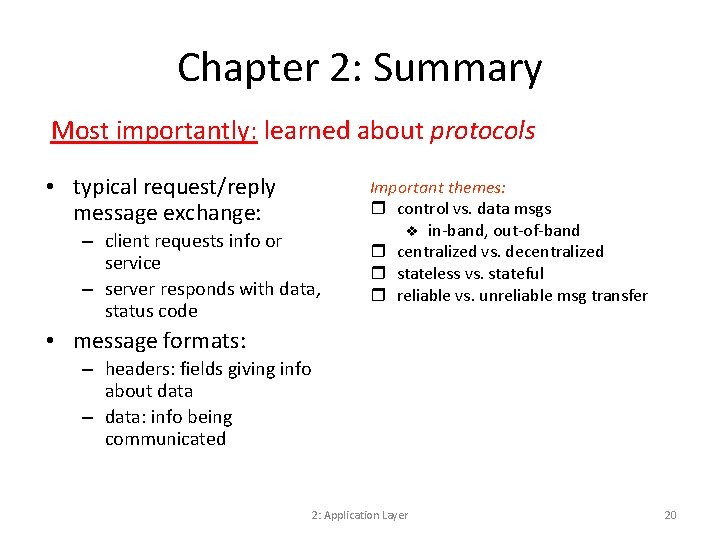
Chapter 2: Summary Most importantly: learned about protocols • typical request/reply message exchange: – client requests info or service – server responds with data, status code Important themes: r control vs. data msgs v in-band, out-of-band r centralized vs. decentralized r stateless vs. stateful r reliable vs. unreliable msg transfer • message formats: – headers: fields giving info about data – data: info being communicated 2: Application Layer 20