
Chapter 2 Animal and Human Language What are
- Slides: 19
Chapter 2: Animal and Human Language
What are the similarities of Human and Animal Languages? - Social Phenomena: Language is a social phenomena. Both human and many species of animals are social being. - Communication: The main purpose of language is to communicate. Both animal and human use language for this purpose - Use of Sign: Communication is not complete without the use of signs. Both animal and human use sign to communicate. - Language is systematic and symbolic: Communicating successfully (letting others know what we want them to know) is systematic. There are systematic rules that govern how to tell/communicate something. The way animal/human let other know something is by using symbols. Symbol incorporates large corpus of endeavor: sound, gesture, movement, and even silence.
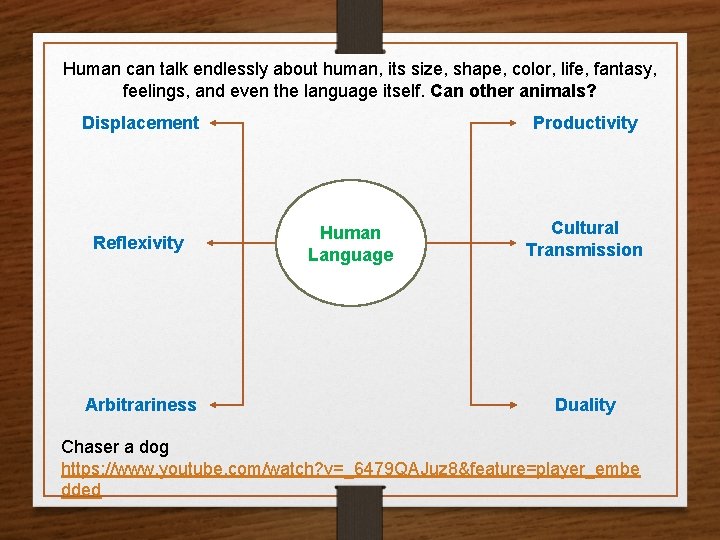
Human can talk endlessly about human, its size, shape, color, life, fantasy, feelings, and even the language itself. Can other animals? Displacement Reflexivity Arbitrariness Productivity Human Language Cultural Transmission Duality Chaser a dog https: //www. youtube. com/watch? v=_6479 QAJuz 8&feature=player_embe dded
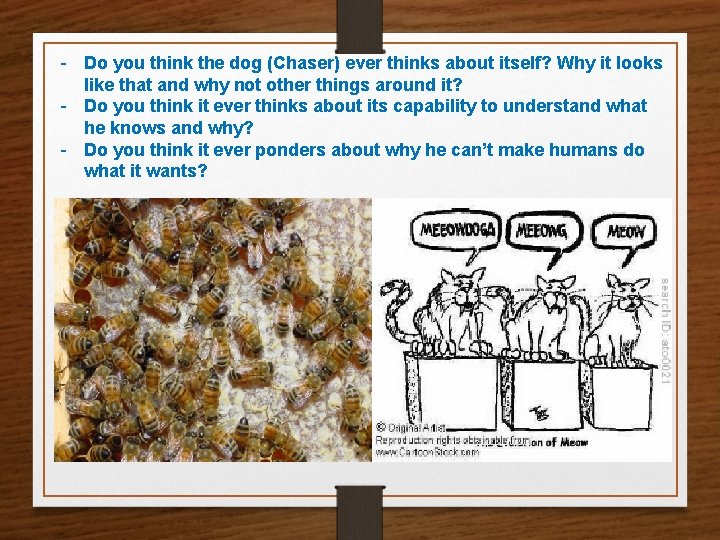
- Do you think the dog (Chaser) ever thinks about itself? Why it looks like that and why not other things around it? - Do you think it ever thinks about its capability to understand what he knows and why? - Do you think it ever ponders about why he can’t make humans do what it wants?
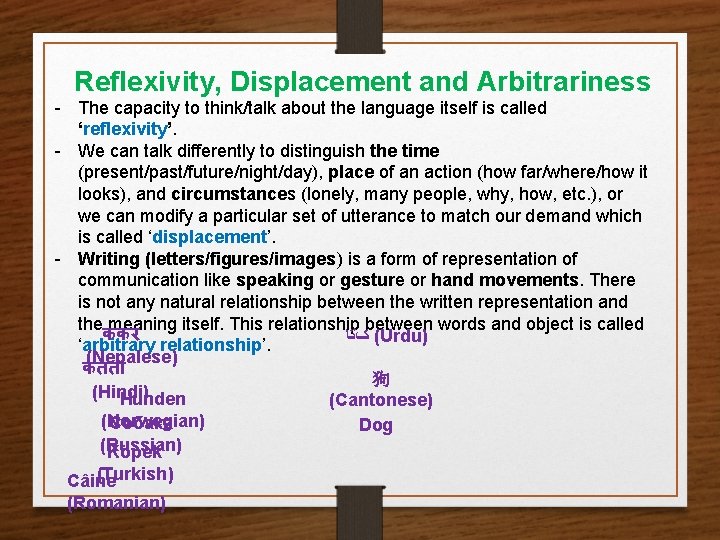
Reflexivity, Displacement and Arbitrariness - The capacity to think/talk about the language itself is called ‘reflexivity’. - We can talk differently to distinguish the time (present/past/future/night/day), place of an action (how far/where/how it looks), and circumstances (lonely, many people, why, how, etc. ), or we can modify a particular set of utterance to match our demand which is called ‘displacement’. - Writing (letters/figures/images) is a form of representation of communication like speaking or gesture or hand movements. There is not any natural relationship between the written representation and the meaning itself. This relationship between words and object is called ककर ( کﺘﺎ Urdu) ‘arbitrary relationship’. (Nepalese) कतत 狗 (Hindi) Hunden (Cantonese) (Norwegian) Собака (Russian) Köpek (Turkish) Câine (Romanian) Dog
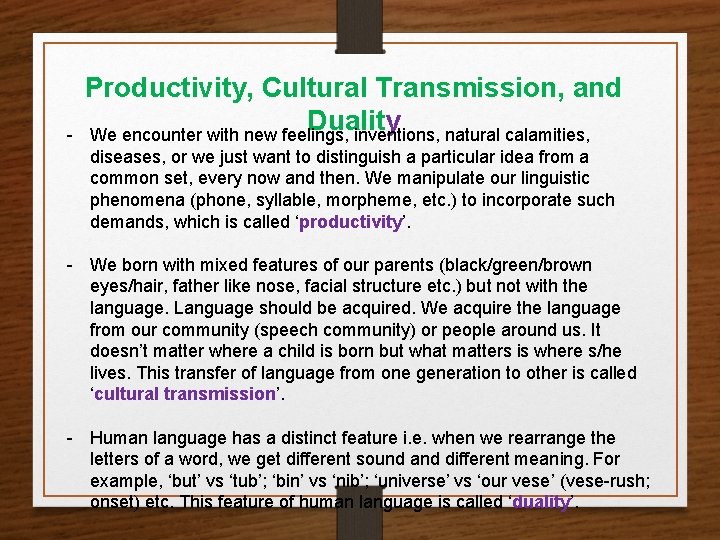
- Productivity, Cultural Transmission, and Duality We encounter with new feelings, inventions, natural calamities, diseases, or we just want to distinguish a particular idea from a common set, every now and then. We manipulate our linguistic phenomena (phone, syllable, morpheme, etc. ) to incorporate such demands, which is called ‘productivity’. - We born with mixed features of our parents (black/green/brown eyes/hair, father like nose, facial structure etc. ) but not with the language. Language should be acquired. We acquire the language from our community (speech community) or people around us. It doesn’t matter where a child is born but what matters is where s/he lives. This transfer of language from one generation to other is called ‘cultural transmission’. - Human language has a distinct feature i. e. when we rearrange the letters of a word, we get different sound and different meaning. For example, ‘but’ vs ‘tub’; ‘bin’ vs ‘nib’; ‘universe’ vs ‘our vese’ (vese-rush; onset) etc. This feature of human language is called ‘duality’.
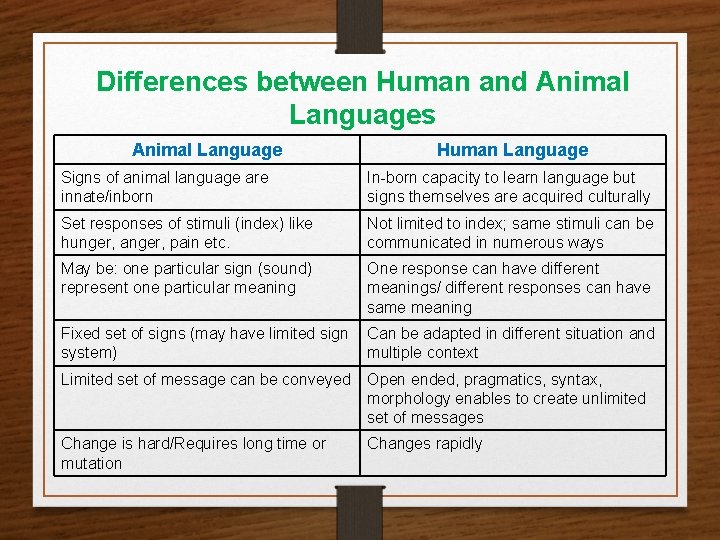
Differences between Human and Animal Languages Animal Language Human Language Signs of animal language are innate/inborn In-born capacity to learn language but signs themselves are acquired culturally Set responses of stimuli (index) like hunger, anger, pain etc. Not limited to index; same stimuli can be communicated in numerous ways May be: one particular sign (sound) represent one particular meaning One response can have different meanings/ different responses can have same meaning Fixed set of signs (may have limited sign system) Can be adapted in different situation and multiple context Limited set of message can be conveyed Open ended, pragmatics, syntax, morphology enables to create unlimited set of messages Change is hard/Requires long time or mutation Changes rapidly
Washoe https: //www. youtube. com/watch? v=OUw. Ov. F 7 Tqg. A Lana https: //www. youtube. com/watch? v=Hi. WDKXRz. Sm. U Koko https: //www. youtube. com/watch? v=SNu. Z 4 OE 6 v. Ck Nim https: //www. youtube. com/watch? v=eybp 1 Rsxn 4 k&list=PLV_Nd. EXYFm. G d. Pg. Fa 7 l. Gbc 2 Wi 2_52 Uu. B 7 g Kanzi https: //www. youtube. com/watch? v=AJ_3 l 1 z 5 r 0 s How language evolve https: //www. youtube. com/watch? v=i. WDKs. Hm 6 g. TA
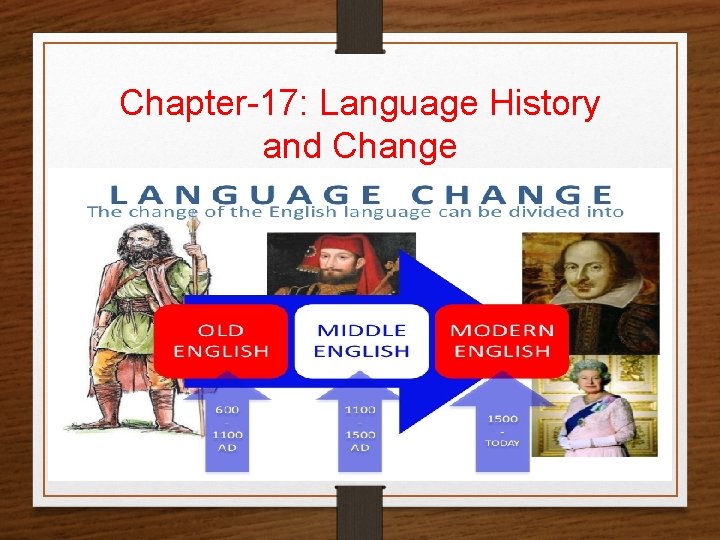
Chapter-17: Language History and Change
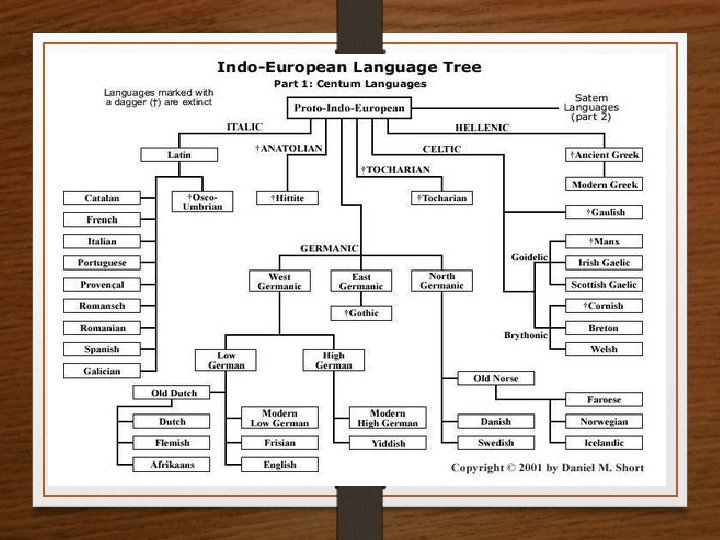
Philology - Philology is derived from the Greek terms φίλος (love) and λόγος (word, reason) and literally means a love of words. It is the study of language in literary sources and is a combination of literary studies, history and linguistics. - During the 19 th Century, it dominated the study of language and the creation of ‘family tree’ took place. - Family tree is a diagrammatical representation of relationship among several generation of people/language - When we encounter similar expressions between two languages meaning somewhat similar ideas, we can assume that such languages are somewhat related. This inquiry is called ‘cognate’. For example: English words (father, mother, and friend) sound similar to German words (vater, mutter, and freund), we can assume that modern English and modern German language may have common ancestor.
Comparative Reconstruction - It is a way of tracing the similarities among many languages to find out the ancestral language locating the original ‘proto’ form. 1. Generative Principal: Believes that some sounds are older than other sounds, and some sounds change more frequently than other. i. Final vowels often disappear ii. Voiceless sounds become voiced, often between vowels iii. Stops become fricatives iv. Consonant become voiceless at the end of the words 2. Sound Reconstruction: Comparing words that contains similar letter cluster at the beginning syllable, or in the middle, or at the end of a word, and comparing their sound we can identity or at least guess the original sound. Which may help us locate the ancestral from of certain language.
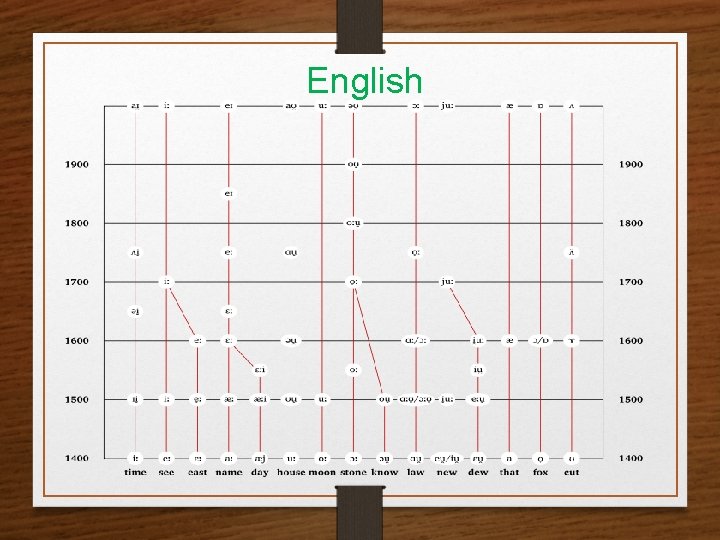
English
- Third largest language on the basis of total population who use English as their native language - Main language of commerce, politics, and academia - Is spreading more rapidly than any other language in the world. - West Germanic language brought to United Kingdom by early settlers as early as 5 century AD. https: //www. youtube. com/watch? v=k. Iz. Fz 9 T 5 rh. I
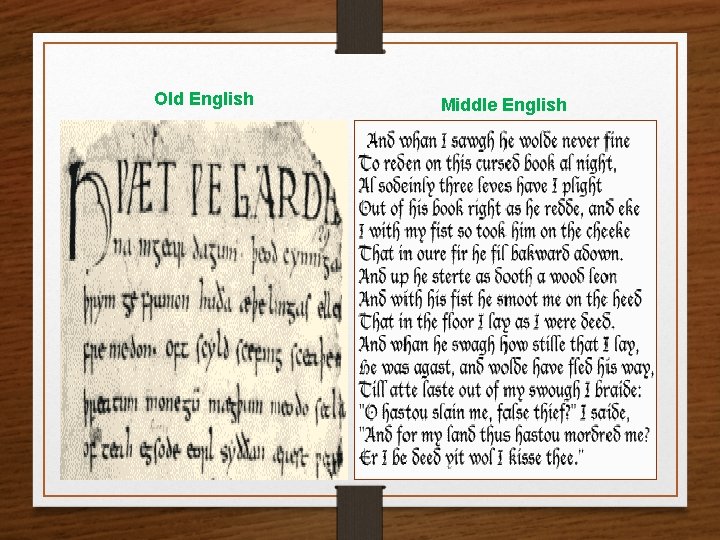
Old English Middle English
Changes of Language External Change: When a language is influenced by other language such as borrowing that forces a change in meaning or even construction of a word itself, it is known as external change. Internal Change: Sometimes the change is not an outcome of any external force but something internal for example the word ‘burn’ is easy to pronounce and write than its original version ‘brinnan’. Slowly people start sayin ‘burn’ and it gets changed. This is called an internal change.
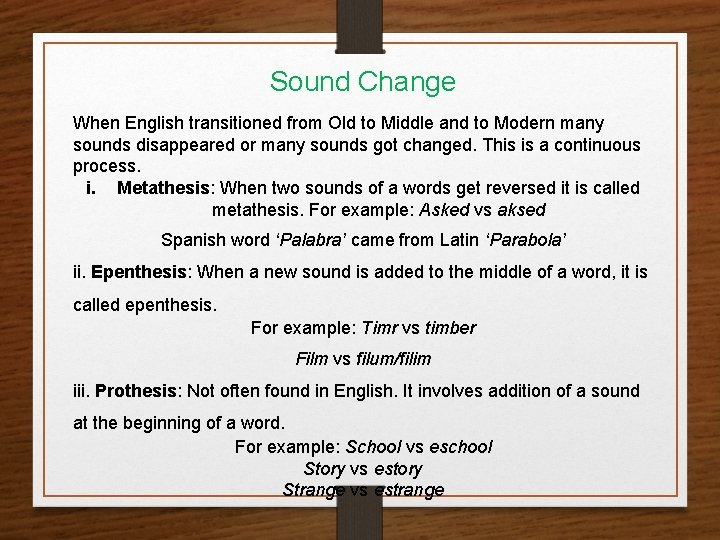
Sound Change When English transitioned from Old to Middle and to Modern many sounds disappeared or many sounds got changed. This is a continuous process. i. Metathesis: When two sounds of a words get reversed it is called metathesis. For example: Asked vs aksed Spanish word ‘Palabra’ came from Latin ‘Parabola’ ii. Epenthesis: When a new sound is added to the middle of a word, it is called epenthesis. For example: Timr vs timber Film vs filum/filim iii. Prothesis: Not often found in English. It involves addition of a sound at the beginning of a word. For example: School vs eschool Story vs estory Strange vs estrange
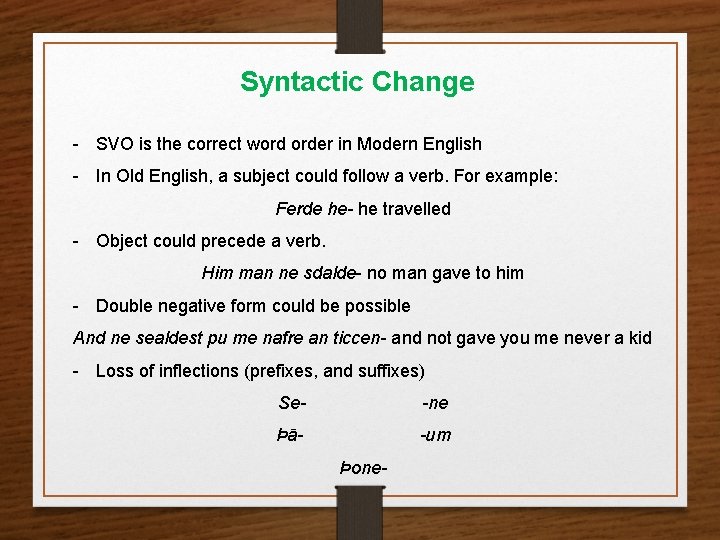
Syntactic Change - SVO is the correct word order in Modern English - In Old English, a subject could follow a verb. For example: Ferde he- he travelled - Object could precede a verb. Him man ne sdalde- no man gave to him - Double negative form could be possible And ne sealdest pu me nafre an ticcen- and not gave you me never a kid - Loss of inflections (prefixes, and suffixes) Se- -ne Þā- -um Þone-
Semantic Changes - Broadening of meaning - Narrowing of Meaning