
Chapter 2 Analysis of the strategic situation External

- Slides: 36
Chapter 2 Analysis of the strategic situation: External environment Manli Huang School of Business Administration, Research Center of Chinese Strategic Management, SCUT
Section 1: external environment and its objective of analysis
1. definition of the external environment • The external environment of enterprises includes all the factors outside of enterprises, which are likely to have impacts on the operation and development of the enterprises. • Direct factors / task factors : can directly exchange with enterprises and affect their behaviors. • Indirect factors / general factors : factors that the have an impact on business through impact on the direct factors. Therefore, those factors are also known as leading factors.
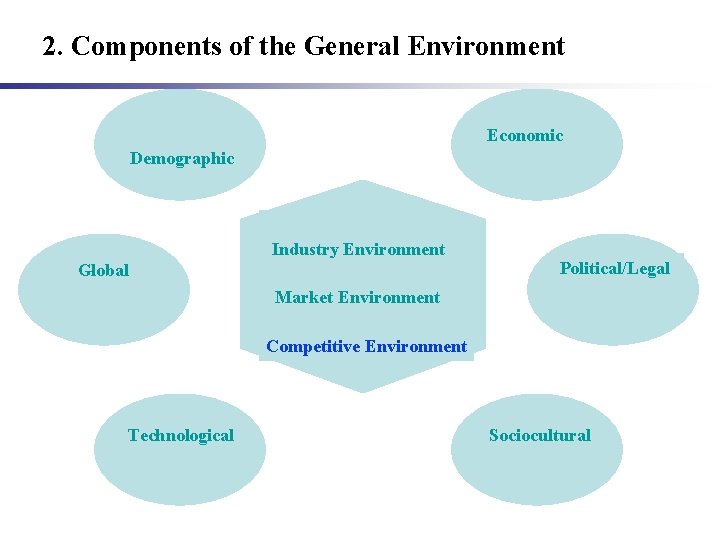
2. Components of the General Environment Economic Demographic Industry Environment Global Political/Legal Market Environment Competitive Environment Technological Sociocultural
3. Interaction between the external environment and enterprises • External environment determines the behavior of enterprises. If only the conduct meets the expectations and requirements of its external interest groups, the enterprises will receive the input, get the opportunity to develop and realize value. Therefore, there is so-called opportunity to promote / market orientation / such decision by systems; • The strategic behavior should not be a simple adaptation to the external environment, but should include (or be largely) positive adaptation, or use the environment, or have creatively impact on the external environment. Otherwise, strategy lost its most fundamental significance. Therefore, we will ask enterprises to influence government policy \ change trade rules \ promote industrial structural optimization \change in consumer demand behaviors, etc. • Interaction between enterprises and the external environment can be directly, and more indirectly occurred.
4. The approaches of the effects of the external environment • The ways that affect external environment vary. • The factors which are conducive to the development of enterprise are known as the "opportunity (O)”; • While others that are not conducive to the development of the enterprises are named as “threat (T).
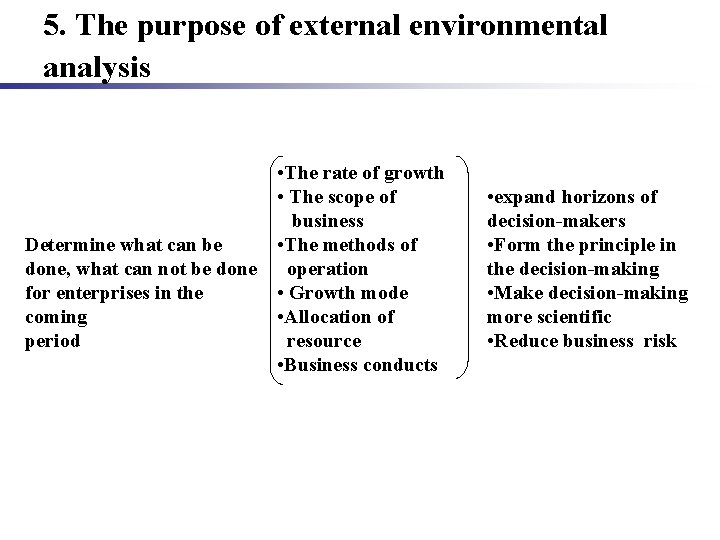
5. The purpose of external environmental analysis • The rate of growth • The scope of business • The methods of Determine what can be done, what can not be done operation for enterprises in the • Growth mode coming • Allocation of period resource • Business conducts • expand horizons of decision-makers • Form the principle in the decision-making • Make decision-making more scientific • Reduce business risk
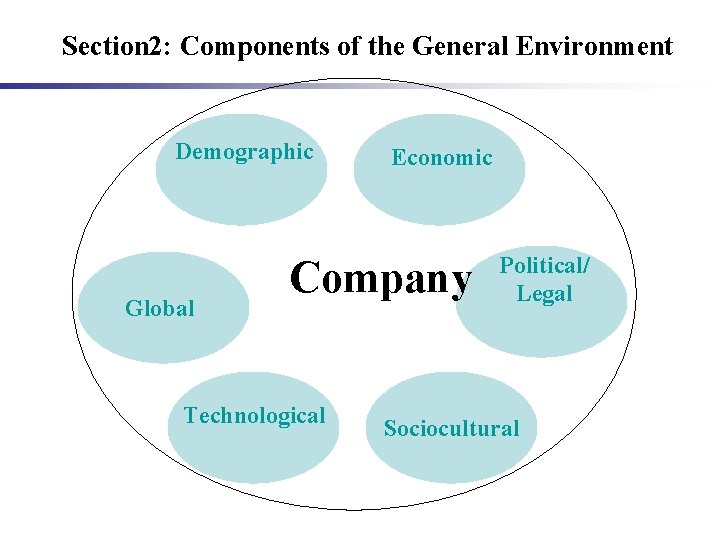
Section 2: Components of the General Environment Demographic Global Economic Company Technological Political/ Legal Sociocultural
1. To find the factors which will affect the options of business strategy • If there are no significant changes of environment in the future, the factors that influenced industry, market, competition and enterprises in the past will still make effect (summary through second-hand information, expert advice, internal visit and questionnaires, etc). • If we already know some events that is happening and is going to happen will change the environment, enterprises need to know the future impact of these events (summary through second-hand information, expert advice, internal visit and questionnaires, etc).
2. Identify and select a relatively important factor • Based on the first step, select a relatively important factor; • The criteria of judgment are the extent of the impact, the time of the impact, the impact occurred, etc; • Use methods of combination of objective data and subjective judgment to determine the weight of these important factors.
3. Predict the trend of change of the key factors • On the basis of the second step, concentrate on and predict the probability , methods and nature of the impact on these key factors; • Method of prediction can be objective, and can also be subjective.
4. Judge the nature of the impact of these trends on corporate strategy • Factors or the impacts which are beneficial to the future development of the enterprise can be called "opportunity". • Factors or the impact which are adverse to the future development of the enterprises can be called "threat". • If the same factor that is an opportunity and a threat, it needs to be researched. • Need to describe the various opportunities and threats through very specific descriptions, in order to avoid differences.
Section 3: Analysis of industry and market demand
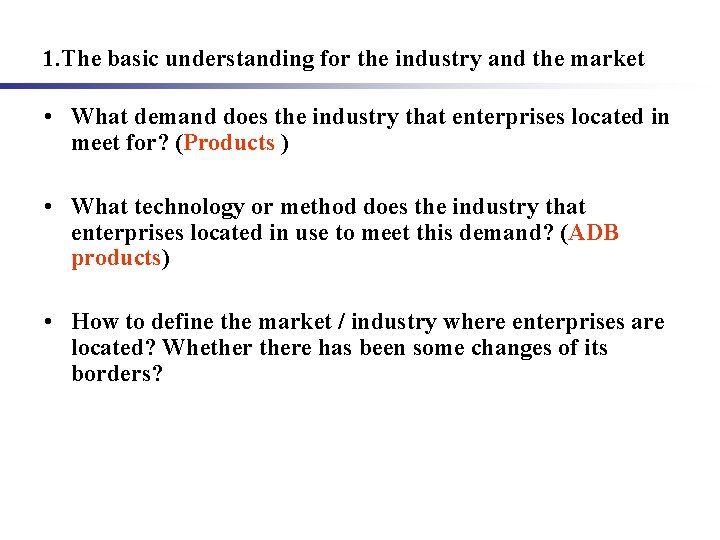
1. The basic understanding for the industry and the market • What demand does the industry that enterprises located in meet for? (Products ) • What technology or method does the industry that enterprises located in use to meet this demand? (ADB products) • How to define the market / industry where enterprises are located? Whethere has been some changes of its borders?
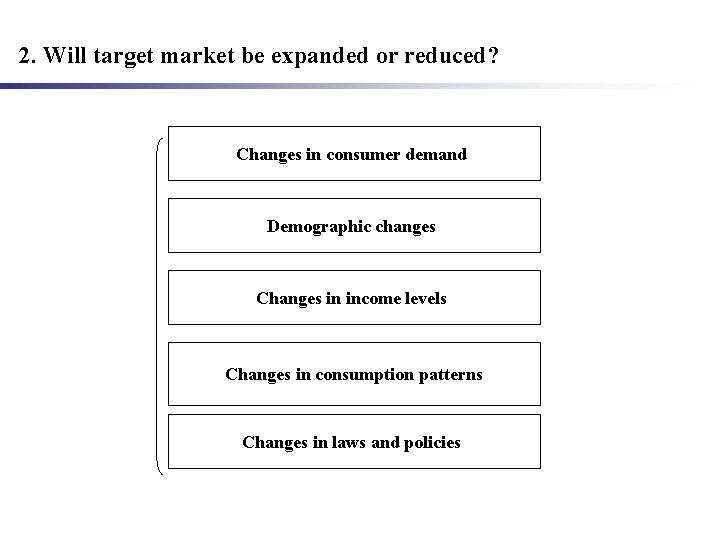
2. Will target market be expanded or reduced? Changes in consumer demand Demographic changes Changes in income levels Changes in consumption patterns Changes in laws and policies
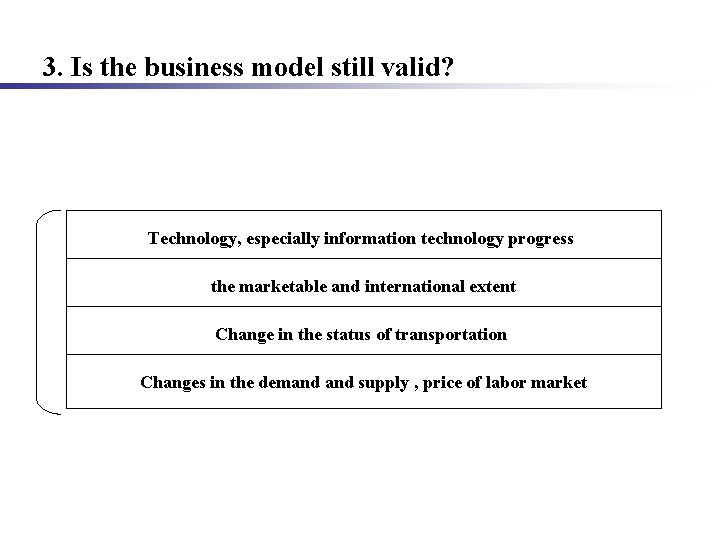
3. Is the business model still valid? Technology, especially information technology progress the marketable and international extent Change in the status of transportation Changes in the demand supply , price of labor market
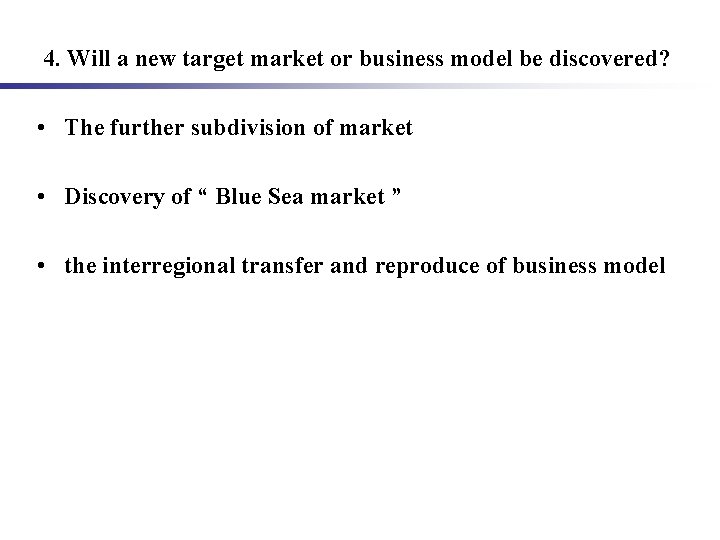
4. Will a new target market or business model be discovered? • The further subdivision of market • Discovery of “ Blue Sea market ” • the interregional transfer and reproduce of business model
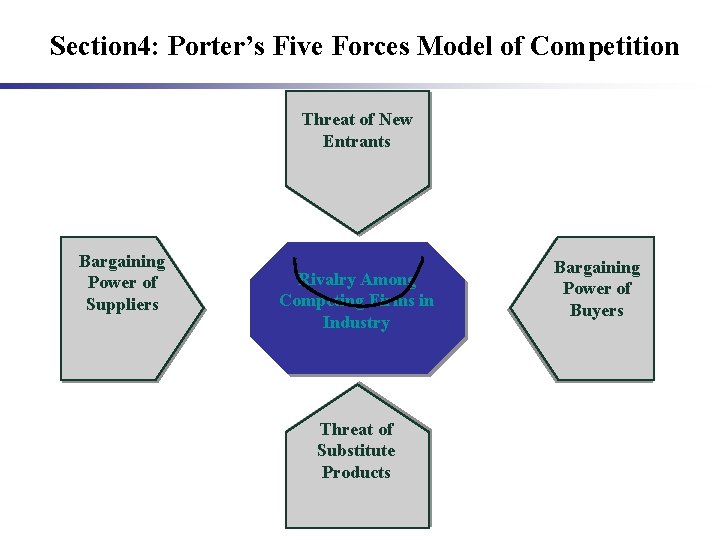
Section 4: Porter’s Five Forces Model of Competition Threat of New Entrants Bargaining Power of Suppliers Rivalry Among Competing Firms in Industry Threat of Substitute Products Bargaining Power of Buyers
Role of the model of industrial structural analysis • Understand the economic factors behind the industry; • Decide to withdraw from or enter into an industry or market; • The various options that stimulate strategic competition in industry;
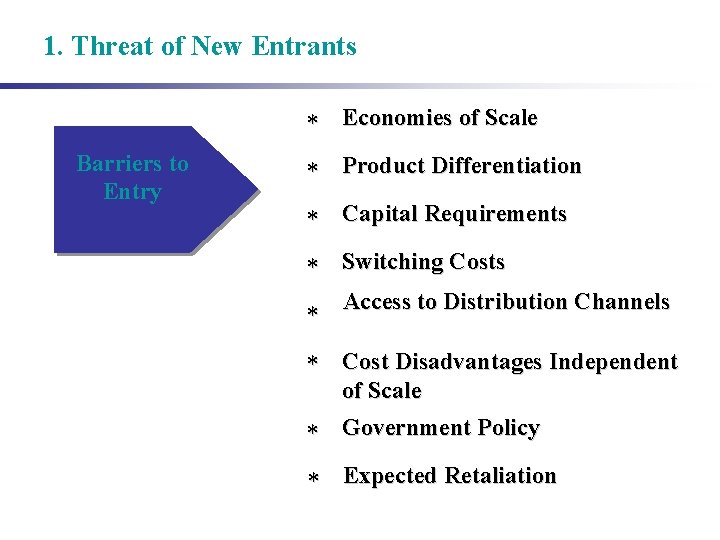
1. Threat of New Entrants * Economies of Scale Barriers to Entry * Product Differentiation * Capital Requirements * Switching Costs Access to Distribution Channels * * Cost Disadvantages Independent of Scale * Government Policy * Expected Retaliation
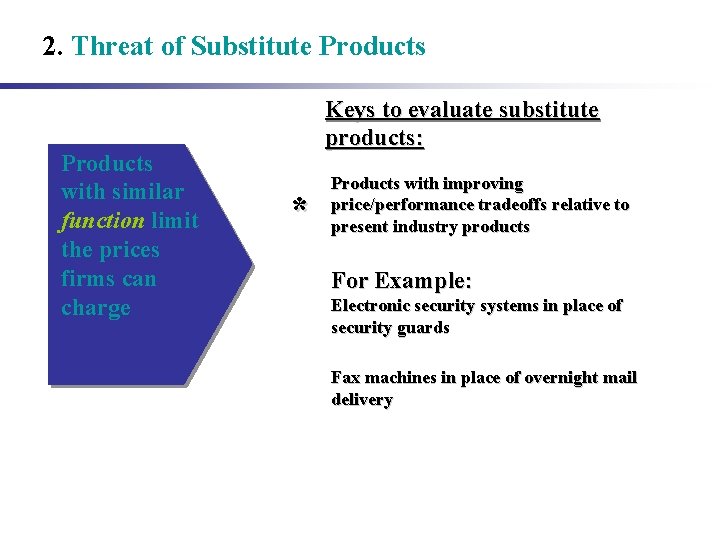
2. Threat of Substitute Products with similar function limit the prices firms can charge Keys to evaluate substitute products: * Products with improving price/performance tradeoffs relative to present industry products For Example: Electronic security systems in place of security guards Fax machines in place of overnight mail delivery
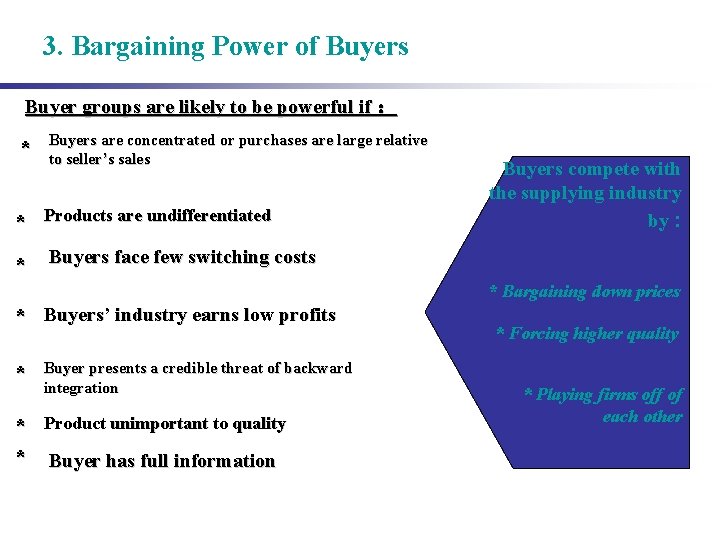
3. Bargaining Power of Buyers Buyer groups are likely to be powerful if : * * Buyers are concentrated or purchases are large relative to seller’s sales Products are undifferentiated Buyers compete with the supplying industry by : * Buyers face few switching costs * Bargaining down prices * Buyers’ industry earns low profits * Buyer presents a credible threat of backward integration * Product unimportant to quality * Buyer has full information * Forcing higher quality * Playing firms off of each other
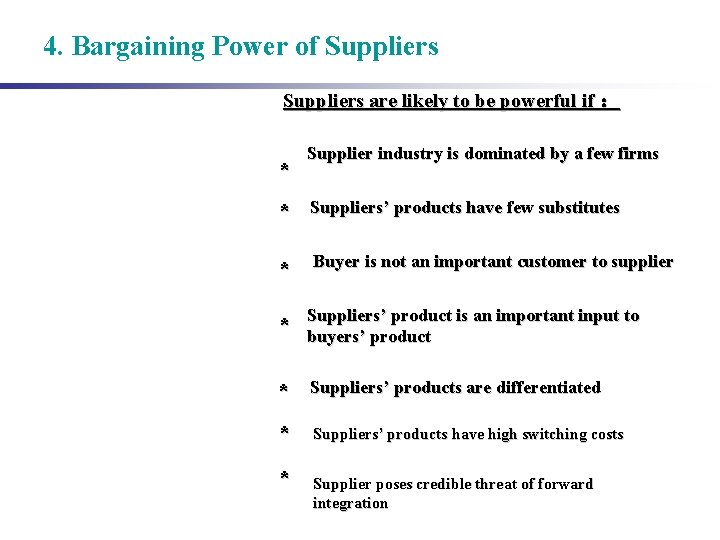
4. Bargaining Power of Suppliers are likely to be powerful if : * Supplier industry is dominated by a few firms * Suppliers’ products have few substitutes * Buyer is not an important customer to supplier * Suppliers’ product is an important input to buyers’ product * Suppliers’ products are differentiated * Suppliers’ products have high switching costs * Supplier poses credible threat of forward integration
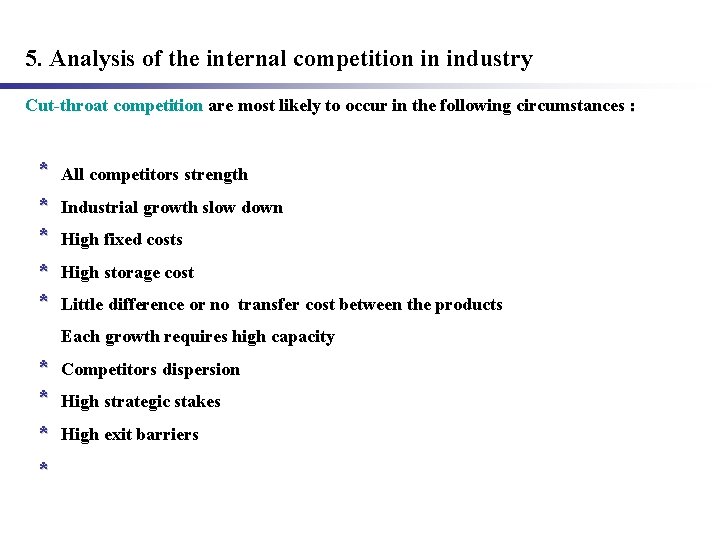
5. Analysis of the internal competition in industry Cut-throat competition are most likely to occur in the following circumstances : * * * All competitors strength Industrial growth slow down High fixed costs High storage cost Little difference or no transfer cost between the products Each growth requires high capacity * * Competitors dispersion High strategic stakes High exit barriers
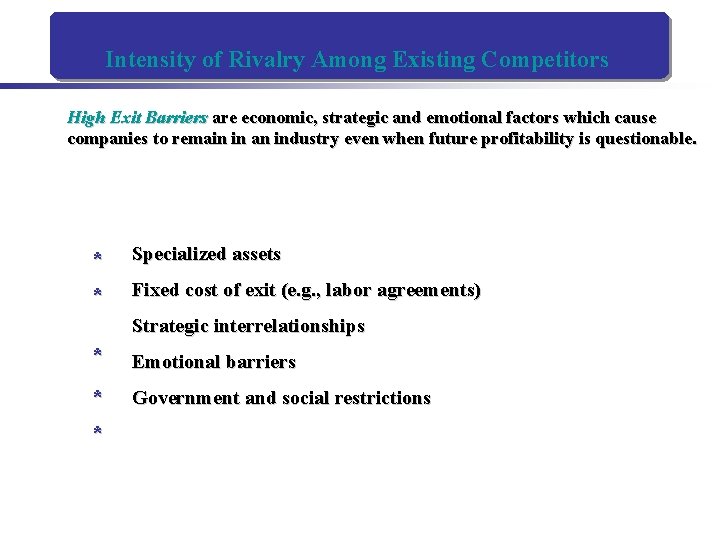
Intensity of Rivalry Among Existing Competitors High Exit Barriers are economic, strategic and emotional factors which cause companies to remain in an industry even when future profitability is questionable. * * Specialized assets Fixed cost of exit (e. g. , labor agreements) Strategic interrelationships * Emotional barriers * * Government and social restrictions
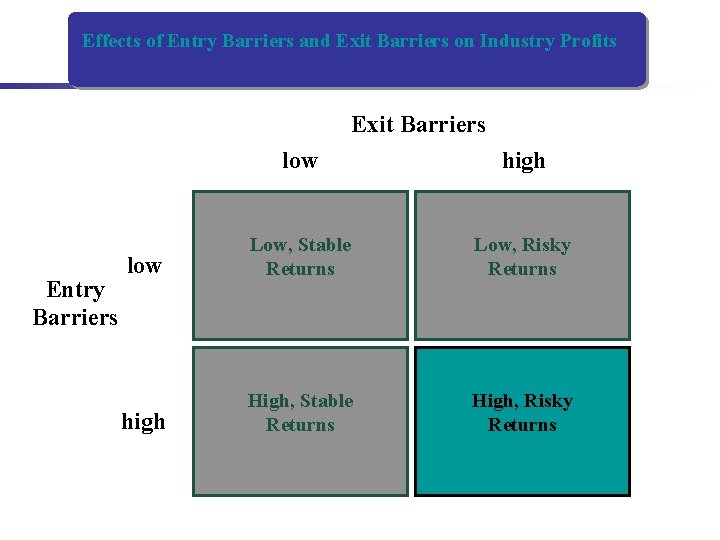
Effects of Entry Barriers and Exit Barriers on Industry Profits Exit Barriers Entry Barriers low high low Low, Stable Returns Low, Risky Returns high High, Stable Returns High, Risky Returns
Sect. 5 Analysis of competitive environment
1. Strategic Group Analysis • Although in the same industry, enterprises in the industry are in fact divided into a number of strategic groups because of different target markets, business models, market positioning and interaction. • The formation and stability of the strategy group itself should be the result of rational industrial competitive structure and mature business competitive behavior. The existence of strategic groups and the competition will help to keep competitive advantage of the industry. • The analysis of the strategic group is conducive to understand the competitive situation and the development trend of the entire industry, to clear competitive targets and to make strategy focused on the key competitors.
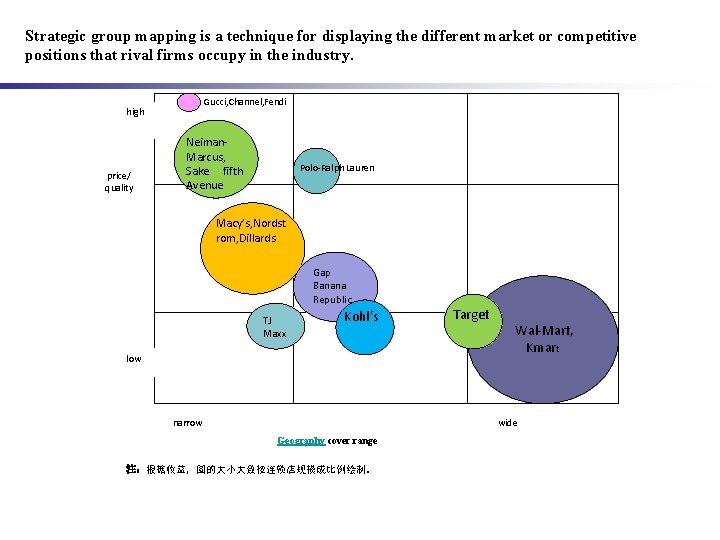
Strategic group mapping is a technique for displaying the different market or competitive positions that rival firms occupy in the industry. Gucci, Channel, Fendi high price/ quality Neiman. Marcus, Sake fifth Avenue Polo-Ralph Lauren Macy’s, Nordst rom, Dillards Gap Banana Republic TJ Maxx Kohl’s low narrow Target Wal-Mart, Kmart wide Geography cover range 注:根据收益,圆的大小大致按连锁店规模成比例绘制。
• Driving forces and competitive pressures do not affect all strategic groups evenly. • Profit prospects vary from group to group based on the relative attractiveness of their market positions. • The closer strategic groups are to each other on the map, the stronger the cross-group competitive rivalry tends to be.
2. The competitive strategy of competitors • The aims of the future\objectives and intentions • The main business model • Basic positions on the market • The focus of allocation of resources
3. Analysis of basic views (assumption) on competitors • Do competitors claim that the environment will change in future? • Do competitors claim that the industry structure will be adjusted? • What do competitors think about their status and position?
4. Analysis of the behavior model of competitors • The history of rivals • The structure of senior managers of competitors • Values of senior managers of competitors • Risk preference of competitors
5. Analysis of competitors’ resources and capacity • Compared with competitors, what is the situation of resource in the enterprise? • Compared with competitors, how is the ability level of the enterprise? • Compared with competitors, whether the enterprise has sustainable competitive advantage in the key areas ----- core competance
5. Analysis of the ability of dynamic interaction • Ability to react • Ability to contain • Ability to implement (speed / quality) • Ability to innovate
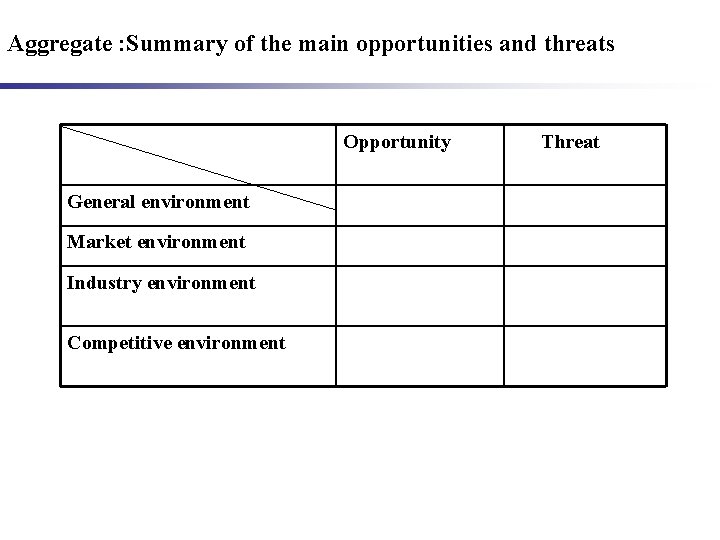
Aggregate : Summary of the main opportunities and threats Opportunity General environment Market environment Industry environment Competitive environment Threat