
Chapter 2 Analog Signals Systems and Transforms Fourier
- Slides: 66
Chapter 2 Analog Signals, Systems, and Transforms
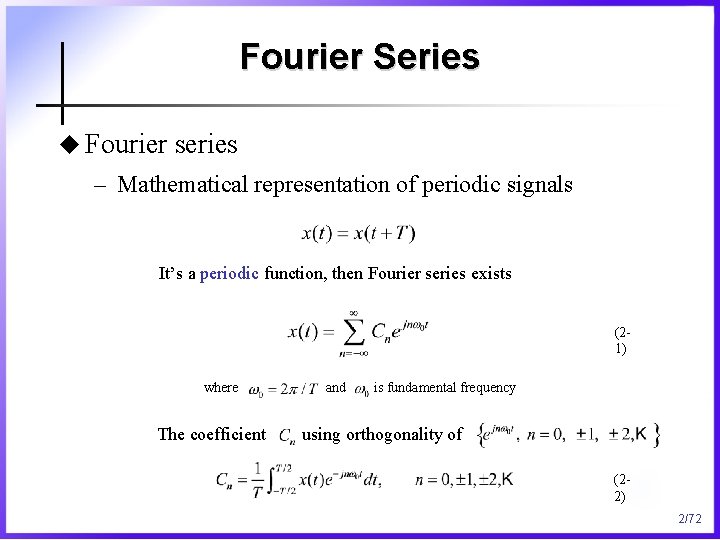
Fourier Series u Fourier series – Mathematical representation of periodic signals It’s a periodic function, then Fourier series exists (21) where The coefficient and is fundamental frequency using orthogonality of (22) 2/72
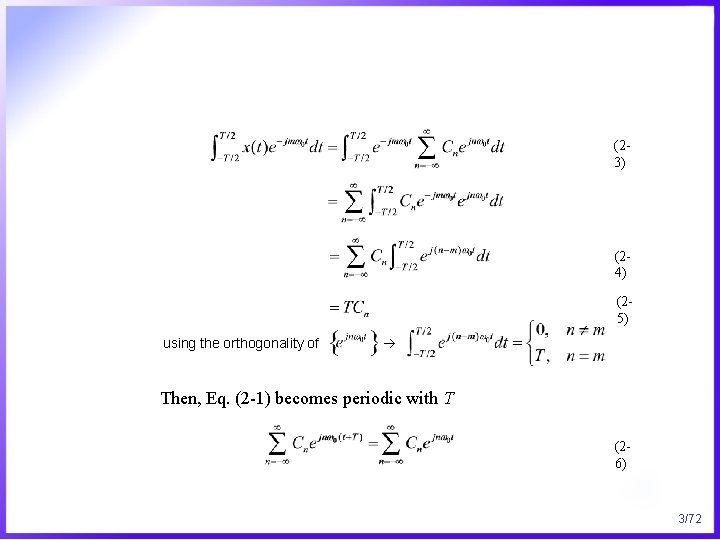
(23) (24) (25) using the orthogonality of Then, Eq. (2 -1) becomes periodic with T (26) 3/72
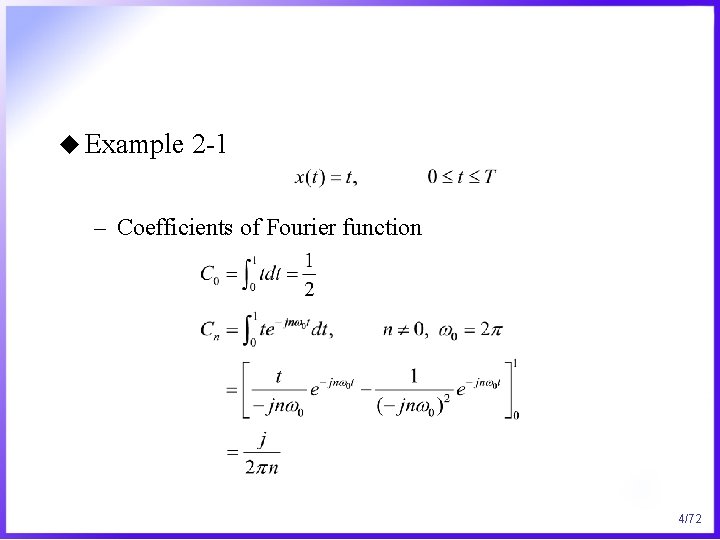
u Example 2 -1 – Coefficients of Fourier function 4/72
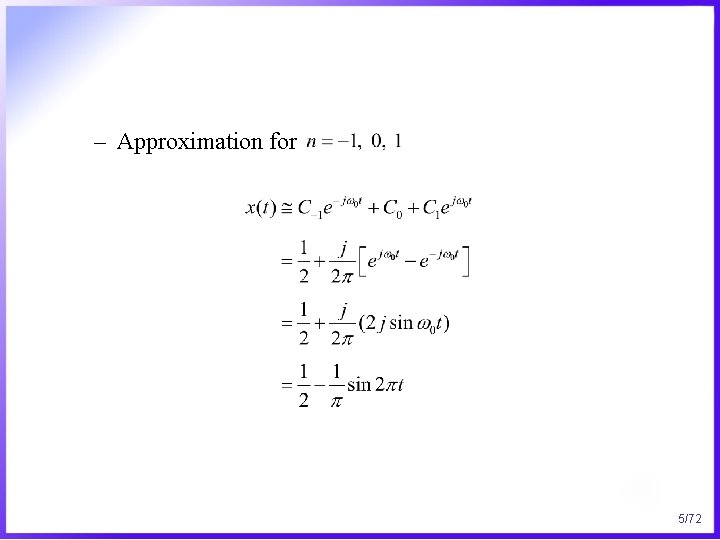
– Approximation for 5/72
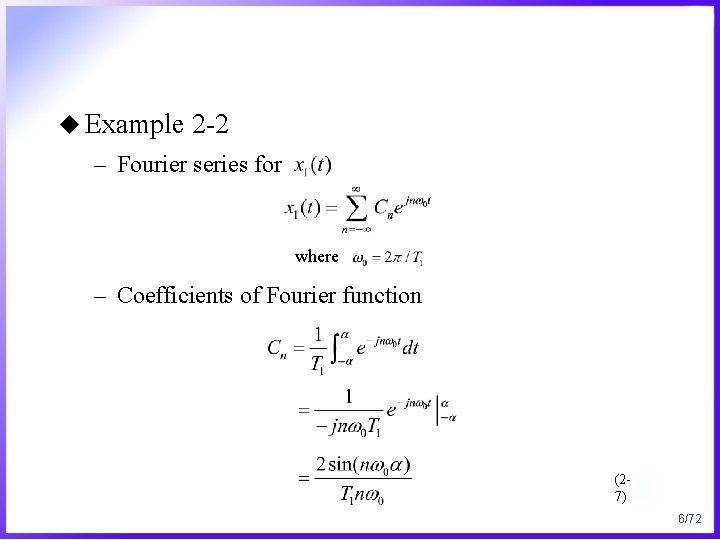
u Example 2 -2 – Fourier series for where – Coefficients of Fourier function (27) 6/72
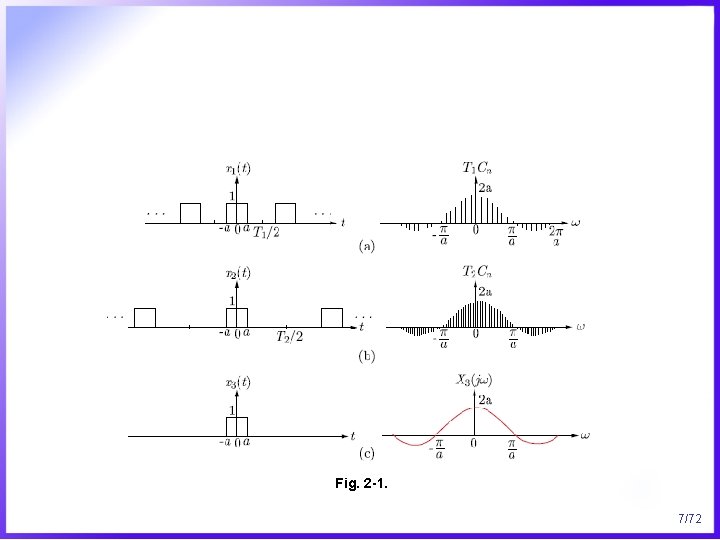
Fig. 2 -1. 7/72
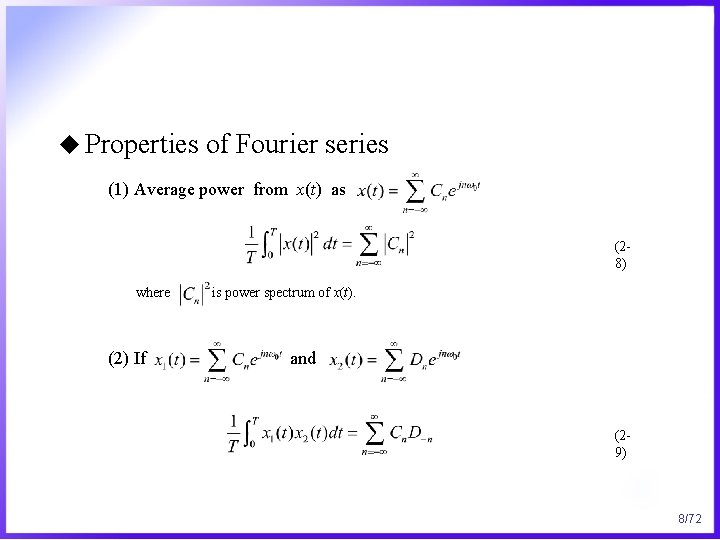
u Properties of Fourier series (1) Average power from x(t) as (28) where (2) If is power spectrum of x(t). and (29) 8/72
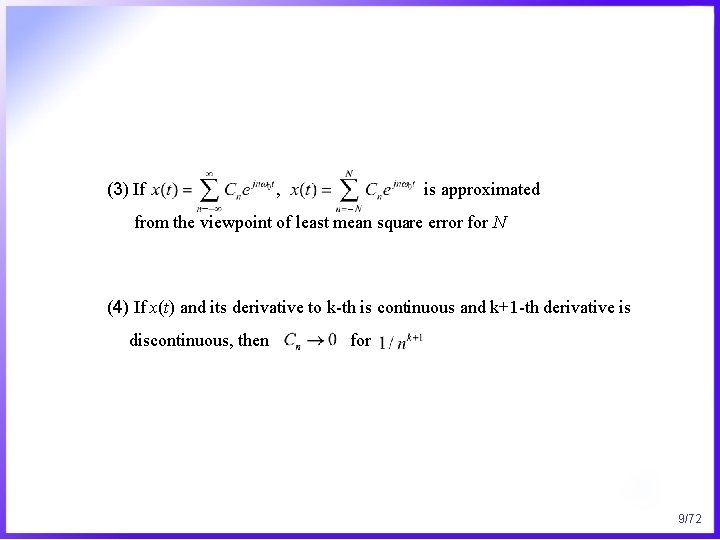
(3) If , is approximated from the viewpoint of least mean square error for N (4) If x(t) and its derivative to k-th is continuous and k+1 -th derivative is discontinuous, then for 9/72
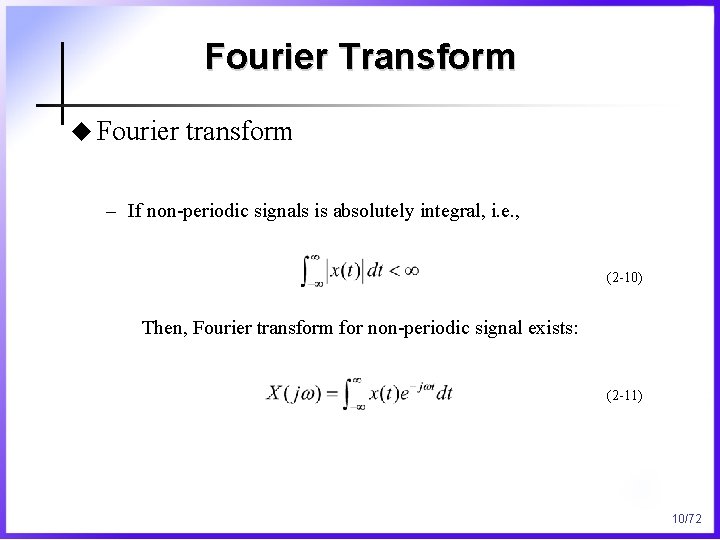
Fourier Transform u Fourier transform – If non-periodic signals is absolutely integral, i. e. , (2 -10) Then, Fourier transform for non-periodic signal exists: (2 -11) 10/72
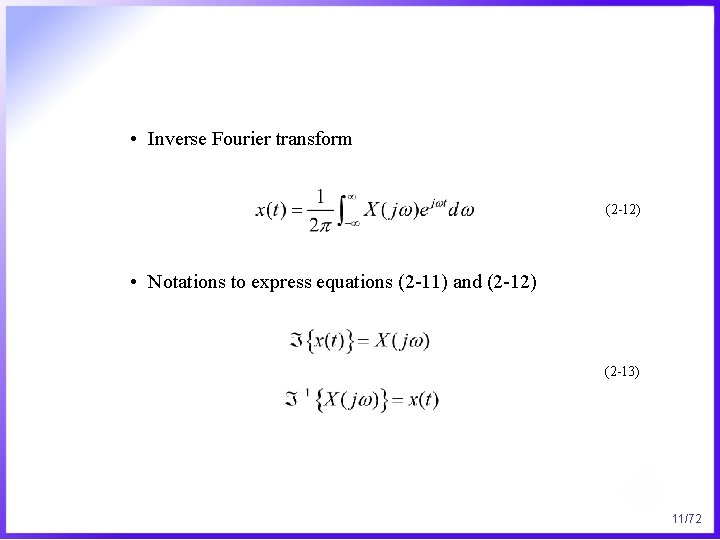
• Inverse Fourier transform (2 -12) • Notations to express equations (2 -11) and (2 -12) (2 -13) 11/72
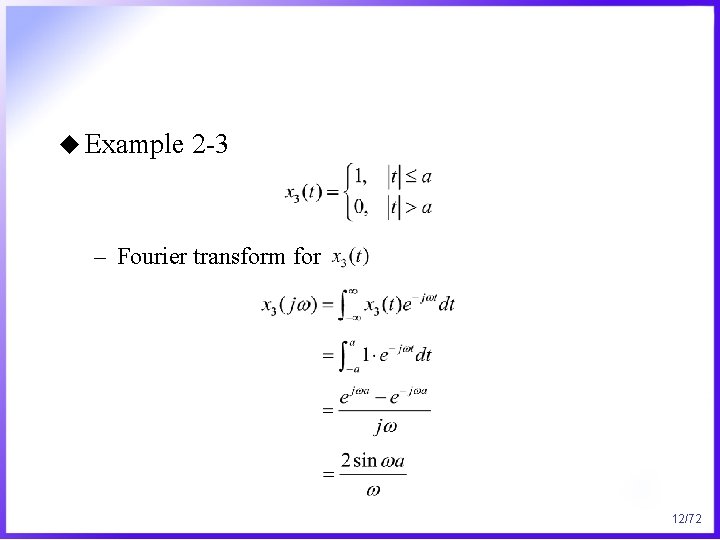
u Example 2 -3 – Fourier transform for 12/72
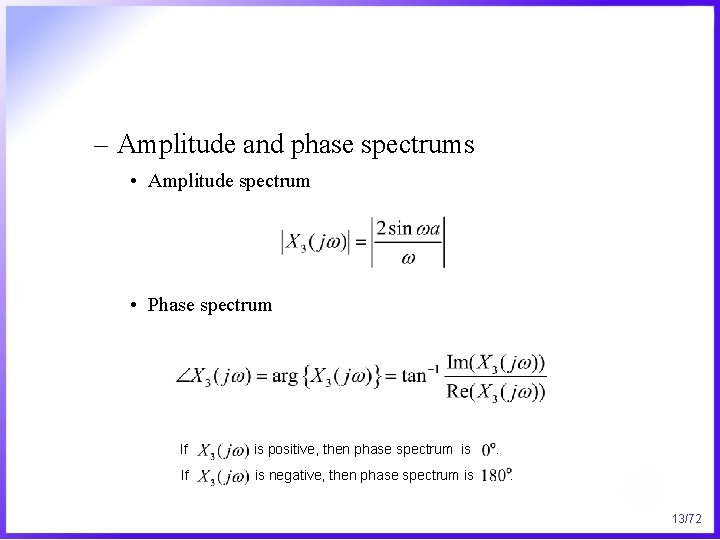
– Amplitude and phase spectrums • Amplitude spectrum • Phase spectrum If is positive, then phase spectrum is If is negative, then phase spectrum is . . 13/72
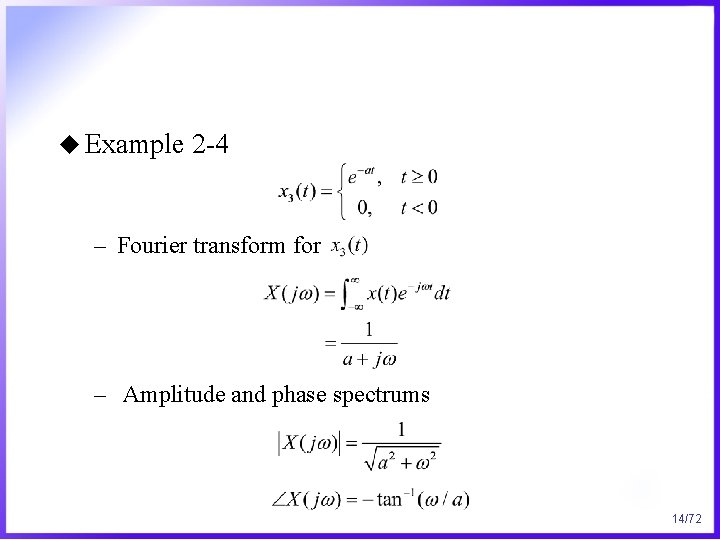
u Example 2 -4 – Fourier transform for – Amplitude and phase spectrums 14/72
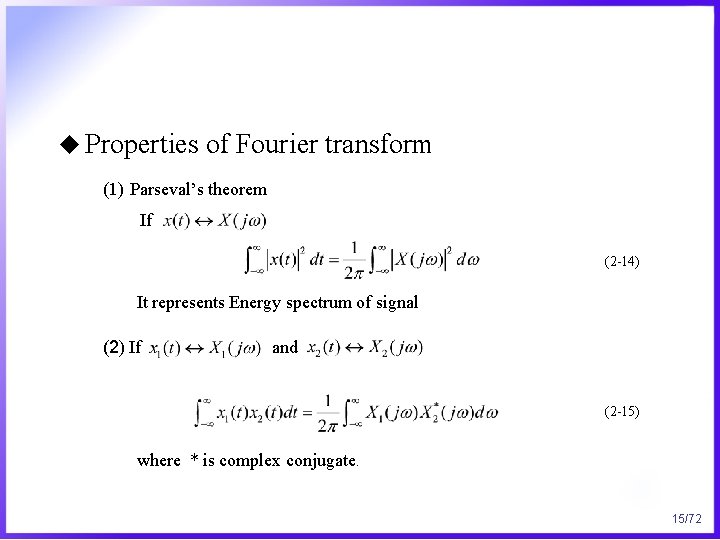
u Properties of Fourier transform (1) Parseval’s theorem If (2 -14) It represents Energy spectrum of signal (2) If and (2 -15) where * is complex conjugate. 15/72
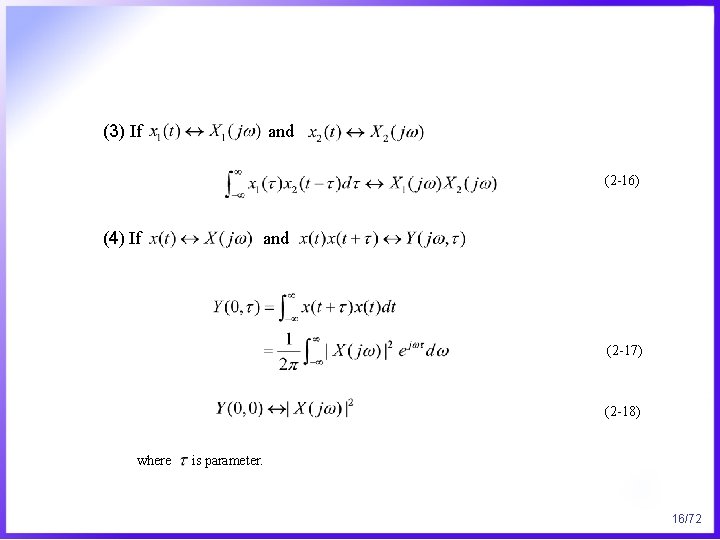
(3) If and (2 -16) (4) If and (2 -17) (2 -18) where is parameter. 16/72
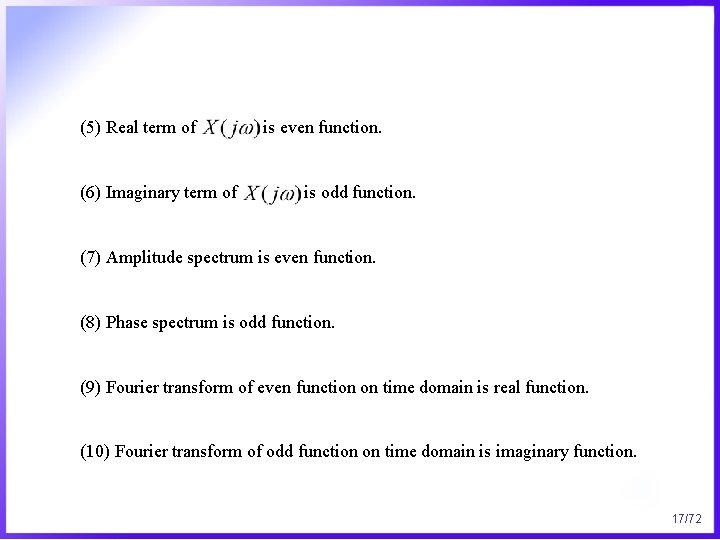
(5) Real term of (6) Imaginary term of is even function. is odd function. (7) Amplitude spectrum is even function. (8) Phase spectrum is odd function. (9) Fourier transform of even function on time domain is real function. (10) Fourier transform of odd function on time domain is imaginary function. 17/72
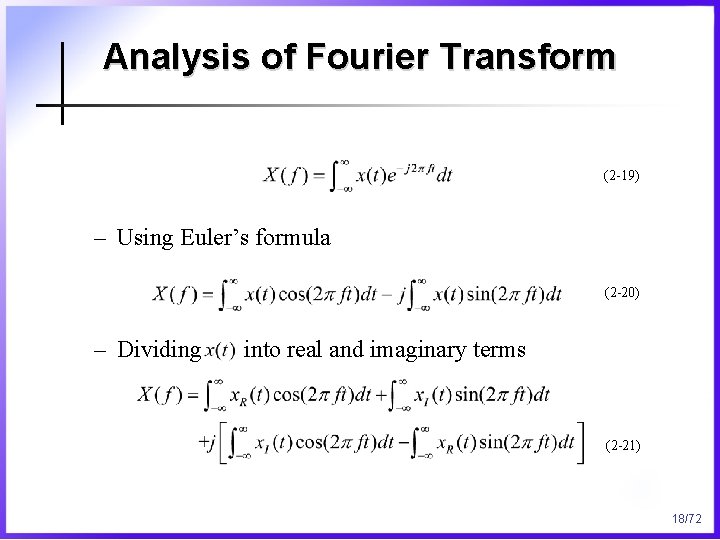
Analysis of Fourier Transform (2 -19) – Using Euler’s formula (2 -20) – Dividing into real and imaginary terms (2 -21) 18/72
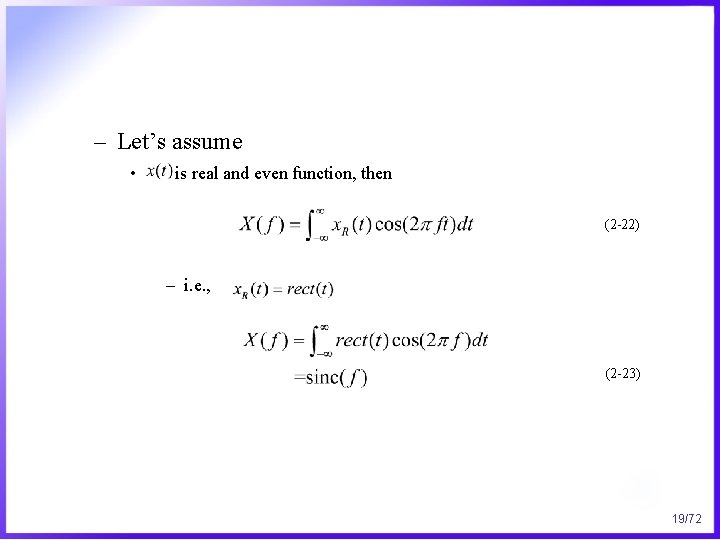
– Let’s assume • is real and even function, then (2 -22) – i. e. , (2 -23) 19/72
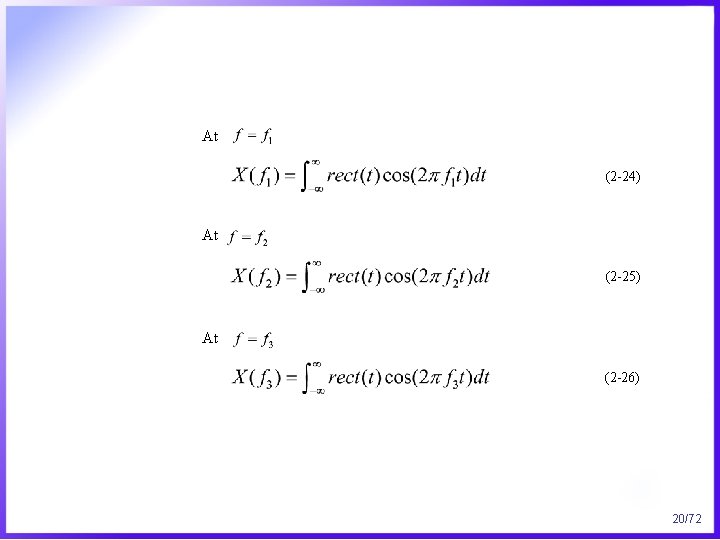
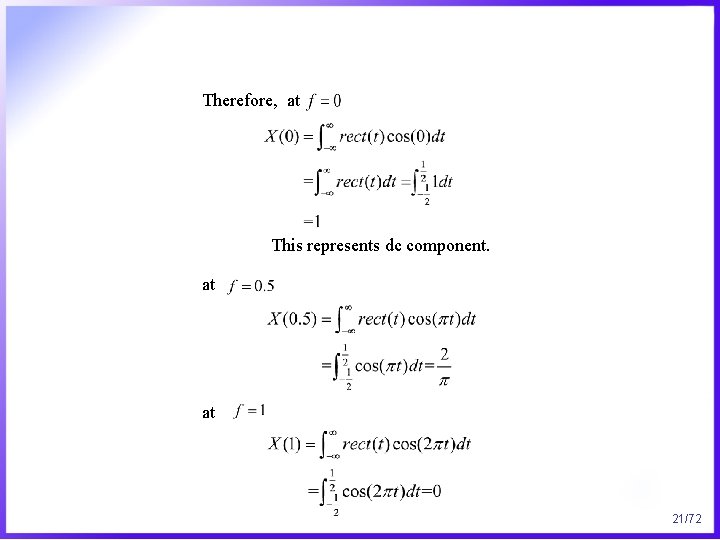
At (2 -24) At (2 -25) At (2 -26) 20/72
Therefore, at This represents dc component. at at 21/72
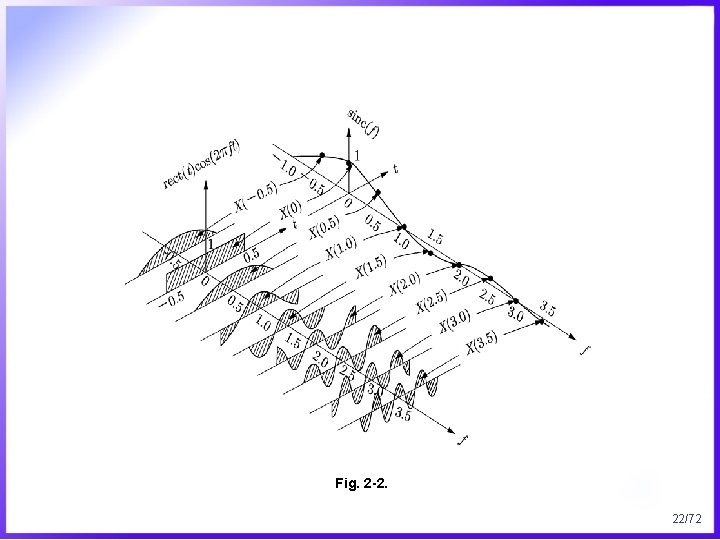
Fig. 2 -2. 22/72
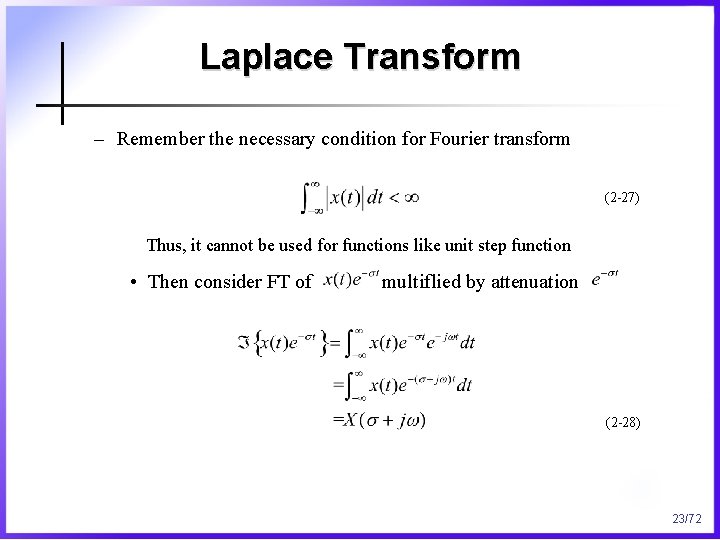
Laplace Transform – Remember the necessary condition for Fourier transform (2 -27) Thus, it cannot be used for functions like unit step function • Then consider FT of multiflied by attenuation (2 -28) 23/72
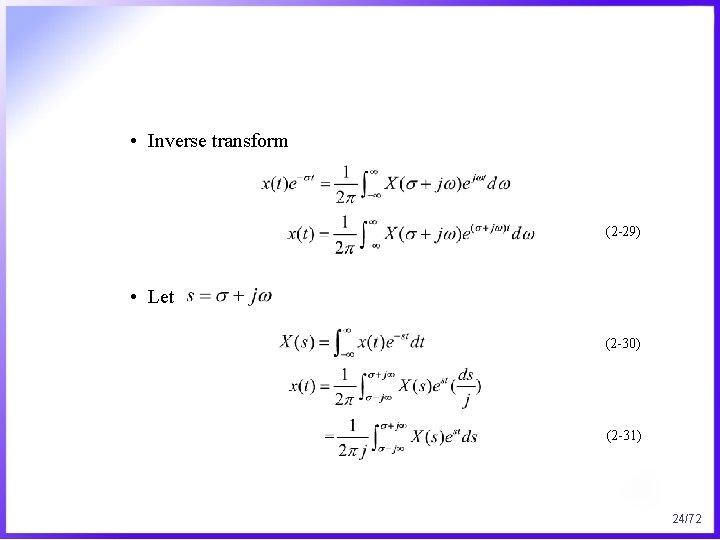
• Inverse transform (2 -29) • Let (2 -30) (2 -31) 24/72
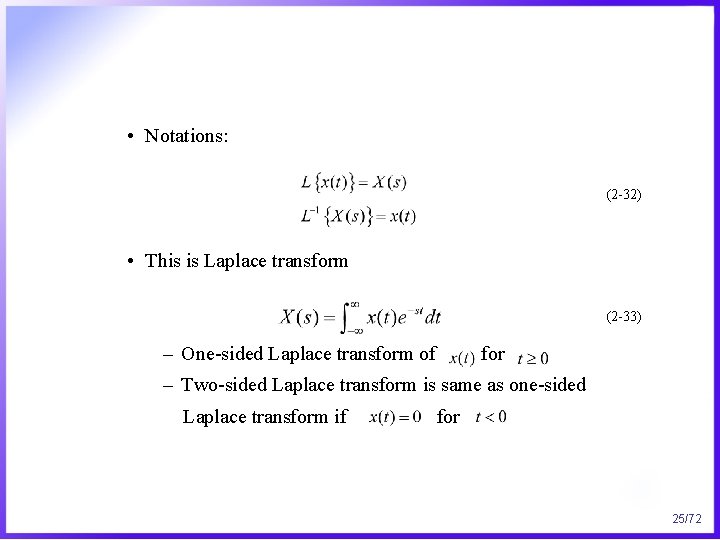
• Notations: (2 -32) • This is Laplace transform (2 -33) – One-sided Laplace transform of for – Two-sided Laplace transform is same as one-sided Laplace transform if for 25/72
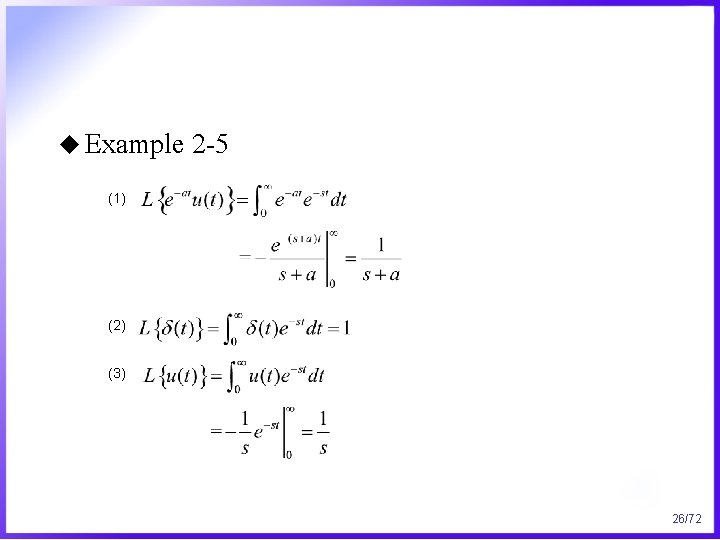
u Example 2 -5 (1) (2) (3) 26/72
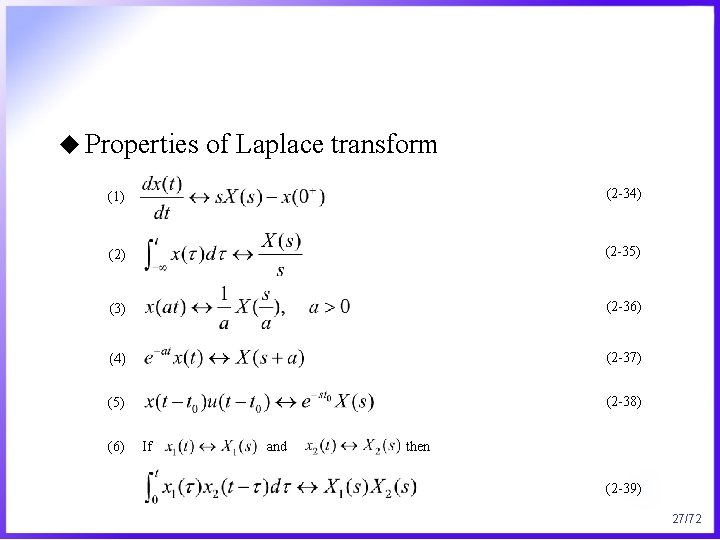
u Properties of Laplace transform (1) (2 -34) (2 -35) (3) (2 -36) (4) (2 -37) (5) (2 -38) (6) If and then (2 -39) 27/72
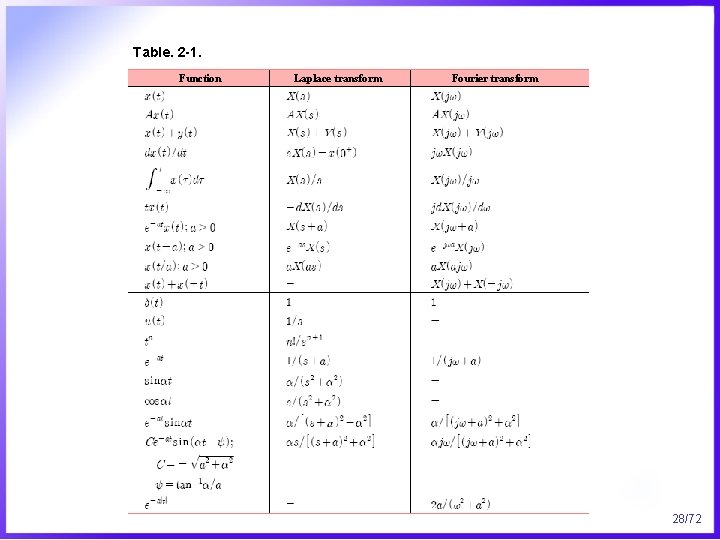
Table. 2 -1. Function Laplace transform Fourier transform 28/72
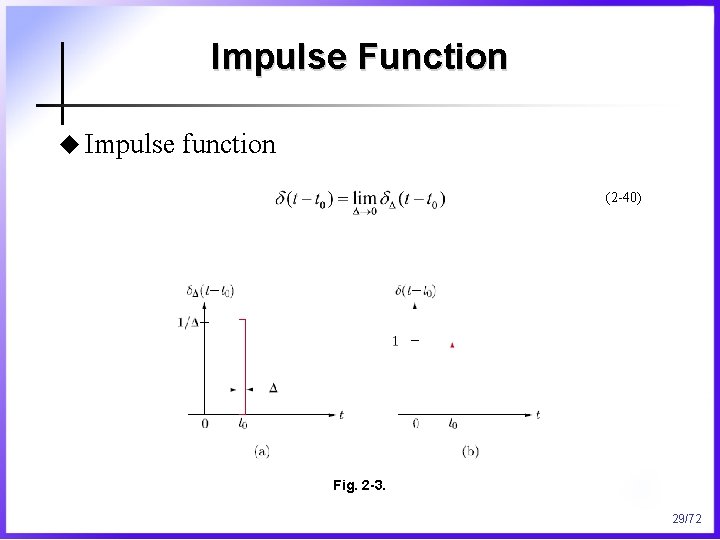
Impulse Function u Impulse function (2 -40) Fig. 2 -3. 29/72
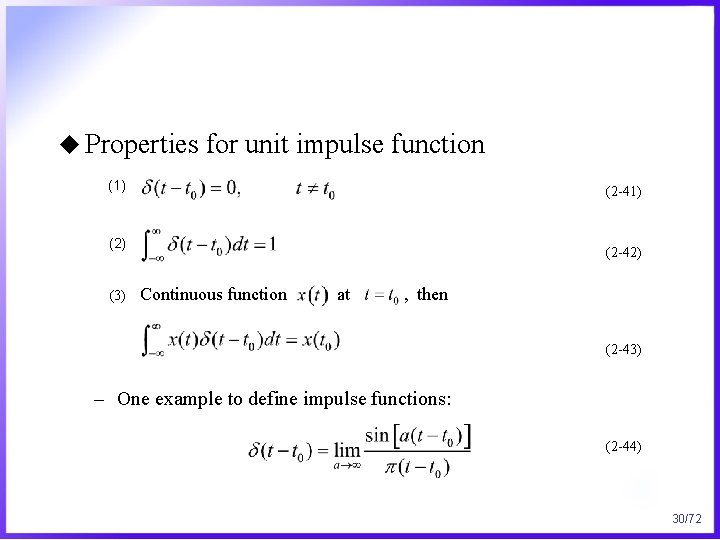
u Properties for unit impulse function (1) (2 -41) (2) (3) (2 -42) Continuous function at , then (2 -43) – One example to define impulse functions: (2 -44) 30/72
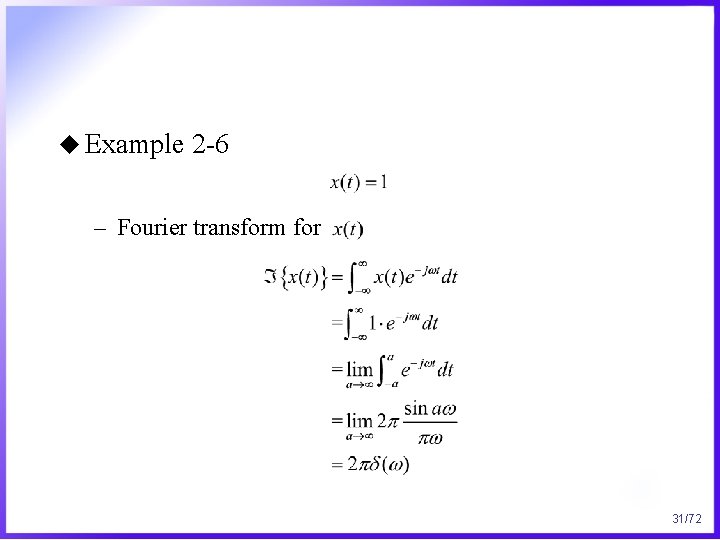
u Example 2 -6 – Fourier transform for 31/72
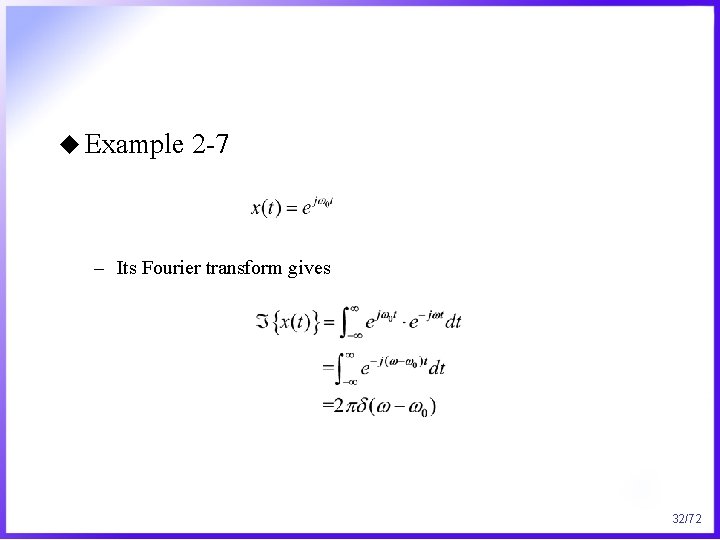
u Example 2 -7 – Its Fourier transform gives 32/72
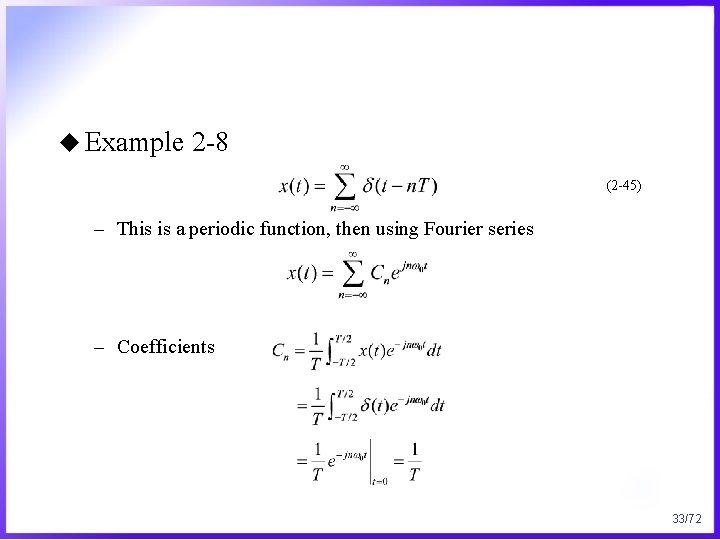
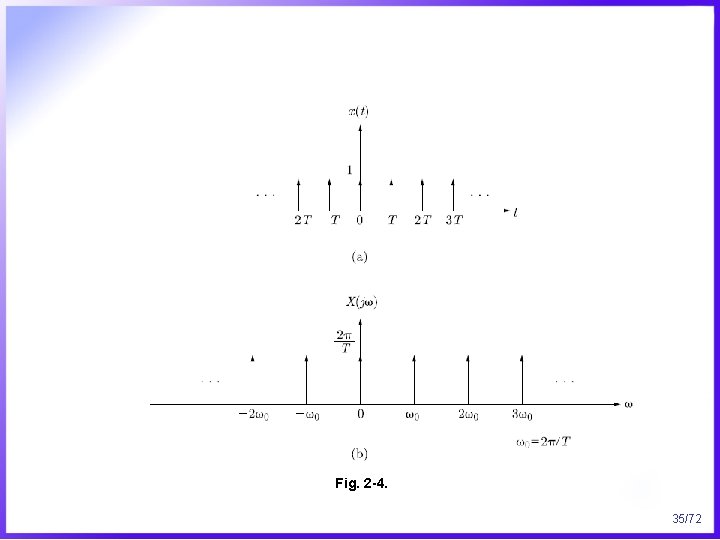
u Example 2 -8 (2 -45) – This is a periodic function, then using Fourier series – Coefficients 33/72
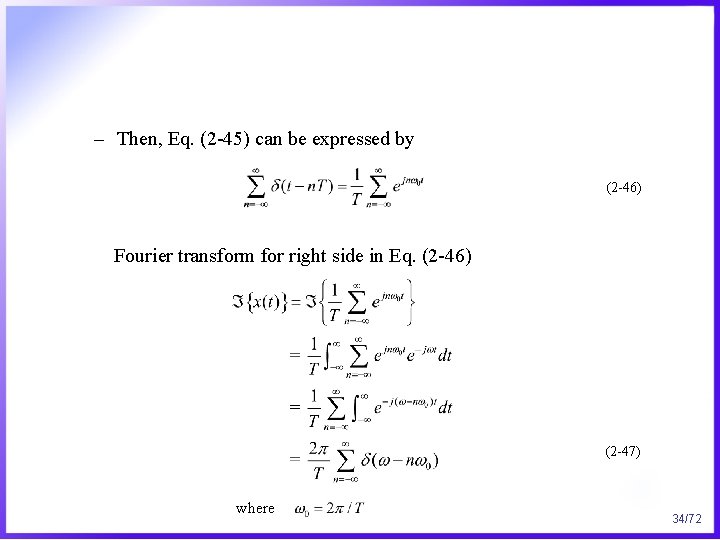
– Then, Eq. (2 -45) can be expressed by (2 -46) Fourier transform for right side in Eq. (2 -46) (2 -47) where 34/72
Fig. 2 -4. 35/72
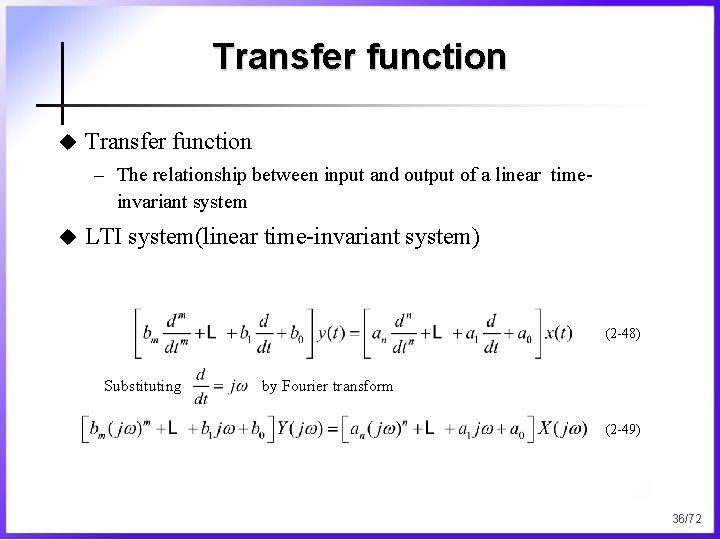
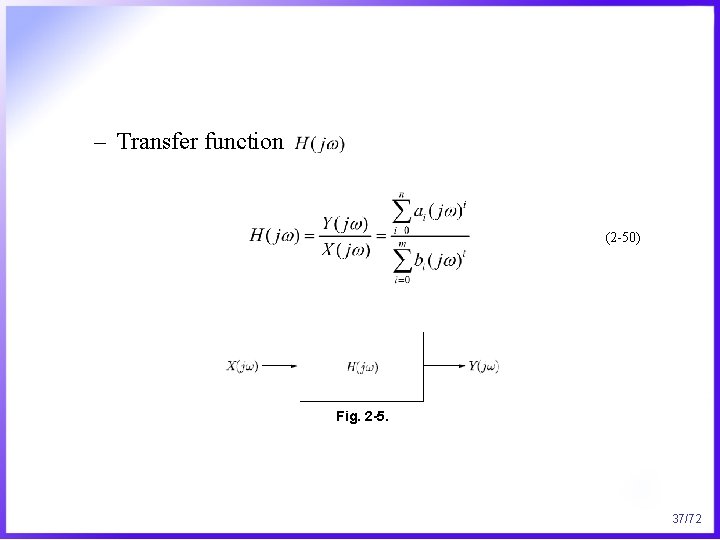
Transfer function u Transfer function – The relationship between input and output of a linear timeinvariant system u LTI system(linear time-invariant system) (2 -48) Substituting by Fourier transform (2 -49) 36/72
– Transfer function (2 -50) Fig. 2 -5. 37/72
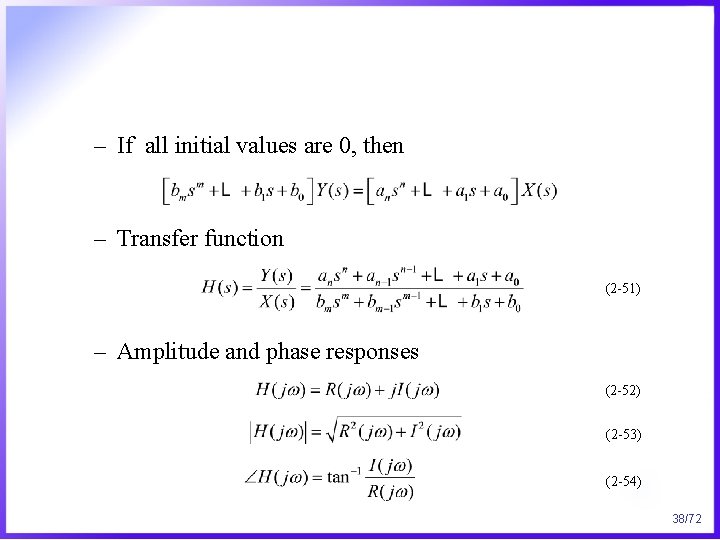
– If all initial values are 0, then – Transfer function (2 -51) – Amplitude and phase responses (2 -52) (2 -53) (2 -54) 38/72
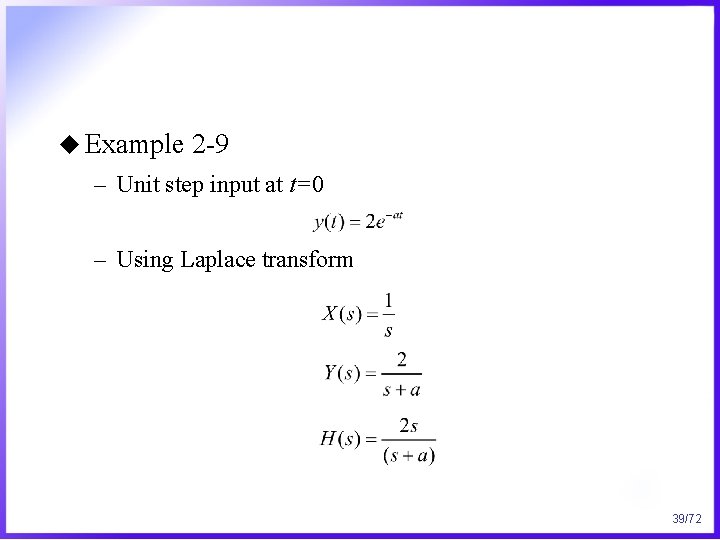
u Example 2 -9 – Unit step input at t=0 – Using Laplace transform 39/72
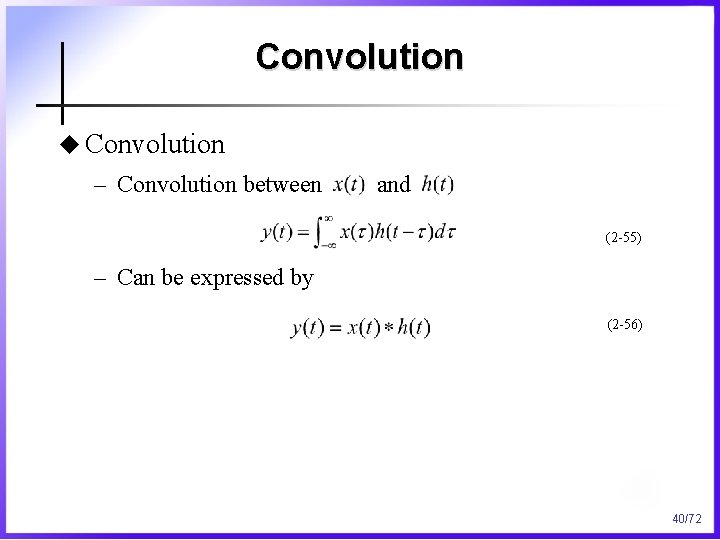
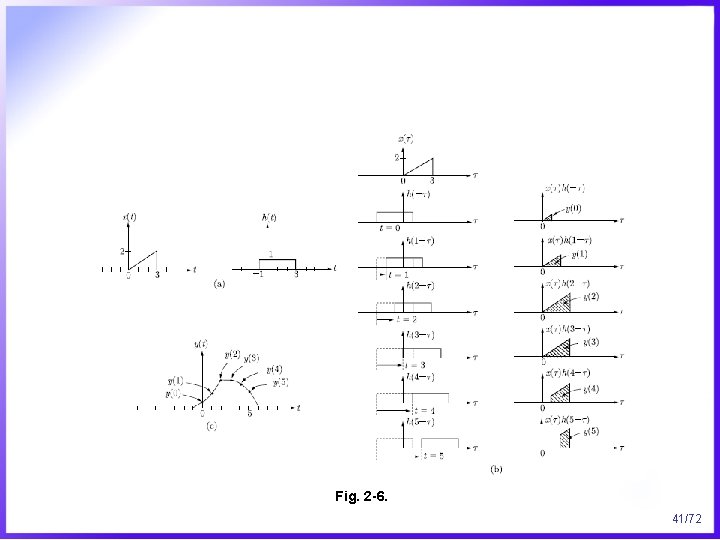
Convolution u Convolution – Convolution between and (2 -55) – Can be expressed by (2 -56) 40/72
Fig. 2 -6. 41/72
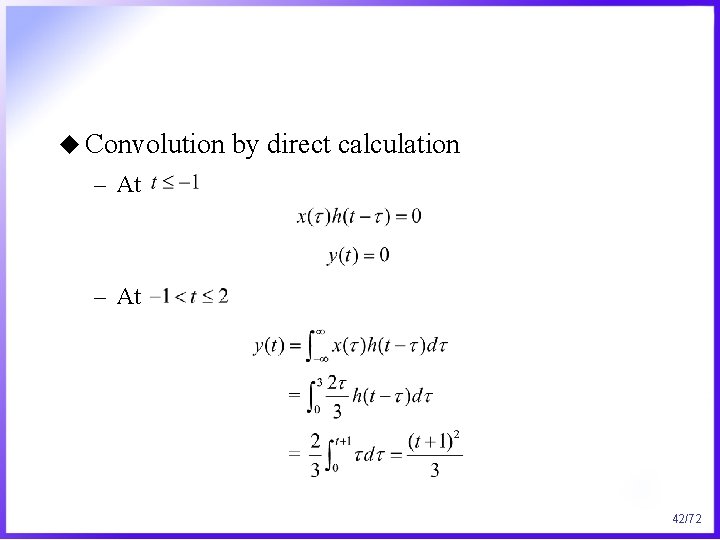
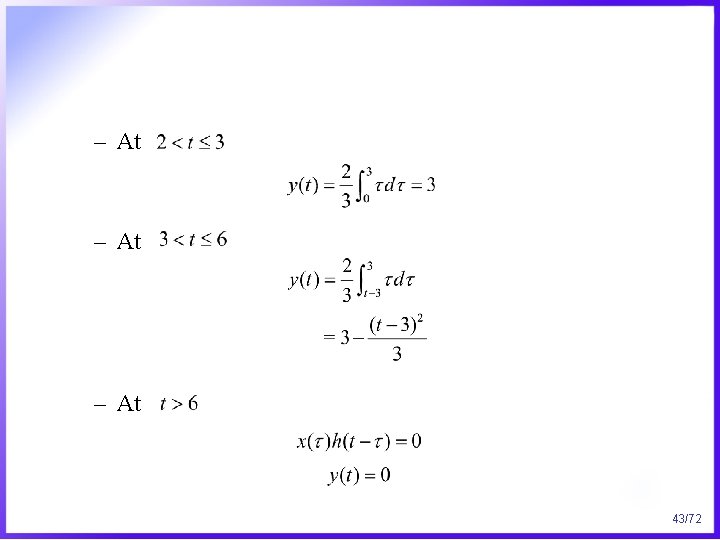
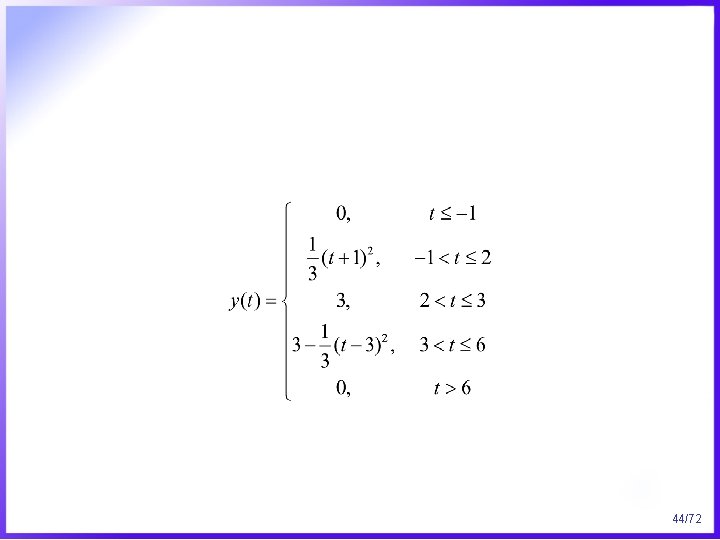
u Convolution by direct calculation – At 42/72
– At 43/72
44/72
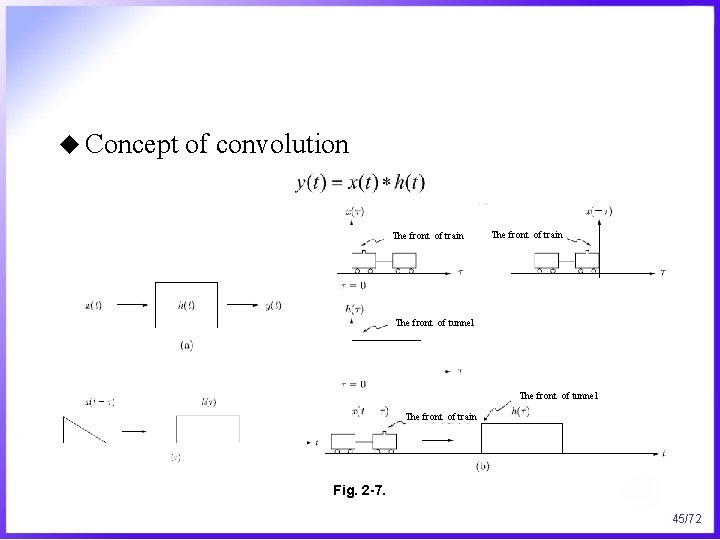
u Concept of convolution The front of train The front of tunnel The front of train Fig. 2 -7. 45/72
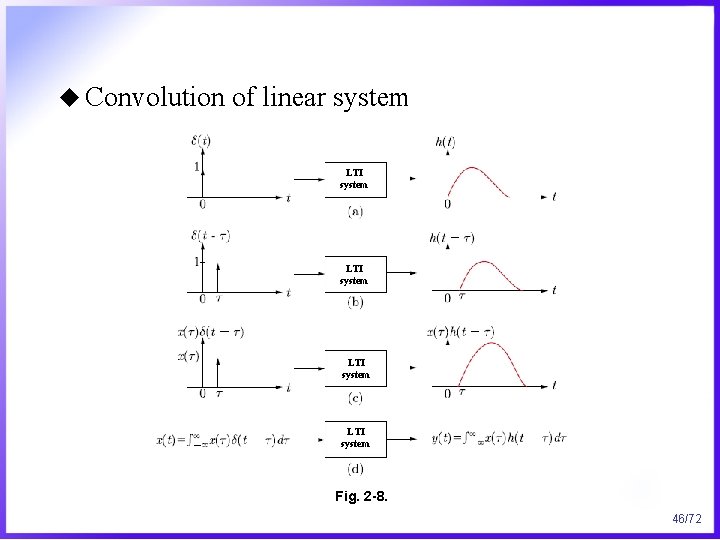
u Convolution of linear system LTI system Fig. 2 -8. 46/72
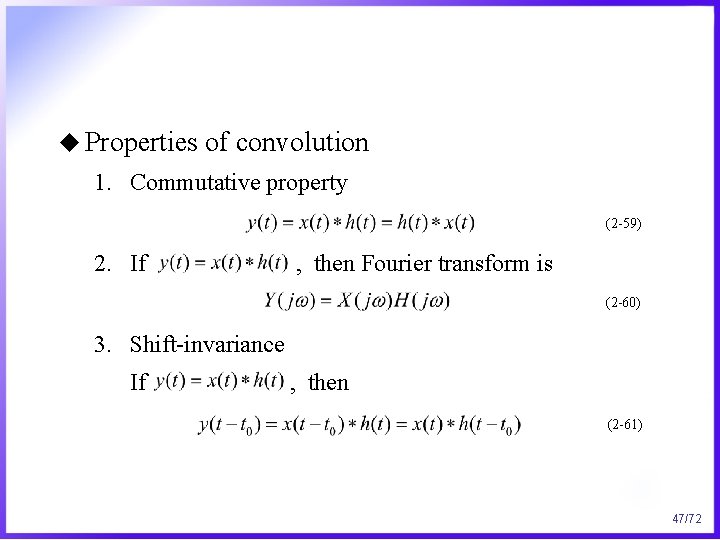
u Properties of convolution 1. Commutative property (2 -59) 2. If , then Fourier transform is (2 -60) 3. Shift-invariance If , then (2 -61) 47/72
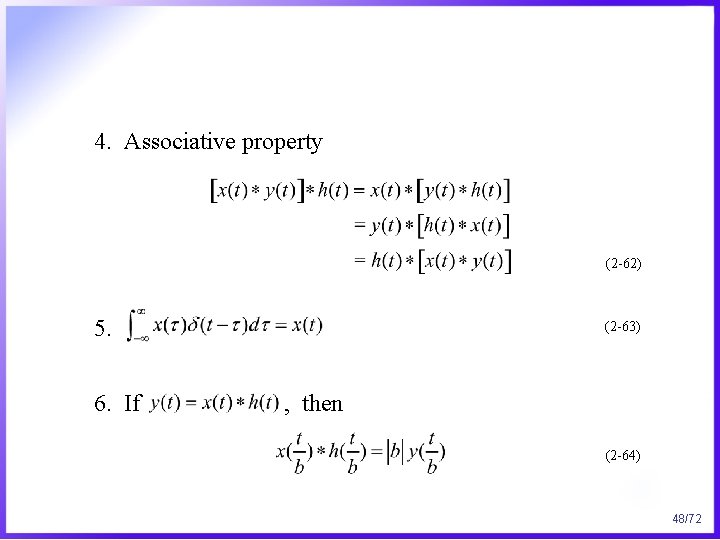
4. Associative property (2 -62) 5. 6. If (2 -63) , then (2 -64) 48/72
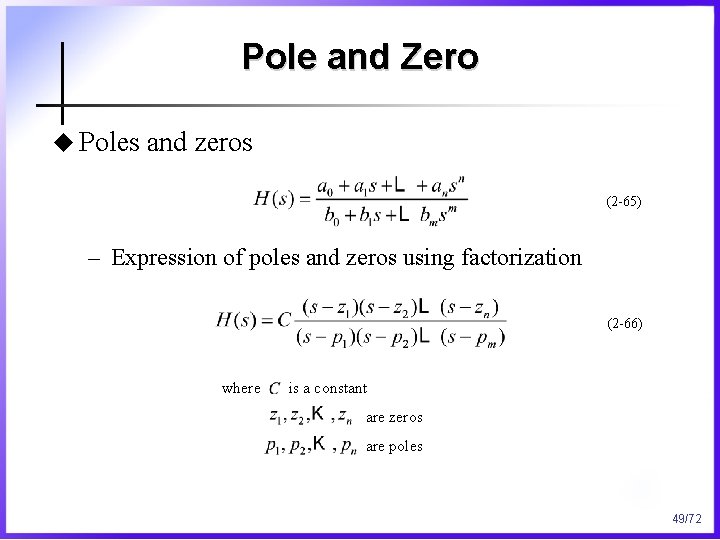
Pole and Zero u Poles and zeros (2 -65) – Expression of poles and zeros using factorization (2 -66) where is a constant are zeros are poles 49/72
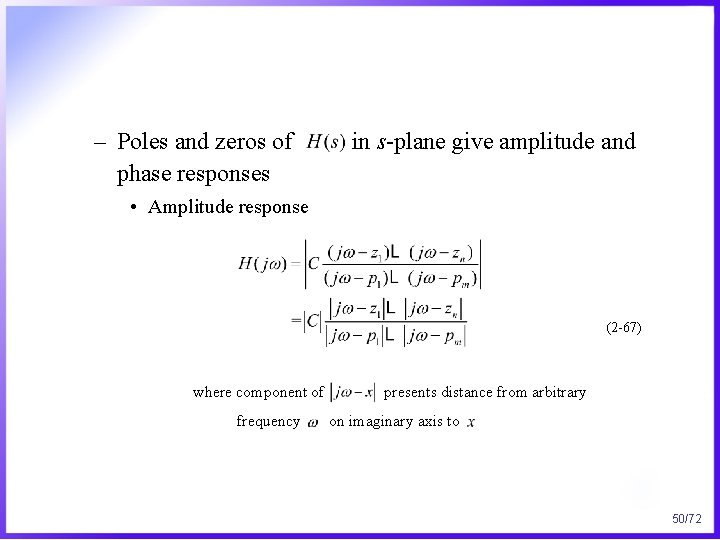
– Poles and zeros of phase responses in s-plane give amplitude and • Amplitude response (2 -67) where component of frequency presents distance from arbitrary on imaginary axis to 50/72
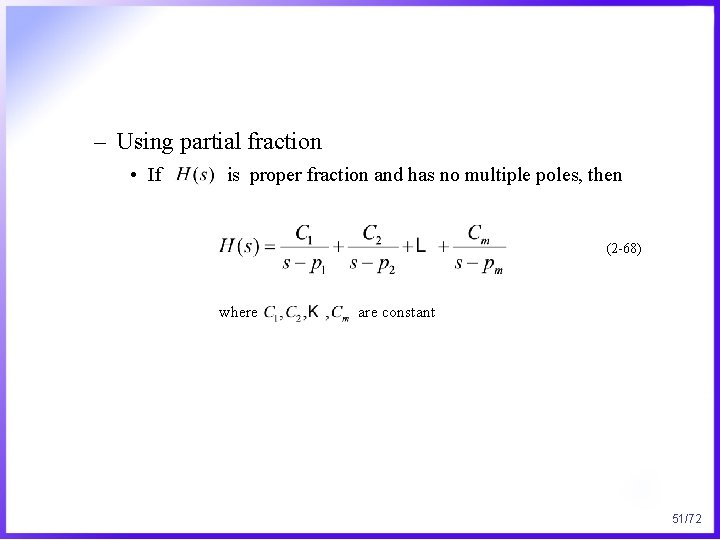
– Using partial fraction • If is proper fraction and has no multiple poles, then (2 -68) where are constant 51/72
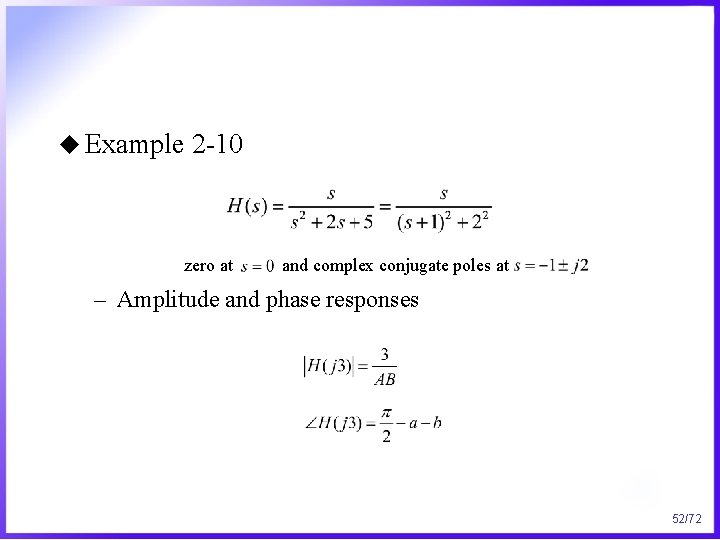
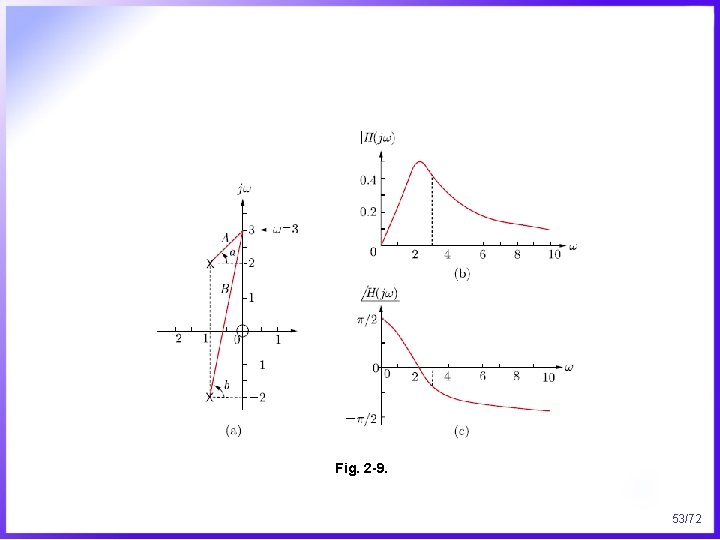
u Example 2 -10 zero at and complex conjugate poles at – Amplitude and phase responses 52/72
Fig. 2 -9. 53/72
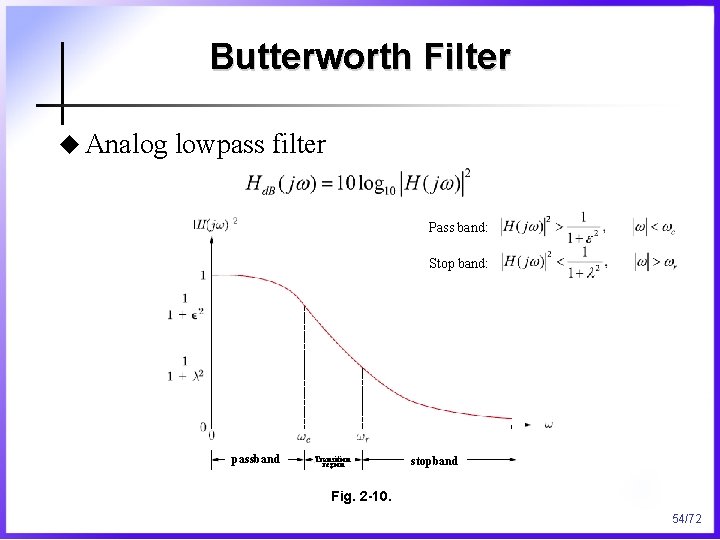
Butterworth Filter u Analog lowpass filter Pass band: Stop band: passband Transition region stopband Fig. 2 -10. 54/72
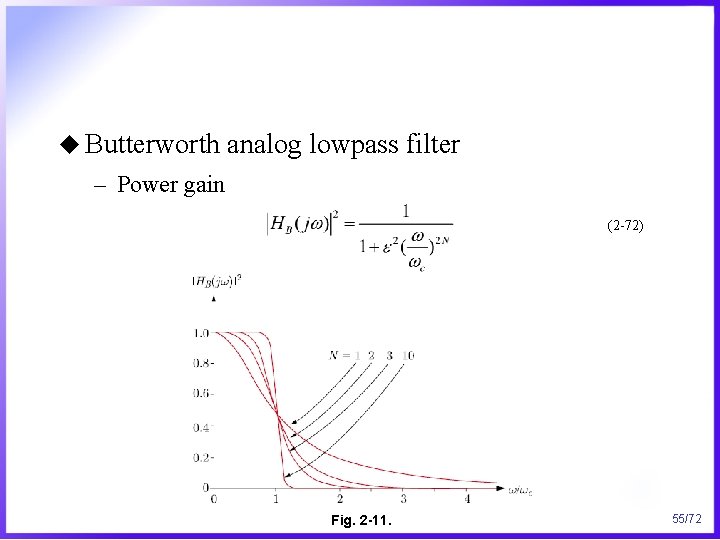
u Butterworth analog lowpass filter – Power gain (2 -72) Fig. 2 -11. 55/72
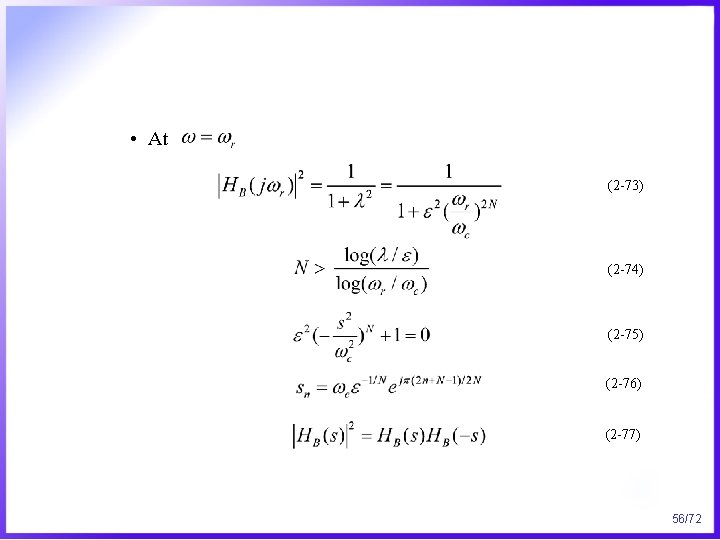
• At (2 -73) (2 -74) (2 -75) (2 -76) (2 -77) 56/72
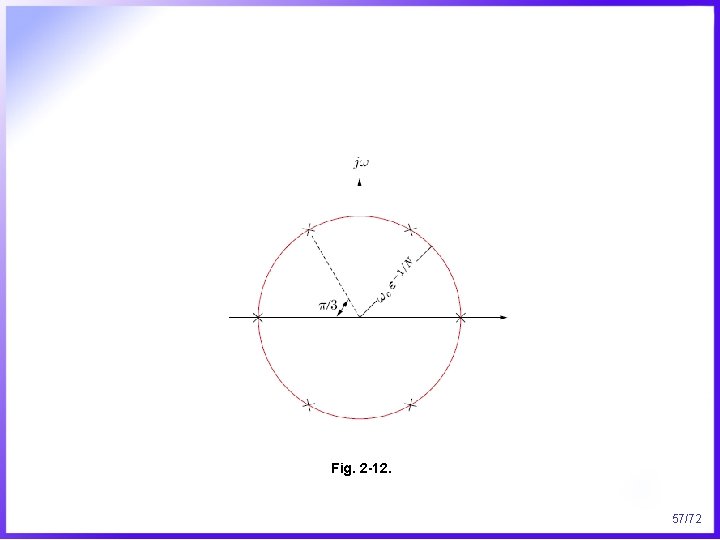
Fig. 2 -12. 57/72
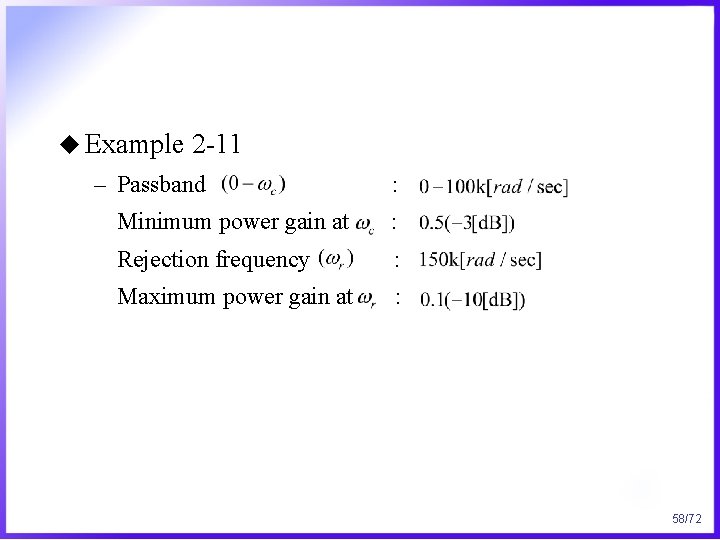
u Example 2 -11 – Passband : Minimum power gain at : Rejection frequency : Maximum power gain at : 58/72
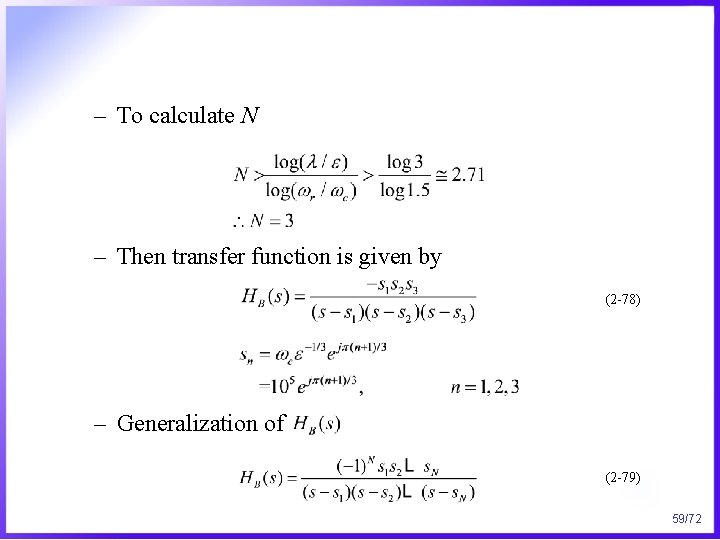
– To calculate N – Then transfer function is given by (2 -78) – Generalization of (2 -79) 59/72
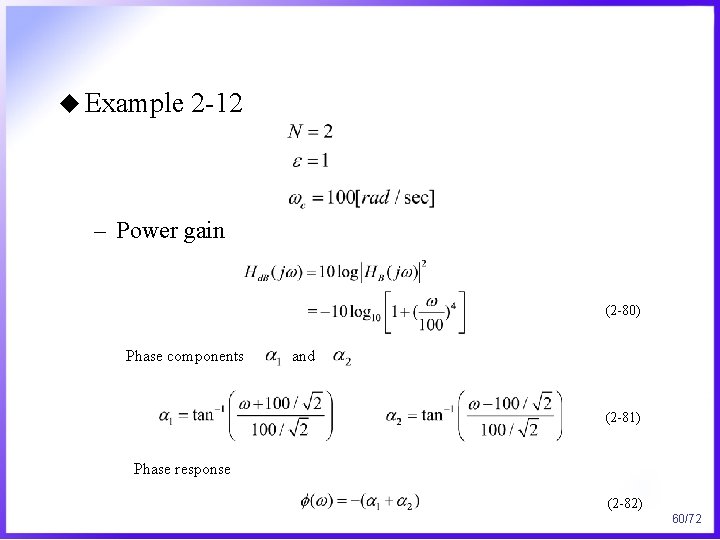
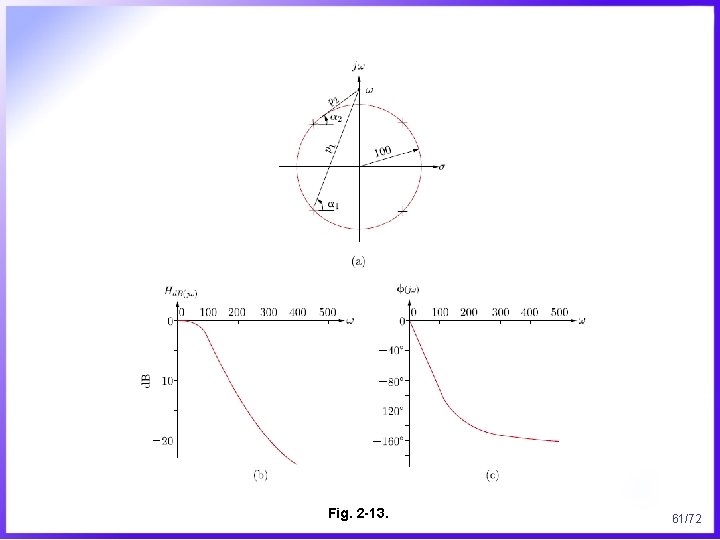
u Example 2 -12 – Power gain (2 -80) Phase components and (2 -81) Phase response (2 -82) 60/72
Fig. 2 -13. 61/72
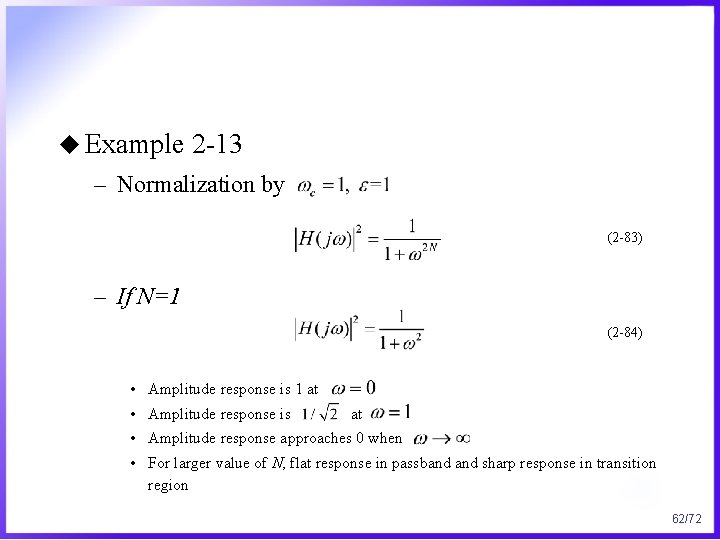
u Example 2 -13 – Normalization by (2 -83) – If N=1 (2 -84) • Amplitude response is 1 at • Amplitude response is at • Amplitude response approaches 0 when • For larger value of N, flat response in passband sharp response in transition region 62/72
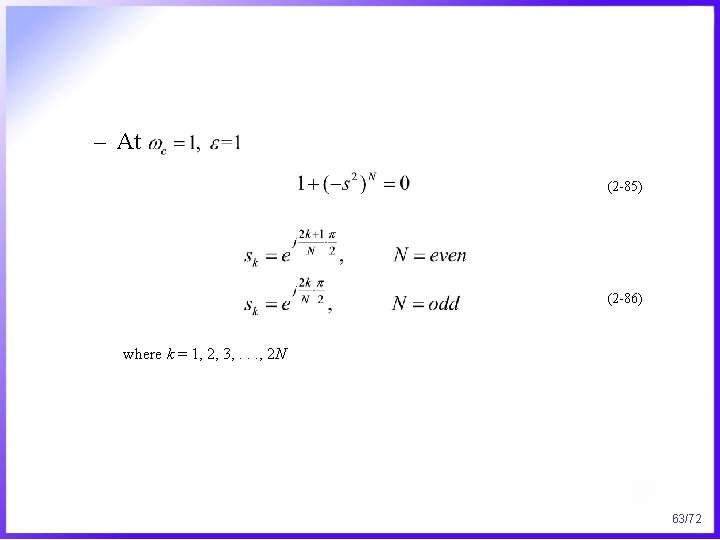
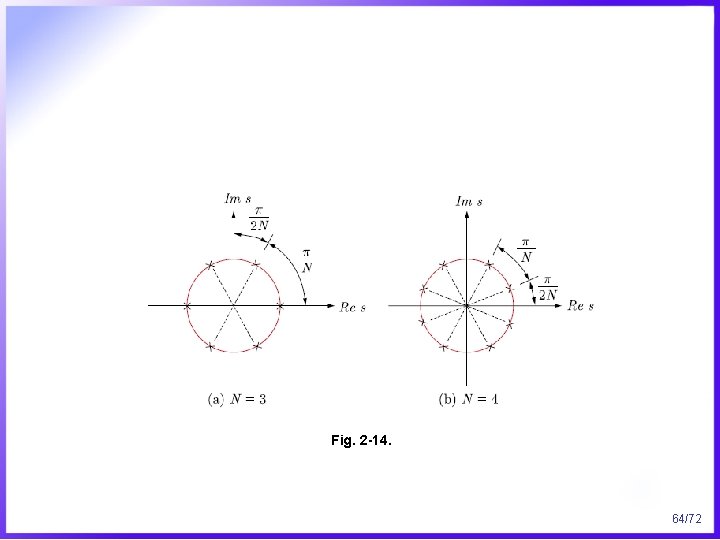
– At (2 -85) (2 -86) where k = 1, 2, 3, . . . , 2 N 63/72
Fig. 2 -14. 64/72
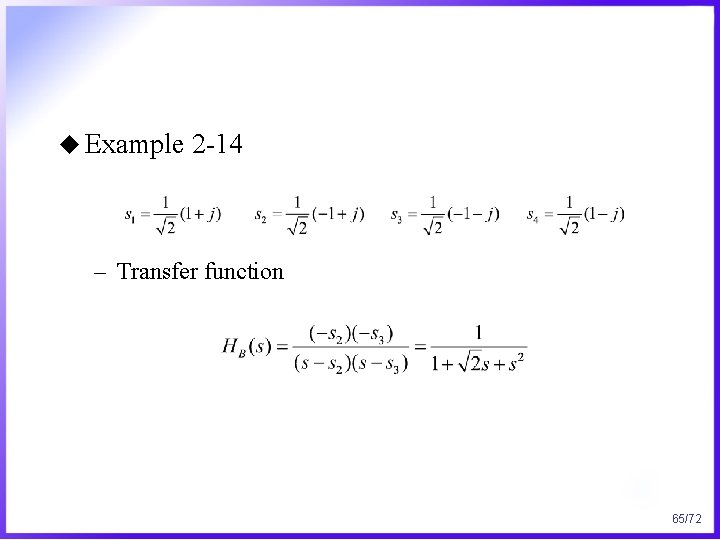
u Example 2 -14 – Transfer function 65/72
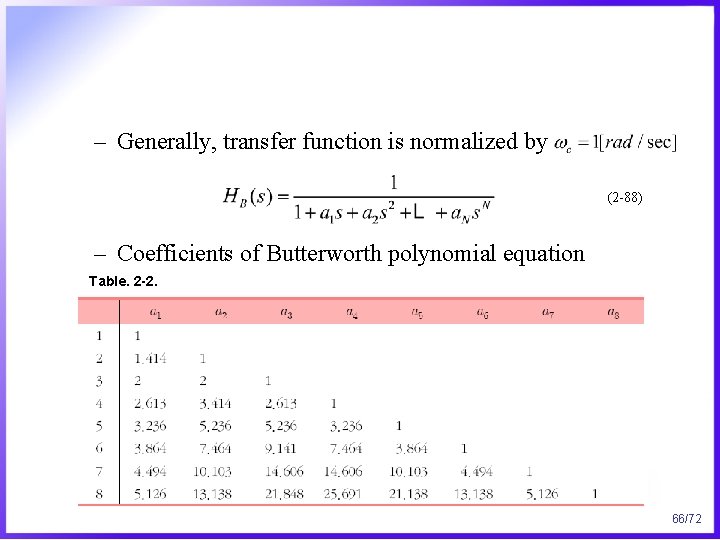
– Generally, transfer function is normalized by (2 -88) – Coefficients of Butterworth polynomial equation Table. 2 -2. 66/72