
Chapter 2 An Introduction to Organic Compounds Conformations












- Slides: 65
Chapter 2 An Introduction to Organic Compounds Conformations Adapted from Profs. Turro & Breslow, Columbia University and Prof. Irene Lee, Case Western Reserve University
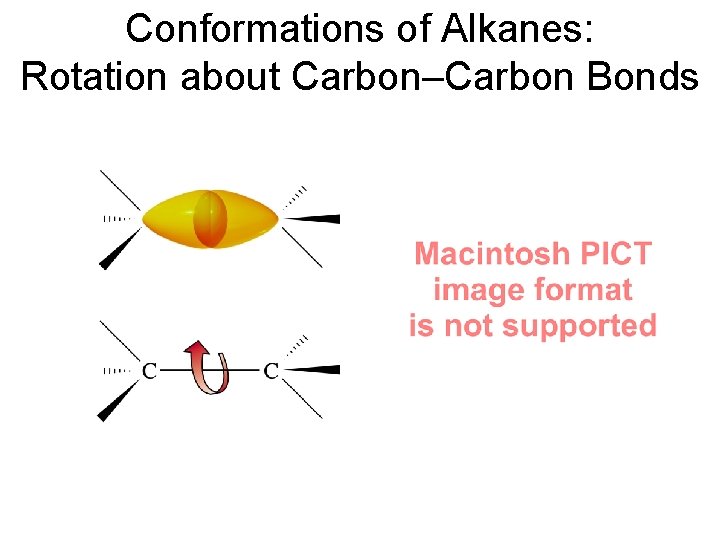
Conformations of Alkanes: Rotation about Carbon–Carbon Bonds
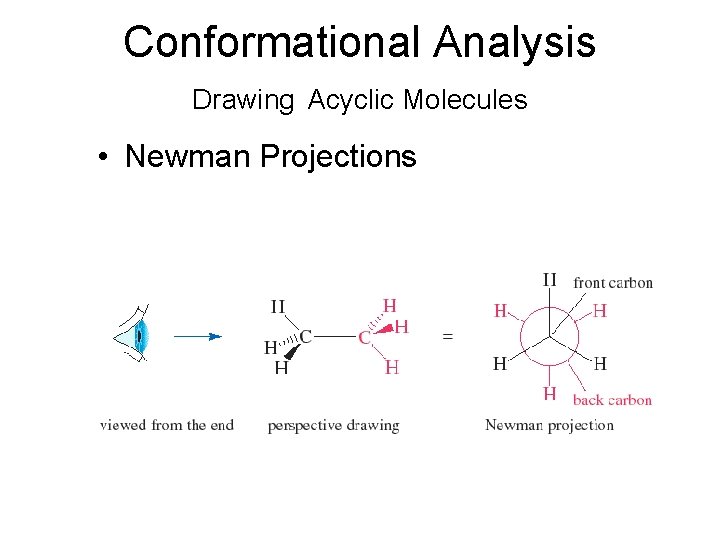
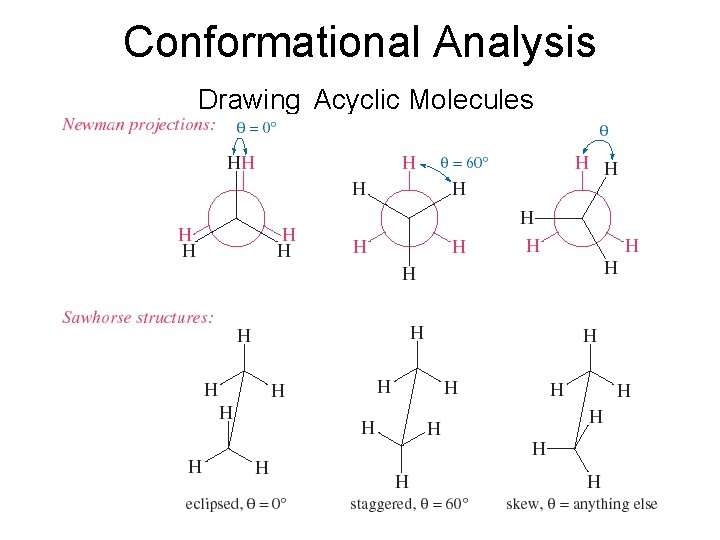
Conformational Analysis Drawing Acyclic Molecules • Newman Projections
Conformational Analysis Drawing Acyclic Molecules • Sawhorse Drawings
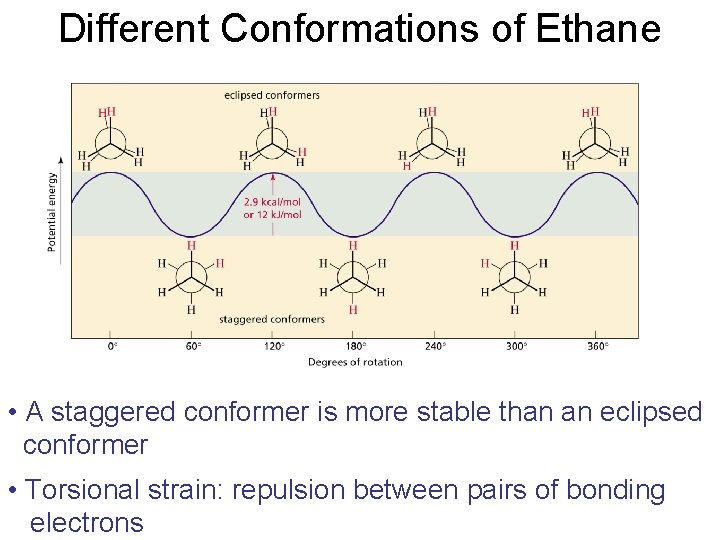
Different Conformations of Ethane • A staggered conformer is more stable than an eclipsed conformer • Torsional strain: repulsion between pairs of bonding electrons
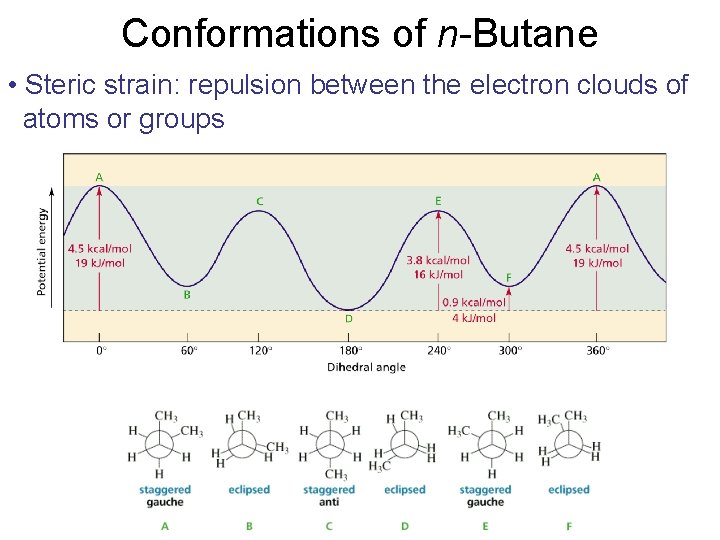
Conformations of n-Butane • Steric strain: repulsion between the electron clouds of atoms or groups
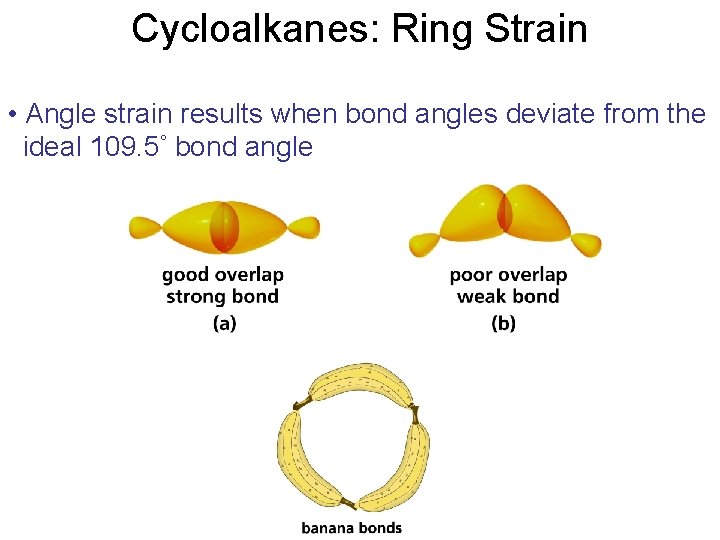
Cycloalkanes: Ring Strain • Angle strain results when bond angles deviate from the ideal 109. 5° bond angle
The Shapes of Cycloalkanes: Planar or Nonplanar?
Adolf von Baeyer (19 th century) • Assumed cycloalkanes were planar polygons. • Believed distortion of bond angles from 109. 5° gives angle strain to some cycloalkanes. • One for two is great in baseball.
Types of Strain • • Torsional strain that results from eclipsed bonds (measure of the dihedral angle) • • Van der Waals strain or (Steric strain) strain that results from atoms being too close together. • • Angle strain results from distortion of bond angles from normal values, for a tetrahedron 109. 5 o
Measuring Strain in Cycloalkanes • Heats of combustion can be used to compare stabilities of isomers. • But cyclopropane, cyclobutane, etc. are not isomers. • All heats of combustion increase as the number of carbon atoms increase.
Measuring Strain in Cycloalkanes • Therefore, divide heats of combustion by number of carbons and compare heats of combustion on a "per CH 2 group" basis.
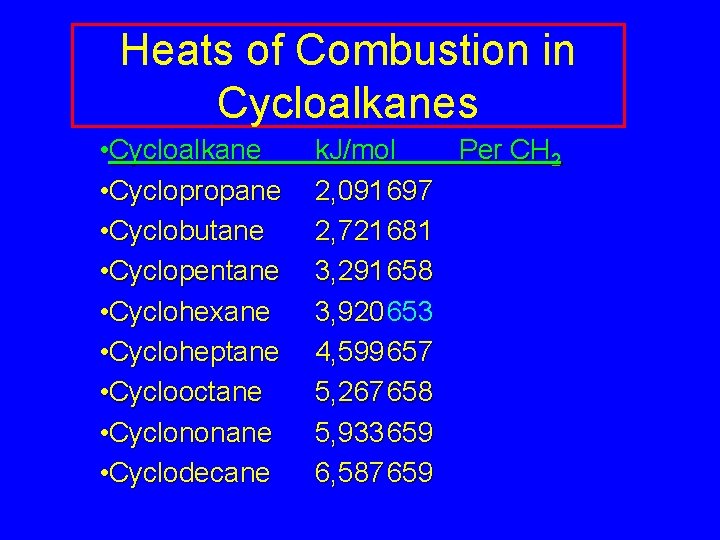
Heats of Combustion in Cycloalkanes • Cycloalkane • Cyclopropane • Cyclobutane • Cyclopentane • Cyclohexane • Cycloheptane • Cyclooctane • Cyclononane • Cyclodecane k. J/mol Per CH 2 2, 091 697 2, 721 681 3, 291 658 3, 920 653 4, 599 657 5, 267 658 5, 933 659 6, 587 659
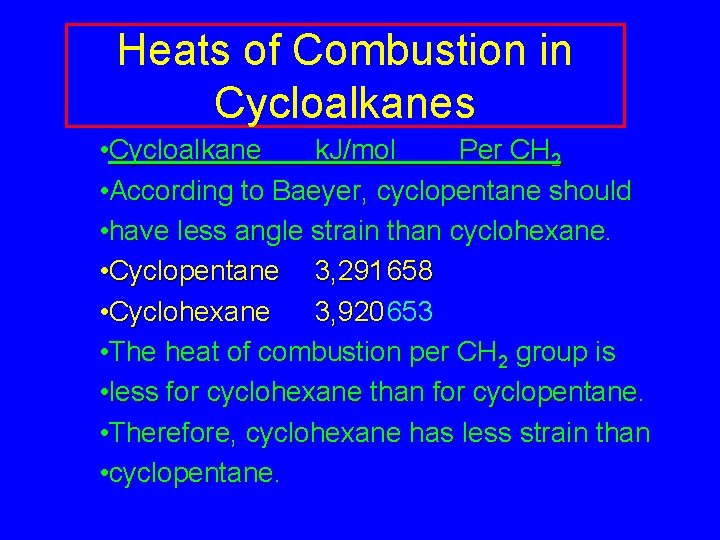
Heats of Combustion in Cycloalkanes • Cycloalkane k. J/mol Per CH 2 • According to Baeyer, cyclopentane should • have less angle strain than cyclohexane. • Cyclopentane 3, 291 658 • Cyclohexane 3, 920 653 • The heat of combustion per CH 2 group is • less for cyclohexane than for cyclopentane. • Therefore, cyclohexane has less strain than • cyclopentane.
Conformations of Cyclohexane • Heat of combustion suggests that angle strain is unimportant in cyclohexane. • Tetrahedral bond angles require nonplanar geometries. • The chair and boat conformations.
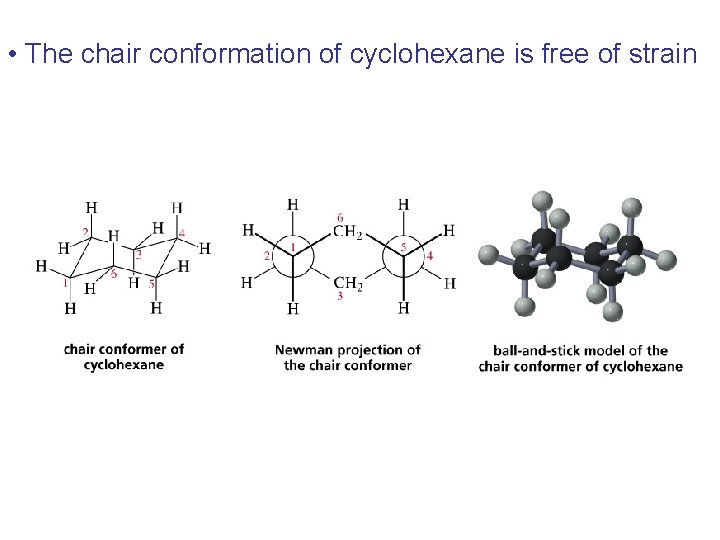
• The chair conformation of cyclohexane is free of strain
Chair is the most stable conformation of cyclohexane • All of the bonds are staggered and the bond angles at carbon are close to tetrahedral.
Boat conformation is less stable than the chair 180 pm • All of the bond angles are close to tetrahedral but close contact between flagpole hydrogens causes strain in boat.
Boat conformation is less stable than the chair • Eclipsed bonds gives torsional strain to boat.
Skew boat is slightly more stable than boat Boat Skew or Twist Boat • Less van der Waals strain and less torsional strain in skew boat.
Generalization • The chair conformation of cyclohexane is the most stable conformation and derivatives of cyclohexane almost always exist in the chair conformation
Axial and Equatorial Bonds in Cyclohexane
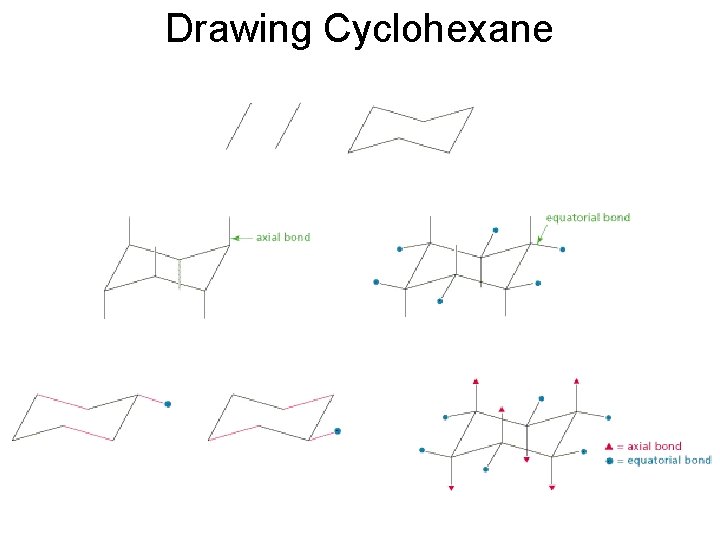
Drawing Cyclohexane
The 12 bonds to the ring can be divided into two sets of 6.
6 Bonds are axial Axial bonds point "north and south"
The 12 bonds to the ring can be divided into two sets of 6.
6 Bonds are equatorial Equatorial bonds lie along the equator
Conformational Inversion (Ring-Flipping) in Cyclohexane
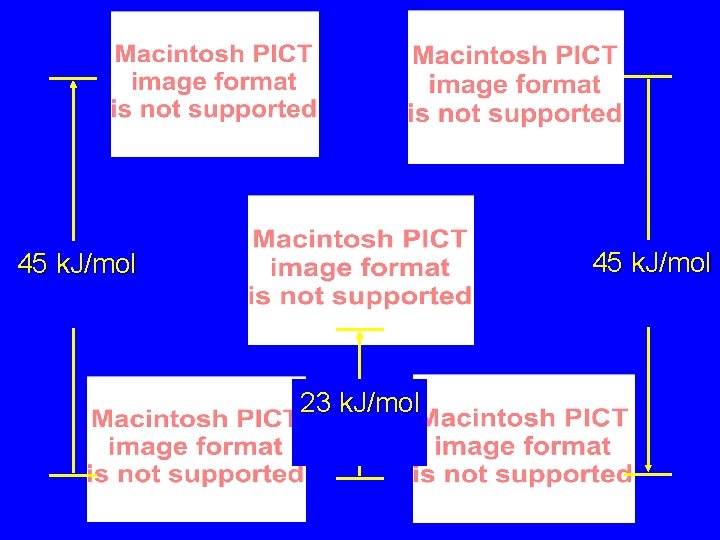
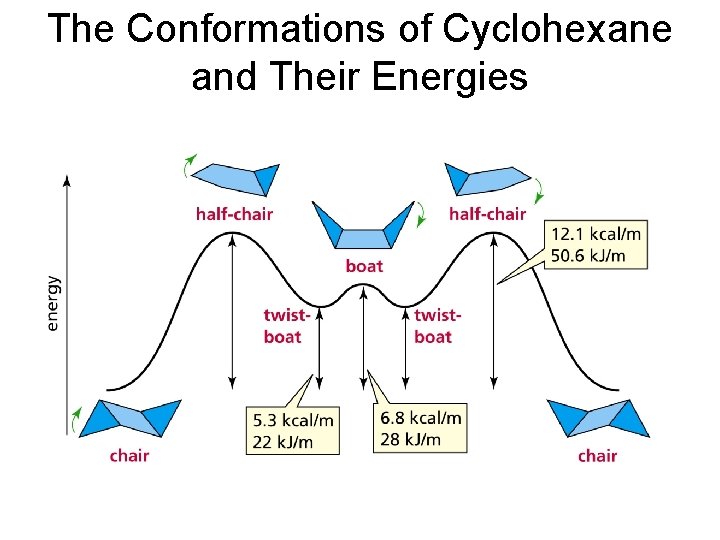
Conformational Inversion • chair-chair interconversion (ring-flipping) • rapid process (activation energy = 45 k. J/mol) • all axial bonds become equatorial and vice versa
Halfchair
Halfchair Skew boat
Halfchair Skew boat
Halfchair Skew boat
45 k. J/mol 23 k. J/mol
The Conformations of Cyclohexane and Their Energies
Conformational Analysis of Monosubstituted Cyclohexanes • most stable conformation is chair • substituent is more stable when equatorial
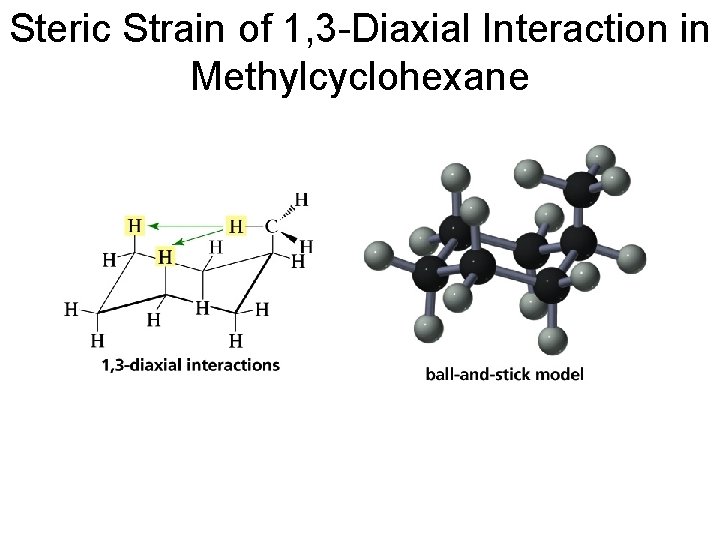
Steric Strain of 1, 3 -Diaxial Interaction in Methylcyclohexane
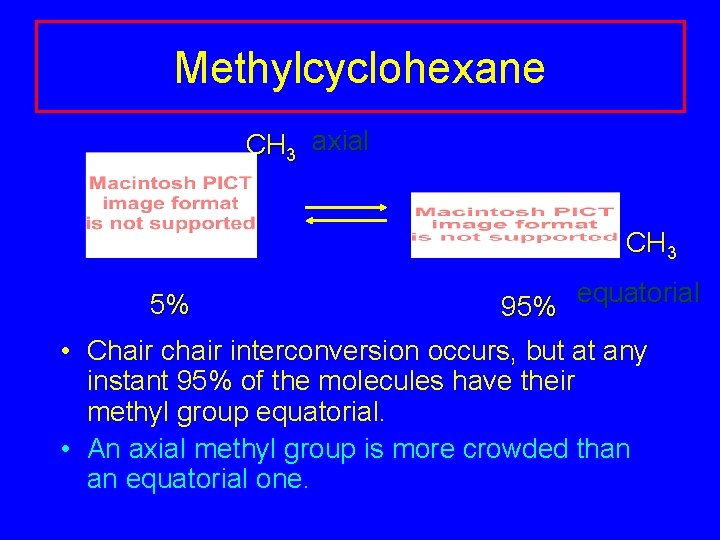
Methylcyclohexane CH 3 axial CH 3 5% 95% equatorial • Chair chair interconversion occurs, but at any instant 95% of the molecules have their methyl group equatorial. • An axial methyl group is more crowded than an equatorial one.
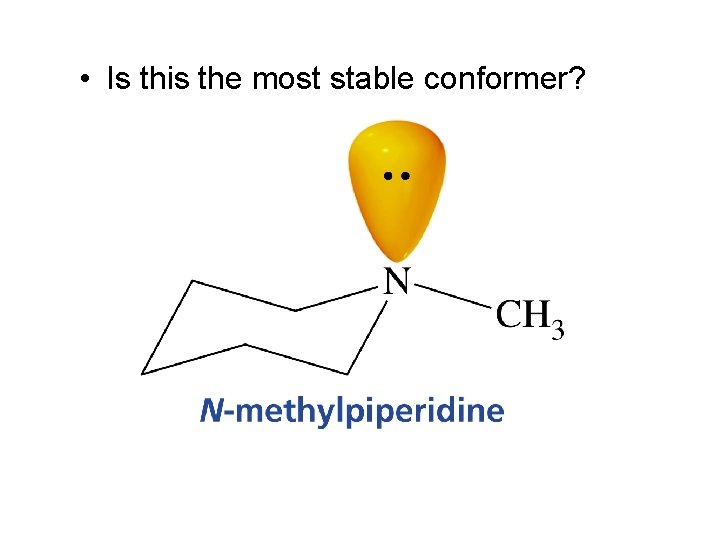
• Is this the most stable conformer?
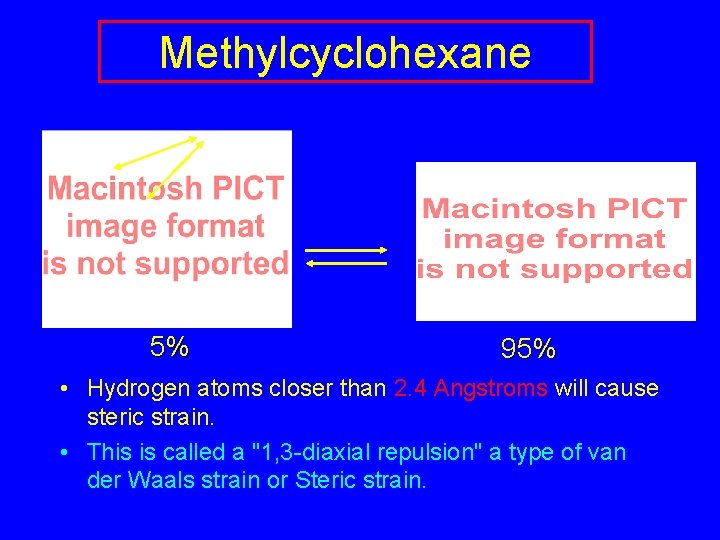
Methylcyclohexane 5% 95% • Hydrogen atoms closer than 2. 4 Angstroms will cause steric strain. • This is called a "1, 3 -diaxial repulsion" a type of van der Waals strain or Steric strain.
Fluorocyclohexane F F 40% 60% • Crowding is less pronounced with a "small" substituent such as fluorine. • Size of substituent is related to its branching.
tert-Butylcyclohexane C(CH 3)3 Less than 0. 01% Greater than 99. 99% • Crowding is more pronounced with a "bulky" substituent such as tert-butyl. • tert-Butyl is highly branched.
tert-Butylcyclohexane van der Waals strain due to 1, 3 -diaxial repulsions
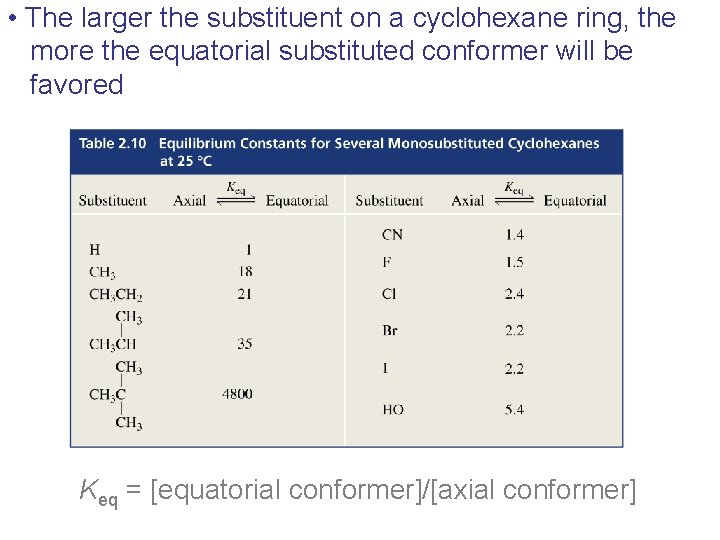
• The larger the substituent on a cyclohexane ring, the more the equatorial substituted conformer will be favored Keq = [equatorial conformer]/[axial conformer]
Disubstituted Cyclohexanes Cis-trans Isomerism
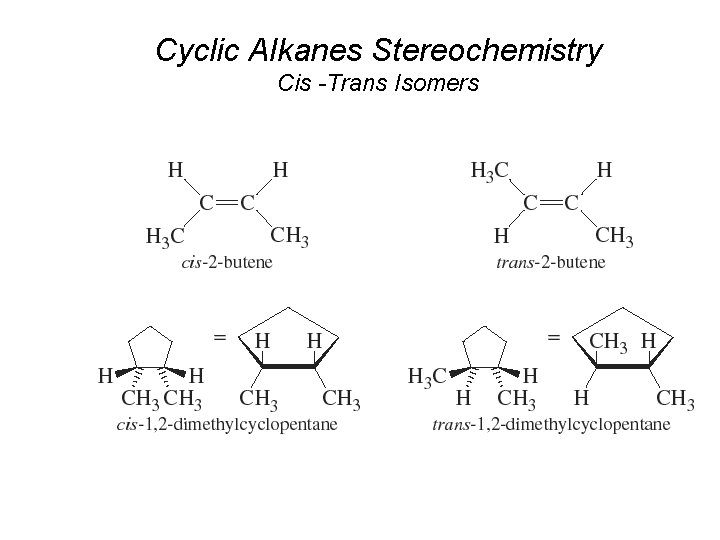
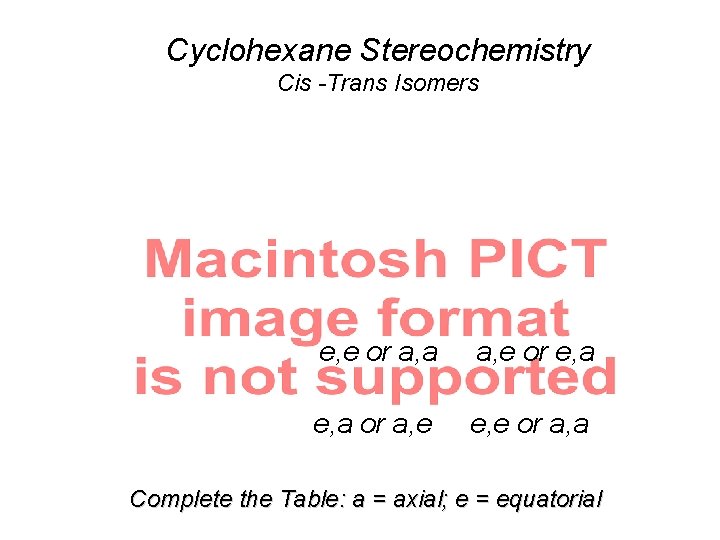
Cyclic Alkanes Stereochemistry Cis -Trans Isomers
The Chair Conformers of cis-1, 4 Dimethylcyclohexane
1, 2 -disubstituted-cis-cyclohexane Stereochemistry axial equatorial
Cyclohexane Stereochemistry Drawings: Cis isomers & the need for perspective Are the methyl groups axial or equatorial? What is the actual conformational shape of the cyclohexane ring?
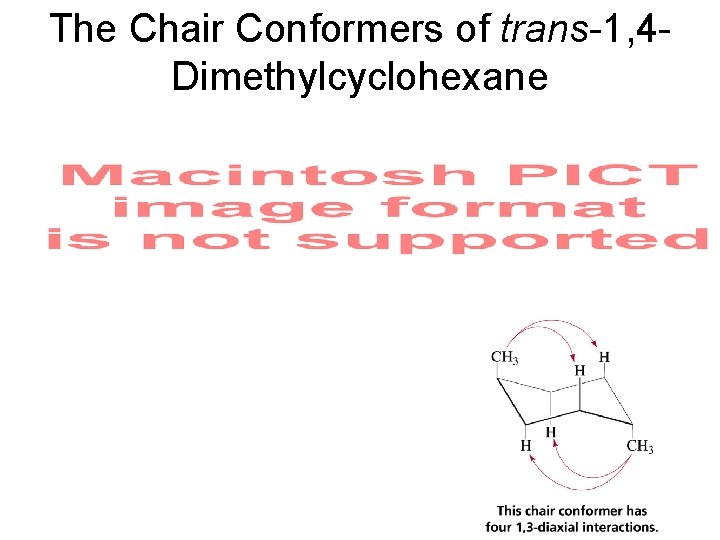
The Chair Conformers of trans-1, 4 Dimethylcyclohexane
Cyclohexane Stereochemistry Trans isomers
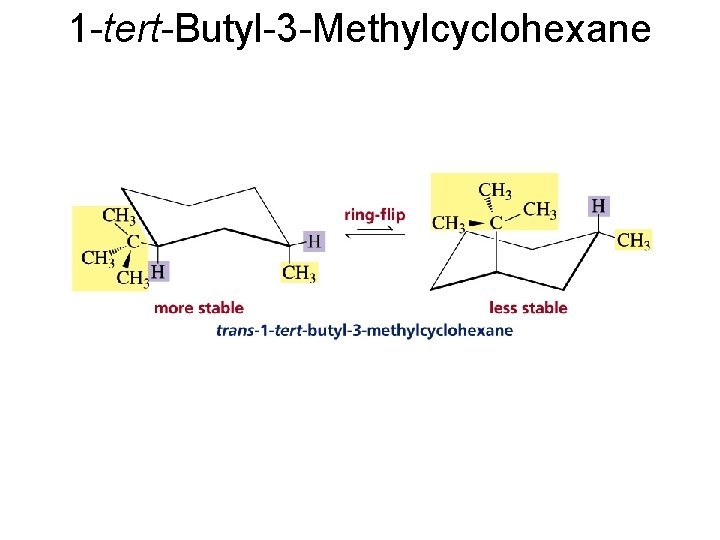
1 -tert-Butyl-3 -Methylcyclohexane
Cyclohexane Stereochemistry Cis -Trans Isomers e, e or a, a a, e or e, a or a, e e, e or a, a Complete the Table: a = axial; e = equatorial
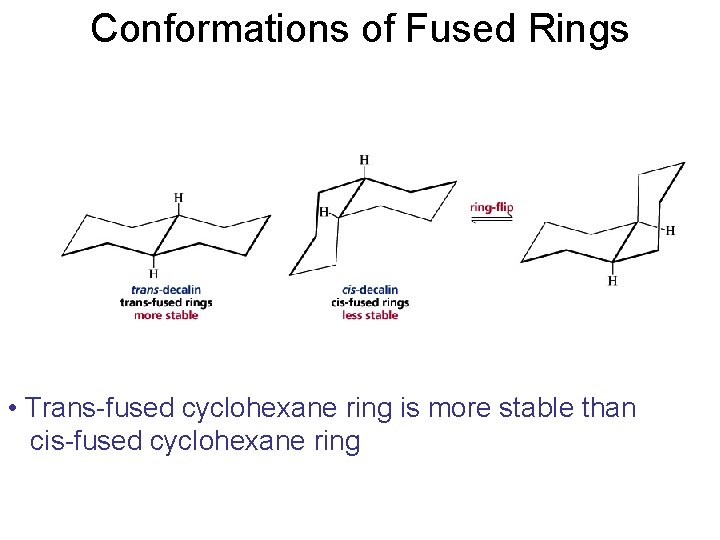
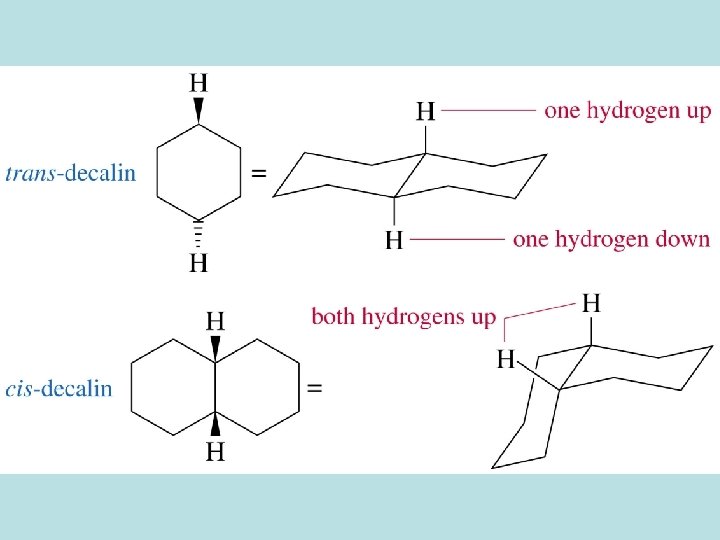
Conformations of Fused Rings • Trans-fused cyclohexane ring is more stable than cis-fused cyclohexane ring
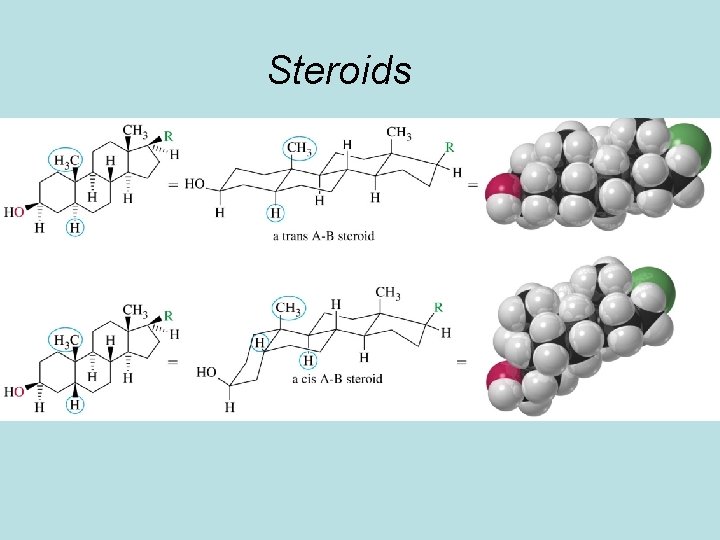
Steroids
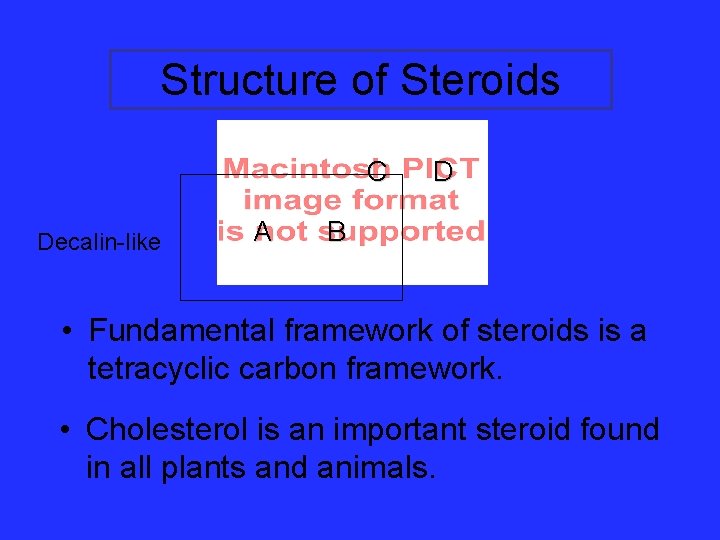
Structure of Steroids C Decalin-like A D B • Fundamental framework of steroids is a tetracyclic carbon framework. • Cholesterol is an important steroid found in all plants and animals.
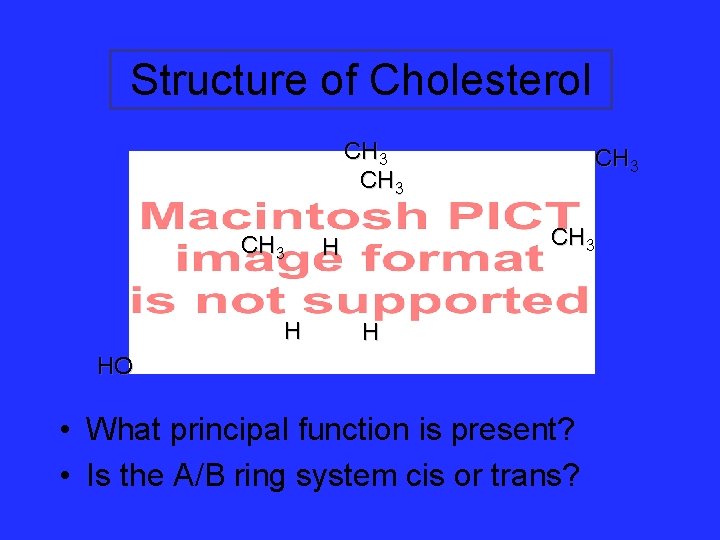
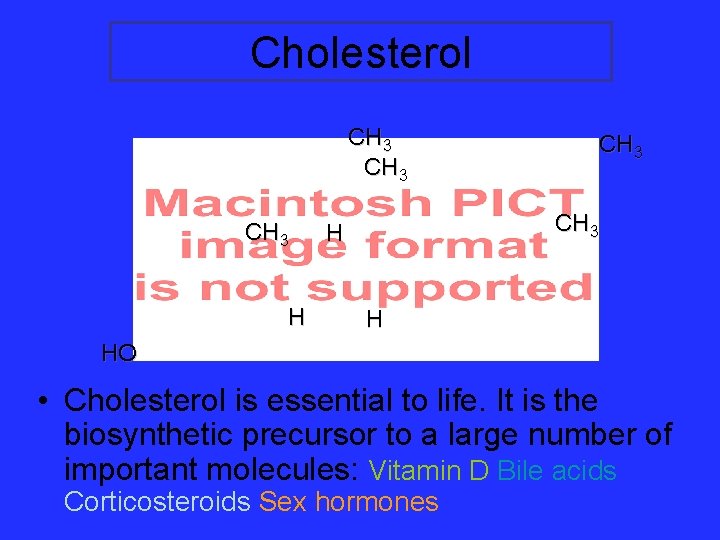
Structure of Cholesterol CH 3 H CH 3 H H HO • What principal function is present? • Is the A/B ring system cis or trans?
Cholesterol CH 3 H CH 3 H H HO • Cholesterol is essential to life. It is the biosynthetic precursor to a large number of important molecules: Vitamin D Bile acids Corticosteroids Sex hormones
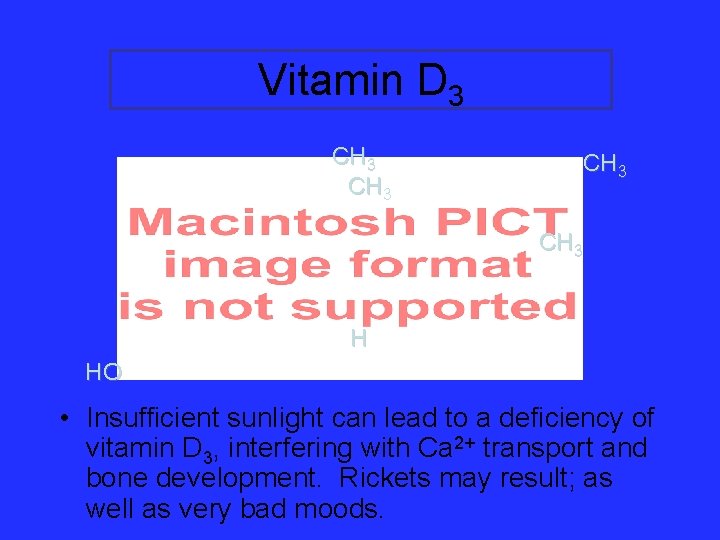
Vitamin D 3 CH 3 H HO • Insufficient sunlight can lead to a deficiency of vitamin D 3, interfering with Ca 2+ transport and bone development. Rickets may result; as well as very bad moods.
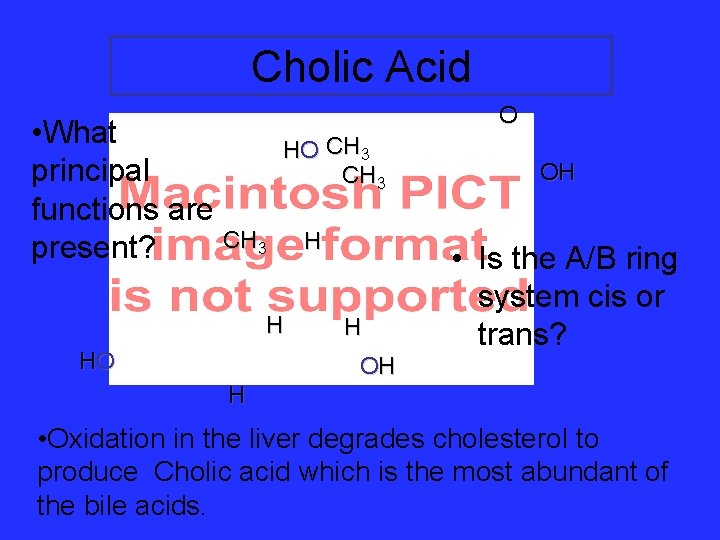
Cholic Acid • What principal functions are CH 3 present? O HO CH 3 H HO H H OH OH • Is the A/B ring system cis or trans? H • Oxidation in the liver degrades cholesterol to produce Cholic acid which is the most abundant of the bile acids.
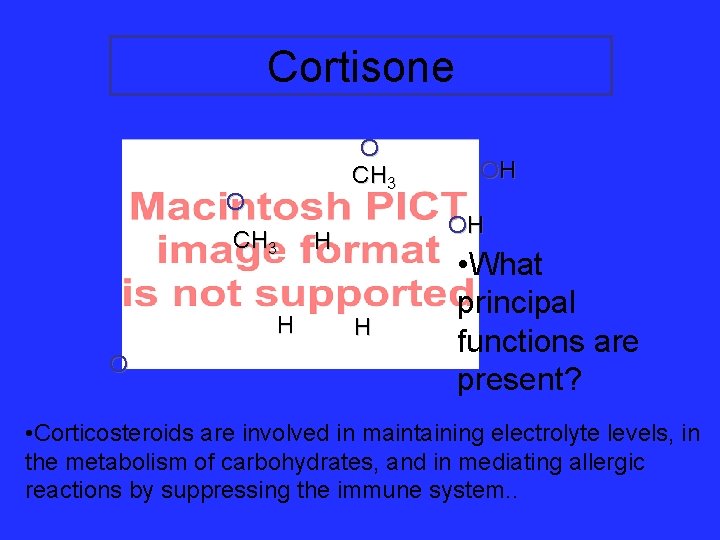
Cortisone O CH 3 H O OH OH H H • What principal functions are present? • Corticosteroids are involved in maintaining electrolyte levels, in the metabolism of carbohydrates, and in mediating allergic reactions by suppressing the immune system. .
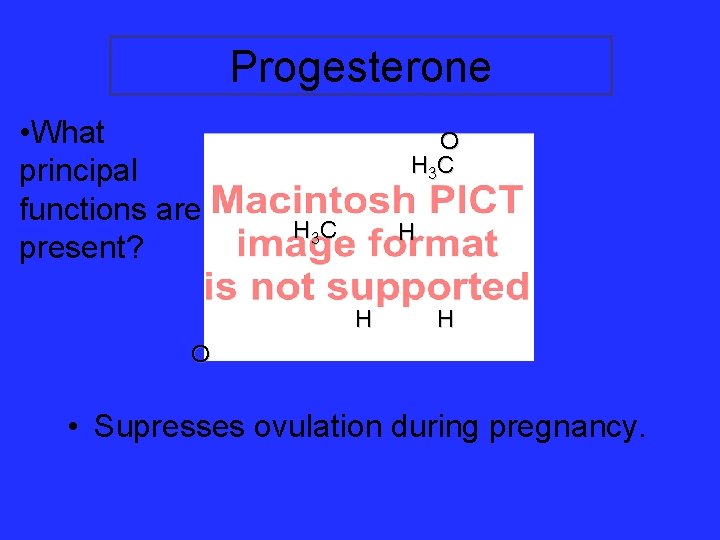
Progesterone • What principal functions are present? O H 3 C H H H O • Supresses ovulation during pregnancy.