
Chapter 2 An Introduction to Forwards and Options
- Slides: 27
Chapter 2 An Introduction to Forwards and Options Copyright © 2009 Pearson Prentice Hall. All rights reserved.
Introduction • Basic derivatives contracts – Forward contracts – Call options – Put options • Types of positions – Long position – Short position • Graphical representation – Payoff diagrams – Profit diagrams Copyright © 2009 Pearson Prentice Hall. All rights reserved. 2 -2
Forward Contracts • Definition: a binding agreement (obligation) to buy/sell an underlying asset in the future, at a price set today • Futures contracts are the same as forwards in principle except for some institutional and pricing differences. • A forward contract specifies – The features and quantity of the asset to be delivered – The delivery logistics, such as time, date, and place – The price the buyer will pay at the time of delivery Copyright © 2009 Pearson Prentice Hall. All rights reserved. 2 -3
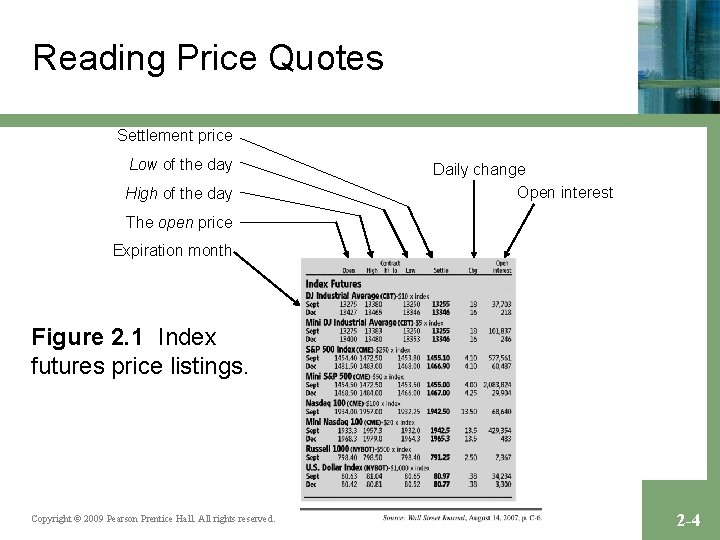
Reading Price Quotes Settlement price Low of the day High of the day Daily change Open interest The open price Expiration month Figure 2. 1 Index futures price listings. Copyright © 2009 Pearson Prentice Hall. All rights reserved. 2 -4
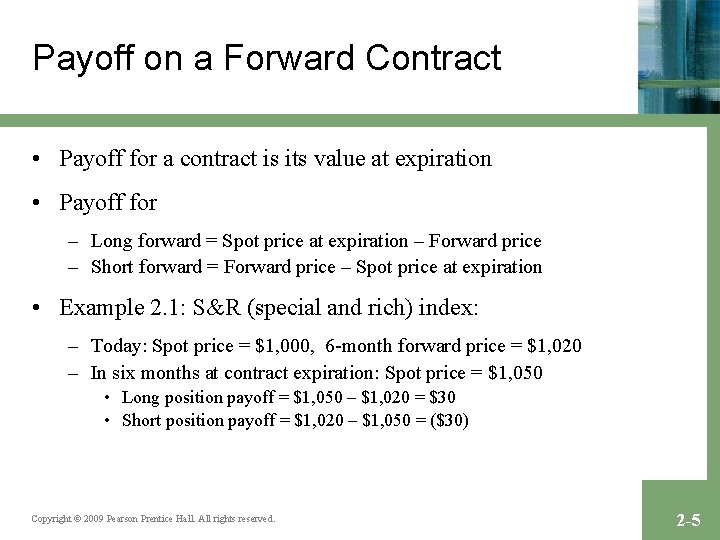
Payoff on a Forward Contract • Payoff for a contract is its value at expiration • Payoff for – Long forward = Spot price at expiration – Forward price – Short forward = Forward price – Spot price at expiration • Example 2. 1: S&R (special and rich) index: – Today: Spot price = $1, 000, 6 -month forward price = $1, 020 – In six months at contract expiration: Spot price = $1, 050 • Long position payoff = $1, 050 – $1, 020 = $30 • Short position payoff = $1, 020 – $1, 050 = ($30) Copyright © 2009 Pearson Prentice Hall. All rights reserved. 2 -5
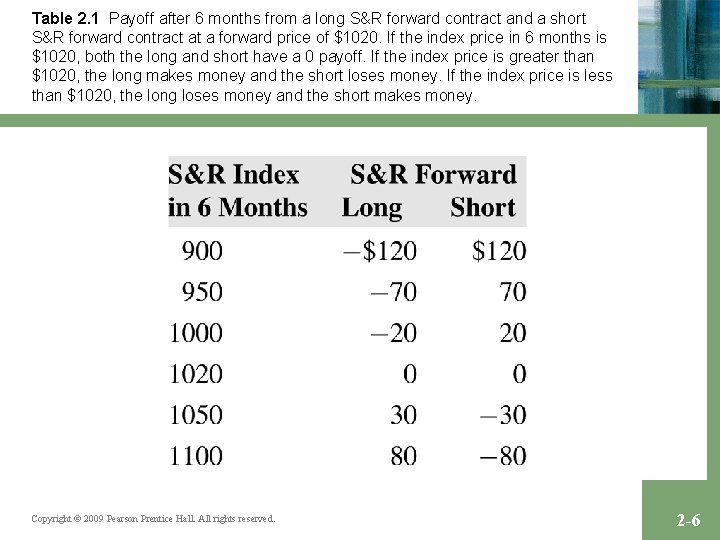
Table 2. 1 Payoff after 6 months from a long S&R forward contract and a short S&R forward contract at a forward price of $1020. If the index price in 6 months is $1020, both the long and short have a 0 payoff. If the index price is greater than $1020, the long makes money and the short loses money. If the index price is less than $1020, the long loses money and the short makes money. Copyright © 2009 Pearson Prentice Hall. All rights reserved. 2 -6
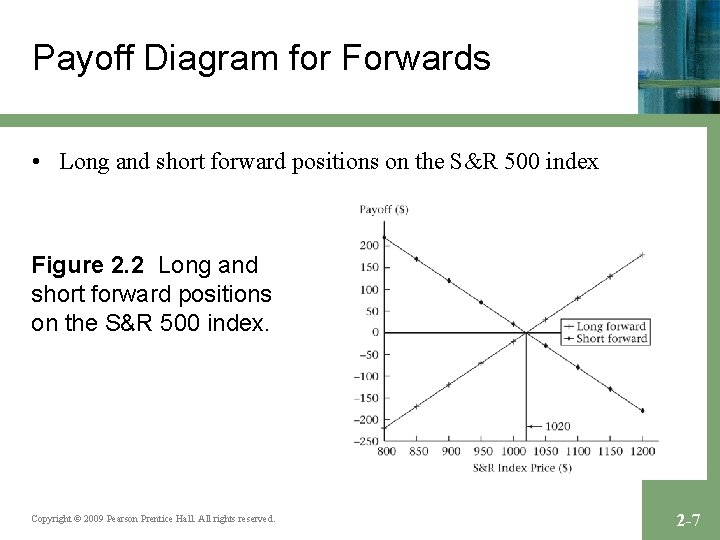
Payoff Diagram for Forwards • Long and short forward positions on the S&R 500 index Figure 2. 2 Long and short forward positions on the S&R 500 index. Copyright © 2009 Pearson Prentice Hall. All rights reserved. 2 -7
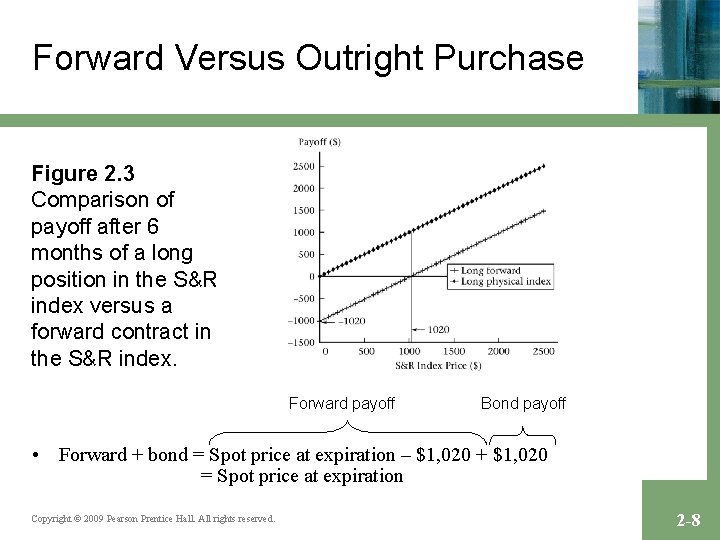
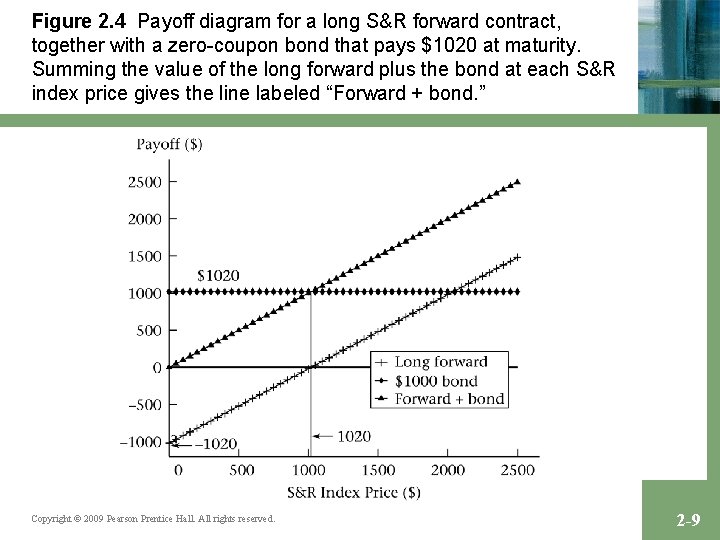
Forward Versus Outright Purchase Figure 2. 3 Comparison of payoff after 6 months of a long position in the S&R index versus a forward contract in the S&R index. Forward payoff Bond payoff • Forward + bond = Spot price at expiration – $1, 020 + $1, 020 = Spot price at expiration Copyright © 2009 Pearson Prentice Hall. All rights reserved. 2 -8
Figure 2. 4 Payoff diagram for a long S&R forward contract, together with a zero-coupon bond that pays $1020 at maturity. Summing the value of the long forward plus the bond at each S&R index price gives the line labeled “Forward + bond. ” Copyright © 2009 Pearson Prentice Hall. All rights reserved. 2 -9
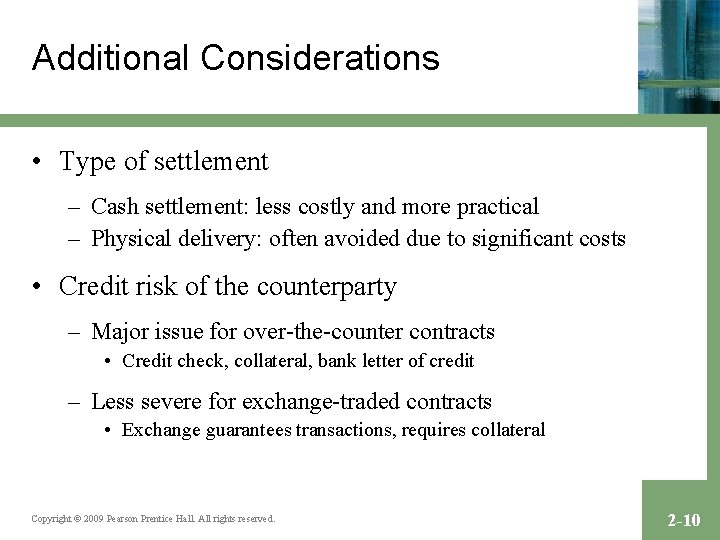
Additional Considerations • Type of settlement – Cash settlement: less costly and more practical – Physical delivery: often avoided due to significant costs • Credit risk of the counterparty – Major issue for over-the-counter contracts • Credit check, collateral, bank letter of credit – Less severe for exchange-traded contracts • Exchange guarantees transactions, requires collateral Copyright © 2009 Pearson Prentice Hall. All rights reserved. 2 -10
Call Options • A non-binding agreement (right but not an obligation) to buy an asset in the future, at a price set today • Preserves the upside potential, while at the same time eliminating the unpleasant downside (for the buyer) • The seller of a call option is obligated to deliver if asked. Copyright © 2009 Pearson Prentice Hall. All rights reserved. 2 -11
Definition and Terminology • A call option gives the owner the right but not the obligation to buy the underlying asset at a predetermined price during a predetermined period. • Strike (or exercise) price: The amount paid by the option buyer for the asset if he/she decides to exercise • Exercise: The act of paying the strike price to buy the asset • Expiration: The date by which the option must be exercised or become worthless • Exercise style: Specifies when the option can be exercised – European-style: Can be exercised only at expiration date – American-style: Can be exercised at any time before expiration – Bermudan-style: Can be exercised during specified periods Copyright © 2009 Pearson Prentice Hall. All rights reserved. 2 -12
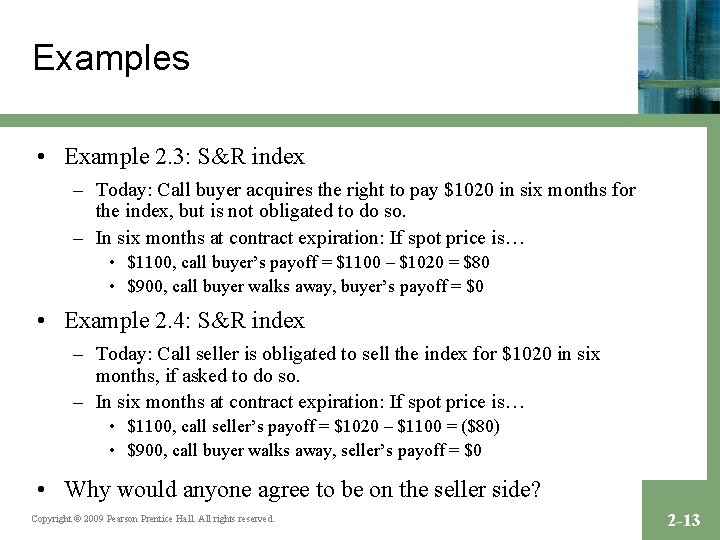
Examples • Example 2. 3: S&R index – Today: Call buyer acquires the right to pay $1020 in six months for the index, but is not obligated to do so. – In six months at contract expiration: If spot price is… • $1100, call buyer’s payoff = $1100 – $1020 = $80 • $900, call buyer walks away, buyer’s payoff = $0 • Example 2. 4: S&R index – Today: Call seller is obligated to sell the index for $1020 in six months, if asked to do so. – In six months at contract expiration: If spot price is… • $1100, call seller’s payoff = $1020 – $1100 = ($80) • $900, call buyer walks away, seller’s payoff = $0 • Why would anyone agree to be on the seller side? Copyright © 2009 Pearson Prentice Hall. All rights reserved. 2 -13
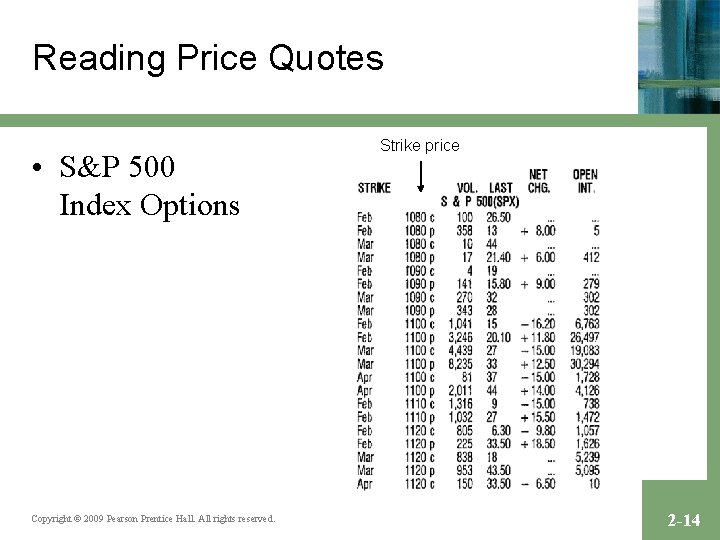
Reading Price Quotes • S&P 500 Index Options Copyright © 2009 Pearson Prentice Hall. All rights reserved. Strike price 2 -14
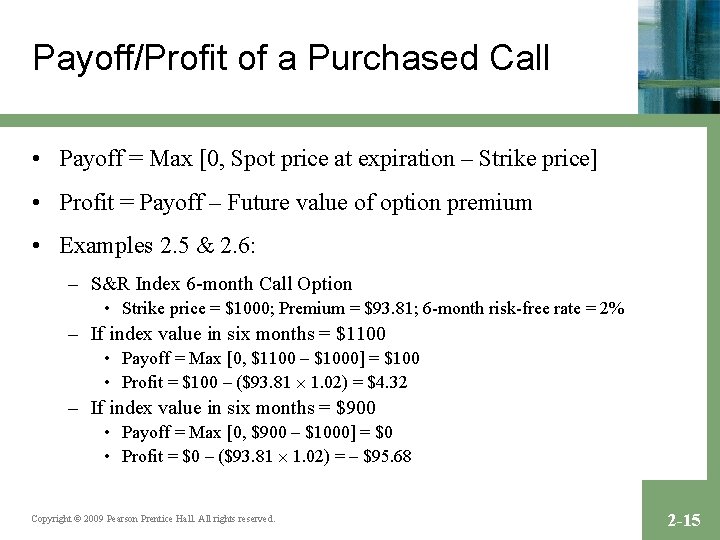
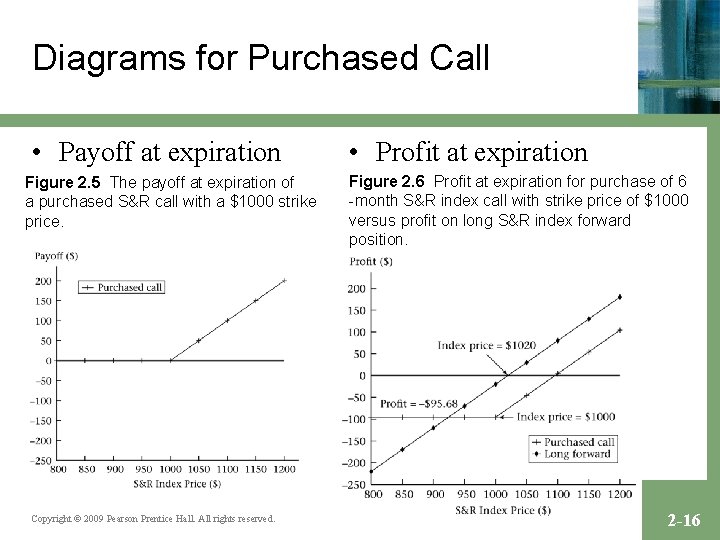
Payoff/Profit of a Purchased Call • Payoff = Max [0, Spot price at expiration – Strike price] • Profit = Payoff – Future value of option premium • Examples 2. 5 & 2. 6: – S&R Index 6 -month Call Option • Strike price = $1000; Premium = $93. 81; 6 -month risk-free rate = 2% – If index value in six months = $1100 • Payoff = Max [0, $1100 – $1000] = $100 • Profit = $100 – ($93. 81 1. 02) = $4. 32 – If index value in six months = $900 • Payoff = Max [0, $900 – $1000] = $0 • Profit = $0 – ($93. 81 1. 02) = – $95. 68 Copyright © 2009 Pearson Prentice Hall. All rights reserved. 2 -15
Diagrams for Purchased Call • Payoff at expiration Figure 2. 5 The payoff at expiration of a purchased S&R call with a $1000 strike price. Copyright © 2009 Pearson Prentice Hall. All rights reserved. • Profit at expiration Figure 2. 6 Profit at expiration for purchase of 6 -month S&R index call with strike price of $1000 versus profit on long S&R index forward position. 2 -16
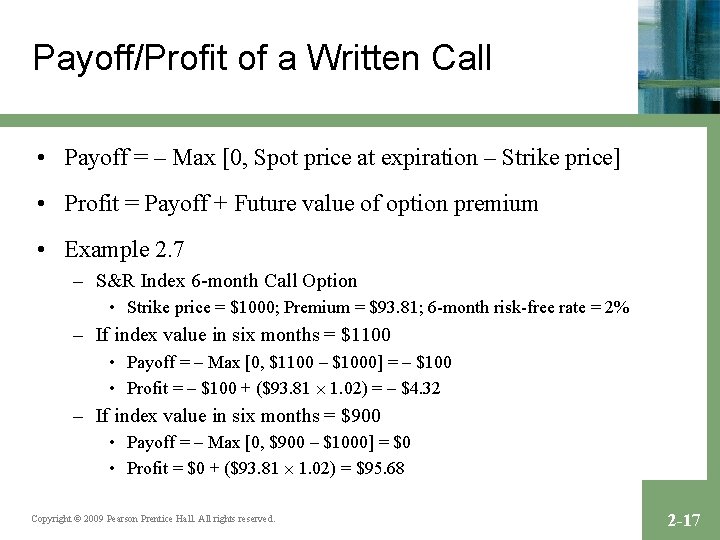
Payoff/Profit of a Written Call • Payoff = – Max [0, Spot price at expiration – Strike price] • Profit = Payoff + Future value of option premium • Example 2. 7 – S&R Index 6 -month Call Option • Strike price = $1000; Premium = $93. 81; 6 -month risk-free rate = 2% – If index value in six months = $1100 • Payoff = – Max [0, $1100 – $1000] = – $100 • Profit = – $100 + ($93. 81 1. 02) = – $4. 32 – If index value in six months = $900 • Payoff = – Max [0, $900 – $1000] = $0 • Profit = $0 + ($93. 81 1. 02) = $95. 68 Copyright © 2009 Pearson Prentice Hall. All rights reserved. 2 -17
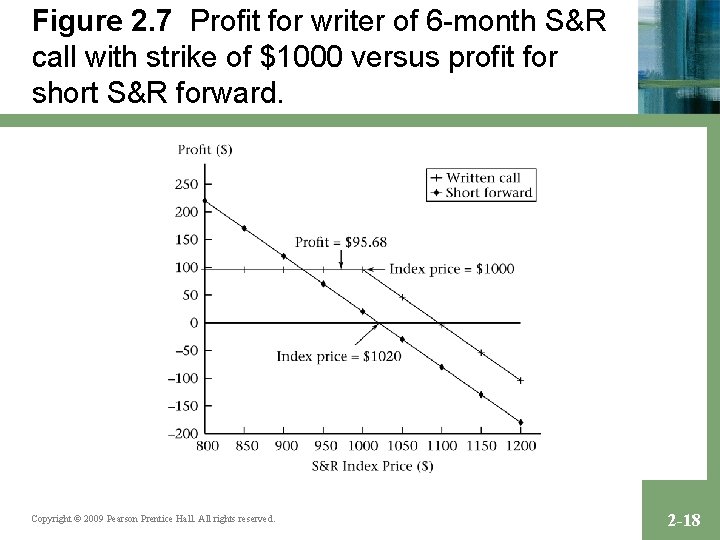
Figure 2. 7 Profit for writer of 6 -month S&R call with strike of $1000 versus profit for short S&R forward. Copyright © 2009 Pearson Prentice Hall. All rights reserved. 2 -18
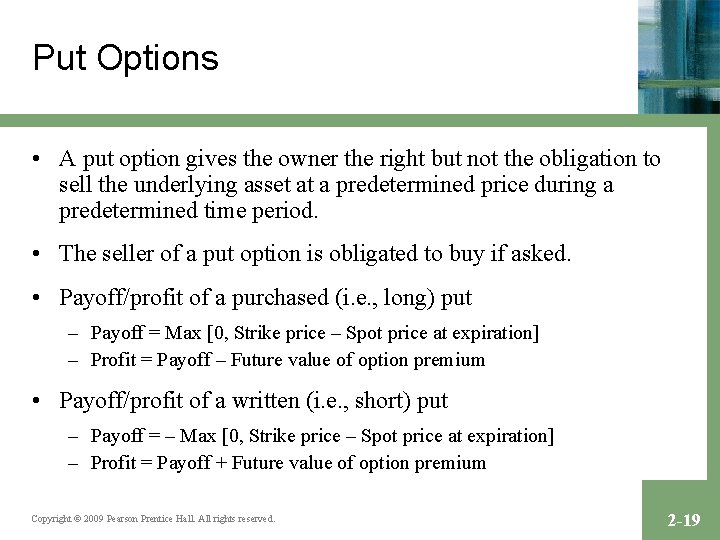
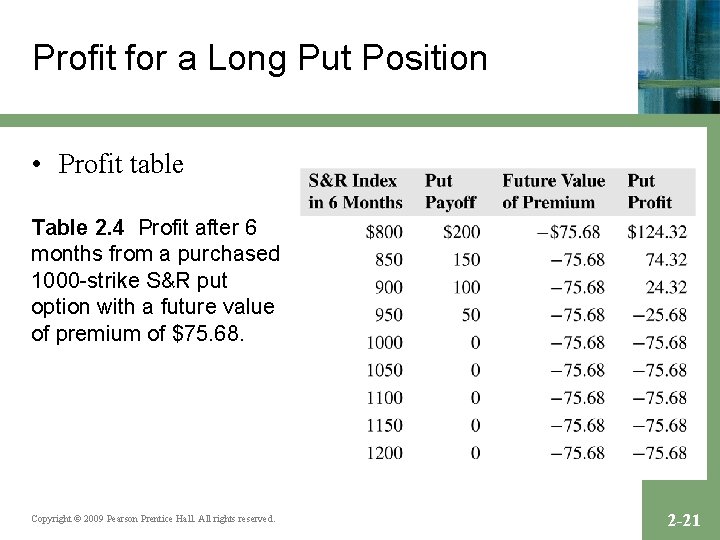
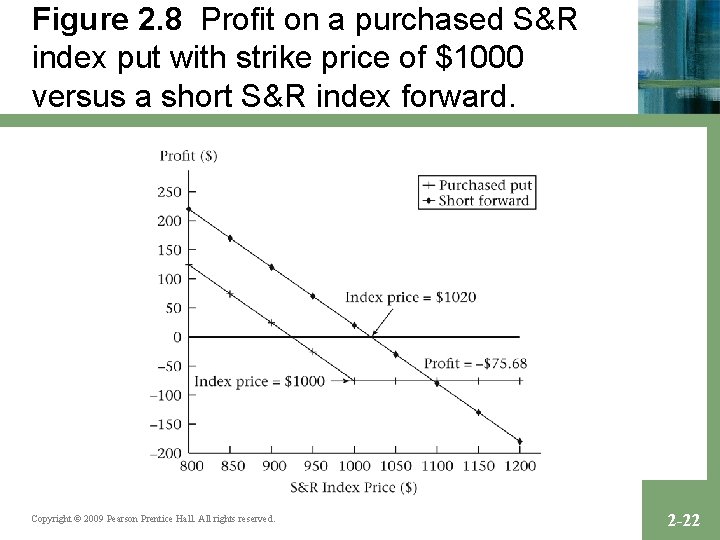
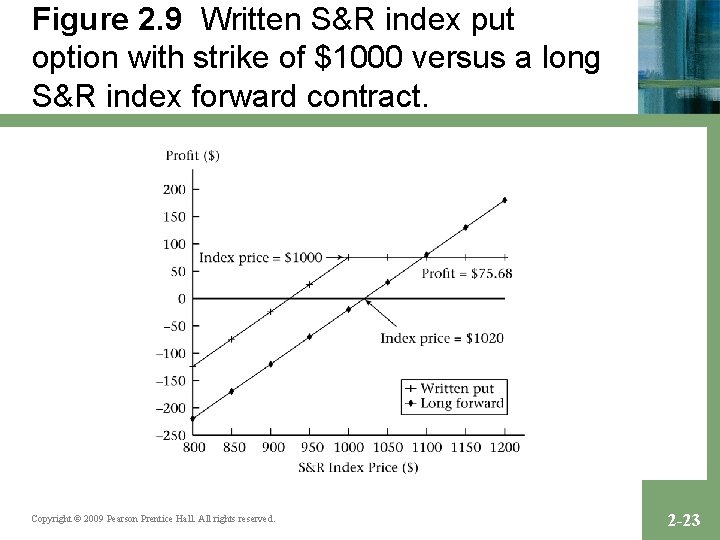
Put Options • A put option gives the owner the right but not the obligation to sell the underlying asset at a predetermined price during a predetermined time period. • The seller of a put option is obligated to buy if asked. • Payoff/profit of a purchased (i. e. , long) put – Payoff = Max [0, Strike price – Spot price at expiration] – Profit = Payoff – Future value of option premium • Payoff/profit of a written (i. e. , short) put – Payoff = – Max [0, Strike price – Spot price at expiration] – Profit = Payoff + Future value of option premium Copyright © 2009 Pearson Prentice Hall. All rights reserved. 2 -19
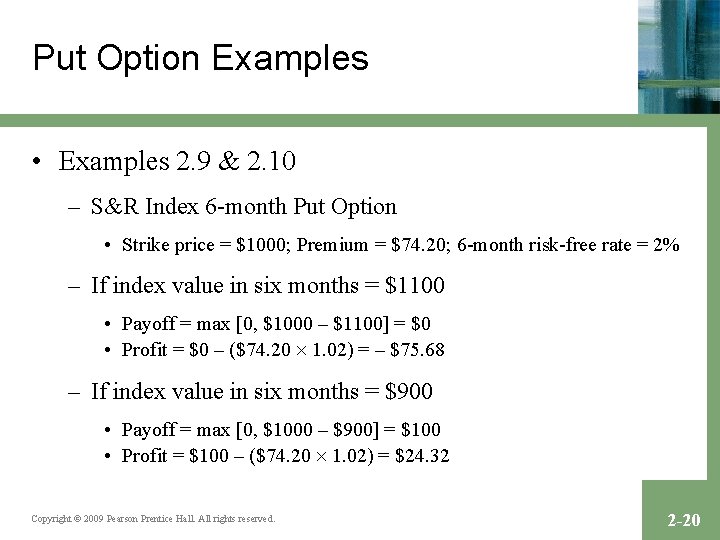
Put Option Examples • Examples 2. 9 & 2. 10 – S&R Index 6 -month Put Option • Strike price = $1000; Premium = $74. 20; 6 -month risk-free rate = 2% – If index value in six months = $1100 • Payoff = max [0, $1000 – $1100] = $0 • Profit = $0 – ($74. 20 1. 02) = – $75. 68 – If index value in six months = $900 • Payoff = max [0, $1000 – $900] = $100 • Profit = $100 – ($74. 20 1. 02) = $24. 32 Copyright © 2009 Pearson Prentice Hall. All rights reserved. 2 -20
Profit for a Long Put Position • Profit table Table 2. 4 Profit after 6 months from a purchased 1000 -strike S&R put option with a future value of premium of $75. 68. Copyright © 2009 Pearson Prentice Hall. All rights reserved. 2 -21
Figure 2. 8 Profit on a purchased S&R index put with strike price of $1000 versus a short S&R index forward. Copyright © 2009 Pearson Prentice Hall. All rights reserved. 2 -22
Figure 2. 9 Written S&R index put option with strike of $1000 versus a long S&R index forward contract. Copyright © 2009 Pearson Prentice Hall. All rights reserved. 2 -23
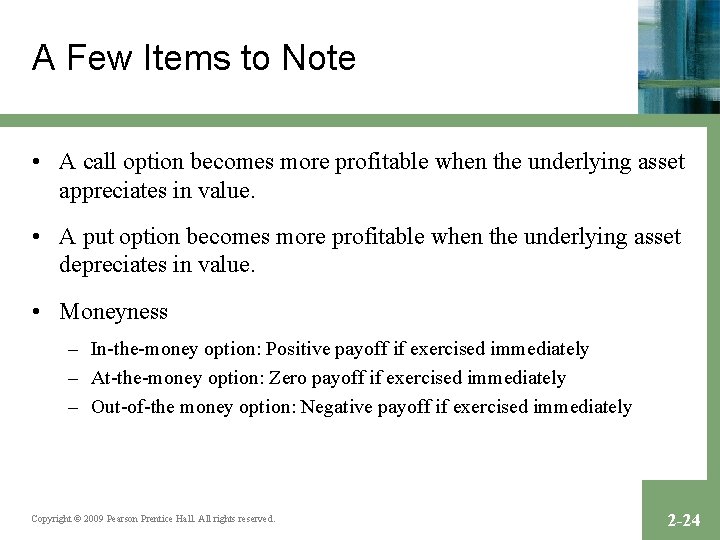
A Few Items to Note • A call option becomes more profitable when the underlying asset appreciates in value. • A put option becomes more profitable when the underlying asset depreciates in value. • Moneyness – In-the-money option: Positive payoff if exercised immediately – At-the-money option: Zero payoff if exercised immediately – Out-of-the money option: Negative payoff if exercised immediately Copyright © 2009 Pearson Prentice Hall. All rights reserved. 2 -24
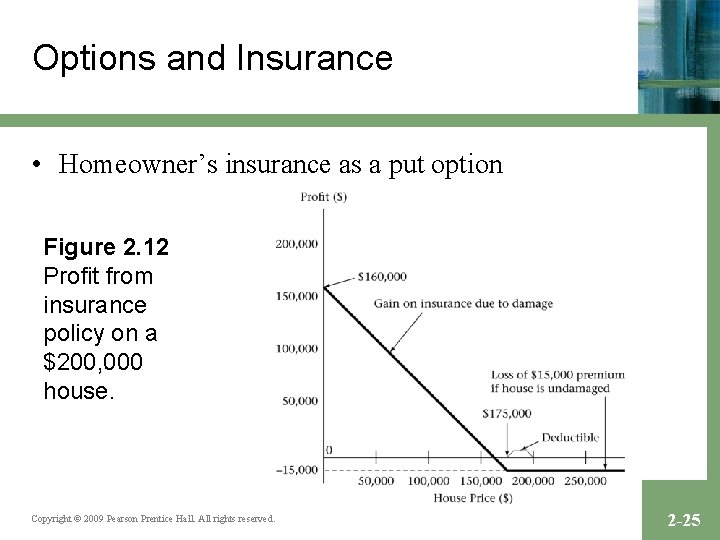
Options and Insurance • Homeowner’s insurance as a put option Figure 2. 12 Profit from insurance policy on a $200, 000 house. Copyright © 2009 Pearson Prentice Hall. All rights reserved. 2 -25
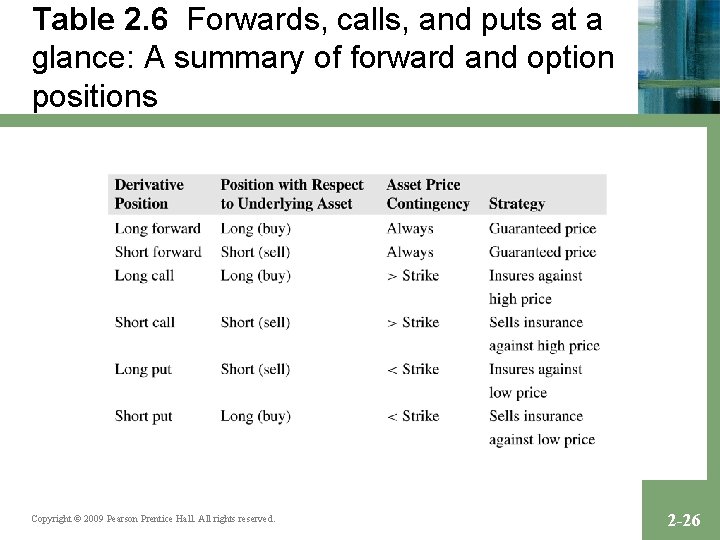
Table 2. 6 Forwards, calls, and puts at a glance: A summary of forward and option positions Copyright © 2009 Pearson Prentice Hall. All rights reserved. 2 -26
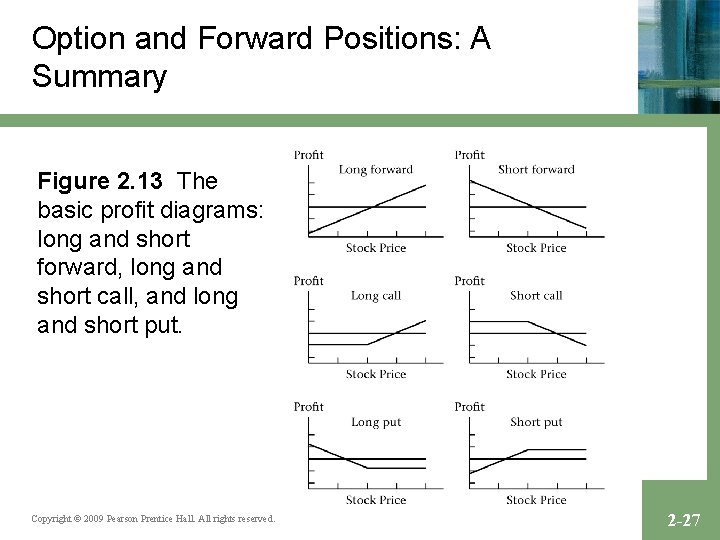
Option and Forward Positions: A Summary Figure 2. 13 The basic profit diagrams: long and short forward, long and short call, and long and short put. Copyright © 2009 Pearson Prentice Hall. All rights reserved. 2 -27