
CHAPTER 2 AMPLITUDE MODULATION AM 1 Principles of
- Slides: 12
CHAPTER 2 AMPLITUDE MODULATION (AM) 1
Principles of AM Definitions: The process of changing the amplitude of a relatively high frequency carrier signal in proportion with the instantaneous value of modulating signal (information) A process of translating information signal from low band frequency to high band frequency. 2
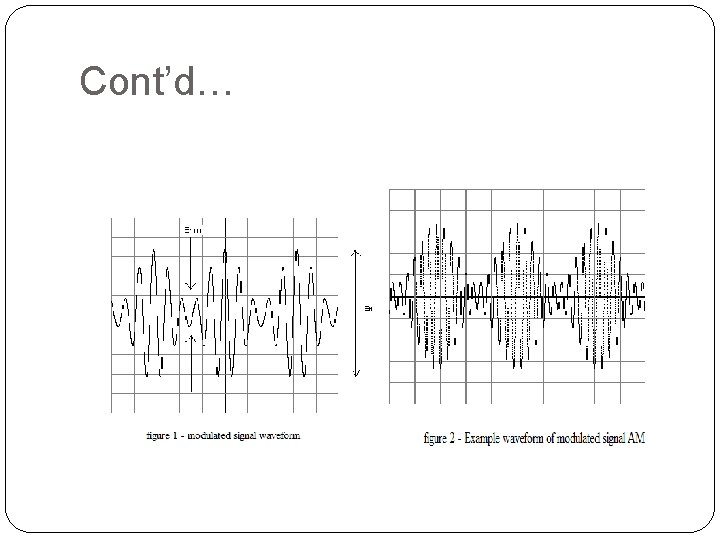
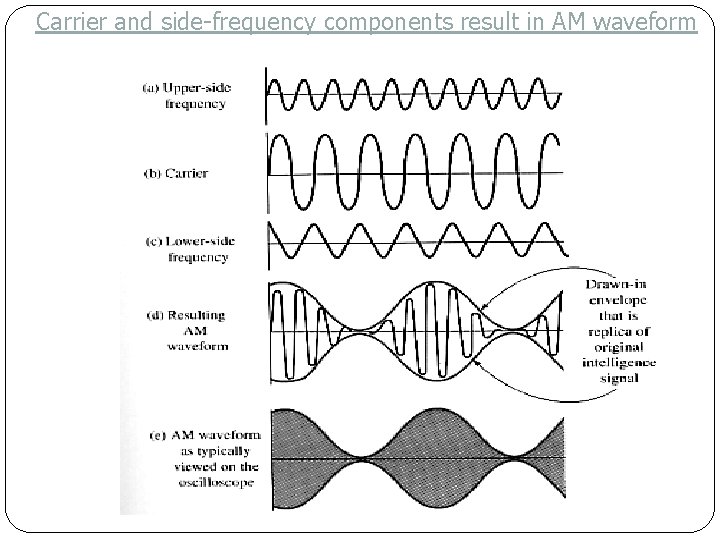
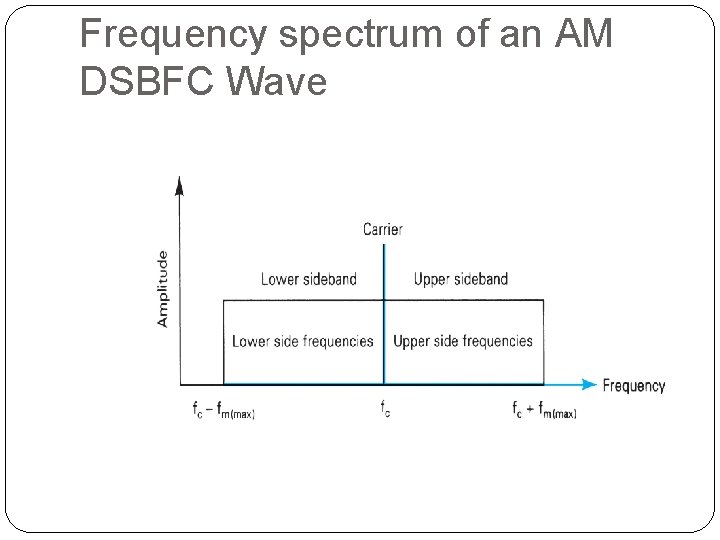
Cont’d… Information signal cannot travel far. It needs carrier signal of higher frequency for long distance destination. Amplitude of the carrier signal varies with the information signal. The modulated signal consist of carrier signal, upper sideband lower sideband signals The modulated AM signal (figure 1 & figure 2) needs to go through demodulation process to get back the information signal. n 3
Cont’d… 4
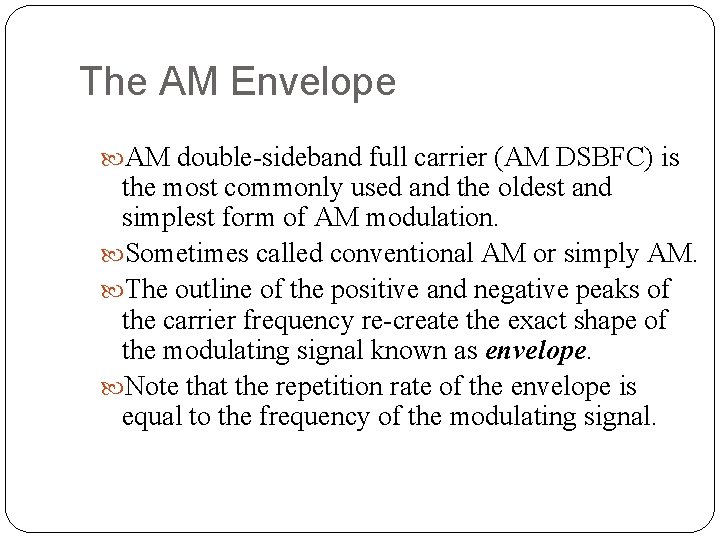
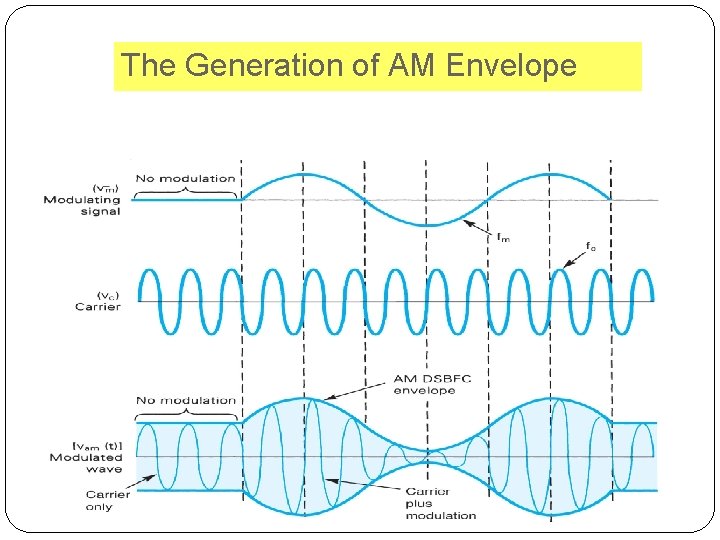
The AM Envelope AM double-sideband full carrier (AM DSBFC) is the most commonly used and the oldest and simplest form of AM modulation. Sometimes called conventional AM or simply AM. The outline of the positive and negative peaks of the carrier frequency re-create the exact shape of the modulating signal known as envelope. Note that the repetition rate of the envelope is equal to the frequency of the modulating signal. 5
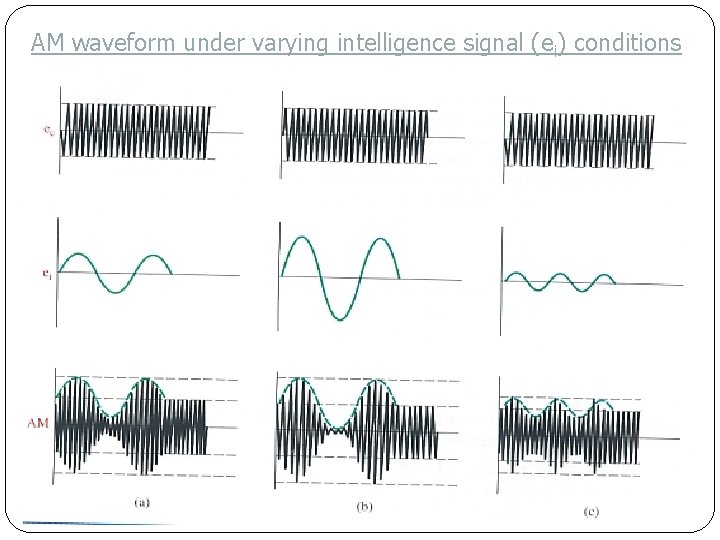
AM waveform under varying intelligence signal (ei) conditions 6
The Generation of AM Envelope 7
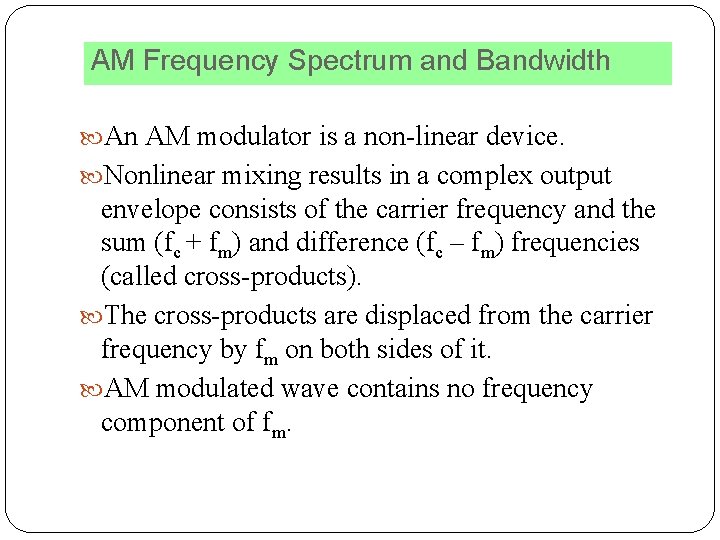
AM Frequency Spectrum and Bandwidth An AM modulator is a non-linear device. Nonlinear mixing results in a complex output envelope consists of the carrier frequency and the sum (fc + fm) and difference (fc – fm) frequencies (called cross-products). The cross-products are displaced from the carrier frequency by fm on both sides of it. AM modulated wave contains no frequency component of fm. 8
Carrier and side-frequency components result in AM waveform 9
Frequency spectrum of an AM DSBFC Wave 10
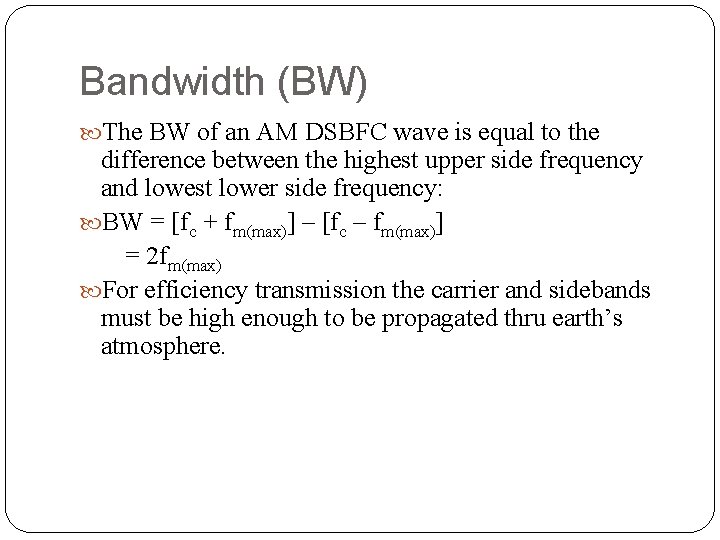
Bandwidth (BW) The BW of an AM DSBFC wave is equal to the difference between the highest upper side frequency and lowest lower side frequency: BW = [fc + fm(max)] – [fc – fm(max)] = 2 fm(max) For efficiency transmission the carrier and sidebands must be high enough to be propagated thru earth’s atmosphere. 11
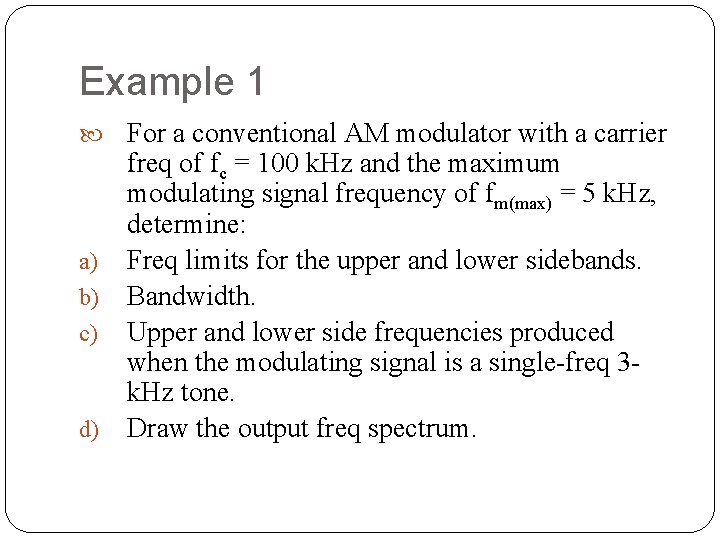
Example 1 For a conventional AM modulator with a carrier freq of fc = 100 k. Hz and the maximum modulating signal frequency of fm(max) = 5 k. Hz, determine: a) Freq limits for the upper and lower sidebands. b) Bandwidth. c) Upper and lower side frequencies produced when the modulating signal is a single-freq 3 k. Hz tone. d) Draw the output freq spectrum. 12