
Chapter 2 Activity Cost Analysis and Planning Prepared

- Slides: 56
Chapter 2 Activity Cost Analysis and Planning Prepared by Douglas Cloud Pepperdine University
2 Objectives 1. Determine the basic patterns of how costs After studying this activity cost respond to changes in unit level chapter, you should drivers. able to: 2. Develop a linearbe cost estimating equation based on unit level activity cost drivers. 3. Discuss problems encountered in cost estimation. 4. Describe and develop alternative classification schemes for activity cost drivers. Continued
3 Objectives 5. Develop cost estimates and cost predictions based on unit and nonunit level activity cost drivers. 6. Explain and illustrate possible errors when cost estimates or predictions are based solely on unit level activity cost drivers in multiple product or service organizations.
4 Two Approaches to Activity Cost Analysis Unit level approach Unit and nonunit level approach
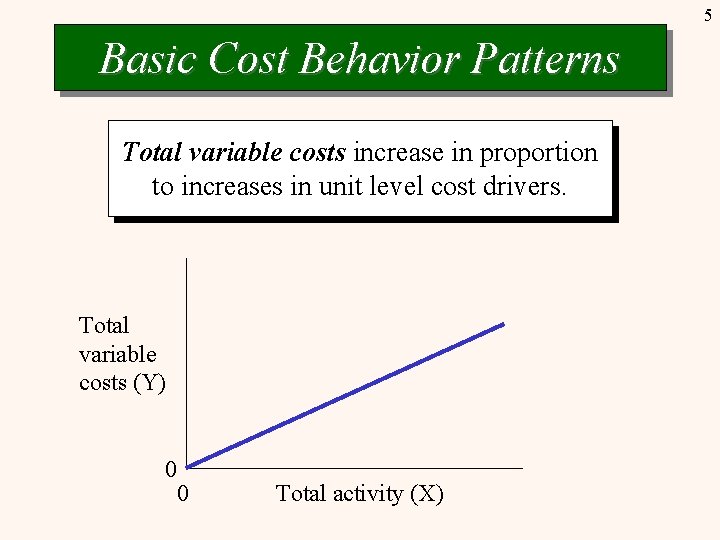
5 Basic Cost Behavior Patterns Total variable costs increase in proportion to increases in unit level cost drivers. Total variable costs (Y) 0 0 Total activity (X)
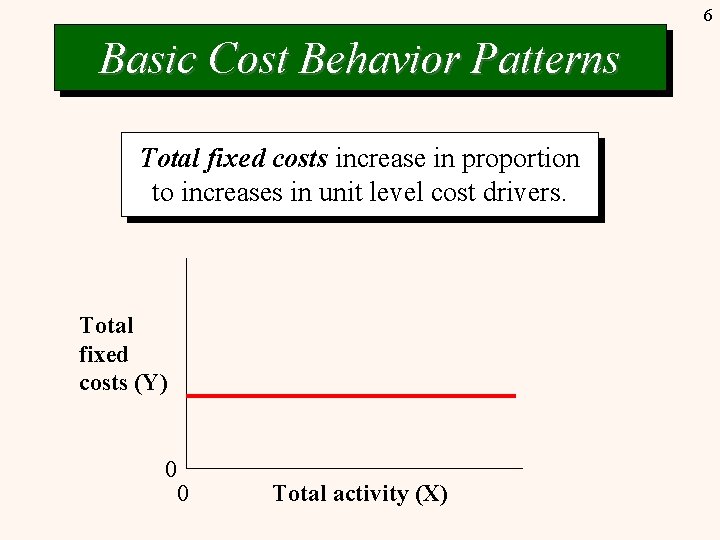
6 Basic Cost Behavior Patterns Total fixed costs increase in proportion to increases in unit level cost drivers. Total fixed costs (Y) 0 0 Total activity (X)
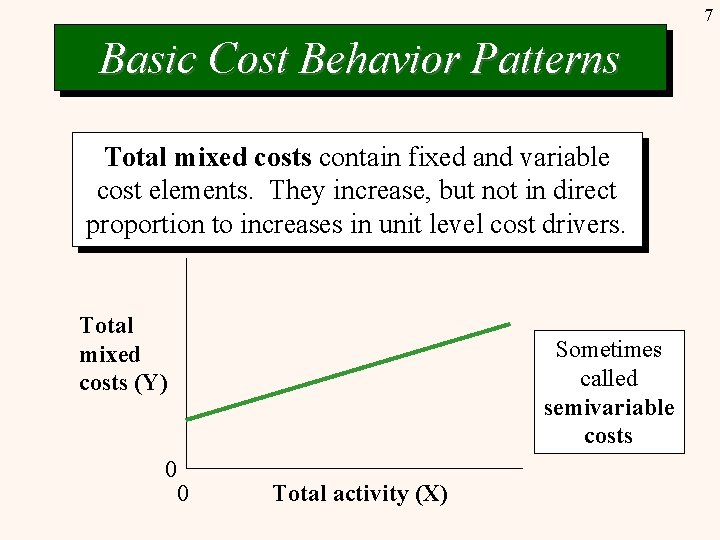
7 Basic Cost Behavior Patterns Total mixed costs contain fixed and variable cost elements. They increase, but not in direct proportion to increases in unit level cost drivers. Total mixed costs (Y) 0 Sometimes called semivariable costs 0 Total activity (X)
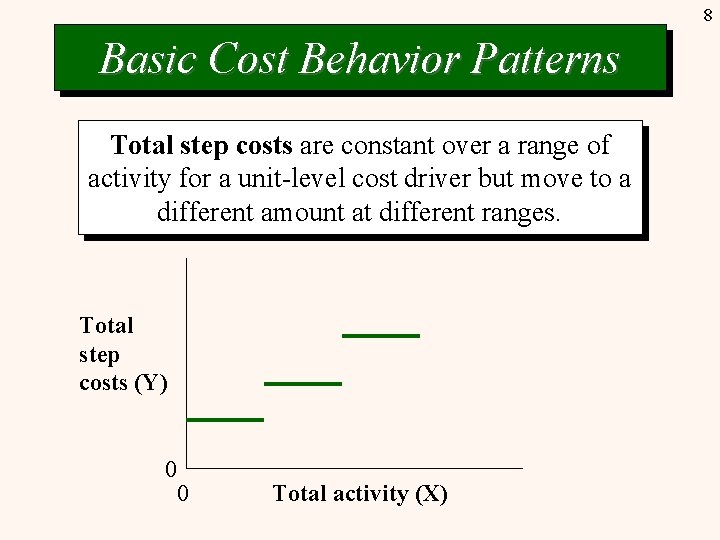
8 Basic Cost Behavior Patterns Total step costs are constant over a range of activity for a unit-level cost driver but move to a different amount at different ranges. Total step costs (Y) 0 0 Total activity (X)
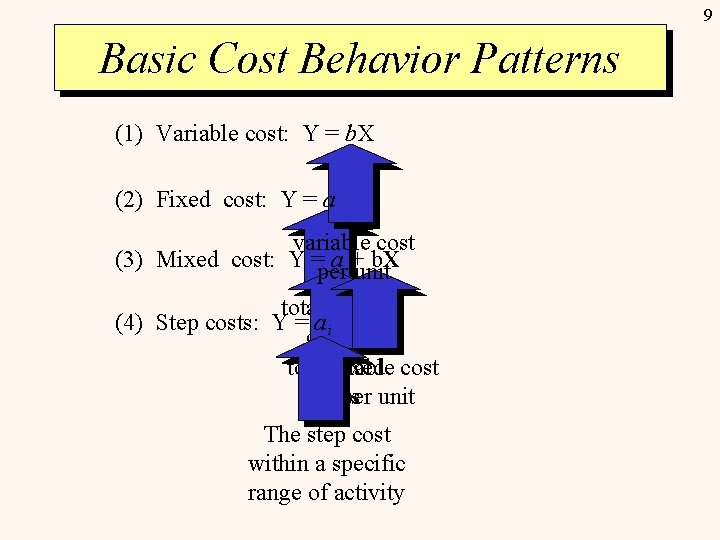
9 Basic Cost Behavior Patterns (1) Variable cost: Y = b. X (2) Fixed cost: Y = a variable cost (3) Mixed cost: Y = a + b. X per unit total fixed (4) Step costs: Y = a i costs total variable fixed costs per unit The step cost within a specific range of activity
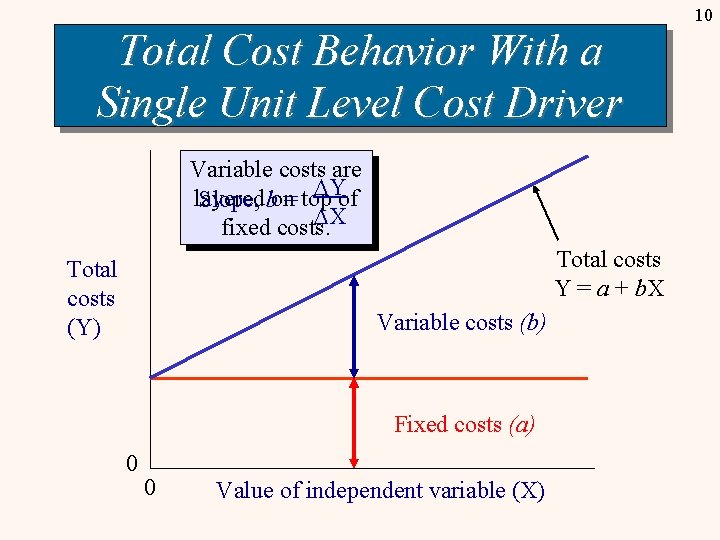
10 Total Cost Behavior With a Single Unit Level Cost Driver Variable costs are Y layered Slope, bon= top of X fixed costs. Total costs Y = a + b. X Total costs (Y) Variable costs (b) Fixed costs (a) 0 0 Value of independent variable (X)
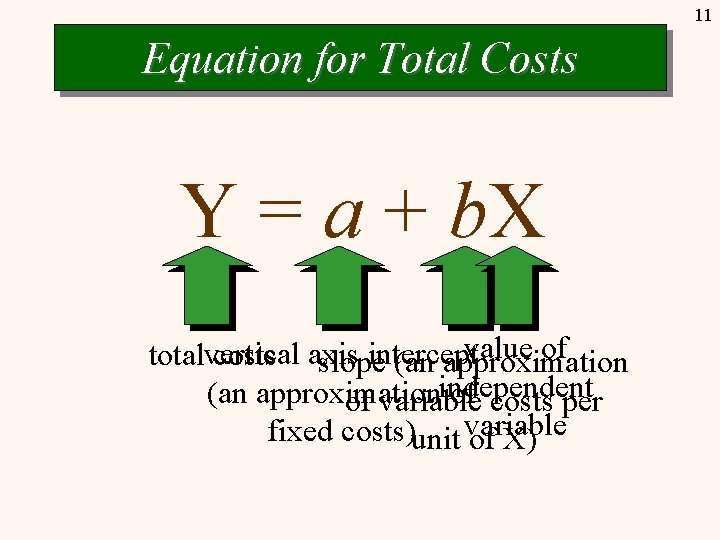
11 Equation for Total Costs Y = a + b. X value of intercept totalvertical costs axis slope (an approximation independent (an approximation of costs per of variable fixed costs)unit variable of X)
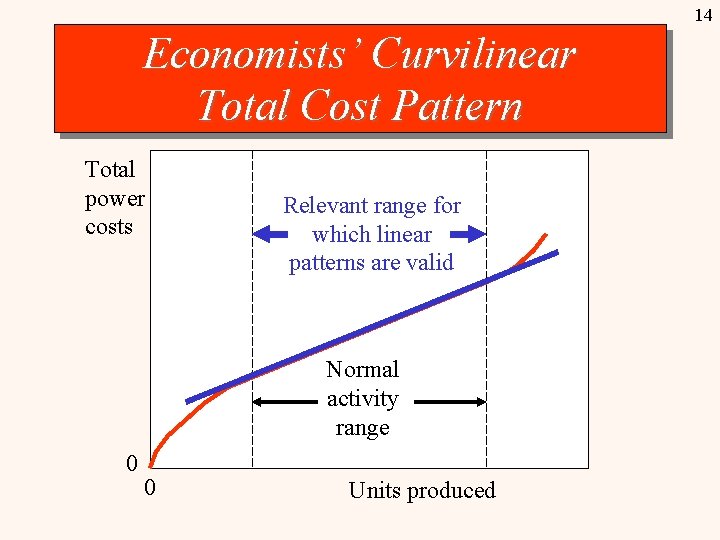
12 Marginal Cost What is marginal cost? Economists say that it’s the varying increment in total cost of making one more unit.
Marginal Cost It is useful to relate marginal cost to three levels of activity: ü Below the activity range for which the facility was designed. ü Within the normal activity range for which the facility was designed. ü Above the activity range for which the facility was designed.
14 Economists’ Curvilinear Total Cost Pattern Total power costs Relevant range for which linear patterns are valid Normal activity range 0 0 Units produced
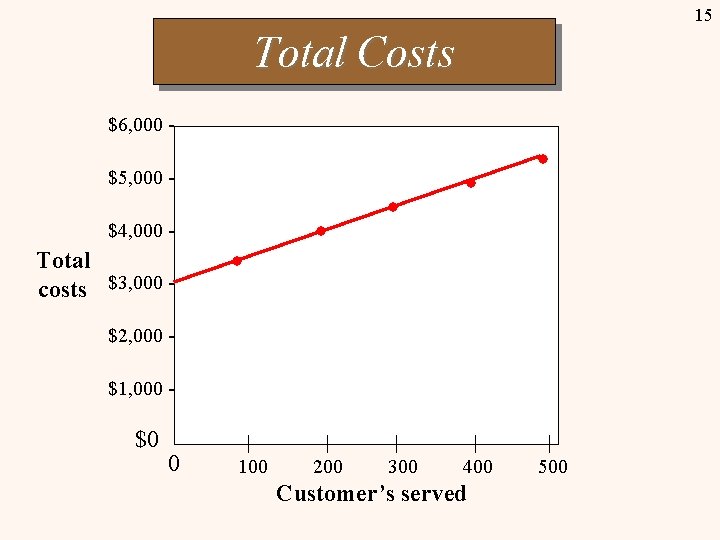
15 Total Costs $6, 000 $5, 000 $4, 000 - Total costs $3, 000 $2, 000 $1, 000 - $0 0 | 100 | 200 | 300 | 400 Customer’s served | 500
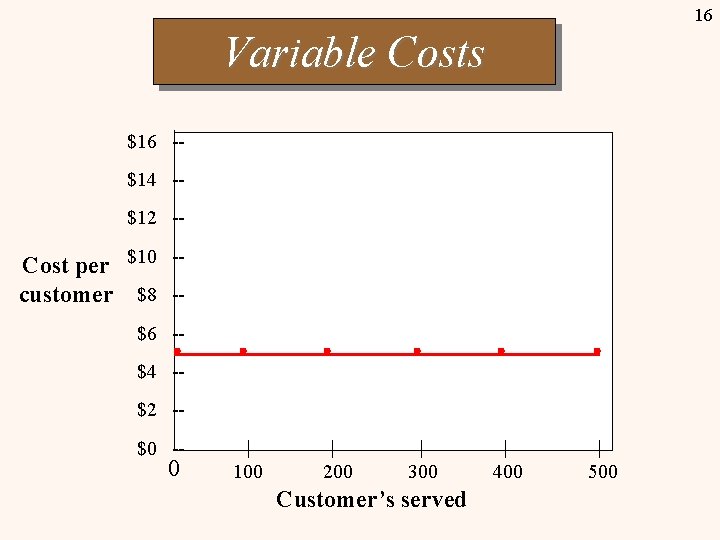
16 Variable Costs $16 -$14 -$12 -- Cost per $10 -customer $8 -$6 -$4 -$2 -$0 -- 0 | 100 | 200 | 300 Customer’s served | 400 | 500
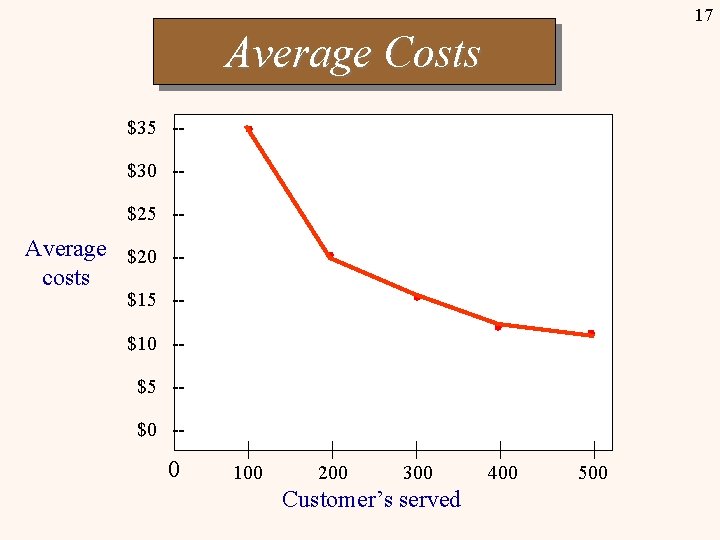
17 Average Costs $35 -$30 -$25 -- Average $20 -costs $15 -$10 -$5 -$0 -- 0 | 100 | 200 | 300 Customer’s served | 400 | 500
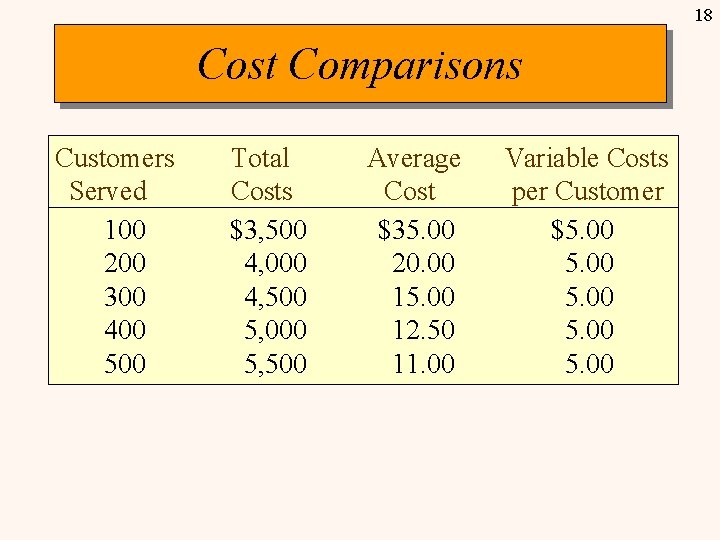
18 Cost Comparisons Customers Served 100 200 300 400 500 Total Costs $3, 500 4, 000 4, 500 5, 000 5, 500 Average Cost $35. 00 20. 00 15. 00 12. 50 11. 00 Variable Costs per Customer $5. 00
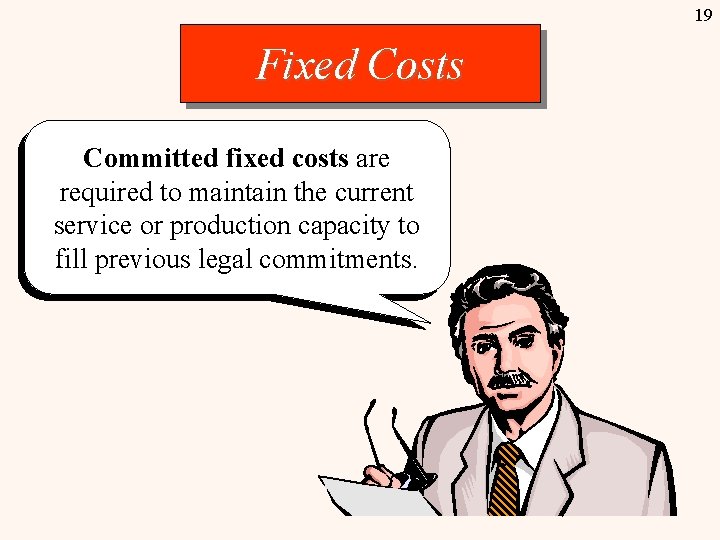
19 Fixed Costs Committed fixed costs are required to maintain the current service or production capacity to fill previous legal commitments.
20 Fixed Costs Discretionary fixed costs are set at a fixed amount each year at the discretion of management.
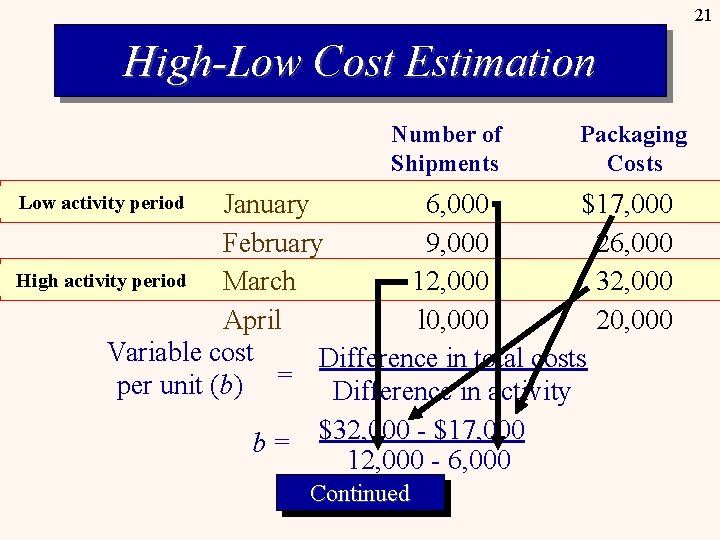
21 High-Low Cost Estimation Number of Shipments Packaging Costs January 6, 000 $17, 000 February 9, 000 26, 000 High activity period March 12, 000 32, 000 April l 0, 000 20, 000 Variable cost Difference in total costs per unit (b) = Difference in activity b = $32, 000 - $17, 000 12, 000 - 6, 000 Low activity period Continued
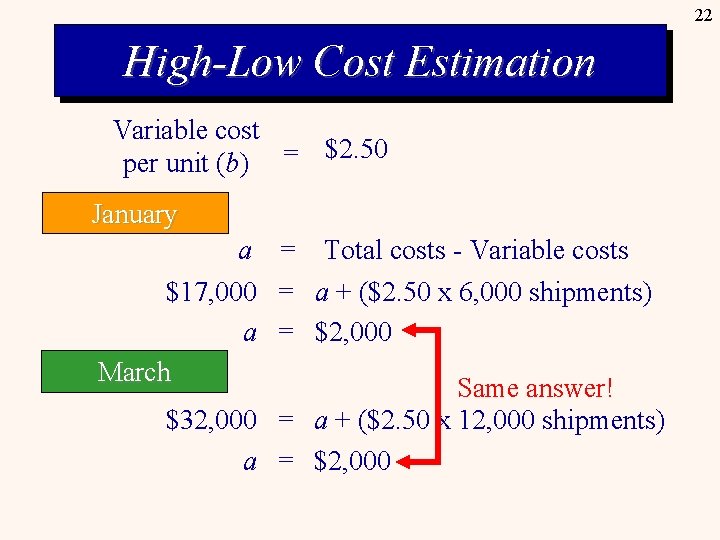
22 High-Low Cost Estimation Variable cost $2. 50 = per unit (b) January a = Total costs - Variable costs $17, 000 = a + ($2. 50 x 6, 000 shipments) a = $2, 000 March Same answer! $32, 000 = a + ($2. 50 x 12, 000 shipments) a = $2, 000
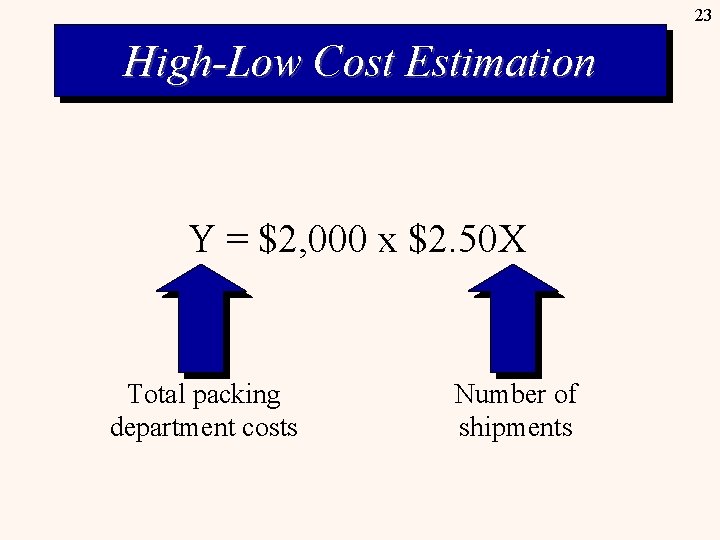
23 High-Low Cost Estimation Y = $2, 000 x $2. 50 X Total packing department costs Number of shipments
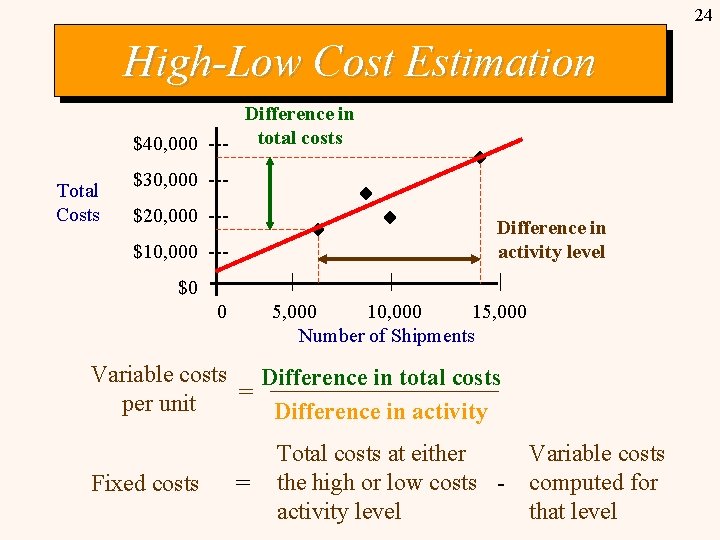
24 High-Low Cost Estimation Difference in $40, 000 --- total costs Total Costs $30, 000 --$20, 000 --$10, 000 --| $0 0 | Difference in activity level | 5, 000 10, 000 15, 000 Number of Shipments Variable costs Difference in total costs = per unit Difference in activity Fixed costs = Total costs at either the high or low costs activity level Variable costs computed for that level
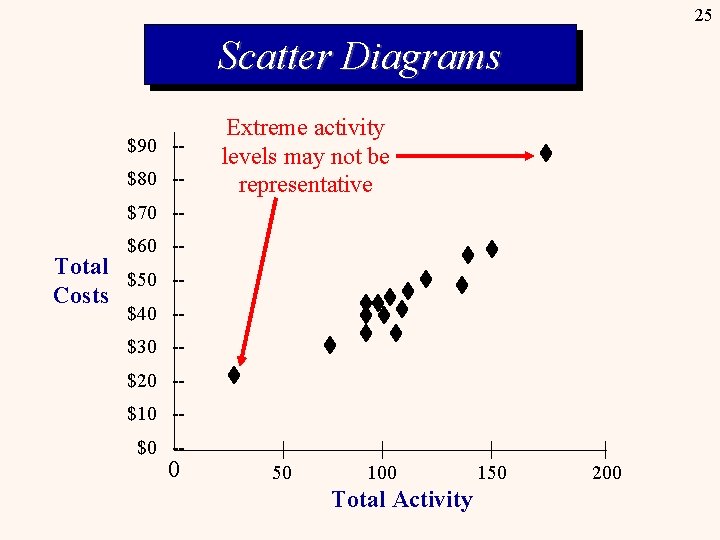
25 Scatter Diagrams $90 -$80 -- Extreme activity levels may not be representative $70 -$60 -- Total $50 -Costs $40 -$30 -$20 -$10 -$0 -- 0 | 50 | 100 Total Activity | 150 | 200
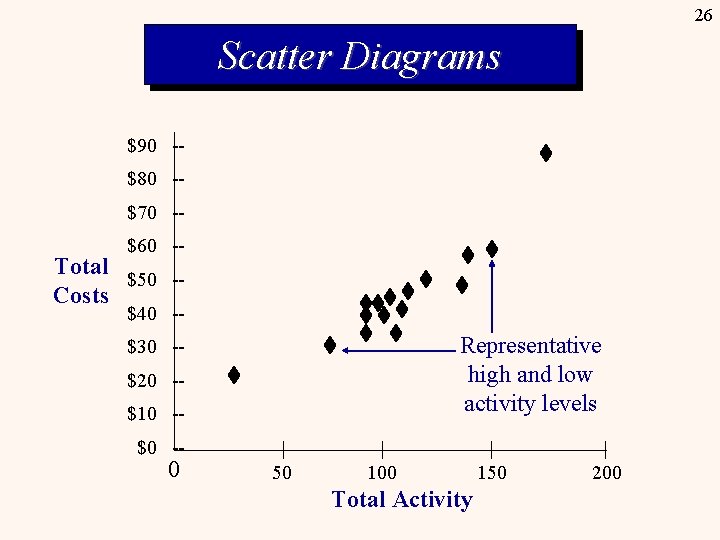
26 Scatter Diagrams $90 -$80 -$70 -$60 -- Total $50 -Costs $40 -- Representative high and low activity levels $30 -$20 -$10 -$0 -- 0 | 50 | 100 Total Activity | 150 | 200
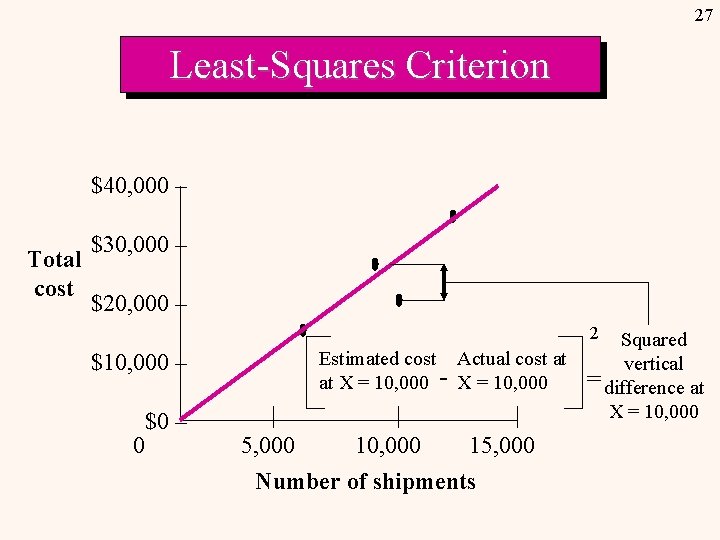
27 Least-Squares Criterion $40, 000 – Total cost $30, 000 – $20, 000 – 2 $10, 000 – 0 $0 – Estimated cost Actual cost at at X = 10, 000 - X = 10, 000 | | | 5, 000 10, 000 15, 000 Number of shipments Squared vertical = difference at X = 10, 000
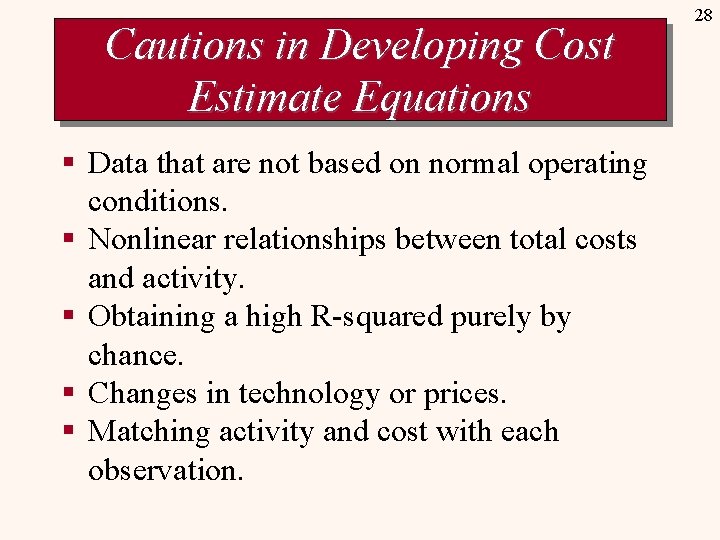
Cautions in Developing Cost Estimate Equations § Data that are not based on normal operating conditions. § Nonlinear relationships between total costs and activity. § Obtaining a high R-squared purely by chance. § Changes in technology or prices. § Matching activity and cost with each observation. 28
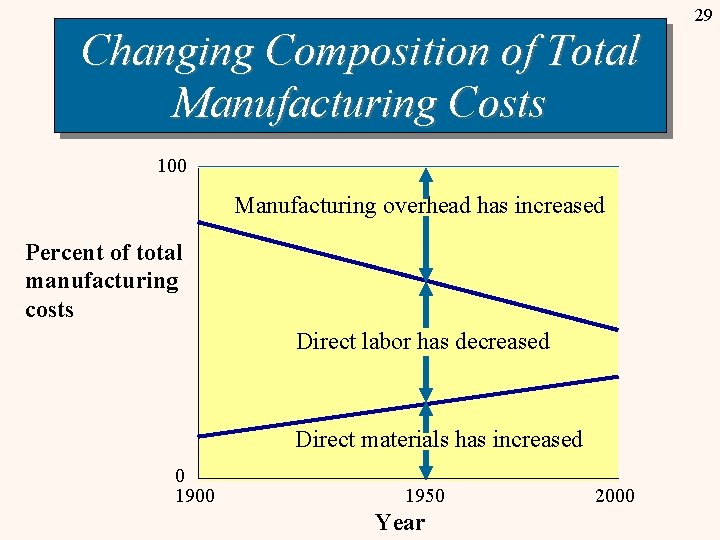
29 Changing Composition of Total Manufacturing Costs 100 Manufacturing overhead has increased Percent of total manufacturing costs Direct labor has decreased Direct materials has increased 0 1900 1950 Year 2000
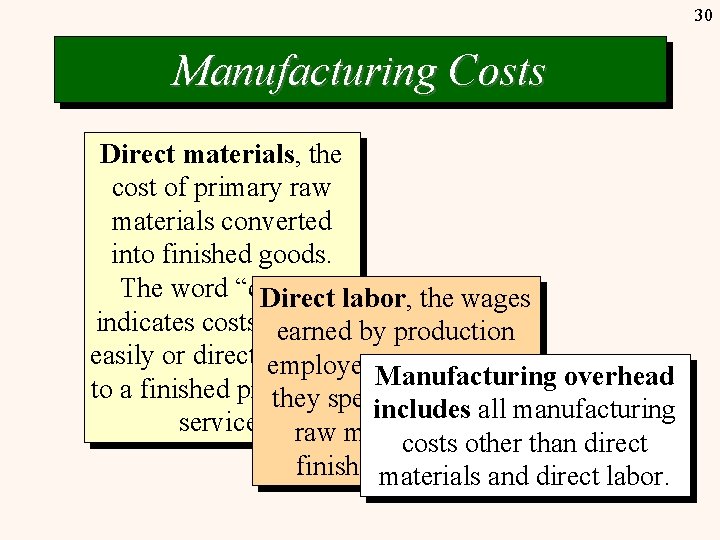
30 Manufacturing Costs Direct materials, the cost of primary raw materials converted into finished goods. The word “direct” Direct labor, the wages indicates costs that are by production earned easily or directlyemployees traced for the time Manufacturing overhead to a finished product or they spend converting includes all manufacturing service. raw materials into costs other than direct finishedmaterials products. and direct labor.
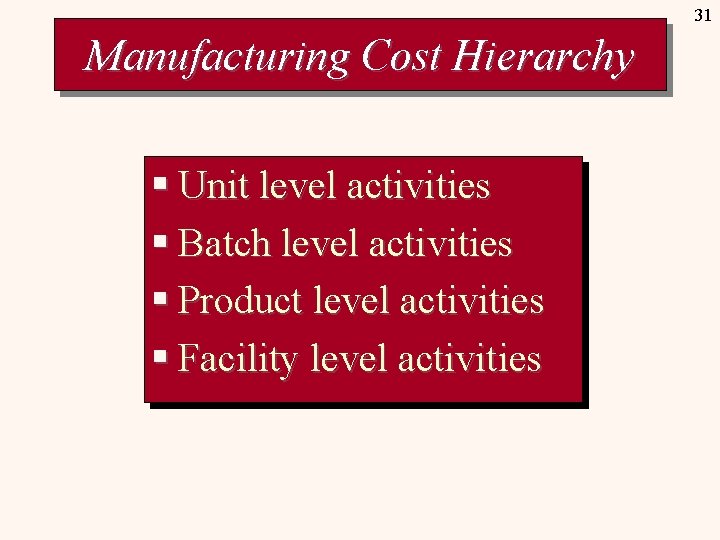
31 Manufacturing Cost Hierarchy § Unit level activities § Batch level activities § Product level activities § Facility level activities
Manufacturing Cost Hierarchy Unit Level Activity This activity is performed for each unit of product produced and sold.
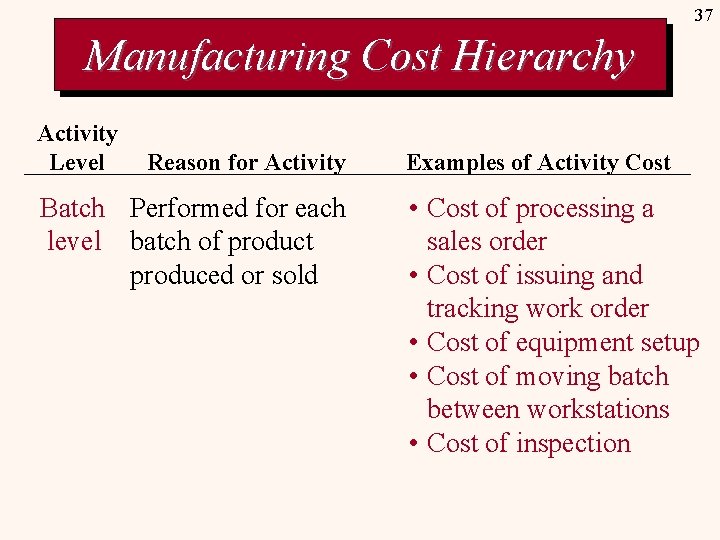
Manufacturing Cost Hierarchy Batch Level Activity This activity is performed for each batch of product produced or sold.
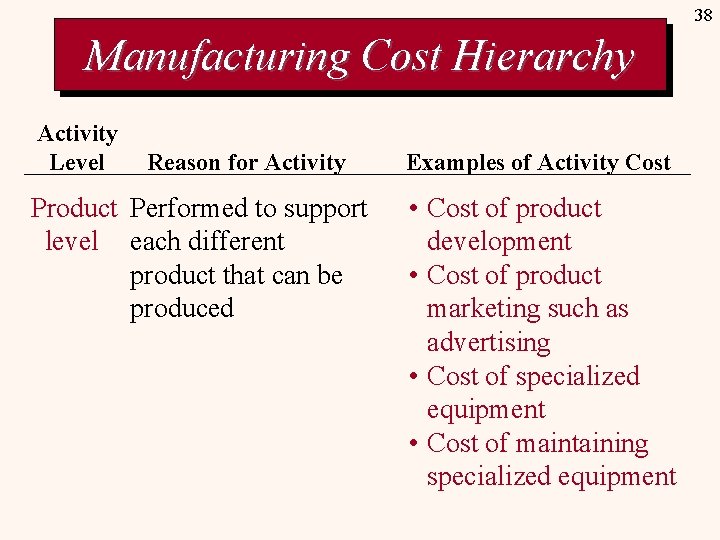
Manufacturing Cost Hierarchy Product Level Activity This activity is performed to support each different product that can be produced.
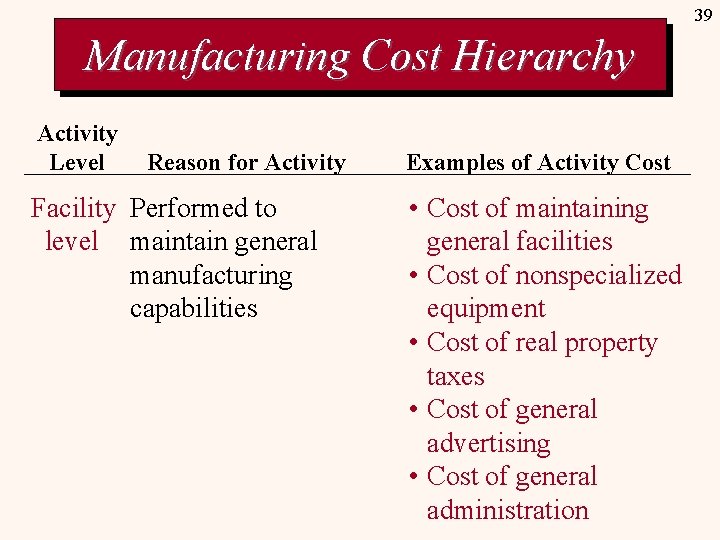
Manufacturing Cost Hierarchy Facility Level Activity This activity is performed to maintain general manufacturing capabilities.
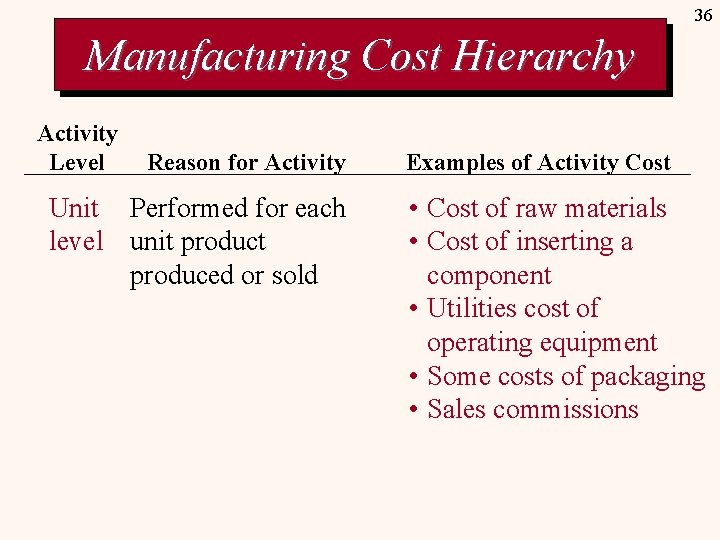
36 Manufacturing Cost Hierarchy Activity Level Reason for Activity Unit Performed for each level unit produced or sold Examples of Activity Cost • Cost of raw materials • Cost of inserting a component • Utilities cost of operating equipment • Some costs of packaging • Sales commissions
37 Manufacturing Cost Hierarchy Activity Level Reason for Activity Batch Performed for each level batch of product produced or sold Examples of Activity Cost • Cost of processing a sales order • Cost of issuing and tracking work order • Cost of equipment setup • Cost of moving batch between workstations • Cost of inspection
38 Manufacturing Cost Hierarchy Activity Level Reason for Activity Product Performed to support level each different product that can be produced Examples of Activity Cost • Cost of product development • Cost of product marketing such as advertising • Cost of specialized equipment • Cost of maintaining specialized equipment
39 Manufacturing Cost Hierarchy Activity Level Reason for Activity Facility Performed to level maintain general manufacturing capabilities Examples of Activity Cost • Cost of maintaining general facilities • Cost of nonspecialized equipment • Cost of real property taxes • Cost of general advertising • Cost of general administration
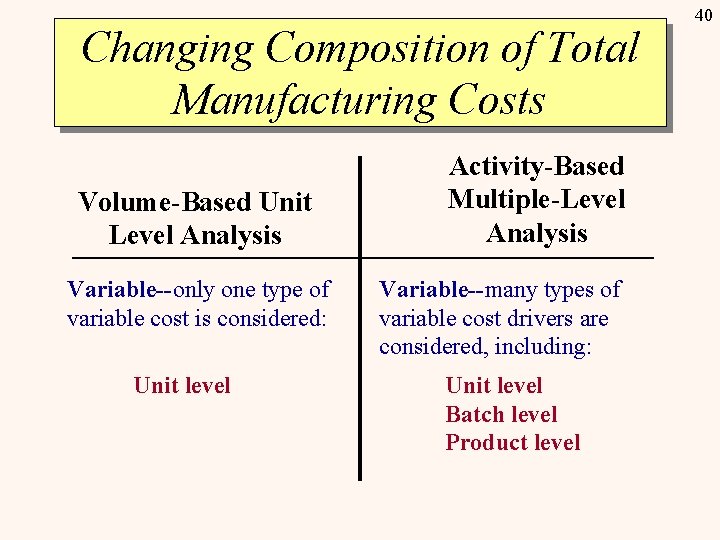
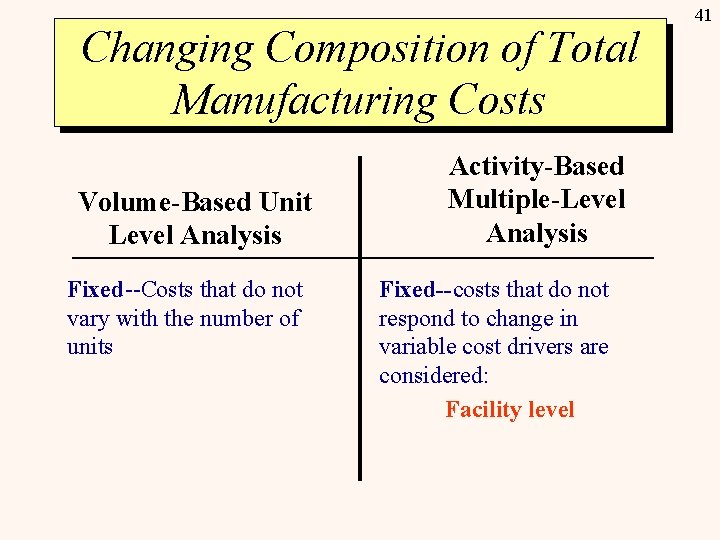
Changing Composition of Total Manufacturing Costs Volume-Based Unit Level Analysis Variable--only one type of variable cost is considered: Unit level Activity-Based Multiple-Level Analysis Variable--many types of variable cost drivers are considered, including: Unit level Batch level Product level 40
Changing Composition of Total Manufacturing Costs Volume-Based Unit Level Analysis Fixed--Costs that do not vary with the number of units Activity-Based Multiple-Level Analysis Fixed--costs that do not respond to change in variable cost drivers are considered: Facility level 41
42 Customer Cost Hierarchy A merchandising organization or the sales division of a manufacturing organization might use the following hierarchy: Unit level activities Order level activities Customer level activities Facilities level activities
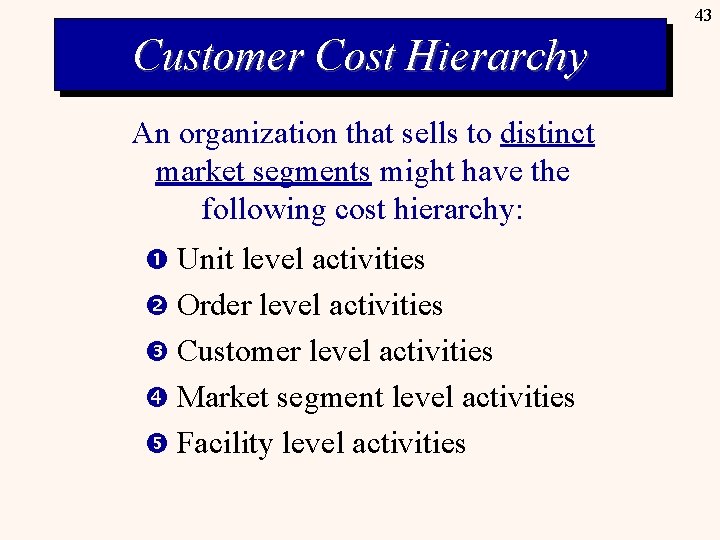
43 Customer Cost Hierarchy An organization that sells to distinct market segments might have the following cost hierarchy: Unit level activities Order level activities Customer level activities Market segment level activities Facility level activities
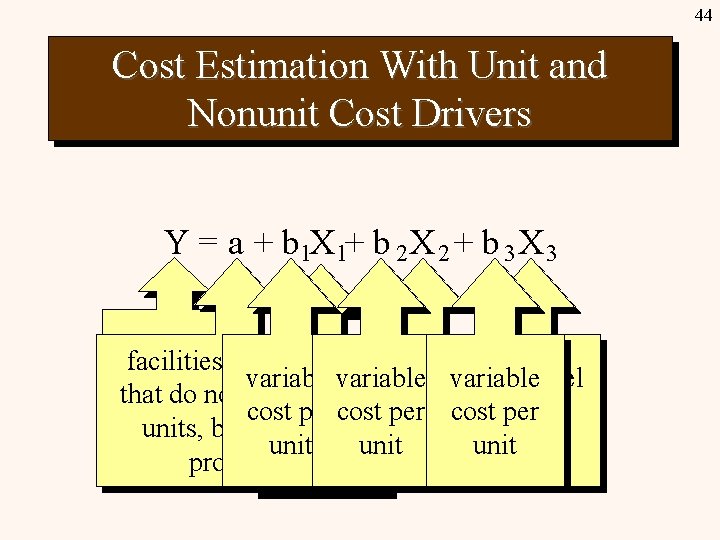
44 Cost Estimation With Unit and Nonunit Cost Drivers Y = a + b 1 X 1+ b 2 X 2 + b 3 X 3 total costs facilities level costs variable unit level for a period variable unit level that do not vary with cost per cost units, batches, or unit drivers products
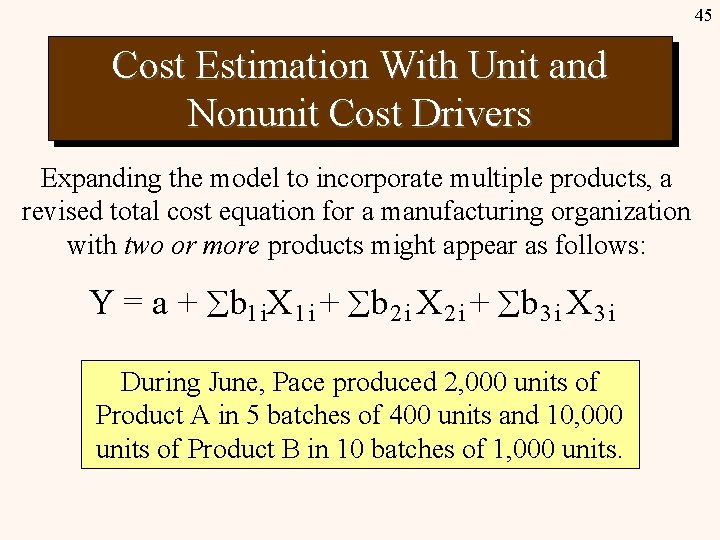
45 Cost Estimation With Unit and Nonunit Cost Drivers Expanding the model to incorporate multiple products, a revised total cost equation for a manufacturing organization with two or more products might appear as follows: Y = a + b 1 i. X 1 i + b 2 i X 2 i + b 3 i X 3 i During June, Pace produced 2, 000 units of Product A in 5 batches of 400 units and 10, 000 units of Product B in 10 batches of 1, 000 units.
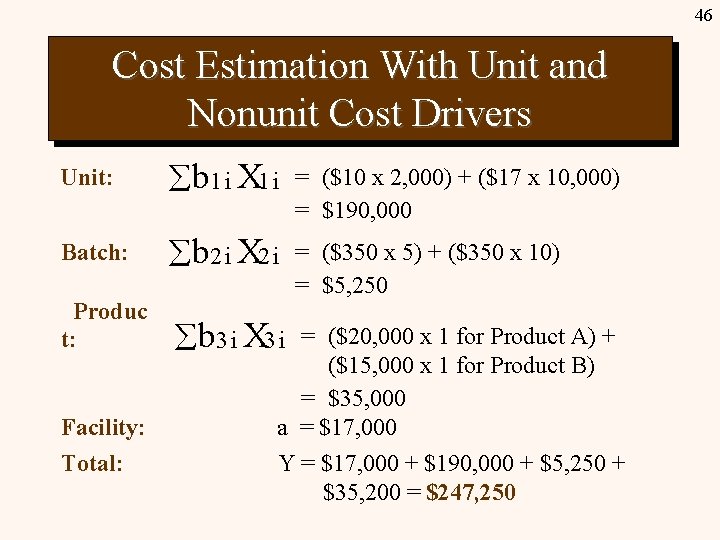
46 Cost Estimation With Unit and Nonunit Cost Drivers Unit: b 1 i X 1 i = ($10 x 2, 000) + ($17 x 10, 000) = $190, 000 Batch: b 2 i X 2 i Produc t: = ($350 x 5) + ($350 x 10) = $5, 250 b 3 i X 3 i Facility: Total: = ($20, 000 x 1 for Product A) + ($15, 000 x 1 for Product B) = $35, 000 a = $17, 000 Y = $17, 000 + $190, 000 + $5, 250 + $35, 200 = $247, 250
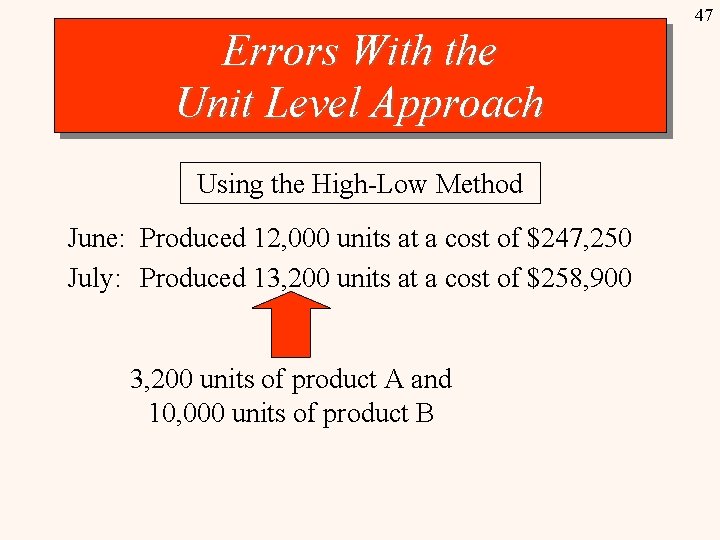
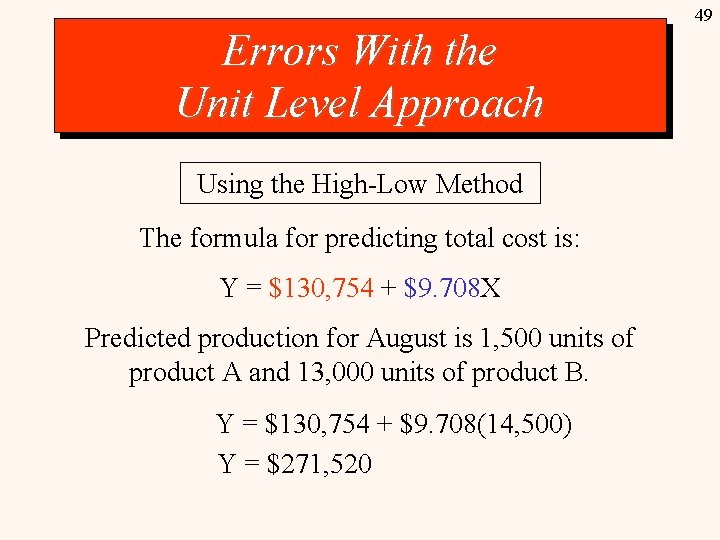
47 Errors With the Unit Level Approach Using the High-Low Method June: Produced 12, 000 units at a cost of $247, 250 July: Produced 13, 200 units at a cost of $258, 900 3, 200 units of product A and 10, 000 units of product B
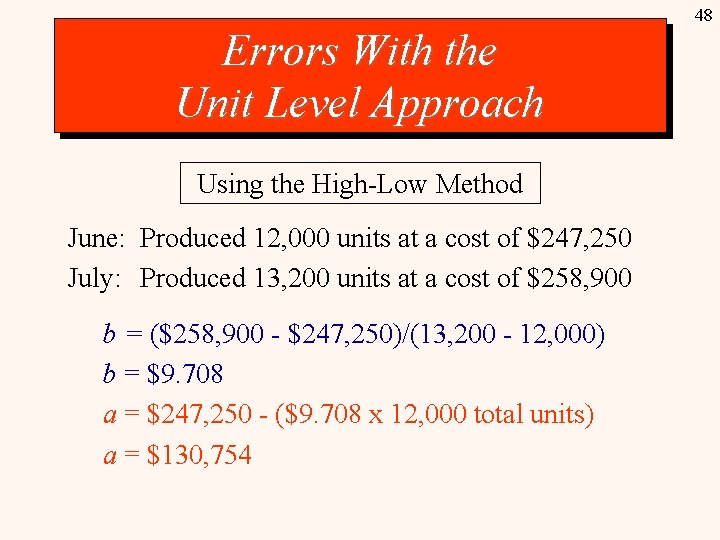
48 Errors With the Unit Level Approach Using the High-Low Method June: Produced 12, 000 units at a cost of $247, 250 July: Produced 13, 200 units at a cost of $258, 900 b = ($258, 900 - $247, 250)/(13, 200 - 12, 000) b = $9. 708 a = $247, 250 - ($9. 708 x 12, 000 total units) a = $130, 754
49 Errors With the Unit Level Approach Using the High-Low Method The formula for predicting total cost is: Y = $130, 754 + $9. 708 X Predicted production for August is 1, 500 units of product A and 13, 000 units of product B. Y = $130, 754 + $9. 708(14, 500) Y = $271, 520
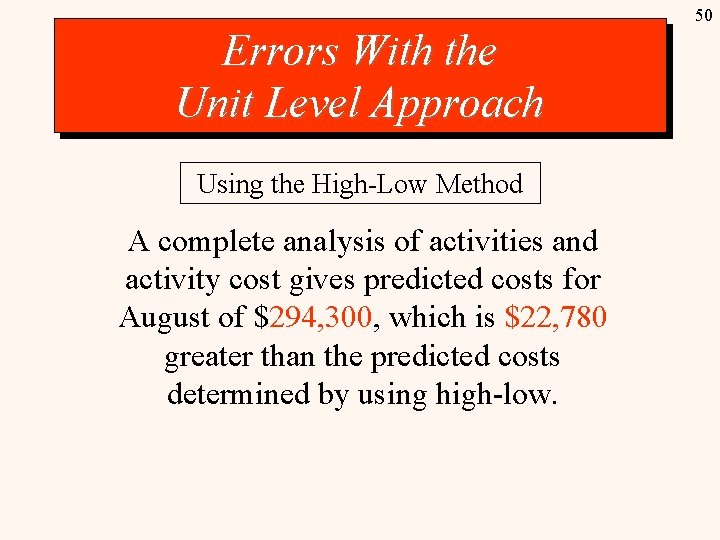
50 Errors With the Unit Level Approach Using the High-Low Method A complete analysis of activities and activity cost gives predicted costs for August of $294, 300, which is $22, 780 greater than the predicted costs determined by using high-low.
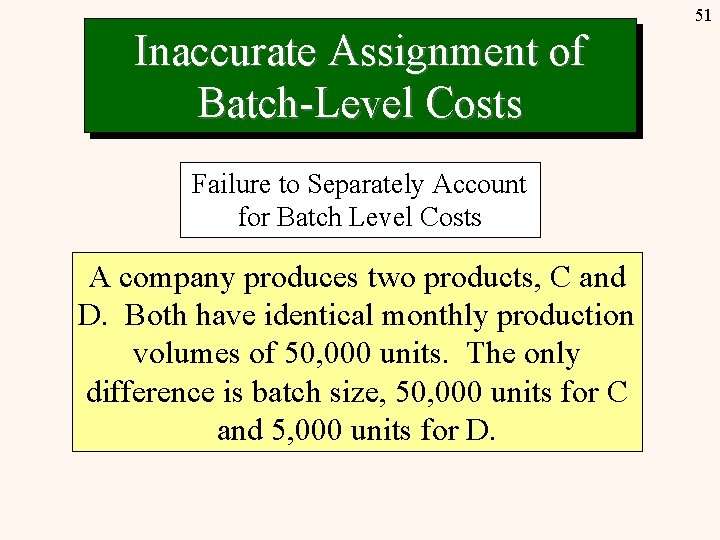
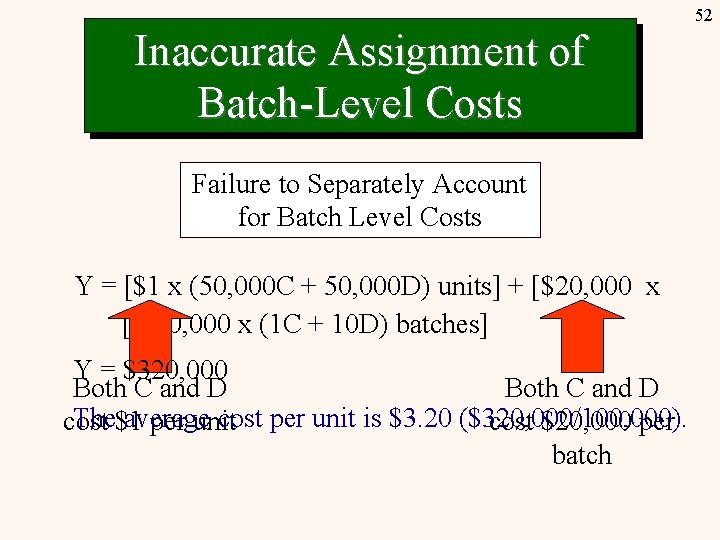
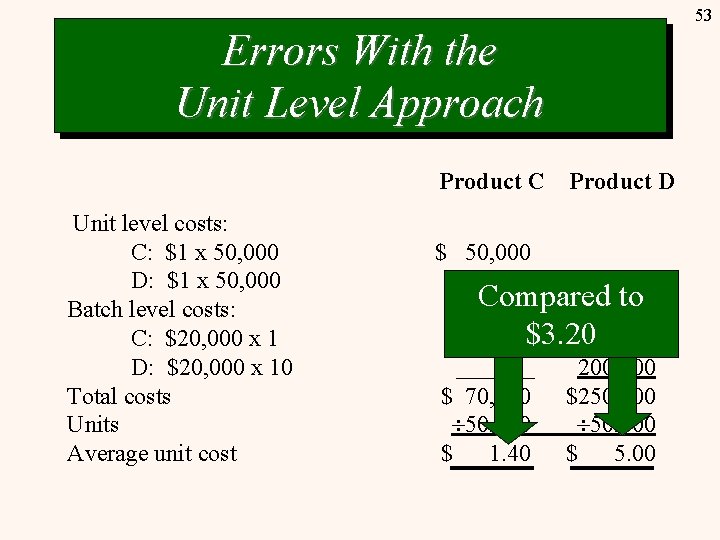
51 Inaccurate Assignment of Batch-Level Costs Failure to Separately Account for Batch Level Costs A company produces two products, C and D. Both have identical monthly production volumes of 50, 000 units. The only difference is batch size, 50, 000 units for C and 5, 000 units for D.
52 Inaccurate Assignment of Batch-Level Costs Failure to Separately Account for Batch Level Costs Y = [$1 x (50, 000 C + 50, 000 D) units] + [$20, 000 x [($20, 000 x (1 C + 10 D) batches] Y = $320, 000 Both C and D The$1 average cost per unit is $3. 20 ($320, 000/100, 000). cost per unit cost $20, 000 per batch
53 Errors With the Unit Level Approach Product C Unit level costs: C: $1 x 50, 000 D: $1 x 50, 000 Batch level costs: C: $20, 000 x 1 D: $20, 000 x 10 Total costs Units Average unit cost Product D $ 50, 000 Compared to 20, 000$3. 20 $ 70, 000 50, 000 $ 1. 40 200, 000 $250, 000 $ 5. 00
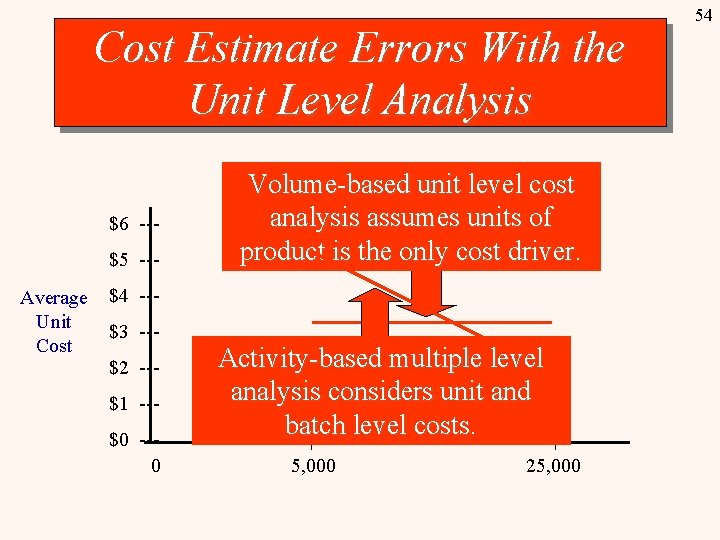
Cost Estimate Errors With the Unit Level Analysis $6 --$5 --Average Unit Cost Volume-based unit level cost analysis assumes units of product is the only cost driver. $4 --$3 --$2 --$1 --$0 --0 Activity-based multiple level analysis considers unit and batch level costs. | 5, 000 | 25, 000 54
55 Chapter 2 The End
56