
Chapter 2 A Scientific Approach to Psychology Objectives
Chapter 2 A Scientific Approach to Psychology
Objectives (slide 1 of 2) 2. 1 Psychological Investigation • Define psychological science. • Describe the steps in the scientific method in psychology. • Discuss the importance of the scientific method. • Illustrate design choices in research. 2. 2 Descriptive Research • Explain the goals of descriptive research. • Discuss the components of a naturalistic observation study. • Compare and contrast case studies, surveys, and correlational studies in terms of descriptive research.
Objectives (slide 2 of 2) 2. 3 Experimental Research • Describe the components of a psychological experimental study. 2. 4 Statistical Analysis • Illustrate the central tendency of and the variation among a set of scores in describing data. • Describe what it means when a study shows an effect that is statistically significant. 2. 5 Ethics in Psychological Research • Examine the rights of participants in research identified in the Belmont study. • Contrast the ethical guidelines for human research studies and animal research studies.
Psychological Science • Studies human behavior in order to learn what “makes people tick. ” Data collection about human behavior uses the same scientific method found in other sciences – Theory: An overarching conceptualization or model about how various factors may influence behavior – Hypothesis: A clear statement or prediction that can be shown to be true or false in an experiment
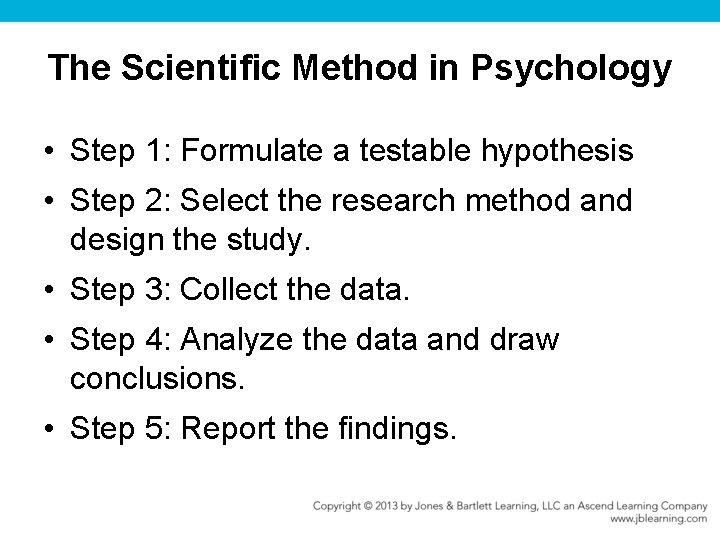
The Scientific Method in Psychology • Step 1: Formulate a testable hypothesis • Step 2: Select the research method and design the study. • Step 3: Collect the data. • Step 4: Analyze the data and draw conclusions. • Step 5: Report the findings.
Comparison Groups • Between-subjects design: - A research plan in which different individuals take part in differing aspects of the study or in which different groups are compared • Within-subjects design: A research plan in which each subject takes part in every part of the study
Why is the Scientific Method Important? In psychology the scientific method is used to determine: • Reactivity • Replicability • Reliability • Validity • Generalizability
Descriptive Research • Descriptive studies are concerned with the relationships between and among behaviors, experiences, and individual attributes (called variables). – Comparative study: A research project that compares similarities and differences between human and animal behavior
Naturalistic Observation • Naturalistic observation involves observing human behavior as it occurs in a real-world setting. • The researcher makes no attempt to interact with or change the behavior of those observed. • Important because study results conducted under controlled conditions often differ from those of a study that takes place “in the wild”
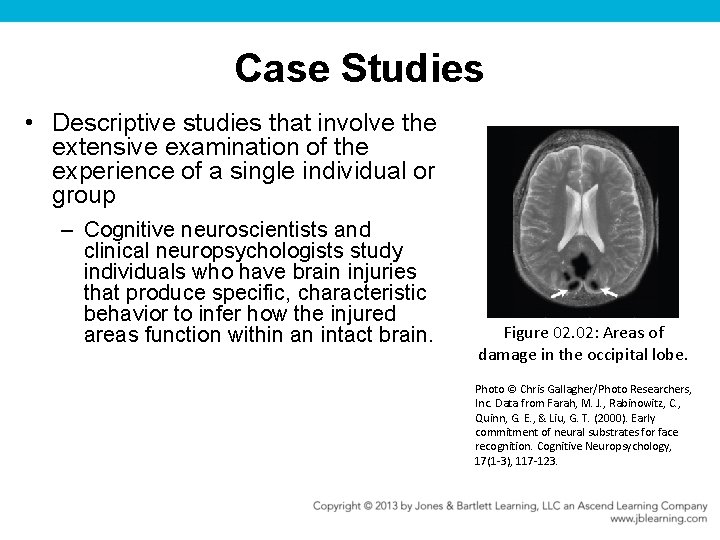
Case Studies • Descriptive studies that involve the extensive examination of the experience of a single individual or group – Cognitive neuroscientists and clinical neuropsychologists study individuals who have brain injuries that produce specific, characteristic behavior to infer how the injured areas function within an intact brain. Figure 02. 02: Areas of damage in the occipital lobe. Photo © Chris Gallagher/Photo Researchers, Inc. Data from Farah, M. J. , Rabinowitz, C. , Quinn, G. E. , & Liu, G. T. (2000). Early commitment of neural substrates for face recognition. Cognitive Neuropsychology, 17(1 -3), 117 -123.
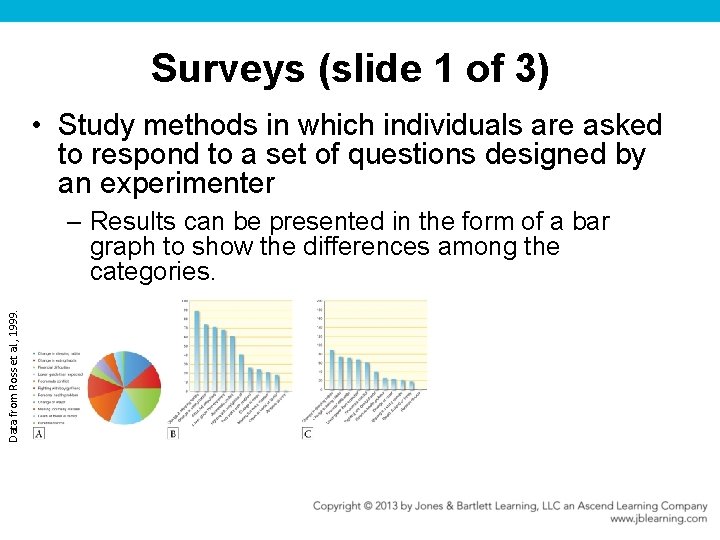
Surveys (slide 1 of 3) • Study methods in which individuals are asked to respond to a set of questions designed by an experimenter Data from Ross et al. , 1999. – Results can be presented in the form of a bar graph to show the differences among the categories.
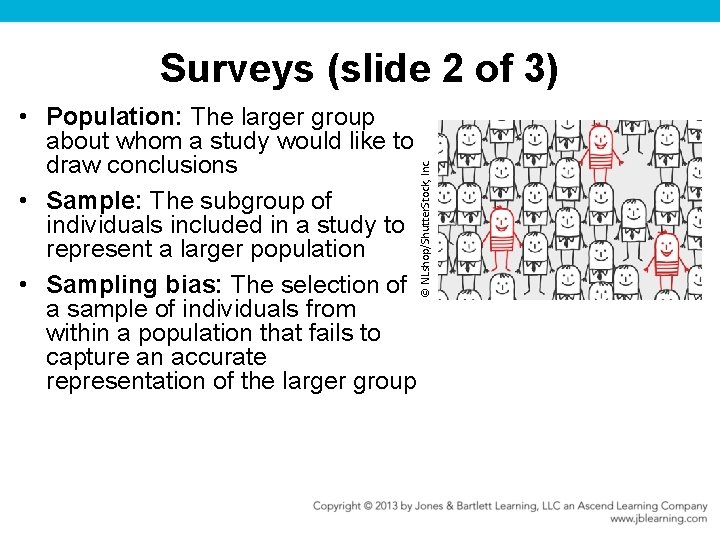
• Population: The larger group about whom a study would like to draw conclusions • Sample: The subgroup of individuals included in a study to represent a larger population • Sampling bias: The selection of a sample of individuals from within a population that fails to capture an accurate representation of the larger group © NLshop/Shutter. Stock, Inc. Surveys (slide 2 of 3)
Surveys (slide 3 of 3) • Convenience sample: A group of participants who are readily available for a study • Random sampling: Selecting which members of a population will participate in a study through a systematic method that gives every person an equal chance of selection
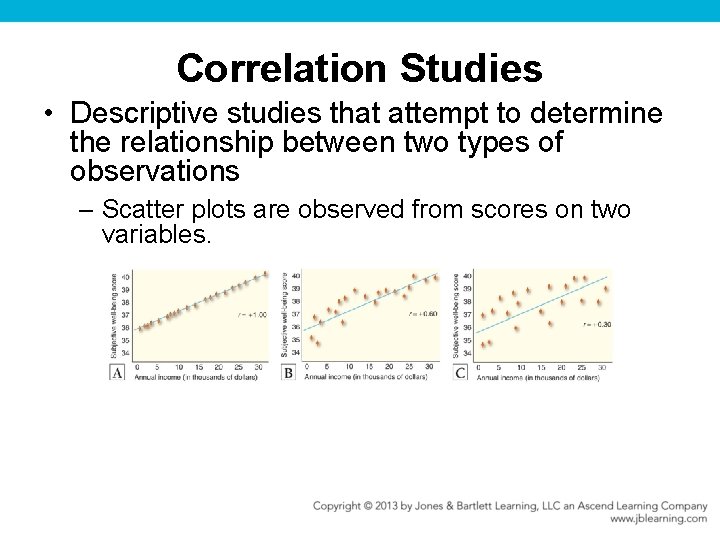
Correlation Studies • Descriptive studies that attempt to determine the relationship between two types of observations – Scatter plots are observed from scores on two variables.
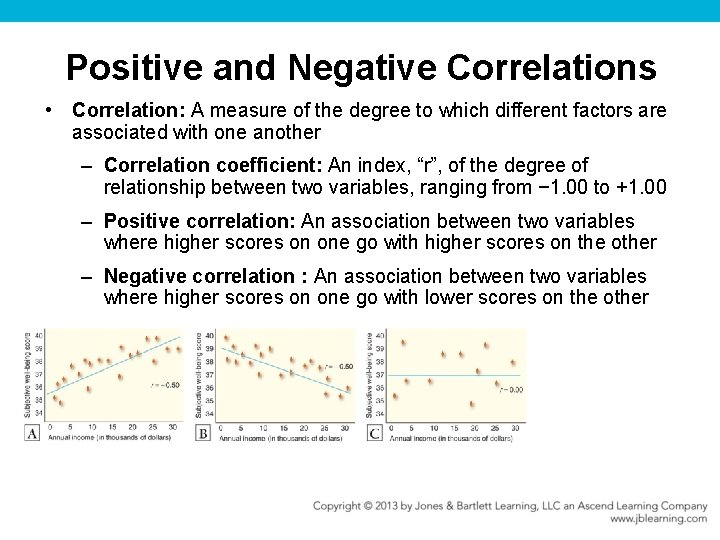
Positive and Negative Correlations • Correlation: A measure of the degree to which different factors are associated with one another – Correlation coefficient: An index, “r”, of the degree of relationship between two variables, ranging from − 1. 00 to +1. 00 – Positive correlation: An association between two variables where higher scores on one go with higher scores on the other – Negative correlation : An association between two variables where higher scores on one go with lower scores on the other
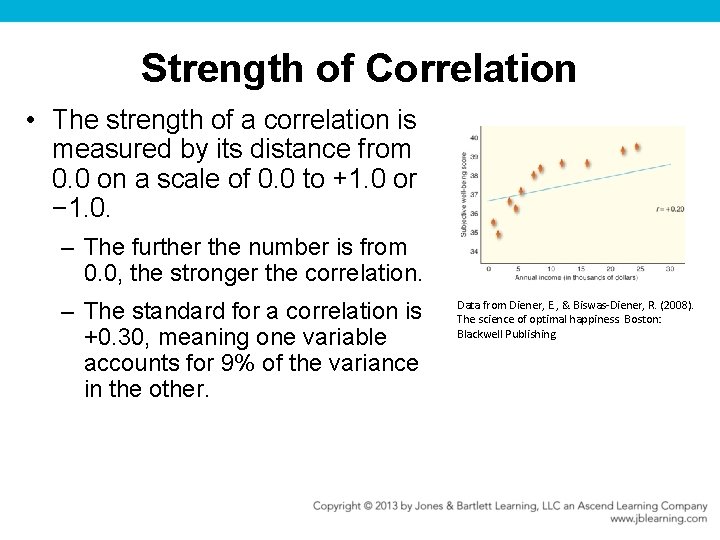
Strength of Correlation • The strength of a correlation is measured by its distance from 0. 0 on a scale of 0. 0 to +1. 0 or − 1. 0. – The further the number is from 0. 0, the stronger the correlation. – The standard for a correlation is +0. 30, meaning one variable accounts for 9% of the variance in the other. Data from Diener, E. , & Biswas-Diener, R. (2008). The science of optimal happiness. Boston: Blackwell Publishing.
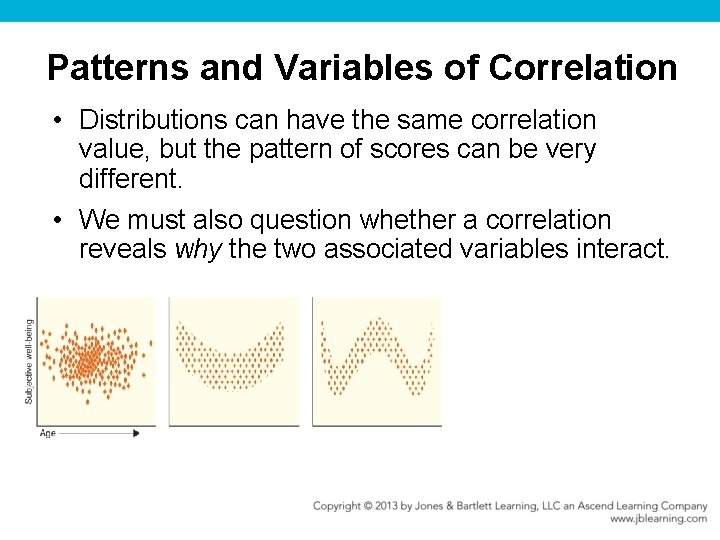
Patterns and Variables of Correlation • Distributions can have the same correlation value, but the pattern of scores can be very different. • We must also question whether a correlation reveals why the two associated variables interact.
Experimental Research • Experiment: A method by which one or more independent factors is manipulated by an experimenter, and the result is measured through one or more dependent variables – Independent variable: The factor that an experimenter manipulates to create different experiences for participants – Dependent variable: The measurement collected to determine if there was any effect of the independent variable in an experiment
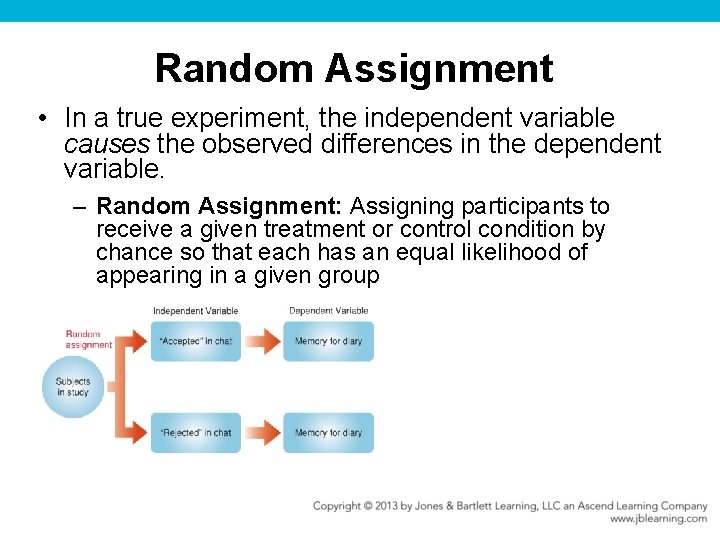
Random Assignment • In a true experiment, the independent variable causes the observed differences in the dependent variable. – Random Assignment: Assigning participants to receive a given treatment or control condition by chance so that each has an equal likelihood of appearing in a given group
Experimental and Control Groups • Experimental group: The group that receives some treatment or experience • Control group: The group that receives no extra treatment or experience
Variables • Interaction between variables occurs when the effect of one independent variable on the dependent variable depends upon the level of another independent variable.
Confounding Variables • Alternative factors that might account for observed differences in the dependent measure. Can occur due to: – Experimenter bias: The introduction of inaccuracy of measurements due to the researcher’s expectations – Social desirability bias: Participants may alter their responses to be perceived as depicting themselves positively. – Placebo effect: A participant’s belief that he or she is receiving a treatment can produce changes in behavior.
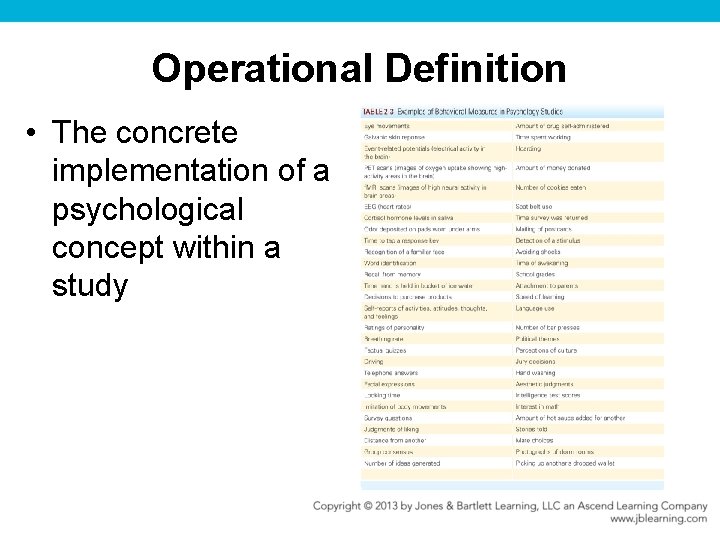
Operational Definition • The concrete implementation of a psychological concept within a study
Types of Experimental Studies • Longitudinal studies follow a person through development by studying him or her at different points in time. • Cross-sectional studies compare people at different ages with different people in the age groups. – Cohort effects are the differences observed between age groups that may be due to differences in their experiences in addition to age.
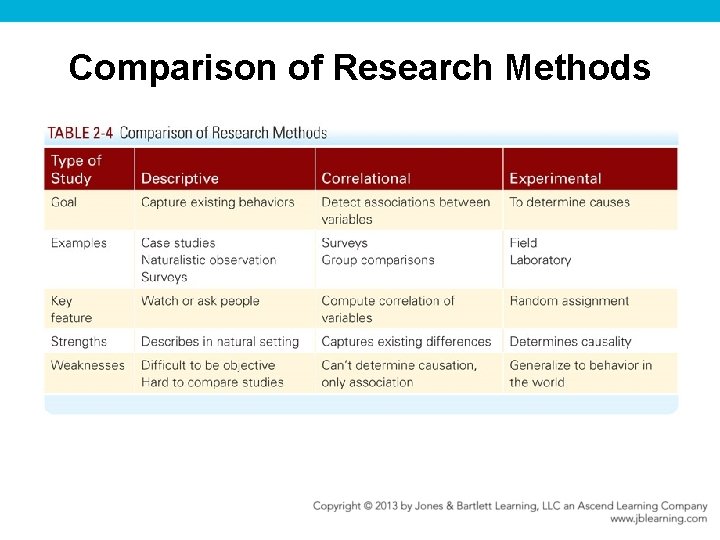
Comparison of Research Methods
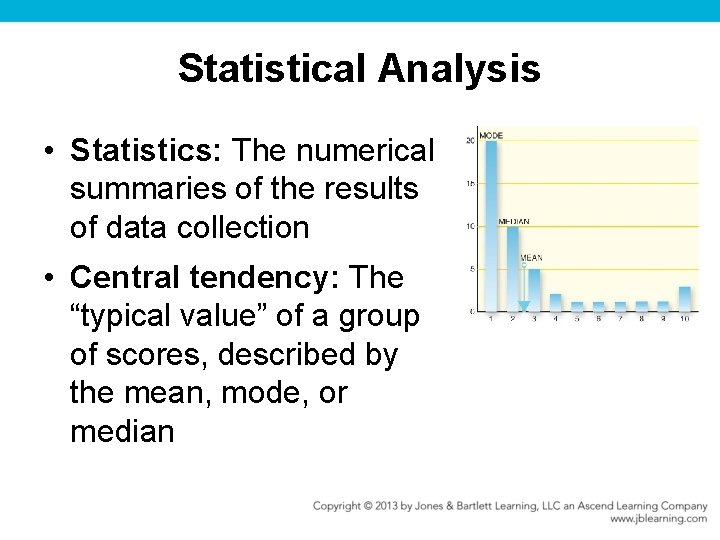
Statistical Analysis • Statistics: The numerical summaries of the results of data collection • Central tendency: The “typical value” of a group of scores, described by the mean, mode, or median
Measures of Central Tendency and Variance • Mode: The most frequently observed score in a data sample • Median: The score at the middle of a distribution of scores from a sample • Mean: The arithmetic average, or the sum of all scores in a sample divided by the number of scores
Variance • Variance: The variability between scores observed on a given dependent variable - Range: A measure of variation in a data sample determined by subtracting the lowest score from the highest score
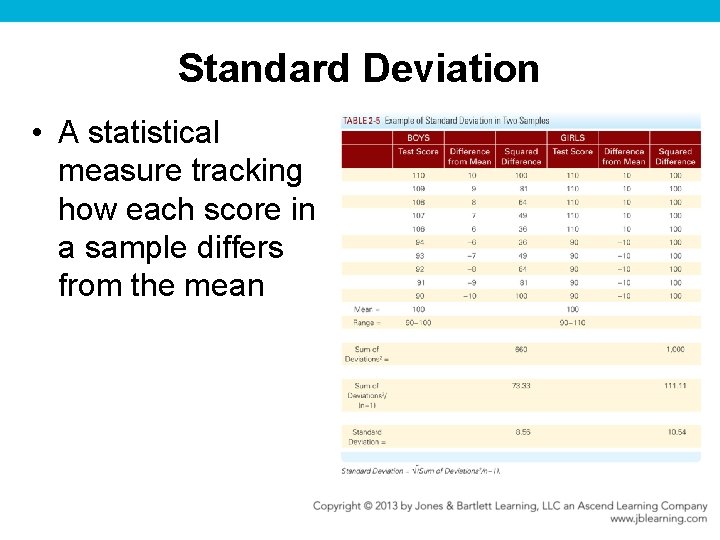
Standard Deviation • A statistical measure tracking how each score in a sample differs from the mean
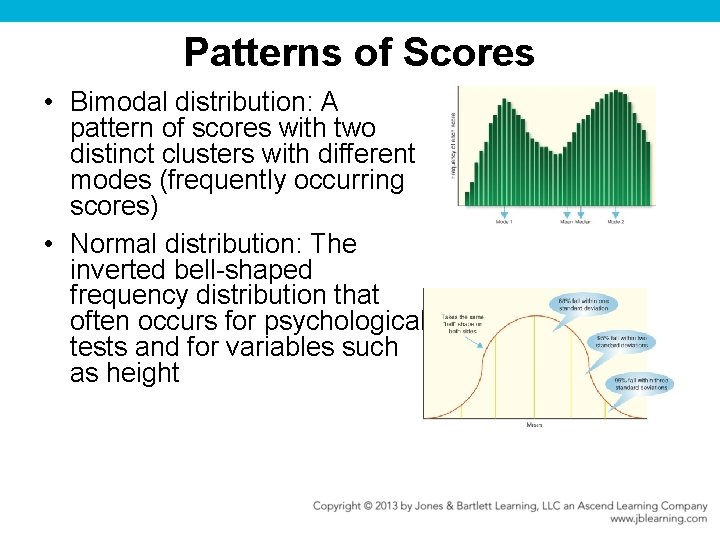
Patterns of Scores • Bimodal distribution: A pattern of scores with two distinct clusters with different modes (frequently occurring scores) • Normal distribution: The inverted bell-shaped frequency distribution that often occurs for psychological tests and for variables such as height
Making Inferences with Statistics • Inferential statistics guide us in making conclusions from data, and help us decide whether any differences observed are meaningful or due to random variation. Based on: – size of the difference between the two groups – variability within each of the groups – how many observations were collected • When the probability (p) of an observed difference occurring is determined to be less than 5% (p <0. 05), it is considered to be statistically significant.
Ethics in Psychological Research • In 1974, the National Research Act was signed into law, creating the National Commission for the Protection of Human Subjects of Biomedical and Behavioral Research. This Common Rule: – Requires federally funded investigators to obtain and document the informed consent of research subjects – Describes requirements for institutional review boards at universities and hospitals to review research before it is conducted – Addresses additional requirements when conducting research with vulnerable populations such as pregnant women, children, and prisoners
Human Research The Belmont Report (Department of Health and Human Services, 1979) identifies the rights of participants in research, including: 1. Respect for persons 2. Beneficence 3. Justice
Informed Consent Process • Participants are given information about: – the nature of the tasks they will be asked to complete – disclosure of any risks and benefits – rights to privacy and confidentiality – the length of participation requested – any compensation provided for participation – the right to withdraw from participating at any time. • Participants can ask questions of the researcher.
Deception • In studies where the experimenter uses deception, the Belmont regulations require a full debriefing following the study. This debriefing: – walks the participants through the study – ensures they understand that they were assigned to the treatment they received at random – ensures that they know the manipulation had nothing to do with them personally – answers any questions before they leave the study
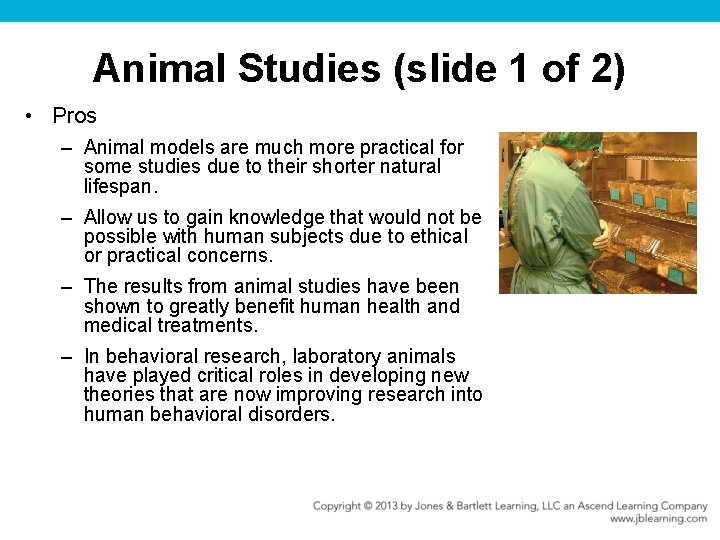
Animal Studies (slide 1 of 2) • Pros – Animal models are much more practical for some studies due to their shorter natural lifespan. – Allow us to gain knowledge that would not be possible with human subjects due to ethical or practical concerns. – The results from animal studies have been shown to greatly benefit human health and medical treatments. – In behavioral research, laboratory animals have played critical roles in developing new theories that are now improving research into human behavioral disorders.
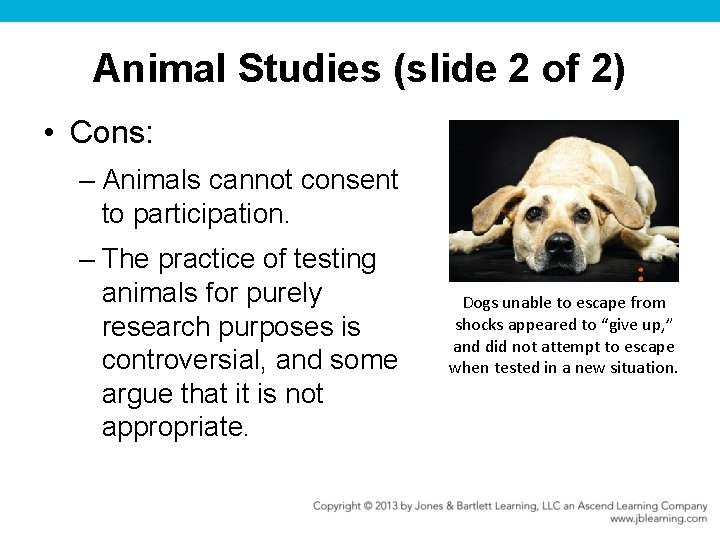
Animal Studies (slide 2 of 2) • Cons: – Animals cannot consent to participation. – The practice of testing animals for purely research purposes is controversial, and some argue that it is not appropriate. Dogs unable to escape from shocks appeared to “give up, ” and did not attempt to escape when tested in a new situation.
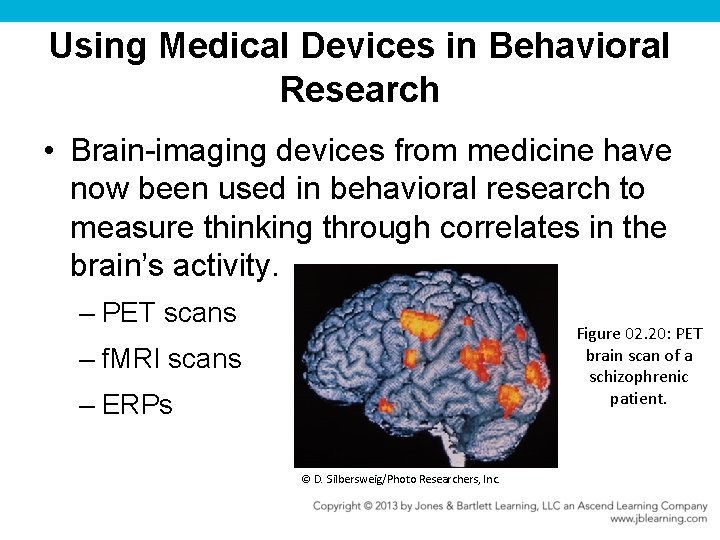
Using Medical Devices in Behavioral Research • Brain-imaging devices from medicine have now been used in behavioral research to measure thinking through correlates in the brain’s activity. – PET scans Figure 02. 20: PET brain scan of a schizophrenic patient. – f. MRI scans – ERPs © D. Silbersweig/Photo Researchers, Inc.
Universal Truths • There is a special area of the human brain devoted to learning and recognizing human faces. • People have a deep need to belong to a social group or relationship. • The basic human emotions are displayed in characteristic facial expressions.
Differences • • • Gender Age Ethnicity Nationality Education Socioeconomic status Environment Personality Culture
- Slides: 40