
Chapter 2 6 Modula 2 Structured Types Types
![RECORD example TYPE Date = RECORD Day : [1. . 31]; Month : [1.](https://slidetodoc.com/presentation_image_h2/959c9334e861542614972e151524de1e/image-13.jpg "RECORD example TYPE Date = RECORD Day : [1. . 31]; Month : [1.")
![Nested RECORDs example (1) TYPE Date VAR = RECORD Day : [1. . 31];](https://slidetodoc.com/presentation_image_h2/959c9334e861542614972e151524de1e/image-16.jpg "Nested RECORDs example (1) TYPE Date VAR = RECORD Day : [1. . 31];")
- Slides: 22
Chapter 2. 6 Modula 2 Structured Types
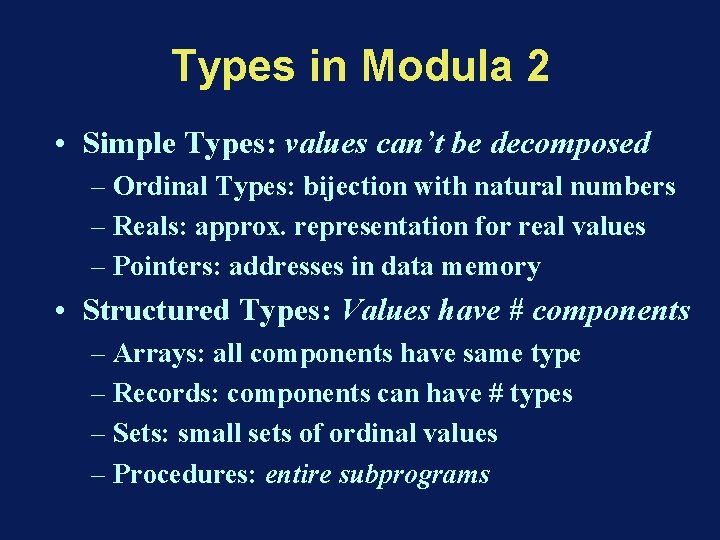
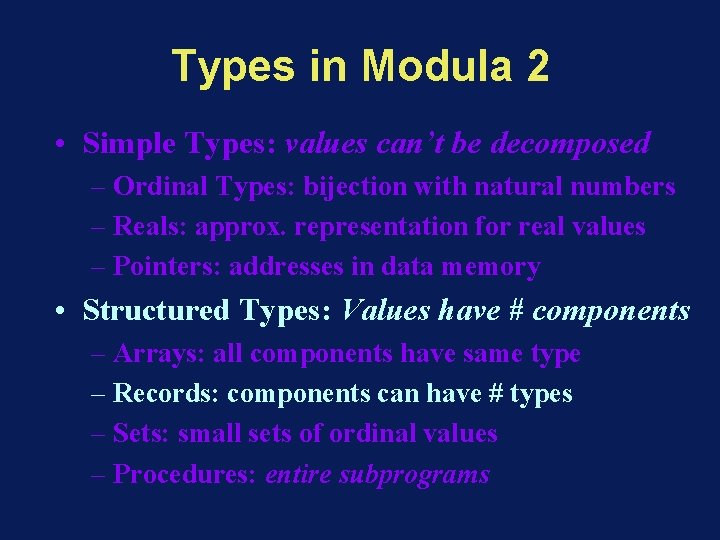
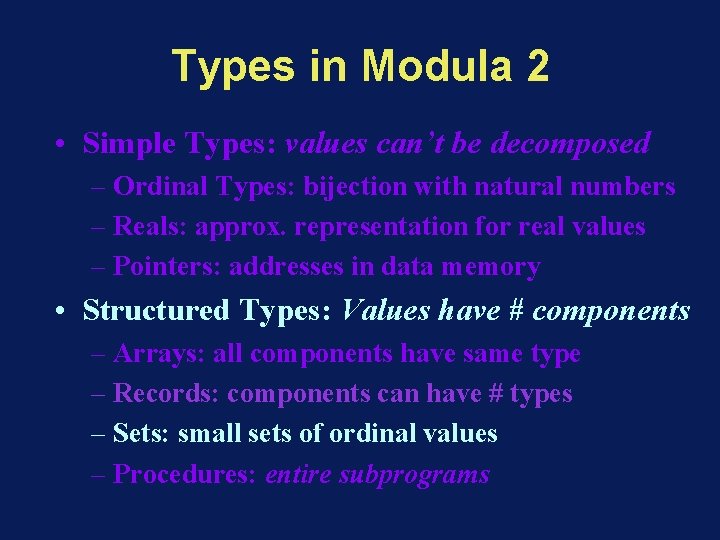
Types in Modula 2 • Simple Types: values can’t be decomposed – Ordinal Types: bijection with natural numbers – Reals: approx. representation for real values – Pointers: addresses in data memory • Structured Types: Values have # components – Arrays: all components have same type – Records: components can have # types – Sets: small sets of ordinal values – Procedures: entire subprograms
Types in Modula 2 • Simple Types: values can’t be decomposed – Ordinal Types: bijection with natural numbers – Reals: approx. representation for real values – Pointers: addresses in data memory • Structured Types: Values have # components – Arrays: all components have same type – Records: components can have # types – Sets: small sets of ordinal values – Procedures: entire subprograms
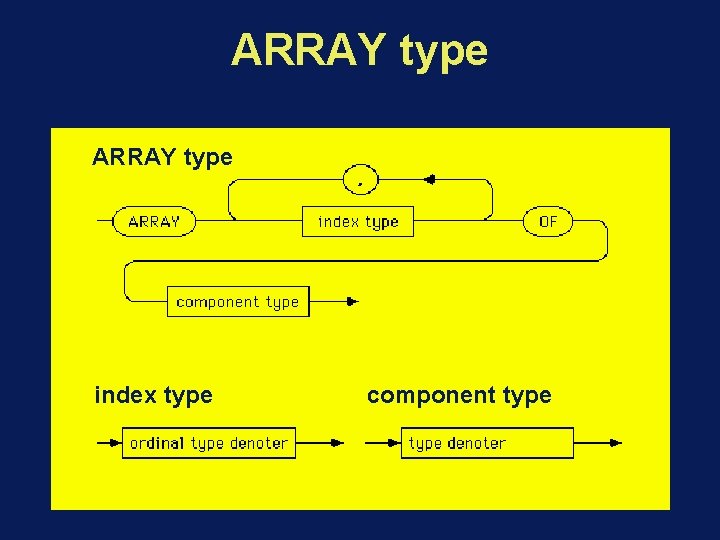
ARRAY type index type component type
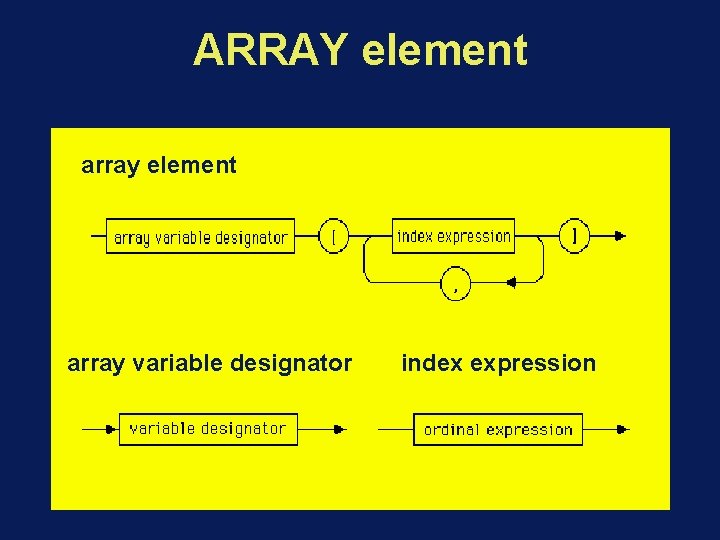
ARRAY element array variable designator index expression
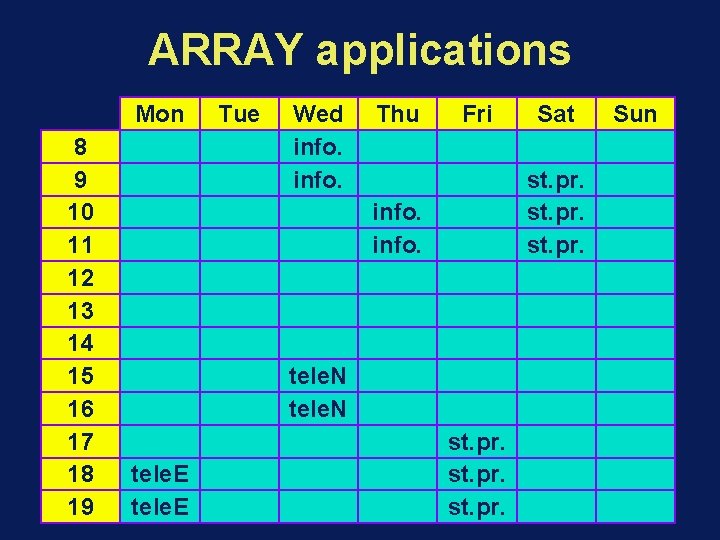
ARRAY applications Mon 8 9 10 11 12 13 14 15 16 17 18 19 Tue Wed info. Thu Fri st. pr. info. tele. N tele. E Sat st. pr. Sun
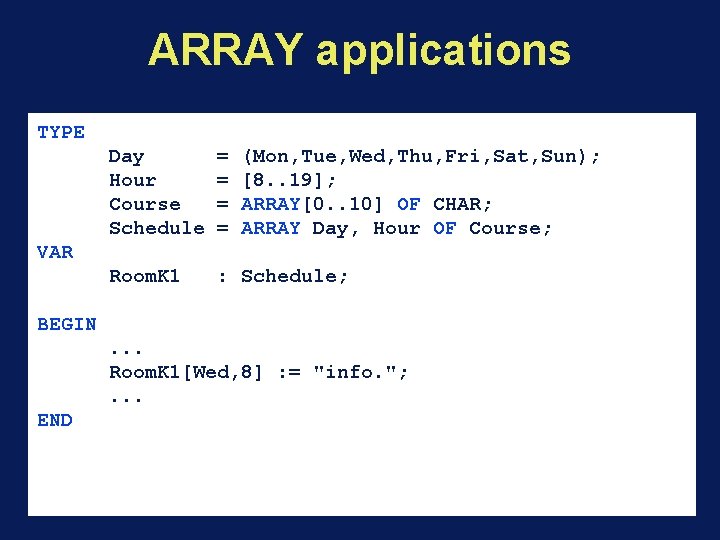
ARRAY applications TYPE Day Hour Course Schedule = = (Mon, Tue, Wed, Thu, Fri, Sat, Sun); [8. . 19]; ARRAY[0. . 10] OF CHAR; ARRAY Day, Hour OF Course; Room. K 1 : Schedule; VAR BEGIN. . . Room. K 1[Wed, 8] : = "info. "; . . . END
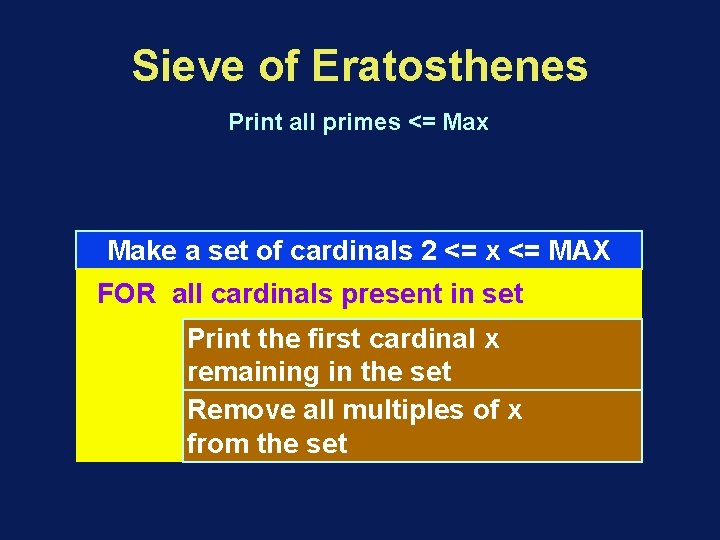
Sieve of Eratosthenes Print all primes <= Max Make a set of cardinals 2 <= x <= MAX FOR all cardinals present in set Print the first cardinal x remaining in the set Remove all multiples of x from the set
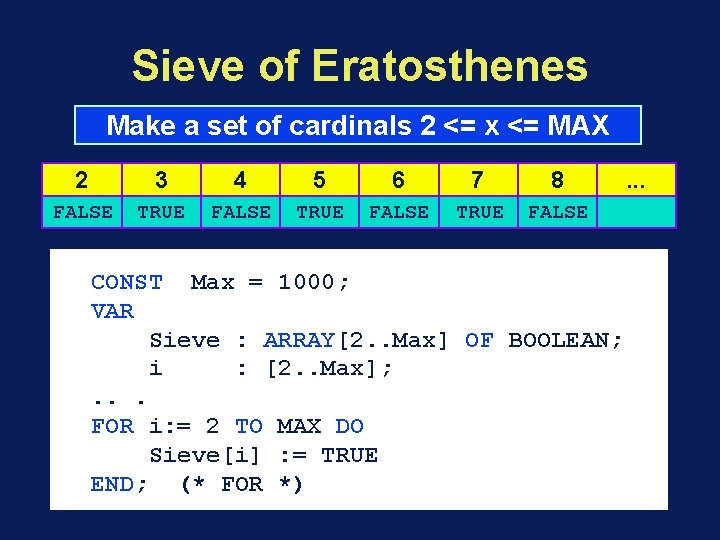
Sieve of Eratosthenes Make a set of cardinals 2 <= x <= MAX 2 3 4 5 6 7 8 FALSE TRUE FALSE CONST Max = 1000; VAR Sieve : ARRAY[2. . Max] OF BOOLEAN; i : [2. . Max]; . . . FOR i: = 2 TO MAX DO Sieve[i] : = TRUE END; (* FOR *) . . .
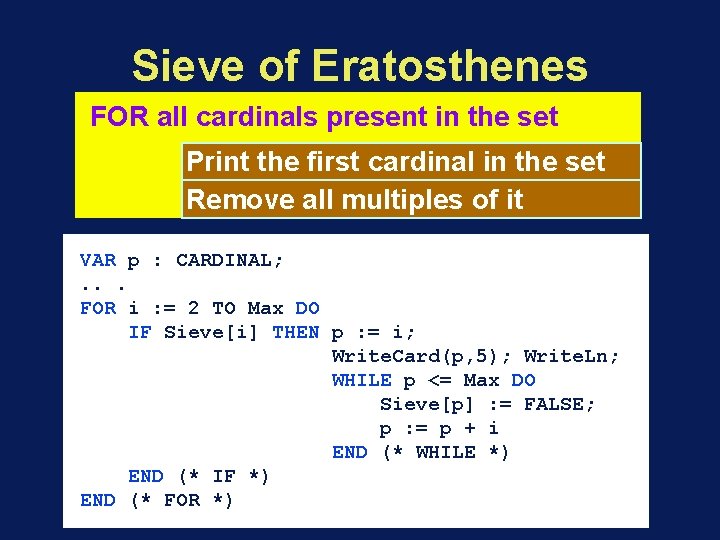
Sieve of Eratosthenes FOR all cardinals present in the set Print the first cardinal in the set Remove all multiples of it VAR p : CARDINAL; . . . FOR i : = 2 TO Max DO IF Sieve[i] THEN p : = i; Write. Card(p, 5); Write. Ln; WHILE p <= Max DO Sieve[p] : = FALSE; p : = p + i END (* WHILE *) END (* IF *) END (* FOR *)
Types in Modula 2 • Simple Types: values can’t be decomposed – Ordinal Types: bijection with natural numbers – Reals: approx. representation for real values – Pointers: addresses in data memory • Structured Types: Values have # components – Arrays: all components have same type – Records: components can have # types – Sets: small sets of ordinal values – Procedures: entire subprograms
Repairing a flat tire Refinement of “tools” • Tools : – Jack : device to lift a car – Wrench : device to loose or fasten bolts
RECORD example TYPE Date = RECORD Day : [1. . 31]; Month : [1. . 12]; Year : [1900. . 2100] END; VAR Today : Date;
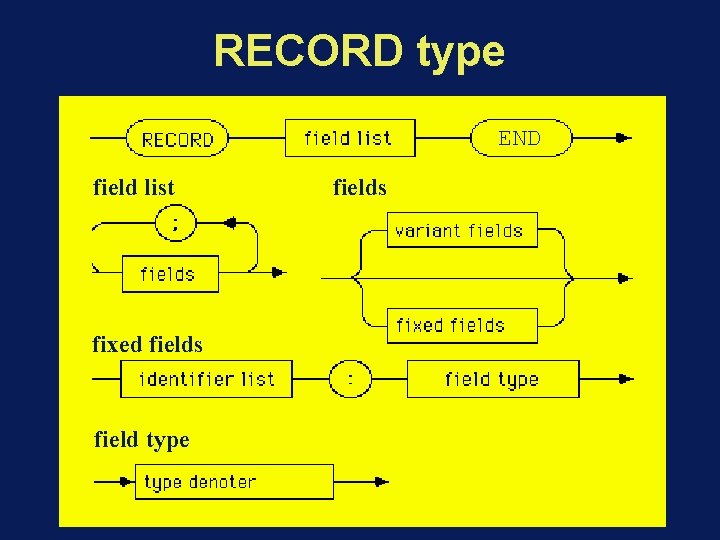
RECORD type END field list fixed fields field type fields
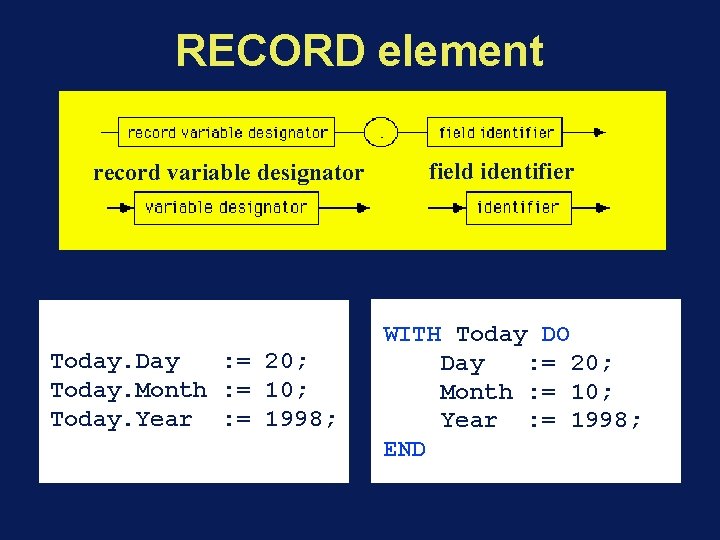
RECORD element record variable designator Today. Day : = 20; Today. Month : = 10; Today. Year : = 1998; field identifier WITH Today DO Day : = 20; Month : = 10; Year : = 1998; END
Nested RECORDs example (1) TYPE Date VAR = RECORD Day : [1. . 31]; Month : [1. . 12]; Year : [1900. . 2100] END; String = ARRAY [0. . 29] OF Char; Identity = RECORD Name, First. Name : String; Birth. Place : String; Birth. Date : Date; Issue. Date : Date; END; Myself Today : Identity; : Date;
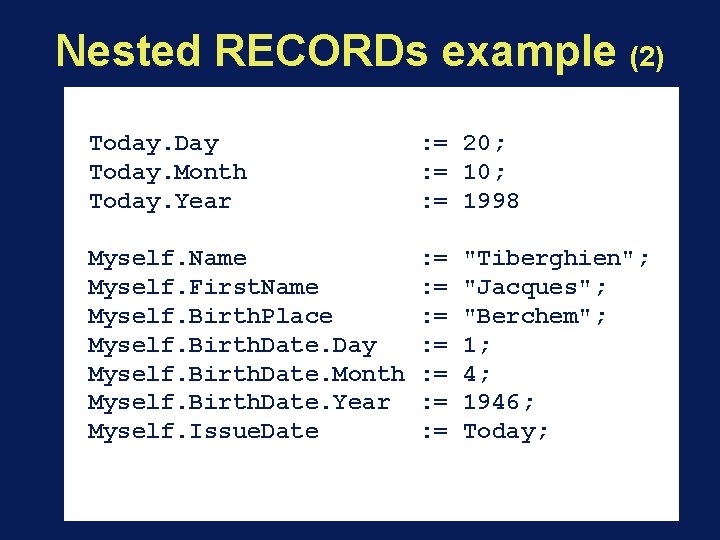
Nested RECORDs example (2) Today. Day Today. Month Today. Year : = 20; : = 1998 Myself. Name Myself. First. Name Myself. Birth. Place Myself. Birth. Date. Day Myself. Birth. Date. Month Myself. Birth. Date. Year Myself. Issue. Date : = : = "Tiberghien"; "Jacques"; "Berchem"; 1; 4; 1946; Today;
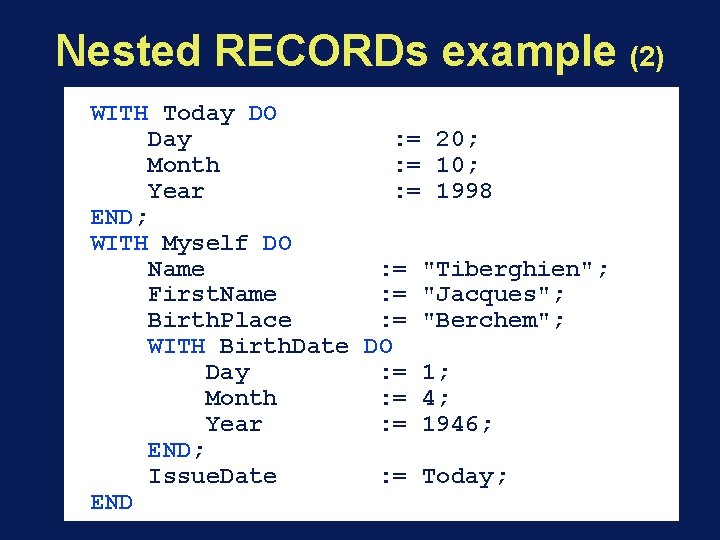
Nested RECORDs example (2) WITH Today DO Day : = 20; Month : = 10; Year : = 1998 END; WITH Myself DO Name : = "Tiberghien"; First. Name : = "Jacques"; Birth. Place : = "Berchem"; WITH Birth. Date DO Day : = 1; Month : = 4; Year : = 1946; END; Issue. Date : = Today; END
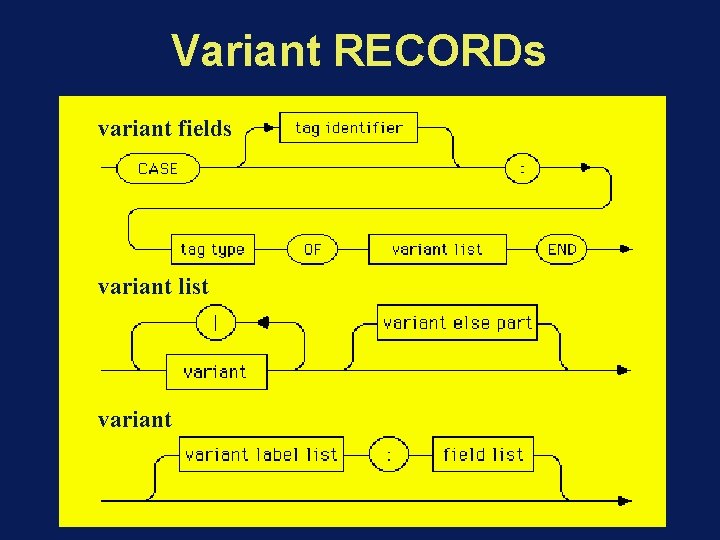
Variant RECORDs variant fields variant list variant
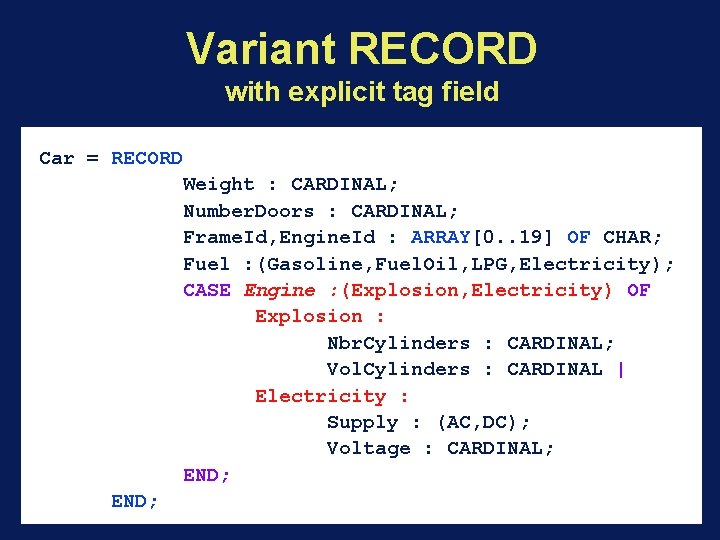
Variant RECORD with explicit tag field Car = RECORD Weight : CARDINAL; Number. Doors : CARDINAL; Frame. Id, Engine. Id : ARRAY[0. . 19] OF CHAR; Fuel : (Gasoline, Fuel. Oil, LPG, Electricity); CASE Engine : (Explosion, Electricity) OF Explosion : Nbr. Cylinders : CARDINAL; Vol. Cylinders : CARDINAL | Electricity : Supply : (AC, DC); Voltage : CARDINAL; END;
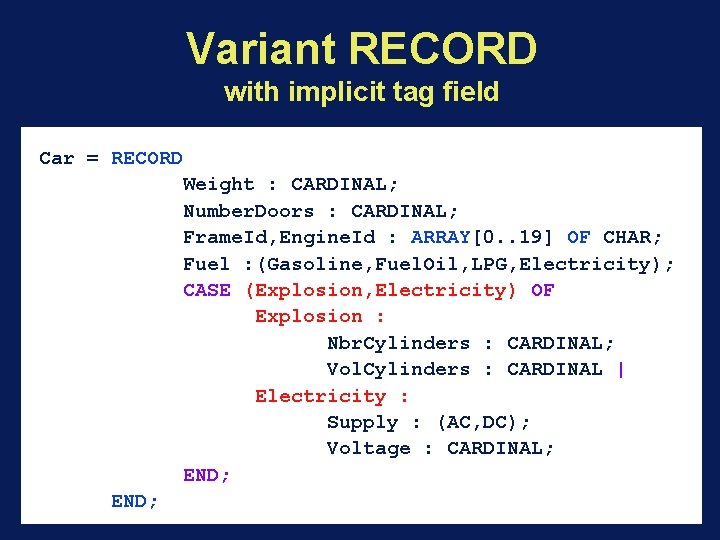
Variant RECORD with implicit tag field Car = RECORD Weight : CARDINAL; Number. Doors : CARDINAL; Frame. Id, Engine. Id : ARRAY[0. . 19] OF CHAR; Fuel : (Gasoline, Fuel. Oil, LPG, Electricity); CASE (Explosion, Electricity) OF Explosion : Nbr. Cylinders : CARDINAL; Vol. Cylinders : CARDINAL | Electricity : Supply : (AC, DC); Voltage : CARDINAL; END;
Types in Modula 2 • Simple Types: values can’t be decomposed – Ordinal Types: bijection with natural numbers – Reals: approx. representation for real values – Pointers: addresses in data memory • Structured Types: Values have # components – Arrays: all components have same type – Records: components can have # types – Sets: small sets of ordinal values – Procedures: entire subprograms