
Chapter 2 2 CULTURAL BLENDING CASE STUDY THE
Chapter 2: 2 CULTURAL BLENDING CASE STUDY: THE SAFAVID EMPIRE
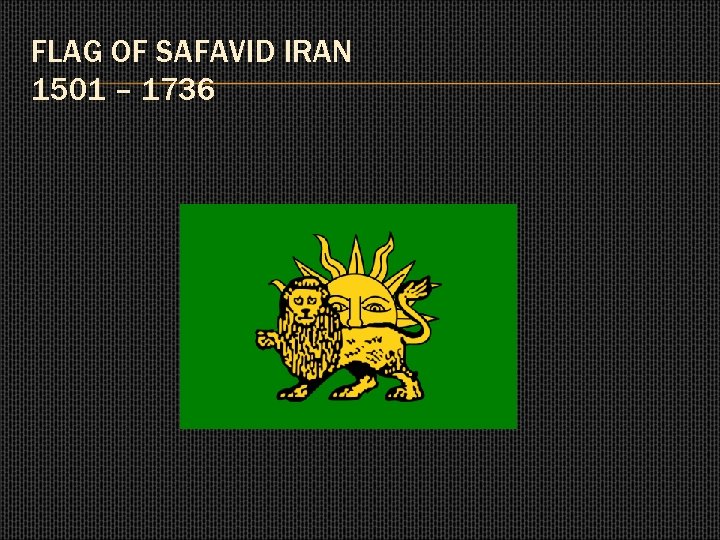
FLAG OF SAFAVID IRAN 1501 – 1736
MAIN IDEA � CULTURAL INTERACION: The Safavid empire produced a rich and complex blended culture in Persia � Modern Iran, which plays a key role in global politics, descended from the culturally diverse Safavid Empire
SETTING THE STAGE � Throughout the course of world history, cultures have interacted with each other. � The Safavid Empire, A shi’ite Muslim dynasty that ruled in Persia between the 16 th and 18 th centuries, provides a striking example of how interaction among peoples can produce a blending of cultures. � It drew from Persian, Ottomans, and Arabs
TERMS & NAMES � Safavid � Isma’il � Shah Abbas � Esfahan
CAUSES OF CULTURAL BLENDING � Migration � Pursuit of religious freedom or conversion � Trade � Conquest � Ex: Ottoman empire motivated to win both territory and convert to Islam � Location on major trading routes created many opportunities with different cultures
RESULTS OF CULTURAL BLENDING � Language: Written Chinese characters used in the Japanese language. Safavid Empires, language Persian, after converted to Islam, Arabic words appeared (like Spanish? ) � Religion and ethical systems: Buddhism spread throughout Asia. Yet Buddhism practice by Tibetans is different from Japanese Zen Buddhism.
RESULTS OF CULTURAL BLENDING • • • Styles of government: Concept of a democratic gov. spread to many areas of the globe. Similar principles but practices in different ways. Racial or ethnic blending: the mestizaje of people of the Americas (Native, Euro, African) Arts and architecture: Chinese artistic elements are found in Safavid Empire tiles and carpets as well as in European paintings.
THE SAFAVIDS BUILD AN EMPIRE � Originally, the Safavids were members on an Islamic religious brotherhood named after their founder, Safi al-Din. � In the 15 th cent, aligned with the Shi’a branch of Islam � Squeezed geographically between the Ottomans, Uzbeks, and the Mughal Empire � Built powerful army to protect themselves
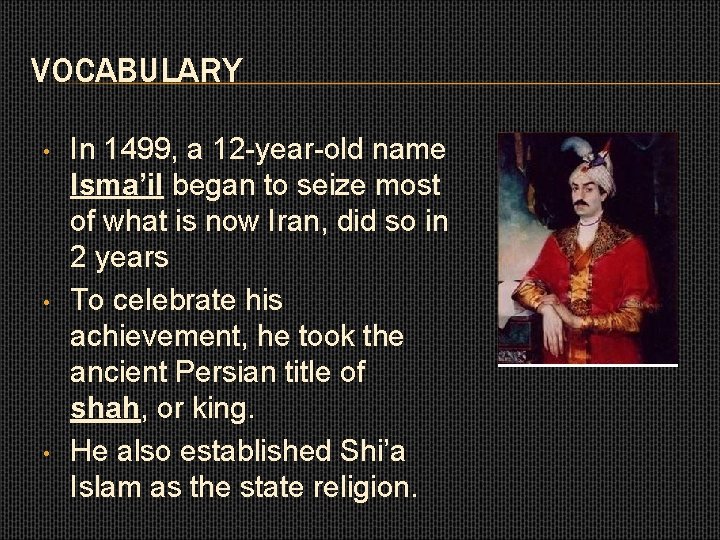
VOCABULARY • • • In 1499, a 12 -year-old name Isma’il began to seize most of what is now Iran, did so in 2 years To celebrate his achievement, he took the ancient Persian title of shah, or king. He also established Shi’a Islam as the state religion.
SECTARIAN HISTORY- SHI’A VS. SUNNI ISLAM • • • He became a religious tyrant, destroyed the Sunni population of Baghdad in his confrontation with the Ottomans Ottoman leader Selim the Grime, ordered the execution of all Shi’a in the Ottoman Empire, 40, 000 dead Battle of Chaldiran in 1514 set the border between the two empires—remains today the border between Iran and Iraq
SHI’A ISLAM • • • Shia Islam (Arabic: ﺷﻴﻌﺔ Shī‘ah, sometimes Shi'a or Shi'ite), is the second largest denomination of Islam, after Sunni Islam. Similar to other branches of Islam, Shi'a Islam is based on the teachings of Islamic holy book, the Qur'an and message of the final prophet of Islam, In contrast to other branches, Shi'a Islam holds that Muhammad's family, the Ahl al-Bayt ("the People of the House"), and certain individuals among his descendants, who are known as Imams, have special spiritual and political rule over the community
SUNNI ISLAM • • • Sunni Islam is the largest denomination of Islam. Sunni Islam is also referred to as Ahl as -Sunnah wa’l-Jamā‘ah (Arabic: ﺃﻬﻞ ﺍﻟﺴﻨﺔ ﻭﺍﻟﺠﻤﺎﻋﺔ "people of the example (of Muhammad) and the community") or Ahl as-Sunnah (Arabic: ﺃﻬﻞ ﺍﻟﺴﻨﺔ for short Turkish: (Sünni). The word Sunni comes from the word Sunnah (Arabic: ﺳﻨﺔ , which means the words and actions[1] or example of the Islamic prophet Muhammad.
A SAFAVID GOLDEN AGE Shah Abbas, or Abbas the Great, took the throne in 1587. He helped create a Safavid culture and golden age that drew from the best of the Ottoman, Persian, and Arab worlds. Reforms: • Limited power of the military • Two new armies (I Persian, 1 Christians-janissary style • Punished corruption severely and promoted only competent people • Hired foreigners from to fill gov positions • Brought members of Christian religious orders – Europeans moved into the land • Industry, trade, and art exchanges grew between the empire and European nations. •
A SAFAVID GOLDEN AGE A New Capital: • The Shah built a new capital at Esfahan (considered one of the most beautiful in world) • Showplace for many artisans (300 Chinese potters , Armenian carpet weavers) Art works: Many Chinese produced metalwork, paintings, calligraphy, glasswork, tile work, and pottery. – blended Chinese and Persian ideas Carpets: biggest influence from the West, their demand for Persian carpets, turned carpet weaving into a national industry. Rug designs incorporated new themes.
THE DYNASTY DECLINES QUICKLY • • In finding a successor, shah Abbas made the same mistake as Suleyman made. He killed or blinded his ablest sons. His incompetent grandson, Safi, led the Safavids down the same road to decline as the Ottomans, more quickly In 1736, Nadir shah Afshar conquered land all the way to India and created an expanded empire. Nadir shah was so cruel that one of his own troops killed him, with his death in 1747, the Safavid Empire fell apart.
MAIN IDEAS- P. 81 3. What are the 4 causes of cultual blending 4. What reforms took place in the Safavid empires under shah Abbas? 5. Why did the Safavid Empire decline so quickly?
CRITICAL THINKING & WRITING 6. FORMING OPINIONS: Which of the results of cultural blending so you think has the most lasting effect on a country? Explain 7. DRAWING CONCLUSIONS: how did the location of the Safavid empire contribute to the cultural blending in the empire? 8. ANALYZING MOTIVES: Why might Isma’il have become so intolerant of the Sunni Muslims?
- Slides: 18